ME-8136   Advanced Fatigue Fracture Analysis Title “ Improvement of fatigue resistance of spot welds used in  automotive applications ”   --- Gajendra Tawade
APPLICATIONS OF SPOT WELDING. Automobile outer body complete.  (spot welded) . Framing station. Car wheel.
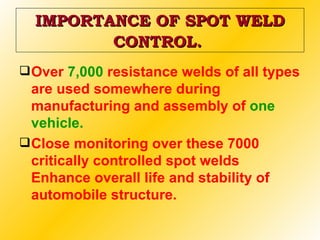
IMPORTANCE OF SPOT WELD CONTROL.   Over  7,000  resistance welds of all types are used somewhere during manufacturing and assembly of  one vehicle.  Close monitoring over these 7000 critically controlled spot welds Enhance overall life and stability of automobile structure.
Spot Welding Principle. WELDING CYCLE: Squeeze. Weld. Forge/Hold. Off. PROCESS VARIABLES : Effective current [KA] Electrode force [lbf] Weld time [cycles] Hold time [Cycles]
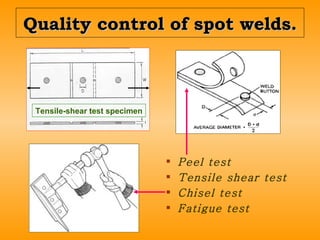
Quality control of spot welds. Peel test  Tensile shear test Chisel test Fatigue test Tensile-shear test specimen
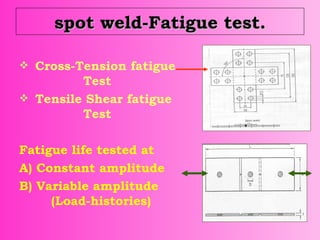
spot weld-Fatigue test. Cross-Tension fatigue  Test  Tensile Shear fatigue  Test   Fatigue life tested at  A) Constant amplitude B) Variable amplitude    (Load-histories)
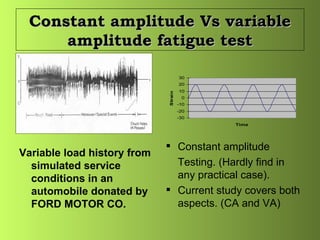
Constant amplitude Vs variable amplitude fatigue test Variable load history from simulated service conditions in an automobile donated by FORD MOTOR CO. Constant amplitude  Testing. (Hardly find in any practical case). Current study covers both aspects. (CA and VA)
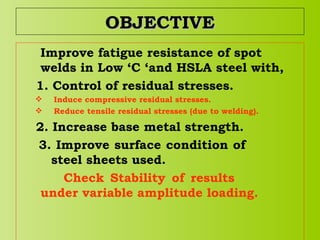
OBJECTIVE Improve fatigue resistance of spot welds in Low ‘C ‘and HSLA steel with, 1. Control of residual stresses. Induce compressive residual stresses. Reduce tensile residual stresses (due to welding). 2. Increase base metal strength. 3. Improve surface condition of    steel sheets used. Check Stability of results  under variable amplitude loading.
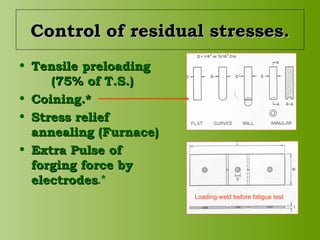
Control of residual stresses. Tensile preloading  (75% of T.S.)  Coining.* Stress relief annealing (Furnace) Extra Pulse of forging force by electrodes .* Loading weld before fatigue test
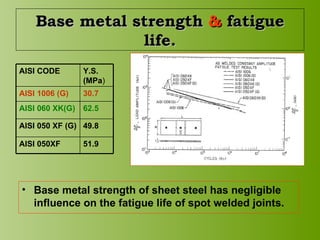
Base metal strength  &  fatigue life. Base metal strength of sheet steel has negligible influence on the fatigue life of spot welded joints.  51.9 AISI 050XF  49.8 AISI 050 XF (G)  62.5 AISI 060 XK(G)   30.7 AISI 1006 (G)   Y.S. (MPa ) AISI CODE
Coating (Galvanizing)  &  fatigue Life. CA Fatigue test result for AISI 050XF-(G) CA Fatigue test result for ASIS 050XF-Bare NO deviation from straight line. Straight line indicates fatigue life calculated by analytical methods (B) (G)
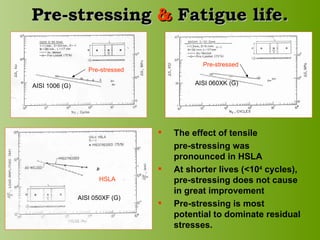
Pre-stressing  &  Fatigue life. The effect of tensile  pre-stressing was pronounced in HSLA At shorter lives (<10 4  cycles), pre-stressing does not cause in great improvement  Pre-stressing is most potential to dominate residual stresses. Pre-stressed Pre-stressed AISI 1006 (G) AISI 050XF (G) AISI 060XK (G) HSLA
Forging force  &  fatigue life. Fatigue strength improves to a lesser extent when weld forge is applied at some time after welding. (cool forge)  Fatigue strength of HSLA improves by 1.4 times when forge is applied immediately after weld cycle. (Weld forge) Cool-forge Weld-forge HSLA HSLA
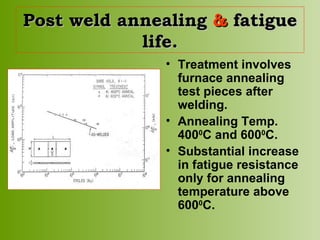
Post weld annealing  &  fatigue life. Treatment involves furnace annealing test pieces after welding. Annealing Temp. 400 0 C and 600 0 C. Substantial increase in fatigue resistance only for annealing temperature   above 600 0 C.
Stability of improvements under variable loading. Improvements in fatigue life resulting from Pre-loading and coining proved to be nearly stable under  full FORD histories  Preloaded-VA As-welded-CA Coined-VA As-welded-CA Full ford History.
Conclusion. Proved that fatigue resistance of tensile shear spot welds particularly HSLA could be greatly improved by treatments which either reduce tensile residual stresses resulting form welding or induced compressive residual stresses at the crack. Such treatments are: A) Pre-stressing & B) Coining. Increasing base metal strength does not greatly alter the fatigue resistance of as welded tensile shear spot welds presumably because such increase are off set by higher residual stresses in the weld. The state of sheet steel surface had little if   any influence on the test results.

Advance fatigue and fracture analysis of spot welds

  • 1.
    ME-8136 Advanced Fatigue Fracture Analysis Title “ Improvement of fatigue resistance of spot welds used in automotive applications ” --- Gajendra Tawade
  • 2.
    APPLICATIONS OF SPOTWELDING. Automobile outer body complete. (spot welded) . Framing station. Car wheel.
  • 3.
    IMPORTANCE OF SPOTWELD CONTROL. Over 7,000 resistance welds of all types are used somewhere during manufacturing and assembly of one vehicle. Close monitoring over these 7000 critically controlled spot welds Enhance overall life and stability of automobile structure.
  • 4.
    Spot Welding Principle.WELDING CYCLE: Squeeze. Weld. Forge/Hold. Off. PROCESS VARIABLES : Effective current [KA] Electrode force [lbf] Weld time [cycles] Hold time [Cycles]
  • 5.
    Quality control ofspot welds. Peel test Tensile shear test Chisel test Fatigue test Tensile-shear test specimen
  • 6.
    spot weld-Fatigue test.Cross-Tension fatigue Test Tensile Shear fatigue Test Fatigue life tested at A) Constant amplitude B) Variable amplitude (Load-histories)
  • 7.
    Constant amplitude Vsvariable amplitude fatigue test Variable load history from simulated service conditions in an automobile donated by FORD MOTOR CO. Constant amplitude Testing. (Hardly find in any practical case). Current study covers both aspects. (CA and VA)
  • 8.
    OBJECTIVE Improve fatigueresistance of spot welds in Low ‘C ‘and HSLA steel with, 1. Control of residual stresses. Induce compressive residual stresses. Reduce tensile residual stresses (due to welding). 2. Increase base metal strength. 3. Improve surface condition of steel sheets used. Check Stability of results under variable amplitude loading.
  • 9.
    Control of residualstresses. Tensile preloading (75% of T.S.) Coining.* Stress relief annealing (Furnace) Extra Pulse of forging force by electrodes .* Loading weld before fatigue test
  • 10.
    Base metal strength & fatigue life. Base metal strength of sheet steel has negligible influence on the fatigue life of spot welded joints. 51.9 AISI 050XF 49.8 AISI 050 XF (G) 62.5 AISI 060 XK(G) 30.7 AISI 1006 (G) Y.S. (MPa ) AISI CODE
  • 11.
    Coating (Galvanizing) & fatigue Life. CA Fatigue test result for AISI 050XF-(G) CA Fatigue test result for ASIS 050XF-Bare NO deviation from straight line. Straight line indicates fatigue life calculated by analytical methods (B) (G)
  • 12.
    Pre-stressing & Fatigue life. The effect of tensile pre-stressing was pronounced in HSLA At shorter lives (<10 4 cycles), pre-stressing does not cause in great improvement Pre-stressing is most potential to dominate residual stresses. Pre-stressed Pre-stressed AISI 1006 (G) AISI 050XF (G) AISI 060XK (G) HSLA
  • 13.
    Forging force & fatigue life. Fatigue strength improves to a lesser extent when weld forge is applied at some time after welding. (cool forge) Fatigue strength of HSLA improves by 1.4 times when forge is applied immediately after weld cycle. (Weld forge) Cool-forge Weld-forge HSLA HSLA
  • 14.
    Post weld annealing & fatigue life. Treatment involves furnace annealing test pieces after welding. Annealing Temp. 400 0 C and 600 0 C. Substantial increase in fatigue resistance only for annealing temperature above 600 0 C.
  • 15.
    Stability of improvementsunder variable loading. Improvements in fatigue life resulting from Pre-loading and coining proved to be nearly stable under full FORD histories Preloaded-VA As-welded-CA Coined-VA As-welded-CA Full ford History.
  • 16.
    Conclusion. Proved thatfatigue resistance of tensile shear spot welds particularly HSLA could be greatly improved by treatments which either reduce tensile residual stresses resulting form welding or induced compressive residual stresses at the crack. Such treatments are: A) Pre-stressing & B) Coining. Increasing base metal strength does not greatly alter the fatigue resistance of as welded tensile shear spot welds presumably because such increase are off set by higher residual stresses in the weld. The state of sheet steel surface had little if any influence on the test results.