Chapter 10 Europe in the Middle Ages  1000 - 1500
 
 
Chapter 10 Summary The  revival of trade  led to the  growth  of  cities and towns , which became important centers for manufacturing.     During the 14th and early 15th centuries, Europeans experienced many problems including the  Black Death, the Hundred Years’ War, and the decline of the Church .
 
Revival in Europe Population almost doubled  in Europe between 1000 and 1300, from 38 to 74 million people.   One reason is that increased stability and peace enabled  food production to rise  dramatically.  
 
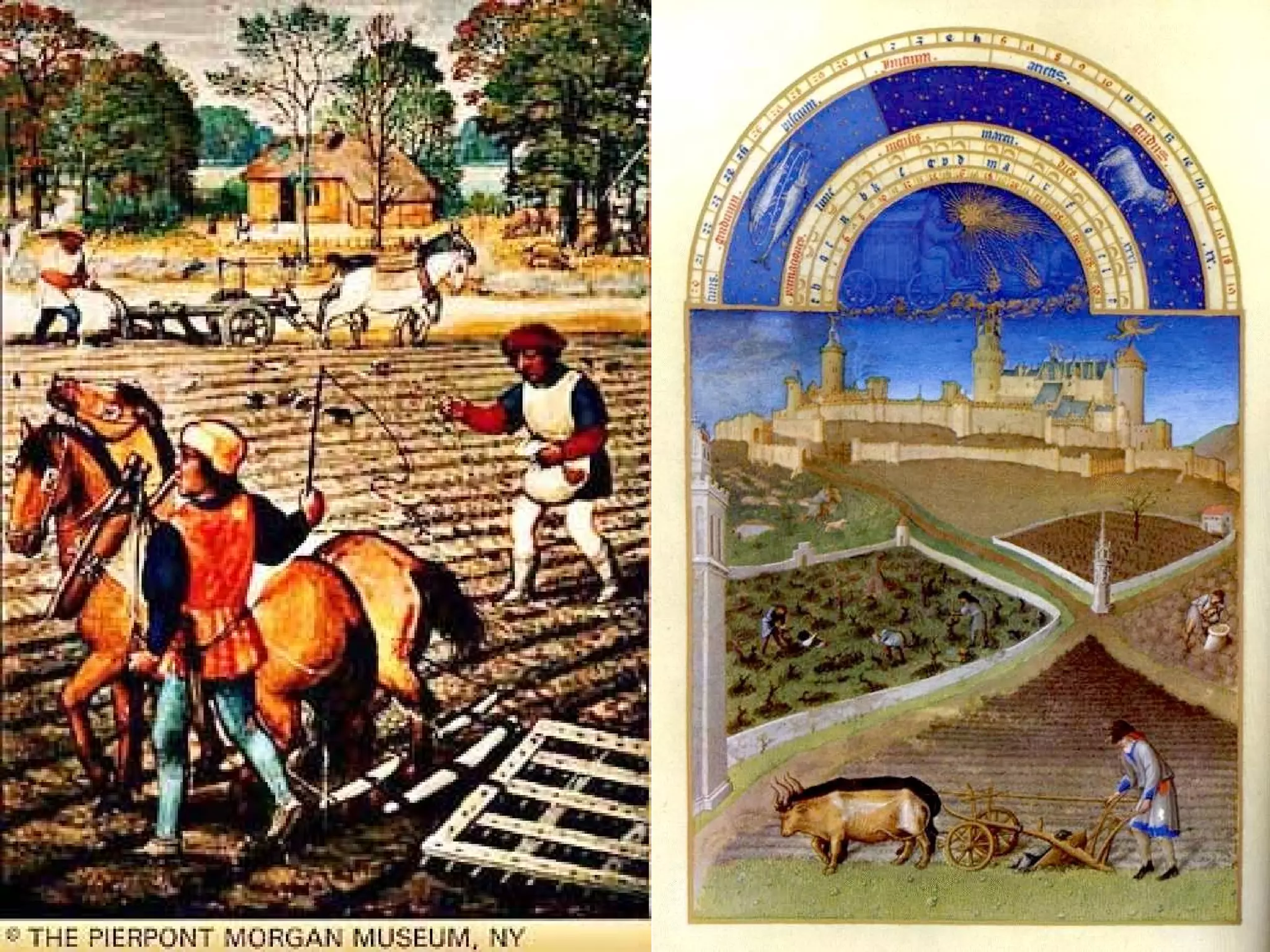
Revival in Europe Technological  advancements in Farming  lead to increases in production Improved horse collar Carrucca  – plow Crop rotation
Heavier Plow
Growth of Cities New cities and towns were founded, especially in northern Europe.   Typically, a group of merchants built a settlement near a  castle  for the trade and the  lord’s protection .     If the settlement prospered, walls were built to protect it.  Walled City = Burg  People = Burgers Leads to the term -  bourgeoise
Montagnana, Italy Towns Grew
The Black Death "The Triumph of Death"
BLACK DEATH Between 1347 and 1351, it ravaged most of Europe.     Possibly as many as  38 million people died  in those four years, out of a total population of 75 million.     The  Italian cities were hit hardest , losing 50 to 60 percent of their population.
BLACK DEATH The plague led to an outbreak of  anti-Semitism –hostility toward Jews.     The worst in Germany.     Thought Jews had poisoned their towns’ wells.     Many Jews fled to Poland, where the king protected them.
Source of the Black Death
The bacteria multiply inside the flea, sticking together to form a plug that blocks its stomach and causes it to become very hungry. The flea then voraciously bites a host and continues to feed, even though it is unable to satisfy its hunger. During the feeding process, blood cannot flow into the blocked stomach, and consequently the flea vomits blood tainted with the bacteria back into the bite wound. The Bubonic plague bacteria then infects a new host, and the flea eventually dies from starvation.
Bubonic plague becomes evident three to seven days after the infection. Initial symptoms are chills, fever, diarrhea, headaches, and the swelling of the infected lymph nodes, as the bacteria replicate there. If untreated, the rate of mortality for bubonic plague is 50%. In  septicemic  plague there is bleeding into the skin and other organs, which creates black patches on the skin. There are bite-like bumps on the skin, commonly red and sometimes white in the center. Untreated septicemic plague is universally fatal, but early treatment with  antibiotics  reduces the mortality rate to 4 to 15%. [1] [2] [3]  People who die from this form of plague often die on the same day symptoms first appear.
Consequences of the Black Death Trade declined.  The shortage of workers made the price of labor rise.  The lowered demand for food resulted in falling prices.
100 Years War France tried to take Gascony back, and England declared war in 1337.     Thus began the Hundred Years’ War between  England and France .
 
Cross bow
Long  Bow
Hundred Years' War
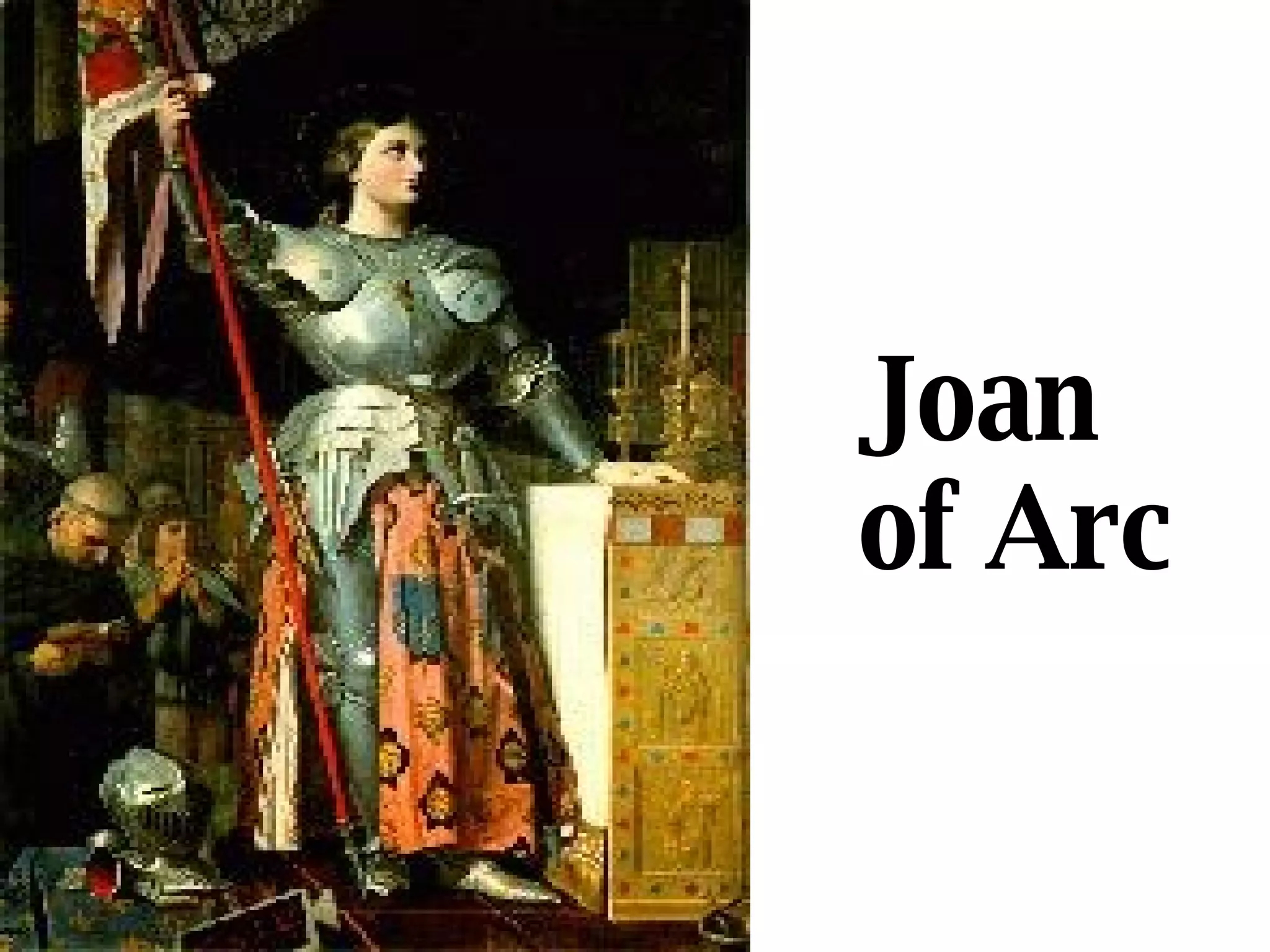
Joan of Arc
Joan of Arc French peasant woman She inspired the French but was put to death  French win the war
Joan of Arc at the Stake
War In England  After the 100 years war, England was faced with even  greater social conflict  at home Known as the  “War of the Roses”  – Noble factions fight to control the monarchy

Ch10 Sec2 Black Death

  • 1.
    Chapter 10 Europein the Middle Ages 1000 - 1500
  • 2.
  • 3.
  • 4.
    Chapter 10 SummaryThe revival of trade led to the growth of cities and towns , which became important centers for manufacturing.  During the 14th and early 15th centuries, Europeans experienced many problems including the Black Death, the Hundred Years’ War, and the decline of the Church .
  • 5.
  • 6.
    Revival in EuropePopulation almost doubled in Europe between 1000 and 1300, from 38 to 74 million people.  One reason is that increased stability and peace enabled food production to rise dramatically. 
  • 7.
  • 8.
    Revival in EuropeTechnological advancements in Farming lead to increases in production Improved horse collar Carrucca – plow Crop rotation
  • 9.
  • 10.
    Growth of CitiesNew cities and towns were founded, especially in northern Europe.  Typically, a group of merchants built a settlement near a castle for the trade and the lord’s protection .  If the settlement prospered, walls were built to protect it. Walled City = Burg People = Burgers Leads to the term - bourgeoise
  • 11.
  • 12.
    The Black Death"The Triumph of Death"
  • 13.
    BLACK DEATH Between1347 and 1351, it ravaged most of Europe.  Possibly as many as 38 million people died in those four years, out of a total population of 75 million.  The Italian cities were hit hardest , losing 50 to 60 percent of their population.
  • 14.
    BLACK DEATH Theplague led to an outbreak of anti-Semitism –hostility toward Jews.  The worst in Germany.  Thought Jews had poisoned their towns’ wells.  Many Jews fled to Poland, where the king protected them.
  • 15.
    Source of theBlack Death
  • 16.
    The bacteria multiplyinside the flea, sticking together to form a plug that blocks its stomach and causes it to become very hungry. The flea then voraciously bites a host and continues to feed, even though it is unable to satisfy its hunger. During the feeding process, blood cannot flow into the blocked stomach, and consequently the flea vomits blood tainted with the bacteria back into the bite wound. The Bubonic plague bacteria then infects a new host, and the flea eventually dies from starvation.
  • 17.
    Bubonic plague becomesevident three to seven days after the infection. Initial symptoms are chills, fever, diarrhea, headaches, and the swelling of the infected lymph nodes, as the bacteria replicate there. If untreated, the rate of mortality for bubonic plague is 50%. In septicemic plague there is bleeding into the skin and other organs, which creates black patches on the skin. There are bite-like bumps on the skin, commonly red and sometimes white in the center. Untreated septicemic plague is universally fatal, but early treatment with antibiotics reduces the mortality rate to 4 to 15%. [1] [2] [3] People who die from this form of plague often die on the same day symptoms first appear.
  • 18.
    Consequences of theBlack Death Trade declined. The shortage of workers made the price of labor rise. The lowered demand for food resulted in falling prices.
  • 19.
    100 Years WarFrance tried to take Gascony back, and England declared war in 1337.  Thus began the Hundred Years’ War between England and France .
  • 20.
  • 21.
  • 22.
  • 23.
  • 24.
  • 25.
    Joan of ArcFrench peasant woman She inspired the French but was put to death French win the war
  • 26.
    Joan of Arcat the Stake
  • 27.
    War In England After the 100 years war, England was faced with even greater social conflict at home Known as the “War of the Roses” – Noble factions fight to control the monarchy