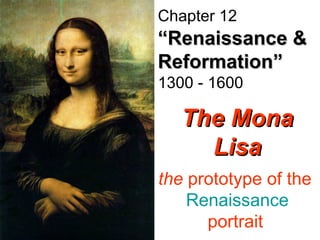
The Mona Lisa the  prototype of the  Renaissance  portrait   Chapter 12   “Renaissance & Reformation”   1300 - 1600
 
The Duomo, a Renaissance Church in Florence, Italy.  Contains artwork by many important Renaissance Artists Brunelleschi’s Dome Giotto’s Belltower
A Rebirth
The Italian Renaissance   The word  renaissance  means rebirth.    The Italian Renaissance, which spread to the rest of Europe, occurred between 1350 and 1550.     The rebirth was of the ancient Greek and Roman worlds.
The Italian Renaissance   Power of the church declines.    Society recovers from plagues and instability of Middle Ages     A  new view of human beings :  emphasized individual ability & worth emerge.
The Italian Renaissance   Milan, Venice, Florence –  3 Great Renaissance cities    Flourished during the crusades and continue shipping & trading.     Italy was a target for invasion from European countries.
 
Advances in Representation & Perspective
Luca Carlevaris ,  The Pier & the Ducal Palace P. 376 http://www.artunframed.com/images/artmis2/carlevaris99.jpg
Michelangelo Two of his best known works: Pieta David
Pieta This famous work of art depicts the body of Jesus on the lap of his mother Mary after the Crucifixion.
Michelangelo: The Early Years
St. Peter’s Basilica Burial Site of Saint Peter, one of Jesus’ twelve apostles. It occupies a "unique position" as one of the holiest sites and as "the greatest of all churches of Christendom."  Many popes buried there. As a piece of architecture – it is regarded as the greatest of it’s time.
 
Michelangelo – St. Peter’s
David 17 foot marble statue portrays the Biblical King David in the nude, at the moment that he decides to battle with Goliath.
Michelangelo – Sistine Chapel
The Italian Renaissance   Charles I ends the Italian wars    Sacks Rome in 1527, pillaging the town.     Spanish influence becomes the dominate force in Italy.
Renaissance Part II
The Italian Renaissance   Secularism :  not religious  2.  Individuality :  quest for perfection     3.  Humanism :  Based on the study of the classics of Greece and Rome

Ch12 Intro

  • 1.
    The Mona Lisathe prototype of the Renaissance portrait Chapter 12 “Renaissance & Reformation” 1300 - 1600
  • 2.
  • 3.
    The Duomo, aRenaissance Church in Florence, Italy. Contains artwork by many important Renaissance Artists Brunelleschi’s Dome Giotto’s Belltower
  • 4.
  • 5.
    The Italian Renaissance The word renaissance means rebirth.  The Italian Renaissance, which spread to the rest of Europe, occurred between 1350 and 1550.  The rebirth was of the ancient Greek and Roman worlds.
  • 6.
    The Italian Renaissance Power of the church declines.  Society recovers from plagues and instability of Middle Ages  A new view of human beings : emphasized individual ability & worth emerge.
  • 7.
    The Italian Renaissance Milan, Venice, Florence – 3 Great Renaissance cities  Flourished during the crusades and continue shipping & trading.  Italy was a target for invasion from European countries.
  • 8.
  • 9.
  • 10.
    Luca Carlevaris , The Pier & the Ducal Palace P. 376 http://www.artunframed.com/images/artmis2/carlevaris99.jpg
  • 11.
    Michelangelo Two ofhis best known works: Pieta David
  • 12.
    Pieta This famouswork of art depicts the body of Jesus on the lap of his mother Mary after the Crucifixion.
  • 13.
  • 14.
    St. Peter’s BasilicaBurial Site of Saint Peter, one of Jesus’ twelve apostles. It occupies a "unique position" as one of the holiest sites and as "the greatest of all churches of Christendom." Many popes buried there. As a piece of architecture – it is regarded as the greatest of it’s time.
  • 15.
  • 16.
  • 17.
    David 17 footmarble statue portrays the Biblical King David in the nude, at the moment that he decides to battle with Goliath.
  • 18.
  • 19.
    The Italian Renaissance Charles I ends the Italian wars  Sacks Rome in 1527, pillaging the town.  Spanish influence becomes the dominate force in Italy.
  • 20.
  • 21.
    The Italian Renaissance Secularism : not religious  2. Individuality : quest for perfection  3. Humanism : Based on the study of the classics of Greece and Rome