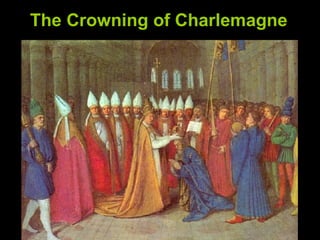
The Crowning of Charlemagne
Charlemagne and His World After viewing “Charlemagne and His World,” you should:   Objectives Understand that Charlemagne brought Europe out of the Dark Ages and into the medieval period.   Know that the Carolingian Renaissance was the first of  three important renaissance periods in Europe.   Recognize the importance of Charlemagne's contributions to  the Europe that exists today.
 
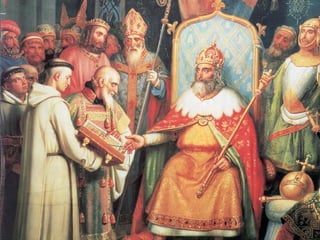
Charlemagne and His World According to Professor Hodges, what experience may have shaped Charlemagne's desire to reinvent himself as a latter-day Roman emperor? Traveling the old Roman roads in Italy, Charlemagne may have conceived of an empire based on the Roman model.
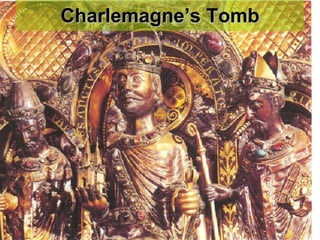
Charlemagne’s Tomb
Charlemagne and His World What accomplishments does the Charlemagne Prize honor? The Charlemagne Prize honors accomplishments in fostering a Europe based on shared economic and social values.
 
 
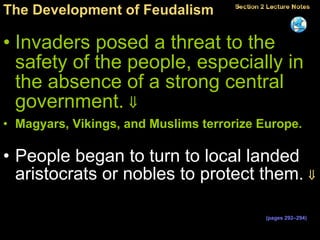
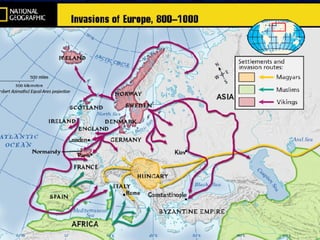
(pages 292–294) Invaders posed a threat to the safety of the people, especially in the absence of a strong central government.   Magyars, Vikings, and Muslims terrorize Europe. The Development of Feudalism   People began to turn to local landed aristocrats or nobles to protect them.  
 
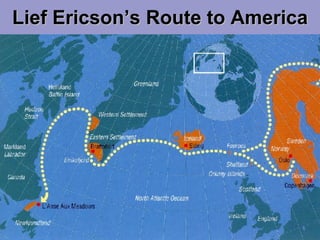
Lief Ericson’s Route to America
Video: Feudalism – Weak Kings, Strong Nobles
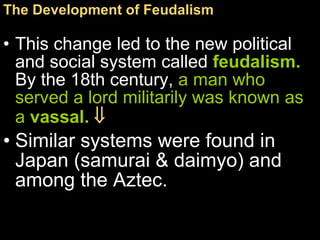
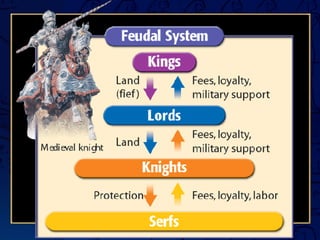
This change led to the new political and social system called  feudalism .  By the 18th century,  a man who served a lord militarily was known as a  vassal .      Similar systems were found in Japan (samurai & daimyo) and among the Aztec. The Development of Feudalism
 
Video:  Medieval Society Hierarchy
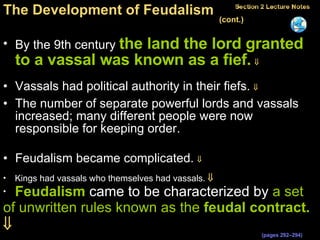
By the 9th century  the land the lord granted to a vassal was known as a fief.    Vassals had political authority in their fiefs.   The number of separate powerful lords and vassals increased; many different people were now responsible for keeping order. The Development of Feudalism (pages 292–294) (cont.) Feudalism became complicated.   Kings had vassals who themselves had vassals.   Feudalism  came to be characterized by  a set of unwritten rules known as the  feudal contract.   
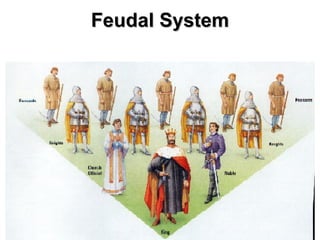
Feudal System
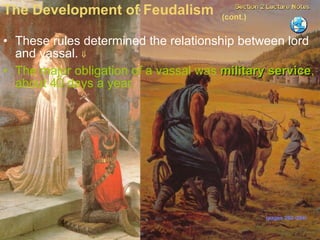
These rules determined the relationship between lord and vassal.   The major obligation of a vassal was  military service , about 40 days a year. The Development of Feudalism (pages 292–294) (cont.)
Video:  Castles, Liege and Lords
It was called  chivalry .      Knights were to defend the Church and defenseless people, treat captives as honored guests, and  fight for glory and not material rewards . The Nobility of the Middle Ages and Aristocratic Women In the eleventh and twelfth centuries, under the influence of the Church,  an ideal of civilized behavior among the nobility evolved.    (pages 295–296)

Ch 9 Sec 2 Feudalism

  • 1.
    The Crowning ofCharlemagne
  • 2.
    Charlemagne and HisWorld After viewing “Charlemagne and His World,” you should:  Objectives Understand that Charlemagne brought Europe out of the Dark Ages and into the medieval period.  Know that the Carolingian Renaissance was the first of three important renaissance periods in Europe.  Recognize the importance of Charlemagne's contributions to the Europe that exists today.
  • 3.
  • 4.
    Charlemagne and HisWorld According to Professor Hodges, what experience may have shaped Charlemagne's desire to reinvent himself as a latter-day Roman emperor? Traveling the old Roman roads in Italy, Charlemagne may have conceived of an empire based on the Roman model.
  • 5.
  • 6.
    Charlemagne and HisWorld What accomplishments does the Charlemagne Prize honor? The Charlemagne Prize honors accomplishments in fostering a Europe based on shared economic and social values.
  • 7.
  • 8.
  • 9.
    (pages 292–294) Invadersposed a threat to the safety of the people, especially in the absence of a strong central government.  Magyars, Vikings, and Muslims terrorize Europe. The Development of Feudalism People began to turn to local landed aristocrats or nobles to protect them. 
  • 10.
  • 11.
  • 12.
    Video: Feudalism –Weak Kings, Strong Nobles
  • 13.
    This change ledto the new political and social system called feudalism . By the 18th century, a man who served a lord militarily was known as a vassal .  Similar systems were found in Japan (samurai & daimyo) and among the Aztec. The Development of Feudalism
  • 14.
  • 15.
    Video: MedievalSociety Hierarchy
  • 16.
    By the 9thcentury the land the lord granted to a vassal was known as a fief.  Vassals had political authority in their fiefs.  The number of separate powerful lords and vassals increased; many different people were now responsible for keeping order. The Development of Feudalism (pages 292–294) (cont.) Feudalism became complicated.  Kings had vassals who themselves had vassals.  Feudalism came to be characterized by a set of unwritten rules known as the feudal contract. 
  • 17.
  • 18.
    These rules determinedthe relationship between lord and vassal.  The major obligation of a vassal was military service , about 40 days a year. The Development of Feudalism (pages 292–294) (cont.)
  • 19.
    Video: Castles,Liege and Lords
  • 20.
    It was called chivalry .  Knights were to defend the Church and defenseless people, treat captives as honored guests, and fight for glory and not material rewards . The Nobility of the Middle Ages and Aristocratic Women In the eleventh and twelfth centuries, under the influence of the Church, an ideal of civilized behavior among the nobility evolved.  (pages 295–296)