BUBONIC PLAGUE
Tristian Gude
Table of Contents
1. Title
2. Table of Contents
3. The Plague
4. The “Black death”
5. Symptoms
6. Exams andTests
7. How It Affects ItsVictims
8. Potential Cures (Source 3)
9. Diagrams
10. Current Research
11. Age range an how you contract it
12. “Cost” of the Plague
13. Conclusion
14. Bibliography
The “Black Death”
 The "Black Death" or the Great Plague,
originated in China in 1334 and spread along
trade routes to Constantinople/Istanbul and
then to Europe.
 “ It claimed an estimated 60% of the
European population (Benedictow, 2008). “
 Entire towns were wiped out. Some
contemporary historians report that on
occasion, there were not enough survivors
remaining to bury the dead (Gross, 1995).
Symptoms
 Fever and chills
 General ill feeling (malaise)
 Headache
 Muscle pain
 Seizures
 Smooth, painful lymph gland swelling called a
bubo that is commonly found in the groin, but may
occur in the armpits or neck, most often at the site
of the infection (bite or scratch); pain may start
before the swelling appears
Exams and Tests
Tests that may be done include:
 Blood culture
 Culture of lymph node aspirate (fluid taken
from an affected lymph node or bubo)
 Sputum culture
How It Affects Its Victims
Deat
h
Potential Cures? (Source 3)
 1. Good smells
People believed that the disease was airborne and they could somehow ward it off if they carried sweet smelling perfumes or flowers with
them.They couldn’t.
 2. Bad smells
Well if good smells didn’t work then maybe bad smelling things would serve to ward off the plague?
 3. Avoiding Baths
Bathing was thought to weaken the heart so people were warned against cleanliness
 4. Lancing the Buboes
Both painful and ineffective, draining the pus from sufferers’ sores did more harm than good. First, it could infect the bloodstream and
cause septicemia secondly, letting the pus out would make the spread of disease faster.
 5. Bleeding
A common cure-all in medieval times, bleeding was used to balance fluids in the body and was thought to restore health
 6. Scourging
Many believed that the plague was a punishment from god, this lead to sufferers flagellating themselves as a form of penance – yet
another ‘cure’ that opened wounds and spread the disease!
 7.Theriac
This concoction with ancient origins was a mixture of treacle, various herbs, leaves and even viper flesh and opium. It was left to ferment
for several years to increase its potency.This would be used as a salve or, if patients could somehow stomach it, it would be eaten.
 8. Drinking mercury and arsenic
Indeed, mercury and arsenic were thought to be able to cure sickness and it was recommended that these substances be consumed in
various potions and remedies.At the very least the poor patients were put out of their misery sooner.
 9. Freshly plucked chickens
some people recommended that sufferers strap chickens (alive or dead) to their swollen buboes
 10. Powdered unicorn horn
People were so desperate for a cure they tried anything, unicorns horns were well known in myth to have magical healing properties so
this magical remedy was an easy sell to a dying population.
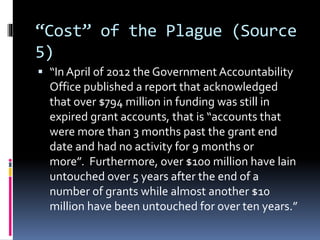
Diagrams!!!
Current Reasearch
 The NIH/NIAID is currently researching the
bubonic plague.
Age Range and How you
contract it
 It is usually spread by flea bite.
 All ages contract this disease.
How it affected daily life
 DEATH, DEATH, AND MORE DEATH!!!!
 Fever and chills
 General ill feeling (malaise)
 Headache
 Muscle pain
 Seizures
 Painful lymph gland swelling called a bubo
“Cost” of the Plague (Source
5)
 “In April of 2012 the Government Accountability
Office published a report that acknowledged
that over $794 million in funding was still in
expired grant accounts, that is “accounts that
were more than 3 months past the grant end
date and had no activity for 9 months or
more”. Furthermore, over $100 million have lain
untouched over 5 years after the end of a
number of grants while almost another $10
million have been untouched for over ten years.”
Conclusion
I believe thatThe Bubonic Plague was one of
the most devastating diseases of all time.
This fact is proven because it is known that
1/3 of Europe’s population was killed by it. In
addition, while in its peak, The Bubonic
plague had little to no treatment and was
extremely fatal that’s to this. Since it killed so
many people and was hard to treat,The
Bubonic Plague was one of the most
devastating diseases of all time.
Bibliography
 "The Black Death, 1348." The Black Death, 1348. N.p., n.d.Web. 12 May
2016.
 "File:Symptoms of Bubonic Plague.svg." -WikimediaCommons. N.p.,
n.d.Web. 14 May 2016.
 "Got the Plague? 10Ways to Cure It (or at LeastTry) |
DigVentures." DigVentures. N.p., n.d.Web. 14 May 2016.
 "History." Centers for Disease Control and Prevention. Centers for Disease
Control and Prevention, 14 Sept. 2015.Web. 12 May 2016.
 "The Modern Cost of the Plague - BORGEN." BORGEN. N.p., 23 Nov.
2013.Web. 15 May 2016.
 Person, Stephen. Bubonic Plague:The Black Death! NewYork: Bearport
Pub., 2010. Print.
 "Plague: MedlinePlus Medical Encyclopedia." U.S National Library of
Medicine. U.S. National Library of Medicine, n.d.Web. 12 May 2016.

Bubonic plague

  • 1.
  • 2.
    Table of Contents 1.Title 2. Table of Contents 3. The Plague 4. The “Black death” 5. Symptoms 6. Exams andTests 7. How It Affects ItsVictims 8. Potential Cures (Source 3) 9. Diagrams 10. Current Research 11. Age range an how you contract it 12. “Cost” of the Plague 13. Conclusion 14. Bibliography
  • 3.
    The “Black Death” The "Black Death" or the Great Plague, originated in China in 1334 and spread along trade routes to Constantinople/Istanbul and then to Europe.  “ It claimed an estimated 60% of the European population (Benedictow, 2008). “  Entire towns were wiped out. Some contemporary historians report that on occasion, there were not enough survivors remaining to bury the dead (Gross, 1995).
  • 4.
    Symptoms  Fever andchills  General ill feeling (malaise)  Headache  Muscle pain  Seizures  Smooth, painful lymph gland swelling called a bubo that is commonly found in the groin, but may occur in the armpits or neck, most often at the site of the infection (bite or scratch); pain may start before the swelling appears
  • 5.
    Exams and Tests Teststhat may be done include:  Blood culture  Culture of lymph node aspirate (fluid taken from an affected lymph node or bubo)  Sputum culture
  • 6.
    How It AffectsIts Victims Deat h
  • 7.
    Potential Cures? (Source3)  1. Good smells People believed that the disease was airborne and they could somehow ward it off if they carried sweet smelling perfumes or flowers with them.They couldn’t.  2. Bad smells Well if good smells didn’t work then maybe bad smelling things would serve to ward off the plague?  3. Avoiding Baths Bathing was thought to weaken the heart so people were warned against cleanliness  4. Lancing the Buboes Both painful and ineffective, draining the pus from sufferers’ sores did more harm than good. First, it could infect the bloodstream and cause septicemia secondly, letting the pus out would make the spread of disease faster.  5. Bleeding A common cure-all in medieval times, bleeding was used to balance fluids in the body and was thought to restore health  6. Scourging Many believed that the plague was a punishment from god, this lead to sufferers flagellating themselves as a form of penance – yet another ‘cure’ that opened wounds and spread the disease!  7.Theriac This concoction with ancient origins was a mixture of treacle, various herbs, leaves and even viper flesh and opium. It was left to ferment for several years to increase its potency.This would be used as a salve or, if patients could somehow stomach it, it would be eaten.  8. Drinking mercury and arsenic Indeed, mercury and arsenic were thought to be able to cure sickness and it was recommended that these substances be consumed in various potions and remedies.At the very least the poor patients were put out of their misery sooner.  9. Freshly plucked chickens some people recommended that sufferers strap chickens (alive or dead) to their swollen buboes  10. Powdered unicorn horn People were so desperate for a cure they tried anything, unicorns horns were well known in myth to have magical healing properties so this magical remedy was an easy sell to a dying population.
  • 8.
  • 9.
    Current Reasearch  TheNIH/NIAID is currently researching the bubonic plague.
  • 10.
    Age Range andHow you contract it  It is usually spread by flea bite.  All ages contract this disease.
  • 11.
    How it affecteddaily life  DEATH, DEATH, AND MORE DEATH!!!!  Fever and chills  General ill feeling (malaise)  Headache  Muscle pain  Seizures  Painful lymph gland swelling called a bubo
  • 12.
    “Cost” of thePlague (Source 5)  “In April of 2012 the Government Accountability Office published a report that acknowledged that over $794 million in funding was still in expired grant accounts, that is “accounts that were more than 3 months past the grant end date and had no activity for 9 months or more”. Furthermore, over $100 million have lain untouched over 5 years after the end of a number of grants while almost another $10 million have been untouched for over ten years.”
  • 13.
    Conclusion I believe thatTheBubonic Plague was one of the most devastating diseases of all time. This fact is proven because it is known that 1/3 of Europe’s population was killed by it. In addition, while in its peak, The Bubonic plague had little to no treatment and was extremely fatal that’s to this. Since it killed so many people and was hard to treat,The Bubonic Plague was one of the most devastating diseases of all time.
  • 14.
    Bibliography  "The BlackDeath, 1348." The Black Death, 1348. N.p., n.d.Web. 12 May 2016.  "File:Symptoms of Bubonic Plague.svg." -WikimediaCommons. N.p., n.d.Web. 14 May 2016.  "Got the Plague? 10Ways to Cure It (or at LeastTry) | DigVentures." DigVentures. N.p., n.d.Web. 14 May 2016.  "History." Centers for Disease Control and Prevention. Centers for Disease Control and Prevention, 14 Sept. 2015.Web. 12 May 2016.  "The Modern Cost of the Plague - BORGEN." BORGEN. N.p., 23 Nov. 2013.Web. 15 May 2016.  Person, Stephen. Bubonic Plague:The Black Death! NewYork: Bearport Pub., 2010. Print.  "Plague: MedlinePlus Medical Encyclopedia." U.S National Library of Medicine. U.S. National Library of Medicine, n.d.Web. 12 May 2016.

Editor's Notes

  • #8 1. Good smells People believed that the disease was airborne and they could somehow ward it off if they carried sweet smelling perfumes or flowers with them. They couldn’t. You might recognize an image of a plague doctor with his striking beaked mask – the beak was filled with scented substances like ambergris, mint or cloves – at the very least this helped mask the smell of the patients. 2. Bad smells Well if good smells didn’t work then maybe bad smelling things would serve to ward off the plague? What sick person wouldn’t want to smear themselves with onions or hang around sewers?! 3. Avoiding Baths Bathing was thought to weaken the heart so people were warned against cleanliness – something which would have gone a long way to contain the disease. oops. 4. Lancing the Buboes Both painful and ineffective, draining the pus from sufferers’ sores did more harm than good. First, it could infect the bloodstream and cause septicemia secondly, letting the pus out would make the spread of disease faster. 5. Bleeding A common cure-all in medieval times, bleeding was used to balance fluids in the body and was thought to restore health. In the case of the plague it only served to cause infection, spread germs and, weaken an already deathly ill person – way to go! 6. Scourging Many believed that the plague was a punishment from god, this lead to sufferers flagellating themselves as a form of penance – yet another ‘cure’ that opened wounds and spread the disease! 7. Theriac This concoction with ancient origins was a mixture of treacle, various herbs, leaves and even viper flesh and opium. It was left to ferment for several years to increase its potency. This would be used as a salve or, if patients could somehow stomach it, it would be eaten. 8. Drinking mercury and arsenic Indeed, mercury and arsenic were thought to be able to cure sickness and it was recommended that these substances be consumed in various potions and remedies. At the very least the poor patients were put out of their misery sooner. 9. Freshly plucked chickens That’s right, from what had to be a cruel joke, some people recommended that sufferers strap chickens (alive or dead) to their swollen buboes. This was supposed to draw out the poisons into the chicken … interesting theory. 10. Powdered unicorn horn