
Ancient china qin and han dynasties
•Download as PPTX, PDF•
2 likes•4,210 views

The Qin Dynasty unified China under Shi Huangdi through military conquest and strong central government. The Han Dynasty then ruled over China for over 400 years, establishing a bureaucracy based on merit and Confucian ideals. Chinese civilization flourished during this time through advances in art, science, medicine, and the establishment of the Silk Road, which expanded trade and spread new ideas.

Recommended
More Related Content
What's hot
What's hot (20)
Viewers also liked
Viewers also liked (20)
Similar to Ancient china qin and han dynasties
Similar to Ancient china qin and han dynasties (20)
More from Kimberly Simpson
More from Kimberly Simpson (20)
Recently uploaded
Recently uploaded (20)
Ancient china qin and han dynasties
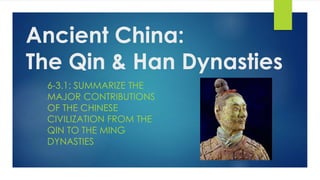
- 1. Ancient China: The Qin & Han Dynasties 6-3.1: SUMMARIZE THE MAJOR CONTRIBUTIONS OF THE CHINESE CIVILIZATION FROM THE QIN TO THE MING DYNASTIES
- 2. Main Ideas Government- Shi Huangdi conquered he warring states, unified China, and built a strong government. Government-The Han Dynasty took over China and established a strong empire that lasted 400 years Culture-Life in Han China set a pattern that is still seen today
- 3. ” “How did the Qin Dynasty unify China? As we go through the next slides, ask yourself this question based on the information given.
- 4. A Legalistic Ruler Under the Mandate of Heaven ongoing wars were signs for the new ruler Emperor Shi Huangdi from the state of Qin-new ruler (13 years old)
- 6. Shi Huangdi of Qin He began ending battles between the Warring States in 221 BC Conquered rival states, drove out nomad invaders, expanded China Ran country as a Legalists, wiped out Confucian teachings He had 460 critics of Confucianists killed & burned books (Why do you think he killed so many?)
- 7. Uniting China Shi Huangdi wanted personal control of strong central government Weakened noble families by taking land, made them live in the capital United his lands by building highways, irrigation projects Forced peasants to work on projects, used high taxes to fund them (similar to how Egyptian Pharaohs built their pyramids)
- 8. Uniting China Set government standards fro weights, measures, coins, writing This made it easier to trade and do business everywhere in China
- 9. The Great Wall Shi Huangdi built a long wall on the northern boarders to stop invaders Forced hundreds of thousands of peasants, criminals to built it Many died from hard labor, creating resentment among people First Great Wall linked smaller walls from Time of Warring States
- 10. Predict how this Great Wall will play a part in the future dynasties and government control of China. Video 4:48
- 11. The Qin Dynasty Ends Shi Huangdi died in 210 BC Was buried in an elaborate tomb (similar to a pyramid) Army of terra cotta soldiers buried nearby Discovered in 1974 Q: Sound familiar? Discovering the Qin video-2:50
- 12. Army of the Terra Cotta Video:3:23
- 13. ” “How did the Han rule China? The Han Dynasty
- 14. The Han Replace the Qin Civil War broke out at the end of the rule of Shi Huangdi’s son General Liu Bang defeated the Qin, ended the war, reunited China Liu Bang began the Han Dynasty- lasted from 202 BC to about 220 AD
- 15. Han Government Lui Bang kept strong government, lowered taxes, reduced punishments Had peasants build roads, canals, irrigation system Set up bureaucracy-chosen officials ran offices, bureaus Officials were often Han family members & trusted people To find officials, they gave people a system of tests on Confucianism Tests helped select educated, ethical people
- 17. Empress Rules Liu Bang died in 195 BC; his widow, Empress Wu, ruled for her son Outlived her son, kept power by placing infants on the throne Died in 180 BC; all her relatives were executed.
- 18. Expanding the Empire Wudi, known as the Martial Emperor, ruled from 141 to 87 BC Wars expanded borders to south China, north Vietnam, north Korea Han stayed in power despite rebellions, revolts, floods, famines
- 19. Han Confucian Social Class Emperor, his court, & scholars that held government positions Largest class: peasants Artisans who made items for daily life and luxury Lowest class: Merchants The military was not an official social class because of (lowest class b/c they did not Confucian beliefs, but joining made anything) did increase a man’s chance of rising in social status because the military was considered a government job https://www.youtube.com/watch?v=5lit3HMnp-g Video: Tung Chung-shu: Confucianism in the Han Dynasty
- 20. Daily Life in Han China Much of Han society lived in villages, worked on farms Most lived in one or two story mud houses Rich farmers used oxen to pull plows; poor pulled plows themselves Simple clothing included clothes stuffed like a quilt for cool months
- 22. Daily Life in Han China They raised wheat, millet in the north, rice in the south Fish and meat were expensive so most people ate them in small portions
- 23. City Living Han cities were centers of trade, education, government Cities were crowed with merchants, craftspeople. Government officials Entertainment included musicians, judges, jugglers, acrobats Some writers say the cities also had street gangs
- 24. Quick Recap of the info In 221 BC, the Qin ruler Shi Huangdi unified China and ruled by harsh Legalist principles The Han Dynasty ruled over a large and successful land The Han Chinese way of life is reflected in Chinese life today Why it matters now…. Strong government remains important in Chinese life today.
- 25. Amazing Achievements Art & Literature: figure paintings (portraits of people) Paintings of realistic scenes from life (some on walls & tombs) Fu poets combined prose and poetry to create long works of literature Shi featured short lines of verse that could be sung
- 26. Science: ancient Seismograph (device that measures the strength of an earthquake). When an earthquake struck, a lever inside caused a ball to drop from a dragon’s mouth into a toad’s mouth, indicating the direction from which the earthquake had came.
- 27. Science: Sundial-uses the position of shadow cast by the sun to tell the time of day.
- 28. Medicine: Acupuncture-the practice of inserting fine needles through the skin at specific points to cure disease or relieve pain https://www.youtube.com/watch?v=re58c7swYAU https://www.youtube.com/watch?v=pMWZmQth2GM
- 29. The Silk Road 4,000 mile-long network of routes stretched westward from China across Asia’s deserts and mountain ranges, through the Middle East, until it reached the Mediterranean Sea Expanded China’s trade and wealth Named after the most famous item traded on these route- Silk Exchanged ideas: religion, law, advancements
- 31. Buddhism Comes to China 1st Century AD- came to China via culture diffusion via trade of Silk Road with India During time of government chaos and hunger throughout China, the people could not find answers in Confucianism or Taoism- they turned to Buddhism for those answers Buddhism offered rebirth and relief from suffering- promises that led to the Chinese embrace its teachings Largest statue of Buddha in the world