The Black Death
and Its Impact on
Europe
By Molly Corti
2 December 2015
1
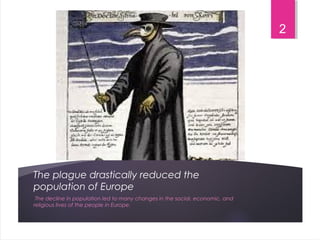
The plague drastically reduced the
population of Europe
The decline in population led to many changes in the social, economic, and
religious lives of the people in Europe.
2
Where did the plague
originate?
3
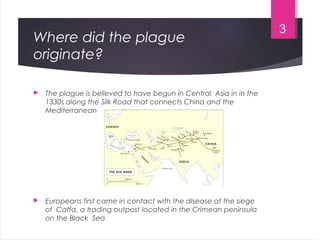
 The plague is believed to have begun in Central Asia in in the
1330s along the Silk Road that connects China and the
Mediterranean
 Europeans first came in contact with the disease at the siege
of Caffa, a trading outpost located in the Crimean peninsula
on the Black Sea
The plague arrives in Europe
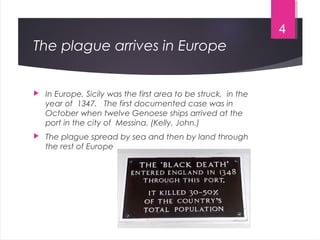
 In Europe, Sicily was the first area to be struck, in the
year of 1347. The first documented case was in
October when twelve Genoese ships arrived at the
port in the city of Messina. (Kelly, John.)
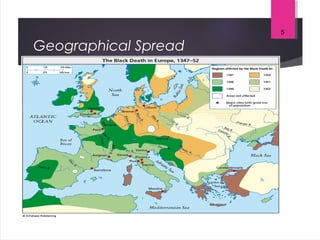
 The plague spread by sea and then by land through
the rest of Europe
4
Geographical Spread
5
How did it spread?
 There have been disagreements about the actual
source of the illness based on the speed of
transmission, mortality rate, season of year, and
symptoms (Theilmann, John and Cate, Frances.)
 The most common theory is that the illness was
caused by a bacterium, Yersinia pestis
6
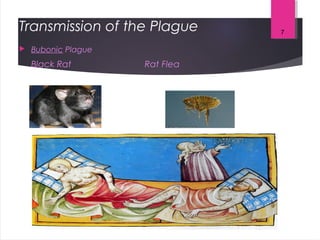
Transmission of the Plague
 Bubonic Plague
Black Rat Rat Flea
7
Transmission of the Plague
 Bubonic Plague
 Caused by bacteria and spread by rats
 Pneumonic Plague
 Occurs when the bacteria infects a person’s respiratory
system
 Transmitted directly from person to person
 More deadly than bubonic plague
8
Mortality
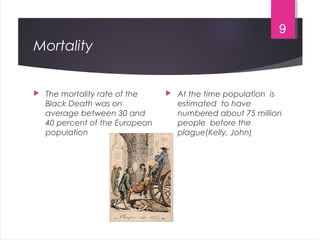
 The mortality rate of the
Black Death was on
average between 30 and
40 percent of the European
population
 At the time population is
estimated to have
numbered about 75 million
people before the
plague(Kelly, John)
9
Other factors that led to high
mortality
 the unsanitary conditions of European cities
 After centuries of population growth, mid -
fourteenth century Europe was overpopulated
 European weather had turned colder and rainy
resulting in series of poor harvests
 Natural disasters including earthquakes and tidal
waves had caused damage in many areas (Kelly,
John)
10
Anti-Semitism contributed to
population loss
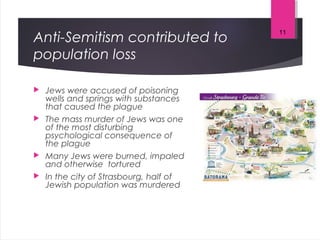
 Jews were accused of poisoning
wells and springs with substances
that caused the plague
 The mass murder of Jews was one
of the most disturbing
psychological consequence of
the plague
 Many Jews were burned, impaled
and otherwise tortured
 In the city of Strasbourg, half of
Jewish population was murdered
11
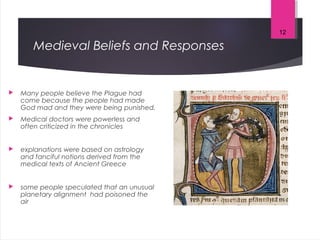
Medieval Beliefs and Responses
 Many people believe the Plague had
come because the people had made
God mad and they were being punished.
 Medical doctors were powerless and
often criticized in the chronicles
 explanations were based on astrology
and fanciful notions derived from the
medical texts of Ancient Greece
 some people speculated that an unusual
planetary alignment had poisoned the
air
12
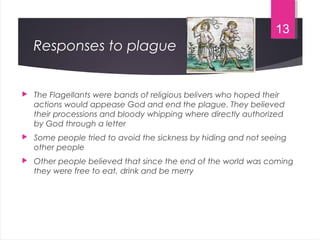
Responses to plague
 The Flagellants were bands of religious belivers who hoped their
actions would appease God and end the plague. They believed
their processions and bloody whipping where directly authorized
by God through a letter
 Some people tried to avoid the sickness by hiding and not seeing
other people
 Other people believed that since the end of the world was coming
they were free to eat, drink and be merry
13
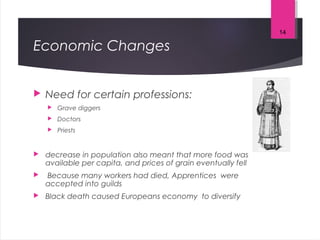
Economic Changes
 Need for certain professions:
 Grave diggers
 Doctors
 Priests
 decrease in population also meant that more food was
available per capita, and prices of grain eventually fell
 Because many workers had died, Apprentices were
accepted into guilds
 Black death caused Europeans economy to diversify
14
Social Changes
 The population of Europe was thought to be
75 million people before the black death
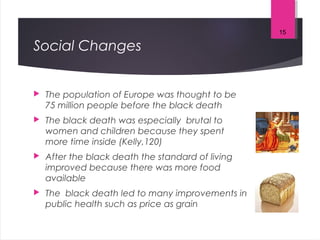
 The black death was especially brutal to
women and children because they spent
more time inside (Kelly,120)
 After the black death the standard of living
improved because there was more food
available
 The black death led to many improvements in
public health such as price as grain
15
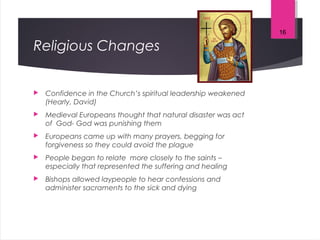
Religious Changes
 Confidence in the Church’s spiritual leadership weakened
(Hearly, David)
 Medieval Europeans thought that natural disaster was act
of God- God was punishing them
 Europeans came up with many prayers, begging for
forgiveness so they could avoid the plague
 People began to relate more closely to the saints –
especially that represented the suffering and healing
 Bishops allowed laypeople to hear confessions and
administer sacraments to the sick and dying
16
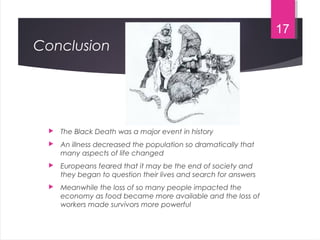
Conclusion
 The Black Death was a major event in history
 An illness decreased the population so dramatically that
many aspects of life changed
 Europeans feared that it may be the end of society and
they began to question their lives and search for answers
 Meanwhile the loss of so many people impacted the
economy as food became more available and the loss of
workers made survivors more powerful
17
References
 Aberth, John. The Black Death: The Great Mortality of 1348-1350 : A Brief History with Documents. Boston,
MA: Bedford/St. Martin's, 2005.
 Cantor, Norman F. In the Wake of the Plague: The Black Death and the World It Made. New York: Free
Press, 2001.
 Legislation and Attitudes Towards Labour in Late-Medieval Western Europe.” Economic History Review,
60 3 (2007) 457-485. JSTOR EBSCOhost (accessed September 17, 2015).
 Cohn Jr, Samuel K. "The Black Death and the Burning of the Jews." Past & Present 196, no. 1 (August
2007): 3-36. Academic Search Complete, EBSCOhost (accessed September 17, 2015).
 Cowie, Leonard. The Black Death and the Pesants’Revolt. London: Wayland Publishers, 1972.
 DeWitte, Sharon N. 2014. "Mortality Risk and Survival in the Aftermath of the Medieval Black Death."
Plos ONE 9, no. 5: 1-8. Academic Search Complete, EBSCOhost (accessed September 17, 2015).
 Dyer, Christopher. Making a Living in the Middle Ages: The People of Britain 850-1520. New Haven: Yale
University Press, 2002.
 Flatow, Ira. Interview with Hedrik Poinar. “DNA Detective Work Identifies Black Death Culprit”. NPR Radio
West Virginia Public Radio, September 2, 2011. Accessed at http://www.npr.org /
2011/09/02/140146784/dna-detective-work-identifies-black-death-culprit
18
References Continued
 Hatcher, John. A Black Death: A Personal History. Cambridge MA: De Capo
Press, 2008.  
 Herlihy, David, and Samuel Kline Cohn. The Black Death and the
Transformation of the West. Cambridge, Mass.: Harvard University Press, 1997.
 Horrox, Rosemary. The Black Death. Manchester: Manchester University Press,
1994.
 Kelly, John. The Great Mortality: An Intimate History of the Black Death, the
Most Devastating Plague of All Time. New York: HarperCollins Publishers, 2005.
 Porter, Stephen. "An historical whodunit." Biologist 51, no. 2 (Summer2004 2004):
109-113. Academic Search Complete, EBSCOhost (accessed September 21,
2015).
 Wheelis, Mark. "Biological Warfare at the 1346 Siege of Caffa." Emerging
Infectious Diease. September 1, 2002. Accessed September 24, 2015.
19

PowerPoint Black Death 1-8-2

  • 1.
    The Black Death andIts Impact on Europe By Molly Corti 2 December 2015 1
  • 2.
    The plague drasticallyreduced the population of Europe The decline in population led to many changes in the social, economic, and religious lives of the people in Europe. 2
  • 3.
    Where did theplague originate? 3  The plague is believed to have begun in Central Asia in in the 1330s along the Silk Road that connects China and the Mediterranean  Europeans first came in contact with the disease at the siege of Caffa, a trading outpost located in the Crimean peninsula on the Black Sea
  • 4.
    The plague arrivesin Europe  In Europe, Sicily was the first area to be struck, in the year of 1347. The first documented case was in October when twelve Genoese ships arrived at the port in the city of Messina. (Kelly, John.)  The plague spread by sea and then by land through the rest of Europe 4
  • 5.
  • 6.
    How did itspread?  There have been disagreements about the actual source of the illness based on the speed of transmission, mortality rate, season of year, and symptoms (Theilmann, John and Cate, Frances.)  The most common theory is that the illness was caused by a bacterium, Yersinia pestis 6
  • 7.
    Transmission of thePlague  Bubonic Plague Black Rat Rat Flea 7
  • 8.
    Transmission of thePlague  Bubonic Plague  Caused by bacteria and spread by rats  Pneumonic Plague  Occurs when the bacteria infects a person’s respiratory system  Transmitted directly from person to person  More deadly than bubonic plague 8
  • 9.
    Mortality  The mortalityrate of the Black Death was on average between 30 and 40 percent of the European population  At the time population is estimated to have numbered about 75 million people before the plague(Kelly, John) 9
  • 10.
    Other factors thatled to high mortality  the unsanitary conditions of European cities  After centuries of population growth, mid - fourteenth century Europe was overpopulated  European weather had turned colder and rainy resulting in series of poor harvests  Natural disasters including earthquakes and tidal waves had caused damage in many areas (Kelly, John) 10
  • 11.
    Anti-Semitism contributed to populationloss  Jews were accused of poisoning wells and springs with substances that caused the plague  The mass murder of Jews was one of the most disturbing psychological consequence of the plague  Many Jews were burned, impaled and otherwise tortured  In the city of Strasbourg, half of Jewish population was murdered 11
  • 12.
    Medieval Beliefs andResponses  Many people believe the Plague had come because the people had made God mad and they were being punished.  Medical doctors were powerless and often criticized in the chronicles  explanations were based on astrology and fanciful notions derived from the medical texts of Ancient Greece  some people speculated that an unusual planetary alignment had poisoned the air 12
  • 13.
    Responses to plague The Flagellants were bands of religious belivers who hoped their actions would appease God and end the plague. They believed their processions and bloody whipping where directly authorized by God through a letter  Some people tried to avoid the sickness by hiding and not seeing other people  Other people believed that since the end of the world was coming they were free to eat, drink and be merry 13
  • 14.
    Economic Changes  Needfor certain professions:  Grave diggers  Doctors  Priests  decrease in population also meant that more food was available per capita, and prices of grain eventually fell  Because many workers had died, Apprentices were accepted into guilds  Black death caused Europeans economy to diversify 14
  • 15.
    Social Changes  Thepopulation of Europe was thought to be 75 million people before the black death  The black death was especially brutal to women and children because they spent more time inside (Kelly,120)  After the black death the standard of living improved because there was more food available  The black death led to many improvements in public health such as price as grain 15
  • 16.
    Religious Changes  Confidencein the Church’s spiritual leadership weakened (Hearly, David)  Medieval Europeans thought that natural disaster was act of God- God was punishing them  Europeans came up with many prayers, begging for forgiveness so they could avoid the plague  People began to relate more closely to the saints – especially that represented the suffering and healing  Bishops allowed laypeople to hear confessions and administer sacraments to the sick and dying 16
  • 17.
    Conclusion  The BlackDeath was a major event in history  An illness decreased the population so dramatically that many aspects of life changed  Europeans feared that it may be the end of society and they began to question their lives and search for answers  Meanwhile the loss of so many people impacted the economy as food became more available and the loss of workers made survivors more powerful 17
  • 18.
    References  Aberth, John.The Black Death: The Great Mortality of 1348-1350 : A Brief History with Documents. Boston, MA: Bedford/St. Martin's, 2005.  Cantor, Norman F. In the Wake of the Plague: The Black Death and the World It Made. New York: Free Press, 2001.  Legislation and Attitudes Towards Labour in Late-Medieval Western Europe.” Economic History Review, 60 3 (2007) 457-485. JSTOR EBSCOhost (accessed September 17, 2015).  Cohn Jr, Samuel K. "The Black Death and the Burning of the Jews." Past & Present 196, no. 1 (August 2007): 3-36. Academic Search Complete, EBSCOhost (accessed September 17, 2015).  Cowie, Leonard. The Black Death and the Pesants’Revolt. London: Wayland Publishers, 1972.  DeWitte, Sharon N. 2014. "Mortality Risk and Survival in the Aftermath of the Medieval Black Death." Plos ONE 9, no. 5: 1-8. Academic Search Complete, EBSCOhost (accessed September 17, 2015).  Dyer, Christopher. Making a Living in the Middle Ages: The People of Britain 850-1520. New Haven: Yale University Press, 2002.  Flatow, Ira. Interview with Hedrik Poinar. “DNA Detective Work Identifies Black Death Culprit”. NPR Radio West Virginia Public Radio, September 2, 2011. Accessed at http://www.npr.org / 2011/09/02/140146784/dna-detective-work-identifies-black-death-culprit 18
  • 19.
    References Continued  Hatcher,John. A Black Death: A Personal History. Cambridge MA: De Capo Press, 2008.    Herlihy, David, and Samuel Kline Cohn. The Black Death and the Transformation of the West. Cambridge, Mass.: Harvard University Press, 1997.  Horrox, Rosemary. The Black Death. Manchester: Manchester University Press, 1994.  Kelly, John. The Great Mortality: An Intimate History of the Black Death, the Most Devastating Plague of All Time. New York: HarperCollins Publishers, 2005.  Porter, Stephen. "An historical whodunit." Biologist 51, no. 2 (Summer2004 2004): 109-113. Academic Search Complete, EBSCOhost (accessed September 21, 2015).  Wheelis, Mark. "Biological Warfare at the 1346 Siege of Caffa." Emerging Infectious Diease. September 1, 2002. Accessed September 24, 2015. 19