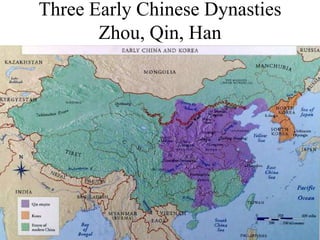
Three Early Chinese Dynasties 
Zhou, Qin, Han
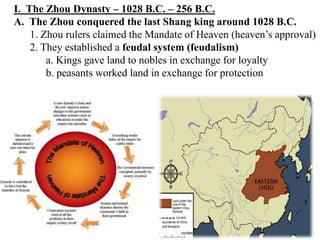
I. The Zhou Dynasty – 1028 B.C. – 256 B.C. 
A. The Zhou conquered the last Shang king around 1028 B.C. 
1. Zhou rulers claimed the Mandate of Heaven (heaven’s approval) 
2. They established a feudal system (feudalism) 
a. Kings gave land to nobles in exchange for loyalty 
b. peasants worked land in exchange for protection
Chinese feudal system developed under the Zhou dynasty 
King 
Grants use of land to 
nobles in exchange for 
loyalty 
Nobles 
Give loyalty and 
armies to the king 
Peasants 
Work the land for the 
nobles in exchange for 
shelter, protection, and 
food 
Merchants 
Lower status than peasants because 
riches come from other’s work
B. Zhou technological advances 
1. Major advancement = use of iron 
2. cast iron = stronger weapons & farming tools; increased production 
3. invented crossbow 
4. invented silk cloth – becomes major trade item
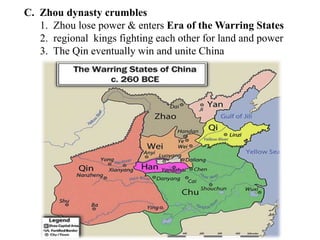
C. Zhou dynasty crumbles 
1. Zhou lose power & enters Era of the Warring States 
2. regional kings fighting each other for land and power 
3. The Qin eventually win and unite China
Critical Intro: 
Explain why you think the feudal government 
of the Zhou Dynasty failed. In other words 
what are some of the inherent weaknesses of a 
centralized feudal government?
II. Two Chinese Philosophies Emerge 
Why do you think there was an effort to find a new governing style? 
Confucianism 
“The Analects” 
Teachings of Confucius 
“Respect yourself and 
others will respect you.” 
Daoism 
Balance/Harmony with Nature
II. Two Chinese Philosophies Emerge 
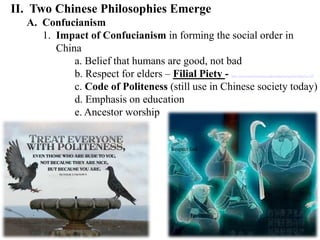
A. Confucianism 
1. Impact of Confucianism in forming the social order in 
China 
a. Belief that humans are good, not bad 
b. Respect for elders – Filial Piety - http://www.stanford.edu/group/confucian/cgi-bin/blog/?p=149 
c. Code of Politeness (still use in Chinese society today) 
d. Emphasis on education 
e. Ancestor worship 
Respect link
II. Two Chinese Philosophies Emerge 
A. Confucianism 
2. Five Primary Relationships 
a. ruler and subject 
b. father and son 
c. elder brother and younger brother 
d. husband and wife 
e. friend and friend 
Respect link
II. Two Chinese Philosophies Emerge 
A. Confucianism 
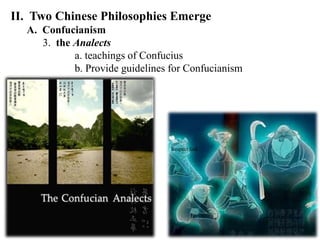
3. the Analects 
a. teachings of Confucius 
b. Provide guidelines for Confucianism 
Respect link
Confucianism 
- Filial Piety – Respect/obey elders/family 
- Every member of society has duty. 
- Role model or follower or both 
He who exercises government by means of his virtue 
may be compared to the north polar star, which keeps 
its place and all the stars turn towards it. 
-Confucious 
What Chinese 
concept is Confucius 
reinforcing? 
Writing and 
teachings of 
Confucius = 
Analects
II. Two Chinese Philosophies Emerge 
B. Taoism 
1. Impact of Taoism in forming Chinese culture and 
values 
a. Humility – low view of one’s own importance 
b. Simple life & inner peace 
c. Harmony/balance with nature 
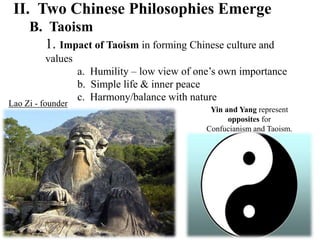
Lao Zi - founder 
Yin and Yang represent 
opposites for 
Confucianism and Taoism.
Critical Intro: 
Are you Yin or Yang?
Critical Intro: 
Write two Confucian style 
quotes, and 2 Daoist style 
quotes.
III. The Qin Dynasty – 221 B.C. – 210 B.C. 
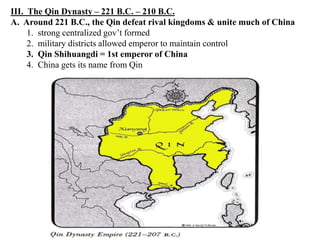
A. Around 221 B.C., the Qin defeat rival kingdoms & unite much of China 
1. strong centralized gov’t formed 
2. military districts allowed emperor to maintain control 
3. Qin Shihuangdi = 1st emperor of China 
4. China gets its name from Qin
B. Qin Shihuangdi – his achievements 
1. standardized weights and measures and coinage 
2. created uniform writing system 
3. constructed Great Wall of China
C. The Great Wall of China 
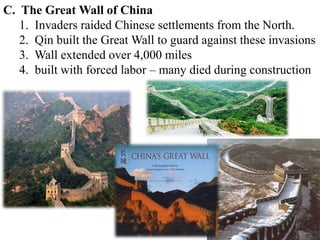
1. Invaders raided Chinese settlements from the North. 
2. Qin built the Great Wall to guard against these invasions 
3. Wall extended over 4,000 miles 
4. built with forced labor – many died during construction
Great Wall “ Not always so Great”?
D. Qin’s Shihuangdi’s Strict Rule 
1. Imposed censorship (burned books) to control information 
2. took power from local lords 
3. many forced-labor projects 
4. legalistic philosophy – strict laws + harsh punishments
D. The End of the Qin Dynasty 
1. Qin Shihuangdi dies in 210 B.C. 
2. He is buried with an army of terra cotta (clay) soldiers and horses 
3. The dynasty weakens; loses control of country 
4. 206 B.C. Han Dynasty comes to power
IV. The Han Dynasty – 206 B.C. – A.D. 220 
A. Wudi – The greatest Han ruler 
1. He greatly expanded the empire 
2. He expanded trade routes to the west known 
as the Silk Roads 
a. Silk Roads = Series of trade routes 
linking China and the Mediterranean 
cultures & Roman Empire
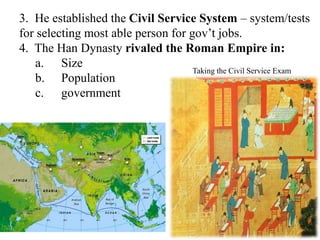
3. He established the Civil Service System – system/tests 
for selecting most able person for gov’t jobs. 
4. The Han Dynasty rivaled the Roman Empire in: 
a. Size 
b. Population 
c. government 
Taking the Civil Service Exam
Silk Roads – Connect China to Mediterranean Sea and Roman Empire
Silk Roads
Silk Roads 
Indian Ocean 
trade routes
B. Fall of the Han Dynasty 
1. After Wudi died the dynasty weakened. 
2. The Huns eventually overthrew the Han Dynasty
C. Other contributions of Classical China 
1. invented paper 
2. porcelain 
3. gun powder 
4. wheelbarrow

Three Classical Chinese Dynasties

  • 1.
    Three Early ChineseDynasties Zhou, Qin, Han
  • 2.
    I. The ZhouDynasty – 1028 B.C. – 256 B.C. A. The Zhou conquered the last Shang king around 1028 B.C. 1. Zhou rulers claimed the Mandate of Heaven (heaven’s approval) 2. They established a feudal system (feudalism) a. Kings gave land to nobles in exchange for loyalty b. peasants worked land in exchange for protection
  • 3.
    Chinese feudal systemdeveloped under the Zhou dynasty King Grants use of land to nobles in exchange for loyalty Nobles Give loyalty and armies to the king Peasants Work the land for the nobles in exchange for shelter, protection, and food Merchants Lower status than peasants because riches come from other’s work
  • 4.
    B. Zhou technologicaladvances 1. Major advancement = use of iron 2. cast iron = stronger weapons & farming tools; increased production 3. invented crossbow 4. invented silk cloth – becomes major trade item
  • 5.
    C. Zhou dynastycrumbles 1. Zhou lose power & enters Era of the Warring States 2. regional kings fighting each other for land and power 3. The Qin eventually win and unite China
  • 6.
    Critical Intro: Explainwhy you think the feudal government of the Zhou Dynasty failed. In other words what are some of the inherent weaknesses of a centralized feudal government?
  • 7.
    II. Two ChinesePhilosophies Emerge Why do you think there was an effort to find a new governing style? Confucianism “The Analects” Teachings of Confucius “Respect yourself and others will respect you.” Daoism Balance/Harmony with Nature
  • 8.
    II. Two ChinesePhilosophies Emerge A. Confucianism 1. Impact of Confucianism in forming the social order in China a. Belief that humans are good, not bad b. Respect for elders – Filial Piety - http://www.stanford.edu/group/confucian/cgi-bin/blog/?p=149 c. Code of Politeness (still use in Chinese society today) d. Emphasis on education e. Ancestor worship Respect link
  • 9.
    II. Two ChinesePhilosophies Emerge A. Confucianism 2. Five Primary Relationships a. ruler and subject b. father and son c. elder brother and younger brother d. husband and wife e. friend and friend Respect link
  • 10.
    II. Two ChinesePhilosophies Emerge A. Confucianism 3. the Analects a. teachings of Confucius b. Provide guidelines for Confucianism Respect link
  • 12.
    Confucianism - FilialPiety – Respect/obey elders/family - Every member of society has duty. - Role model or follower or both He who exercises government by means of his virtue may be compared to the north polar star, which keeps its place and all the stars turn towards it. -Confucious What Chinese concept is Confucius reinforcing? Writing and teachings of Confucius = Analects
  • 13.
    II. Two ChinesePhilosophies Emerge B. Taoism 1. Impact of Taoism in forming Chinese culture and values a. Humility – low view of one’s own importance b. Simple life & inner peace c. Harmony/balance with nature Lao Zi - founder Yin and Yang represent opposites for Confucianism and Taoism.
  • 15.
    Critical Intro: Areyou Yin or Yang?
  • 16.
    Critical Intro: Writetwo Confucian style quotes, and 2 Daoist style quotes.
  • 17.
    III. The QinDynasty – 221 B.C. – 210 B.C. A. Around 221 B.C., the Qin defeat rival kingdoms & unite much of China 1. strong centralized gov’t formed 2. military districts allowed emperor to maintain control 3. Qin Shihuangdi = 1st emperor of China 4. China gets its name from Qin
  • 18.
    B. Qin Shihuangdi– his achievements 1. standardized weights and measures and coinage 2. created uniform writing system 3. constructed Great Wall of China
  • 19.
    C. The GreatWall of China 1. Invaders raided Chinese settlements from the North. 2. Qin built the Great Wall to guard against these invasions 3. Wall extended over 4,000 miles 4. built with forced labor – many died during construction
  • 23.
    Great Wall “Not always so Great”?
  • 24.
    D. Qin’s Shihuangdi’sStrict Rule 1. Imposed censorship (burned books) to control information 2. took power from local lords 3. many forced-labor projects 4. legalistic philosophy – strict laws + harsh punishments
  • 25.
    D. The Endof the Qin Dynasty 1. Qin Shihuangdi dies in 210 B.C. 2. He is buried with an army of terra cotta (clay) soldiers and horses 3. The dynasty weakens; loses control of country 4. 206 B.C. Han Dynasty comes to power
  • 26.
    IV. The HanDynasty – 206 B.C. – A.D. 220 A. Wudi – The greatest Han ruler 1. He greatly expanded the empire 2. He expanded trade routes to the west known as the Silk Roads a. Silk Roads = Series of trade routes linking China and the Mediterranean cultures & Roman Empire
  • 27.
    3. He establishedthe Civil Service System – system/tests for selecting most able person for gov’t jobs. 4. The Han Dynasty rivaled the Roman Empire in: a. Size b. Population c. government Taking the Civil Service Exam
  • 29.
    Silk Roads –Connect China to Mediterranean Sea and Roman Empire
  • 30.
  • 32.
    Silk Roads IndianOcean trade routes
  • 33.
    B. Fall ofthe Han Dynasty 1. After Wudi died the dynasty weakened. 2. The Huns eventually overthrew the Han Dynasty
  • 34.
    C. Other contributionsof Classical China 1. invented paper 2. porcelain 3. gun powder 4. wheelbarrow