Copyright © 2004 South-Western. All rights reserved.
PowerPoint Presentation by Charlie Cook
Copyright © 2004 South-
Western. All rights reserved. 6–2
Objectives
After studying this chapter, you should be able to:
1. Discuss the systems approach to training and
development.
2. Describe the components of training-needs
assessment.
3. Identify the principles of learning and describe how
they facilitate training.
4. Identify the types of training methods used for
managers and nonmanagers.
5. Discuss the advantages and disadvantages of
various evaluation criteria.
Copyright © 2004 South-
Western. All rights reserved. 6–3
Objectives (cont’d)
After studying this chapter, you should be able to:
6. Describe the special training programs that are
currently popular.
Copyright © 2004 South-
Western. All rights reserved. 6–4
Training and Development and Other HRM
Functions
Training may permit hiringTraining may permit hiring
less-qualified applicantsless-qualified applicants
Training may permit hiringTraining may permit hiring
less-qualified applicantsless-qualified applicants SelectionSelectionSelectionSelection Effective selection mayEffective selection may
reduce training needsreduce training needs
Effective selection mayEffective selection may
reduce training needsreduce training needs
Training aids in theTraining aids in the
achievement of performanceachievement of performance
Training aids in theTraining aids in the
achievement of performanceachievement of performance
PerformancePerformance
AppraisalAppraisal
PerformancePerformance
AppraisalAppraisal
A basis for assessingA basis for assessing
training needs and resultstraining needs and results
A basis for assessingA basis for assessing
training needs and resultstraining needs and results
Training and development mayTraining and development may
lead to higher paylead to higher pay
Training and development mayTraining and development may
lead to higher paylead to higher pay
CompensationCompensation
ManagementManagement
CompensationCompensation
ManagementManagement
A basis for determiningA basis for determining
employee’s rate of payemployee’s rate of pay
A basis for determiningA basis for determining
employee’s rate of payemployee’s rate of pay
Presentation Slide 6–1
Availability of training can aidAvailability of training can aid
in recruitmentin recruitment
Availability of training can aidAvailability of training can aid
in recruitmentin recruitment RecruitmentRecruitmentRecruitmentRecruitment Provide an additionalProvide an additional
source of traineessource of trainees
Provide an additionalProvide an additional
source of traineessource of trainees
Training may include a role forTraining may include a role for
the unionthe union
Training may include a role forTraining may include a role for
the unionthe union Labor RelationsLabor RelationsLabor RelationsLabor Relations Union cooperation canUnion cooperation can
facilitate training effortsfacilitate training efforts
Union cooperation canUnion cooperation can
facilitate training effortsfacilitate training efforts
Copyright © 2004 South-
Western. All rights reserved. 6–5
Training and Development
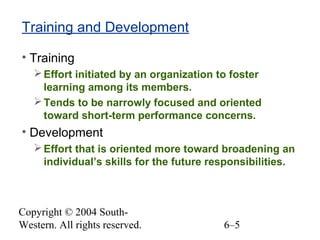
• Training
Effort initiated by an organization to foster
learning among its members.
Tends to be narrowly focused and oriented
toward short-term performance concerns.
• Development
Effort that is oriented more toward broadening an
individual’s skills for the future responsibilities.
Copyright © 2004 South-
Western. All rights reserved. 6–6
Use of the Types of Training
Figure 6.1
How Often the Types of
Training Are Offered
Source: Tammy Galvin, “The Methods,” Training 38, no. 10 (October 2001): 48–56.
Copyright © 2004 South-
Western. All rights reserved. 6–7
Training Dollars Spent On…
Figure 6.2Source: Tammy Galvin, “The People,” Training 38, no. 10 (October 2001): 58–64.
Copyright © 2004 South-
Western. All rights reserved. 6–8
The Systems Approach to Training and
Development
• Four Phases
Needs assessment
Program design
Implementation
Evaluation
Copyright © 2004 South-
Western. All rights reserved. 6–9
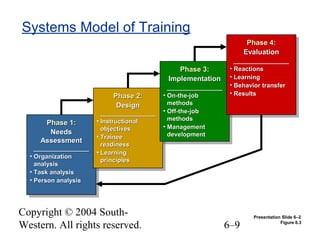
Systems Model of Training
Figure 6.3
Presentation Slide 6–2
Phase 1:Phase 1:
NeedsNeeds
AssessmentAssessment
________________________________
• OrganizationOrganization
analysisanalysis
• Task analysisTask analysis
• Person analysisPerson analysis
Phase 1:Phase 1:
NeedsNeeds
AssessmentAssessment
________________________________
• OrganizationOrganization
analysisanalysis
• Task analysisTask analysis
• Person analysisPerson analysis
Phase 2:Phase 2:
DesignDesign
________________________________
• InstructionalInstructional
objectivesobjectives
• TraineeTrainee
readinessreadiness
• LearningLearning
principlesprinciples
Phase 2:Phase 2:
DesignDesign
________________________________
• InstructionalInstructional
objectivesobjectives
• TraineeTrainee
readinessreadiness
• LearningLearning
principlesprinciples
Phase 3:Phase 3:
ImplementationImplementation
________________________________
• On-the-jobOn-the-job
methodsmethods
• Off-the-jobOff-the-job
methodsmethods
• ManagementManagement
developmentdevelopment
Phase 3:Phase 3:
ImplementationImplementation
________________________________
• On-the-jobOn-the-job
methodsmethods
• Off-the-jobOff-the-job
methodsmethods
• ManagementManagement
developmentdevelopment
Phase 4:Phase 4:
EvaluationEvaluation
________________________________
• ReactionsReactions
• LearningLearning
• Behavior transferBehavior transfer
• ResultsResults
Phase 4:Phase 4:
EvaluationEvaluation
________________________________
• ReactionsReactions
• LearningLearning
• Behavior transferBehavior transfer
• ResultsResults
Copyright © 2004 South-
Western. All rights reserved. 6–10
Needs Assessment for Training
• Competency assessment
 Analysis of the sets of skills and knowledge needed for
decision-oriented and knowledge-intensive jobs.
Figure 6.4
Presentation Slide 6–3
• ORGANIZATIONALORGANIZATIONAL
ANALYSISANALYSIS
TASK ANALYSISTASK ANALYSIS
• PERSON ANALYSISPERSON ANALYSIS
• ORGANIZATIONALORGANIZATIONAL
ANALYSISANALYSIS
TASK ANALYSISTASK ANALYSIS
• PERSON ANALYSISPERSON ANALYSIS
……of environment, strategies, and resourcesof environment, strategies, and resources
to determine where to emphasize trainingto determine where to emphasize training
……of environment, strategies, and resourcesof environment, strategies, and resources
to determine where to emphasize trainingto determine where to emphasize training
……of the activities to be performed in order toof the activities to be performed in order to
determine the KSAs needed.determine the KSAs needed.
……of the activities to be performed in order toof the activities to be performed in order to
determine the KSAs needed.determine the KSAs needed.
……of performance, knowledge, and skills inof performance, knowledge, and skills in
order to determine who needs training.order to determine who needs training.
……of performance, knowledge, and skills inof performance, knowledge, and skills in
order to determine who needs training.order to determine who needs training.
Copyright © 2004 South-
Western. All rights reserved. 6–11
Phase 1: Conducting the Needs
Assessment
• Organization Analysis
An examination of the environment, strategies,
and resources of the organization to determine
where training emphasis should be placed.
• Task Analysis
The process of determining what the content of a
training program should be on the basis of a
study of the tasks and duties involved in the job.
• Person Analysis
A determination of the specific individuals who
need training.
Copyright © 2004 South-
Western. All rights reserved. 6–12
Phase 2: Designing Training Programs
Characteristics of successful trainersCharacteristics of successful trainersCharacteristics of successful trainersCharacteristics of successful trainers
Trainee readiness and motivationTrainee readiness and motivationTrainee readiness and motivationTrainee readiness and motivation
Issues in training designIssues in training designIssues in training designIssues in training design
Instructional objectivesInstructional objectivesInstructional objectivesInstructional objectives
Principles of learningPrinciples of learningPrinciples of learningPrinciples of learning
Copyright © 2004 South-
Western. All rights reserved. 6–13
Designing the Training Program
• Instructional Objectives
Represent the desired outcomes of a training
program
Performance-centered objectives
Provide a basis for choosing methods
and materials and for selecting
the means for assessing
whether the instruction
will be successful.
Copyright © 2004 South-
Western. All rights reserved. 6–14
Trainee Readiness and Motivation
• Strategies for Creating a Motivated Training
Environment:
Use positive reinforcement.
Eliminate threats and punishment.
Be flexible.
Have participants set personal goals.
Design interesting instruction.
Break down physical and psychological obstacles
to learning.
Copyright © 2004 South-
Western. All rights reserved. 6–15
Principles of
Learning
Figure 6.5Presentation Slide 6–4
Individual
differences
Goal setting
Meaning-
fulness of
presentation
Modeling
Feedback and
reinforcement
Whole-versus-
part learning
Massed-versus-
distributed
learning
Active practice
and repetition
PRINCIPLESPRINCIPLES
OFOF
LEARNINGLEARNING
PRINCIPLESPRINCIPLES
OFOF
LEARNINGLEARNING
Copyright © 2004 South-
Western. All rights reserved. 6–16
Principles of Learning
Recognition of individual learningRecognition of individual learning
differencesdifferences
Recognition of individual learningRecognition of individual learning
differencesdifferences
Meaningfulness of presentationMeaningfulness of presentationMeaningfulness of presentationMeaningfulness of presentation
Focus on learning and transferFocus on learning and transferFocus on learning and transferFocus on learning and transfer
Goal setting - What’s the value?Goal setting - What’s the value?Goal setting - What’s the value?Goal setting - What’s the value?
Behavioral modelingBehavioral modelingBehavioral modelingBehavioral modeling
Copyright © 2004 South-
Western. All rights reserved. 6–17
Principles of Learning (cont’d)
Feedback and knowledge ofFeedback and knowledge of
progress (learning curve)progress (learning curve)
Feedback and knowledge ofFeedback and knowledge of
progress (learning curve)progress (learning curve)
Whole versus-part learningWhole versus-part learningWhole versus-part learningWhole versus-part learning
Focus on method and processFocus on method and processFocus on method and processFocus on method and process
Active practice and repetitionActive practice and repetitionActive practice and repetitionActive practice and repetition
Massed-vs-distributed learningMassed-vs-distributed learningMassed-vs-distributed learningMassed-vs-distributed learning
Copyright © 2004 South-
Western. All rights reserved. 6–18
A Typical Learning Curve
PlateauPlateau
Performance
Low
High
Time (weeks)
Figure 6.6
Presentation Slide 6–5
Copyright © 2004 South-
Western. All rights reserved. 6–19
Feedback and Reinforcement
• Behavior Modification
The technique based on the principle that
behavior that is rewarded, or positively
reinforced, is repeated more frequently, whereas
behavior that is penalized or unrewarded will
decrease in frequency.
Copyright © 2004 South-
Western. All rights reserved. 6–20
Characteristics of Successful Instructors
• Knowledge of the subject
• Adaptability
• Sincerity
• Sense of humor
• Interest
• Clear instructions
• Individual assistance
• Enthusiasm
Copyright © 2004 South-
Western. All rights reserved. 6–21
Phase 3: Implementing the Training
Program
Importance of training outcomesImportance of training outcomesImportance of training outcomesImportance of training outcomes
Type of traineesType of traineesType of traineesType of trainees
Choosing the instructional methodChoosing the instructional methodChoosing the instructional methodChoosing the instructional method
Nature of trainingNature of trainingNature of trainingNature of training
Organizational extent of trainingOrganizational extent of trainingOrganizational extent of trainingOrganizational extent of training
Copyright © 2004 South-
Western. All rights reserved. 6–22
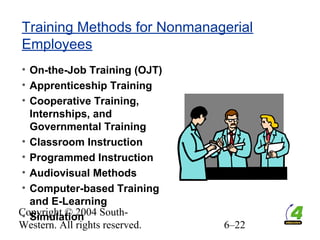
Training Methods for Nonmanagerial
Employees
• On-the-Job Training (OJT)
• Apprenticeship Training
• Cooperative Training,
Internships, and
Governmental Training
• Classroom Instruction
• Programmed Instruction
• Audiovisual Methods
• Computer-based Training
and E-Learning
• Simulation
Copyright © 2004 South-
Western. All rights reserved. 6–23
Training Methods for Nonmanagerial
Employees (cont’d)
• On-the-job training (OJT)
Method by which employees are given hands-on
experience with instructions from their supervisor
or other trainer.
• Apprenticeship training
System of training in which a worker entering the
skilled trades is given thorough instruction and
experience, both on and off the job, in the
practical and theoretical aspects of the work.
Copyright © 2004 South-
Western. All rights reserved. 6–24
Training Methods for Nonmanagerial
Employees (cont’d)
• Cooperative Training
Training program that combines practical on-the-
job experience with formal educational classes.
• Internship Programs
Programs jointly sponsored by colleges,
universities, and other organizations that offer
students the opportunity to gain real-life
experience while allowing them to find out how
they will perform in work organizations.
Copyright © 2004 South-
Western. All rights reserved. 6–25
Training Methods for Nonmanagerial
Employees (cont’d)
• Vestibule Training
A special type of classroom facility is used to give
instruction in the operation of equipment like that
found in operating departments
The emphasis is on instruction rather than
production.
Copyright © 2004 South-
Western. All rights reserved. 6–26
Training Methods for Nonmanagerial
Employees (cont’d)
• Computer-assisted Instruction (CAI)
A system that delivers instructional materials
directly through a computer terminal in an
interactive format.
• Computer-managed Instruction (CMI)
A system normally employed in
conjunction with CAI that uses
a computer to generate and
score tests and to determine
the level of training proficiency.
Copyright © 2004 South-
Western. All rights reserved. 6–27
How Different Industries Use Technology For Training
HRM 7
Copyright © 2004 South-
Western. All rights reserved. 6–28
Advantages of Web-based Training
• Learning is self-paced.
• Training comes to the employee.
• Training is interactive.
• New employees do not have to wait for a
scheduled training session.
• Training can focus on specific needs as
revealed by built-in tests.
• Trainees can be referred to online help or written
material.
Copyright © 2004 South-
Western. All rights reserved. 6–29
Advantages of Web-based Training (cont’d)
• It is easier to revise a computer program than
to change classroom-training materials.
• Record keeping is facilitated.
• The computer program can be linked to video
presentations.
• The training can be cost-effective if used for a
large number of employees.
Copyright © 2004 South-
Western. All rights reserved. 6–30
Training Methods for Management
Development
• On-the-Job Experiences
• Seminars and Conferences
• Case Studies
• Management Games
• Role Playing
• Behavior Modeling
Copyright © 2004 South-
Western. All rights reserved. 6–31
On-the-Job Experiences
• Coaching
• Understudy Assignment
• Job Rotation
• Lateral Transfer
• Special Projects
• Action Learning
• Staff Meetings
• Planned Career Progressions
Copyright © 2004 South-
Western. All rights reserved. 6–32
The
Leadership
Grid®
Figure 6.7
Source: Robert R. Blake and
Anne Adams McCanse,
Leadership Dilemmas—Grid
Solutions (Houston: Gulf
Publishing, 1991), 29. (First
published as The Managerial
Grid Figure by Robert R. Blake
and Jane S. Mouton.) Courtesy
of Gulf Publishing Company,
Houston, Texas, 800-231-6275.
All rights reserved.
Copyright © 2004 South-
Western. All rights reserved. 6–33
Case Studies
• The use of case studies is most appropriate
when:
Analytic, problem-solving, and critical thinking
skills are most important.
The KSAs are complex and participants need time
to master them.
Active participation is desired.
The process of learning (questioning,
interpreting, and so on) is as important as the
content.
Team problem solving and interaction are
possible.
Copyright © 2004 South-
Western. All rights reserved. 6–34
Case Studies
• When Using Case Studies…
Be clear about learning objectives, and list
possible ways to achieve the objectives.
Decide which objectives would be best served by
the case method.
Identify available cases that might work, or
consider writing your own.
Set up the activity—including the case material,
the room, and the schedule.
Follow the principles of effective group dynamics.
Figure 6.8a
Source: Adapted from Albert A. Einsiedel, Jr., “Case Studies: Indispensable
Tools for Trainers,” Training and Development, August 1995, 50–53.
Copyright © 2004 South-
Western. All rights reserved. 6–35
Case Studies (cont’d)
• When Using Case Studies…
Provide a chance for all learners to take part and
try to keep the groups small.
Stop for process checks and be ready to
intervene if group dynamics get out of hand.
Allow for different learning styles.
Clarify the trainer’s role.
Bridge the gap between theory and practice.
Figure 6.8b
Source: Adapted from Albert A. Einsiedel, Jr., “Case Studies: Indispensable
Tools for Trainers,” Training and Development, August 1995, 50–53.
Copyright © 2004 South-
Western. All rights reserved. 6–36
Role Playing
• Successful role play requires that instructors:
Ensure that group members are comfortable with
each other.
Select and prepare the role players by introducing
a specific situation.
To help participants prepare, ask them to
describe potential characters.
Realize that volunteers make better role players.
Copyright © 2004 South-
Western. All rights reserved. 6–37
Role Playing (cont’d)
• Successful role play requires that instructors:
Prepare the observers by giving them specific
tasks (such as evaluation or feedback).
Guide the role-play enactment through its bumps
(since it is not scripted).
Keep it short.
Discuss the enactment and prepare bulleted
points of what was learned.
Copyright © 2004 South-
Western. All rights reserved. 6–38
Behavior Modeling
• Behavior Modeling
An approach that demonstrates desired behavior
and gives trainees the chance to practice and
role-play those behaviors and receive feedback.
Involves four basic components:
Learning points
Model
Practice and role play
Feedback and reinforcement
Copyright © 2004 South-
Western. All rights reserved. 6–39
Phase 4: Evaluating the Training Program
• Criteria for
Evaluating
Training
Figure 6.9
ReactionsReactionsReactionsReactions
BehaviorBehaviorBehaviorBehavior
LearningLearningLearningLearning
ResultsResultsResultsResults
Copyright © 2004 South-
Western. All rights reserved. 6–40
Training Program Evaluation
Criterion 4: Results assessmentCriterion 4: Results assessmentCriterion 4: Results assessmentCriterion 4: Results assessment
Criterion 2: Extent of learningCriterion 2: Extent of learningCriterion 2: Extent of learningCriterion 2: Extent of learning
Measuring program effectivenessMeasuring program effectivenessMeasuring program effectivenessMeasuring program effectiveness
Criterion 1: Trainee reactionsCriterion 1: Trainee reactionsCriterion 1: Trainee reactionsCriterion 1: Trainee reactions
Criterion 3: Learning transfer to jobCriterion 3: Learning transfer to jobCriterion 3: Learning transfer to jobCriterion 3: Learning transfer to job
Copyright © 2004 South-
Western. All rights reserved. 6–41
Criterion 1: Reactions
• Participant Reactions.
The simplest and most common approach to
training evaluation is assessing trainees.
Potential questions might include the following:
What were your learning goals for this
program? Did you achieve them?
Did you like this program?
Would you recommend it to others who have
similar learning goals? What suggestions do
you have for improving the program?
Should the organization continue to offer it?
Copyright © 2004 South-
Western. All rights reserved. 6–42
Criterion 2: Learning
• Checking to see whether they actually learned
anything.
Testing knowledge and skills before beginning a
training program gives a baseline standard on
trainees that can be measured again after training
to determine improvement.
However, in addition to testing trainees, test
employees who did not attend the training to
estimate the differential effect of the training.
Copyright © 2004 South-
Western. All rights reserved. 6–43
Criterion 3: Behavior
• Transfer of Training
Effective application of principles learned to what
is required on the job.
• Maximizing the Transfer of Training
Feature identical elements
Focus on general principles
Establish a climate for transfer.
Give employees transfer strategies
Copyright © 2004 South-
Western. All rights reserved. 6–44
Criterion 4: Results
• Utility of Training Programs.
The benefits derived from training.
• Return on Investment
Viewing training in terms of the extent to which it
provides knowledge and skills that create a
competitive advantage and a culture that is ready
for continuous change.
Copyright © 2004 South-
Western. All rights reserved. 6–45
Criterion 4: Results (cont’d)
• Benchmarking
The process of measuring one’s own services
and practices against the recognized leaders in
order to identify areas for improvement.
Plan: conduct a self-audit to identify areas for
benchmarking.
Do: collect data about activities.
Check: Analyze data.
Act: Establish goals, implement changes, monitor
progress, and redefine benchmarks.
Copyright © 2004 South-
Western. All rights reserved. 6–46
Special Training and Development Topics
Basic skills education trainingBasic skills education trainingBasic skills education trainingBasic skills education training
Organization-wide training programsOrganization-wide training programsOrganization-wide training programsOrganization-wide training programs
New and old employee orientationNew and old employee orientationNew and old employee orientationNew and old employee orientation
Teamwork trainingTeamwork trainingTeamwork trainingTeamwork training
Copyright © 2004 South-
Western. All rights reserved. 6–47
Special Topics in Training and
Development
• Orientation
A formal process of familiarizing new employees
with the organization, their jobs, and their work
units.
• Basic Skills Training
Typical basic skills: Reading, writing, computing,
speaking, listening, problem solving, managing
oneself, knowing how to learn, working as part of
a team, leading others.
Copyright © 2004 South-
Western. All rights reserved. 6–48
Items for an Orientation Packet
• Company history
• Copy of specific job goals
and descriptions
• List of unique terms in the
industry, company, and job
• Organizational publications
• Telephone numbers and
locations of key personnel
• Performance appraisal forms
and procedures
• List of on-the-job training
opportunities
• Safety and emergency
procedures
• Policy handbook
• Current organization chart
• Map of facility
• Union contract
• List of holidays
• List of employee benefits
• Sources of information
• Insurance plans
Figure 6.10
Copyright © 2004 South-
Western. All rights reserved. 6–49
Remedial Programs
in the Workplace
Figure 6.11
Source: Scott Hayes, “The ABCs of Workplace Literacy,” Workforce 78, no. 4 (April 1999):
70–74. Used with permission of the Manufacturing Institute’s Center for Workforce Success.
Copyright © 2004 South-
Western. All rights reserved. 6–50
Team Training Skills
Figure 6.12
Source: George Bohlander and Kathy McCarthy, “How to Get the Most
from Team Training,” National Productivity Review, Autumn 1996, 25–35.
Copyright © 2004 South-
Western. All rights reserved. 6–51
Special Training and Development Topics
Crisis prevention trainingCrisis prevention trainingCrisis prevention trainingCrisis prevention training
Organization-wide training programsOrganization-wide training programsOrganization-wide training programsOrganization-wide training programs
Diversity trainingDiversity trainingDiversity trainingDiversity training
Global trainingGlobal trainingGlobal trainingGlobal training

Chapter 06 Training and Development

  • 1.
    Copyright © 2004South-Western. All rights reserved. PowerPoint Presentation by Charlie Cook
  • 2.
    Copyright © 2004South- Western. All rights reserved. 6–2 Objectives After studying this chapter, you should be able to: 1. Discuss the systems approach to training and development. 2. Describe the components of training-needs assessment. 3. Identify the principles of learning and describe how they facilitate training. 4. Identify the types of training methods used for managers and nonmanagers. 5. Discuss the advantages and disadvantages of various evaluation criteria.
  • 3.
    Copyright © 2004South- Western. All rights reserved. 6–3 Objectives (cont’d) After studying this chapter, you should be able to: 6. Describe the special training programs that are currently popular.
  • 4.
    Copyright © 2004South- Western. All rights reserved. 6–4 Training and Development and Other HRM Functions Training may permit hiringTraining may permit hiring less-qualified applicantsless-qualified applicants Training may permit hiringTraining may permit hiring less-qualified applicantsless-qualified applicants SelectionSelectionSelectionSelection Effective selection mayEffective selection may reduce training needsreduce training needs Effective selection mayEffective selection may reduce training needsreduce training needs Training aids in theTraining aids in the achievement of performanceachievement of performance Training aids in theTraining aids in the achievement of performanceachievement of performance PerformancePerformance AppraisalAppraisal PerformancePerformance AppraisalAppraisal A basis for assessingA basis for assessing training needs and resultstraining needs and results A basis for assessingA basis for assessing training needs and resultstraining needs and results Training and development mayTraining and development may lead to higher paylead to higher pay Training and development mayTraining and development may lead to higher paylead to higher pay CompensationCompensation ManagementManagement CompensationCompensation ManagementManagement A basis for determiningA basis for determining employee’s rate of payemployee’s rate of pay A basis for determiningA basis for determining employee’s rate of payemployee’s rate of pay Presentation Slide 6–1 Availability of training can aidAvailability of training can aid in recruitmentin recruitment Availability of training can aidAvailability of training can aid in recruitmentin recruitment RecruitmentRecruitmentRecruitmentRecruitment Provide an additionalProvide an additional source of traineessource of trainees Provide an additionalProvide an additional source of traineessource of trainees Training may include a role forTraining may include a role for the unionthe union Training may include a role forTraining may include a role for the unionthe union Labor RelationsLabor RelationsLabor RelationsLabor Relations Union cooperation canUnion cooperation can facilitate training effortsfacilitate training efforts Union cooperation canUnion cooperation can facilitate training effortsfacilitate training efforts
  • 5.
    Copyright © 2004South- Western. All rights reserved. 6–5 Training and Development • Training Effort initiated by an organization to foster learning among its members. Tends to be narrowly focused and oriented toward short-term performance concerns. • Development Effort that is oriented more toward broadening an individual’s skills for the future responsibilities.
  • 6.
    Copyright © 2004South- Western. All rights reserved. 6–6 Use of the Types of Training Figure 6.1 How Often the Types of Training Are Offered Source: Tammy Galvin, “The Methods,” Training 38, no. 10 (October 2001): 48–56.
  • 7.
    Copyright © 2004South- Western. All rights reserved. 6–7 Training Dollars Spent On… Figure 6.2Source: Tammy Galvin, “The People,” Training 38, no. 10 (October 2001): 58–64.
  • 8.
    Copyright © 2004South- Western. All rights reserved. 6–8 The Systems Approach to Training and Development • Four Phases Needs assessment Program design Implementation Evaluation
  • 9.
    Copyright © 2004South- Western. All rights reserved. 6–9 Systems Model of Training Figure 6.3 Presentation Slide 6–2 Phase 1:Phase 1: NeedsNeeds AssessmentAssessment ________________________________ • OrganizationOrganization analysisanalysis • Task analysisTask analysis • Person analysisPerson analysis Phase 1:Phase 1: NeedsNeeds AssessmentAssessment ________________________________ • OrganizationOrganization analysisanalysis • Task analysisTask analysis • Person analysisPerson analysis Phase 2:Phase 2: DesignDesign ________________________________ • InstructionalInstructional objectivesobjectives • TraineeTrainee readinessreadiness • LearningLearning principlesprinciples Phase 2:Phase 2: DesignDesign ________________________________ • InstructionalInstructional objectivesobjectives • TraineeTrainee readinessreadiness • LearningLearning principlesprinciples Phase 3:Phase 3: ImplementationImplementation ________________________________ • On-the-jobOn-the-job methodsmethods • Off-the-jobOff-the-job methodsmethods • ManagementManagement developmentdevelopment Phase 3:Phase 3: ImplementationImplementation ________________________________ • On-the-jobOn-the-job methodsmethods • Off-the-jobOff-the-job methodsmethods • ManagementManagement developmentdevelopment Phase 4:Phase 4: EvaluationEvaluation ________________________________ • ReactionsReactions • LearningLearning • Behavior transferBehavior transfer • ResultsResults Phase 4:Phase 4: EvaluationEvaluation ________________________________ • ReactionsReactions • LearningLearning • Behavior transferBehavior transfer • ResultsResults
  • 10.
    Copyright © 2004South- Western. All rights reserved. 6–10 Needs Assessment for Training • Competency assessment  Analysis of the sets of skills and knowledge needed for decision-oriented and knowledge-intensive jobs. Figure 6.4 Presentation Slide 6–3 • ORGANIZATIONALORGANIZATIONAL ANALYSISANALYSIS TASK ANALYSISTASK ANALYSIS • PERSON ANALYSISPERSON ANALYSIS • ORGANIZATIONALORGANIZATIONAL ANALYSISANALYSIS TASK ANALYSISTASK ANALYSIS • PERSON ANALYSISPERSON ANALYSIS ……of environment, strategies, and resourcesof environment, strategies, and resources to determine where to emphasize trainingto determine where to emphasize training ……of environment, strategies, and resourcesof environment, strategies, and resources to determine where to emphasize trainingto determine where to emphasize training ……of the activities to be performed in order toof the activities to be performed in order to determine the KSAs needed.determine the KSAs needed. ……of the activities to be performed in order toof the activities to be performed in order to determine the KSAs needed.determine the KSAs needed. ……of performance, knowledge, and skills inof performance, knowledge, and skills in order to determine who needs training.order to determine who needs training. ……of performance, knowledge, and skills inof performance, knowledge, and skills in order to determine who needs training.order to determine who needs training.
  • 11.
    Copyright © 2004South- Western. All rights reserved. 6–11 Phase 1: Conducting the Needs Assessment • Organization Analysis An examination of the environment, strategies, and resources of the organization to determine where training emphasis should be placed. • Task Analysis The process of determining what the content of a training program should be on the basis of a study of the tasks and duties involved in the job. • Person Analysis A determination of the specific individuals who need training.
  • 12.
    Copyright © 2004South- Western. All rights reserved. 6–12 Phase 2: Designing Training Programs Characteristics of successful trainersCharacteristics of successful trainersCharacteristics of successful trainersCharacteristics of successful trainers Trainee readiness and motivationTrainee readiness and motivationTrainee readiness and motivationTrainee readiness and motivation Issues in training designIssues in training designIssues in training designIssues in training design Instructional objectivesInstructional objectivesInstructional objectivesInstructional objectives Principles of learningPrinciples of learningPrinciples of learningPrinciples of learning
  • 13.
    Copyright © 2004South- Western. All rights reserved. 6–13 Designing the Training Program • Instructional Objectives Represent the desired outcomes of a training program Performance-centered objectives Provide a basis for choosing methods and materials and for selecting the means for assessing whether the instruction will be successful.
  • 14.
    Copyright © 2004South- Western. All rights reserved. 6–14 Trainee Readiness and Motivation • Strategies for Creating a Motivated Training Environment: Use positive reinforcement. Eliminate threats and punishment. Be flexible. Have participants set personal goals. Design interesting instruction. Break down physical and psychological obstacles to learning.
  • 15.
    Copyright © 2004South- Western. All rights reserved. 6–15 Principles of Learning Figure 6.5Presentation Slide 6–4 Individual differences Goal setting Meaning- fulness of presentation Modeling Feedback and reinforcement Whole-versus- part learning Massed-versus- distributed learning Active practice and repetition PRINCIPLESPRINCIPLES OFOF LEARNINGLEARNING PRINCIPLESPRINCIPLES OFOF LEARNINGLEARNING
  • 16.
    Copyright © 2004South- Western. All rights reserved. 6–16 Principles of Learning Recognition of individual learningRecognition of individual learning differencesdifferences Recognition of individual learningRecognition of individual learning differencesdifferences Meaningfulness of presentationMeaningfulness of presentationMeaningfulness of presentationMeaningfulness of presentation Focus on learning and transferFocus on learning and transferFocus on learning and transferFocus on learning and transfer Goal setting - What’s the value?Goal setting - What’s the value?Goal setting - What’s the value?Goal setting - What’s the value? Behavioral modelingBehavioral modelingBehavioral modelingBehavioral modeling
  • 17.
    Copyright © 2004South- Western. All rights reserved. 6–17 Principles of Learning (cont’d) Feedback and knowledge ofFeedback and knowledge of progress (learning curve)progress (learning curve) Feedback and knowledge ofFeedback and knowledge of progress (learning curve)progress (learning curve) Whole versus-part learningWhole versus-part learningWhole versus-part learningWhole versus-part learning Focus on method and processFocus on method and processFocus on method and processFocus on method and process Active practice and repetitionActive practice and repetitionActive practice and repetitionActive practice and repetition Massed-vs-distributed learningMassed-vs-distributed learningMassed-vs-distributed learningMassed-vs-distributed learning
  • 18.
    Copyright © 2004South- Western. All rights reserved. 6–18 A Typical Learning Curve PlateauPlateau Performance Low High Time (weeks) Figure 6.6 Presentation Slide 6–5
  • 19.
    Copyright © 2004South- Western. All rights reserved. 6–19 Feedback and Reinforcement • Behavior Modification The technique based on the principle that behavior that is rewarded, or positively reinforced, is repeated more frequently, whereas behavior that is penalized or unrewarded will decrease in frequency.
  • 20.
    Copyright © 2004South- Western. All rights reserved. 6–20 Characteristics of Successful Instructors • Knowledge of the subject • Adaptability • Sincerity • Sense of humor • Interest • Clear instructions • Individual assistance • Enthusiasm
  • 21.
    Copyright © 2004South- Western. All rights reserved. 6–21 Phase 3: Implementing the Training Program Importance of training outcomesImportance of training outcomesImportance of training outcomesImportance of training outcomes Type of traineesType of traineesType of traineesType of trainees Choosing the instructional methodChoosing the instructional methodChoosing the instructional methodChoosing the instructional method Nature of trainingNature of trainingNature of trainingNature of training Organizational extent of trainingOrganizational extent of trainingOrganizational extent of trainingOrganizational extent of training
  • 22.
    Copyright © 2004South- Western. All rights reserved. 6–22 Training Methods for Nonmanagerial Employees • On-the-Job Training (OJT) • Apprenticeship Training • Cooperative Training, Internships, and Governmental Training • Classroom Instruction • Programmed Instruction • Audiovisual Methods • Computer-based Training and E-Learning • Simulation
  • 23.
    Copyright © 2004South- Western. All rights reserved. 6–23 Training Methods for Nonmanagerial Employees (cont’d) • On-the-job training (OJT) Method by which employees are given hands-on experience with instructions from their supervisor or other trainer. • Apprenticeship training System of training in which a worker entering the skilled trades is given thorough instruction and experience, both on and off the job, in the practical and theoretical aspects of the work.
  • 24.
    Copyright © 2004South- Western. All rights reserved. 6–24 Training Methods for Nonmanagerial Employees (cont’d) • Cooperative Training Training program that combines practical on-the- job experience with formal educational classes. • Internship Programs Programs jointly sponsored by colleges, universities, and other organizations that offer students the opportunity to gain real-life experience while allowing them to find out how they will perform in work organizations.
  • 25.
    Copyright © 2004South- Western. All rights reserved. 6–25 Training Methods for Nonmanagerial Employees (cont’d) • Vestibule Training A special type of classroom facility is used to give instruction in the operation of equipment like that found in operating departments The emphasis is on instruction rather than production.
  • 26.
    Copyright © 2004South- Western. All rights reserved. 6–26 Training Methods for Nonmanagerial Employees (cont’d) • Computer-assisted Instruction (CAI) A system that delivers instructional materials directly through a computer terminal in an interactive format. • Computer-managed Instruction (CMI) A system normally employed in conjunction with CAI that uses a computer to generate and score tests and to determine the level of training proficiency.
  • 27.
    Copyright © 2004South- Western. All rights reserved. 6–27 How Different Industries Use Technology For Training HRM 7
  • 28.
    Copyright © 2004South- Western. All rights reserved. 6–28 Advantages of Web-based Training • Learning is self-paced. • Training comes to the employee. • Training is interactive. • New employees do not have to wait for a scheduled training session. • Training can focus on specific needs as revealed by built-in tests. • Trainees can be referred to online help or written material.
  • 29.
    Copyright © 2004South- Western. All rights reserved. 6–29 Advantages of Web-based Training (cont’d) • It is easier to revise a computer program than to change classroom-training materials. • Record keeping is facilitated. • The computer program can be linked to video presentations. • The training can be cost-effective if used for a large number of employees.
  • 30.
    Copyright © 2004South- Western. All rights reserved. 6–30 Training Methods for Management Development • On-the-Job Experiences • Seminars and Conferences • Case Studies • Management Games • Role Playing • Behavior Modeling
  • 31.
    Copyright © 2004South- Western. All rights reserved. 6–31 On-the-Job Experiences • Coaching • Understudy Assignment • Job Rotation • Lateral Transfer • Special Projects • Action Learning • Staff Meetings • Planned Career Progressions
  • 32.
    Copyright © 2004South- Western. All rights reserved. 6–32 The Leadership Grid® Figure 6.7 Source: Robert R. Blake and Anne Adams McCanse, Leadership Dilemmas—Grid Solutions (Houston: Gulf Publishing, 1991), 29. (First published as The Managerial Grid Figure by Robert R. Blake and Jane S. Mouton.) Courtesy of Gulf Publishing Company, Houston, Texas, 800-231-6275. All rights reserved.
  • 33.
    Copyright © 2004South- Western. All rights reserved. 6–33 Case Studies • The use of case studies is most appropriate when: Analytic, problem-solving, and critical thinking skills are most important. The KSAs are complex and participants need time to master them. Active participation is desired. The process of learning (questioning, interpreting, and so on) is as important as the content. Team problem solving and interaction are possible.
  • 34.
    Copyright © 2004South- Western. All rights reserved. 6–34 Case Studies • When Using Case Studies… Be clear about learning objectives, and list possible ways to achieve the objectives. Decide which objectives would be best served by the case method. Identify available cases that might work, or consider writing your own. Set up the activity—including the case material, the room, and the schedule. Follow the principles of effective group dynamics. Figure 6.8a Source: Adapted from Albert A. Einsiedel, Jr., “Case Studies: Indispensable Tools for Trainers,” Training and Development, August 1995, 50–53.
  • 35.
    Copyright © 2004South- Western. All rights reserved. 6–35 Case Studies (cont’d) • When Using Case Studies… Provide a chance for all learners to take part and try to keep the groups small. Stop for process checks and be ready to intervene if group dynamics get out of hand. Allow for different learning styles. Clarify the trainer’s role. Bridge the gap between theory and practice. Figure 6.8b Source: Adapted from Albert A. Einsiedel, Jr., “Case Studies: Indispensable Tools for Trainers,” Training and Development, August 1995, 50–53.
  • 36.
    Copyright © 2004South- Western. All rights reserved. 6–36 Role Playing • Successful role play requires that instructors: Ensure that group members are comfortable with each other. Select and prepare the role players by introducing a specific situation. To help participants prepare, ask them to describe potential characters. Realize that volunteers make better role players.
  • 37.
    Copyright © 2004South- Western. All rights reserved. 6–37 Role Playing (cont’d) • Successful role play requires that instructors: Prepare the observers by giving them specific tasks (such as evaluation or feedback). Guide the role-play enactment through its bumps (since it is not scripted). Keep it short. Discuss the enactment and prepare bulleted points of what was learned.
  • 38.
    Copyright © 2004South- Western. All rights reserved. 6–38 Behavior Modeling • Behavior Modeling An approach that demonstrates desired behavior and gives trainees the chance to practice and role-play those behaviors and receive feedback. Involves four basic components: Learning points Model Practice and role play Feedback and reinforcement
  • 39.
    Copyright © 2004South- Western. All rights reserved. 6–39 Phase 4: Evaluating the Training Program • Criteria for Evaluating Training Figure 6.9 ReactionsReactionsReactionsReactions BehaviorBehaviorBehaviorBehavior LearningLearningLearningLearning ResultsResultsResultsResults
  • 40.
    Copyright © 2004South- Western. All rights reserved. 6–40 Training Program Evaluation Criterion 4: Results assessmentCriterion 4: Results assessmentCriterion 4: Results assessmentCriterion 4: Results assessment Criterion 2: Extent of learningCriterion 2: Extent of learningCriterion 2: Extent of learningCriterion 2: Extent of learning Measuring program effectivenessMeasuring program effectivenessMeasuring program effectivenessMeasuring program effectiveness Criterion 1: Trainee reactionsCriterion 1: Trainee reactionsCriterion 1: Trainee reactionsCriterion 1: Trainee reactions Criterion 3: Learning transfer to jobCriterion 3: Learning transfer to jobCriterion 3: Learning transfer to jobCriterion 3: Learning transfer to job
  • 41.
    Copyright © 2004South- Western. All rights reserved. 6–41 Criterion 1: Reactions • Participant Reactions. The simplest and most common approach to training evaluation is assessing trainees. Potential questions might include the following: What were your learning goals for this program? Did you achieve them? Did you like this program? Would you recommend it to others who have similar learning goals? What suggestions do you have for improving the program? Should the organization continue to offer it?
  • 42.
    Copyright © 2004South- Western. All rights reserved. 6–42 Criterion 2: Learning • Checking to see whether they actually learned anything. Testing knowledge and skills before beginning a training program gives a baseline standard on trainees that can be measured again after training to determine improvement. However, in addition to testing trainees, test employees who did not attend the training to estimate the differential effect of the training.
  • 43.
    Copyright © 2004South- Western. All rights reserved. 6–43 Criterion 3: Behavior • Transfer of Training Effective application of principles learned to what is required on the job. • Maximizing the Transfer of Training Feature identical elements Focus on general principles Establish a climate for transfer. Give employees transfer strategies
  • 44.
    Copyright © 2004South- Western. All rights reserved. 6–44 Criterion 4: Results • Utility of Training Programs. The benefits derived from training. • Return on Investment Viewing training in terms of the extent to which it provides knowledge and skills that create a competitive advantage and a culture that is ready for continuous change.
  • 45.
    Copyright © 2004South- Western. All rights reserved. 6–45 Criterion 4: Results (cont’d) • Benchmarking The process of measuring one’s own services and practices against the recognized leaders in order to identify areas for improvement. Plan: conduct a self-audit to identify areas for benchmarking. Do: collect data about activities. Check: Analyze data. Act: Establish goals, implement changes, monitor progress, and redefine benchmarks.
  • 46.
    Copyright © 2004South- Western. All rights reserved. 6–46 Special Training and Development Topics Basic skills education trainingBasic skills education trainingBasic skills education trainingBasic skills education training Organization-wide training programsOrganization-wide training programsOrganization-wide training programsOrganization-wide training programs New and old employee orientationNew and old employee orientationNew and old employee orientationNew and old employee orientation Teamwork trainingTeamwork trainingTeamwork trainingTeamwork training
  • 47.
    Copyright © 2004South- Western. All rights reserved. 6–47 Special Topics in Training and Development • Orientation A formal process of familiarizing new employees with the organization, their jobs, and their work units. • Basic Skills Training Typical basic skills: Reading, writing, computing, speaking, listening, problem solving, managing oneself, knowing how to learn, working as part of a team, leading others.
  • 48.
    Copyright © 2004South- Western. All rights reserved. 6–48 Items for an Orientation Packet • Company history • Copy of specific job goals and descriptions • List of unique terms in the industry, company, and job • Organizational publications • Telephone numbers and locations of key personnel • Performance appraisal forms and procedures • List of on-the-job training opportunities • Safety and emergency procedures • Policy handbook • Current organization chart • Map of facility • Union contract • List of holidays • List of employee benefits • Sources of information • Insurance plans Figure 6.10
  • 49.
    Copyright © 2004South- Western. All rights reserved. 6–49 Remedial Programs in the Workplace Figure 6.11 Source: Scott Hayes, “The ABCs of Workplace Literacy,” Workforce 78, no. 4 (April 1999): 70–74. Used with permission of the Manufacturing Institute’s Center for Workforce Success.
  • 50.
    Copyright © 2004South- Western. All rights reserved. 6–50 Team Training Skills Figure 6.12 Source: George Bohlander and Kathy McCarthy, “How to Get the Most from Team Training,” National Productivity Review, Autumn 1996, 25–35.
  • 51.
    Copyright © 2004South- Western. All rights reserved. 6–51 Special Training and Development Topics Crisis prevention trainingCrisis prevention trainingCrisis prevention trainingCrisis prevention training Organization-wide training programsOrganization-wide training programsOrganization-wide training programsOrganization-wide training programs Diversity trainingDiversity trainingDiversity trainingDiversity training Global trainingGlobal trainingGlobal trainingGlobal training

Editor's Notes

  • #13 <number>
  • #17 <number>
  • #18 <number>
  • #22 <number>
  • #41 <number>
  • #47 <number>
  • #52 <number>