Training & Development
Lecture 10
Definition
Smith (1996) defines training as a planned process
to achieve effective performance in an activity or
range of activities.
There is a common view that training consists of
formal activities that allow people to acquire or
refine knowledge, skills and attitudes needed for
their current jobs
It is about bridging the training gap
Learning
It is about bringing about relative
permanent change as a result of experience.
Social learning theory(Bandura)- states that
learning is a continuous interaction between
the individual and the particular social
environment in which he/she functions.
Continued..
Four process involved in learning as per
the social learning theory
1. Attention process
2. Retention process
3. Motor Reproduction process
4. Reinforcement process.
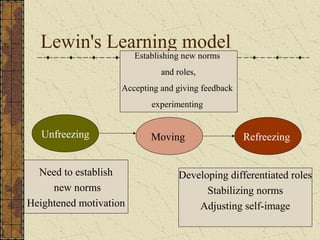
Lewin's Learning model
Unfreezing Moving Refreezing
Need to establish
new norms
Heightened motivation
Establishing new norms
and roles,
Accepting and giving feedback
experimenting
Developing differentiated roles
Stabilizing norms
Adjusting self-image
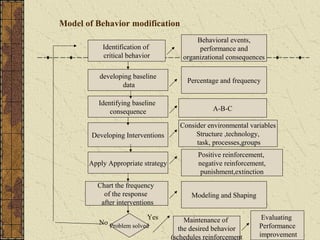
Behavior Modification
It refers to the practical application of
reinforcement theory in organizational
setup.
Five step model of it application followed
universally
Steps for behavior mod. model
Stage1 –identification of critical behavior
Stage2- developing baseline data
Stage 3-Identifying baseline
consequence(ABC model)
Stage 4- Developing and implementing
interventions.
Stage 5- Evaluating performance
improvement
developing baseline
data
Identification of
critical behavior
Identifying baseline
consequence
Developing Interventions
Apply Appropriate strategy
Chart the frequency
of the response
after interventions
Maintenance of
the desired behavior
(schedules reinforcement
Evaluating
Performance
improvement
Problem solved
No
Yes
Behavioral events,
performance and
organizational consequences
A-B-C
Consider environmental variables
Structure ,technology,
task, processes,groups
Percentage and frequency
Modeling and Shaping
Positive reinforcement,
negative reinforcement,
punishment,extinction
Model of Behavior modification
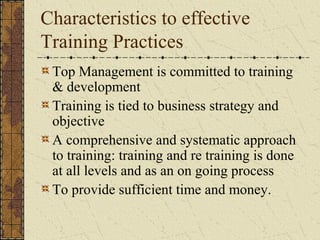
Characteristics to effective
Training Practices
Top Management is committed to training
& development
Training is tied to business strategy and
objective
A comprehensive and systematic approach
to training: training and re training is done
at all levels and as an on going process
To provide sufficient time and money.
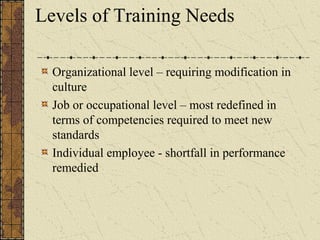
Levels of Training Needs
Organizational level – requiring modification in
culture
Job or occupational level – most redefined in
terms of competencies required to meet new
standards
Individual employee - shortfall in performance
remedied
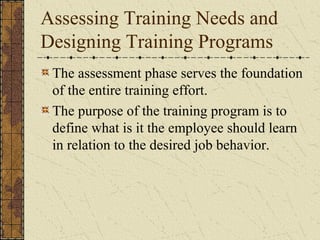
Assessing Training Needs and
Designing Training Programs
The assessment phase serves the foundation
of the entire training effort.
The purpose of the training program is to
define what is it the employee should learn
in relation to the desired job behavior.
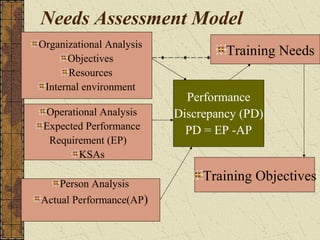
Needs Assessment Model
Organizational Analysis
Objectives
Resources
Internal environment
Person Analysis
Actual Performance(AP)
Operational Analysis
Expected Performance
Requirement (EP)
KSAs
Training Needs
Training Objectives
Performance
Discrepancy (PD)
PD = EP -AP
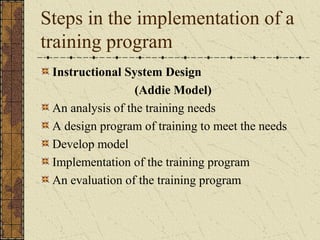
Steps in the implementation of a
training program
Instructional System Design
(Addie Model)
An analysis of the training needs
A design program of training to meet the needs
Develop model
Implementation of the training program
An evaluation of the training program
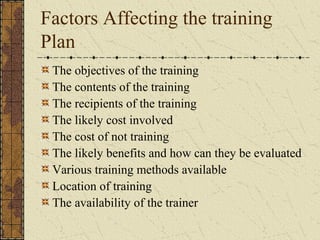
Factors Affecting the training
Plan
The objectives of the training
The contents of the training
The recipients of the training
The likely cost involved
The cost of not training
The likely benefits and how can they be evaluated
Various training methods available
Location of training
The availability of the trainer
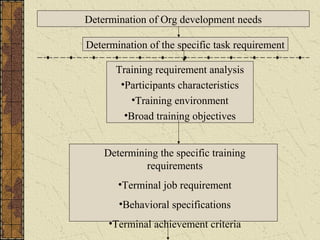
Training requirement analysis
•Participants characteristics
•Training environment
•Broad training objectives
Determination of the specific task requirement
Determination of Org development needs
Determining the specific training
requirements
•Terminal job requirement
•Behavioral specifications
•Terminal achievement criteria
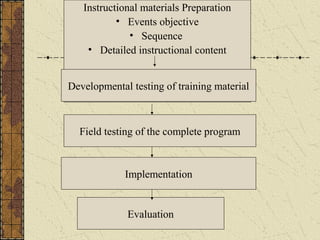
Instructional materials Preparation
• Events objective
• Sequence
• Detailed instructional content
Developmental testing of training material
Field testing of the complete program
Implementation
Evaluation
Nine requirements of a
systematic training program
It should be realistic
It should be a conscious effort
Provide time,skill&knowledge of the trainer in such
measures that the participants can convert each training
event into an experience for themselves.
Protect the participants and the setting from the harm
and expensive error arising from lack of practice.
Expose the participants to skill and ideas beyond those
available in their normal settings
Provide the opportunity for experimentation beyond
the tolerances of an organization and for feedback of
results
Give participants the experience of belonging to
groups outside their everyday settings,especially with
people in the same field and occupation.
Provide opportunities to step back from day to day
activities,think about the task and role as a
whole,analyze priorities and division of time, and how
the new ways to fit into a participants pattern of life.
Provide opportunities for a very intensive stretching
experiences for participants through specialized
programs with highly skilled trainers
Training methods
Simulating Real life
1. Role playing
2. Games
3. In basket exercise
Continued…
1. Role playing:
Help participants experience what
something sounds and feels like.
It is elaborately preplanned
Mainly useful for training behavioral
dimensions
Continued..
2. Simulation Games:
These focus primarily on the process of
interpersonal relations,on how decisions are
made and with what consequences ,rather
than on the substance of the decision.
Games have set rules and predictable
results.
Continued..
3. In basket Exercise:
More elaborate simulations create a complex
organization,rotate participants through key
roles in it,and have them deal with specific
task in settings of a kind they will encounter
in real life.
Incidents and cases
Gives a wider scope of working
Help participants develop a habit of taking
more factors into account than they usually
do,analyze them care fully and put them
together in an integrated picture for guiding
understanding and action.
Individualized training
Tutoring and coaching individuals through
reading and writing assignments
It enables each participants to determine the
pace of training
A tutor adapts his or her activities to the
participants condition
Other Methods
Seminar
Workshops
Group Discussions
Lectures
Distance learning
Laboratory Training
Job Rotation
Projects
Evaluation of the training
program
Evaluation of the training can be done at various
levels
1. Reaction Level-reviewing trainees reaction to the
training and the trainer
2. Learning Level-changes in knowledge,skill and
attitudes
3. Job Behavioral Level- change in job behavior
4. Organizational Level-effect on the organization
5. Ultimate level- benefit to the organization and the
individual
Transfer of Training
It refers to the extend to which knowledge,
skill, abilities or other characteristics
learned in training can be applied on the
job
It can be a :
Positive transfer
Negatives transfer
Neutral
Training Initiatives
Learning organizations:
E.g.:HPCL
1. People express their capacity to create desired
results
2. New and expansive patterns of thinking are
nurtured
3. Collective aspirations are set free
4. People learn together
5. Learning does not start and end but is
continuous process over the life time
Elements of a learning
organization
Building a shared vision
Continuously developing personal skills
and vision
Capability to reflect about theirs company
Team learning
Systematic learning
Continued…
Transfer of knowledge through Academy-
industry interface
Eg:Management Development Institute &Indian
Institute of Petroleum Management
Multi-skilling,Retraining and Deployment
Eg: BHEL
Developing Global Learning and Training
Capabilities
Eg: Motorola
Career Development
Career is a sequence of job occupied by a person
during the course of a lifetime.
Career development looks at the long term career
effectiveness and success of organizational
personnel
Organizations Career Development: tracking
career paths to ensure capable managerial and
technical talent to meet organizational needs
Individual Career Development: focuses on
assisting individual to identify their career goals
and to determine what they need to do to achieve
it.
Need of Career Development
Ensures needed talent will be available
Improves the organizations Ability to attract
and retain high talent
Ensures growth opportunity for all
employees
Reduces Employee frustration
Career Stages
Exploration
Establishment
Mid-career
Late Career
Decline
Types of Careers
Steady-State -One-time commitment to certain kind of job that is maintained
throughout one’s working life.
Linear- A person progresses through a sequence of jobs and each job
entails progress over the prior one in terms of responsibility, skills needed,
level in the hierarchy of an organization, and so on.
Spiral- A person holds different types of jobs that build on each other but
tend to be fundamentally different
Transitory- Person changes jobs frequently and each job is different
from the one before
Effective Organizational Career
Development
Challenging jobs
Dissemination of career options information
Job posting
Assessment centers
Career Counseling
Career Development Workshops
Continuing training
Job Changes
Individual’s Career development
Identify and organize your skills
Convert these inventories in general career
fields
Test these possibilities against the realities
of the organizations and the job market

Training & development lecture8

  • 1.
  • 2.
    Definition Smith (1996) definestraining as a planned process to achieve effective performance in an activity or range of activities. There is a common view that training consists of formal activities that allow people to acquire or refine knowledge, skills and attitudes needed for their current jobs It is about bridging the training gap
  • 3.
    Learning It is aboutbringing about relative permanent change as a result of experience. Social learning theory(Bandura)- states that learning is a continuous interaction between the individual and the particular social environment in which he/she functions.
  • 4.
    Continued.. Four process involvedin learning as per the social learning theory 1. Attention process 2. Retention process 3. Motor Reproduction process 4. Reinforcement process.
  • 5.
    Lewin's Learning model UnfreezingMoving Refreezing Need to establish new norms Heightened motivation Establishing new norms and roles, Accepting and giving feedback experimenting Developing differentiated roles Stabilizing norms Adjusting self-image
  • 6.
    Behavior Modification It refersto the practical application of reinforcement theory in organizational setup. Five step model of it application followed universally
  • 7.
    Steps for behaviormod. model Stage1 –identification of critical behavior Stage2- developing baseline data Stage 3-Identifying baseline consequence(ABC model) Stage 4- Developing and implementing interventions. Stage 5- Evaluating performance improvement
  • 8.
    developing baseline data Identification of criticalbehavior Identifying baseline consequence Developing Interventions Apply Appropriate strategy Chart the frequency of the response after interventions Maintenance of the desired behavior (schedules reinforcement Evaluating Performance improvement Problem solved No Yes Behavioral events, performance and organizational consequences A-B-C Consider environmental variables Structure ,technology, task, processes,groups Percentage and frequency Modeling and Shaping Positive reinforcement, negative reinforcement, punishment,extinction Model of Behavior modification
  • 9.
    Characteristics to effective TrainingPractices Top Management is committed to training & development Training is tied to business strategy and objective A comprehensive and systematic approach to training: training and re training is done at all levels and as an on going process To provide sufficient time and money.
  • 10.
    Levels of TrainingNeeds Organizational level – requiring modification in culture Job or occupational level – most redefined in terms of competencies required to meet new standards Individual employee - shortfall in performance remedied
  • 11.
    Assessing Training Needsand Designing Training Programs The assessment phase serves the foundation of the entire training effort. The purpose of the training program is to define what is it the employee should learn in relation to the desired job behavior.
  • 12.
    Needs Assessment Model OrganizationalAnalysis Objectives Resources Internal environment Person Analysis Actual Performance(AP) Operational Analysis Expected Performance Requirement (EP) KSAs Training Needs Training Objectives Performance Discrepancy (PD) PD = EP -AP
  • 13.
    Steps in theimplementation of a training program Instructional System Design (Addie Model) An analysis of the training needs A design program of training to meet the needs Develop model Implementation of the training program An evaluation of the training program
  • 14.
    Factors Affecting thetraining Plan The objectives of the training The contents of the training The recipients of the training The likely cost involved The cost of not training The likely benefits and how can they be evaluated Various training methods available Location of training The availability of the trainer
  • 15.
    Training requirement analysis •Participantscharacteristics •Training environment •Broad training objectives Determination of the specific task requirement Determination of Org development needs Determining the specific training requirements •Terminal job requirement •Behavioral specifications •Terminal achievement criteria
  • 16.
    Instructional materials Preparation •Events objective • Sequence • Detailed instructional content Developmental testing of training material Field testing of the complete program Implementation Evaluation
  • 17.
    Nine requirements ofa systematic training program It should be realistic It should be a conscious effort Provide time,skill&knowledge of the trainer in such measures that the participants can convert each training event into an experience for themselves. Protect the participants and the setting from the harm and expensive error arising from lack of practice. Expose the participants to skill and ideas beyond those available in their normal settings
  • 18.
    Provide the opportunityfor experimentation beyond the tolerances of an organization and for feedback of results Give participants the experience of belonging to groups outside their everyday settings,especially with people in the same field and occupation. Provide opportunities to step back from day to day activities,think about the task and role as a whole,analyze priorities and division of time, and how the new ways to fit into a participants pattern of life. Provide opportunities for a very intensive stretching experiences for participants through specialized programs with highly skilled trainers
  • 19.
    Training methods Simulating Reallife 1. Role playing 2. Games 3. In basket exercise
  • 20.
    Continued… 1. Role playing: Helpparticipants experience what something sounds and feels like. It is elaborately preplanned Mainly useful for training behavioral dimensions
  • 21.
    Continued.. 2. Simulation Games: Thesefocus primarily on the process of interpersonal relations,on how decisions are made and with what consequences ,rather than on the substance of the decision. Games have set rules and predictable results.
  • 22.
    Continued.. 3. In basketExercise: More elaborate simulations create a complex organization,rotate participants through key roles in it,and have them deal with specific task in settings of a kind they will encounter in real life.
  • 23.
    Incidents and cases Givesa wider scope of working Help participants develop a habit of taking more factors into account than they usually do,analyze them care fully and put them together in an integrated picture for guiding understanding and action.
  • 24.
    Individualized training Tutoring andcoaching individuals through reading and writing assignments It enables each participants to determine the pace of training A tutor adapts his or her activities to the participants condition
  • 25.
    Other Methods Seminar Workshops Group Discussions Lectures Distancelearning Laboratory Training Job Rotation Projects
  • 26.
    Evaluation of thetraining program Evaluation of the training can be done at various levels 1. Reaction Level-reviewing trainees reaction to the training and the trainer 2. Learning Level-changes in knowledge,skill and attitudes 3. Job Behavioral Level- change in job behavior 4. Organizational Level-effect on the organization 5. Ultimate level- benefit to the organization and the individual
  • 27.
    Transfer of Training Itrefers to the extend to which knowledge, skill, abilities or other characteristics learned in training can be applied on the job It can be a : Positive transfer Negatives transfer Neutral
  • 28.
    Training Initiatives Learning organizations: E.g.:HPCL 1.People express their capacity to create desired results 2. New and expansive patterns of thinking are nurtured 3. Collective aspirations are set free 4. People learn together 5. Learning does not start and end but is continuous process over the life time
  • 29.
    Elements of alearning organization Building a shared vision Continuously developing personal skills and vision Capability to reflect about theirs company Team learning Systematic learning
  • 30.
    Continued… Transfer of knowledgethrough Academy- industry interface Eg:Management Development Institute &Indian Institute of Petroleum Management Multi-skilling,Retraining and Deployment Eg: BHEL Developing Global Learning and Training Capabilities Eg: Motorola
  • 31.
    Career Development Career isa sequence of job occupied by a person during the course of a lifetime. Career development looks at the long term career effectiveness and success of organizational personnel Organizations Career Development: tracking career paths to ensure capable managerial and technical talent to meet organizational needs Individual Career Development: focuses on assisting individual to identify their career goals and to determine what they need to do to achieve it.
  • 32.
    Need of CareerDevelopment Ensures needed talent will be available Improves the organizations Ability to attract and retain high talent Ensures growth opportunity for all employees Reduces Employee frustration
  • 33.
  • 34.
    Types of Careers Steady-State-One-time commitment to certain kind of job that is maintained throughout one’s working life. Linear- A person progresses through a sequence of jobs and each job entails progress over the prior one in terms of responsibility, skills needed, level in the hierarchy of an organization, and so on. Spiral- A person holds different types of jobs that build on each other but tend to be fundamentally different Transitory- Person changes jobs frequently and each job is different from the one before
  • 35.
    Effective Organizational Career Development Challengingjobs Dissemination of career options information Job posting Assessment centers Career Counseling Career Development Workshops Continuing training Job Changes
  • 36.
    Individual’s Career development Identifyand organize your skills Convert these inventories in general career fields Test these possibilities against the realities of the organizations and the job market