Training & Development
PRESENTED BY:
P.ARUN VENKATESH (13UTA05)
B.KARTHIKEYA (13UTA17)
RA.MANIKHANDAN (13UTA20)
M.MURUGESAN (13UTA22)
P.VIGNESH (13UTA37)
T.VIVEK SUTHIN WESLY (13UTA49)
What is training?
 Training
 planned effort by a company to facilitate
employees’
 learning of job-related competencies.
 The goal of training
2
3
Differences between Training,
Education & Development
 Training is short term, task oriented and targeted
on achieving a change of attitude, skills and
knowledge in a specific area.
 Education is a lifetime investment.
 Development is a long term investment in human
resources.
4
Definition
 Training is a systematic process through
which an organization’s human resources
gain knowledge and develop skills by
instruction and practical activities that result
in improved corporate performance.
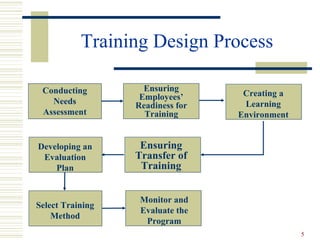
Training Design Process
5
Conducting
Needs
Assessment
Ensuring
Employees’
Readiness for
Training
Creating a
Learning
Environment
Ensuring
Transfer of
Training
Developing an
Evaluation
Plan
Select Training
Method
Monitor and
Evaluate the
Program
6
Importance of Training
 Maintains qualified products / services
 Achieves high service standards
 Provides information for new comers
 Refreshes memory of old employees
 Achieves learning about new things; technology,
products / service delivery
 Reduces mistakes - minimizing costs
 Opportunity for staff to feedback / suggest improvements
 Improves communication & relationships - better
teamwork
7
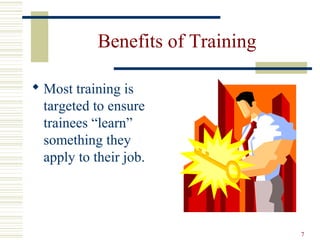
Benefits of Training
 Most training is
targeted to ensure
trainees “learn”
something they
apply to their job.
8
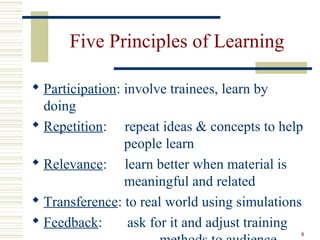
Five Principles of Learning
 Participation: involve trainees, learn by
doing
 Repetition: repeat ideas & concepts to help
people learn
 Relevance: learn better when material is
meaningful and related
 Transference: to real world using simulations
 Feedback: ask for it and adjust training
9
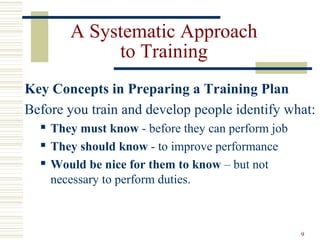
A Systematic Approach
to Training
Key Concepts in Preparing a Training Plan
Before you train and develop people identify what:
 They must know - before they can perform job
 They should know - to improve performance
 Would be nice for them to know – but not
necessary to perform duties.
10
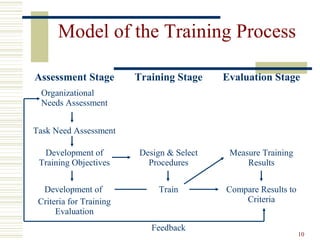
Model of the Training Process
Assessment Stage Training Stage Evaluation Stage
Organizational
Needs Assessment
Task Need Assessment
Development of
Training Objectives
Design & Select
Procedures
Measure Training
Results
Development of
Criteria for Training
Evaluation
Train Compare Results to
Criteria
Feedback
11
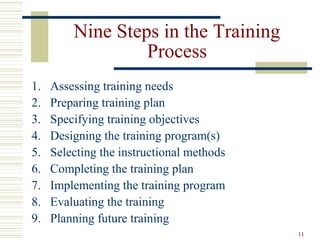
Nine Steps in the Training
Process
1. Assessing training needs
2. Preparing training plan
3. Specifying training objectives
4. Designing the training program(s)
5. Selecting the instructional methods
6. Completing the training plan
7. Implementing the training program
8. Evaluating the training
9. Planning future training
12
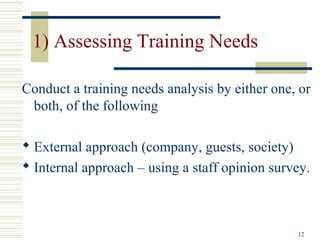
1) Assessing Training Needs
Conduct a training needs analysis by either one, or
both, of the following
 External approach (company, guests, society)
 Internal approach – using a staff opinion survey.
13
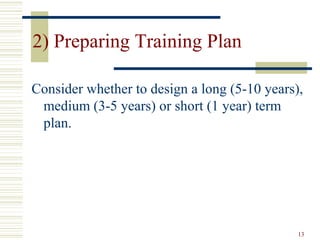
2) Preparing Training Plan
Consider whether to design a long (5-10 years),
medium (3-5 years) or short (1 year) term
plan.
14
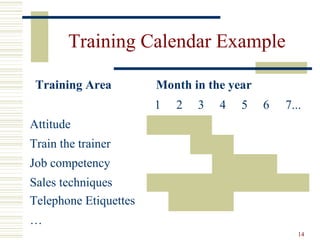
Training Calendar Example
1 2 3 4 5 6 7...
Attitude
Train the trainer
Job competency
Sales techniques
Telephone Etiquettes
…
Training Area Month in the year
15
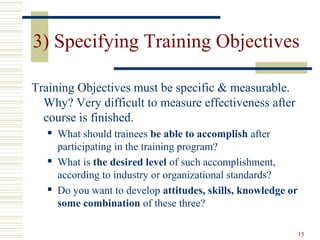
3) Specifying Training Objectives
Training Objectives must be specific & measurable.
Why? Very difficult to measure effectiveness after
course is finished.
 What should trainees be able to accomplish after
participating in the training program?
 What is the desired level of such accomplishment,
according to industry or organizational standards?
 Do you want to develop attitudes, skills, knowledge or
some combination of these three?
16
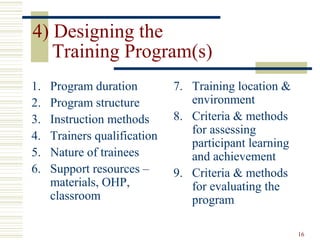
4) Designing the
Training Program(s)
1. Program duration
2. Program structure
3. Instruction methods
4. Trainers qualification
5. Nature of trainees
6. Support resources –
materials, OHP,
classroom
7. Training location &
environment
8. Criteria & methods
for assessing
participant learning
and achievement
9. Criteria & methods
for evaluating the
program
17
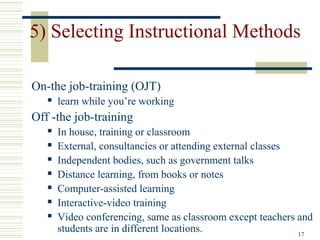
5) Selecting Instructional Methods
On-the job-training (OJT)
 learn while you’re working
Off -the job-training
 In house, training or classroom
 External, consultancies or attending external classes
 Independent bodies, such as government talks
 Distance learning, from books or notes
 Computer-assisted learning
 Interactive-video training
 Video conferencing, same as classroom except teachers and
students are in different locations.
18
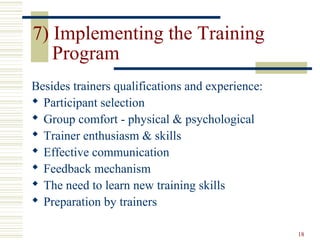
7) Implementing the Training
Program
Besides trainers qualifications and experience:
 Participant selection
 Group comfort - physical & psychological
 Trainer enthusiasm & skills
 Effective communication
 Feedback mechanism
 The need to learn new training skills
 Preparation by trainers
19
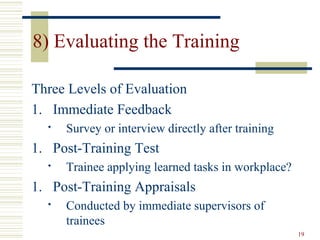
8) Evaluating the Training
Three Levels of Evaluation
1. Immediate Feedback
 Survey or interview directly after training
1. Post-Training Test
 Trainee applying learned tasks in workplace?
1. Post-Training Appraisals
 Conducted by immediate supervisors of
trainees
20
9) Planning Future Training
Last step in the training process
 After taking all evaluated comments, trainers
should modify the programs to keep good
things and make suggested improvements
 Remember, even with the same topic for
different trainees, trainers should address many
parts of the training process again and consider
new approaches.
IMPLEMENTING TRANING
PROGRAMS
 On the job training
 Types
 Coaching or Understudy method
 Job rotation
21
OJT PROCESS
 Prepare the learner
 Present the operation
 Do a try out
 Follow up
22
APPRENTICESHIP
TRANING
 Apprentices act 1961
 Promotion of new skills
 Improvement of old skills
23
INFORMAL LEARNING
 American society survey
 80% of employees prefer
24
EVALUATING THE
TRAINING EFFORT
• REACTION
• EVALUATE TRAINEES REACTION TO THE
PROGRAM
• LEARNING
• ASSESING THE TRAINEES
• BEHAVIOUR
• ATTITUDE CHANGE
• RESULTS
• MEASURING THE RESULTS
25
LEADING ORGANIATION
CHANGE
 UNFREEZING STAGE
 ESTABLISH A SENSE OF URGENCY
 MOBILIZE COMMITMENT
 MOVING STAGE
 CREATE A GUIDING COALITION
 DEVELOP AND COMMUNICATE A SHARED VISION
 HELP EMPLOYESS MAKE THE CHANGE
 CONSOLIDATE GAINS
 REFREEZING STAGE
 REINFORCE THE NEW WAYS OF DOING THINGS
 MONITOR AND ASSESS PROGRESS
26
OFF THE JOB
MANAGEMENT TRAINING
 THE CASE STUDY METHOD
 MANAGEMENT GAMES
 OUTSIDE SEMINARS
 UNIVERSITY-RELATED PROGRAMS
 ROLE PLAYING
 BEHAVIOUR MODELLING
27
BEHAVIOUR MODELLING
 MODELLING
 ROLE PLAYING
 SOCIAL REINFORCEMENT
 TRANSFER OF TRAINING
28
29

Training & Development - HR

  • 1.
    Training & Development PRESENTEDBY: P.ARUN VENKATESH (13UTA05) B.KARTHIKEYA (13UTA17) RA.MANIKHANDAN (13UTA20) M.MURUGESAN (13UTA22) P.VIGNESH (13UTA37) T.VIVEK SUTHIN WESLY (13UTA49)
  • 2.
    What is training? Training  planned effort by a company to facilitate employees’  learning of job-related competencies.  The goal of training 2
  • 3.
    3 Differences between Training, Education& Development  Training is short term, task oriented and targeted on achieving a change of attitude, skills and knowledge in a specific area.  Education is a lifetime investment.  Development is a long term investment in human resources.
  • 4.
    4 Definition  Training isa systematic process through which an organization’s human resources gain knowledge and develop skills by instruction and practical activities that result in improved corporate performance.
  • 5.
    Training Design Process 5 Conducting Needs Assessment Ensuring Employees’ Readinessfor Training Creating a Learning Environment Ensuring Transfer of Training Developing an Evaluation Plan Select Training Method Monitor and Evaluate the Program
  • 6.
    6 Importance of Training Maintains qualified products / services  Achieves high service standards  Provides information for new comers  Refreshes memory of old employees  Achieves learning about new things; technology, products / service delivery  Reduces mistakes - minimizing costs  Opportunity for staff to feedback / suggest improvements  Improves communication & relationships - better teamwork
  • 7.
    7 Benefits of Training Most training is targeted to ensure trainees “learn” something they apply to their job.
  • 8.
    8 Five Principles ofLearning  Participation: involve trainees, learn by doing  Repetition: repeat ideas & concepts to help people learn  Relevance: learn better when material is meaningful and related  Transference: to real world using simulations  Feedback: ask for it and adjust training
  • 9.
    9 A Systematic Approach toTraining Key Concepts in Preparing a Training Plan Before you train and develop people identify what:  They must know - before they can perform job  They should know - to improve performance  Would be nice for them to know – but not necessary to perform duties.
  • 10.
    10 Model of theTraining Process Assessment Stage Training Stage Evaluation Stage Organizational Needs Assessment Task Need Assessment Development of Training Objectives Design & Select Procedures Measure Training Results Development of Criteria for Training Evaluation Train Compare Results to Criteria Feedback
  • 11.
    11 Nine Steps inthe Training Process 1. Assessing training needs 2. Preparing training plan 3. Specifying training objectives 4. Designing the training program(s) 5. Selecting the instructional methods 6. Completing the training plan 7. Implementing the training program 8. Evaluating the training 9. Planning future training
  • 12.
    12 1) Assessing TrainingNeeds Conduct a training needs analysis by either one, or both, of the following  External approach (company, guests, society)  Internal approach – using a staff opinion survey.
  • 13.
    13 2) Preparing TrainingPlan Consider whether to design a long (5-10 years), medium (3-5 years) or short (1 year) term plan.
  • 14.
    14 Training Calendar Example 12 3 4 5 6 7... Attitude Train the trainer Job competency Sales techniques Telephone Etiquettes … Training Area Month in the year
  • 15.
    15 3) Specifying TrainingObjectives Training Objectives must be specific & measurable. Why? Very difficult to measure effectiveness after course is finished.  What should trainees be able to accomplish after participating in the training program?  What is the desired level of such accomplishment, according to industry or organizational standards?  Do you want to develop attitudes, skills, knowledge or some combination of these three?
  • 16.
    16 4) Designing the TrainingProgram(s) 1. Program duration 2. Program structure 3. Instruction methods 4. Trainers qualification 5. Nature of trainees 6. Support resources – materials, OHP, classroom 7. Training location & environment 8. Criteria & methods for assessing participant learning and achievement 9. Criteria & methods for evaluating the program
  • 17.
    17 5) Selecting InstructionalMethods On-the job-training (OJT)  learn while you’re working Off -the job-training  In house, training or classroom  External, consultancies or attending external classes  Independent bodies, such as government talks  Distance learning, from books or notes  Computer-assisted learning  Interactive-video training  Video conferencing, same as classroom except teachers and students are in different locations.
  • 18.
    18 7) Implementing theTraining Program Besides trainers qualifications and experience:  Participant selection  Group comfort - physical & psychological  Trainer enthusiasm & skills  Effective communication  Feedback mechanism  The need to learn new training skills  Preparation by trainers
  • 19.
    19 8) Evaluating theTraining Three Levels of Evaluation 1. Immediate Feedback  Survey or interview directly after training 1. Post-Training Test  Trainee applying learned tasks in workplace? 1. Post-Training Appraisals  Conducted by immediate supervisors of trainees
  • 20.
    20 9) Planning FutureTraining Last step in the training process  After taking all evaluated comments, trainers should modify the programs to keep good things and make suggested improvements  Remember, even with the same topic for different trainees, trainers should address many parts of the training process again and consider new approaches.
  • 21.
    IMPLEMENTING TRANING PROGRAMS  Onthe job training  Types  Coaching or Understudy method  Job rotation 21
  • 22.
    OJT PROCESS  Preparethe learner  Present the operation  Do a try out  Follow up 22
  • 23.
    APPRENTICESHIP TRANING  Apprentices act1961  Promotion of new skills  Improvement of old skills 23
  • 24.
    INFORMAL LEARNING  Americansociety survey  80% of employees prefer 24
  • 25.
    EVALUATING THE TRAINING EFFORT •REACTION • EVALUATE TRAINEES REACTION TO THE PROGRAM • LEARNING • ASSESING THE TRAINEES • BEHAVIOUR • ATTITUDE CHANGE • RESULTS • MEASURING THE RESULTS 25
  • 26.
    LEADING ORGANIATION CHANGE  UNFREEZINGSTAGE  ESTABLISH A SENSE OF URGENCY  MOBILIZE COMMITMENT  MOVING STAGE  CREATE A GUIDING COALITION  DEVELOP AND COMMUNICATE A SHARED VISION  HELP EMPLOYESS MAKE THE CHANGE  CONSOLIDATE GAINS  REFREEZING STAGE  REINFORCE THE NEW WAYS OF DOING THINGS  MONITOR AND ASSESS PROGRESS 26
  • 27.
    OFF THE JOB MANAGEMENTTRAINING  THE CASE STUDY METHOD  MANAGEMENT GAMES  OUTSIDE SEMINARS  UNIVERSITY-RELATED PROGRAMS  ROLE PLAYING  BEHAVIOUR MODELLING 27
  • 28.
    BEHAVIOUR MODELLING  MODELLING ROLE PLAYING  SOCIAL REINFORCEMENT  TRANSFER OF TRAINING 28
  • 29.

Editor's Notes

  • #3 master the knowledge, skill, and behaviors emphasized in training programs, and apply them to their day-to-day activities
  • #4 It is usually job related. It tends to be initiated by a person in the area of his/her interest