Fundamentals of Human Resource Management, 10/e, DeCenzo/Robbins Chapter 5, slide 1
Chapter 5
Effective Job Analysis
Fundamentals of Human Resource Management, 10/e, DeCenzo/Robbins Chapter 5, slide 2
Human resource planning is a process
by which an organization ensures that
 it has the right number and kinds of people
 at the right place
 at the right time
 capable of effectively and efficiently completing
those tasks that will help the organization achieve its
overall strategic objectives
Introduction
Fundamentals of Human Resource Management, 10/e, DeCenzo/Robbins Chapter 5, slide 3
HR planning must be
 linked to the organization’s overall strategy
to compete domestically and globally
 translated into the number and types of
workers needed
Senior HRM staff need to lead top
management in planning for HRM issues.
Introduction
Fundamentals of Human Resource Management, 10/e, DeCenzo/Robbins Chapter 5, slide 4
A mission statement defines what business the
organization is in, including
 why it exists
 who its customers are
 strategic goals set by senior management to establish
targets for the organization to achieve
An Organizational Framework
Goals are generally defined for the next 5-20 years.
Fundamentals of Human Resource Management, 10/e, DeCenzo/Robbins Chapter 5, slide 5
During a corporate assessment,
 SWOT (Strengths-Weaknesses-Opportunities-
Threats) analysis determines what is needed to
meet objectives
 strengths and weaknesses and core competencies
are identified
HRM determines what knowledge, skills, and abilities are needed by
the organization’s human resources through a job analysis.
Linking Organizational Strategy to HR Planning
Fundamentals of Human Resource Management, 10/e, DeCenzo/Robbins Chapter 5, slide 6
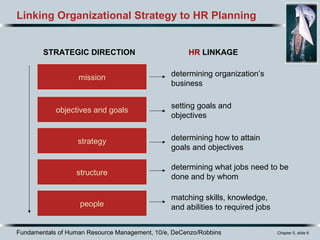
mission
objectives and goals
strategy
structure
people
STRATEGIC DIRECTION HR LINKAGE
determining organization’s
business
setting goals and
objectives
determining how to attain
goals and objectives
determining what jobs need to be
done and by whom
matching skills, knowledge,
and abilities to required jobs
Linking Organizational Strategy to HR Planning
Fundamentals of Human Resource Management, 10/e, DeCenzo/Robbins Chapter 5, slide 7
HR must ensure staff levels meet strategic
planning goals.
An HR inventory report summarizes
information on current workers and their skills
HR information systems (HRIS)
 process employee information
 quickly generate analyses and reports
 provide compensation/benefits support
Linking Organizational Strategy to HR Planning
Fundamentals of Human Resource Management, 10/e, DeCenzo/Robbins Chapter 5, slide 8
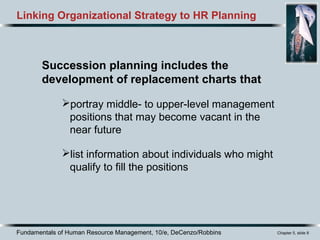
Succession planning includes the
development of replacement charts that
portray middle- to upper-level management
positions that may become vacant in the
near future
list information about individuals who might
qualify to fill the positions
Linking Organizational Strategy to HR Planning
Fundamentals of Human Resource Management, 10/e, DeCenzo/Robbins Chapter 5, slide 9
HR must forecast staff requirements.
HR creates an inventory of future staffing
needs for job level and type, broken down by
year
forecasts must detail the specific knowledge,
skills, and abilities needed, not just “we need
25 new employees”
Linking Organizational Strategy to HR Planning
Fundamentals of Human Resource Management, 10/e, DeCenzo/Robbins Chapter 5, slide 10
Linking Organizational Strategy to Human Resource Planning
HR predicts the future labor supply.
a unit’s supply of human resources comes from:
new hires
contingent workers
transfers-in
individuals returning from leaves
predicting these can range from simple to
complex
transfers are more difficult to predict since they
depend on actions in other units
Fundamentals of Human Resource Management, 10/e, DeCenzo/Robbins Chapter 5, slide 11
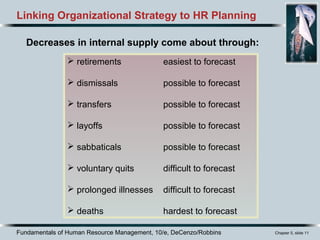
Decreases in internal supply come about through:
Linking Organizational Strategy to HR Planning
 retirements easiest to forecast
 dismissals possible to forecast
 transfers possible to forecast
 layoffs possible to forecast
 sabbaticals possible to forecast
 voluntary quits difficult to forecast
 prolonged illnesses difficult to forecast
 deaths hardest to forecast
Fundamentals of Human Resource Management, 10/e, DeCenzo/Robbins Chapter 5, slide 12
Candidates come from
migration into a community
recent graduates
individuals returning from military service
increases in the number of unemployed and
employed individuals seeking other
opportunities, either part-time or full-time
Linking Organizational Strategy to HR Planning
The potential labor supply can be expanded by formal or
on-the-job training.
Fundamentals of Human Resource Management, 10/e, DeCenzo/Robbins Chapter 5, slide 13
To match labor demand and supply, HR
compares forecasts for demand and supply of
workers
monitors current and future shortages, and
overstaffing. Sometimes, strategic goals must
change as a result
uses downsizing to reduce supply and
balance demand
Linking Organizational Strategy to HR Planning
Fundamentals of Human Resource Management, 10/e, DeCenzo/Robbins Chapter 5, slide 14
Employment Planning and
the Strategic Planning Process
Linking Organizational Strategy to HR Planning
demand for labor
compare demand
for and supply of
human resources
recruitment
decruitment
define
organization
mission
establish
corporate goals
and objectives
demand exceeds
supply
supply exceeds
demand
assess current
human resources
-- - - - - - - - - - - - -
HRMS:
job analysis
Outcomes
supply of
human resources
Fundamentals of Human Resource Management, 10/e, DeCenzo/Robbins Chapter 5, slide 15
Job analysis is a systematic exploration of the
activities within a job.
 It defines and documents the duties, responsibilities, and
accountabilities of a job and the conditions under which a job
is performed.
 This analysis “involves the identification and description of
what is happening on the job accurately and precisely
identifying the required tasks, the knowledge, and the skills
necessary for performing them, and the conditions under
which they must be performed.”
Job Analysis
See
http://www.staffing-and-recruiting-essentials.com/Sample-Job-Analysis.htm
for a sample job analysis.
Fundamentals of Human Resource Management, 10/e, DeCenzo/Robbins Chapter 5, slide 16
Job analysis methods
1. observation– job analyst watches employees directly or reviews
film of workers on the job
2. individual interview– a team of job incumbents is selected and
extensively interviewed
3. group interview– a number of job incumbents are interviewed
simultaneously
4. structured questionnaire– workers complete a specifically
designed questionnaire
5. technical conference– uses supervisors with an extensive
knowledge of the job
6. diary– job incumbents record their daily activities
The best results are usually achieved with some combination of methods.
Job Analysis
Fundamentals of Human Resource Management, 10/e, DeCenzo/Robbins Chapter 5, slide 17
Job Analysis
understand the purpose
of the job analysis
understand the roles of
jobs in the organization
seek clarification
develop draft
review draft
with supervisor
benchmark positions
determine how to collect
job analysis information
Fundamentals of Human Resource Management, 10/e, DeCenzo/Robbins Chapter 5, slide 18
The Occupational Information Network
(O*NET) content model includes:
Job Analysis
See http://online.onetcenter.org/
1. worker characteristics
2. worker requirements
3. experience requirements
4. occupation-specific information
5. workforce characteristics
6. occupational requirements
Fundamentals of Human Resource Management, 10/e, DeCenzo/Robbins Chapter 5, slide 19
Fundamentals of Human Resource Management, 10/e, DeCenzo/Robbins Chapter 5, slide 20
Position analysis questionnaire (PAQ)
jobs are rated on 194 elements, grouped
in six major divisions and 28 sections
the elements represent requirements
applicable to all types of jobs
its quantitative structure allows many job
comparisons, however, it appears to
apply to only higher-level jobs
Job Analysis
Fundamentals of Human Resource Management, 10/e, DeCenzo/Robbins Chapter 5, slide 21
 Job descriptions A job description is a written statement of what
the jobholder does, how it is done, under what conditions, and
why
Job descriptions list:
 Job title usually describes the job and hints at the nature and
duties of the job.
 ■ Job identification section includes the department location of
the job, who the person reports to.
 ■ Job duties or essential functions lists the job duties in order of
importance.
 ■ Job specifications that explain the personal qualifications
necessary to perform the duties listed above including specific
skills, education, certification, and physical abilities.
They are critical to:
 describing job to candidates
 guiding new-hires
 developing performance evaluation criteria
 evaluating job’s compensation worth
Job Analysis
Fundamentals of Human Resource Management, 10/e, DeCenzo/Robbins Chapter 5, slide 22
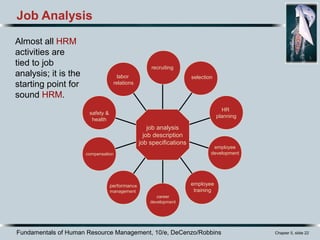
labor
relations
safety &
health
HR
planning
Job Analysis
Almost all HRM
activities are
tied to job
analysis; it is the
starting point for
sound HRM.
job analysis
job description
job specifications
performance
management
compensation
employee
training
employee
development
career
development
recruiting
selection
Fundamentals of Human Resource Management, 10/e, DeCenzo/Robbins Chapter 5, slide 23
Video: Jim Harris, Three Keys
to Maximize Productivity
Job Analysis
Job design is how a position and its tasks are organized.
great job design enriches and motivates through
skill variety task identity task significance
autonomy feedback from job itself
flexible work schedules keep employees motivated
and loyal
flex time job sharing telecommuting
part of HR planning and job analysis is finding team
members with
technical and interpersonal skills
Fundamentals of Human Resource Management, 10/e, DeCenzo/Robbins Chapter 5, slide 24
True or False?
1. HR planning must be separate from the organization’s overall strategy.
False!
2. A mission statement defines what business the organization is in.
True!
3. To forecast staff requirements, HR creates an inventory of future
staffing needs for job level and type, broken down by decade.
False!
4. Job analysis is a systematic exploration of the activities within a job.
True!
5. A position analysis questionnaire is more qualitative than quantitative in
nature.
False!
6. Job design is how a position and its tasks are organized.
True!

Chapter 5

  • 1.
    Fundamentals of HumanResource Management, 10/e, DeCenzo/Robbins Chapter 5, slide 1 Chapter 5 Effective Job Analysis
  • 2.
    Fundamentals of HumanResource Management, 10/e, DeCenzo/Robbins Chapter 5, slide 2 Human resource planning is a process by which an organization ensures that  it has the right number and kinds of people  at the right place  at the right time  capable of effectively and efficiently completing those tasks that will help the organization achieve its overall strategic objectives Introduction
  • 3.
    Fundamentals of HumanResource Management, 10/e, DeCenzo/Robbins Chapter 5, slide 3 HR planning must be  linked to the organization’s overall strategy to compete domestically and globally  translated into the number and types of workers needed Senior HRM staff need to lead top management in planning for HRM issues. Introduction
  • 4.
    Fundamentals of HumanResource Management, 10/e, DeCenzo/Robbins Chapter 5, slide 4 A mission statement defines what business the organization is in, including  why it exists  who its customers are  strategic goals set by senior management to establish targets for the organization to achieve An Organizational Framework Goals are generally defined for the next 5-20 years.
  • 5.
    Fundamentals of HumanResource Management, 10/e, DeCenzo/Robbins Chapter 5, slide 5 During a corporate assessment,  SWOT (Strengths-Weaknesses-Opportunities- Threats) analysis determines what is needed to meet objectives  strengths and weaknesses and core competencies are identified HRM determines what knowledge, skills, and abilities are needed by the organization’s human resources through a job analysis. Linking Organizational Strategy to HR Planning
  • 6.
    Fundamentals of HumanResource Management, 10/e, DeCenzo/Robbins Chapter 5, slide 6 mission objectives and goals strategy structure people STRATEGIC DIRECTION HR LINKAGE determining organization’s business setting goals and objectives determining how to attain goals and objectives determining what jobs need to be done and by whom matching skills, knowledge, and abilities to required jobs Linking Organizational Strategy to HR Planning
  • 7.
    Fundamentals of HumanResource Management, 10/e, DeCenzo/Robbins Chapter 5, slide 7 HR must ensure staff levels meet strategic planning goals. An HR inventory report summarizes information on current workers and their skills HR information systems (HRIS)  process employee information  quickly generate analyses and reports  provide compensation/benefits support Linking Organizational Strategy to HR Planning
  • 8.
    Fundamentals of HumanResource Management, 10/e, DeCenzo/Robbins Chapter 5, slide 8 Succession planning includes the development of replacement charts that portray middle- to upper-level management positions that may become vacant in the near future list information about individuals who might qualify to fill the positions Linking Organizational Strategy to HR Planning
  • 9.
    Fundamentals of HumanResource Management, 10/e, DeCenzo/Robbins Chapter 5, slide 9 HR must forecast staff requirements. HR creates an inventory of future staffing needs for job level and type, broken down by year forecasts must detail the specific knowledge, skills, and abilities needed, not just “we need 25 new employees” Linking Organizational Strategy to HR Planning
  • 10.
    Fundamentals of HumanResource Management, 10/e, DeCenzo/Robbins Chapter 5, slide 10 Linking Organizational Strategy to Human Resource Planning HR predicts the future labor supply. a unit’s supply of human resources comes from: new hires contingent workers transfers-in individuals returning from leaves predicting these can range from simple to complex transfers are more difficult to predict since they depend on actions in other units
  • 11.
    Fundamentals of HumanResource Management, 10/e, DeCenzo/Robbins Chapter 5, slide 11 Decreases in internal supply come about through: Linking Organizational Strategy to HR Planning  retirements easiest to forecast  dismissals possible to forecast  transfers possible to forecast  layoffs possible to forecast  sabbaticals possible to forecast  voluntary quits difficult to forecast  prolonged illnesses difficult to forecast  deaths hardest to forecast
  • 12.
    Fundamentals of HumanResource Management, 10/e, DeCenzo/Robbins Chapter 5, slide 12 Candidates come from migration into a community recent graduates individuals returning from military service increases in the number of unemployed and employed individuals seeking other opportunities, either part-time or full-time Linking Organizational Strategy to HR Planning The potential labor supply can be expanded by formal or on-the-job training.
  • 13.
    Fundamentals of HumanResource Management, 10/e, DeCenzo/Robbins Chapter 5, slide 13 To match labor demand and supply, HR compares forecasts for demand and supply of workers monitors current and future shortages, and overstaffing. Sometimes, strategic goals must change as a result uses downsizing to reduce supply and balance demand Linking Organizational Strategy to HR Planning
  • 14.
    Fundamentals of HumanResource Management, 10/e, DeCenzo/Robbins Chapter 5, slide 14 Employment Planning and the Strategic Planning Process Linking Organizational Strategy to HR Planning demand for labor compare demand for and supply of human resources recruitment decruitment define organization mission establish corporate goals and objectives demand exceeds supply supply exceeds demand assess current human resources -- - - - - - - - - - - - - HRMS: job analysis Outcomes supply of human resources
  • 15.
    Fundamentals of HumanResource Management, 10/e, DeCenzo/Robbins Chapter 5, slide 15 Job analysis is a systematic exploration of the activities within a job.  It defines and documents the duties, responsibilities, and accountabilities of a job and the conditions under which a job is performed.  This analysis “involves the identification and description of what is happening on the job accurately and precisely identifying the required tasks, the knowledge, and the skills necessary for performing them, and the conditions under which they must be performed.” Job Analysis See http://www.staffing-and-recruiting-essentials.com/Sample-Job-Analysis.htm for a sample job analysis.
  • 16.
    Fundamentals of HumanResource Management, 10/e, DeCenzo/Robbins Chapter 5, slide 16 Job analysis methods 1. observation– job analyst watches employees directly or reviews film of workers on the job 2. individual interview– a team of job incumbents is selected and extensively interviewed 3. group interview– a number of job incumbents are interviewed simultaneously 4. structured questionnaire– workers complete a specifically designed questionnaire 5. technical conference– uses supervisors with an extensive knowledge of the job 6. diary– job incumbents record their daily activities The best results are usually achieved with some combination of methods. Job Analysis
  • 17.
    Fundamentals of HumanResource Management, 10/e, DeCenzo/Robbins Chapter 5, slide 17 Job Analysis understand the purpose of the job analysis understand the roles of jobs in the organization seek clarification develop draft review draft with supervisor benchmark positions determine how to collect job analysis information
  • 18.
    Fundamentals of HumanResource Management, 10/e, DeCenzo/Robbins Chapter 5, slide 18 The Occupational Information Network (O*NET) content model includes: Job Analysis See http://online.onetcenter.org/ 1. worker characteristics 2. worker requirements 3. experience requirements 4. occupation-specific information 5. workforce characteristics 6. occupational requirements
  • 19.
    Fundamentals of HumanResource Management, 10/e, DeCenzo/Robbins Chapter 5, slide 19
  • 20.
    Fundamentals of HumanResource Management, 10/e, DeCenzo/Robbins Chapter 5, slide 20 Position analysis questionnaire (PAQ) jobs are rated on 194 elements, grouped in six major divisions and 28 sections the elements represent requirements applicable to all types of jobs its quantitative structure allows many job comparisons, however, it appears to apply to only higher-level jobs Job Analysis
  • 21.
    Fundamentals of HumanResource Management, 10/e, DeCenzo/Robbins Chapter 5, slide 21  Job descriptions A job description is a written statement of what the jobholder does, how it is done, under what conditions, and why Job descriptions list:  Job title usually describes the job and hints at the nature and duties of the job.  ■ Job identification section includes the department location of the job, who the person reports to.  ■ Job duties or essential functions lists the job duties in order of importance.  ■ Job specifications that explain the personal qualifications necessary to perform the duties listed above including specific skills, education, certification, and physical abilities. They are critical to:  describing job to candidates  guiding new-hires  developing performance evaluation criteria  evaluating job’s compensation worth Job Analysis
  • 22.
    Fundamentals of HumanResource Management, 10/e, DeCenzo/Robbins Chapter 5, slide 22 labor relations safety & health HR planning Job Analysis Almost all HRM activities are tied to job analysis; it is the starting point for sound HRM. job analysis job description job specifications performance management compensation employee training employee development career development recruiting selection
  • 23.
    Fundamentals of HumanResource Management, 10/e, DeCenzo/Robbins Chapter 5, slide 23 Video: Jim Harris, Three Keys to Maximize Productivity Job Analysis Job design is how a position and its tasks are organized. great job design enriches and motivates through skill variety task identity task significance autonomy feedback from job itself flexible work schedules keep employees motivated and loyal flex time job sharing telecommuting part of HR planning and job analysis is finding team members with technical and interpersonal skills
  • 24.
    Fundamentals of HumanResource Management, 10/e, DeCenzo/Robbins Chapter 5, slide 24 True or False? 1. HR planning must be separate from the organization’s overall strategy. False! 2. A mission statement defines what business the organization is in. True! 3. To forecast staff requirements, HR creates an inventory of future staffing needs for job level and type, broken down by decade. False! 4. Job analysis is a systematic exploration of the activities within a job. True! 5. A position analysis questionnaire is more qualitative than quantitative in nature. False! 6. Job design is how a position and its tasks are organized. True!