Copyright © 2004 South-Western. All rights reserved.
PowerPoint Presentation by Charlie Cook
Copyright © 2004 South-
Western. All rights reserved. 7–2
Objectives
After studying this chapter, you should be able to:
1. Explain how a career development program
integrates individual and organizational needs.
2. Describe the conditions that help make a career
development program successful.
3. Discuss how job opportunities can be inventoried
and employee potential assessed.
4. Compare the methods used for identifying and
developing managerial talent.
5. Cite the ways in which employers can facilitate the
career development of women.
Copyright © 2004 South-
Western. All rights reserved. 7–3
Objectives (cont’d)
After studying this chapter, you should be able to:
6. Discuss the ways in which employers can facilitate
the career development of members of minority
groups and of dual-career couples.
7. Describe the various aspects of personal career
development that one should consider.
Copyright © 2004 South-
Western. All rights reserved. 7–4
Career Development: Creating Favorable
Conditions
• Management Participation
 Provide top management
support
 Provide collaboration
between line managers
and HR managers
 Train management
personnel
• Setting Goals
 Plan human resources
strategy
• Changing HR Policies
 Provide for job rotation
 Provide outplacement
service
• Announcing the Program
 Explain its philosophy
Presentation Slide 7–1
Copyright © 2004 South-
Western. All rights reserved. 7–5
Career Development: Determining
Employee Potential
• Career Planning Workbooks
Stimulate thinking about careers,
strengths/limitations, development needs
• Career Planning Workshops
Discuss and compare attitudes, concerns, plans
• Career Counseling
Discuss job, career interests, goals
Presentation Slide 7–2
Copyright © 2004 South-
Western. All rights reserved. 7–6
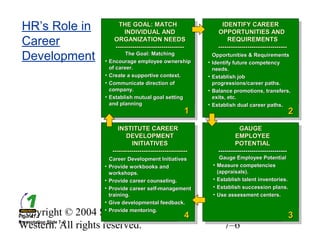
HR’s Role in
Career
Development
Figure 7.1
THE GOAL: MATCHTHE GOAL: MATCH
INDIVIDUAL ANDINDIVIDUAL AND
ORGANIZATION NEEDSORGANIZATION NEEDS
------------------------------------------------------------------
The Goal: MatchingThe Goal: Matching
• Encourage employee ownershipEncourage employee ownership
of career.of career.
• Create a supportive context.Create a supportive context.
• Communicate direction ofCommunicate direction of
company.company.
• Establish mutual goal settingEstablish mutual goal setting
and planningand planning
THE GOAL: MATCHTHE GOAL: MATCH
INDIVIDUAL ANDINDIVIDUAL AND
ORGANIZATION NEEDSORGANIZATION NEEDS
------------------------------------------------------------------
The Goal: MatchingThe Goal: Matching
• Encourage employee ownershipEncourage employee ownership
of career.of career.
• Create a supportive context.Create a supportive context.
• Communicate direction ofCommunicate direction of
company.company.
• Establish mutual goal settingEstablish mutual goal setting
and planningand planning
IDENTIFY CAREERIDENTIFY CAREER
OPPORTUNITIES ANDOPPORTUNITIES AND
REQUIREMENTSREQUIREMENTS
------------------------------------------------------------------
Opportunities & RequirementsOpportunities & Requirements
• Identify future competencyIdentify future competency
needs.needs.
• Establish jobEstablish job
progressions/career paths.progressions/career paths.
• Balance promotions, transfers,Balance promotions, transfers,
exits, etc.exits, etc.
• Establish dual career paths.Establish dual career paths.
IDENTIFY CAREERIDENTIFY CAREER
OPPORTUNITIES ANDOPPORTUNITIES AND
REQUIREMENTSREQUIREMENTS
------------------------------------------------------------------
Opportunities & RequirementsOpportunities & Requirements
• Identify future competencyIdentify future competency
needs.needs.
• Establish jobEstablish job
progressions/career paths.progressions/career paths.
• Balance promotions, transfers,Balance promotions, transfers,
exits, etc.exits, etc.
• Establish dual career paths.Establish dual career paths.
GAUGEGAUGE
EMPLOYEEEMPLOYEE
POTENTIALPOTENTIAL
------------------------------------------------------------------
Gauge Employee PotentialGauge Employee Potential
• Measure competenciesMeasure competencies
(appraisals).(appraisals).
• Establish talent inventories.Establish talent inventories.
• Establish succession plans.Establish succession plans.
• Use assessment centers.Use assessment centers.
GAUGEGAUGE
EMPLOYEEEMPLOYEE
POTENTIALPOTENTIAL
------------------------------------------------------------------
Gauge Employee PotentialGauge Employee Potential
• Measure competenciesMeasure competencies
(appraisals).(appraisals).
• Establish talent inventories.Establish talent inventories.
• Establish succession plans.Establish succession plans.
• Use assessment centers.Use assessment centers.
INSTITUTE CAREERINSTITUTE CAREER
DEVELOPMENTDEVELOPMENT
INITIATIVESINITIATIVES
------------------------------------------------------------------------
Career Development InitiativesCareer Development Initiatives
• Provide workbooks andProvide workbooks and
workshops.workshops.
• Provide career counseling.Provide career counseling.
• Provide career self-managementProvide career self-management
training.training.
• Give developmental feedback.Give developmental feedback.
• Provide mentoring.Provide mentoring.
INSTITUTE CAREERINSTITUTE CAREER
DEVELOPMENTDEVELOPMENT
INITIATIVESINITIATIVES
------------------------------------------------------------------------
Career Development InitiativesCareer Development Initiatives
• Provide workbooks andProvide workbooks and
workshops.workshops.
• Provide career counseling.Provide career counseling.
• Provide career self-managementProvide career self-management
training.training.
• Give developmental feedback.Give developmental feedback.
• Provide mentoring.Provide mentoring.
11 22
44 33
Presentation Slide 7–3
Copyright © 2004 South-
Western. All rights reserved. 7–7
The Goal: Matching Individual and
Organizational Needs
• The Employee’s Role
• The Organization’s Role: Establishing a
Favorable Context
• Blending Individual and Organizational Goals
Copyright © 2004 South-
Western. All rights reserved. 7–8
Balancing Individual and Organizational Needs
Figure 7.2
Copyright © 2004 South-
Western. All rights reserved. 7–9
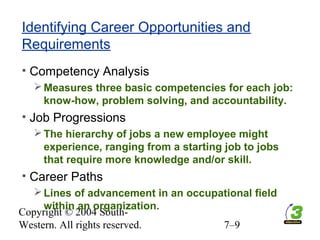
Identifying Career Opportunities and
Requirements
• Competency Analysis
Measures three basic competencies for each job:
know-how, problem solving, and accountability.
• Job Progressions
The hierarchy of jobs a new employee might
experience, ranging from a starting job to jobs
that require more knowledge and/or skill.
• Career Paths
Lines of advancement in an occupational field
within an organization.
Copyright © 2004 South-
Western. All rights reserved. 7–10
Typical Line of Advancement in HR Management
Figure 7.3
Copyright © 2004 South-
Western. All rights reserved. 7–11
Career Path Of Colin Powell
HRM 1
1954 Joins ROTC program
1957 Enrolls in City College of New York 1963 Tour of duty in Vietnam
1968 Graduates from U.S. Army Command and General Staff College (CGSC)
1971 Graduate School at the George Washington University
1972 White House Fellow under President Richard Nixon
1974 Commander of 1st Battalion, 32nd Infantry in Korea
1977 Colonel, Commander of 2nd Brigade, 101st Infantry
1978 Works in Office of Secretary of Defense under President Jimmy Carter
1982 Brigadier General, Commander of 4th Infantry Division
1982 Deputy Commanding General of Combined Arms Combat Developments Activity
1987 National Security Advisor under President Ronald Reagan
1989 Chairman, Joint Chiefs of Staff under President George Bush
1992 Approached to be Bill Clinton’s vice presidential running mate (declined)
1993 Chairman, Joint Chiefs of Staff under President Bill Clinton
1993 Retired from military service
2000 Secretary of State under President George W. Bush
Copyright © 2004 South-
Western. All rights reserved. 7–12
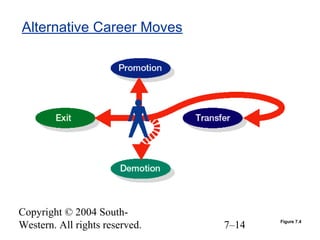
Career Changes
• Promotion
A change of assignment to a job at a higher level
in the organization.
Principal criteria for determining promotions are
merit, seniority, and potential.
• Transfer
The placement of an individual in another job for
which the duties, responsibilities, status, and
remuneration are approximately equal to those of
the previous job.
Copyright © 2004 South-
Western. All rights reserved. 7–13
Career Change Organizational Assistance
• Relocation services
Services provided to an employee who is
transferred to a new location:
 Help in moving, in selling a home, in orienting to a new
culture, and/or in learning a new language.
• Outplacement services
Services provided by organizations to help
terminated employees find a new job.
Copyright © 2004 South-
Western. All rights reserved. 7–14
Alternative Career Moves
Figure 7.4
Copyright © 2004 South-
Western. All rights reserved. 7–15
Dual Career Tracks: Xenova System
HRM 2
Scientist
Senior Scientist
Section Leader Research Associate
Department Head Principal Scientist
Source: Adapted from Alan Garmonsway of Xenova and Michael Wellin of Behavioral
Transformation, “Creating the Right Natural Chemistry,” People Management 1, no. 19
(September 21, 1995): 36–39.
Copyright © 2004 South-
Western. All rights reserved. 7–16
Human Capital Profiles for Two Different Careers
Figure 7.5Source: Scott Snell, Cornell University.
Copyright © 2004 South-
Western. All rights reserved. 7–17
Using Assessment Centers
• Assessment Center
A process by which individuals are evaluated as
they participate in a series of situations that
resemble what they might be called upon to
handle on the job.
In-basket training
 A process for evaluating trainees by simulating a real-life
work situation
Leaderless group discussions
 A process that places trainees in a conference setting to
discuss an assigned topic, either with or without
designated group roles
Copyright © 2004 South-
Western. All rights reserved. 7–18
Successful Career-Management Practices
• Placing clear expectations on employees.
• Giving employees the opportunity for transfer.
• Providing a clear and thorough succession plan
• Encouraging performance through rewards and
recognition.
• Giving employees the time and resources they need
to consider short- and long-term career goals.
• Encouraging employees to continually assess their
skills and career direction.
Copyright © 2004 South-
Western. All rights reserved. 7–19
Internal Barriers to Career Advancement
• Lack of time, budgets, and resources for
employees to plan their careers and to
undertake training and development.
• Rigid job specifications, lack of leadership
support for career management, and a short-
term focus.
• Lack of career opportunities and pathways within
the organization for employees.
Copyright © 2004 South-
Western. All rights reserved. 7–20
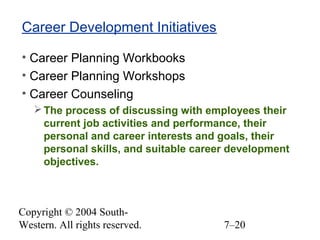
Career Development Initiatives
• Career Planning Workbooks
• Career Planning Workshops
• Career Counseling
The process of discussing with employees their
current job activities and performance, their
personal and career interests and goals, their
personal skills, and suitable career development
objectives.
Copyright © 2004 South-
Western. All rights reserved. 7–21
Individualized Career Development
• Fast-track Program
A program that encourages young managers with
high potential to remain with an organization by
enabling them to advance more rapidly than those
with less potential.
• Career Self-Management Training
Helping employees learn to continuously gather
feedback and information about their careers.
Encouraging them to prepare for mobility.
Copyright © 2004 South-
Western. All rights reserved. 7–22
Mentoring
• Mentors
Executives who coach, advise, and encourage
individuals of lesser rank.
• Mentoring functions
Functions concerned with the career
advancement and psychological aspects of the
person being mentored.
Copyright © 2004 South-
Western. All rights reserved. 7–23
Top Ten Myths about Mentors
1. Mentors exist only for
career development.
2. You need only one
mentor.
3. Mentoring is a one-way
process.
4. A mentor has to be
older than the protégé.
5. A mentor has to be the
same gender and race
as the protégé.
6. Mentor relationships just
happen.
7. Highly profiled people
make the best mentors.
8. Once a mentor, always
a mentor.
9. Mentoring is a
complicated process.
10.Mentor-protégé
expectations are the
same for everyone.
Figure 7.6
Copyright © 2004 South-
Western. All rights reserved. 7–24
Mentoring Functions
Figure 7.7
Source: Matt Starcevich, Ph.D. and Fred Friend, “Effective Mentoring Relationships from
the Mentee’s Perspective,” Workforce, supplement (July 1999): 2–3. Used with permission
of the Center for Coaching and Mentoring, Inc., http://coachingandmentoring.com/.
Copyright © 2004 South-
Western. All rights reserved. 7–25
Forming a Mentoring Relationship
• Research the mentor’s background.
• Make contact with the mentor.
• Request help on a particular matter.
• Consider what you can offer in exchange.
• Arrange a meeting.
• Follow up.
• Ask to meet on an
ongoing basis.
Copyright © 2004 South-
Western. All rights reserved. 7–26
Mentor Checklist
HRM 5
Source: Excerpted with permission of the publisher from Connecting with Success: How to Build Your
Mentoring Network to Fast-Forward Your Career, by Kathleen Barton; Davis-Black Publishing, 800.624.1765.
Copyright © 2004 South-
Western. All rights reserved. 7–27
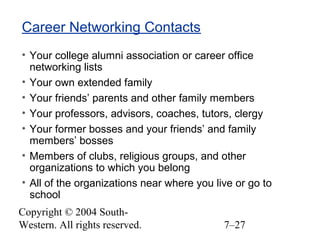
Career Networking Contacts
• Your college alumni association or career office
networking lists
• Your own extended family
• Your friends’ parents and other family members
• Your professors, advisors, coaches, tutors, clergy
• Your former bosses and your friends’ and family
members’ bosses
• Members of clubs, religious groups, and other
organizations to which you belong
• All of the organizations near where you live or go to
school
Copyright © 2004 South-
Western. All rights reserved. 7–28
Career Development for Women
• The “Glass Ceiling”
Artificial barriers based on attitudinal or
organizational bias that prevent qualified women
from advancing upward in their organizations into
management level positions.
• Eliminating Barriers to Advancement
Development of women’s networks
Online e-mentoring for women
Diminishing stereotyping of women
Presence of women in significant managerial
positions
Copyright © 2004 South-
Western. All rights reserved. 7–29
Glass-Ceiling Audits
• Glass ceiling audit factors:
Upper-level management and executive training
Rotational assignments International assignments
Opportunities for promotion
Opportunities for executive development programs at
universities
Desirable compensation packages
Opportunities to participate on high-profile project
teams
Upper-level special assignments
Copyright © 2004 South-
Western. All rights reserved. 7–30
The Top Ten Highest-Paid Women in America
Figure 7.8
ANNUAL LONG-TERM 2000
RANK EXECUTIVE NAME/TITLE/COMPANY NAME COMP. COMP. COMP.
MILLIONS
1. HEATHER KILLEN, Senior VP, Yahoo! $0.3 $32.5 $32.7
2. DAWN G. LEPORE, Vice-Chmn., Exec. VP & CIO, Charles Schwab 2.1 20.2 22.3
3. M. ZITA COBB, Executive VP, JDS Uniphase 0.4 18.3 18.7
4. SUSAN D. DESMOND-HELLMANN, Executive VP, Genentech 0.9 15.2 16.1
5. TERRI A. DIAL, Group Executive VP, Wells Fargo 2.0 10.7 12.8
6. JANICE M. ROBERTS, Senior VP, 3Com 0.5 11.7 12.2
7. LOIS D. JULIBER, COO, Colgate-Palmolive 1.6 10.6 12.2
8. DONNA S. BINKS, Executive VP & CFO, Adaptive Broadband 0.5 10.0 10.4
9. DEBORAH C. HOPKINS, Executive VP & CFO, Lucent Technologies 5.2 4.3 9.5
10. LESLIE C. TORTORA, CIO, Goldman Sachs Group 7.5 1.9 9.4
Data: Execucomp, provided by Standard & Poor’s Institutional Market Services, a division of the McGraw-Hill Companies
Source: Louis Lavelle, “For Female CEOs, It’s Stingy at the Top,” Business Week (April 23, 2001).
Copyright © 2004 South-
Western. All rights reserved. 7–31
Career Development for Minorities
• Career development for minorities is advanced
by:
Organizational support for the advancement of
minorities to significant management positions
Provision of internships to attract minorities to
management careers
Organization of training courses to foster the
development of minority’s managerial skills and
knowledge.
Copyright © 2004 South-
Western. All rights reserved. 7–32
Dual-Career Couples
• Dual-Career Partnerships
Couples in which both members follow their own
careers and actively support each other’s career
development.
 Flexible work schedules
 Adaptive leave policies
 Work-at-home
 On-premises day care
 Job sharing
Copyright © 2004 South-
Western. All rights reserved. 7–33
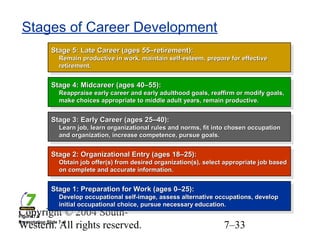
Stages of Career Development
Figure 7.9
Stage 5: Late Career (ages 55–retirement):Stage 5: Late Career (ages 55–retirement):
Remain productive in work, maintain self-esteem, prepare for effectiveRemain productive in work, maintain self-esteem, prepare for effective
retirement.retirement.
Stage 5: Late Career (ages 55–retirement):Stage 5: Late Career (ages 55–retirement):
Remain productive in work, maintain self-esteem, prepare for effectiveRemain productive in work, maintain self-esteem, prepare for effective
retirement.retirement.
Stage 4: Midcareer (ages 40–55):Stage 4: Midcareer (ages 40–55):
Reappraise early career and early adulthood goals, reaffirm or modify goals,Reappraise early career and early adulthood goals, reaffirm or modify goals,
make choices appropriate to middle adult years, remain productive.make choices appropriate to middle adult years, remain productive.
Stage 4: Midcareer (ages 40–55):Stage 4: Midcareer (ages 40–55):
Reappraise early career and early adulthood goals, reaffirm or modify goals,Reappraise early career and early adulthood goals, reaffirm or modify goals,
make choices appropriate to middle adult years, remain productive.make choices appropriate to middle adult years, remain productive.
Stage 3: Early Career (ages 25–40):Stage 3: Early Career (ages 25–40):
Learn job, learn organizational rules and norms, fit into chosen occupationLearn job, learn organizational rules and norms, fit into chosen occupation
and organization, increase competence, pursue goals.and organization, increase competence, pursue goals.
Stage 3: Early Career (ages 25–40):Stage 3: Early Career (ages 25–40):
Learn job, learn organizational rules and norms, fit into chosen occupationLearn job, learn organizational rules and norms, fit into chosen occupation
and organization, increase competence, pursue goals.and organization, increase competence, pursue goals.
Stage 2: Organizational Entry (ages 18–25):Stage 2: Organizational Entry (ages 18–25):
Obtain job offer(s) from desired organization(s), select appropriate job basedObtain job offer(s) from desired organization(s), select appropriate job based
on complete and accurate information.on complete and accurate information.
Stage 2: Organizational Entry (ages 18–25):Stage 2: Organizational Entry (ages 18–25):
Obtain job offer(s) from desired organization(s), select appropriate job basedObtain job offer(s) from desired organization(s), select appropriate job based
on complete and accurate information.on complete and accurate information.
Stage 1: Preparation for Work (ages 0–25):Stage 1: Preparation for Work (ages 0–25):
Develop occupational self-image, assess alternative occupations, developDevelop occupational self-image, assess alternative occupations, develop
initial occupational choice, pursue necessary education.initial occupational choice, pursue necessary education.
Stage 1: Preparation for Work (ages 0–25):Stage 1: Preparation for Work (ages 0–25):
Develop occupational self-image, assess alternative occupations, developDevelop occupational self-image, assess alternative occupations, develop
initial occupational choice, pursue necessary education.initial occupational choice, pursue necessary education.
Presentation Slide 7–4
Copyright © 2004 South-
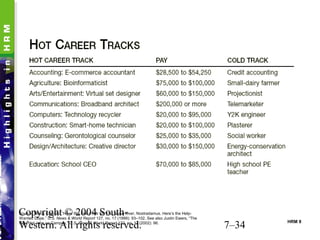
Western. All rights reserved. 7–34 HRM 8
Source: Mindy Charski, “Have We Got a Job for You: Move Over, Nostradamus. Here’s the Help-
Wanted Dope,” U.S. News & World Report 127, no. 17 (1999): 93–102. See also Justin Ewers, “The
New Hot Jobs on Campus,” U.S. News & World Report 133, no. 12 (2002): 96.
Copyright © 2004 South-
Western. All rights reserved. 7–35
CISS Orientation and Basic Scales
• Influencing
 Leadership, law/politics,
public speaking, sales,
advertising
• Organizing
 Supervision, financial
services, office practices
• Analyzing
 Mathematics, science
• Helping
 Adult development,
counseling, child
development, religious
activities, medical practice
• Creating
 Art/design, performing arts,
writing, international
activities, fashion, culinary
arts
• Producing
 Mechanical crafts, wood-
working, farming/forestry,
Plants/gardens, animal care
• Adventuring
 Athletics/physical fitness,
military/law enforcement,
risks/adventure
Source: ©1992 David Campbell, Ph.D. All rights reserved. Published and distributed by NCS
Assessments, P.O. Box 1416 Minneapolis, MN 55440. Reproduced with permission. “Campbell
Interest and Skill Survey” and “CISS” are both registered trademarks of David Campbell, Ph.D. Presentation Slide 7–5
Copyright © 2004 South-
Western. All rights reserved. 7–36
Combinations of Career Interests and Skills
Figure 7.10
ExploreExplore PursuePursue
AvoidAvoid DevelopDevelop
INTERESTS
Low High
LowHigh
SKILLS
Presentation Slide 7–6
Copyright © 2004 South-
Western. All rights reserved. 7–37
The Plateauing Trap
• Career Plateau
Situation in which for either organizational or
personal reasons the probability of moving up the
career ladder is low.
• Types of Plateaus
Structural plateau: end of advancement
Content plateau: lack of challenge
Life plateau: crisis of personal identity
Copyright © 2004 South-
Western. All rights reserved. 7–38
Twelve Steps for Starting a New Business
Figure 7.12
Source: From Business in a Changing World, 3rd edition, by W. Cunningham, R. Aldag, and S. Block: 139 © 1993.
Reprinted with permission of South-Western College Publishing, a division of Thomson Learning. Fax 800-730-2215.
Copyright © 2004 South-
Western. All rights reserved. 7–39
Keeping a Career in Perspective
• Maintaining Off-the-Job Interests
• Having a Healthy Marital and/or Family Life
• Planning for Retirement
• Maintaining a Healthy Balance

Chapter 07 Career Development

  • 1.
    Copyright © 2004South-Western. All rights reserved. PowerPoint Presentation by Charlie Cook
  • 2.
    Copyright © 2004South- Western. All rights reserved. 7–2 Objectives After studying this chapter, you should be able to: 1. Explain how a career development program integrates individual and organizational needs. 2. Describe the conditions that help make a career development program successful. 3. Discuss how job opportunities can be inventoried and employee potential assessed. 4. Compare the methods used for identifying and developing managerial talent. 5. Cite the ways in which employers can facilitate the career development of women.
  • 3.
    Copyright © 2004South- Western. All rights reserved. 7–3 Objectives (cont’d) After studying this chapter, you should be able to: 6. Discuss the ways in which employers can facilitate the career development of members of minority groups and of dual-career couples. 7. Describe the various aspects of personal career development that one should consider.
  • 4.
    Copyright © 2004South- Western. All rights reserved. 7–4 Career Development: Creating Favorable Conditions • Management Participation  Provide top management support  Provide collaboration between line managers and HR managers  Train management personnel • Setting Goals  Plan human resources strategy • Changing HR Policies  Provide for job rotation  Provide outplacement service • Announcing the Program  Explain its philosophy Presentation Slide 7–1
  • 5.
    Copyright © 2004South- Western. All rights reserved. 7–5 Career Development: Determining Employee Potential • Career Planning Workbooks Stimulate thinking about careers, strengths/limitations, development needs • Career Planning Workshops Discuss and compare attitudes, concerns, plans • Career Counseling Discuss job, career interests, goals Presentation Slide 7–2
  • 6.
    Copyright © 2004South- Western. All rights reserved. 7–6 HR’s Role in Career Development Figure 7.1 THE GOAL: MATCHTHE GOAL: MATCH INDIVIDUAL ANDINDIVIDUAL AND ORGANIZATION NEEDSORGANIZATION NEEDS ------------------------------------------------------------------ The Goal: MatchingThe Goal: Matching • Encourage employee ownershipEncourage employee ownership of career.of career. • Create a supportive context.Create a supportive context. • Communicate direction ofCommunicate direction of company.company. • Establish mutual goal settingEstablish mutual goal setting and planningand planning THE GOAL: MATCHTHE GOAL: MATCH INDIVIDUAL ANDINDIVIDUAL AND ORGANIZATION NEEDSORGANIZATION NEEDS ------------------------------------------------------------------ The Goal: MatchingThe Goal: Matching • Encourage employee ownershipEncourage employee ownership of career.of career. • Create a supportive context.Create a supportive context. • Communicate direction ofCommunicate direction of company.company. • Establish mutual goal settingEstablish mutual goal setting and planningand planning IDENTIFY CAREERIDENTIFY CAREER OPPORTUNITIES ANDOPPORTUNITIES AND REQUIREMENTSREQUIREMENTS ------------------------------------------------------------------ Opportunities & RequirementsOpportunities & Requirements • Identify future competencyIdentify future competency needs.needs. • Establish jobEstablish job progressions/career paths.progressions/career paths. • Balance promotions, transfers,Balance promotions, transfers, exits, etc.exits, etc. • Establish dual career paths.Establish dual career paths. IDENTIFY CAREERIDENTIFY CAREER OPPORTUNITIES ANDOPPORTUNITIES AND REQUIREMENTSREQUIREMENTS ------------------------------------------------------------------ Opportunities & RequirementsOpportunities & Requirements • Identify future competencyIdentify future competency needs.needs. • Establish jobEstablish job progressions/career paths.progressions/career paths. • Balance promotions, transfers,Balance promotions, transfers, exits, etc.exits, etc. • Establish dual career paths.Establish dual career paths. GAUGEGAUGE EMPLOYEEEMPLOYEE POTENTIALPOTENTIAL ------------------------------------------------------------------ Gauge Employee PotentialGauge Employee Potential • Measure competenciesMeasure competencies (appraisals).(appraisals). • Establish talent inventories.Establish talent inventories. • Establish succession plans.Establish succession plans. • Use assessment centers.Use assessment centers. GAUGEGAUGE EMPLOYEEEMPLOYEE POTENTIALPOTENTIAL ------------------------------------------------------------------ Gauge Employee PotentialGauge Employee Potential • Measure competenciesMeasure competencies (appraisals).(appraisals). • Establish talent inventories.Establish talent inventories. • Establish succession plans.Establish succession plans. • Use assessment centers.Use assessment centers. INSTITUTE CAREERINSTITUTE CAREER DEVELOPMENTDEVELOPMENT INITIATIVESINITIATIVES ------------------------------------------------------------------------ Career Development InitiativesCareer Development Initiatives • Provide workbooks andProvide workbooks and workshops.workshops. • Provide career counseling.Provide career counseling. • Provide career self-managementProvide career self-management training.training. • Give developmental feedback.Give developmental feedback. • Provide mentoring.Provide mentoring. INSTITUTE CAREERINSTITUTE CAREER DEVELOPMENTDEVELOPMENT INITIATIVESINITIATIVES ------------------------------------------------------------------------ Career Development InitiativesCareer Development Initiatives • Provide workbooks andProvide workbooks and workshops.workshops. • Provide career counseling.Provide career counseling. • Provide career self-managementProvide career self-management training.training. • Give developmental feedback.Give developmental feedback. • Provide mentoring.Provide mentoring. 11 22 44 33 Presentation Slide 7–3
  • 7.
    Copyright © 2004South- Western. All rights reserved. 7–7 The Goal: Matching Individual and Organizational Needs • The Employee’s Role • The Organization’s Role: Establishing a Favorable Context • Blending Individual and Organizational Goals
  • 8.
    Copyright © 2004South- Western. All rights reserved. 7–8 Balancing Individual and Organizational Needs Figure 7.2
  • 9.
    Copyright © 2004South- Western. All rights reserved. 7–9 Identifying Career Opportunities and Requirements • Competency Analysis Measures three basic competencies for each job: know-how, problem solving, and accountability. • Job Progressions The hierarchy of jobs a new employee might experience, ranging from a starting job to jobs that require more knowledge and/or skill. • Career Paths Lines of advancement in an occupational field within an organization.
  • 10.
    Copyright © 2004South- Western. All rights reserved. 7–10 Typical Line of Advancement in HR Management Figure 7.3
  • 11.
    Copyright © 2004South- Western. All rights reserved. 7–11 Career Path Of Colin Powell HRM 1 1954 Joins ROTC program 1957 Enrolls in City College of New York 1963 Tour of duty in Vietnam 1968 Graduates from U.S. Army Command and General Staff College (CGSC) 1971 Graduate School at the George Washington University 1972 White House Fellow under President Richard Nixon 1974 Commander of 1st Battalion, 32nd Infantry in Korea 1977 Colonel, Commander of 2nd Brigade, 101st Infantry 1978 Works in Office of Secretary of Defense under President Jimmy Carter 1982 Brigadier General, Commander of 4th Infantry Division 1982 Deputy Commanding General of Combined Arms Combat Developments Activity 1987 National Security Advisor under President Ronald Reagan 1989 Chairman, Joint Chiefs of Staff under President George Bush 1992 Approached to be Bill Clinton’s vice presidential running mate (declined) 1993 Chairman, Joint Chiefs of Staff under President Bill Clinton 1993 Retired from military service 2000 Secretary of State under President George W. Bush
  • 12.
    Copyright © 2004South- Western. All rights reserved. 7–12 Career Changes • Promotion A change of assignment to a job at a higher level in the organization. Principal criteria for determining promotions are merit, seniority, and potential. • Transfer The placement of an individual in another job for which the duties, responsibilities, status, and remuneration are approximately equal to those of the previous job.
  • 13.
    Copyright © 2004South- Western. All rights reserved. 7–13 Career Change Organizational Assistance • Relocation services Services provided to an employee who is transferred to a new location:  Help in moving, in selling a home, in orienting to a new culture, and/or in learning a new language. • Outplacement services Services provided by organizations to help terminated employees find a new job.
  • 14.
    Copyright © 2004South- Western. All rights reserved. 7–14 Alternative Career Moves Figure 7.4
  • 15.
    Copyright © 2004South- Western. All rights reserved. 7–15 Dual Career Tracks: Xenova System HRM 2 Scientist Senior Scientist Section Leader Research Associate Department Head Principal Scientist Source: Adapted from Alan Garmonsway of Xenova and Michael Wellin of Behavioral Transformation, “Creating the Right Natural Chemistry,” People Management 1, no. 19 (September 21, 1995): 36–39.
  • 16.
    Copyright © 2004South- Western. All rights reserved. 7–16 Human Capital Profiles for Two Different Careers Figure 7.5Source: Scott Snell, Cornell University.
  • 17.
    Copyright © 2004South- Western. All rights reserved. 7–17 Using Assessment Centers • Assessment Center A process by which individuals are evaluated as they participate in a series of situations that resemble what they might be called upon to handle on the job. In-basket training  A process for evaluating trainees by simulating a real-life work situation Leaderless group discussions  A process that places trainees in a conference setting to discuss an assigned topic, either with or without designated group roles
  • 18.
    Copyright © 2004South- Western. All rights reserved. 7–18 Successful Career-Management Practices • Placing clear expectations on employees. • Giving employees the opportunity for transfer. • Providing a clear and thorough succession plan • Encouraging performance through rewards and recognition. • Giving employees the time and resources they need to consider short- and long-term career goals. • Encouraging employees to continually assess their skills and career direction.
  • 19.
    Copyright © 2004South- Western. All rights reserved. 7–19 Internal Barriers to Career Advancement • Lack of time, budgets, and resources for employees to plan their careers and to undertake training and development. • Rigid job specifications, lack of leadership support for career management, and a short- term focus. • Lack of career opportunities and pathways within the organization for employees.
  • 20.
    Copyright © 2004South- Western. All rights reserved. 7–20 Career Development Initiatives • Career Planning Workbooks • Career Planning Workshops • Career Counseling The process of discussing with employees their current job activities and performance, their personal and career interests and goals, their personal skills, and suitable career development objectives.
  • 21.
    Copyright © 2004South- Western. All rights reserved. 7–21 Individualized Career Development • Fast-track Program A program that encourages young managers with high potential to remain with an organization by enabling them to advance more rapidly than those with less potential. • Career Self-Management Training Helping employees learn to continuously gather feedback and information about their careers. Encouraging them to prepare for mobility.
  • 22.
    Copyright © 2004South- Western. All rights reserved. 7–22 Mentoring • Mentors Executives who coach, advise, and encourage individuals of lesser rank. • Mentoring functions Functions concerned with the career advancement and psychological aspects of the person being mentored.
  • 23.
    Copyright © 2004South- Western. All rights reserved. 7–23 Top Ten Myths about Mentors 1. Mentors exist only for career development. 2. You need only one mentor. 3. Mentoring is a one-way process. 4. A mentor has to be older than the protégé. 5. A mentor has to be the same gender and race as the protégé. 6. Mentor relationships just happen. 7. Highly profiled people make the best mentors. 8. Once a mentor, always a mentor. 9. Mentoring is a complicated process. 10.Mentor-protégé expectations are the same for everyone. Figure 7.6
  • 24.
    Copyright © 2004South- Western. All rights reserved. 7–24 Mentoring Functions Figure 7.7 Source: Matt Starcevich, Ph.D. and Fred Friend, “Effective Mentoring Relationships from the Mentee’s Perspective,” Workforce, supplement (July 1999): 2–3. Used with permission of the Center for Coaching and Mentoring, Inc., http://coachingandmentoring.com/.
  • 25.
    Copyright © 2004South- Western. All rights reserved. 7–25 Forming a Mentoring Relationship • Research the mentor’s background. • Make contact with the mentor. • Request help on a particular matter. • Consider what you can offer in exchange. • Arrange a meeting. • Follow up. • Ask to meet on an ongoing basis.
  • 26.
    Copyright © 2004South- Western. All rights reserved. 7–26 Mentor Checklist HRM 5 Source: Excerpted with permission of the publisher from Connecting with Success: How to Build Your Mentoring Network to Fast-Forward Your Career, by Kathleen Barton; Davis-Black Publishing, 800.624.1765.
  • 27.
    Copyright © 2004South- Western. All rights reserved. 7–27 Career Networking Contacts • Your college alumni association or career office networking lists • Your own extended family • Your friends’ parents and other family members • Your professors, advisors, coaches, tutors, clergy • Your former bosses and your friends’ and family members’ bosses • Members of clubs, religious groups, and other organizations to which you belong • All of the organizations near where you live or go to school
  • 28.
    Copyright © 2004South- Western. All rights reserved. 7–28 Career Development for Women • The “Glass Ceiling” Artificial barriers based on attitudinal or organizational bias that prevent qualified women from advancing upward in their organizations into management level positions. • Eliminating Barriers to Advancement Development of women’s networks Online e-mentoring for women Diminishing stereotyping of women Presence of women in significant managerial positions
  • 29.
    Copyright © 2004South- Western. All rights reserved. 7–29 Glass-Ceiling Audits • Glass ceiling audit factors: Upper-level management and executive training Rotational assignments International assignments Opportunities for promotion Opportunities for executive development programs at universities Desirable compensation packages Opportunities to participate on high-profile project teams Upper-level special assignments
  • 30.
    Copyright © 2004South- Western. All rights reserved. 7–30 The Top Ten Highest-Paid Women in America Figure 7.8 ANNUAL LONG-TERM 2000 RANK EXECUTIVE NAME/TITLE/COMPANY NAME COMP. COMP. COMP. MILLIONS 1. HEATHER KILLEN, Senior VP, Yahoo! $0.3 $32.5 $32.7 2. DAWN G. LEPORE, Vice-Chmn., Exec. VP & CIO, Charles Schwab 2.1 20.2 22.3 3. M. ZITA COBB, Executive VP, JDS Uniphase 0.4 18.3 18.7 4. SUSAN D. DESMOND-HELLMANN, Executive VP, Genentech 0.9 15.2 16.1 5. TERRI A. DIAL, Group Executive VP, Wells Fargo 2.0 10.7 12.8 6. JANICE M. ROBERTS, Senior VP, 3Com 0.5 11.7 12.2 7. LOIS D. JULIBER, COO, Colgate-Palmolive 1.6 10.6 12.2 8. DONNA S. BINKS, Executive VP & CFO, Adaptive Broadband 0.5 10.0 10.4 9. DEBORAH C. HOPKINS, Executive VP & CFO, Lucent Technologies 5.2 4.3 9.5 10. LESLIE C. TORTORA, CIO, Goldman Sachs Group 7.5 1.9 9.4 Data: Execucomp, provided by Standard & Poor’s Institutional Market Services, a division of the McGraw-Hill Companies Source: Louis Lavelle, “For Female CEOs, It’s Stingy at the Top,” Business Week (April 23, 2001).
  • 31.
    Copyright © 2004South- Western. All rights reserved. 7–31 Career Development for Minorities • Career development for minorities is advanced by: Organizational support for the advancement of minorities to significant management positions Provision of internships to attract minorities to management careers Organization of training courses to foster the development of minority’s managerial skills and knowledge.
  • 32.
    Copyright © 2004South- Western. All rights reserved. 7–32 Dual-Career Couples • Dual-Career Partnerships Couples in which both members follow their own careers and actively support each other’s career development.  Flexible work schedules  Adaptive leave policies  Work-at-home  On-premises day care  Job sharing
  • 33.
    Copyright © 2004South- Western. All rights reserved. 7–33 Stages of Career Development Figure 7.9 Stage 5: Late Career (ages 55–retirement):Stage 5: Late Career (ages 55–retirement): Remain productive in work, maintain self-esteem, prepare for effectiveRemain productive in work, maintain self-esteem, prepare for effective retirement.retirement. Stage 5: Late Career (ages 55–retirement):Stage 5: Late Career (ages 55–retirement): Remain productive in work, maintain self-esteem, prepare for effectiveRemain productive in work, maintain self-esteem, prepare for effective retirement.retirement. Stage 4: Midcareer (ages 40–55):Stage 4: Midcareer (ages 40–55): Reappraise early career and early adulthood goals, reaffirm or modify goals,Reappraise early career and early adulthood goals, reaffirm or modify goals, make choices appropriate to middle adult years, remain productive.make choices appropriate to middle adult years, remain productive. Stage 4: Midcareer (ages 40–55):Stage 4: Midcareer (ages 40–55): Reappraise early career and early adulthood goals, reaffirm or modify goals,Reappraise early career and early adulthood goals, reaffirm or modify goals, make choices appropriate to middle adult years, remain productive.make choices appropriate to middle adult years, remain productive. Stage 3: Early Career (ages 25–40):Stage 3: Early Career (ages 25–40): Learn job, learn organizational rules and norms, fit into chosen occupationLearn job, learn organizational rules and norms, fit into chosen occupation and organization, increase competence, pursue goals.and organization, increase competence, pursue goals. Stage 3: Early Career (ages 25–40):Stage 3: Early Career (ages 25–40): Learn job, learn organizational rules and norms, fit into chosen occupationLearn job, learn organizational rules and norms, fit into chosen occupation and organization, increase competence, pursue goals.and organization, increase competence, pursue goals. Stage 2: Organizational Entry (ages 18–25):Stage 2: Organizational Entry (ages 18–25): Obtain job offer(s) from desired organization(s), select appropriate job basedObtain job offer(s) from desired organization(s), select appropriate job based on complete and accurate information.on complete and accurate information. Stage 2: Organizational Entry (ages 18–25):Stage 2: Organizational Entry (ages 18–25): Obtain job offer(s) from desired organization(s), select appropriate job basedObtain job offer(s) from desired organization(s), select appropriate job based on complete and accurate information.on complete and accurate information. Stage 1: Preparation for Work (ages 0–25):Stage 1: Preparation for Work (ages 0–25): Develop occupational self-image, assess alternative occupations, developDevelop occupational self-image, assess alternative occupations, develop initial occupational choice, pursue necessary education.initial occupational choice, pursue necessary education. Stage 1: Preparation for Work (ages 0–25):Stage 1: Preparation for Work (ages 0–25): Develop occupational self-image, assess alternative occupations, developDevelop occupational self-image, assess alternative occupations, develop initial occupational choice, pursue necessary education.initial occupational choice, pursue necessary education. Presentation Slide 7–4
  • 34.
    Copyright © 2004South- Western. All rights reserved. 7–34 HRM 8 Source: Mindy Charski, “Have We Got a Job for You: Move Over, Nostradamus. Here’s the Help- Wanted Dope,” U.S. News & World Report 127, no. 17 (1999): 93–102. See also Justin Ewers, “The New Hot Jobs on Campus,” U.S. News & World Report 133, no. 12 (2002): 96.
  • 35.
    Copyright © 2004South- Western. All rights reserved. 7–35 CISS Orientation and Basic Scales • Influencing  Leadership, law/politics, public speaking, sales, advertising • Organizing  Supervision, financial services, office practices • Analyzing  Mathematics, science • Helping  Adult development, counseling, child development, religious activities, medical practice • Creating  Art/design, performing arts, writing, international activities, fashion, culinary arts • Producing  Mechanical crafts, wood- working, farming/forestry, Plants/gardens, animal care • Adventuring  Athletics/physical fitness, military/law enforcement, risks/adventure Source: ©1992 David Campbell, Ph.D. All rights reserved. Published and distributed by NCS Assessments, P.O. Box 1416 Minneapolis, MN 55440. Reproduced with permission. “Campbell Interest and Skill Survey” and “CISS” are both registered trademarks of David Campbell, Ph.D. Presentation Slide 7–5
  • 36.
    Copyright © 2004South- Western. All rights reserved. 7–36 Combinations of Career Interests and Skills Figure 7.10 ExploreExplore PursuePursue AvoidAvoid DevelopDevelop INTERESTS Low High LowHigh SKILLS Presentation Slide 7–6
  • 37.
    Copyright © 2004South- Western. All rights reserved. 7–37 The Plateauing Trap • Career Plateau Situation in which for either organizational or personal reasons the probability of moving up the career ladder is low. • Types of Plateaus Structural plateau: end of advancement Content plateau: lack of challenge Life plateau: crisis of personal identity
  • 38.
    Copyright © 2004South- Western. All rights reserved. 7–38 Twelve Steps for Starting a New Business Figure 7.12 Source: From Business in a Changing World, 3rd edition, by W. Cunningham, R. Aldag, and S. Block: 139 © 1993. Reprinted with permission of South-Western College Publishing, a division of Thomson Learning. Fax 800-730-2215.
  • 39.
    Copyright © 2004South- Western. All rights reserved. 7–39 Keeping a Career in Perspective • Maintaining Off-the-Job Interests • Having a Healthy Marital and/or Family Life • Planning for Retirement • Maintaining a Healthy Balance