Applications of Differentiation 
Copyright © Cengage Learning. All rights reserved.
Concavity and the Second 
Derivative Test 
Copyright © Cengage Learning. All rights reserved.
3 
Objectives 
 Determine intervals on which a function is concave 
upward or concave downward. 
 Find any points of inflection of the graph of a function. 
 Apply the Second Derivative Test to find relative 
extrema of a function.
4 
Concavity
5 
Concavity 
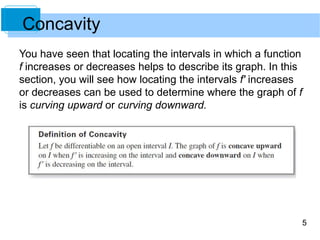
You have seen that locating the intervals in which a function 
f increases or decreases helps to describe its graph. In this 
section, you will see how locating the intervals f' increases 
or decreases can be used to determine where the graph of f 
is curving upward or curving downward.
6 
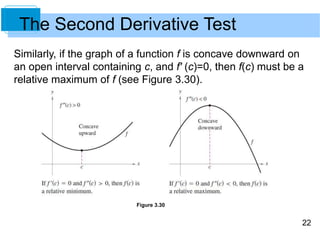
The following graphical interpretation of concavity is useful. 
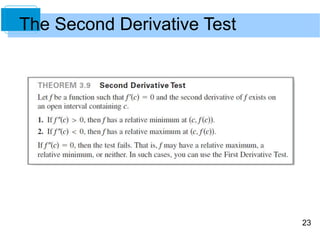
1. Let f be differentiable on an open interval I. If the graph 
of f is concave upward on I, then the graph of f lies 
above all of its tangent lines on I. [See Figure 3.23(a).] 
Figure 3.23(a) 
Concavity
7 
2. Let f be differentiable on an open interval I. If the graph 
of f is concave downward on I, then the graph of f lies 
below all of its tangent lines on I. [See Figure 3.23(b).] 
Figure 3.23(b) 
Concavity
Figure 3.24 8 
Concavity 
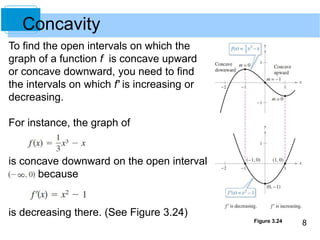
To find the open intervals on which the 
graph of a function f is concave upward 
or concave downward, you need to find 
the intervals on which f' is increasing or 
decreasing. 
For instance, the graph of 
is concave downward on the open interval 
because 
is decreasing there. (See Figure 3.24)
9 
Concavity 
Similarly, the graph of f is concave upward on the interval 
because f' is increasing on . 
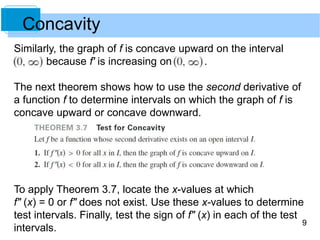
The next theorem shows how to use the second derivative of 
a function f to determine intervals on which the graph of f is 
concave upward or concave downward. 
To apply Theorem 3.7, locate the x-values at which 
f" (x) = 0 or f" does not exist. Use these x-values to determine 
test intervals. Finally, test the sign of f" (x) in each of the test 
intervals.
10 
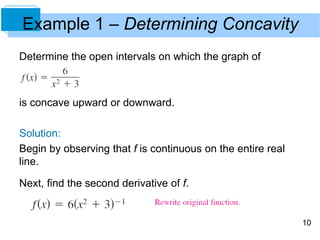
Example 1 – Determining Concavity 
Determine the open intervals on which the graph of 
is concave upward or downward. 
Solution: 
Begin by observing that f is continuous on the entire real 
line. 
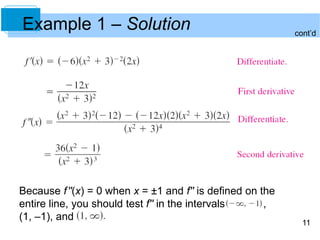
Next, find the second derivative of f.
11 
Example 1 – Solution 
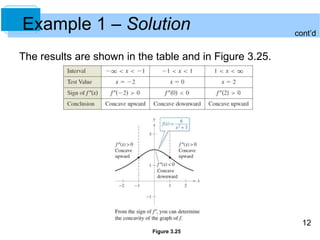
Because f ''(x) = 0 when x = ±1 and f'' is defined on the 
entire line, you should test f'' in the intervals , 
(1, –1), and 
cont’d
12 
Example 1 – Solution 
The results are shown in the table and in Figure 3.25. 
Figure 3.25 
cont’d
cont’d 
13 
Concavity 
The function given in Example 1 is continuous on the entire 
real number line. 
When there are x-values at which the function is not 
continuous, these values should be used, along with the 
points at which f"(x)= 0 or f"(x) does not exist, to form the 
test intervals.
14 
Points of Inflection
15 
Points of Inflection 
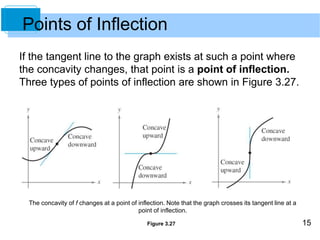
If the tangent line to the graph exists at such a point where 
the concavity changes, that point is a point of inflection. 
Three types of points of inflection are shown in Figure 3.27. 
The concavity of f changes at a point of inflection. Note that the graph crosses its tangent line at a 
point of inflection. 
Figure 3.27
16 
Points of Inflection 
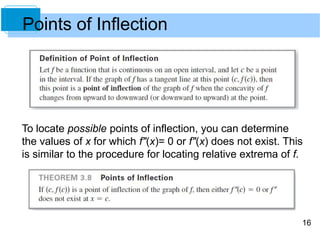
To locate possible points of inflection, you can determine 
the values of x for which f"(x)= 0 or f"(x) does not exist. This 
is similar to the procedure for locating relative extrema of f.
Example 3 – Finding Points of Inflection 
17 
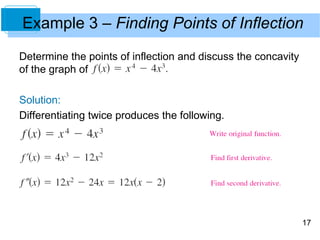
Determine the points of inflection and discuss the concavity 
of the graph of 
Solution: 
Differentiating twice produces the following.
18 
Example 3 – Solution 
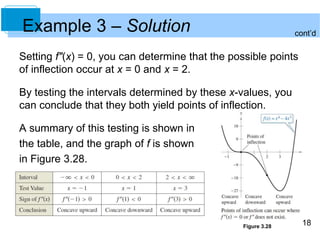
Setting f"(x) = 0, you can determine that the possible points 
of inflection occur at x = 0 and x = 2. 
By testing the intervals determined by these x-values, you 
can conclude that they both yield points of inflection. 
A summary of this testing is shown in 
the table, and the graph of f is shown 
in Figure 3.28. 
Figure 3.28 
cont’d
19 
Points of Inflection 
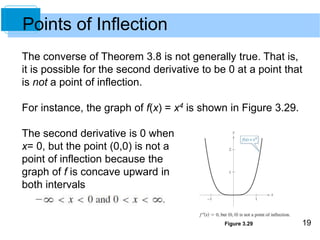
The converse of Theorem 3.8 is not generally true. That is, 
it is possible for the second derivative to be 0 at a point that 
is not a point of inflection. 
For instance, the graph of f(x) = x4 is shown in Figure 3.29. 
The second derivative is 0 when 
x= 0, but the point (0,0) is not a 
point of inflection because the 
graph of f is concave upward in 
both intervals 
Figure 3.29
20 
The Second Derivative Test
21 
The Second Derivative Test 
In addition to testing for concavity, the second derivative can 
be used to perform a simple test for relative maxima and 
minima. 
The test is based on the fact that if the graph of f is concave 
upward on an open interval containing c , and f' (c)=0, then 
f(c) must be a relative minimum of f.
22 
The Second Derivative Test 
Similarly, if the graph of a function f is concave downward on 
an open interval containing c, and f' (c)=0, then f(c) must be a 
relative maximum of f (see Figure 3.30). 
Figure 3.30
23 
The Second Derivative Test
24 
Example 4 – Using the Second Derivative Test 
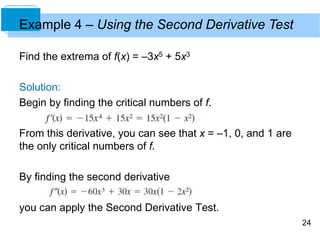
Find the extrema of f(x) = –3x5 + 5x3 
Solution: 
Begin by finding the critical numbers of f. 
From this derivative, you can see that x = –1, 0, and 1 are 
the only critical numbers of f. 
By finding the second derivative 
you can apply the Second Derivative Test.
cont’d 
25 
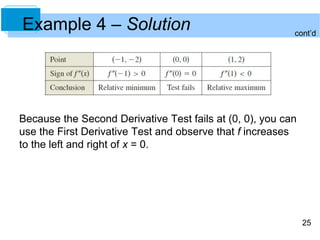
Example 4 – Solution 
Because the Second Derivative Test fails at (0, 0), you can 
use the First Derivative Test and observe that f increases 
to the left and right of x = 0.
26 
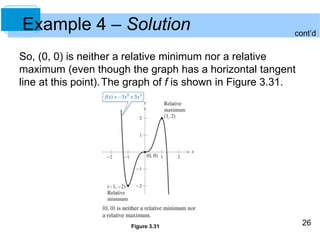
Example 4 – Solution 
So, (0, 0) is neither a relative minimum nor a relative 
maximum (even though the graph has a horizontal tangent 
line at this point).The graph of f is shown in Figure 3.31. 
Figure 3.31 
cont’d

Lar calc10 ch03_sec4

  • 1.
    Applications of Differentiation Copyright © Cengage Learning. All rights reserved.
  • 2.
    Concavity and theSecond Derivative Test Copyright © Cengage Learning. All rights reserved.
  • 3.
    3 Objectives Determine intervals on which a function is concave upward or concave downward.  Find any points of inflection of the graph of a function.  Apply the Second Derivative Test to find relative extrema of a function.
  • 4.
  • 5.
    5 Concavity Youhave seen that locating the intervals in which a function f increases or decreases helps to describe its graph. In this section, you will see how locating the intervals f' increases or decreases can be used to determine where the graph of f is curving upward or curving downward.
  • 6.
    6 The followinggraphical interpretation of concavity is useful. 1. Let f be differentiable on an open interval I. If the graph of f is concave upward on I, then the graph of f lies above all of its tangent lines on I. [See Figure 3.23(a).] Figure 3.23(a) Concavity
  • 7.
    7 2. Letf be differentiable on an open interval I. If the graph of f is concave downward on I, then the graph of f lies below all of its tangent lines on I. [See Figure 3.23(b).] Figure 3.23(b) Concavity
  • 8.
    Figure 3.24 8 Concavity To find the open intervals on which the graph of a function f is concave upward or concave downward, you need to find the intervals on which f' is increasing or decreasing. For instance, the graph of is concave downward on the open interval because is decreasing there. (See Figure 3.24)
  • 9.
    9 Concavity Similarly,the graph of f is concave upward on the interval because f' is increasing on . The next theorem shows how to use the second derivative of a function f to determine intervals on which the graph of f is concave upward or concave downward. To apply Theorem 3.7, locate the x-values at which f" (x) = 0 or f" does not exist. Use these x-values to determine test intervals. Finally, test the sign of f" (x) in each of the test intervals.
  • 10.
    10 Example 1– Determining Concavity Determine the open intervals on which the graph of is concave upward or downward. Solution: Begin by observing that f is continuous on the entire real line. Next, find the second derivative of f.
  • 11.
    11 Example 1– Solution Because f ''(x) = 0 when x = ±1 and f'' is defined on the entire line, you should test f'' in the intervals , (1, –1), and cont’d
  • 12.
    12 Example 1– Solution The results are shown in the table and in Figure 3.25. Figure 3.25 cont’d
  • 13.
    cont’d 13 Concavity The function given in Example 1 is continuous on the entire real number line. When there are x-values at which the function is not continuous, these values should be used, along with the points at which f"(x)= 0 or f"(x) does not exist, to form the test intervals.
  • 14.
    14 Points ofInflection
  • 15.
    15 Points ofInflection If the tangent line to the graph exists at such a point where the concavity changes, that point is a point of inflection. Three types of points of inflection are shown in Figure 3.27. The concavity of f changes at a point of inflection. Note that the graph crosses its tangent line at a point of inflection. Figure 3.27
  • 16.
    16 Points ofInflection To locate possible points of inflection, you can determine the values of x for which f"(x)= 0 or f"(x) does not exist. This is similar to the procedure for locating relative extrema of f.
  • 17.
    Example 3 –Finding Points of Inflection 17 Determine the points of inflection and discuss the concavity of the graph of Solution: Differentiating twice produces the following.
  • 18.
    18 Example 3– Solution Setting f"(x) = 0, you can determine that the possible points of inflection occur at x = 0 and x = 2. By testing the intervals determined by these x-values, you can conclude that they both yield points of inflection. A summary of this testing is shown in the table, and the graph of f is shown in Figure 3.28. Figure 3.28 cont’d
  • 19.
    19 Points ofInflection The converse of Theorem 3.8 is not generally true. That is, it is possible for the second derivative to be 0 at a point that is not a point of inflection. For instance, the graph of f(x) = x4 is shown in Figure 3.29. The second derivative is 0 when x= 0, but the point (0,0) is not a point of inflection because the graph of f is concave upward in both intervals Figure 3.29
  • 20.
    20 The SecondDerivative Test
  • 21.
    21 The SecondDerivative Test In addition to testing for concavity, the second derivative can be used to perform a simple test for relative maxima and minima. The test is based on the fact that if the graph of f is concave upward on an open interval containing c , and f' (c)=0, then f(c) must be a relative minimum of f.
  • 22.
    22 The SecondDerivative Test Similarly, if the graph of a function f is concave downward on an open interval containing c, and f' (c)=0, then f(c) must be a relative maximum of f (see Figure 3.30). Figure 3.30
  • 23.
    23 The SecondDerivative Test
  • 24.
    24 Example 4– Using the Second Derivative Test Find the extrema of f(x) = –3x5 + 5x3 Solution: Begin by finding the critical numbers of f. From this derivative, you can see that x = –1, 0, and 1 are the only critical numbers of f. By finding the second derivative you can apply the Second Derivative Test.
  • 25.
    cont’d 25 Example4 – Solution Because the Second Derivative Test fails at (0, 0), you can use the First Derivative Test and observe that f increases to the left and right of x = 0.
  • 26.
    26 Example 4– Solution So, (0, 0) is neither a relative minimum nor a relative maximum (even though the graph has a horizontal tangent line at this point).The graph of f is shown in Figure 3.31. Figure 3.31 cont’d