Paramedic Care:
Principles & Practice
Volume 5
Trauma Emergencies
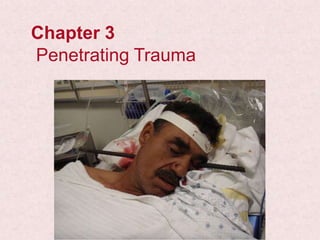
Chapter 3
Penetrating Trauma
Topics
Introduction to Penetrating Trauma
Kinetics of Penetrating Trauma
Specific Tissue/Organ Injuries
Special Concerns with Penetrating Trauma
Introduction to
Penetrating Trauma
Introduction to
Penetrating Trauma
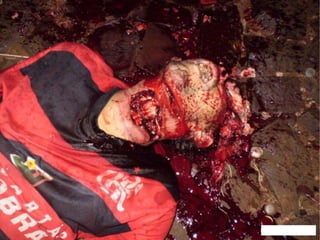
There are 30,000 deaths in the U.S. annually due to
shootings.
Other mechanisms of penetrating trauma include:
Knives, arrows, nails, etc.
Understanding the principles of energy exchange
increases the index of suspicion associated with the
MOI.
Kinetics of Penetrating
Trauma
Kinetics of Penetrating Trauma
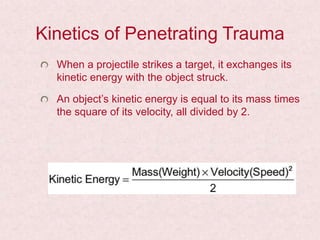
When a projectile strikes a target, it exchanges its
kinetic energy with the object struck.
An objectโ€™s kinetic energy is equal to its mass times
the square of its velocity, all divided by 2.
Kinetics of Penetrating
Trauma
The greater the mass of an object, the greater its
energy.
If you double the mass of an object, it will have twice
the kinetic energy.
The speed (or velocity) of an object has a squared
relationship to its kinetic energy.
If you double the speed of an object, its kinetic energy
increases by fourfold.
Ballistics
Study of the characteristics of projectiles in motion
and effects upon objects impacted
Factors affecting energy exchange between a
projectile and body tissue:
Velocity
Profile
Stability
Expansion and fragmentation
Secondary Impacts
Shape
Ballistics
Velocity
Causes trajectory
Faster = straighter trajectory
Slower = more curved due to gravity
Ballistics
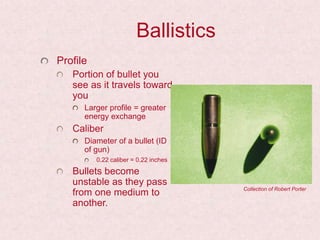
Profile
Portion of bullet you
see as it travels toward
you
Larger profile = greater
energy exchange
Caliber
Diameter of a bullet (ID
of gun)
0.22 caliber = 0.22 inches
Bullets become
unstable as they pass
from one medium to
another.
Collection of Robert Porter
Ballistics
Stability
Bullet length increases bullet tumbling
Can reduce the accuracy of the shot
Reduced by rifling in barrel (spinning)
Yaw
Gyroscopic effect on the center axis of the bullet
that reduces tumbling
Tumbling of bullet once it strikes object
Increases rate of energy exchange
Greater tissue damage
Ballistics
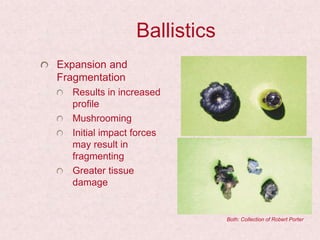
Expansion and
Fragmentation
Results in increased
profile
Mushrooming
Initial impact forces
may result in
fragmenting
Greater tissue
damage
Both: Collection of Robert Porter
Ballistics
Secondary Impacts
Bullet striking other objects can cause yaw and tumble
Body armor (Kevlar)
Transmits energy throughout entire vest resulting in blunt
trauma
Myocardial contusion
Pulmonary contusion
Rib fractures
Ballistics
Shape
Handgun ammunition is rather blunt
More resistant to travel through human tissue
Releases kinetic energy more quickly
Rifle bullets are more pointed and cut through the
tissue more efficiently
May tumble or fragment
Specific Weapon
Characteristics
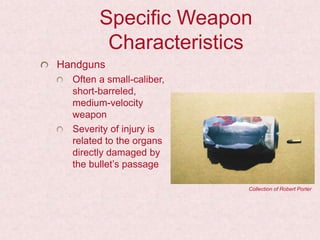
Handguns
Often a small-caliber,
short-barreled,
medium-velocity
weapon
Severity of injury is
related to the organs
directly damaged by
the bulletโ€™s passage
Collection of Robert Porter
Rifles
Specific Weapon
Characteristics
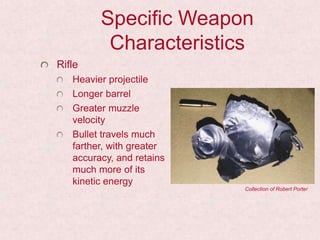
Rifle
Heavier projectile
Longer barrel
Greater muzzle
velocity
Bullet travels much
farther, with greater
accuracy, and retains
much more of its
kinetic energy
Collection of Robert Porter
Specific Weapon
Characteristics
Assault Rifle
Generally has a larger magazine capacity
Multiple wounds and casualties can be expected
Will fire in both the semiautomatic and automatic mode
Specific Weapon
Characteristics
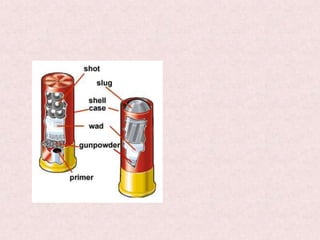
Shotgun
May fire a single
projectile (a slug) or
numerous spheres
(pellets or shot) at
medium velocity
The larger the shot,
the smaller the
number of projectiles
http://www.youtube.co
m/watch?v=vQvqESdC
k7U
Specific Weapon
Characteristics
Knives and Arrows
Slow-moving, penetrating objects cause low-velocity,
low-energy wounds
Usually limited to physical injury caused by direct contact
between the blade or object and the victimโ€™s tissue
Hunting tips designed for arrows can be especially
damaging
Biomechanics of
Penetrating Trauma
Direct Injury
Occurs as the projectile strikes tissue, contuses and
tears that tissue, and displaces the tissue
Limited to the profile of the bullet as it moves through
the body
Handgun bullet damage is usually limited to direct
injury
Biomechanics of
Penetrating Trauma
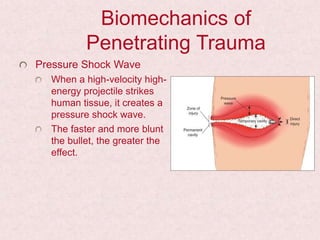
Pressure Shock Wave
When a high-velocity high-
energy projectile strikes
human tissue, it creates a
pressure shock wave.
The faster and more blunt
the bullet, the greater the
effect.
Biomechanics of
Penetrating Trauma
Temporary Cavity
Space created behind the high-energy bullet as tissue
moves rapidly away from the bulletโ€™s path
After the bulletโ€™s passage, tissue elasticity causes the
temporary cavity to close
Cavitation
Biomechanics of
Penetrating Trauma
Permanent Cavity
Tissue may not return to its normal orientation,
resulting in a permanent cavity
Cavity fills with debris
Zone of Injury
Zone of injury extends beyond the permanent cavity
May be slow to heal
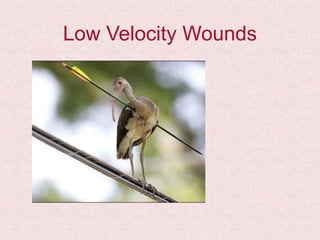
Low Velocity Wounds
Low-Velocity Wounds
Objects
Knives, ice-picks, arrows
Flying objects or debris
Injury limited to tissue impacted
Object pathway
Object twisting or moved
Oblique angle
Attacker Characteristics
Males: outward and crosswise
Females: overhand and downward
Specific Tissue/Organ Injuries
Specific Tissue/Organ
Injuries
Connective Tissue
Absorbs energy and limits tissue damage
Organs
Solid organs
Dense and low resilience
Hemorrhage associated with solid organ projectile
damage is often severe
Hollow organs
Fluid filled: transmit energy = increased damage
Air filled: absorb energy = less damage
Connective Tissue
Including muscles and skin
Dense, elastic, hold together well
โ€˜Absorb energy while limiting tissue damageโ€™
Damage is limited to projectileโ€™s pathway
Solid Organs
Liver, spleen, kidneys, pancreas, brain
Have density but not resiliency
Hemorrhage is often severe
Damage outside of the profile
Hollow Organs
Bowel, stomach, heart, bladder
Muscular and hold fluid
If filled with fluid, organ may tear explosively
If filled with air (not distended), injury tolerated
Pericardial tamponade
Specific Tissue/Organ
Injuries
Lungs
Air in lung absorbs energy
Parenchyma is compressed and rebounds
Pneumothorax or hemothorax can result
Bone
Resists displacement until it shatters
Alters projectile path
General Body Regions
Extremities
Injury limited to resiliency of tissue
60โ€“80% of injuries with <10% mortality
Do not immediately threaten life
Injuries above the elbow or knee are more likely to
cause significant vascular injury
Abdomen (includes pelvis)
Highly susceptible to injury and hemorrhage
Bowel perforation: 12โ€“24 hrs. peritoneal irritation
General Body Regions
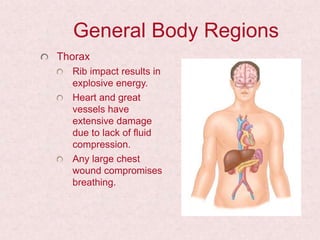
Thorax
Rib impact results in
explosive energy.
Heart and great
vessels have
extensive damage
due to lack of fluid
compression.
Any large chest
wound compromises
breathing.
General Body Regions
Neck
Damages trachea and blood vessels
Neurological problems
Sucking neck wound
Head
Cavitational energy trapped inside skull
Serious bleeding, lethal
Wound Characteristics
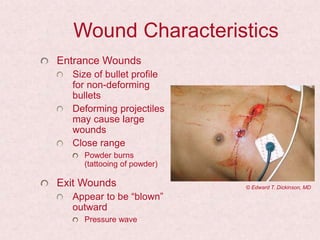
Entrance Wounds
Size of bullet profile
for non-deforming
bullets
Deforming projectiles
may cause large
wounds
Close range
Powder burns
(tattooing of powder)
Exit Wounds
Appear to be โ€œblownโ€
outward
Pressure wave
ยฉ Edward T. Dickinson, MD
Special Concerns With
Penetrating Trauma
Special Concerns With
Penetrating Trauma
Scene Size-up
Law enforcement
DO NOT ENTER
UNTIL SCENE IS
SAFE!
Weapons: victim or
assailant
Preserve crime scene
when possible
ยฉ Mikael Karlsson/On Scene Photography
Special Concerns With
Penetrating Trauma
Penetrating Wound Assessment
Try to determine the pathway of the penetrating
object
Internal organ injury potential
Entrance and exit wounds
Special Concerns With
Penetrating Trauma
Penetrating Wound
Care
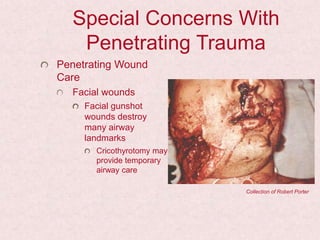
Facial wounds
Facial gunshot
wounds destroy
many airway
landmarks
Cricothyrotomy may
provide temporary
airway care
Collection of Robert Porter
Special Concerns With
Penetrating Trauma
Penetrating Wound Care
Chest wounds
Requires a large wound to be present for air to
move into the chest cavity
Open pnuemothorax
Tension pnuemothorax
Consider the possibility of heart and great vessel
damage
Pericardial tamponade
Special Concerns With
Penetrating Trauma
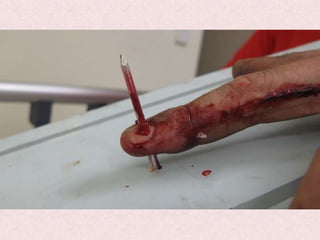
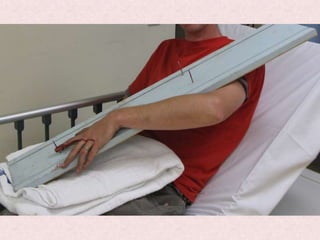
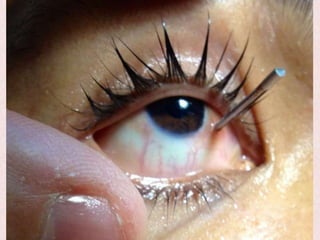
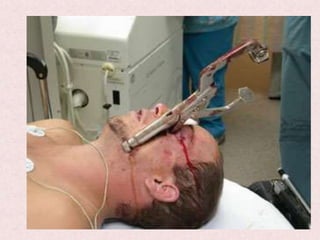
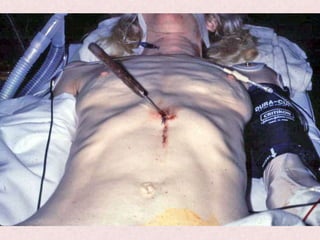
Impaled Objects
Low energy
Dangerous to remove
Do not remove unless:
In cheek, neck, or trachea
Interferes with CPR
Summary
Introduction to Penetrating Trauma
Kinetics of Penetrating Trauma
Specific Tissue/Organ Injuries
Special Concerns with Penetrating Trauma

Ch03 penetrating

  • 1.
    Paramedic Care: Principles &Practice Volume 5 Trauma Emergencies
  • 2.
  • 3.
    Topics Introduction to PenetratingTrauma Kinetics of Penetrating Trauma Specific Tissue/Organ Injuries Special Concerns with Penetrating Trauma
  • 4.
  • 5.
    Introduction to Penetrating Trauma Thereare 30,000 deaths in the U.S. annually due to shootings. Other mechanisms of penetrating trauma include: Knives, arrows, nails, etc. Understanding the principles of energy exchange increases the index of suspicion associated with the MOI.
  • 6.
  • 7.
    Kinetics of PenetratingTrauma When a projectile strikes a target, it exchanges its kinetic energy with the object struck. An objectโ€™s kinetic energy is equal to its mass times the square of its velocity, all divided by 2.
  • 8.
    Kinetics of Penetrating Trauma Thegreater the mass of an object, the greater its energy. If you double the mass of an object, it will have twice the kinetic energy. The speed (or velocity) of an object has a squared relationship to its kinetic energy. If you double the speed of an object, its kinetic energy increases by fourfold.
  • 9.
    Ballistics Study of thecharacteristics of projectiles in motion and effects upon objects impacted Factors affecting energy exchange between a projectile and body tissue: Velocity Profile Stability Expansion and fragmentation Secondary Impacts Shape
  • 10.
    Ballistics Velocity Causes trajectory Faster =straighter trajectory Slower = more curved due to gravity
  • 11.
    Ballistics Profile Portion of bulletyou see as it travels toward you Larger profile = greater energy exchange Caliber Diameter of a bullet (ID of gun) 0.22 caliber = 0.22 inches Bullets become unstable as they pass from one medium to another. Collection of Robert Porter
  • 12.
    Ballistics Stability Bullet length increasesbullet tumbling Can reduce the accuracy of the shot Reduced by rifling in barrel (spinning) Yaw Gyroscopic effect on the center axis of the bullet that reduces tumbling Tumbling of bullet once it strikes object Increases rate of energy exchange Greater tissue damage
  • 13.
    Ballistics Expansion and Fragmentation Results inincreased profile Mushrooming Initial impact forces may result in fragmenting Greater tissue damage Both: Collection of Robert Porter
  • 14.
    Ballistics Secondary Impacts Bullet strikingother objects can cause yaw and tumble Body armor (Kevlar) Transmits energy throughout entire vest resulting in blunt trauma Myocardial contusion Pulmonary contusion Rib fractures
  • 15.
    Ballistics Shape Handgun ammunition israther blunt More resistant to travel through human tissue Releases kinetic energy more quickly Rifle bullets are more pointed and cut through the tissue more efficiently May tumble or fragment
  • 17.
    Specific Weapon Characteristics Handguns Often asmall-caliber, short-barreled, medium-velocity weapon Severity of injury is related to the organs directly damaged by the bulletโ€™s passage Collection of Robert Porter
  • 18.
  • 19.
    Specific Weapon Characteristics Rifle Heavier projectile Longerbarrel Greater muzzle velocity Bullet travels much farther, with greater accuracy, and retains much more of its kinetic energy Collection of Robert Porter
  • 20.
    Specific Weapon Characteristics Assault Rifle Generallyhas a larger magazine capacity Multiple wounds and casualties can be expected Will fire in both the semiautomatic and automatic mode
  • 22.
    Specific Weapon Characteristics Shotgun May firea single projectile (a slug) or numerous spheres (pellets or shot) at medium velocity The larger the shot, the smaller the number of projectiles
  • 24.
  • 25.
    Specific Weapon Characteristics Knives andArrows Slow-moving, penetrating objects cause low-velocity, low-energy wounds Usually limited to physical injury caused by direct contact between the blade or object and the victimโ€™s tissue Hunting tips designed for arrows can be especially damaging
  • 26.
    Biomechanics of Penetrating Trauma DirectInjury Occurs as the projectile strikes tissue, contuses and tears that tissue, and displaces the tissue Limited to the profile of the bullet as it moves through the body Handgun bullet damage is usually limited to direct injury
  • 27.
    Biomechanics of Penetrating Trauma PressureShock Wave When a high-velocity high- energy projectile strikes human tissue, it creates a pressure shock wave. The faster and more blunt the bullet, the greater the effect.
  • 28.
    Biomechanics of Penetrating Trauma TemporaryCavity Space created behind the high-energy bullet as tissue moves rapidly away from the bulletโ€™s path After the bulletโ€™s passage, tissue elasticity causes the temporary cavity to close Cavitation
  • 29.
    Biomechanics of Penetrating Trauma PermanentCavity Tissue may not return to its normal orientation, resulting in a permanent cavity Cavity fills with debris Zone of Injury Zone of injury extends beyond the permanent cavity May be slow to heal
  • 30.
  • 31.
    Low-Velocity Wounds Objects Knives, ice-picks,arrows Flying objects or debris Injury limited to tissue impacted Object pathway Object twisting or moved Oblique angle Attacker Characteristics Males: outward and crosswise Females: overhand and downward
  • 32.
  • 33.
    Specific Tissue/Organ Injuries Connective Tissue Absorbsenergy and limits tissue damage Organs Solid organs Dense and low resilience Hemorrhage associated with solid organ projectile damage is often severe Hollow organs Fluid filled: transmit energy = increased damage Air filled: absorb energy = less damage
  • 34.
    Connective Tissue Including musclesand skin Dense, elastic, hold together well โ€˜Absorb energy while limiting tissue damageโ€™ Damage is limited to projectileโ€™s pathway
  • 35.
    Solid Organs Liver, spleen,kidneys, pancreas, brain Have density but not resiliency Hemorrhage is often severe Damage outside of the profile
  • 36.
    Hollow Organs Bowel, stomach,heart, bladder Muscular and hold fluid If filled with fluid, organ may tear explosively If filled with air (not distended), injury tolerated Pericardial tamponade
  • 37.
    Specific Tissue/Organ Injuries Lungs Air inlung absorbs energy Parenchyma is compressed and rebounds Pneumothorax or hemothorax can result Bone Resists displacement until it shatters Alters projectile path
  • 38.
    General Body Regions Extremities Injurylimited to resiliency of tissue 60โ€“80% of injuries with <10% mortality Do not immediately threaten life Injuries above the elbow or knee are more likely to cause significant vascular injury Abdomen (includes pelvis) Highly susceptible to injury and hemorrhage Bowel perforation: 12โ€“24 hrs. peritoneal irritation
  • 39.
    General Body Regions Thorax Ribimpact results in explosive energy. Heart and great vessels have extensive damage due to lack of fluid compression. Any large chest wound compromises breathing.
  • 40.
    General Body Regions Neck Damagestrachea and blood vessels Neurological problems Sucking neck wound Head Cavitational energy trapped inside skull Serious bleeding, lethal
  • 42.
    Wound Characteristics Entrance Wounds Sizeof bullet profile for non-deforming bullets Deforming projectiles may cause large wounds Close range Powder burns (tattooing of powder) Exit Wounds Appear to be โ€œblownโ€ outward Pressure wave ยฉ Edward T. Dickinson, MD
  • 43.
  • 44.
    Special Concerns With PenetratingTrauma Scene Size-up Law enforcement DO NOT ENTER UNTIL SCENE IS SAFE! Weapons: victim or assailant Preserve crime scene when possible ยฉ Mikael Karlsson/On Scene Photography
  • 45.
    Special Concerns With PenetratingTrauma Penetrating Wound Assessment Try to determine the pathway of the penetrating object Internal organ injury potential Entrance and exit wounds
  • 46.
    Special Concerns With PenetratingTrauma Penetrating Wound Care Facial wounds Facial gunshot wounds destroy many airway landmarks Cricothyrotomy may provide temporary airway care Collection of Robert Porter
  • 47.
    Special Concerns With PenetratingTrauma Penetrating Wound Care Chest wounds Requires a large wound to be present for air to move into the chest cavity Open pnuemothorax Tension pnuemothorax Consider the possibility of heart and great vessel damage Pericardial tamponade
  • 48.
    Special Concerns With PenetratingTrauma Impaled Objects Low energy Dangerous to remove Do not remove unless: In cheek, neck, or trachea Interferes with CPR
  • 56.
    Summary Introduction to PenetratingTrauma Kinetics of Penetrating Trauma Specific Tissue/Organ Injuries Special Concerns with Penetrating Trauma