GUN SHOT WOUND MANAGEMENT
Presenter :Dr.Madhavan
LESSON PLAN
• INTRODUCTION
• WOUND BALLISTICS
• TYPES OF BULLET MOVEMENTS
• MECHANISM OF INJURY IN SHRAPNEL BULLETS
• CLASSIFICATION OF GUN SHOT WOUNDS
• MANAGEMENT
• SUMMARY
OBJECTIVES
• AT THE END OF THE CLASS STUDENTS MUST BE ABLE TO KNOW
THE MECHANISM OF GUN SHOT WOUNDS
• THE CLASSIFIAION OF GUN SHOT WOUNDS
• THE STEP-BY-STEP APPROCH IN MANAGEMENT OF GUN SHOT
WOUNDS
INTRODUCTION
• Gun shot wounds are high energy injuries that contribute to extensive
soft tissue damage and comminuted bony fractures
• The incidence of bullet wounds in civilian trauma has increased in
many parts of the world, sometimes approaching to epidemic level
• For surgeons with limited experience there is contradictory advice on
management
Schwab CW. Violence: America’s uncivil war: Presidential Address, sixth scientific assembly of the Eastern Association for the
Surgery of Trauma. J Trauma 1993;35:657-65
• So, to clarify this gunshot injuries of the limbs, without major vascular
injury, must include current concepts of ballistic wounding, the
pathology of soft-tissue wounds and fractures, and of bacterial
contamination for better management of gun shot injuries is been
studied widely
Wound Ballistics
• Wound ballistics is the science that studies the effects of penetrating
projectiles on the body
• Three observable phenomena occur when a bullet strikes the tissue
• First, tissue is crushed by the projectile as it passes through, leading to a
localized area of cell necrosis that is proportional to the size of the
projectile
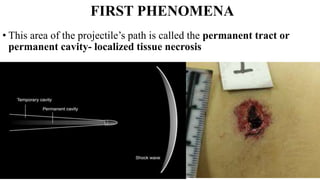
FIRST PHENOMENA
• This area of the projectile’s path is called the permanent tract or
permanent cavity- localized tissue necrosis
SECOND PHENOMENA
• There is a second area in which elastic tissue is stretched, causing a
temporary cavity
• The stretch occurs because of a lateral displacement of tissue that
occurs after the passage of the projectile.
• This transient lateral displacement of tissue, such as skeletal muscle,
vessels, and nerves, macroscopically appears as blunt trauma.
• Inelastic tissue, such as bone may results in fracture
Fackler ML, Malinowski JA: The wound profile: A visual method for quantifying gunshot wound compo- nents. J Trauma
1985;25:522-529
THIRD PHENOMENA
• A third component, known as the shock wave is a pressure wave that
travels at the speed of sound preceding the bullet in tissue
• This pressure wave is of very short duration, a few microseconds,
although it may generate pressures of up to 100 ATM in magnitude.
• The shock wave has not been shown to cause tissue injury
Dziemian AJ, Mendelson JA, Lindsey D: Comparison of the wounding characteristics of some commonly encountered
bullets. J Trauma 1961;1: 341-353
• The damage it causes varies by its velocity, where it enters,
trajectory, weight and design
As a bullet enters the body
• It forms a cavitation or expansion, of the surrounding tissue
• It also lacerates the tissue it encounters
• The bullet may yaw, or tumble, as it slows, further lacerating the tissue an
follow often unpredictable pathways within the body
TYPES OF BULLET MOVEMENTS
DAMANGE TO SKIN AND MUSCLE
These tissues are relatively elastic and therefore tolerate the temporary
stretching effect of the cavitation relatively well with limited tissue
necrosis
NEUROVASCULAR STRUCTURES
Nerves and vessels are often relatively fixed anatomically
and therefore are vulnerable to the temporary distorting effect of
cavitation.
They can remain macroscopically intact away from the permanent cavity;
however, intimal damage in vessels and axonal damage in nerves can
result in functional failure even some distance from the path of the
bullet.
BONE
The unique strength of this tissue
means that it exerts a significant
retarding effect on projectiles that strike
it. This results in considerable energy
transfer, often with extensive
fragmentation of both bone and bullet.
This follows the potential for these
fragments to be accelerated as
secondary missiles.
• Bone injury is common with gunshot wounds to the extremities.
Fractures may occur either when the projectile strikes bone or, rarely,
indirectly by the temporary cavity
Grundfest H: Penetration of Steel Spheres Into Bone. Missile Casualties Re- port Number 10. Interim Report. Office of
Scientific Research and Develop- ment, 1945
• Direct fractures occur when a projectile strikes the bone
• The density and relatively inelastic behaviour of bone
• Fracture line extends beyond the area crushed by the projectile
• Results in bone comminution and secondary missiles from bone itself
which leading to extensive soft tissue damage
• This kind of damage mostly caused by shrapnel bullets on impaction the
release of small metallic ball with high force make the exit more larger
and irregular compared to the entry with lots of soft tissue and bony
distraction
• High chances of infection as it enters the wound it will take the dirt and
cloth pieces into the wound
• Ballistic trauma would induce immediate myofiber trauma, alongside
secondary atrophy and vascular damage
• Myofibre trauma initiates a chain of events, including necrosis and
inflammation, which then activates satellite cells to aid muscle
regeneration
SHARPANEL BULLETS
• Because the secondary missiles of bone disrupt tissue before it is
stretched by the temporary cavity, results in increasing comminution
around the bullet path, possibly causing increased soft-tissue disruption
• A commonly used firearm such as the shotgun is technically defined as
low velocity, yet this device inflicts devastating wounds when fired at
close range due to high-energy transfer
Fackler, M. L. Gunshot wound review. Ann. Emerg. Med. 28, 194–203 (1996).
CLASSIFICATION OF GUN SHOT WOUNDS
• LOW VELOCITY : <350 METERS PER SECOND
• INTERMEDIATE VELOCITY : 350-650 METERS PER
SECOND
• HIGH VELOCITY :>600 METERS PER SECOND
ACCORDING TO VELOCITY
ACCORDING TO LIMB ISCHEMIAAND ENERGY
ACCORDING TO SIZE ,CONAMINATION AND VASCULARITY
LOW VELOCITY
• Muzzle velocity <350 meters per second or < 1,200 feet per second
• Most handguns
• Wounds comparable to Gustillo-anderson Type I Or II
INTERMEDIATE VELOCITY
• Muzzle velocity 350-650 meters per second or 1,200-2,000 feet per
second
• Shotgun blasts
• Highly variable depending on distance from target
• Wound contamination/infection with close range injuries due to shotgun
wadding
WOUNDING POTENTIAL DEPENDS ON 3 FACTORS
• Shot pattern
• Load (size of individual pellet)
• Distance from target
HIGH VELOCITY
• Muzzle velocity >600 meters per second or >2,000 feet per second
• Military (assault) and hunting rifles
• Wounds comparable to Gustillo-anderson Type III regardless of size
• High risk of infection
• INTERPRETATION:
• Multiple studies have examined the efficacy of the MESS
both retrospectively and prospectively and have found it to
correlate well with the treatment of major limb trauma.
• A MESS score of greater than or equal to 7 had a 100%
predictable value for amputation
• Pros:
–High specificity for predicting amputation
• Cons:
–Low sensitivity for predicting amputation
• In 1895, Stanley Boyd
said “The most important
divisions of fractures -
simple, compound and
complicated - are based
upon the condition of the
soft parts.
The Gustilo – Anderson classification divides soft-tissue wounding of
open fractures into three grades – I, II & III.
• Gustilo, Mendoza and Williams. (J.Trauma 1984)
• The III grade was later further subdivided into types IIIA, IIIB & IIIC.
• The Gustilo-Mendoza-Williams open-fracture classification separately
identifies, as type IIIC, those grade III open fractures with arterial
injuries that require vascular repair to restore limb viability
• Gustilo et al. demonstrated a 50% risk of osteomyelitis after such
injuries, with amputation (early or late) a frequent outcome
• Proposed by Dr. S. Rajasekaran et al
• A score for predicting salvage and outcome in Gustilo type
III A and type III B open tibial fractures
GANGA HOSPITAL OPEN INJURY SEVERITY
SCORE
• The severity of injury to the covering structures, skeletal
structures and musculotendinous & nerve units were assessed
individually on an incremental score of one to five
• Seven Co-morbid conditions known to influence the management
and prognosis were each given a score of two
INTERPRETATION
• Score of <14 are advised salvage
• Score of 17 and above end up in amputation
• Whereas score of 15-16 fall into gray zone where decision is made on patient-to-
patient bases
WOUND
CONTAMINATION
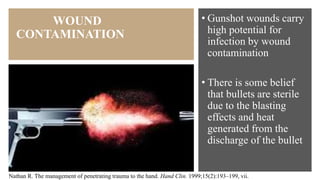
• Gunshot wounds carry
high potential for
infection by wound
contamination
• There is some belief
that bullets are sterile
due to the blasting
effects and heat
generated from the
discharge of the bullet
Nathan R. The management of penetrating trauma to the hand. Hand Clin. 1999;15(2):193–199, vii.
• However, Thoresby et al done experiments showed that bullets are not
rendered sterile by firing and are capable of conveying infection. Their
outcomes showed that the temporary cavitation effect might create a
vacuum that can pull foreign materials, including dirt and bacteria,
into the wound, potentially leading to wound infection.
Thoresby FP, Darlow HM. The mechanisms of primary infection of bullet wounds. Br J Surg. 1967;54(5):359–361
Tian et al performed a study that provides evidence that an
important factor is the level of bacterial growth, a level of 105 causing
infection. After a gunshot wound, this critical number is reached 6 hours
after injury, especially in non vitalized tissue, and therefore
debridement should be performed within 6 hours.
The type of
weapon used can also be a
factor in the potential for
wound contamination.
Shotguns have been
shown to cause higher
rates of infection than
other low-velocity guns.
MANAGEMENT
Management of gunshot wounds it's been believed that
1. Resuscitation
2. Early debridement
3. Antibiotic treatment
4. Reconstruction
5. Rehabilitation offer patients the best chance for full functional
recovery
Assess and
resuscitate
Wound
irrigation
Assess the
local wound
Soft tissue
injury needs
surgery ?
NO
Dress and
antibiotic and
observe
yes
Urgent
exploration
and
irrigation
Fracture
required
stabilization ?
splintage
Splintage by
Exfix,ORIF/IMIL,
Tissue cover
Wound needs
dressing, VAC
dressing
Reinspect after 48 hours
and consider delayed
primary closer
Antibiotic beads pouch
Early
antibiotic
prophylaxis
FIRST AID
• Look for heavy venous and/or arterial bleeds
• Extremities can receive tourniquets, if necessary, inguinal and non-
tourniquet areas should be packed and secured immediately
• Understand the path of the bullet
• For instance, placing tourniquets on a leg is great, but if you find an
exit wound near the hip or higher, we must consider the possibility of
additional bleeding in the hip, intestines that also to be taken care at the
same time
PACKING OF THE EXIT WOUND
FLUID RESUSCITATION
According to Advance trauma life support (ATLS)
• The recommended administering fluid is 1 liter of crystalloid fluid and
starting blood products as soon as possible
Studies have found that large volume of crystalloid infusion in the setting
of trauma worsen the outcome and increases the chances of
1.Coagulopathy
2.Systemic inflammatory response syndrome(SIRS)
3.Acute respiratory distress syndrome(ARDS)
4.Pulmonary edema
5.Death
• The newest data supports that permissive hypotension is acceptable
• Any increase in patient circulating volume before achieving hemostasis
will result in disruption of early clot formation and worsen
hemorrhage
IRRIGATION PRINCIPLES
Gustilo fracture type Irrigation volume/additives
• I 3 Liters normal saline with liquid castile soap additive only.
• II 6 Liters normal saline with liquid castile soap additive only
• IIIA-C 9 Liters normal saline with liquid castile soap additive. Highly
contaminated wounds may benefit from antibiotic in the irrigation solution
• We must make sure all removable debris and the lead contamination from the
bullet to be washed
• Lead is soluble in synovial fluid and has been shown to induce lead
synovitis and degenerative arthritis.
• Also, can cause systemic lead poisoning
• The normal blood lead level for adults is 0 to 19 μg/dL. Nearly 95% of
the lead storage in the body occurs in bone.
• The half-life of lead in the blood stream is less than 2 months compared
with 20 to 30 years in the bone.
Linden M, Manton W, Stewart R, et al. Lead poisoning from retained bullets. Patho-genesis, diagnosis, and management. Ann Surg. 1982;195(3):305–313.
X-rays
DEBRIDEMENT PRINCIPLES
Skin:
• Excise all devitalized skin and resect edges until dermal bleeding is
encountered.
• Extend the open wound to evaluate underlying structures.
• Longitudinal incisions are best.
Subcutaneous tissue and fat:
• Excise all devitalized tissue
• Affected subcutaneous fat and tissue should be freely excised
• These tissues have a sparse blood supply and on subsequent
debridement, further devitalized tissues may become apparent
Fascia:
• Excise all devitalized tissue
• As with subcutaneous fat, contaminated fascia should be freely excised
Muscle:
• Excise all devitalized tissue
• Muscle provides an excellent environment for bacteria to flourish
• Thus, extensive debridement of contaminated and devascularized
tissue should be completed
•
• Attention to the classic “C’s” of muscle viability can assist the
decision for excision:
• color
• consistency
• contractility
• capacity to bleed
• Caution should be taken with excision of tendons and ligaments.
These should be meticulously cleaned and left for later debridement if
they prove to be devitalized.
Bone:
• Remove all devitalized bone
• The ends of the bone should be delivered into the wound and
cleaned/debrided
• Large portions of cancellous bone can be cleaned and used as graft
material (only if not directly involved and not grossly contaminated.
Clinical judgment is needed in this case).
• The principle of staged treatment, using delayed primary suture (DPS)
• Wounds may be reinspected at 48 hours “SECOND LOOK”
• Closure should be planned for four to five days after injury
• Suturing is appropriate only if all tissues appear healthy and without
undue tension
WOUND CLOSURE
Elton and Bouzard postulated that, in gunshot wounds, early
closure is not necessary, and they primarily treated gunshot wounds with
delayed closure, therefore, if the injury is isolated to bone, nerve, or
tendon, local debridement and leaving the wound open would be an
acceptable treatment.
Bilos ZJ, Eskestrand T. External fixator use in comminuted gunshot fractures of the proximal phalanx. J Hand Surg Am.
1979;4(4):
357–359
ANTIBIOTICS
• Intravenous antibiotic prophylaxis is needed for at least 48 hours with a first-
generation cephalosporin, and if there is a cavitary lesion or soft tissue
defects, gentamicin should also be added
• The high- velocity/high-energy gunshot wounds must be treated with 48 to
72 hours of antibiotic therapy to prevent infections
• TETANUS TOXIOD AND HUMAN TETANUS IMMUNE
GLOBULIN(HTIG ) 250–500 IU MUST BE GIVEN
• IV Amoxiclav 1.2g /cefazolin 1g TID until 1st debridement (if
penicillin allergic IV clindamycin 600mg QDS)
• IV Gentamicin 1.5mg/kg to added in deep wounds
• Plus, Teicoplanin 800mg (12mg/kg)TID or Vancomycin 15mg/kg 1g
TID
• Post op continue IV Augmentin 1.2g TID until wound closure or max of
72 hours
• CT angiogram with 3D
reconstruction of lower
limb shows dye not passing
the tibial vessels
ANGIOGRAM
• Upper limb
angiography
shows there is no
flow in the
brachial artery in
a patient with gun
shot wound
ORIF/EXTERNAL
FIXATION
Unstable/operative fracture pattern in
low-velocity gunshot injury
Stabilize extremity with associated
vascular or nerve injuries
Stabilize soft tissues in high
velocity/high energy gunshot injuries
Grossly contaminated/devitalized
wounds managed with aggressive
debridement per open fracture protocol
EXTERNAL FIXATION
• High-velocity gunshot wounds or close-range shotgun blasts
• Associated vascular and extensive soft tissue injuries
• Temporize extremity until amenable to intramedullary nailing
• Gun shot injury to leg which is
stabilized with external fixator
INTRAMEDULLARY NAILING
• Diaphyseal femur fracture secondary to low-velocity gunshot wound
• Superficial wound debridement and immediate reamed nailing
• Outcomes, Similar union and infection rates to closed injuries
Lead from
bullet induce
arthritis
• Intra-articular missile
• May lead to local
inflammation, arthritis
and lead intoxication
(plumbism)
• Arthrotomy to be done
• A mangled extremity is a life-threatening injury. Some extremity
injuries are so severe that amputation is a safer than attempting limb
preservation
• Injudicious efforts at salvage may be doomed to failure, with the risk of
life-threatening complications, particularly infection
• The patient’s physical (and emotional) ability to tolerate injury and
prolonged, extensive treatment must be taken into account
• Whenever possible, options and
outcomes must be discussed with the
patient and/or family at an early stage,
either before amputation, or before
starting out on a long and complex
journey of reconstruction.
• Appropriate primary amputation usually
results in a wound which heals
satisfactorily, effectively preventing
infection, and early return to function
SUMMARY
• Gun shot wounds are high energy injuries that contribute to extensive soft tissue
damage and comminuted bony fractures. Due to limited exposure, there is
contradictory in management this wounds
• Wound ballistics is the science that studies the effects of penetrating projectiles on
the body
• The temporary cavity formation is responsible for extensive soft tissue injury and
comminuted fractures
• Precession movement of the bullets cause devastating injuries
• Short guns with shrapnel bullets causing a larger and irregular exit wounds
making fractured bone itself as secondary missiles
• Management:Resuscitation Irrigation IV Antibiotics Debridement Fracture
stabilization ”second look” definitive fixation flap cover Rehabilitation
• Amputations are done when ever the limb salvage is debatable with the patient's
life ,regarding infection, prolonged reconstruction, functional recovery
1.The study of gun shot wounds is known as ?
Wound ballistics
2.Three phenomena occurs in a gun shot wound ?
permanent cavity, temporary cavity ,shock wave
3.The phenomena which responsible for maximum damage in gun
shot wounds?
Temporary cavitation
4.What is high velocity gun shot injuries ?
>2000ft/sec
• 5.What is the sequence of gun shot injury management ?
• Management: Resuscitation Irrigation IV Antibiotics
Debridement Fracture stabilization ”second look”
definitive fixation flap cover Rehabilitation
GUN SHOT-1.pptx

GUN SHOT-1.pptx

  • 1.
    GUN SHOT WOUNDMANAGEMENT Presenter :Dr.Madhavan
  • 2.
    LESSON PLAN • INTRODUCTION •WOUND BALLISTICS • TYPES OF BULLET MOVEMENTS • MECHANISM OF INJURY IN SHRAPNEL BULLETS • CLASSIFICATION OF GUN SHOT WOUNDS • MANAGEMENT • SUMMARY
  • 3.
    OBJECTIVES • AT THEEND OF THE CLASS STUDENTS MUST BE ABLE TO KNOW THE MECHANISM OF GUN SHOT WOUNDS • THE CLASSIFIAION OF GUN SHOT WOUNDS • THE STEP-BY-STEP APPROCH IN MANAGEMENT OF GUN SHOT WOUNDS
  • 4.
  • 5.
    • Gun shotwounds are high energy injuries that contribute to extensive soft tissue damage and comminuted bony fractures • The incidence of bullet wounds in civilian trauma has increased in many parts of the world, sometimes approaching to epidemic level • For surgeons with limited experience there is contradictory advice on management Schwab CW. Violence: America’s uncivil war: Presidential Address, sixth scientific assembly of the Eastern Association for the Surgery of Trauma. J Trauma 1993;35:657-65
  • 6.
    • So, toclarify this gunshot injuries of the limbs, without major vascular injury, must include current concepts of ballistic wounding, the pathology of soft-tissue wounds and fractures, and of bacterial contamination for better management of gun shot injuries is been studied widely
  • 7.
    Wound Ballistics • Woundballistics is the science that studies the effects of penetrating projectiles on the body • Three observable phenomena occur when a bullet strikes the tissue • First, tissue is crushed by the projectile as it passes through, leading to a localized area of cell necrosis that is proportional to the size of the projectile
  • 8.
    FIRST PHENOMENA • Thisarea of the projectile’s path is called the permanent tract or permanent cavity- localized tissue necrosis
  • 9.
    SECOND PHENOMENA • Thereis a second area in which elastic tissue is stretched, causing a temporary cavity • The stretch occurs because of a lateral displacement of tissue that occurs after the passage of the projectile. • This transient lateral displacement of tissue, such as skeletal muscle, vessels, and nerves, macroscopically appears as blunt trauma. • Inelastic tissue, such as bone may results in fracture Fackler ML, Malinowski JA: The wound profile: A visual method for quantifying gunshot wound compo- nents. J Trauma 1985;25:522-529
  • 10.
    THIRD PHENOMENA • Athird component, known as the shock wave is a pressure wave that travels at the speed of sound preceding the bullet in tissue • This pressure wave is of very short duration, a few microseconds, although it may generate pressures of up to 100 ATM in magnitude. • The shock wave has not been shown to cause tissue injury Dziemian AJ, Mendelson JA, Lindsey D: Comparison of the wounding characteristics of some commonly encountered bullets. J Trauma 1961;1: 341-353
  • 13.
    • The damageit causes varies by its velocity, where it enters, trajectory, weight and design As a bullet enters the body • It forms a cavitation or expansion, of the surrounding tissue • It also lacerates the tissue it encounters • The bullet may yaw, or tumble, as it slows, further lacerating the tissue an follow often unpredictable pathways within the body
  • 15.
    TYPES OF BULLETMOVEMENTS
  • 16.
    DAMANGE TO SKINAND MUSCLE These tissues are relatively elastic and therefore tolerate the temporary stretching effect of the cavitation relatively well with limited tissue necrosis
  • 18.
    NEUROVASCULAR STRUCTURES Nerves andvessels are often relatively fixed anatomically and therefore are vulnerable to the temporary distorting effect of cavitation. They can remain macroscopically intact away from the permanent cavity; however, intimal damage in vessels and axonal damage in nerves can result in functional failure even some distance from the path of the bullet.
  • 19.
    BONE The unique strengthof this tissue means that it exerts a significant retarding effect on projectiles that strike it. This results in considerable energy transfer, often with extensive fragmentation of both bone and bullet. This follows the potential for these fragments to be accelerated as secondary missiles.
  • 20.
    • Bone injuryis common with gunshot wounds to the extremities. Fractures may occur either when the projectile strikes bone or, rarely, indirectly by the temporary cavity Grundfest H: Penetration of Steel Spheres Into Bone. Missile Casualties Re- port Number 10. Interim Report. Office of Scientific Research and Develop- ment, 1945
  • 21.
    • Direct fracturesoccur when a projectile strikes the bone • The density and relatively inelastic behaviour of bone • Fracture line extends beyond the area crushed by the projectile • Results in bone comminution and secondary missiles from bone itself which leading to extensive soft tissue damage
  • 22.
    • This kindof damage mostly caused by shrapnel bullets on impaction the release of small metallic ball with high force make the exit more larger and irregular compared to the entry with lots of soft tissue and bony distraction • High chances of infection as it enters the wound it will take the dirt and cloth pieces into the wound
  • 23.
    • Ballistic traumawould induce immediate myofiber trauma, alongside secondary atrophy and vascular damage • Myofibre trauma initiates a chain of events, including necrosis and inflammation, which then activates satellite cells to aid muscle regeneration
  • 26.
  • 31.
    • Because thesecondary missiles of bone disrupt tissue before it is stretched by the temporary cavity, results in increasing comminution around the bullet path, possibly causing increased soft-tissue disruption • A commonly used firearm such as the shotgun is technically defined as low velocity, yet this device inflicts devastating wounds when fired at close range due to high-energy transfer Fackler, M. L. Gunshot wound review. Ann. Emerg. Med. 28, 194–203 (1996).
  • 32.
    CLASSIFICATION OF GUNSHOT WOUNDS • LOW VELOCITY : <350 METERS PER SECOND • INTERMEDIATE VELOCITY : 350-650 METERS PER SECOND • HIGH VELOCITY :>600 METERS PER SECOND ACCORDING TO VELOCITY ACCORDING TO LIMB ISCHEMIAAND ENERGY ACCORDING TO SIZE ,CONAMINATION AND VASCULARITY
  • 33.
    LOW VELOCITY • Muzzlevelocity <350 meters per second or < 1,200 feet per second • Most handguns • Wounds comparable to Gustillo-anderson Type I Or II
  • 34.
    INTERMEDIATE VELOCITY • Muzzlevelocity 350-650 meters per second or 1,200-2,000 feet per second • Shotgun blasts • Highly variable depending on distance from target • Wound contamination/infection with close range injuries due to shotgun wadding
  • 35.
    WOUNDING POTENTIAL DEPENDSON 3 FACTORS • Shot pattern • Load (size of individual pellet) • Distance from target
  • 36.
    HIGH VELOCITY • Muzzlevelocity >600 meters per second or >2,000 feet per second • Military (assault) and hunting rifles • Wounds comparable to Gustillo-anderson Type III regardless of size • High risk of infection
  • 39.
    • INTERPRETATION: • Multiplestudies have examined the efficacy of the MESS both retrospectively and prospectively and have found it to correlate well with the treatment of major limb trauma. • A MESS score of greater than or equal to 7 had a 100% predictable value for amputation • Pros: –High specificity for predicting amputation • Cons: –Low sensitivity for predicting amputation
  • 40.
    • In 1895,Stanley Boyd said “The most important divisions of fractures - simple, compound and complicated - are based upon the condition of the soft parts.
  • 41.
    The Gustilo –Anderson classification divides soft-tissue wounding of open fractures into three grades – I, II & III.
  • 44.
    • Gustilo, Mendozaand Williams. (J.Trauma 1984) • The III grade was later further subdivided into types IIIA, IIIB & IIIC.
  • 45.
    • The Gustilo-Mendoza-Williamsopen-fracture classification separately identifies, as type IIIC, those grade III open fractures with arterial injuries that require vascular repair to restore limb viability • Gustilo et al. demonstrated a 50% risk of osteomyelitis after such injuries, with amputation (early or late) a frequent outcome
  • 46.
    • Proposed byDr. S. Rajasekaran et al • A score for predicting salvage and outcome in Gustilo type III A and type III B open tibial fractures GANGA HOSPITAL OPEN INJURY SEVERITY SCORE
  • 47.
    • The severityof injury to the covering structures, skeletal structures and musculotendinous & nerve units were assessed individually on an incremental score of one to five • Seven Co-morbid conditions known to influence the management and prognosis were each given a score of two
  • 50.
    INTERPRETATION • Score of<14 are advised salvage • Score of 17 and above end up in amputation • Whereas score of 15-16 fall into gray zone where decision is made on patient-to- patient bases
  • 51.
    WOUND CONTAMINATION • Gunshot woundscarry high potential for infection by wound contamination • There is some belief that bullets are sterile due to the blasting effects and heat generated from the discharge of the bullet Nathan R. The management of penetrating trauma to the hand. Hand Clin. 1999;15(2):193–199, vii.
  • 52.
    • However, Thoresbyet al done experiments showed that bullets are not rendered sterile by firing and are capable of conveying infection. Their outcomes showed that the temporary cavitation effect might create a vacuum that can pull foreign materials, including dirt and bacteria, into the wound, potentially leading to wound infection. Thoresby FP, Darlow HM. The mechanisms of primary infection of bullet wounds. Br J Surg. 1967;54(5):359–361
  • 53.
    Tian et alperformed a study that provides evidence that an important factor is the level of bacterial growth, a level of 105 causing infection. After a gunshot wound, this critical number is reached 6 hours after injury, especially in non vitalized tissue, and therefore debridement should be performed within 6 hours.
  • 54.
    The type of weaponused can also be a factor in the potential for wound contamination. Shotguns have been shown to cause higher rates of infection than other low-velocity guns.
  • 55.
    MANAGEMENT Management of gunshotwounds it's been believed that 1. Resuscitation 2. Early debridement 3. Antibiotic treatment 4. Reconstruction 5. Rehabilitation offer patients the best chance for full functional recovery
  • 56.
    Assess and resuscitate Wound irrigation Assess the localwound Soft tissue injury needs surgery ? NO Dress and antibiotic and observe yes Urgent exploration and irrigation Fracture required stabilization ? splintage Splintage by Exfix,ORIF/IMIL, Tissue cover Wound needs dressing, VAC dressing Reinspect after 48 hours and consider delayed primary closer Antibiotic beads pouch Early antibiotic prophylaxis
  • 57.
    FIRST AID • Lookfor heavy venous and/or arterial bleeds • Extremities can receive tourniquets, if necessary, inguinal and non- tourniquet areas should be packed and secured immediately • Understand the path of the bullet • For instance, placing tourniquets on a leg is great, but if you find an exit wound near the hip or higher, we must consider the possibility of additional bleeding in the hip, intestines that also to be taken care at the same time
  • 59.
    PACKING OF THEEXIT WOUND
  • 60.
    FLUID RESUSCITATION According toAdvance trauma life support (ATLS) • The recommended administering fluid is 1 liter of crystalloid fluid and starting blood products as soon as possible Studies have found that large volume of crystalloid infusion in the setting of trauma worsen the outcome and increases the chances of 1.Coagulopathy 2.Systemic inflammatory response syndrome(SIRS) 3.Acute respiratory distress syndrome(ARDS) 4.Pulmonary edema 5.Death
  • 61.
    • The newestdata supports that permissive hypotension is acceptable • Any increase in patient circulating volume before achieving hemostasis will result in disruption of early clot formation and worsen hemorrhage
  • 62.
    IRRIGATION PRINCIPLES Gustilo fracturetype Irrigation volume/additives • I 3 Liters normal saline with liquid castile soap additive only. • II 6 Liters normal saline with liquid castile soap additive only • IIIA-C 9 Liters normal saline with liquid castile soap additive. Highly contaminated wounds may benefit from antibiotic in the irrigation solution • We must make sure all removable debris and the lead contamination from the bullet to be washed
  • 64.
    • Lead issoluble in synovial fluid and has been shown to induce lead synovitis and degenerative arthritis. • Also, can cause systemic lead poisoning • The normal blood lead level for adults is 0 to 19 μg/dL. Nearly 95% of the lead storage in the body occurs in bone. • The half-life of lead in the blood stream is less than 2 months compared with 20 to 30 years in the bone. Linden M, Manton W, Stewart R, et al. Lead poisoning from retained bullets. Patho-genesis, diagnosis, and management. Ann Surg. 1982;195(3):305–313.
  • 65.
  • 66.
    DEBRIDEMENT PRINCIPLES Skin: • Exciseall devitalized skin and resect edges until dermal bleeding is encountered. • Extend the open wound to evaluate underlying structures. • Longitudinal incisions are best.
  • 67.
    Subcutaneous tissue andfat: • Excise all devitalized tissue • Affected subcutaneous fat and tissue should be freely excised • These tissues have a sparse blood supply and on subsequent debridement, further devitalized tissues may become apparent Fascia: • Excise all devitalized tissue • As with subcutaneous fat, contaminated fascia should be freely excised
  • 68.
    Muscle: • Excise alldevitalized tissue • Muscle provides an excellent environment for bacteria to flourish • Thus, extensive debridement of contaminated and devascularized tissue should be completed • • Attention to the classic “C’s” of muscle viability can assist the decision for excision: • color • consistency • contractility • capacity to bleed
  • 69.
    • Caution shouldbe taken with excision of tendons and ligaments. These should be meticulously cleaned and left for later debridement if they prove to be devitalized.
  • 70.
    Bone: • Remove alldevitalized bone • The ends of the bone should be delivered into the wound and cleaned/debrided • Large portions of cancellous bone can be cleaned and used as graft material (only if not directly involved and not grossly contaminated. Clinical judgment is needed in this case).
  • 71.
    • The principleof staged treatment, using delayed primary suture (DPS) • Wounds may be reinspected at 48 hours “SECOND LOOK” • Closure should be planned for four to five days after injury • Suturing is appropriate only if all tissues appear healthy and without undue tension WOUND CLOSURE
  • 72.
    Elton and Bouzardpostulated that, in gunshot wounds, early closure is not necessary, and they primarily treated gunshot wounds with delayed closure, therefore, if the injury is isolated to bone, nerve, or tendon, local debridement and leaving the wound open would be an acceptable treatment. Bilos ZJ, Eskestrand T. External fixator use in comminuted gunshot fractures of the proximal phalanx. J Hand Surg Am. 1979;4(4): 357–359
  • 73.
    ANTIBIOTICS • Intravenous antibioticprophylaxis is needed for at least 48 hours with a first- generation cephalosporin, and if there is a cavitary lesion or soft tissue defects, gentamicin should also be added • The high- velocity/high-energy gunshot wounds must be treated with 48 to 72 hours of antibiotic therapy to prevent infections • TETANUS TOXIOD AND HUMAN TETANUS IMMUNE GLOBULIN(HTIG ) 250–500 IU MUST BE GIVEN
  • 74.
    • IV Amoxiclav1.2g /cefazolin 1g TID until 1st debridement (if penicillin allergic IV clindamycin 600mg QDS) • IV Gentamicin 1.5mg/kg to added in deep wounds • Plus, Teicoplanin 800mg (12mg/kg)TID or Vancomycin 15mg/kg 1g TID • Post op continue IV Augmentin 1.2g TID until wound closure or max of 72 hours
  • 75.
    • CT angiogramwith 3D reconstruction of lower limb shows dye not passing the tibial vessels
  • 76.
    ANGIOGRAM • Upper limb angiography showsthere is no flow in the brachial artery in a patient with gun shot wound
  • 77.
    ORIF/EXTERNAL FIXATION Unstable/operative fracture patternin low-velocity gunshot injury Stabilize extremity with associated vascular or nerve injuries Stabilize soft tissues in high velocity/high energy gunshot injuries Grossly contaminated/devitalized wounds managed with aggressive debridement per open fracture protocol
  • 79.
    EXTERNAL FIXATION • High-velocitygunshot wounds or close-range shotgun blasts • Associated vascular and extensive soft tissue injuries • Temporize extremity until amenable to intramedullary nailing
  • 80.
    • Gun shotinjury to leg which is stabilized with external fixator
  • 83.
    INTRAMEDULLARY NAILING • Diaphysealfemur fracture secondary to low-velocity gunshot wound • Superficial wound debridement and immediate reamed nailing • Outcomes, Similar union and infection rates to closed injuries
  • 85.
    Lead from bullet induce arthritis •Intra-articular missile • May lead to local inflammation, arthritis and lead intoxication (plumbism) • Arthrotomy to be done
  • 87.
    • A mangledextremity is a life-threatening injury. Some extremity injuries are so severe that amputation is a safer than attempting limb preservation • Injudicious efforts at salvage may be doomed to failure, with the risk of life-threatening complications, particularly infection • The patient’s physical (and emotional) ability to tolerate injury and prolonged, extensive treatment must be taken into account
  • 88.
    • Whenever possible,options and outcomes must be discussed with the patient and/or family at an early stage, either before amputation, or before starting out on a long and complex journey of reconstruction. • Appropriate primary amputation usually results in a wound which heals satisfactorily, effectively preventing infection, and early return to function
  • 89.
    SUMMARY • Gun shotwounds are high energy injuries that contribute to extensive soft tissue damage and comminuted bony fractures. Due to limited exposure, there is contradictory in management this wounds • Wound ballistics is the science that studies the effects of penetrating projectiles on the body • The temporary cavity formation is responsible for extensive soft tissue injury and comminuted fractures • Precession movement of the bullets cause devastating injuries • Short guns with shrapnel bullets causing a larger and irregular exit wounds making fractured bone itself as secondary missiles • Management:Resuscitation Irrigation IV Antibiotics Debridement Fracture stabilization ”second look” definitive fixation flap cover Rehabilitation • Amputations are done when ever the limb salvage is debatable with the patient's life ,regarding infection, prolonged reconstruction, functional recovery
  • 90.
    1.The study ofgun shot wounds is known as ? Wound ballistics 2.Three phenomena occurs in a gun shot wound ? permanent cavity, temporary cavity ,shock wave 3.The phenomena which responsible for maximum damage in gun shot wounds? Temporary cavitation 4.What is high velocity gun shot injuries ? >2000ft/sec • 5.What is the sequence of gun shot injury management ? • Management: Resuscitation Irrigation IV Antibiotics Debridement Fracture stabilization ”second look” definitive fixation flap cover Rehabilitation