Chapter 22
Childbirth and Gynecologic
Emergencies
Childbirth and Gynecologic
Emergencies of Pregnancy
• Birth canal: vagina, lower part of uterus
• Cervix: opening at lower end of uterus
• Placenta: organ through which mother and
fetus exchange nourishment and waste
• Umbilical cord: extension of placenta
• Amniotic sac: bag of water surrounding
fetus
• Crowning: fetus’s head bulges out of
vaginal opening
Childbirth and Gynecologic
Emergencies of Pregnancy
• Bloody show: mucus and blood
discharged during labor
• Labor: process of childbirth
• Miscarriage: delivery of fetus before it can
live independently of mother
Childbirth and Gynecologic
Emergencies of Pregnancy
Predelivery Emergencies
• Miscarriage
− Usually occurs in first trimester
− Most occur because fetus was not developing
properly.
Miscarriage: What to Look For
• Cramping in lower abdomen
• Aching in lower back
• Vaginal bleeding
− Could be sudden and heavy
• Passage of tissue from vagina
Miscarriage: What to do
• Reassure the woman.
• Help into comfortable position.
• Have her place sanitary pad over the
outside of the vagina.
• Transport expelled tissue to hospital.
• Seek medical care or call 9-1-1.
Vaginal Bleeding During
Pregnancy
• Vaginal bleeding in the third trimester
constitutes an emergency.
• Things to check for:
− Extent of bleeding
− Pulse rate
− Female first aid provider
Vaginal Bleeding During
Pregnancy: What to Look For
• Mild spotting
• Heavy bleeding
• Signs of shock
Vaginal Bleeding During
Pregnancy: What to Do
• Place woman on left side.
• Have her place sanitary pad over the
outside of the vagina.
• Call 9-1-1.
• Treat for shock.
Vaginal Bleeding Caused by
Injury: What to Look For
• Injuries of external genitalia
• Severe pain
• Bleeding in vaginal area
• Massive vaginal bleeding
Vaginal Bleeding Caused by
Injury: What to Do
• Place direct pressure over dressing.
• Apply ice.
• Do not place dressings inside vagina.
• Place person on left side.
• If sexual assault, explain need for
evidence preservation.
• Seek medical care.
Non–Injury-Related Vaginal
Bleeding
• Most likely to be menstrual
• Can indicate more serious conditions
− Childbirth
− Miscarriage
− Infection
Non–Injury-Related Vaginal
Bleeding: What to Look For
• Abdominal cramps
• Blood in vaginal area
Non–Injury-Related Vaginal
Bleeding: What to Do
• Reassure person.
• Help her into comfortable position with
legs bent.
• Have woman place sanitary pad over the
outside of vagina.
• Seek medical care.
Imminent Delivery
• Only transport if:
− No urge to push or crowning
− First pregnancy
• Have woman wear both lap and shoulder
seat belts.
• If necessary, have her lie on left side.
Imminent Delivery
• No time to transport if:
− Crowning or urge to push
− Not a first pregnancy
• Call 9-1-1.
• Prepare a private, clean area.
Emergency Delivery
• Wear exam gloves.
• Do not touch vaginal area.
• Do not allow the mother to use the toilet.
• Do not hold woman’s legs together.
Emergency Delivery
• If head does not present first:
− It is a complicated delivery.
− Tell woman to stop pushing.
− Call 9-1-1.
Stages of Labor
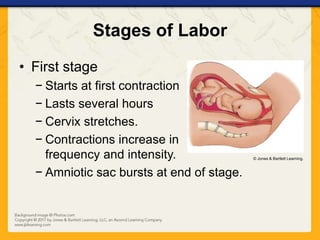
• First stage
− Starts at first contraction
− Lasts several hours
− Cervix stretches.
− Contractions increase in
frequency and intensity.
− Amniotic sac bursts at end of stage.
© Jones & Bartlett Learning.
Stages of Labor
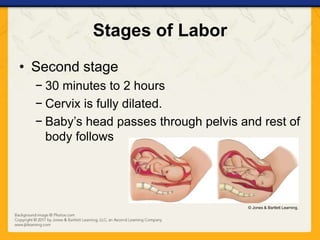
• Second stage
− 30 minutes to 2 hours
− Cervix is fully dilated.
− Baby’s head passes through pelvis and rest of
body follows
© Jones & Bartlett Learning.
Stages of Labor
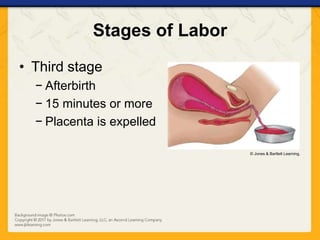
• Third stage
− Afterbirth
− 15 minutes or more
− Placenta is expelled
© Jones & Bartlett Learning.
Imminent Delivery:
What to Look For
• Woman has had a baby before
• Contractions less than 2 minutes apart
• Amniotic sac ruptured
• Mother feels like she must move her
bowels
Imminent Delivery: What to Do
• Wash hands and wear exam gloves.
• Have mother lie in acceptable position.
• Remind woman to take:
− Short, quick breaths during contractions
− Deep breaths between contractions
• Place absorbent, clean materials under
buttocks.
Imminent Delivery: What to Do
• When head appears:
− Place palm over head; apply slight pressure.
− Have woman stop pushing.
− Do not push on fontanelles.
• If amniotic sac does not break, tear with
fingers and push away from baby’s head
and mouth.
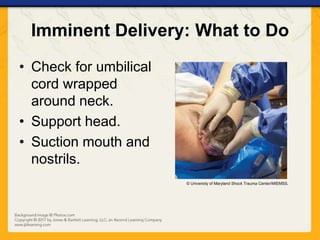
Imminent Delivery: What to Do
• Check for umbilical
cord wrapped
around neck.
• Support head.
• Suction mouth and
nostrils.
© University of Maryland Shock Trauma Center/MIEMSS.
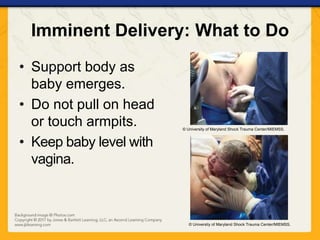
Imminent Delivery: What to Do
• Support body as
baby emerges.
• Do not pull on head
or touch armpits.
• Keep baby level with
vagina.
© University of Maryland Shock Trauma Center/MIEMSS.
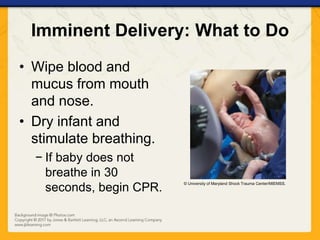
Imminent Delivery: What to Do
• Wipe blood and
mucus from mouth
and nose.
• Dry infant and
stimulate breathing.
− If baby does not
breathe in 30
seconds, begin CPR.
© University of Maryland Shock Trauma Center/MIEMSS.
Imminent Delivery: What to Do
• Wrap infant, place on side, keep level
with vagina.
• Tie the umbilical cord.
• Cutting the cord
− No need to cut if transporting to hospital.
Imminent Delivery: What to Do
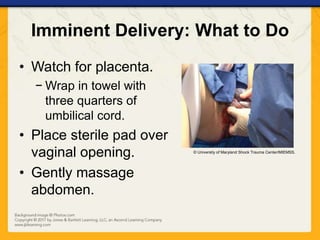
• Watch for placenta.
− Wrap in towel with
three quarters of
umbilical cord.
• Place sterile pad over
vaginal opening.
• Gently massage
abdomen.
© University of Maryland Shock Trauma Center/MIEMSS.
Delivery Aftercare
• Monitor mother’s breathing and pulse.
• Replace sheets and blankets.
• If blood loss continues, massage uterus.
• Encourage mother to breastfeed.
Initial Care of the Newborn
• Monitor breathing and pulse.
• Keep infant warm, dry, comfortable.
• If newborn is motionless:
− Tap bottom of foot or shoulder.
− Perform CPR if unresponsive, not breathing,
or gasping.
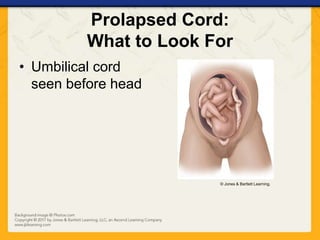
Prolapsed Cord:
What to Look For
• Umbilical cord
seen before head
© Jones & Bartlett Learning.
Prolapsed Cord: What to Do
• Raise mother’s buttocks.
• Insert gloved fingers into vagina on either
side of cord.
− Do not push cord into vagina.
• Call 9-1-1.
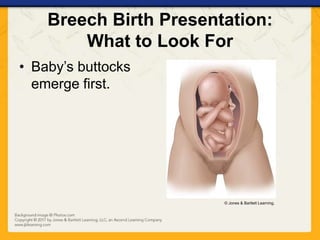
Breech Birth Presentation:
What to Look For
• Baby’s buttocks
emerge first.
© Jones & Bartlett Learning.
Breech Birth Presentation:
What to Do
• Place hand in vagina.
• Form a V with fingers on either side of
baby’s nose.
• Push vaginal wall away from face.
• Call 9-1-1.
• Have woman continue to push.
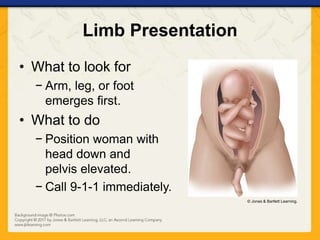
Limb Presentation
• What to look for
− Arm, leg, or foot
emerges first.
• What to do
− Position woman with
head down and
pelvis elevated.
− Call 9-1-1 immediately.
© Jones & Bartlett Learning.
Meconium: What to Look For
• Baby’s first feces in amniotic fluid
• May cause distress and respiratory
problems if breathed into lungs
• Green or brown-yellow amniotic fluid,
almost odorless
Meconium: What to Do
• Keep infant in moderately head-down
position.
• Suction mouth and nostrils.
• Keep baby’s airway open.
• Call 9-1-1.
Premature Birth:
What to Look For
• Birth before 37th week of gestation
• Smaller and thinner infant
• Proportionately larger head
• Cheesy, white coating on skin is minimal
or absent
Premature Birth: What to Do
• Keep warm.
• Keep mouth and nose clear of mucus.
• Monitor breathing.
• Perform CPR if necessary.
Gynecologic Emergencies
• Reproductive system problems that occur
in nonpregnant women
Sexual Assault and Rape
• Rape
− Criminal act of forcing another person to
submit to sexual intercourse
− Physical injury and psychological trauma are
common.
Sexual Assault and Rape:
What to Look For
• Headaches
• Sleeplessness, nightmares
• Nausea, muscle spasms
• Confusion
• Depression
• Anxiety, jumpiness
Sexual Assault and Rape:
What to Do
• Do not ask a lot of questions.
• Do not blame; be supportive.
• Determine which injuries require care.
• Do not expose genitalia unless injury
requires immediate care.
• Try to preserve evidence.
Sexual Assault and Rape:
What to Do
• If person refuses aid:
− Have a friend stay with the person.
− Protect the person’s privacy.
− Provide contact of local rape crisis center.
• Get person to medical care.

Ch22 presentation childbirth_and_gynecologic

  • 1.
    Chapter 22 Childbirth andGynecologic Emergencies
  • 2.
    Childbirth and Gynecologic Emergenciesof Pregnancy • Birth canal: vagina, lower part of uterus • Cervix: opening at lower end of uterus • Placenta: organ through which mother and fetus exchange nourishment and waste
  • 3.
    • Umbilical cord:extension of placenta • Amniotic sac: bag of water surrounding fetus • Crowning: fetus’s head bulges out of vaginal opening Childbirth and Gynecologic Emergencies of Pregnancy
  • 4.
    • Bloody show:mucus and blood discharged during labor • Labor: process of childbirth • Miscarriage: delivery of fetus before it can live independently of mother Childbirth and Gynecologic Emergencies of Pregnancy
  • 5.
    Predelivery Emergencies • Miscarriage −Usually occurs in first trimester − Most occur because fetus was not developing properly.
  • 6.
    Miscarriage: What toLook For • Cramping in lower abdomen • Aching in lower back • Vaginal bleeding − Could be sudden and heavy • Passage of tissue from vagina
  • 7.
    Miscarriage: What todo • Reassure the woman. • Help into comfortable position. • Have her place sanitary pad over the outside of the vagina. • Transport expelled tissue to hospital. • Seek medical care or call 9-1-1.
  • 8.
    Vaginal Bleeding During Pregnancy •Vaginal bleeding in the third trimester constitutes an emergency. • Things to check for: − Extent of bleeding − Pulse rate − Female first aid provider
  • 9.
    Vaginal Bleeding During Pregnancy:What to Look For • Mild spotting • Heavy bleeding • Signs of shock
  • 10.
    Vaginal Bleeding During Pregnancy:What to Do • Place woman on left side. • Have her place sanitary pad over the outside of the vagina. • Call 9-1-1. • Treat for shock.
  • 11.
    Vaginal Bleeding Causedby Injury: What to Look For • Injuries of external genitalia • Severe pain • Bleeding in vaginal area • Massive vaginal bleeding
  • 12.
    Vaginal Bleeding Causedby Injury: What to Do • Place direct pressure over dressing. • Apply ice. • Do not place dressings inside vagina. • Place person on left side. • If sexual assault, explain need for evidence preservation. • Seek medical care.
  • 13.
    Non–Injury-Related Vaginal Bleeding • Mostlikely to be menstrual • Can indicate more serious conditions − Childbirth − Miscarriage − Infection
  • 14.
    Non–Injury-Related Vaginal Bleeding: Whatto Look For • Abdominal cramps • Blood in vaginal area
  • 15.
    Non–Injury-Related Vaginal Bleeding: Whatto Do • Reassure person. • Help her into comfortable position with legs bent. • Have woman place sanitary pad over the outside of vagina. • Seek medical care.
  • 16.
    Imminent Delivery • Onlytransport if: − No urge to push or crowning − First pregnancy • Have woman wear both lap and shoulder seat belts. • If necessary, have her lie on left side.
  • 17.
    Imminent Delivery • Notime to transport if: − Crowning or urge to push − Not a first pregnancy • Call 9-1-1. • Prepare a private, clean area.
  • 18.
    Emergency Delivery • Wearexam gloves. • Do not touch vaginal area. • Do not allow the mother to use the toilet. • Do not hold woman’s legs together.
  • 19.
    Emergency Delivery • Ifhead does not present first: − It is a complicated delivery. − Tell woman to stop pushing. − Call 9-1-1.
  • 20.
    Stages of Labor •First stage − Starts at first contraction − Lasts several hours − Cervix stretches. − Contractions increase in frequency and intensity. − Amniotic sac bursts at end of stage. © Jones & Bartlett Learning.
  • 21.
    Stages of Labor •Second stage − 30 minutes to 2 hours − Cervix is fully dilated. − Baby’s head passes through pelvis and rest of body follows © Jones & Bartlett Learning.
  • 22.
    Stages of Labor •Third stage − Afterbirth − 15 minutes or more − Placenta is expelled © Jones & Bartlett Learning.
  • 23.
    Imminent Delivery: What toLook For • Woman has had a baby before • Contractions less than 2 minutes apart • Amniotic sac ruptured • Mother feels like she must move her bowels
  • 24.
    Imminent Delivery: Whatto Do • Wash hands and wear exam gloves. • Have mother lie in acceptable position. • Remind woman to take: − Short, quick breaths during contractions − Deep breaths between contractions • Place absorbent, clean materials under buttocks.
  • 25.
    Imminent Delivery: Whatto Do • When head appears: − Place palm over head; apply slight pressure. − Have woman stop pushing. − Do not push on fontanelles. • If amniotic sac does not break, tear with fingers and push away from baby’s head and mouth.
  • 26.
    Imminent Delivery: Whatto Do • Check for umbilical cord wrapped around neck. • Support head. • Suction mouth and nostrils. © University of Maryland Shock Trauma Center/MIEMSS.
  • 27.
    Imminent Delivery: Whatto Do • Support body as baby emerges. • Do not pull on head or touch armpits. • Keep baby level with vagina. © University of Maryland Shock Trauma Center/MIEMSS. © University of Maryland Shock Trauma Center/MIEMSS.
  • 28.
    Imminent Delivery: Whatto Do • Wipe blood and mucus from mouth and nose. • Dry infant and stimulate breathing. − If baby does not breathe in 30 seconds, begin CPR. © University of Maryland Shock Trauma Center/MIEMSS.
  • 29.
    Imminent Delivery: Whatto Do • Wrap infant, place on side, keep level with vagina. • Tie the umbilical cord. • Cutting the cord − No need to cut if transporting to hospital.
  • 30.
    Imminent Delivery: Whatto Do • Watch for placenta. − Wrap in towel with three quarters of umbilical cord. • Place sterile pad over vaginal opening. • Gently massage abdomen. © University of Maryland Shock Trauma Center/MIEMSS.
  • 31.
    Delivery Aftercare • Monitormother’s breathing and pulse. • Replace sheets and blankets. • If blood loss continues, massage uterus. • Encourage mother to breastfeed.
  • 32.
    Initial Care ofthe Newborn • Monitor breathing and pulse. • Keep infant warm, dry, comfortable. • If newborn is motionless: − Tap bottom of foot or shoulder. − Perform CPR if unresponsive, not breathing, or gasping.
  • 33.
    Prolapsed Cord: What toLook For • Umbilical cord seen before head © Jones & Bartlett Learning.
  • 34.
    Prolapsed Cord: Whatto Do • Raise mother’s buttocks. • Insert gloved fingers into vagina on either side of cord. − Do not push cord into vagina. • Call 9-1-1.
  • 35.
    Breech Birth Presentation: Whatto Look For • Baby’s buttocks emerge first. © Jones & Bartlett Learning.
  • 36.
    Breech Birth Presentation: Whatto Do • Place hand in vagina. • Form a V with fingers on either side of baby’s nose. • Push vaginal wall away from face. • Call 9-1-1. • Have woman continue to push.
  • 37.
    Limb Presentation • Whatto look for − Arm, leg, or foot emerges first. • What to do − Position woman with head down and pelvis elevated. − Call 9-1-1 immediately. © Jones & Bartlett Learning.
  • 38.
    Meconium: What toLook For • Baby’s first feces in amniotic fluid • May cause distress and respiratory problems if breathed into lungs • Green or brown-yellow amniotic fluid, almost odorless
  • 39.
    Meconium: What toDo • Keep infant in moderately head-down position. • Suction mouth and nostrils. • Keep baby’s airway open. • Call 9-1-1.
  • 40.
    Premature Birth: What toLook For • Birth before 37th week of gestation • Smaller and thinner infant • Proportionately larger head • Cheesy, white coating on skin is minimal or absent
  • 41.
    Premature Birth: Whatto Do • Keep warm. • Keep mouth and nose clear of mucus. • Monitor breathing. • Perform CPR if necessary.
  • 42.
    Gynecologic Emergencies • Reproductivesystem problems that occur in nonpregnant women
  • 43.
    Sexual Assault andRape • Rape − Criminal act of forcing another person to submit to sexual intercourse − Physical injury and psychological trauma are common.
  • 44.
    Sexual Assault andRape: What to Look For • Headaches • Sleeplessness, nightmares • Nausea, muscle spasms • Confusion • Depression • Anxiety, jumpiness
  • 45.
    Sexual Assault andRape: What to Do • Do not ask a lot of questions. • Do not blame; be supportive. • Determine which injuries require care. • Do not expose genitalia unless injury requires immediate care. • Try to preserve evidence.
  • 46.
    Sexual Assault andRape: What to Do • If person refuses aid: − Have a friend stay with the person. − Protect the person’s privacy. − Provide contact of local rape crisis center. • Get person to medical care.