FORENSIC BALLISTICS
DR AMEER CT MD(Hom)
Assistant Professor
Father Muller Homoeopathic Medical College, Mangalore
At the end of the session, you will be able to
 Define forensic ballistics and firearms
 Understand different types of firearms and
ammunitions
 Differentiate features of entry and exit wounds
in firearms
 Enlist Medico-legal aspects
Forensic Ballistics
The Science dealing with the investigation
of firearms, ammunition, and the problems
arising from their use
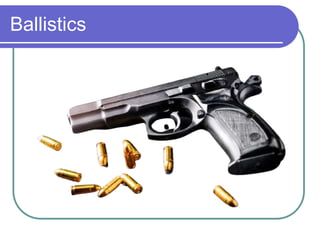
Ballistics
Ballistics
Ballistics
1. Proximal (Internal) Ballistics
Study of firearms and projectile
2. Intermediate (Exterior) Ballistics
Study of motion of projectile after it leaves the gun barrel
till the time it hits the target
3. Terminal Ballistics
Study of behaviour of missiles once they penetrate target
4. Wound Ballistics
Study of the effects of missiles on living tissue
FIREARMS
Firearms
Any weapon which discharge a missile by
the expansive force of the gases produced
by burning of an explosive substance
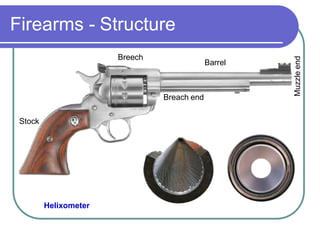
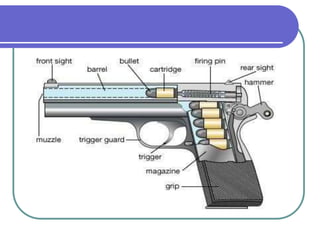
Firearms - Structure
Stock
Breech
Barrel
Breach end
Muzzle
end
Helixometer
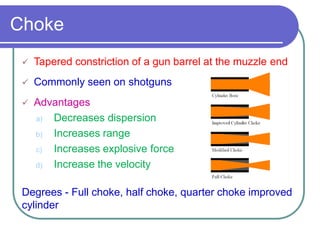
Choke
 Tapered constriction of a gun barrel at the muzzle end
 Commonly seen on shotguns
 Advantages
a) Decreases dispersion
b) Increases range
c) Increases explosive force
d) Increase the velocity
Degrees - Full choke, half choke, quarter choke improved
cylinder
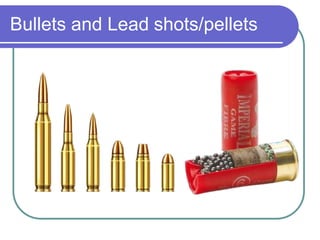
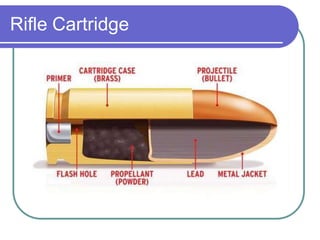
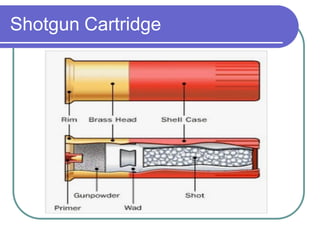
Bullets and Lead shots/pellets
Rifle Cartridge
Shotgun Cartridge
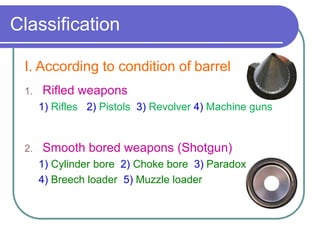
Classification
I. According to condition of barrel
1. Rifled weapons
1) Rifles 2) Pistols 3) Revolver 4) Machine guns
2. Smooth bored weapons (Shotgun)
1) Cylinder bore 2) Choke bore 3) Paradox
4) Breech loader 5) Muzzle loader
Classification
II. According to firing action
1) Over-bolt action 2) Under-bolt action
3) Lever action 4) Pump action / auto-loading model
III. According to barrel length
1) Side arms – Shot barrels gun. (Pistol, Revolver)
2) Shoulder arms – Long barrel gun. (Rifles)
FIREARM WOUNDS
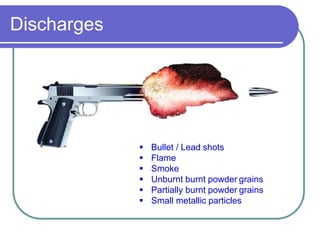
Discharges
 Bullet / Lead shots
 Flame
 Smoke
 Unburnt burnt powder grains
 Partially burnt powder grains
 Small metallic particles
Extension
Shotguns
Flame - upto 15cm
Smoke - upto 30cm
Unburnt & partially burnt powder grains - upto 60 - 90cm
Riffle
Flame - upto 8cm
Smoke - upto 15cm
Unburnt & partially burnt powder grains - upto 40 - 50cm
Small metallic particles - upto 40 - 50cm
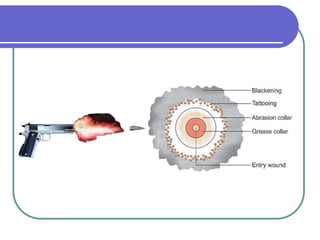
Abrasion collar / marginal abrasion: abrasion around the hole due
to rubbing of the gyrating body of the bullet against the inverted
epidermis and heat of the bullet
Grease or dirt collar / bullet wipe soiling: black coloured narrow
ring of skin, lining the defect and is sharply outlined from the removal
of substances from the bullet as it passes through the skin
Back spatter: suck of blood, hair, fragments of tissues, cloth fibres
back to the barrel
Smudging / fouling / blackening: deposit of smoke / fragments of
metal
Tattooing / stippling / peppering: Unburnt particles of the powder
are embedded in the skin
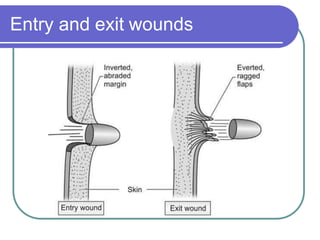
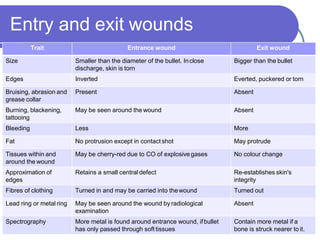
Entry and exit wounds
Trait Entrance wound Exit wound
Size Smaller than the diameter of the bullet. Inclose
discharge, skin is torn
Bigger than the bullet
Edges Inverted Everted, puckered or torn
Bruising, abrasion and
grease collar
Present Absent
Burning, blackening,
tattooing
May be seen around the wound Absent
Bleeding Less More
Fat No protrusion except in contact shot May protrude
Tissues within and
around the wound
May be cherry-red due to CO of explosive gases No colour change
Approximation of
edges
Retains a small central defect Re-establishes skin's
integrity
Fibres of clothing Turned in and may be carried into thewound Turned out
Lead ring or metal ring May be seen around the wound byradiological
examination
Absent
Spectrography More metal is found around entrance wound, ifbullet
has only passed through softtissues
Contain more metal if a
bone is struck nearer to it.
Wounds from Shotguns
Character of wounds depends on
1. Distance from which the weapon is discharged
a) Contact and near contact wounds
b) Close range (up to one metre)
c) Short range (1 to 2 metres)
d) Intermediate range (2 to 4 metres)
e) Long or Distant range (above 4 metres)
2. Size of the shots
3. Nature of the explosive
4. Gun itself
Character of wounds - shotguns
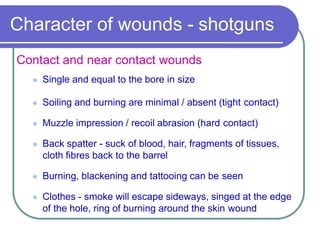
Contact and near contact wounds
 Single and equal to the bore in size
 Soiling and burning are minimal / absent (tight contact)
 Muzzle impression / recoil abrasion (hard contact)
 Back spatter - suck of blood, hair, fragments of tissues,
cloth fibres back to the barrel
 Burning, blackening and tattooing can be seen
 Clothes - smoke will escape sideways, singed at the edge
of the hole, ring of burning around the skin wound
Character of wounds - shotguns
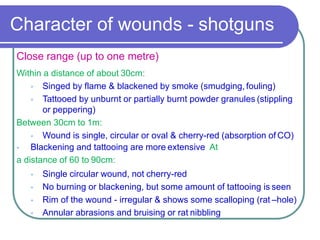
Close range (up to one metre)
Within a distance of about 30cm:
 Singed by flame & blackened by smoke (smudging, fouling)
 Tattooed by unburnt or partially burnt powder granules (stippling
or peppering)
Between 30cm to 1m:
 Wound is single, circular or oval & cherry-red (absorption of CO)
 Blackening and tattooing are more extensive At
a distance of 60 to 90cm:
 Single circular wound, not cherry-red
 No burning or blackening, but some amount of tattooing is seen
 Rim of the wound - irregular & shows some scalloping (rat –hole)
 Annular abrasions and bruising or rat nibbling
Character of wounds - shotguns
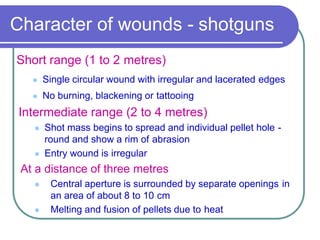
Short range (1 to 2 metres)
 Single circular wound with irregular and lacerated edges
 No burning, blackening or tattooing
Intermediate range (2 to 4 metres)
 Shot mass begins to spread and individual pellet hole -
round and show a rim of abrasion
 Entry wound is irregular
At a distance of three metres
 Central aperture is surrounded by separate openings in
an area of about 8 to 10 cm
 Melting and fusion of pellets due to heat
Character of wounds - shotguns
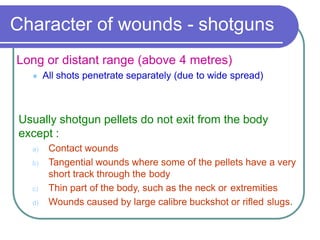
Long or distant range (above 4 metres)
 All shots penetrate separately (due to wide spread)
Usually shotgun pellets do not exit from the body
except :
a) Contact wounds
b) Tangential wounds where some of the pellets have a very
short track through the body
c) Thin part of the body, such as the neck or extremities
d) Wounds caused by large calibre buckshot or rifled slugs.
Wounds from Riffled weapon
Revolver / Automatic Pistol / Riffle
Character of wounds (Entry wound) depends on
Distance from which the weapon is discharged
1. Contact shot: In firm or hard contact
2. Close shot: 5 - 8cm
3. Near shot: up to 50cm
4. Distant shot: above 50cm
Contact shot: In firm or hard contact
 Similar to shotgun
Close shot: (flame up to 5 - 8cm)
 Entrance wound is circular with inverted edges
 Bruising, burning, blackening and tattooing
 Abrasion collar and grease or dirt collar - present
Near shot: (flame up to 50cm)
 Entry wound - round hole, slightly smaller than the
diameter of the bullet, due to elasticity of the skin,
 Bruised and inverted margin, blackening and tattooing
 Abrasion and grease collar - present
Distant shot: above 50cm
 Entrance wound – circular, smaller than the missile due
to the elasticity of the skin, and margins are inverted
 Burning, blackening and tattooing are not seen (Pseudo-
tattooing in case of intermediary target)
 X-ray gives a picture of lead snowstorm
Types of bullets
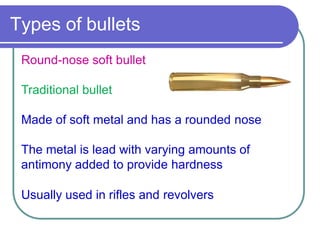
Round-nose soft bullet
Traditional bullet
Made of soft metal and has a rounded nose
The metal is lead with varying amounts of
antimony added to provide hardness
Usually used in rifles and revolvers
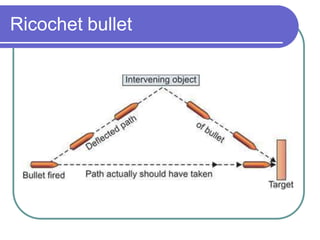
Ricochet bullet
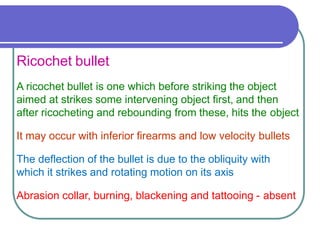
Ricochet bullet
A ricochet bullet is one which before striking the object
aimed at strikes some intervening object first, and then
after ricocheting and rebounding from these, hits the object
It may occur with inferior firearms and low velocity bullets
The deflection of the bullet is due to the obliquity with
which it strikes and rotating motion on its axis
Abrasion collar, burning, blackening and tattooing - absent
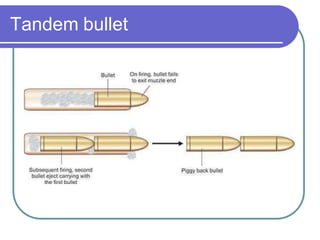
Tandem bullet
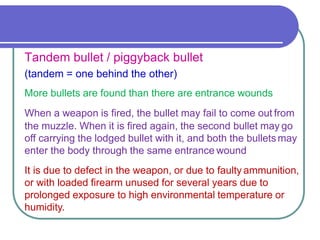
Tandem bullet / piggyback bullet
(tandem = one behind the other)
More bullets are found than there are entrance wounds
When a weapon is fired, the bullet may fail to come out from
the muzzle. When it is fired again, the second bullet may go
off carrying the lodged bullet with it, and both the bulletsmay
enter the body through the same entrance wound
It is due to defect in the weapon, or due to faulty ammunition,
or with loaded firearm unused for several years due to
prolonged exposure to high environmental temperature or
humidity.
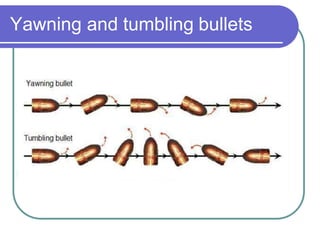
Yawning and tumbling bullets
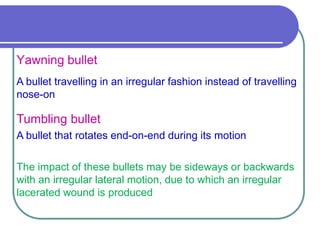
Yawning bullet
A bullet travelling in an irregular fashion instead of travelling
nose-on
Tumbling bullet
A bullet that rotates end-on-end during its motion
The impact of these bullets may be sideways or backwards
with an irregular lateral motion, due to which an irregular
lacerated wound is produced
Souvenir bullets
If a bullet is present for a long time in the body,
there will be no fresh bleeding in the surrounding
area and a dense fibrous tissue capsule usually
surrounds it.
A small scar indicates the original entrance wound
Lead poisoning may occur due to absorption of
lead from lead bullets remaining in a body.
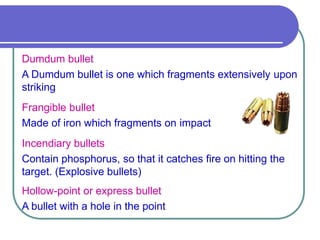
Dumdum bullet
A Dumdum bullet is one which fragments extensively upon
striking
Frangible bullet
Made of iron which fragments on impact
Incendiary bullets
Contain phosphorus, so that it catches fire on hitting the
target. (Explosive bullets)
Hollow-point or express bullet
A bullet with a hole in the point
Medico-legal aspects
 Kind of weapon
 Range of fire
 Direction of fire
 Time of firearm discharge
 Cause of death
 Manner of death – Suicide, homicide, accidental
At the end of the session, you are able to
 Define forensic ballistics and firearms
 Understand different types of firearms and
ammunitions
 Differentiate features of entry and exit wounds
in firearms
 Enlist Medico-legal aspects
Thank you

firearms-

  • 1.
    FORENSIC BALLISTICS DR AMEERCT MD(Hom) Assistant Professor Father Muller Homoeopathic Medical College, Mangalore
  • 2.
    At the endof the session, you will be able to  Define forensic ballistics and firearms  Understand different types of firearms and ammunitions  Differentiate features of entry and exit wounds in firearms  Enlist Medico-legal aspects
  • 3.
    Forensic Ballistics The Sciencedealing with the investigation of firearms, ammunition, and the problems arising from their use
  • 4.
  • 5.
  • 6.
    Ballistics 1. Proximal (Internal)Ballistics Study of firearms and projectile 2. Intermediate (Exterior) Ballistics Study of motion of projectile after it leaves the gun barrel till the time it hits the target 3. Terminal Ballistics Study of behaviour of missiles once they penetrate target 4. Wound Ballistics Study of the effects of missiles on living tissue
  • 7.
  • 8.
    Firearms Any weapon whichdischarge a missile by the expansive force of the gases produced by burning of an explosive substance
  • 9.
  • 11.
    Choke  Tapered constrictionof a gun barrel at the muzzle end  Commonly seen on shotguns  Advantages a) Decreases dispersion b) Increases range c) Increases explosive force d) Increase the velocity Degrees - Full choke, half choke, quarter choke improved cylinder
  • 12.
    Bullets and Leadshots/pellets
  • 13.
  • 14.
  • 15.
    Classification I. According tocondition of barrel 1. Rifled weapons 1) Rifles 2) Pistols 3) Revolver 4) Machine guns 2. Smooth bored weapons (Shotgun) 1) Cylinder bore 2) Choke bore 3) Paradox 4) Breech loader 5) Muzzle loader
  • 16.
    Classification II. According tofiring action 1) Over-bolt action 2) Under-bolt action 3) Lever action 4) Pump action / auto-loading model III. According to barrel length 1) Side arms – Shot barrels gun. (Pistol, Revolver) 2) Shoulder arms – Long barrel gun. (Rifles)
  • 17.
  • 18.
    Discharges  Bullet /Lead shots  Flame  Smoke  Unburnt burnt powder grains  Partially burnt powder grains  Small metallic particles
  • 19.
    Extension Shotguns Flame - upto15cm Smoke - upto 30cm Unburnt & partially burnt powder grains - upto 60 - 90cm Riffle Flame - upto 8cm Smoke - upto 15cm Unburnt & partially burnt powder grains - upto 40 - 50cm Small metallic particles - upto 40 - 50cm
  • 21.
    Abrasion collar /marginal abrasion: abrasion around the hole due to rubbing of the gyrating body of the bullet against the inverted epidermis and heat of the bullet Grease or dirt collar / bullet wipe soiling: black coloured narrow ring of skin, lining the defect and is sharply outlined from the removal of substances from the bullet as it passes through the skin Back spatter: suck of blood, hair, fragments of tissues, cloth fibres back to the barrel Smudging / fouling / blackening: deposit of smoke / fragments of metal Tattooing / stippling / peppering: Unburnt particles of the powder are embedded in the skin
  • 22.
  • 23.
    Entry and exitwounds Trait Entrance wound Exit wound Size Smaller than the diameter of the bullet. Inclose discharge, skin is torn Bigger than the bullet Edges Inverted Everted, puckered or torn Bruising, abrasion and grease collar Present Absent Burning, blackening, tattooing May be seen around the wound Absent Bleeding Less More Fat No protrusion except in contact shot May protrude Tissues within and around the wound May be cherry-red due to CO of explosive gases No colour change Approximation of edges Retains a small central defect Re-establishes skin's integrity Fibres of clothing Turned in and may be carried into thewound Turned out Lead ring or metal ring May be seen around the wound byradiological examination Absent Spectrography More metal is found around entrance wound, ifbullet has only passed through softtissues Contain more metal if a bone is struck nearer to it.
  • 24.
    Wounds from Shotguns Characterof wounds depends on 1. Distance from which the weapon is discharged a) Contact and near contact wounds b) Close range (up to one metre) c) Short range (1 to 2 metres) d) Intermediate range (2 to 4 metres) e) Long or Distant range (above 4 metres) 2. Size of the shots 3. Nature of the explosive 4. Gun itself
  • 25.
    Character of wounds- shotguns Contact and near contact wounds  Single and equal to the bore in size  Soiling and burning are minimal / absent (tight contact)  Muzzle impression / recoil abrasion (hard contact)  Back spatter - suck of blood, hair, fragments of tissues, cloth fibres back to the barrel  Burning, blackening and tattooing can be seen  Clothes - smoke will escape sideways, singed at the edge of the hole, ring of burning around the skin wound
  • 26.
    Character of wounds- shotguns Close range (up to one metre) Within a distance of about 30cm:  Singed by flame & blackened by smoke (smudging, fouling)  Tattooed by unburnt or partially burnt powder granules (stippling or peppering) Between 30cm to 1m:  Wound is single, circular or oval & cherry-red (absorption of CO)  Blackening and tattooing are more extensive At a distance of 60 to 90cm:  Single circular wound, not cherry-red  No burning or blackening, but some amount of tattooing is seen  Rim of the wound - irregular & shows some scalloping (rat –hole)  Annular abrasions and bruising or rat nibbling
  • 27.
    Character of wounds- shotguns Short range (1 to 2 metres)  Single circular wound with irregular and lacerated edges  No burning, blackening or tattooing Intermediate range (2 to 4 metres)  Shot mass begins to spread and individual pellet hole - round and show a rim of abrasion  Entry wound is irregular At a distance of three metres  Central aperture is surrounded by separate openings in an area of about 8 to 10 cm  Melting and fusion of pellets due to heat
  • 28.
    Character of wounds- shotguns Long or distant range (above 4 metres)  All shots penetrate separately (due to wide spread) Usually shotgun pellets do not exit from the body except : a) Contact wounds b) Tangential wounds where some of the pellets have a very short track through the body c) Thin part of the body, such as the neck or extremities d) Wounds caused by large calibre buckshot or rifled slugs.
  • 29.
    Wounds from Riffledweapon Revolver / Automatic Pistol / Riffle Character of wounds (Entry wound) depends on Distance from which the weapon is discharged 1. Contact shot: In firm or hard contact 2. Close shot: 5 - 8cm 3. Near shot: up to 50cm 4. Distant shot: above 50cm
  • 30.
    Contact shot: Infirm or hard contact  Similar to shotgun Close shot: (flame up to 5 - 8cm)  Entrance wound is circular with inverted edges  Bruising, burning, blackening and tattooing  Abrasion collar and grease or dirt collar - present
  • 31.
    Near shot: (flameup to 50cm)  Entry wound - round hole, slightly smaller than the diameter of the bullet, due to elasticity of the skin,  Bruised and inverted margin, blackening and tattooing  Abrasion and grease collar - present Distant shot: above 50cm  Entrance wound – circular, smaller than the missile due to the elasticity of the skin, and margins are inverted  Burning, blackening and tattooing are not seen (Pseudo- tattooing in case of intermediary target)  X-ray gives a picture of lead snowstorm
  • 32.
    Types of bullets Round-nosesoft bullet Traditional bullet Made of soft metal and has a rounded nose The metal is lead with varying amounts of antimony added to provide hardness Usually used in rifles and revolvers
  • 33.
  • 34.
    Ricochet bullet A ricochetbullet is one which before striking the object aimed at strikes some intervening object first, and then after ricocheting and rebounding from these, hits the object It may occur with inferior firearms and low velocity bullets The deflection of the bullet is due to the obliquity with which it strikes and rotating motion on its axis Abrasion collar, burning, blackening and tattooing - absent
  • 35.
  • 36.
    Tandem bullet /piggyback bullet (tandem = one behind the other) More bullets are found than there are entrance wounds When a weapon is fired, the bullet may fail to come out from the muzzle. When it is fired again, the second bullet may go off carrying the lodged bullet with it, and both the bulletsmay enter the body through the same entrance wound It is due to defect in the weapon, or due to faulty ammunition, or with loaded firearm unused for several years due to prolonged exposure to high environmental temperature or humidity.
  • 37.
  • 38.
    Yawning bullet A bullettravelling in an irregular fashion instead of travelling nose-on Tumbling bullet A bullet that rotates end-on-end during its motion The impact of these bullets may be sideways or backwards with an irregular lateral motion, due to which an irregular lacerated wound is produced
  • 39.
    Souvenir bullets If abullet is present for a long time in the body, there will be no fresh bleeding in the surrounding area and a dense fibrous tissue capsule usually surrounds it. A small scar indicates the original entrance wound Lead poisoning may occur due to absorption of lead from lead bullets remaining in a body.
  • 40.
    Dumdum bullet A Dumdumbullet is one which fragments extensively upon striking Frangible bullet Made of iron which fragments on impact Incendiary bullets Contain phosphorus, so that it catches fire on hitting the target. (Explosive bullets) Hollow-point or express bullet A bullet with a hole in the point
  • 41.
    Medico-legal aspects  Kindof weapon  Range of fire  Direction of fire  Time of firearm discharge  Cause of death  Manner of death – Suicide, homicide, accidental
  • 42.
    At the endof the session, you are able to  Define forensic ballistics and firearms  Understand different types of firearms and ammunitions  Differentiate features of entry and exit wounds in firearms  Enlist Medico-legal aspects
  • 43.