TOPIC: Gunshot & Stab Wound
LECTURER: Dr. Jalloh
1
Objectives
 Upon successful completion of this session, student will
be able:
 Characteristics of gunshot wounds
 Types of gunshot wounds
 Types of wounds
 Identify relationship between kinetic energy and
prediction of injury
 Identify how energy is transmitted from a penetrating
object to body tissue
 Identify characteristics of handguns, shotguns and
rifles
 Identify organ injuries associated with gunshot
injuries
2
Objectives cont’d
Identify management goals for a patient with
gunshot wounds
Identify items that could cause stab/penetration
trauma
Identify potential internal organ injuries dependent
on item causing stab/penetration injury
Identify management goals for a stab/penetrating
trauma patient
3
Gunshots…
4
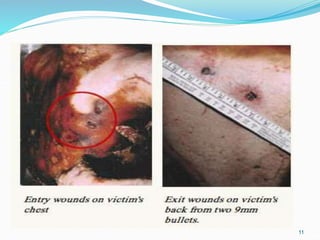
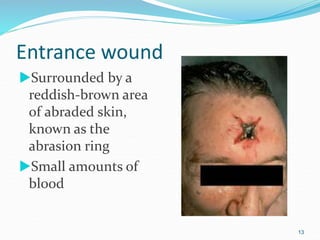
1. Entrance wounds can be round, oval or irregular (atypical)
an abrasion ring is almost always present.
2. Exit wounds are usually irregular and there is no abrasion
ring in the vast majority of cases
3. The wound mechanism and injury severity are mostly
related to the kinetic energy transferred by the bullet to the
tissues
4. Inverted edges due to the bullet movement inside the body
5
1. Penetrating wounds : the bullet enters the body but does
not exit
2. Perforating wounds: the bullet enters and exist the body
3. Re – entry wounds: the bullet passes through a body
segment, exits and re- enters the body
4. Tangential wounds: the bullet strikes the skin at a shallow
angle producing a superficial wound
6
A wound is damage to the tissues of the body caused by a
mechanical force. This includes shooting , knifing and
explosives etc.
1. ABRAISON:
This is injury caused by a tangential (at an angle) and
glancing(short lived) force to the superficial layer of the skin
that is epidermis. There is rarely any bleeding because blood
vessels lie in the deeper layer of the skin in the dermis.
2. BRUISES:
These are injuries to the deeper layer of the skin the dermis
caused by blunt trauma. The force caused rupture of the
capillaries in the dermis of the skin which bleeds
7
3. LACERATION
This is injury caused by blunt force trauma to the deeper
layers of the skin that is the dermis with associated bleeding.
The wound edges may be tissue bridging (go across) the wound
edge.
4. INCISION WOUNDS
These are caused by sharp objects causing injury to the deeper
layer of the skin. There is associated profused bleeding. The
wound edges are sharply demarcated with no tissue bridging.
TWO TYPES OF INCISION WOUNDS
a. SLASH WOUND; The length is greater than the depth
b. STAB WOUND; The depth is greater than the length
8
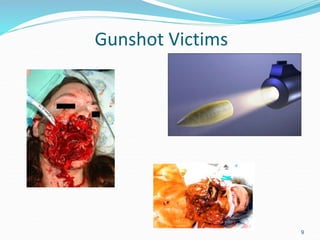
Gunshot Victims
9
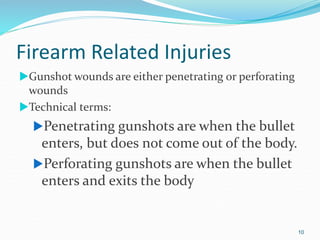
Firearm Related Injuries
Gunshot wounds are either penetrating or perforating
wounds
Technical terms:
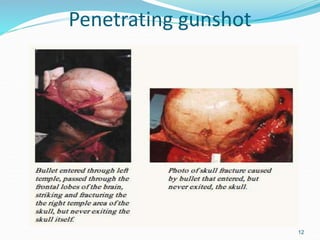
Penetrating gunshots are when the bullet
enters, but does not come out of the body.
Perforating gunshots are when the bullet
enters and exits the body
10
Perforating Gunshots
11
Penetrating gunshot
12
Entrance wound
Surrounded by a
reddish-brown area
of abraded skin,
known as the
abrasion ring
Small amounts of
blood
13
Mechanism of Energy Exchange
As bullet passes through tissue, it decelerates,
dissipating and transferring kinetic energy to tissues
Cause of the injury is the kinetic energy
Velocity more important than mass in determining
how much damage is done
Small bullet at high speed will do more
damage than large bullet at slow speed
14
Mechanism of Energy Exchange
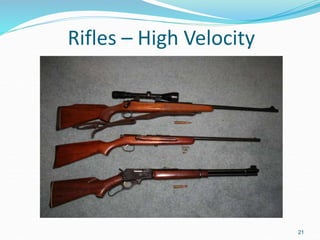
 High velocity
 High powered rifles; hunting rifles
 Sniper rifles
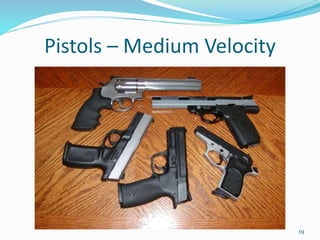
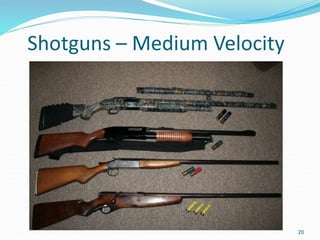
 Medium velocity
 Handguns, shotguns
 Compound bows and arrows (higher energy released)
 Low velocity
 Knives, arrows
 Falling through plate glass window, stepping on sharp
objects.
15
Medium & High Velocity
 These items are usually propelled by gunpowder or
other explosive
 Faster the object, the deeper the injury
 Causes damage to the tissue it impacts
 Creates a “pressure wave” which causes damage
frequently greater than the tissue directly impacted
 If bone is struck, bone shatters and multiple bone
fragments are dispersed
16
Low velocity
 Usually a result of items such as knives that are
propelled by a person’s own power
 Also includes objects inadvertently stepped on
 Includes many objects a casualty may be impaled on
 Damage usually limited to the area directly in contact
with the object
17
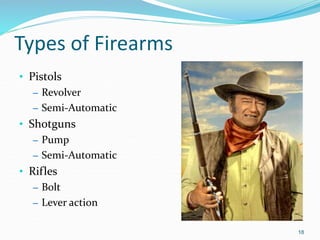
Types of Firearms
• Pistols
– Revolver
– Semi-Automatic
• Shotguns
– Pump
– Semi-Automatic
• Rifles
– Bolt
– Lever action
18
Pistols – Medium Velocity
19
Shotguns – Medium Velocity
20
Rifles – High Velocity
21
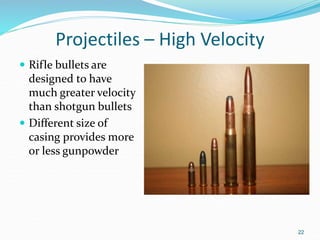
Projectiles – High Velocity
 Rifle bullets are
designed to have
much greater velocity
than shotgun bullets
 Different size of
casing provides more
or less gunpowder
22
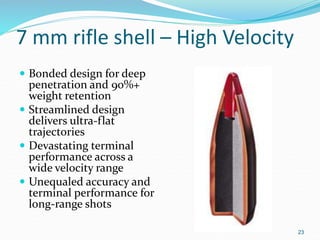
7 mm rifle shell – High Velocity
 Bonded design for deep
penetration and 90%+
weight retention
 Streamlined design
delivers ultra-flat
trajectories
 Devastating terminal
performance across a
wide velocity range
 Unequaled accuracy and
terminal performance for
long-range shots
23
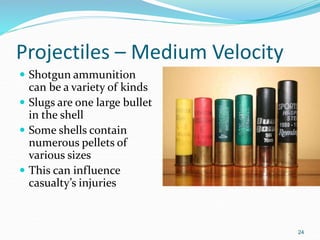
Projectiles – Medium Velocity
 Shotgun ammunition
can be a variety of kinds
 Slugs are one large bullet
in the shell
 Some shells contain
numerous pellets of
various sizes
 This can influence
casualty’s injuries
24
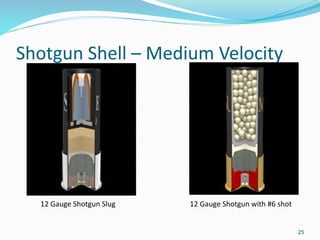
Shotgun Shell – Medium Velocity
25
12 Gauge Shotgun Slug 12 Gauge Shotgun with #6 shot
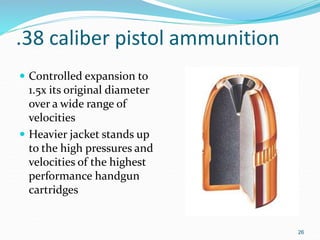
.38 caliber pistol ammunition
 Controlled expansion to
1.5x its original diameter
over a wide range of
velocities
 Heavier jacket stands up
to the high pressures and
velocities of the highest
performance handgun
cartridges
26
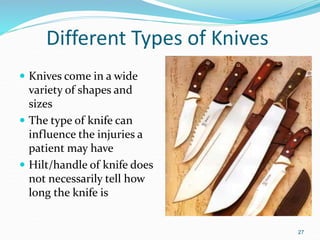
Different Types of Knives
 Knives come in a wide
variety of shapes and
sizes
 The type of knife can
influence the injuries a
patient may have
 Hilt/handle of knife does
not necessarily tell how
long the knife is
27
Anticipation of Injury
 Trajectory may or may not be straight
 Knowing anatomy helps anticipate organ injury
 Anticipating organ injury helps in knowing what signs
and symptoms to watch for
 Anticipation of injury = proactive care
 Head wound = monitoring level of consciousness
 Chest wound = assessing lung sounds
 Abdominal wound = assessing internal blood loss
28
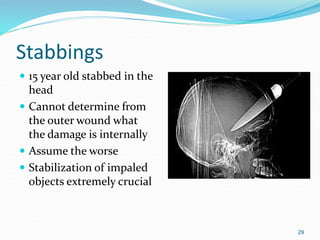
Stabbings
 15 year old stabbed in the
head
 Cannot determine from
the outer wound what
the damage is internally
 Assume the worse
 Stabilization of impaled
objects extremely crucial
29
Police Officer Stabbing
What injuries do you suspect?
30
Principles of Wound Care
 What are principles of wound care for previous
wounds?
 Scene safety – even in the ED
 Do your ABC Approach
 Control bleeding
 Usually little to no bleeding while object still
impaled
 Prevent further damage
 Immobilize the object in place
 Gauze, tape, whatever it takes
 Reduce infection
 Prevent further contamination
31
Field Management Goals
 Critical casualty need rapid transport.
 Difficult to assess internal damage in the field
 Stop any visible bleeding that could cause hemorrhage
 hypovolemia
 Address airway issues
 Tension Pneumothorax chest decompression
 Suction to keep airway open
 Intubate to secure the airway
 Surgery is the answer to critical gunshots
32
Field Management Goals
Focus on the basics
If there is a hole – plug it
If there is bleeding – stop it
If they can’t breathe – ventilate
33
Thank you
34

First Aid gunshot wound.power point presentation

  • 1.
    TOPIC: Gunshot &Stab Wound LECTURER: Dr. Jalloh 1
  • 2.
    Objectives  Upon successfulcompletion of this session, student will be able:  Characteristics of gunshot wounds  Types of gunshot wounds  Types of wounds  Identify relationship between kinetic energy and prediction of injury  Identify how energy is transmitted from a penetrating object to body tissue  Identify characteristics of handguns, shotguns and rifles  Identify organ injuries associated with gunshot injuries 2
  • 3.
    Objectives cont’d Identify managementgoals for a patient with gunshot wounds Identify items that could cause stab/penetration trauma Identify potential internal organ injuries dependent on item causing stab/penetration injury Identify management goals for a stab/penetrating trauma patient 3
  • 4.
  • 5.
    1. Entrance woundscan be round, oval or irregular (atypical) an abrasion ring is almost always present. 2. Exit wounds are usually irregular and there is no abrasion ring in the vast majority of cases 3. The wound mechanism and injury severity are mostly related to the kinetic energy transferred by the bullet to the tissues 4. Inverted edges due to the bullet movement inside the body 5
  • 6.
    1. Penetrating wounds: the bullet enters the body but does not exit 2. Perforating wounds: the bullet enters and exist the body 3. Re – entry wounds: the bullet passes through a body segment, exits and re- enters the body 4. Tangential wounds: the bullet strikes the skin at a shallow angle producing a superficial wound 6
  • 7.
    A wound isdamage to the tissues of the body caused by a mechanical force. This includes shooting , knifing and explosives etc. 1. ABRAISON: This is injury caused by a tangential (at an angle) and glancing(short lived) force to the superficial layer of the skin that is epidermis. There is rarely any bleeding because blood vessels lie in the deeper layer of the skin in the dermis. 2. BRUISES: These are injuries to the deeper layer of the skin the dermis caused by blunt trauma. The force caused rupture of the capillaries in the dermis of the skin which bleeds 7
  • 8.
    3. LACERATION This isinjury caused by blunt force trauma to the deeper layers of the skin that is the dermis with associated bleeding. The wound edges may be tissue bridging (go across) the wound edge. 4. INCISION WOUNDS These are caused by sharp objects causing injury to the deeper layer of the skin. There is associated profused bleeding. The wound edges are sharply demarcated with no tissue bridging. TWO TYPES OF INCISION WOUNDS a. SLASH WOUND; The length is greater than the depth b. STAB WOUND; The depth is greater than the length 8
  • 9.
  • 10.
    Firearm Related Injuries Gunshotwounds are either penetrating or perforating wounds Technical terms: Penetrating gunshots are when the bullet enters, but does not come out of the body. Perforating gunshots are when the bullet enters and exits the body 10
  • 11.
  • 12.
  • 13.
    Entrance wound Surrounded bya reddish-brown area of abraded skin, known as the abrasion ring Small amounts of blood 13
  • 14.
    Mechanism of EnergyExchange As bullet passes through tissue, it decelerates, dissipating and transferring kinetic energy to tissues Cause of the injury is the kinetic energy Velocity more important than mass in determining how much damage is done Small bullet at high speed will do more damage than large bullet at slow speed 14
  • 15.
    Mechanism of EnergyExchange  High velocity  High powered rifles; hunting rifles  Sniper rifles  Medium velocity  Handguns, shotguns  Compound bows and arrows (higher energy released)  Low velocity  Knives, arrows  Falling through plate glass window, stepping on sharp objects. 15
  • 16.
    Medium & HighVelocity  These items are usually propelled by gunpowder or other explosive  Faster the object, the deeper the injury  Causes damage to the tissue it impacts  Creates a “pressure wave” which causes damage frequently greater than the tissue directly impacted  If bone is struck, bone shatters and multiple bone fragments are dispersed 16
  • 17.
    Low velocity  Usuallya result of items such as knives that are propelled by a person’s own power  Also includes objects inadvertently stepped on  Includes many objects a casualty may be impaled on  Damage usually limited to the area directly in contact with the object 17
  • 18.
    Types of Firearms •Pistols – Revolver – Semi-Automatic • Shotguns – Pump – Semi-Automatic • Rifles – Bolt – Lever action 18
  • 19.
    Pistols – MediumVelocity 19
  • 20.
  • 21.
    Rifles – HighVelocity 21
  • 22.
    Projectiles – HighVelocity  Rifle bullets are designed to have much greater velocity than shotgun bullets  Different size of casing provides more or less gunpowder 22
  • 23.
    7 mm rifleshell – High Velocity  Bonded design for deep penetration and 90%+ weight retention  Streamlined design delivers ultra-flat trajectories  Devastating terminal performance across a wide velocity range  Unequaled accuracy and terminal performance for long-range shots 23
  • 24.
    Projectiles – MediumVelocity  Shotgun ammunition can be a variety of kinds  Slugs are one large bullet in the shell  Some shells contain numerous pellets of various sizes  This can influence casualty’s injuries 24
  • 25.
    Shotgun Shell –Medium Velocity 25 12 Gauge Shotgun Slug 12 Gauge Shotgun with #6 shot
  • 26.
    .38 caliber pistolammunition  Controlled expansion to 1.5x its original diameter over a wide range of velocities  Heavier jacket stands up to the high pressures and velocities of the highest performance handgun cartridges 26
  • 27.
    Different Types ofKnives  Knives come in a wide variety of shapes and sizes  The type of knife can influence the injuries a patient may have  Hilt/handle of knife does not necessarily tell how long the knife is 27
  • 28.
    Anticipation of Injury Trajectory may or may not be straight  Knowing anatomy helps anticipate organ injury  Anticipating organ injury helps in knowing what signs and symptoms to watch for  Anticipation of injury = proactive care  Head wound = monitoring level of consciousness  Chest wound = assessing lung sounds  Abdominal wound = assessing internal blood loss 28
  • 29.
    Stabbings  15 yearold stabbed in the head  Cannot determine from the outer wound what the damage is internally  Assume the worse  Stabilization of impaled objects extremely crucial 29
  • 30.
    Police Officer Stabbing Whatinjuries do you suspect? 30
  • 31.
    Principles of WoundCare  What are principles of wound care for previous wounds?  Scene safety – even in the ED  Do your ABC Approach  Control bleeding  Usually little to no bleeding while object still impaled  Prevent further damage  Immobilize the object in place  Gauze, tape, whatever it takes  Reduce infection  Prevent further contamination 31
  • 32.
    Field Management Goals Critical casualty need rapid transport.  Difficult to assess internal damage in the field  Stop any visible bleeding that could cause hemorrhage  hypovolemia  Address airway issues  Tension Pneumothorax chest decompression  Suction to keep airway open  Intubate to secure the airway  Surgery is the answer to critical gunshots 32
  • 33.
    Field Management Goals Focuson the basics If there is a hole – plug it If there is bleeding – stop it If they can’t breathe – ventilate 33
  • 34.

Editor's Notes

  • #16 Compound bows and arrows are more sophisticated than regular bows and arrows and produce higher energy which makes them a medium velocity weapon.
  • #17 The focus of EMS is not so much to worry about “what kind of bullet was used” but to focus on the injury at hand to take care of. If the bullet type is known, it is just another piece of information passed onto the hospital staff. EMS should focus on “taking care of the hole”.
  • #31 Evaluate for chest and abdominal injuries. Not knowing depth or trajectory of stabbing implement, can have organ injury that is angled away from external injury pattern.