Sinusitis
By:
Ikram khan
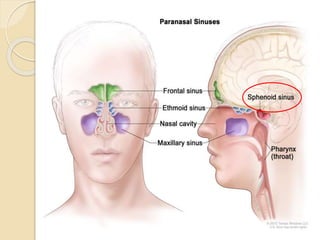
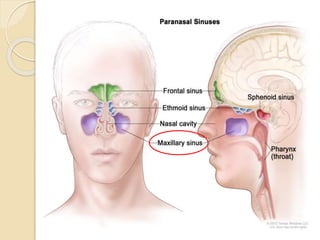
Introduction to sinus:
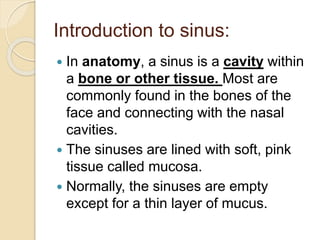
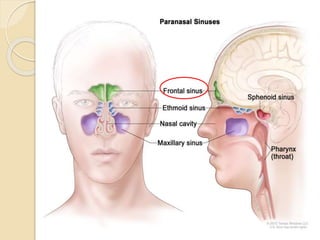
 In anatomy, a sinus is a cavity within
a bone or other tissue. Most are
commonly found in the bones of the
face and connecting with the nasal
cavities.
 The sinuses are lined with soft, pink
tissue called mucosa.
 Normally, the sinuses are empty
except for a thin layer of mucus.
Sinusitis (rhinosinusitis)
1. Sinusitis is the inflammation of the
mucous lining of the nasal passages
and sinuses. The sinuses are air-filled
chambers in the skull.
2. Sinusitis occurs:
 Obstruction or congestion cause the
paranasal sinus openings to become
blocked.
 When the sinus openings become
blocked or too much mucus builds up in
the chambers.
 Bacteria and other germs can grow more
easily, leading to infection and
Causes
Viruses
(90 – 98% )acute
sinusitis
Bacteria
Normally present in the nasal
passages and throat and
harmless.
Fungi
Diabetes, leukemia, AIDS, or
other conditions that impair the
immune system.
Allergies, Asthma, and Immune
Response
Seasonal allergic rhinitis that
cause mucus blockage lead to
sinusitis
Disease
weaken the immune
system e.g diabetes,
AIDS.
Polyps (small benign growths)
in the nasal passage block
mucous drainage and restrict
airflow. Result from previous
sinus infections.
Acute sinusitis
 Acute sinusitis (acute rhinosinusitis) causes the
cavities around your nasal passages (sinuses) to
become inflamed and swollen.
 Acute sinusitis is most often caused by the
common cold. Other triggers include bacteria,
allergies and fungal infections
 Duration, Less than 4 weeks
 Bacterial and viral sinusitis are difficult to
distinguish. However, if symptoms last less than
10 days, it is generally considered viral sinusitis.
When symptoms last more than 10 days, it is
considered bacterial sinusitis.
Sign and Symptoms
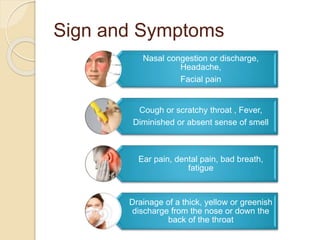
Nasal congestion or discharge,
Headache,
Facial pain
Cough or scratchy throat , Fever,
Diminished or absent sense of smell
Ear pain, dental pain, bad breath,
fatigue
Drainage of a thick, yellow or greenish
discharge from the nose or down the
back of the throat
Diagnosing
 Diagnosing acute sinusitis usually
involves a physical exam. Your doctor
will gently tap your sinuses with his
fingers to identify an infection. The
exam may involve looking into your
nose with a light to identify
inflammation, polyps, tumors, or other
abnormalities.
Treatment of acute sinusitis
 Lifestyle & Home Remedies
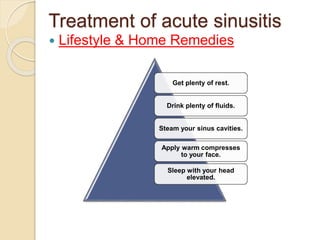
Get plenty of rest.
Drink plenty of fluids.
Steam your sinus cavities.
Apply warm compresses
to your face.
Sleep with your head
elevated.
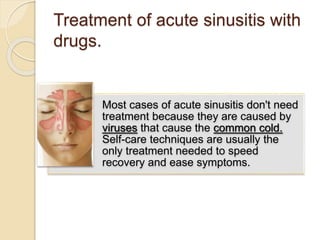
Treatment of acute sinusitis with
drugs.
Most cases of acute sinusitis don't need
treatment because they are caused by
viruses that cause the common cold.
Self-care techniques are usually the
only treatment needed to speed
recovery and ease symptoms.
Treatments to relieve
symptoms
Saline nasal spray.
Decongestants.
Nasal corticosteroids.
Over-the-counter pain relievers.
Antibiotics
Antibiotics usually aren't needed to treat acute sinusitis.
Antibiotics won't help when acute sinusitis is caused
by a viral or fungal infection.
Most cases of bacterial sinusitis improve without
antibiotics.
Antibiotics used to treat acute sinusitis caused by a
bacterial infection include amoxicillin
The combination drug trimethoprim-sulfamethoxazole
(Bactrim, Septra, others).
Chronic sinusitis
 Chronic sinusitis is a common
condition in which the cavities around
nasal passages (sinuses) become
inflamed and swollen and persist
despite treatment attempts.
 This condition interferes with drainage
and causes mucus to build up.
 If you have chronic sinusitis, it may be
difficult to breathe through your
nose.
 For sinusitis lasting more than 8 or 12
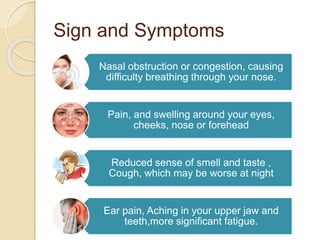
Sign and Symptoms
Nasal obstruction or congestion, causing
difficulty breathing through your nose.
Pain, and swelling around your eyes,
cheeks, nose or forehead
Reduced sense of smell and taste ,
Cough, which may be worse at night
Ear pain, Aching in your upper jaw and
teeth,more significant fatigue.
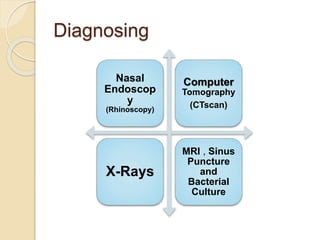
Diagnosing
Nasal
Endoscop
y
(Rhinoscopy)
Computer
Tomography
(CTscan)
X-Rays
MRI , Sinus
Puncture
and
Bacterial
Culture
Treatment of chronic sinusitis
 Antibiotics
 Amoxicillin-clavulanate (Augmentin,
generic) has replaced amoxicillin as the
antibiotic recommended for treating
chronic bacterial sinusitis in both children
and adults.
 For adults with sinusitis and penicillin
allergies, doctors recommend either
doxycycline or the fluoroquinolones
levofloxacin or moxifloxacin.
 Children should not take doxycycline
because it can cause tooth discoloration.
Corticosteroids
 They may be helpful for patients with
sinusitis (either chronic or acute) who have
a history of allergic rhinitis.
 Nasal spray steroids can help reduce
inflammation and mucus production.
 Beclomethasone ,flunisolide and
budesonide ,Approved for children over
age 6.
 Mometasone furoate, Approved for use in
patients as young as age 3.
 Fluticasone ,Approved for children over
age 4 year.
Decongestants
 Decongestants are drugs that help
reduce nasal congestion.
 Decongestants should never be used
in infants .
 And children under the age of 4 years.
 pseudoephedrine or phenylephrine
 Naphazoline, Tetrahydrozoline
Surgery
 Surgery can unblock the sinuses
when drug therapy is not effective or if
there are other complications, such as
structural abnormalities or fungal
sinusitis.
Insertion of a Drainage
Tube
 The simplest surgical approach is
the insertion of a drainage tube into
the sinuses followed by an infusion of
sterile water to flush them out.
Functional Endoscopic Sinus
Surgery
 Functional endoscopic sinus surgery
(FESS) is the standard procedure for
most patients requiring surgical
management of chronic sinusitis . The
procedure allows correction of
obstructions, including any polyp and
ventilation and drainage to aid
healing.
 Adults need only a local anesthetic for
the procedure, although a general
anesthetic is needed for children.
Complications
Osteomyelitis.
 One important complication is infection of the
bones (osteomyelitis) of the forehead and
other facial bones. In such cases, the patient
usually experiences headache, fever, and a
soft swelling over the bone.
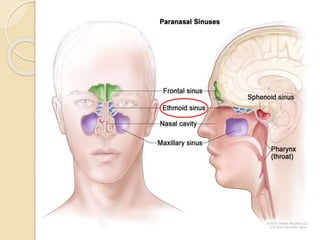
Infection of the Eye Socket:
 Infection of the eye socket, or orbital
infection, which causes swelling and
subsequent drooping of the eyelid, is a rare
but serious complication of ethmoid sinusitis.
In these cases, the patient loses movement
in the eye.
Complications
 Brain Infection:
 The most dangerous complication of
sinusitis, particularly frontal and
sphenoid sinusitis, is the spread of
infection by anaerobic bacteria to the
brain, either through the bones or
blood vessels. Abscesses, meningitis,
and other life-threatening conditions may
result.
 In such cases, the patient may
experience mild personality changes,
headache, altered consciousness, visual
problems, and, finally, seizures, coma,
and death.

Introduction to sinus

  • 1.
  • 2.
    Introduction to sinus: In anatomy, a sinus is a cavity within a bone or other tissue. Most are commonly found in the bones of the face and connecting with the nasal cavities.  The sinuses are lined with soft, pink tissue called mucosa.  Normally, the sinuses are empty except for a thin layer of mucus.
  • 7.
    Sinusitis (rhinosinusitis) 1. Sinusitisis the inflammation of the mucous lining of the nasal passages and sinuses. The sinuses are air-filled chambers in the skull. 2. Sinusitis occurs:  Obstruction or congestion cause the paranasal sinus openings to become blocked.  When the sinus openings become blocked or too much mucus builds up in the chambers.  Bacteria and other germs can grow more easily, leading to infection and
  • 8.
    Causes Viruses (90 – 98%)acute sinusitis Bacteria Normally present in the nasal passages and throat and harmless. Fungi Diabetes, leukemia, AIDS, or other conditions that impair the immune system. Allergies, Asthma, and Immune Response Seasonal allergic rhinitis that cause mucus blockage lead to sinusitis Disease weaken the immune system e.g diabetes, AIDS. Polyps (small benign growths) in the nasal passage block mucous drainage and restrict airflow. Result from previous sinus infections.
  • 9.
    Acute sinusitis  Acutesinusitis (acute rhinosinusitis) causes the cavities around your nasal passages (sinuses) to become inflamed and swollen.  Acute sinusitis is most often caused by the common cold. Other triggers include bacteria, allergies and fungal infections  Duration, Less than 4 weeks  Bacterial and viral sinusitis are difficult to distinguish. However, if symptoms last less than 10 days, it is generally considered viral sinusitis. When symptoms last more than 10 days, it is considered bacterial sinusitis.
  • 10.
    Sign and Symptoms Nasalcongestion or discharge, Headache, Facial pain Cough or scratchy throat , Fever, Diminished or absent sense of smell Ear pain, dental pain, bad breath, fatigue Drainage of a thick, yellow or greenish discharge from the nose or down the back of the throat
  • 11.
    Diagnosing  Diagnosing acutesinusitis usually involves a physical exam. Your doctor will gently tap your sinuses with his fingers to identify an infection. The exam may involve looking into your nose with a light to identify inflammation, polyps, tumors, or other abnormalities.
  • 12.
    Treatment of acutesinusitis  Lifestyle & Home Remedies Get plenty of rest. Drink plenty of fluids. Steam your sinus cavities. Apply warm compresses to your face. Sleep with your head elevated.
  • 13.
    Treatment of acutesinusitis with drugs. Most cases of acute sinusitis don't need treatment because they are caused by viruses that cause the common cold. Self-care techniques are usually the only treatment needed to speed recovery and ease symptoms.
  • 14.
    Treatments to relieve symptoms Salinenasal spray. Decongestants. Nasal corticosteroids. Over-the-counter pain relievers.
  • 15.
    Antibiotics Antibiotics usually aren'tneeded to treat acute sinusitis. Antibiotics won't help when acute sinusitis is caused by a viral or fungal infection. Most cases of bacterial sinusitis improve without antibiotics. Antibiotics used to treat acute sinusitis caused by a bacterial infection include amoxicillin The combination drug trimethoprim-sulfamethoxazole (Bactrim, Septra, others).
  • 16.
    Chronic sinusitis  Chronicsinusitis is a common condition in which the cavities around nasal passages (sinuses) become inflamed and swollen and persist despite treatment attempts.  This condition interferes with drainage and causes mucus to build up.  If you have chronic sinusitis, it may be difficult to breathe through your nose.  For sinusitis lasting more than 8 or 12
  • 17.
    Sign and Symptoms Nasalobstruction or congestion, causing difficulty breathing through your nose. Pain, and swelling around your eyes, cheeks, nose or forehead Reduced sense of smell and taste , Cough, which may be worse at night Ear pain, Aching in your upper jaw and teeth,more significant fatigue.
  • 18.
  • 19.
    Treatment of chronicsinusitis  Antibiotics  Amoxicillin-clavulanate (Augmentin, generic) has replaced amoxicillin as the antibiotic recommended for treating chronic bacterial sinusitis in both children and adults.  For adults with sinusitis and penicillin allergies, doctors recommend either doxycycline or the fluoroquinolones levofloxacin or moxifloxacin.  Children should not take doxycycline because it can cause tooth discoloration.
  • 20.
    Corticosteroids  They maybe helpful for patients with sinusitis (either chronic or acute) who have a history of allergic rhinitis.  Nasal spray steroids can help reduce inflammation and mucus production.  Beclomethasone ,flunisolide and budesonide ,Approved for children over age 6.  Mometasone furoate, Approved for use in patients as young as age 3.  Fluticasone ,Approved for children over age 4 year.
  • 21.
    Decongestants  Decongestants aredrugs that help reduce nasal congestion.  Decongestants should never be used in infants .  And children under the age of 4 years.  pseudoephedrine or phenylephrine  Naphazoline, Tetrahydrozoline
  • 22.
    Surgery  Surgery canunblock the sinuses when drug therapy is not effective or if there are other complications, such as structural abnormalities or fungal sinusitis.
  • 23.
    Insertion of aDrainage Tube  The simplest surgical approach is the insertion of a drainage tube into the sinuses followed by an infusion of sterile water to flush them out.
  • 24.
    Functional Endoscopic Sinus Surgery Functional endoscopic sinus surgery (FESS) is the standard procedure for most patients requiring surgical management of chronic sinusitis . The procedure allows correction of obstructions, including any polyp and ventilation and drainage to aid healing.  Adults need only a local anesthetic for the procedure, although a general anesthetic is needed for children.
  • 25.
    Complications Osteomyelitis.  One importantcomplication is infection of the bones (osteomyelitis) of the forehead and other facial bones. In such cases, the patient usually experiences headache, fever, and a soft swelling over the bone. Infection of the Eye Socket:  Infection of the eye socket, or orbital infection, which causes swelling and subsequent drooping of the eyelid, is a rare but serious complication of ethmoid sinusitis. In these cases, the patient loses movement in the eye.
  • 26.
    Complications  Brain Infection: The most dangerous complication of sinusitis, particularly frontal and sphenoid sinusitis, is the spread of infection by anaerobic bacteria to the brain, either through the bones or blood vessels. Abscesses, meningitis, and other life-threatening conditions may result.  In such cases, the patient may experience mild personality changes, headache, altered consciousness, visual problems, and, finally, seizures, coma, and death.