
William Stallings  Computer Organization  and Architecture Chapter 5 External Memory
Types of External Memory Magnetic Disk RAID Removable Optical CD-ROM CD-Writable (WORM) CD-R/W DVD Magnetic Tape
Magnetic Disk Metal or plastic disk coated with magnetizable material (iron oxide…rust) Range of packaging Floppy Winchester hard disk Removable hard disk
Data Organization and Formatting Concentric rings or tracks Gaps between tracks Reduce gap to increase capacity Same number of bits per track (variable packing density) Constant angular velocity Tracks divided into sectors Minimum block size is one sector May have more than one sector per block
Disk Data Layout
Fixed/Movable Head Disk Fixed head One read write head per track Heads mounted on fixed ridged arm Movable head One read write head per side Mounted on a movable arm
Fixed and Movable Heads
Removable or Not Removable disk Can be removed from drive and replaced with another disk Provides unlimited storage capacity Easy data transfer between systems Nonremovable disk Permanently mounted in the drive
Floppy Disk 8”, 5.25”, 3.5” Small capacity Up to 1.44Mbyte (2.88M never popular) Slow Universal Cheap
Winchester Hard Disk (1) Developed by IBM in Winchester (USA) Sealed unit One or more platters (disks) Heads fly on boundary layer of air as disk spins Very small head to disk gap Getting more robust
Winchester Hard Disk (2) Universal Cheap Fastest external storage Getting larger all the time Multiple Gigabyte now usual
Removable Hard Disk ZIP Cheap Very common Only 100M JAZ Not cheap 1G L-120 (a: drive) Also reads 3.5” floppy Becoming more popular?
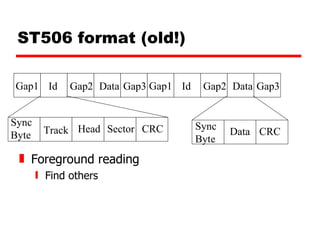
Finding Sectors Must be able to identify start of track and sector Format disk Additional information not available to user Marks tracks and sectors
ST506 format (old!) Foreground reading Find others Gap1 Id Gap2 Data Gap3 Gap1 Id Gap2 Data Gap3 Track Sync Byte Head Sector CRC Sync Byte Data CRC
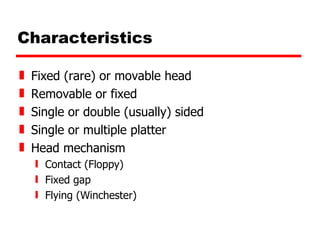
Characteristics Fixed (rare) or movable head Removable or fixed Single or double (usually) sided Single or multiple platter Head mechanism Contact (Floppy) Fixed gap Flying (Winchester)
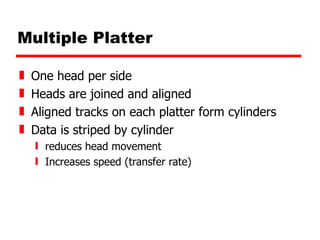
Multiple Platter One head per side Heads are joined and aligned Aligned tracks on each platter form cylinders Data is striped by cylinder reduces head movement Increases speed (transfer rate)
Speed Seek time Moving head to correct track (Rotational) latency Waiting for data to rotate under head Access time = Seek + Latency Transfer rate
RAID Redundant Array of Independent Disks  Redundant Array of Inexpensive Disks 6 levels in common use Not a hierarchy Set of physical disks viewed as single logical drive by O/S Data distributed across physical drives Can use redundant capacity to store parity information
RAID 0 No redundancy Data striped across all disks Round Robin striping Increase speed Multiple data requests probably not on same disk Disks seek in parallel A set of data is likely to be striped across multiple disks
RAID 1 Mirrored Disks Data is striped across disks 2 copies of each stripe on separate disks Read from either Write to both Recovery is simple Swap faulty disk & re-mirror No down time Expensive
RAID 2 Disks are synchronized Very small stripes Often single byte/word Error correction calculated across corresponding bits on disks Multiple parity disks store Hamming code error correction in corresponding positions Lots of redundancy Expensive Not used
RAID 3 Similar to RAID 2 Only one redundant disk, no matter how large the array Simple parity bit for each set of corresponding bits Data on failed drive can be reconstructed from surviving data and parity info Very high transfer rates
RAID 4 Each disk operates independently Good for high I/O request rate Large stripes Bit by bit parity calculated across stripes on each disk Parity stored on parity disk
RAID 5 Like RAID 4 Parity striped across all disks Round robin allocation for parity stripe Avoids RAID 4 bottleneck at parity disk Commonly used in network servers N.B. DOES NOT MEAN 5 DISKS!!!!!
Optical Storage CD-ROM Originally for audio 650Mbytes giving over 70 minutes audio Polycarbonate coated with highly reflective coat, usually aluminum Data stored as pits Read by reflecting laser Constant packing density Constant linear velocity
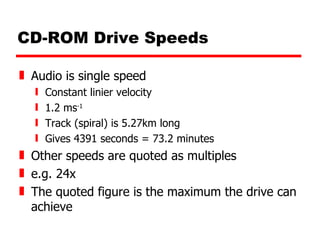
CD-ROM Drive Speeds Audio is single speed Constant linier velocity 1.2 ms -1 Track (spiral) is 5.27km long Gives 4391 seconds = 73.2 minutes Other speeds are quoted as multiples e.g. 24x The quoted figure is the maximum the drive can achieve
Comparison of Disk Layouts
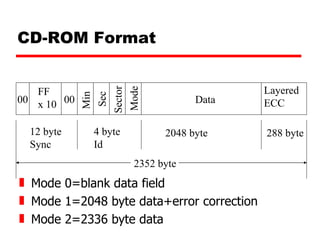
CD-ROM Format Mode 0=blank data field Mode 1=2048 byte data+error correction Mode 2=2336 byte data 00 00 FF  x 10 Min Sec Sector Mode Data Layered ECC 12 byte Sync 4 byte Id 2048 byte 288 byte 2352 byte
Random Access on  CD-ROM Difficult Move head to rough position Set correct speed Read address Adjust to required location (Yawn!)
CD-ROM for & against Large capacity (?) Easy to mass produce Removable Robust Expensive for small runs Slow Read only
Other Optical Storage CD-Writable WORM Now affordable Compatible with CD-ROM drives CD-RW Erasable Getting cheaper Mostly CD-ROM drive compatible
DVD - what’s in a name? Digital Video Disk Used to indicate a player for movies Only plays video disks Digital Versatile Disk Used to indicate a computer drive Will read computer disks and play video disks Dogs Veritable Dinner Officially - nothing!!!
DVD - technology Multi-layer Very high capacity (4.7G per layer) Full length movie on single disk Using MPEG compression Finally standardized (honest!) Movies carry regional coding Players only play correct region films Can be “fixed”
DVD - Writable Loads of trouble with standards First generation DVD drives may not read first generation DVD-W disks First generation DVD drives may not read CD-RW disks Wait for it to settle down before buying!
Foreground Reading Check out optical disk storage options Check out Mini Disk
Magnetic Tape Serial access Slow Very cheap Backup and archive
Digital Audio Tape (DAT) Uses rotating head (like video) High capacity on small tape 4Gbyte uncompressed 8Gbyte compressed Backup of PC/network servers

Ch 5 95

  • 1.
    William Stallings Computer Organization and Architecture Chapter 5 External Memory
  • 2.
    Types of ExternalMemory Magnetic Disk RAID Removable Optical CD-ROM CD-Writable (WORM) CD-R/W DVD Magnetic Tape
  • 3.
    Magnetic Disk Metalor plastic disk coated with magnetizable material (iron oxide…rust) Range of packaging Floppy Winchester hard disk Removable hard disk
  • 4.
    Data Organization andFormatting Concentric rings or tracks Gaps between tracks Reduce gap to increase capacity Same number of bits per track (variable packing density) Constant angular velocity Tracks divided into sectors Minimum block size is one sector May have more than one sector per block
  • 5.
  • 6.
    Fixed/Movable Head DiskFixed head One read write head per track Heads mounted on fixed ridged arm Movable head One read write head per side Mounted on a movable arm
  • 7.
  • 8.
    Removable or NotRemovable disk Can be removed from drive and replaced with another disk Provides unlimited storage capacity Easy data transfer between systems Nonremovable disk Permanently mounted in the drive
  • 9.
    Floppy Disk 8”,5.25”, 3.5” Small capacity Up to 1.44Mbyte (2.88M never popular) Slow Universal Cheap
  • 10.
    Winchester Hard Disk(1) Developed by IBM in Winchester (USA) Sealed unit One or more platters (disks) Heads fly on boundary layer of air as disk spins Very small head to disk gap Getting more robust
  • 11.
    Winchester Hard Disk(2) Universal Cheap Fastest external storage Getting larger all the time Multiple Gigabyte now usual
  • 12.
    Removable Hard DiskZIP Cheap Very common Only 100M JAZ Not cheap 1G L-120 (a: drive) Also reads 3.5” floppy Becoming more popular?
  • 13.
    Finding Sectors Mustbe able to identify start of track and sector Format disk Additional information not available to user Marks tracks and sectors
  • 14.
    ST506 format (old!)Foreground reading Find others Gap1 Id Gap2 Data Gap3 Gap1 Id Gap2 Data Gap3 Track Sync Byte Head Sector CRC Sync Byte Data CRC
  • 15.
    Characteristics Fixed (rare)or movable head Removable or fixed Single or double (usually) sided Single or multiple platter Head mechanism Contact (Floppy) Fixed gap Flying (Winchester)
  • 16.
    Multiple Platter Onehead per side Heads are joined and aligned Aligned tracks on each platter form cylinders Data is striped by cylinder reduces head movement Increases speed (transfer rate)
  • 17.
    Speed Seek timeMoving head to correct track (Rotational) latency Waiting for data to rotate under head Access time = Seek + Latency Transfer rate
  • 18.
    RAID Redundant Arrayof Independent Disks Redundant Array of Inexpensive Disks 6 levels in common use Not a hierarchy Set of physical disks viewed as single logical drive by O/S Data distributed across physical drives Can use redundant capacity to store parity information
  • 19.
    RAID 0 Noredundancy Data striped across all disks Round Robin striping Increase speed Multiple data requests probably not on same disk Disks seek in parallel A set of data is likely to be striped across multiple disks
  • 20.
    RAID 1 MirroredDisks Data is striped across disks 2 copies of each stripe on separate disks Read from either Write to both Recovery is simple Swap faulty disk & re-mirror No down time Expensive
  • 21.
    RAID 2 Disksare synchronized Very small stripes Often single byte/word Error correction calculated across corresponding bits on disks Multiple parity disks store Hamming code error correction in corresponding positions Lots of redundancy Expensive Not used
  • 22.
    RAID 3 Similarto RAID 2 Only one redundant disk, no matter how large the array Simple parity bit for each set of corresponding bits Data on failed drive can be reconstructed from surviving data and parity info Very high transfer rates
  • 23.
    RAID 4 Eachdisk operates independently Good for high I/O request rate Large stripes Bit by bit parity calculated across stripes on each disk Parity stored on parity disk
  • 24.
    RAID 5 LikeRAID 4 Parity striped across all disks Round robin allocation for parity stripe Avoids RAID 4 bottleneck at parity disk Commonly used in network servers N.B. DOES NOT MEAN 5 DISKS!!!!!
  • 25.
    Optical Storage CD-ROMOriginally for audio 650Mbytes giving over 70 minutes audio Polycarbonate coated with highly reflective coat, usually aluminum Data stored as pits Read by reflecting laser Constant packing density Constant linear velocity
  • 26.
    CD-ROM Drive SpeedsAudio is single speed Constant linier velocity 1.2 ms -1 Track (spiral) is 5.27km long Gives 4391 seconds = 73.2 minutes Other speeds are quoted as multiples e.g. 24x The quoted figure is the maximum the drive can achieve
  • 27.
  • 28.
    CD-ROM Format Mode0=blank data field Mode 1=2048 byte data+error correction Mode 2=2336 byte data 00 00 FF x 10 Min Sec Sector Mode Data Layered ECC 12 byte Sync 4 byte Id 2048 byte 288 byte 2352 byte
  • 29.
    Random Access on CD-ROM Difficult Move head to rough position Set correct speed Read address Adjust to required location (Yawn!)
  • 30.
    CD-ROM for &against Large capacity (?) Easy to mass produce Removable Robust Expensive for small runs Slow Read only
  • 31.
    Other Optical StorageCD-Writable WORM Now affordable Compatible with CD-ROM drives CD-RW Erasable Getting cheaper Mostly CD-ROM drive compatible
  • 32.
    DVD - what’sin a name? Digital Video Disk Used to indicate a player for movies Only plays video disks Digital Versatile Disk Used to indicate a computer drive Will read computer disks and play video disks Dogs Veritable Dinner Officially - nothing!!!
  • 33.
    DVD - technologyMulti-layer Very high capacity (4.7G per layer) Full length movie on single disk Using MPEG compression Finally standardized (honest!) Movies carry regional coding Players only play correct region films Can be “fixed”
  • 34.
    DVD - WritableLoads of trouble with standards First generation DVD drives may not read first generation DVD-W disks First generation DVD drives may not read CD-RW disks Wait for it to settle down before buying!
  • 35.
    Foreground Reading Checkout optical disk storage options Check out Mini Disk
  • 36.
    Magnetic Tape Serialaccess Slow Very cheap Backup and archive
  • 37.
    Digital Audio Tape(DAT) Uses rotating head (like video) High capacity on small tape 4Gbyte uncompressed 8Gbyte compressed Backup of PC/network servers