William Stallings
Computer Organization
and Architecture
Chapter 5
External Memory
Types of External Memory
 Magnetic Disk
 RAID
 Removable
 Optical
 CD-ROM
 CD-Writable (WORM)
 CD-R/W
 DVD
 Magnetic Tape
Magnetic Disk
 Metal or plastic disk coated with
magnetizable material (iron oxide…rust)
 Range of packaging
 Floppy
 Winchester hard disk
 Removable hard disk
Data Organization and
Formatting
 Concentric rings or tracks
 Gaps between tracks
 Reduce gap to increase capacity
 Same number of bits per track (variable packing
density)
 Constant angular velocity
 Tracks divided into sectors
 Minimum block size is one sector
 May have more than one sector per block
Disk Data Layout
Fixed/Movable Head Disk
 Fixed head
 One read write head per track
 Heads mounted on fixed ridged arm
 Movable head
 One read write head per side
 Mounted on a movable arm
Fixed and Movable Heads
Removable or Not
 Removable disk
 Can be removed from drive and replaced with
another disk
 Provides unlimited storage capacity
 Easy data transfer between systems
 Nonremovable disk
 Permanently mounted in the drive
Floppy Disk
 8”, 5.25”, 3.5”
 Small capacity
 Up to 1.44Mbyte (2.88M never popular)
 Slow
 Universal
 Cheap
Winchester Hard Disk (1)
 Developed by IBM in Winchester (USA)
 Sealed unit
 One or more platters (disks)
 Heads fly on boundary layer of air as disk
spins
 Very small head to disk gap
 Getting more robust
Winchester Hard Disk (2)
 Universal
 Cheap
 Fastest external storage
 Getting larger all the time
 Multiple Gigabyte now usual
Removable Hard Disk
 ZIP
 Cheap
 Very common
 Only 100M
 JAZ
 Not cheap
 1G
 L-120 (a: drive)
 Also reads 3.5” floppy
 Becoming more popular?
Finding Sectors
 Must be able to identify start of track and
sector
 Format disk
 Additional information not available to user
 Marks tracks and sectors
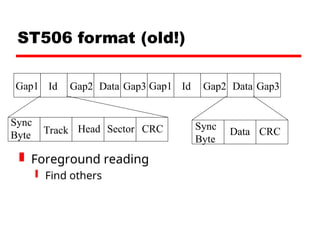
Gap1 Id Gap2 Data Gap3 Gap1 Id Gap2 Data Gap3
Track
Sync
Byte
Head Sector CRC Sync
Byte
Data CRC
ST506 format (old!)
 Foreground reading
 Find others
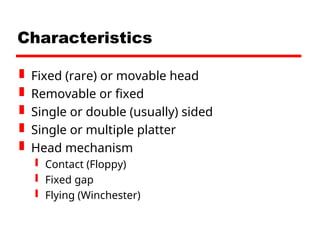
Characteristics
 Fixed (rare) or movable head
 Removable or fixed
 Single or double (usually) sided
 Single or multiple platter
 Head mechanism
 Contact (Floppy)
 Fixed gap
 Flying (Winchester)
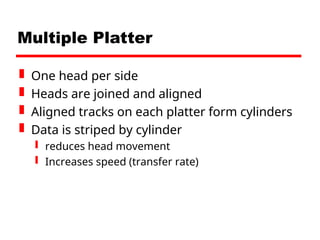
Multiple Platter
 One head per side
 Heads are joined and aligned
 Aligned tracks on each platter form cylinders
 Data is striped by cylinder
 reduces head movement
 Increases speed (transfer rate)
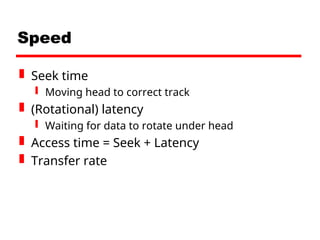
Speed
 Seek time
 Moving head to correct track
 (Rotational) latency
 Waiting for data to rotate under head
 Access time = Seek + Latency
 Transfer rate
RAID
 Redundant Array of Independent Disks
 Redundant Array of Inexpensive Disks
 6 levels in common use
 Not a hierarchy
 Set of physical disks viewed as single logical drive
by O/S
 Data distributed across physical drives
 Can use redundant capacity to store parity
information
RAID 0
 No redundancy
 Data striped across all disks
 Round Robin striping
 Increase speed
 Multiple data requests probably not on same disk
 Disks seek in parallel
 A set of data is likely to be striped across multiple
disks
RAID 1
 Mirrored Disks
 Data is striped across disks
 2 copies of each stripe on separate disks
 Read from either
 Write to both
 Recovery is simple
 Swap faulty disk & re-mirror
 No down time
 Expensive
RAID 2
 Disks are synchronized
 Very small stripes
 Often single byte/word
 Error correction calculated across corresponding bits
on disks
 Multiple parity disks store Hamming code error
correction in corresponding positions
 Lots of redundancy
 Expensive
 Not used
RAID 3
 Similar to RAID 2
 Only one redundant disk, no matter how
large the array
 Simple parity bit for each set of
corresponding bits
 Data on failed drive can be reconstructed
from surviving data and parity info
 Very high transfer rates
RAID 4
 Each disk operates independently
 Good for high I/O request rate
 Large stripes
 Bit by bit parity calculated across stripes on
each disk
 Parity stored on parity disk
RAID 5
 Like RAID 4
 Parity striped across all disks
 Round robin allocation for parity stripe
 Avoids RAID 4 bottleneck at parity disk
 Commonly used in network servers
 N.B. DOES NOT MEAN 5 DISKS!!!!!
Optical Storage CD-ROM
 Originally for audio
 650Mbytes giving over 70 minutes audio
 Polycarbonate coated with highly reflective
coat, usually aluminum
 Data stored as pits
 Read by reflecting laser
 Constant packing density
 Constant linear velocity
CD-ROM Drive Speeds
 Audio is single speed
 Constant linier velocity
 1.2 ms-1
 Track (spiral) is 5.27km long
 Gives 4391 seconds = 73.2 minutes
 Other speeds are quoted as multiples
 e.g. 24x
 The quoted figure is the maximum the drive
can achieve
Comparison of Disk Layouts
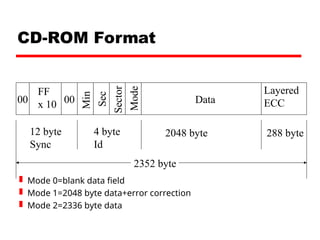
00 00
FF
x 10
Min
Sec
Sector
Mode
Data
Layered
ECC
12 byte
Sync
4 byte
Id
2048 byte 288 byte
2352 byte
CD-ROM Format
 Mode 0=blank data field
 Mode 1=2048 byte data+error correction
 Mode 2=2336 byte data
Random Access on
CD-ROM
 Difficult
 Move head to rough position
 Set correct speed
 Read address
 Adjust to required location
 (Yawn!)
CD-ROM for & against
 Large capacity (?)
 Easy to mass produce
 Removable
 Robust
 Expensive for small runs
 Slow
 Read only
Other Optical Storage
 CD-Writable
 WORM
 Now affordable
 Compatible with CD-ROM drives
 CD-RW
 Erasable
 Getting cheaper
 Mostly CD-ROM drive compatible
DVD - what’s in a name?
 Digital Video Disk
 Used to indicate a player for movies
 Only plays video disks
 Digital Versatile Disk
 Used to indicate a computer drive
 Will read computer disks and play video disks
 Dogs Veritable Dinner
 Officially - nothing!!!
DVD - technology
 Multi-layer
 Very high capacity (4.7G per layer)
 Full length movie on single disk
 Using MPEG compression
 Finally standardized (honest!)
 Movies carry regional coding
 Players only play correct region films
 Can be “fixed”
DVD - Writable
 Loads of trouble with standards
 First generation DVD drives may not read first
generation DVD-W disks
 First generation DVD drives may not read CD-
RW disks
 Wait for it to settle down before buying!
Foreground Reading
 Check out optical disk storage options
 Check out Mini Disk
Magnetic Tape
 Serial access
 Slow
 Very cheap
 Backup and archive
Digital Audio Tape (DAT)
 Uses rotating head (like video)
 High capacity on small tape
 4Gbyte uncompressed
 8Gbyte compressed
 Backup of PC/network servers

Ch5_William Stallings Computer Organization and Architecture

  • 1.
    William Stallings Computer Organization andArchitecture Chapter 5 External Memory
  • 2.
    Types of ExternalMemory  Magnetic Disk  RAID  Removable  Optical  CD-ROM  CD-Writable (WORM)  CD-R/W  DVD  Magnetic Tape
  • 3.
    Magnetic Disk  Metalor plastic disk coated with magnetizable material (iron oxide…rust)  Range of packaging  Floppy  Winchester hard disk  Removable hard disk
  • 4.
    Data Organization and Formatting Concentric rings or tracks  Gaps between tracks  Reduce gap to increase capacity  Same number of bits per track (variable packing density)  Constant angular velocity  Tracks divided into sectors  Minimum block size is one sector  May have more than one sector per block
  • 5.
  • 6.
    Fixed/Movable Head Disk Fixed head  One read write head per track  Heads mounted on fixed ridged arm  Movable head  One read write head per side  Mounted on a movable arm
  • 7.
  • 8.
    Removable or Not Removable disk  Can be removed from drive and replaced with another disk  Provides unlimited storage capacity  Easy data transfer between systems  Nonremovable disk  Permanently mounted in the drive
  • 9.
    Floppy Disk  8”,5.25”, 3.5”  Small capacity  Up to 1.44Mbyte (2.88M never popular)  Slow  Universal  Cheap
  • 10.
    Winchester Hard Disk(1)  Developed by IBM in Winchester (USA)  Sealed unit  One or more platters (disks)  Heads fly on boundary layer of air as disk spins  Very small head to disk gap  Getting more robust
  • 11.
    Winchester Hard Disk(2)  Universal  Cheap  Fastest external storage  Getting larger all the time  Multiple Gigabyte now usual
  • 12.
    Removable Hard Disk ZIP  Cheap  Very common  Only 100M  JAZ  Not cheap  1G  L-120 (a: drive)  Also reads 3.5” floppy  Becoming more popular?
  • 13.
    Finding Sectors  Mustbe able to identify start of track and sector  Format disk  Additional information not available to user  Marks tracks and sectors
  • 14.
    Gap1 Id Gap2Data Gap3 Gap1 Id Gap2 Data Gap3 Track Sync Byte Head Sector CRC Sync Byte Data CRC ST506 format (old!)  Foreground reading  Find others
  • 15.
    Characteristics  Fixed (rare)or movable head  Removable or fixed  Single or double (usually) sided  Single or multiple platter  Head mechanism  Contact (Floppy)  Fixed gap  Flying (Winchester)
  • 16.
    Multiple Platter  Onehead per side  Heads are joined and aligned  Aligned tracks on each platter form cylinders  Data is striped by cylinder  reduces head movement  Increases speed (transfer rate)
  • 17.
    Speed  Seek time Moving head to correct track  (Rotational) latency  Waiting for data to rotate under head  Access time = Seek + Latency  Transfer rate
  • 18.
    RAID  Redundant Arrayof Independent Disks  Redundant Array of Inexpensive Disks  6 levels in common use  Not a hierarchy  Set of physical disks viewed as single logical drive by O/S  Data distributed across physical drives  Can use redundant capacity to store parity information
  • 19.
    RAID 0  Noredundancy  Data striped across all disks  Round Robin striping  Increase speed  Multiple data requests probably not on same disk  Disks seek in parallel  A set of data is likely to be striped across multiple disks
  • 20.
    RAID 1  MirroredDisks  Data is striped across disks  2 copies of each stripe on separate disks  Read from either  Write to both  Recovery is simple  Swap faulty disk & re-mirror  No down time  Expensive
  • 21.
    RAID 2  Disksare synchronized  Very small stripes  Often single byte/word  Error correction calculated across corresponding bits on disks  Multiple parity disks store Hamming code error correction in corresponding positions  Lots of redundancy  Expensive  Not used
  • 22.
    RAID 3  Similarto RAID 2  Only one redundant disk, no matter how large the array  Simple parity bit for each set of corresponding bits  Data on failed drive can be reconstructed from surviving data and parity info  Very high transfer rates
  • 23.
    RAID 4  Eachdisk operates independently  Good for high I/O request rate  Large stripes  Bit by bit parity calculated across stripes on each disk  Parity stored on parity disk
  • 24.
    RAID 5  LikeRAID 4  Parity striped across all disks  Round robin allocation for parity stripe  Avoids RAID 4 bottleneck at parity disk  Commonly used in network servers  N.B. DOES NOT MEAN 5 DISKS!!!!!
  • 25.
    Optical Storage CD-ROM Originally for audio  650Mbytes giving over 70 minutes audio  Polycarbonate coated with highly reflective coat, usually aluminum  Data stored as pits  Read by reflecting laser  Constant packing density  Constant linear velocity
  • 26.
    CD-ROM Drive Speeds Audio is single speed  Constant linier velocity  1.2 ms-1  Track (spiral) is 5.27km long  Gives 4391 seconds = 73.2 minutes  Other speeds are quoted as multiples  e.g. 24x  The quoted figure is the maximum the drive can achieve
  • 27.
  • 28.
    00 00 FF x 10 Min Sec Sector Mode Data Layered ECC 12byte Sync 4 byte Id 2048 byte 288 byte 2352 byte CD-ROM Format  Mode 0=blank data field  Mode 1=2048 byte data+error correction  Mode 2=2336 byte data
  • 29.
    Random Access on CD-ROM Difficult  Move head to rough position  Set correct speed  Read address  Adjust to required location  (Yawn!)
  • 30.
    CD-ROM for &against  Large capacity (?)  Easy to mass produce  Removable  Robust  Expensive for small runs  Slow  Read only
  • 31.
    Other Optical Storage CD-Writable  WORM  Now affordable  Compatible with CD-ROM drives  CD-RW  Erasable  Getting cheaper  Mostly CD-ROM drive compatible
  • 32.
    DVD - what’sin a name?  Digital Video Disk  Used to indicate a player for movies  Only plays video disks  Digital Versatile Disk  Used to indicate a computer drive  Will read computer disks and play video disks  Dogs Veritable Dinner  Officially - nothing!!!
  • 33.
    DVD - technology Multi-layer  Very high capacity (4.7G per layer)  Full length movie on single disk  Using MPEG compression  Finally standardized (honest!)  Movies carry regional coding  Players only play correct region films  Can be “fixed”
  • 34.
    DVD - Writable Loads of trouble with standards  First generation DVD drives may not read first generation DVD-W disks  First generation DVD drives may not read CD- RW disks  Wait for it to settle down before buying!
  • 35.
    Foreground Reading  Checkout optical disk storage options  Check out Mini Disk
  • 36.
    Magnetic Tape  Serialaccess  Slow  Very cheap  Backup and archive
  • 37.
    Digital Audio Tape(DAT)  Uses rotating head (like video)  High capacity on small tape  4Gbyte uncompressed  8Gbyte compressed  Backup of PC/network servers