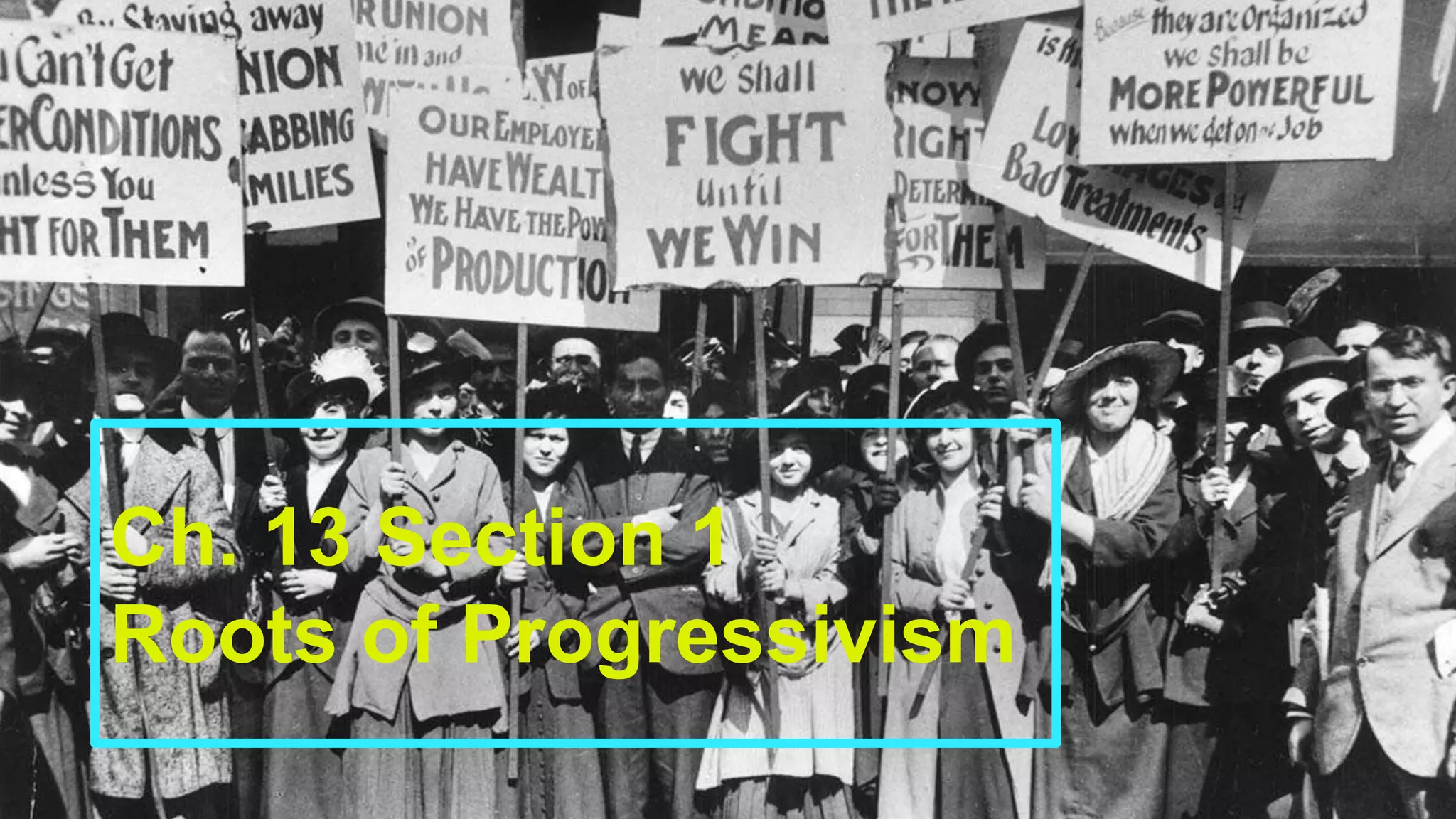
Ch. 13 Section 1
Roots of Progressivism
Objectives:
1. Discuss the rise of the
progressive movement.
2.Evaluate the impact of initiative,
referendum, recall, and the 17th
amendment.
Who were the Progressives?
-Progressive era- 1890-1920
-Not a tightly organized political movement
-A collection of different views about how to fix the problems they believed existed
in America
-Believed industrialization and Urbanization created many societal problems and
government should play a more active role in fixing them
-Belonged to both major parties
Beginnings of Progressivism
-A reaction to laissez-faire economics
-Poor working class led progressives to believe government needed
to change before it could fix society's problems
-Believed in Science and technology/ thought scientific methods
could produce solutions for societies
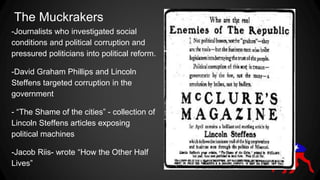
The Muckrakers
-Journalists who investigated social
conditions and political corruption and
pressured politicians into political reform.
-David Graham Phillips and Lincoln
Steffens targeted corruption in the
government
- “The Shame of the cities” - collection of
Lincoln Steffens articles exposing
political machines
-Jacob Riis- wrote “How the Other Half
Lives”
Ida Tarbell
McClure’s magazine published a
series of articles criticizing the
Standard Oil Company and J.D.
Rockafeller.
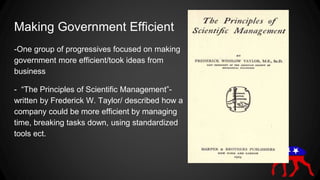
Making Government Efficient
-One group of progressives focused on making
government more efficient/took ideas from
business
- “The Principles of Scientific Management”-
written by Frederick W. Taylor/ described how a
company could be more efficient by managing
time, breaking tasks down, using standardized
tools ect.
Galveston 1900 Storm
● In 1900, the deadliest natural disaster in US history hit Galveston
Island. In the wake of the disaster, efficiency experts implemented
new city development and management policies.
● Efficiency progressives wanted a commission plan/ cities government
would be broken into several departments with an expert
commissioner leading the department/ Galveston TX adopted
commission plan in 1901
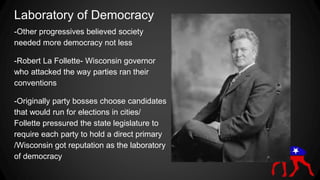
Laboratory of Democracy
-Other progressives believed society
needed more democracy not less
-Robert La Follette- Wisconsin governor
who attacked the way parties ran their
conventions
-Originally party bosses choose candidates
that would run for elections in cities/
Follette pressured the state legislature to
require each party to hold a direct primary
/Wisconsin got reputation as the laboratory
of democracy
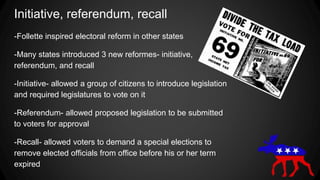
Initiative, referendum, recall
-Follette inspired electoral reform in other states
-Many states introduced 3 new reformes- initiative,
referendum, and recall
-Initiative- allowed a group of citizens to introduce legislation
and required legislatures to vote on it
-Referendum- allowed proposed legislation to be submitted
to voters for approval
-Recall- allowed voters to demand a special elections to
remove elected officials from office before his or her term
expired
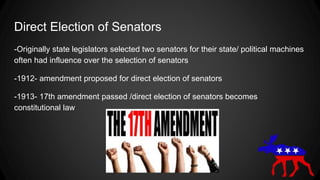
Direct Election of Senators
-Originally state legislators selected two senators for their state/ political machines
often had influence over the selection of senators
-1912- amendment proposed for direct election of senators
-1913- 17th amendment passed /direct election of senators becomes
constitutional law
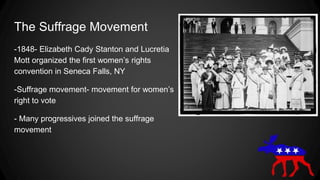
The Suffrage Movement
-1848- Elizabeth Cady Stanton and Lucretia
Mott organized the first women’s rights
convention in Seneca Falls, NY
-Suffrage movement- movement for women’s
right to vote
- Many progressives joined the suffrage
movement
Early Problems
-Suffrage movement had a slow start /some women
were attacked
-When 15th amendment was passed many women
wanted the amendment to be worded to give
women the right to vote as well.
-
House divided…
Debate over 15th amendment split the suffrage movement into two groups
National Woman Suffrage Association and American Woman Suffrage association
-National Women Suffrage Association- led by Elizabeth Cady Stanton and Susan
B. Anthony/ focused on passing a Constitutional amendment for women’s suffrage
-American Woman Suffrage Association- led by Lucy Stone and Julia Ward Howe/
wanted to convince state governments to give women the right to vote
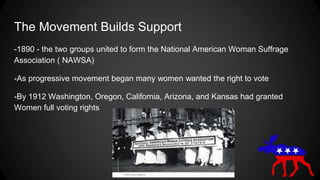
The Movement Builds Support
-1890 - the two groups united to form the National American Woman Suffrage
Association ( NAWSA)
-As progressive movement began many women wanted the right to vote
-By 1912 Washington, Oregon, California, Arizona, and Kansas had granted
Women full voting rights
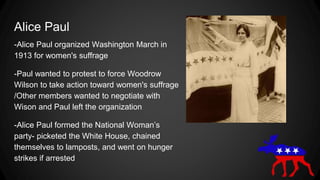
Alice Paul
-Alice Paul organized Washington March in
1913 for women's suffrage
-Paul wanted to protest to force Woodrow
Wilson to take action toward women's suffrage
/Other members wanted to negotiate with
Wison and Paul left the organization
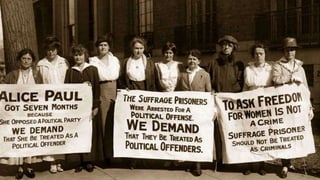
-Alice Paul formed the National Woman’s
party- picketed the White House, chained
themselves to lamposts, and went on hunger
strikes if arrested
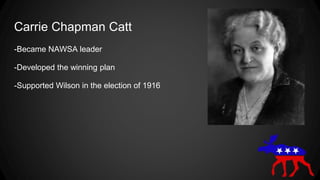
Carrie Chapman Catt
-Became NAWSA leader
-Developed the winning plan
-Supported Wilson in the election of 1916
The 19th Amendment
-1918- House of Representatives tried to pass
a women’s suffrage amendmendment but it
failed to pass through the senate
-1919-the senate finally passed the 19th
amendment
-August 26th 1920- the 19th amendment was
ratified and adopted into the constitution/
women gained the right to vote
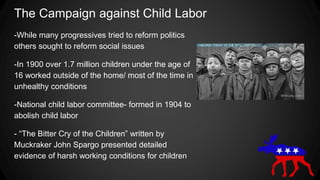
The Campaign against Child Labor
-While many progressives tried to reform politics
others sought to reform social issues
-In 1900 over 1.7 million children under the age of
16 worked outside of the home/ most of the time in
unhealthy conditions
-National child labor committee- formed in 1904 to
abolish child labor
- “The Bitter Cry of the Children” written by
Muckraker John Spargo presented detailed
evidence of harsh working conditions for children
Health and Safety Codes
-Adult workers also labored in harsh conditions
especially in the coal mine and railroad industry
-1911- Triangle Shirtwaist company caught first in
New York City/ about 150 women died trapped by
doors locked from the outside
-During 1900 thousands died or were injured on
the job but their families received little
compensation
-Progressives joined union leaders to fight for
compensation laws, zoning laws and health codes
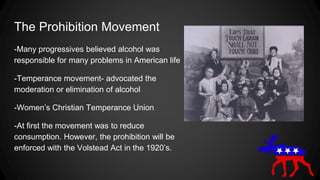
The Prohibition Movement
-Many progressives believed alcohol was
responsible for many problems in American life
-Temperance movement- advocated the
moderation or elimination of alcohol
-Women’s Christian Temperance Union
-At first the movement was to reduce
consumption. However, the prohibition will be
enforced with the Volstead Act in the 1920’s.
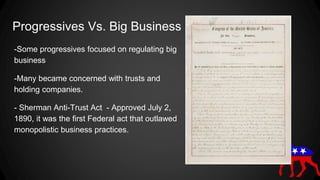
Progressives Vs. Big Business
-Some progressives focused on regulating big
business
-Many became concerned with trusts and
holding companies.
- Sherman Anti-Trust Act - Approved July 2,
1890, it was the first Federal act that outlawed
monopolistic business practices.
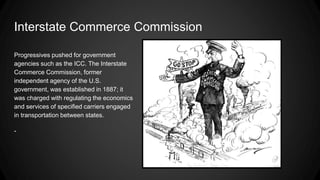
Interstate Commerce Commission
Progressives pushed for government
agencies such as the ICC. The Interstate
Commerce Commission, former
independent agency of the U.S.
government, was established in 1887; it
was charged with regulating the economics
and services of specified carriers engaged
in transportation between states.
-
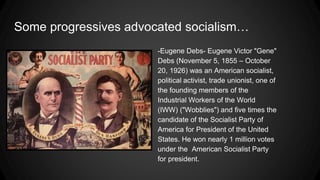
Some progressives advocated socialism…
-Eugene Debs- Eugene Victor "Gene"
Debs (November 5, 1855 – October
20, 1926) was an American socialist,
political activist, trade unionist, one of
the founding members of the
Industrial Workers of the World
(IWW) ("Wobblies") and five times the
candidate of the Socialist Party of
America for President of the United
States. He won nearly 1 million votes
under the American Socialist Party
for president.

Ch 13.1 roots of progressivism

  • 1.
    Ch. 13 Section1 Roots of Progressivism
  • 2.
    Objectives: 1. Discuss therise of the progressive movement. 2.Evaluate the impact of initiative, referendum, recall, and the 17th amendment.
  • 3.
    Who were theProgressives? -Progressive era- 1890-1920 -Not a tightly organized political movement -A collection of different views about how to fix the problems they believed existed in America -Believed industrialization and Urbanization created many societal problems and government should play a more active role in fixing them -Belonged to both major parties
  • 4.
    Beginnings of Progressivism -Areaction to laissez-faire economics -Poor working class led progressives to believe government needed to change before it could fix society's problems -Believed in Science and technology/ thought scientific methods could produce solutions for societies
  • 5.
    The Muckrakers -Journalists whoinvestigated social conditions and political corruption and pressured politicians into political reform. -David Graham Phillips and Lincoln Steffens targeted corruption in the government - “The Shame of the cities” - collection of Lincoln Steffens articles exposing political machines -Jacob Riis- wrote “How the Other Half Lives”
  • 6.
    Ida Tarbell McClure’s magazinepublished a series of articles criticizing the Standard Oil Company and J.D. Rockafeller.
  • 7.
    Making Government Efficient -Onegroup of progressives focused on making government more efficient/took ideas from business - “The Principles of Scientific Management”- written by Frederick W. Taylor/ described how a company could be more efficient by managing time, breaking tasks down, using standardized tools ect.
  • 8.
    Galveston 1900 Storm ●In 1900, the deadliest natural disaster in US history hit Galveston Island. In the wake of the disaster, efficiency experts implemented new city development and management policies. ● Efficiency progressives wanted a commission plan/ cities government would be broken into several departments with an expert commissioner leading the department/ Galveston TX adopted commission plan in 1901
  • 9.
    Laboratory of Democracy -Otherprogressives believed society needed more democracy not less -Robert La Follette- Wisconsin governor who attacked the way parties ran their conventions -Originally party bosses choose candidates that would run for elections in cities/ Follette pressured the state legislature to require each party to hold a direct primary /Wisconsin got reputation as the laboratory of democracy
  • 10.
    Initiative, referendum, recall -Folletteinspired electoral reform in other states -Many states introduced 3 new reformes- initiative, referendum, and recall -Initiative- allowed a group of citizens to introduce legislation and required legislatures to vote on it -Referendum- allowed proposed legislation to be submitted to voters for approval -Recall- allowed voters to demand a special elections to remove elected officials from office before his or her term expired
  • 11.
    Direct Election ofSenators -Originally state legislators selected two senators for their state/ political machines often had influence over the selection of senators -1912- amendment proposed for direct election of senators -1913- 17th amendment passed /direct election of senators becomes constitutional law
  • 12.
    The Suffrage Movement -1848-Elizabeth Cady Stanton and Lucretia Mott organized the first women’s rights convention in Seneca Falls, NY -Suffrage movement- movement for women’s right to vote - Many progressives joined the suffrage movement
  • 13.
    Early Problems -Suffrage movementhad a slow start /some women were attacked -When 15th amendment was passed many women wanted the amendment to be worded to give women the right to vote as well. -
  • 14.
    House divided… Debate over15th amendment split the suffrage movement into two groups National Woman Suffrage Association and American Woman Suffrage association -National Women Suffrage Association- led by Elizabeth Cady Stanton and Susan B. Anthony/ focused on passing a Constitutional amendment for women’s suffrage -American Woman Suffrage Association- led by Lucy Stone and Julia Ward Howe/ wanted to convince state governments to give women the right to vote
  • 15.
    The Movement BuildsSupport -1890 - the two groups united to form the National American Woman Suffrage Association ( NAWSA) -As progressive movement began many women wanted the right to vote -By 1912 Washington, Oregon, California, Arizona, and Kansas had granted Women full voting rights
  • 16.
    Alice Paul -Alice Paulorganized Washington March in 1913 for women's suffrage -Paul wanted to protest to force Woodrow Wilson to take action toward women's suffrage /Other members wanted to negotiate with Wison and Paul left the organization -Alice Paul formed the National Woman’s party- picketed the White House, chained themselves to lamposts, and went on hunger strikes if arrested
  • 18.
    Carrie Chapman Catt -BecameNAWSA leader -Developed the winning plan -Supported Wilson in the election of 1916
  • 19.
    The 19th Amendment -1918-House of Representatives tried to pass a women’s suffrage amendmendment but it failed to pass through the senate -1919-the senate finally passed the 19th amendment -August 26th 1920- the 19th amendment was ratified and adopted into the constitution/ women gained the right to vote
  • 20.
    The Campaign againstChild Labor -While many progressives tried to reform politics others sought to reform social issues -In 1900 over 1.7 million children under the age of 16 worked outside of the home/ most of the time in unhealthy conditions -National child labor committee- formed in 1904 to abolish child labor - “The Bitter Cry of the Children” written by Muckraker John Spargo presented detailed evidence of harsh working conditions for children
  • 21.
    Health and SafetyCodes -Adult workers also labored in harsh conditions especially in the coal mine and railroad industry -1911- Triangle Shirtwaist company caught first in New York City/ about 150 women died trapped by doors locked from the outside -During 1900 thousands died or were injured on the job but their families received little compensation -Progressives joined union leaders to fight for compensation laws, zoning laws and health codes
  • 22.
    The Prohibition Movement -Manyprogressives believed alcohol was responsible for many problems in American life -Temperance movement- advocated the moderation or elimination of alcohol -Women’s Christian Temperance Union -At first the movement was to reduce consumption. However, the prohibition will be enforced with the Volstead Act in the 1920’s.
  • 23.
    Progressives Vs. BigBusiness -Some progressives focused on regulating big business -Many became concerned with trusts and holding companies. - Sherman Anti-Trust Act - Approved July 2, 1890, it was the first Federal act that outlawed monopolistic business practices.
  • 24.
    Interstate Commerce Commission Progressivespushed for government agencies such as the ICC. The Interstate Commerce Commission, former independent agency of the U.S. government, was established in 1887; it was charged with regulating the economics and services of specified carriers engaged in transportation between states. -
  • 25.
    Some progressives advocatedsocialism… -Eugene Debs- Eugene Victor "Gene" Debs (November 5, 1855 – October 20, 1926) was an American socialist, political activist, trade unionist, one of the founding members of the Industrial Workers of the World (IWW) ("Wobblies") and five times the candidate of the Socialist Party of America for President of the United States. He won nearly 1 million votes under the American Socialist Party for president.