Parallax is the apparent change in position of an object when viewed from different positions. It can be used to measure distances to celestial objects. Stellar parallax involves measuring the difference in the position of a nearby star observed from opposite sides of Earth's orbit around the Sun. This allows astronomers to determine the star's distance using trigonometry. In 1989, the Hipparcos satellite improved parallax measurements for over 100,000 nearby stars. The Gaia satellite, launched in 2013, can measure parallax angles to greater accuracy, mapping stars up to tens of thousands of light years away.
Covers the subject topic of Physics, focusing on Units and Measurement and introduces Parallax.Defines physical quantities: fundamental (length, mass, time) and derived (speed, area, velocity).
Describes various measurement systems (CGS, FPS, MKS, SI) and lists base SI units such as metre, kilogram, second.
Introduces the concept of Parallax as an apparent shift in position of an object from different viewpoints.
Explains uses of parallax in optical instruments and its significance in depth perception for vision.
Discusses the application of parallax in measuring stellar distances, method of annual parallax.
Details measurements of parallax using Proxima Centauri and historical implications on heliocentrism.
Highlights satellite missions like Hipparcos and Gaia for distance measurement improvement using parallax.
Explains lunar parallax as it applies to the Moon, its maximum values, and illustrates using diagrams.
Presentation concluded with details about creator and class.
SUBJECT : PHYSICS
CHAPTER : UNITS AND MEASUREMENT
TOPIC : PARALLAX
CLASS : 11TH
MADE BY : ASWIN KUMAR.R
4.
Page 4
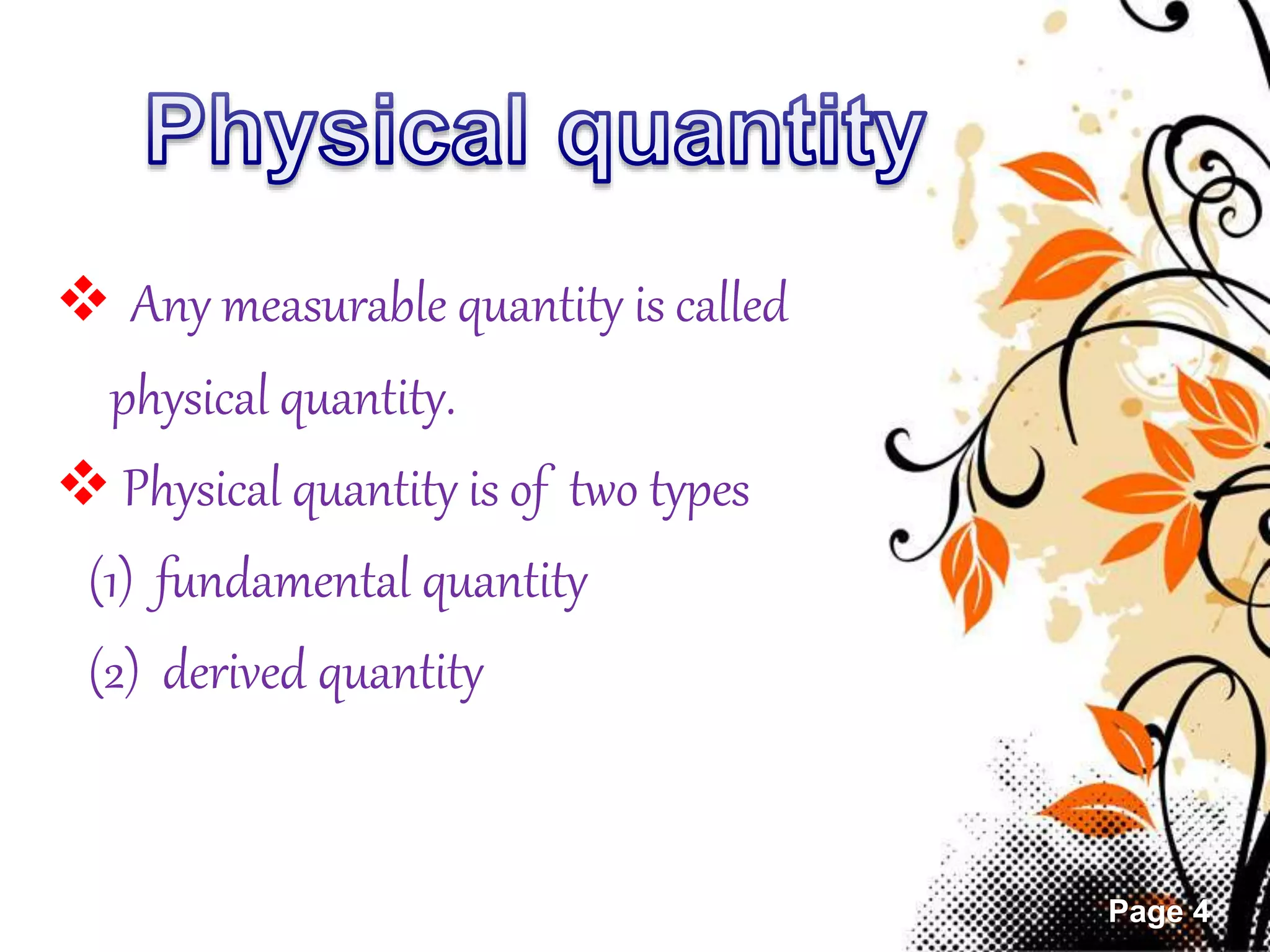
Any measurable quantity is called
physical quantity.
Physical quantity is of two types
(1) fundamental quantity
(2) derived quantity
5.
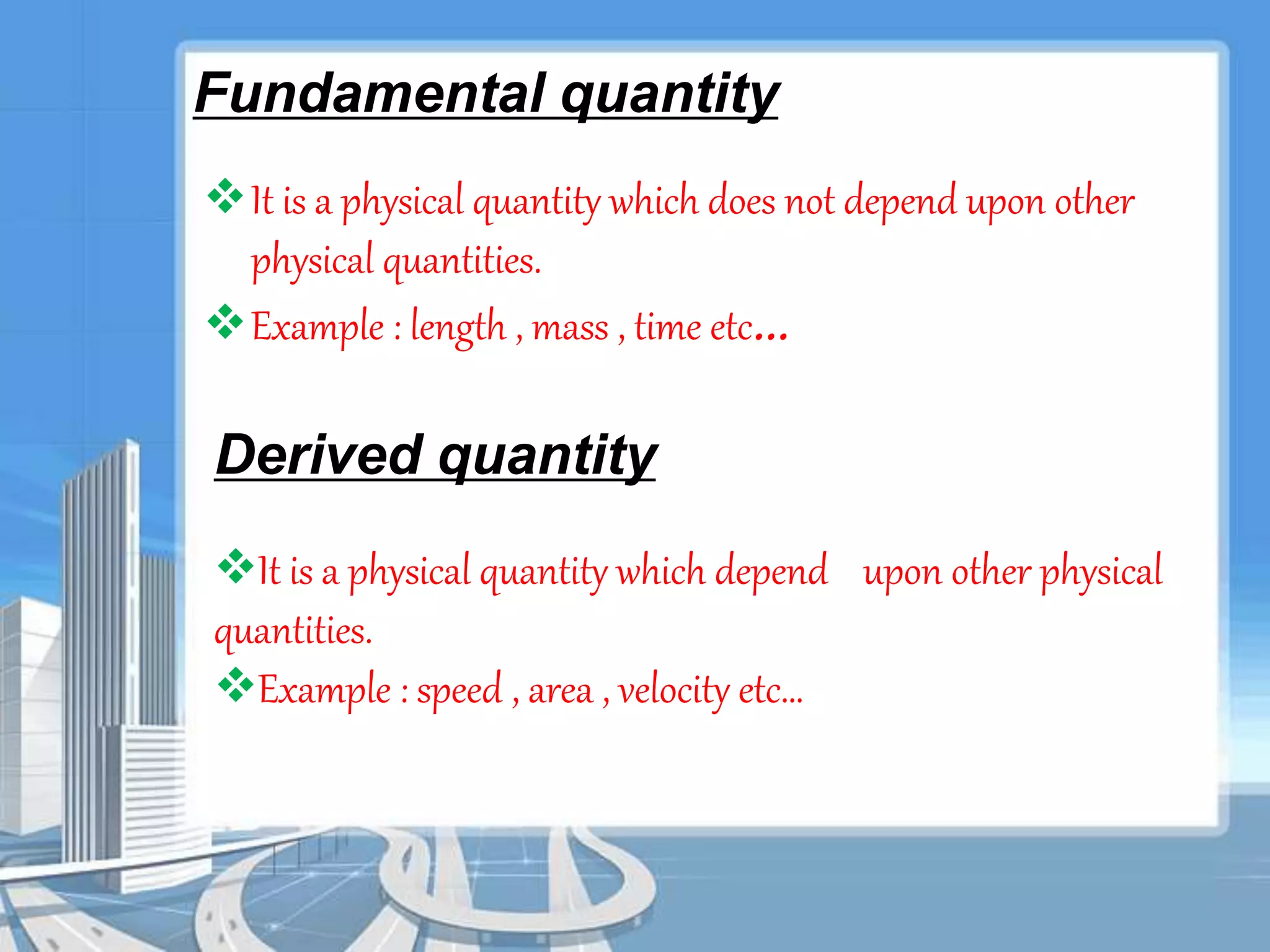
Fundamental quantity
Itis a physical quantity which does not depend upon other
physical quantities.
Example : length , mass , time etc…
Derived quantity
It is a physical quantity which depend upon other physical
quantities.
Example : speed , area , velocity etc…
6.
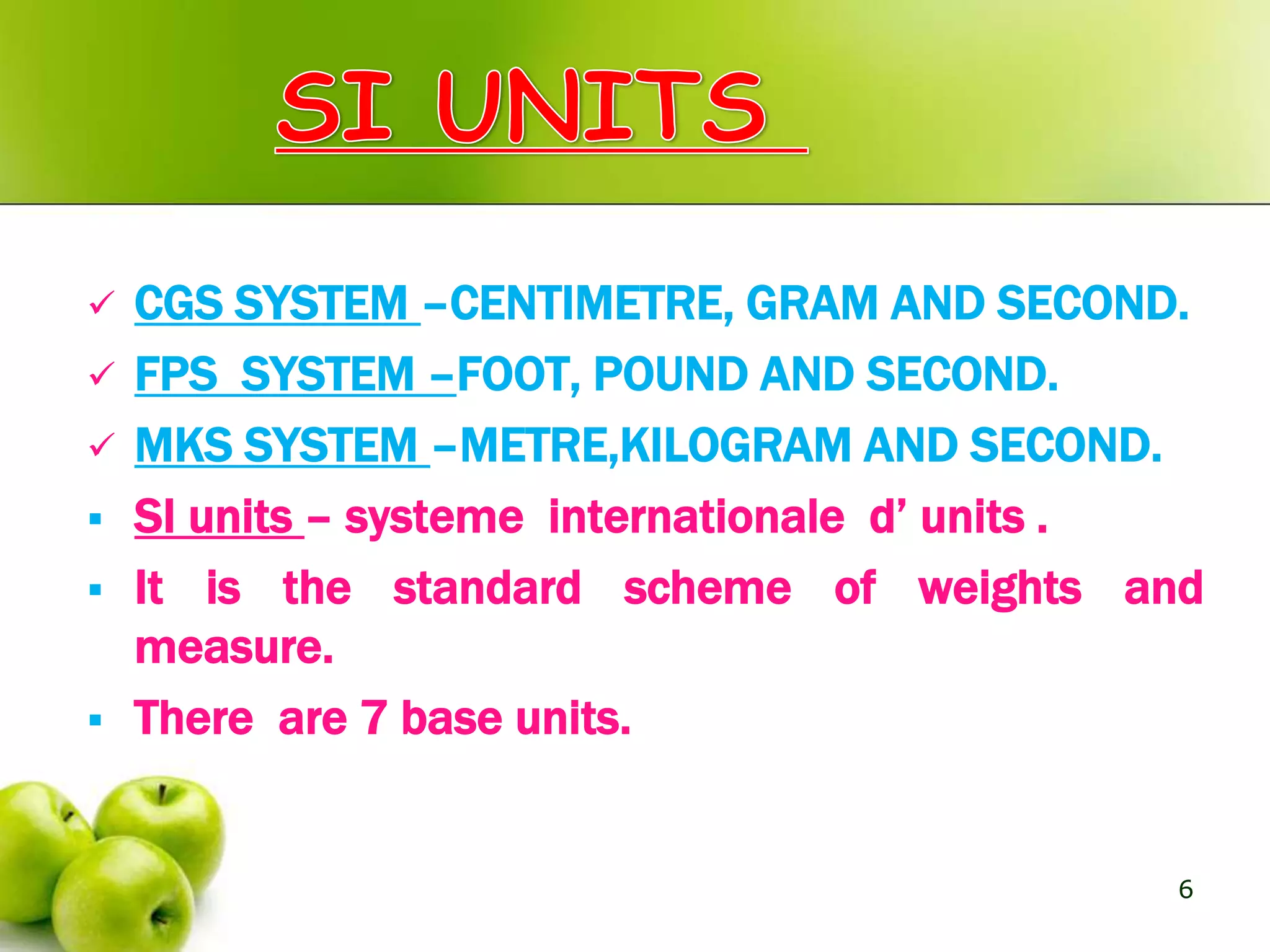
CGS SYSTEM–CENTIMETRE, GRAM AND SECOND.
FPS SYSTEM –FOOT, POUND AND SECOND.
MKS SYSTEM –METRE,KILOGRAM AND SECOND.
SI units – systeme internationale d’ units .
It is the standard scheme of weights and
measure.
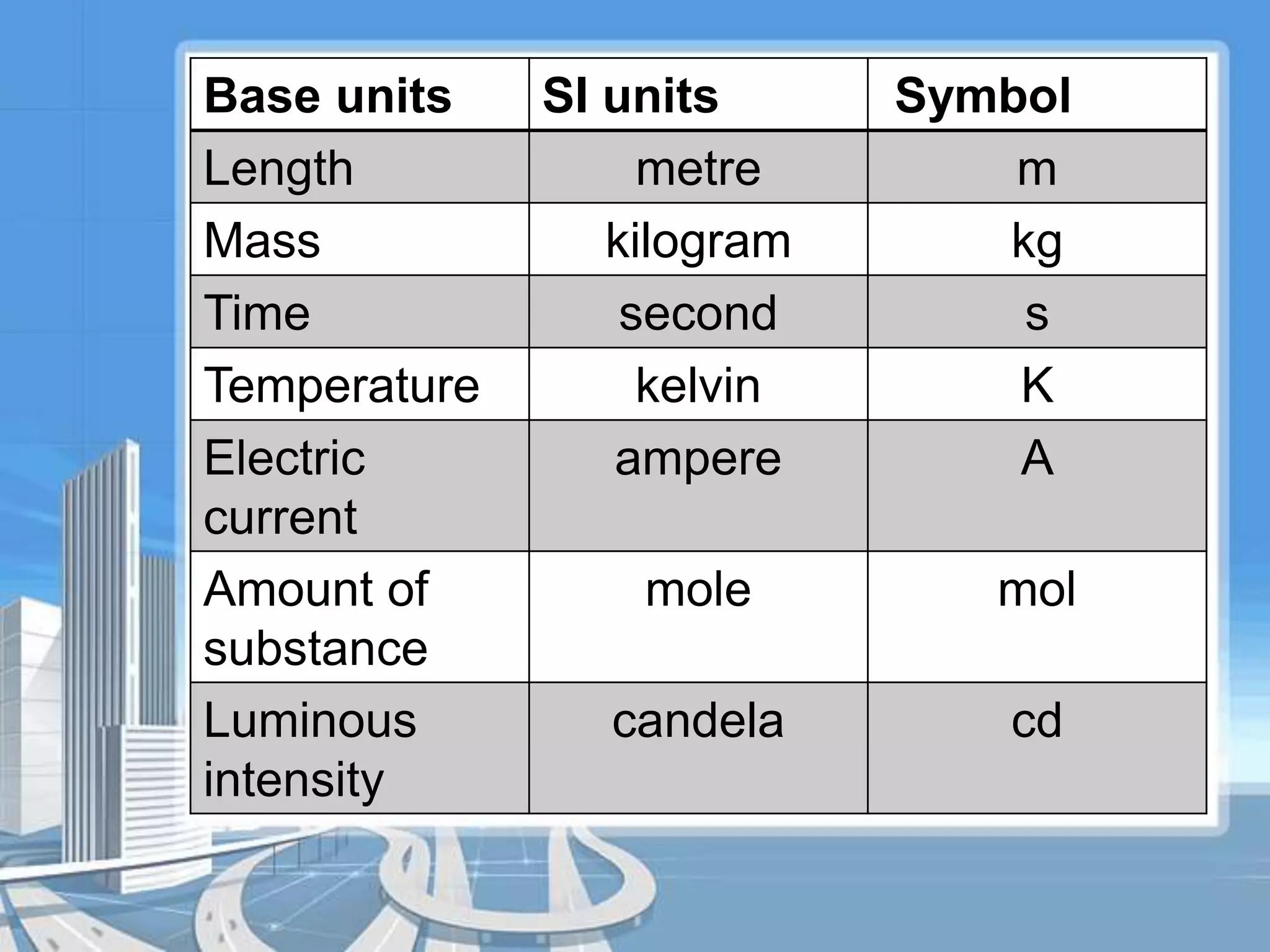
There are 7 base units.
6
7.
Base units SIunits Symbol
Length metre m
Mass kilogram kg
Time second s
Temperature kelvin K
Electric
ampere A
current
Amount of
substance
mole mol
Luminous
intensity
candela cd
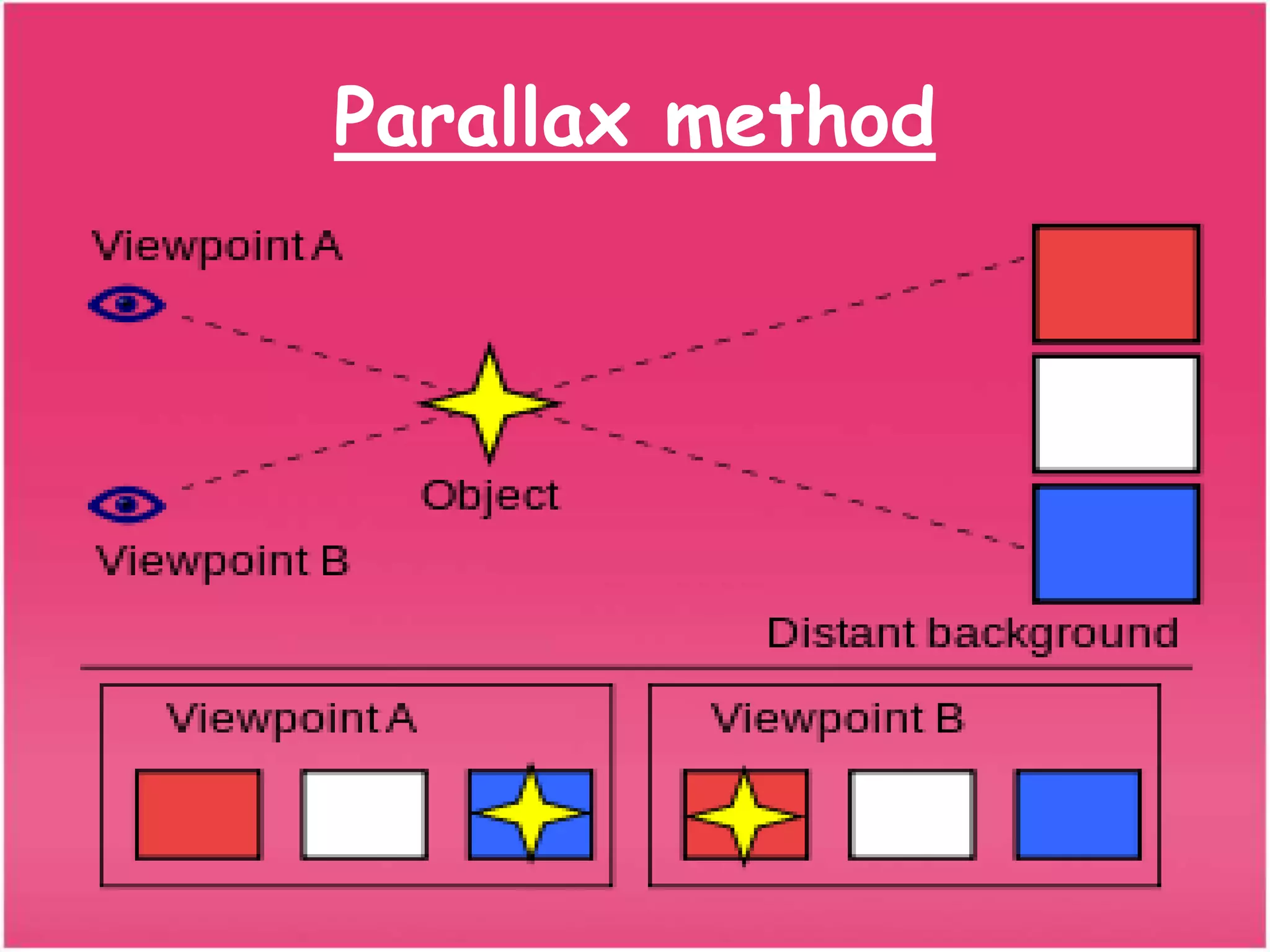
Parallax is adisplacement or difference in the apparent
position of an object viewed along two different lines of
sight, and is measured by the angle or semi-angle of
inclination between those two lines.[1][2] The term is derived
from the Greekπαράλλαξις (parallaxis), meaning "alteration".
Nearby objects have a larger parallax than more distant
objects when observed from different positions, so parallax
can be used to determine distances.
Astronomers use the principle of parallax to measure
distances to the closer stars. Here, the term "parallax" is
the semi-angle of inclination between two sight-lines to the
star, as observed when the Earth is on opposite sides of the
sun in its orbit.[3]These distances form the lowest rung of
what is called "the cosmic distance ladder", the first in a
succession of methods by which astronomers determine the
distances to celestial objects, serving as a basis for other
distance measurements in astronomy forming the higher
rungs of the ladder.
11.
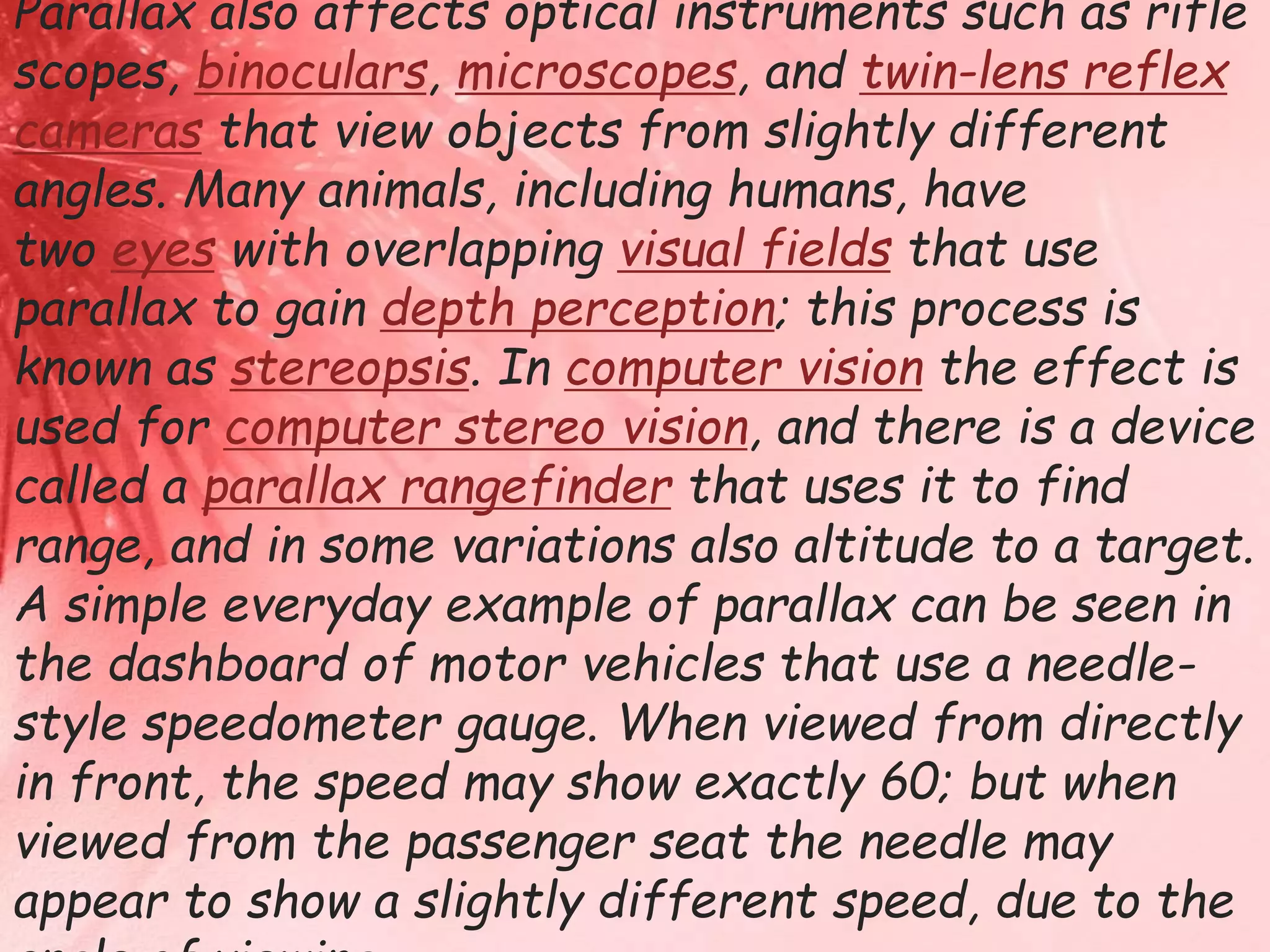
Parallax also affectsoptical instruments such as rifle
scopes, binoculars, microscopes, and twin-lens reflex
cameras that view objects from slightly different
angles. Many animals, including humans, have
two eyes with overlapping visual fields that use
parallax to gain depth perception; this process is
known as stereopsis. In computer vision the effect is
used for computer stereo vision, and there is a device
called a parallax rangefinder that uses it to find
range, and in some variations also altitude to a target.
A simple everyday example of parallax can be seen in
the dashboard of motor vehicles that use a needle-style
speedometer gauge. When viewed from directly
in front, the speed may show exactly 60; but when
viewed from the passenger seat the needle may
appear to show a slightly different speed, due to the
angle of viewing.
12.
LOGO This imagedemonstrates parallax. The Sun is visible above the
streetlight. The reflection in the water is a virtual image of
the Sun and the streetlight. The location of the virtual image
is below the surface of the water, offering a different
vantage point of the streetlight, which appears to be shifted
relative to the more distant Sun.
As the eyes of humans and other animals are in different
positions on the head, they present different views
simultaneously. This is the basis of stereopsis, the process by
which the brain exploits the parallax due to the different
views from the eye to gain depth perception and estimate
distances to objects.[4] Animals also use motion parallax, in
which the animals (or just the head) move to gain different
viewpoints. For example, pigeons (whose eyes do not have
overlapping fields of view and thus cannot use stereopsis) bob
their heads up and down to see depth.[5]
The motion parallax is exploited also in wiggle stereoscopy,
computer graphics which provide depth cues through
viewpoint-shifting animation rather than through binocular
14.
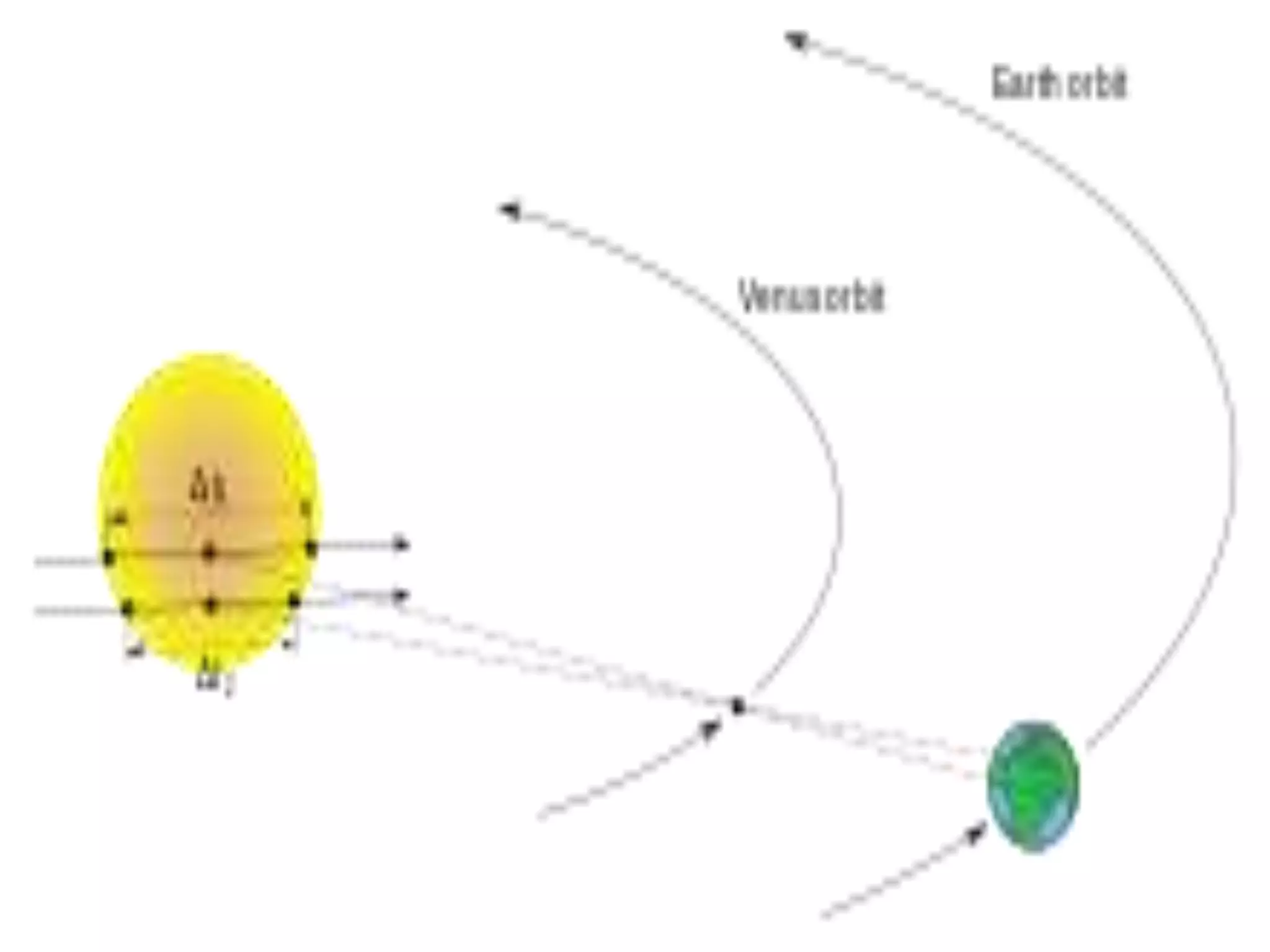
Parallax in astronomy
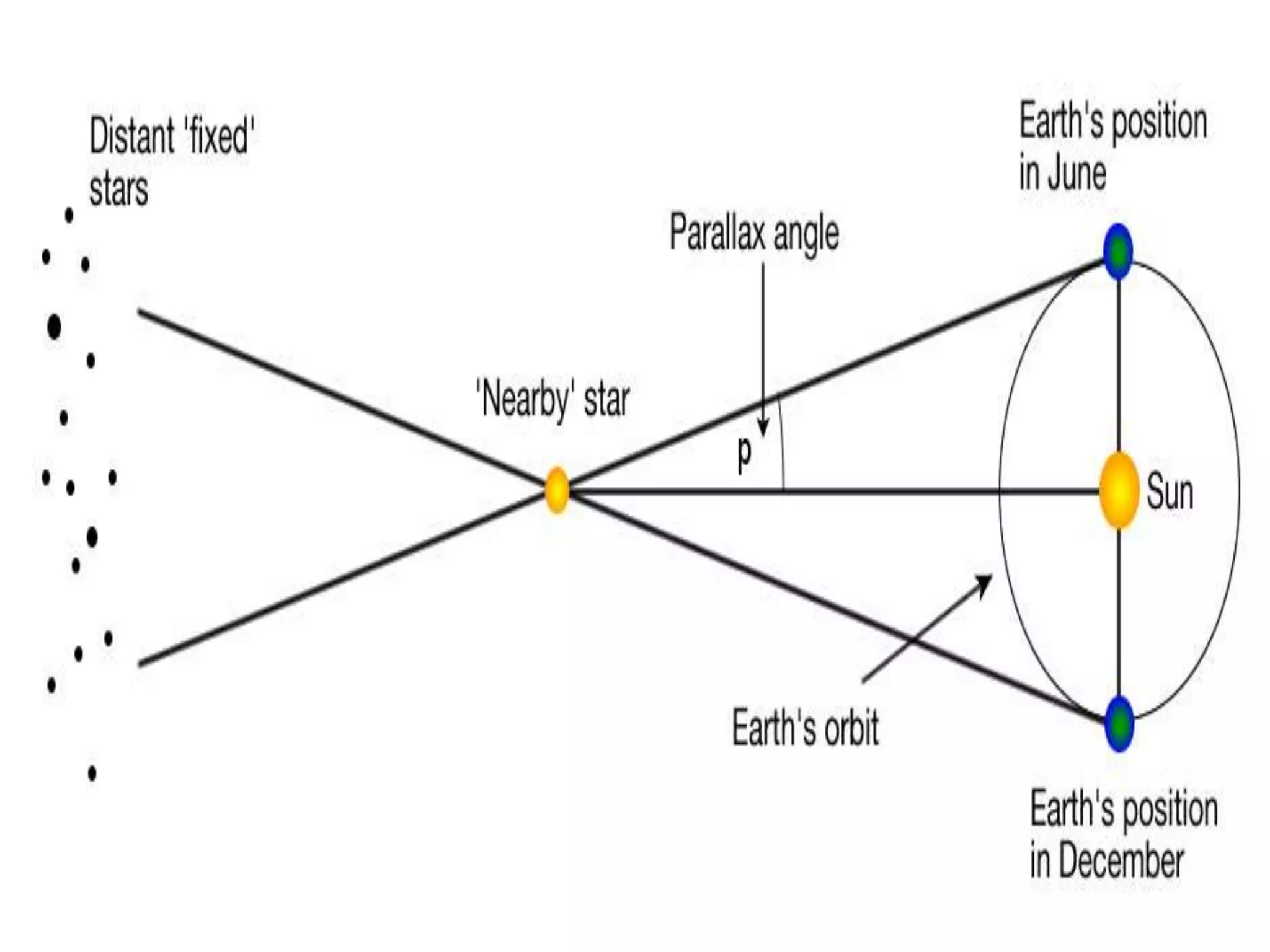
Parallax is an angle subtended by a line
on a point. In the upper diagram the earth
in its orbit sweeps the parallax angle
subtended on the sun. The lower diagram
shows an equal angle swept by the sun in
a geostatic model. A similar diagram can
be drawn for a star except that the angle
of parallax would be minuscule.
Parallax arises due to change in
viewpoint occurring due to motion of the
observer, of the observed, or of both.
What is essential is relative motion. By
observing parallax, measuring angles,
and using geometry, one can
determine distance.
16.
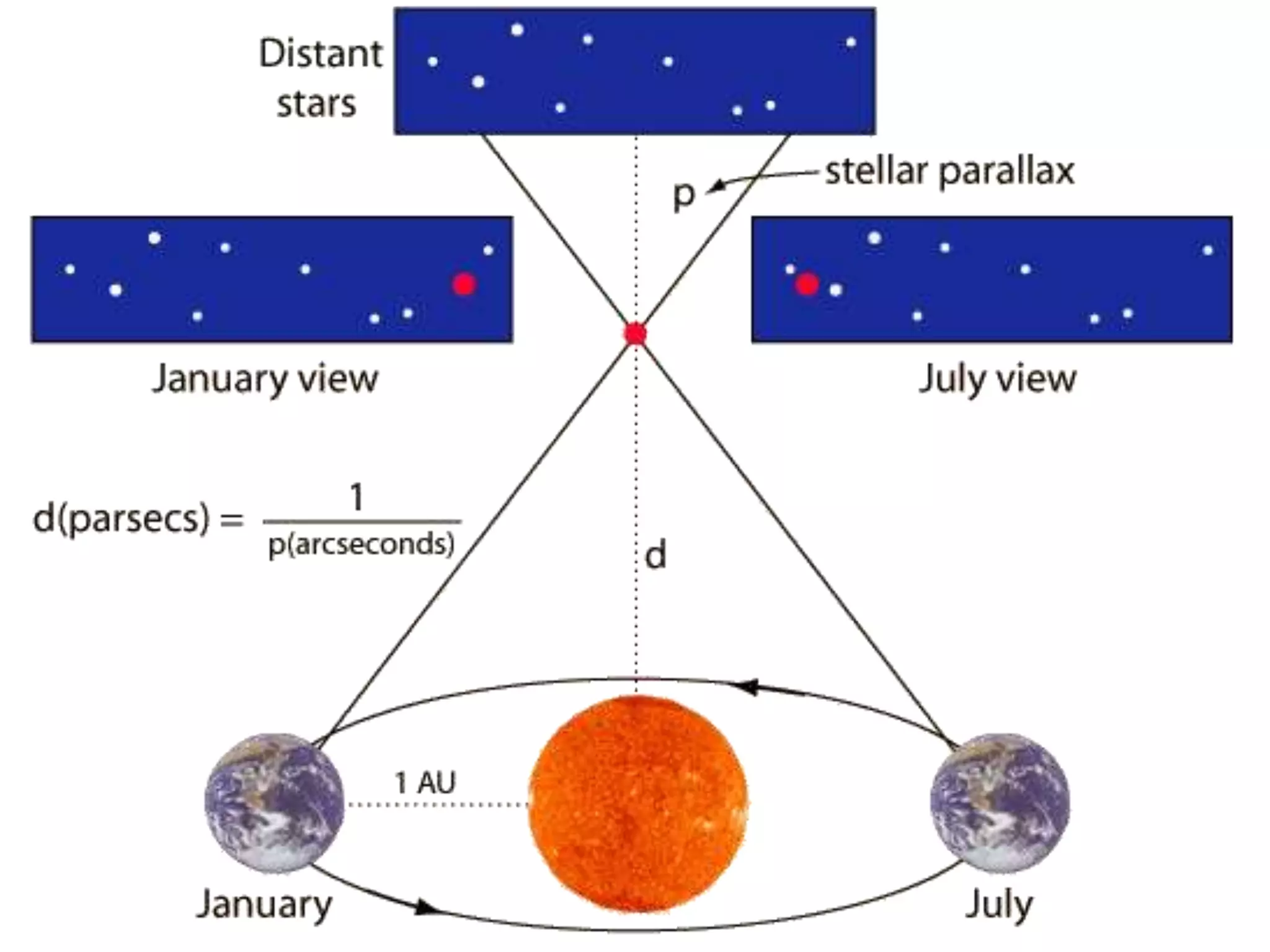
Stellar parallax
Stellarparallax created by the relative motion between the Earth and
a star can be seen, in the Copernican model, as arising from the orbit of
the Earth around the Sun: the star only appears to move relative to more
distant objects in the sky. In a geostatic model, the movement of the star
would have to be taken as real with the star oscillating across the sky with
respect to the background stars.
Stellar parallax is most often measured using annual parallax, defined as
the difference in position of a star as seen from the Earth and Sun, i. e.
the angle subtended at a star by the mean radius of the Earth's orbit
around the Sun. The parsec (3.26 light-years) is defined as the distance
for which the annual parallax is 1 arcsecond. Annual parallax is normally
measured by observing the position of a star at different times of
the year as the Earth moves through its orbit. Measurement of annual
parallax was the first reliable way to determine the distances to the
closest stars. The first successful measurements of stellar parallax were
made byFriedrich Bessel in 1838 for the star 61 Cygni using
a heliometer.[6] Stellar parallax remains the standard for calibrating other
measurement methods. Accurate calculations of distance based on stellar
parallax require a measurement of the distance from the Earth to the Sun,
now based on radar reflection off the surfaces of planets.[7]
18.
measure. The neareststar to the Sun (and thus the star with the largest
parallax), Proxima Centauri, has a parallax of 0.7687 ± 0.0003 arcsec.[8] This angle
is approximately that subtended by an object 2 centimeters in diameter located 5.3
kilometers away.
2014).[9]
The fact that stellar parallax was so small that it was unobservable at the time was
used as the main scientific argument against heliocentrism during the early modern
age. It is clear from Euclid's geometry that the effect would be undetectable if
the stars were far enough away, but for various reasons such gigantic distances
involved seemed entirely implausible: it was one of Tycho's principal objections
to Copernican heliocentrism that in order for it to be compatible with the lack of
observable stellar parallax, there would have to be an enormous and unlikely void
between the orbit of Saturn and the eighth sphere (the fixed stars).[10]
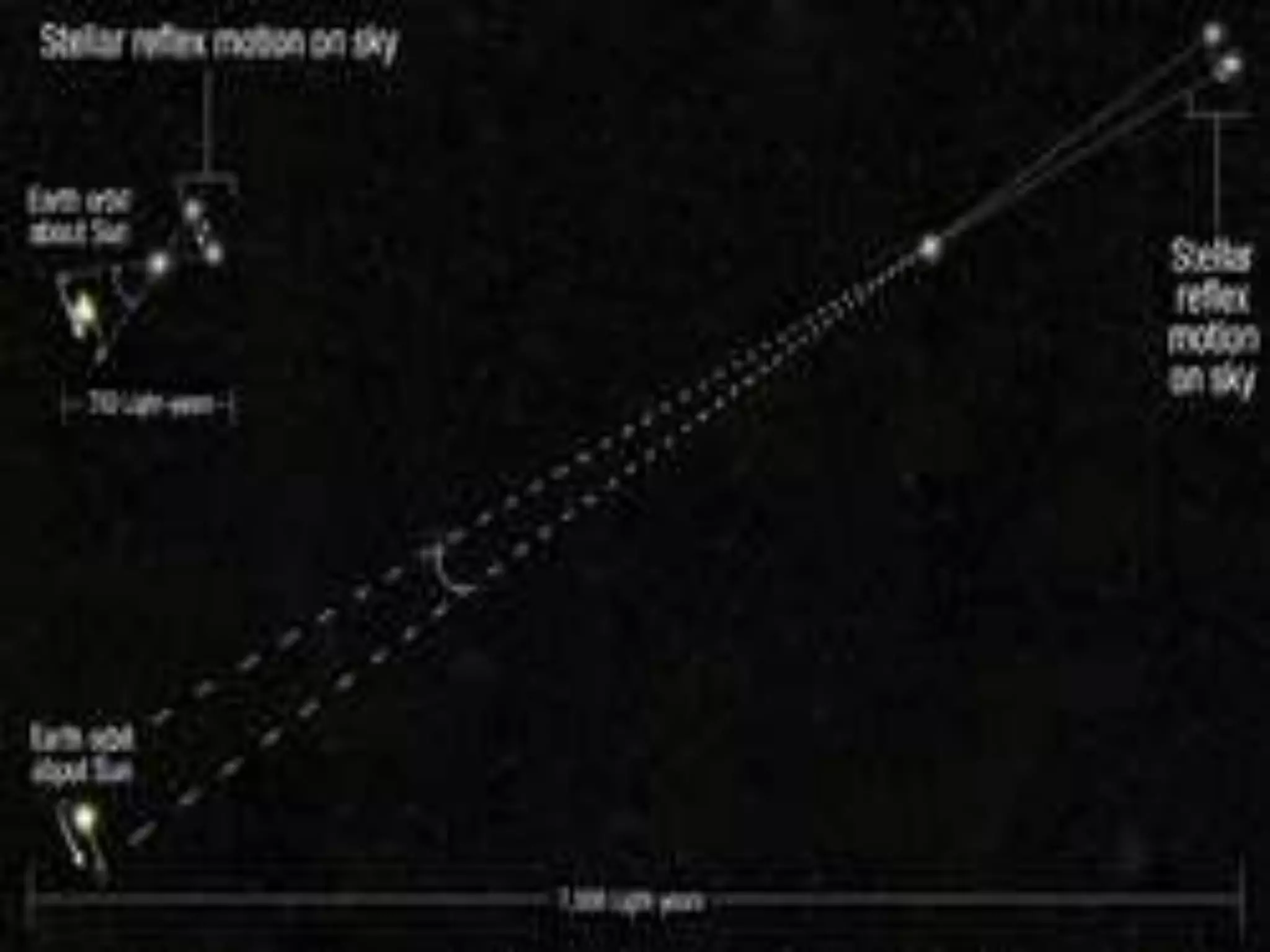
In 1989, the satellite Hipparcos was launched primarily for obtaining improved
parallaxes and proper motions for over 100,000 nearby stars, increasing the reach
of the method tenfold. Even so, Hipparcos is only able to measure parallax angles
for stars up to about 1,600 light-years away, a little more than one percent of the
diameter of theMilky Way Galaxy. The European Space Agency's Gaia mission,
launched in December 2013, will be able to measure parallax angles to an accuracy
of 10 microarcseconds, thus mapping nearby stars (and potentially planets) up to a
distance of tens of thousands of light-years from Earth.[11][12] In April 2014, NASA
astronomers reported that the Hubble Space Telescope, by using spatial scanning,
can now precisely measure distances up to 10,000 light-years away, a ten-fold
improvement over earlier measurements.[9] (related image)
20.
The angles involvedin these calculations are very small and thus difficult to measure. The nearest star to
the Sun (and thus the star with the largest parallax), Proxima Centauri, has a parallax of
0.7687 ± 0.0003 arcsec.[8] This angle is approximately that subtended by an object 2 centimeters in
diameter located 5.3 kilometers away.
The fact that stellar parallax was so small that it was unobservable at the time was used as the main
scientific argument against heliocentrism during the early modern age. It is clear
from Euclid's geometry that the effect would be undetectable if the stars were far enough away, but for
various reasons such gigantic distances involved seemed entirely implausible: it was one of Tycho's
principal objections to Copernican heliocentrism that in order for it to be compatible with the lack of
observable stellar parallax, there would have to be an enormous and unlikely void between the orbit of
Saturn and the eighth sphere (the fixed stars).[10]
22.
In 1989, thesatellite Hipparcos was launched primarily for obtaining improved parallaxes
and proper motions for over 100,000 nearby stars, increasing the reach of the method tenfold.
Even so, Hipparcos is only able to measure parallax angles for stars up to about 1,600 light-years
away, a little more than one percent of the diameter of theMilky Way Galaxy.
The European Space Agency's Gaia mission, launched in December 2013, will be able to measure
parallax angles to an accuracy of 10 microarcseconds, thus mapping nearby stars (and
potentially planets) up to a distance of tens of thousands of light-years from Earth.[11][12] In April
2014, NASA astronomers reported that the Hubble Space Telescope, by using spatial scanning,
can now precisely measure distances up to 10,000 light-years away, a ten-fold improvement over
earlier measurements.[9] (related image)
24.
Distance measurement
Distancemeasurement by parallax is a special case of the principle of triangulation, which
states that one can solve for all the sides and angles in a network of triangles if, in addition to all
the angles in the network, the length of at least one side has been measured. Thus, the careful
measurement of the length of one baseline can fix the scale of an entire triangulation network.
In parallax, the triangle is extremely long and narrow, and by measuring both its shortest side
(the motion of the observer) and the small top angle (always less than 1 arcsecond,[6] leaving the
other two close to 90 degrees), the length of the long sides (in practice considered to be equal)
can be determined.
26.
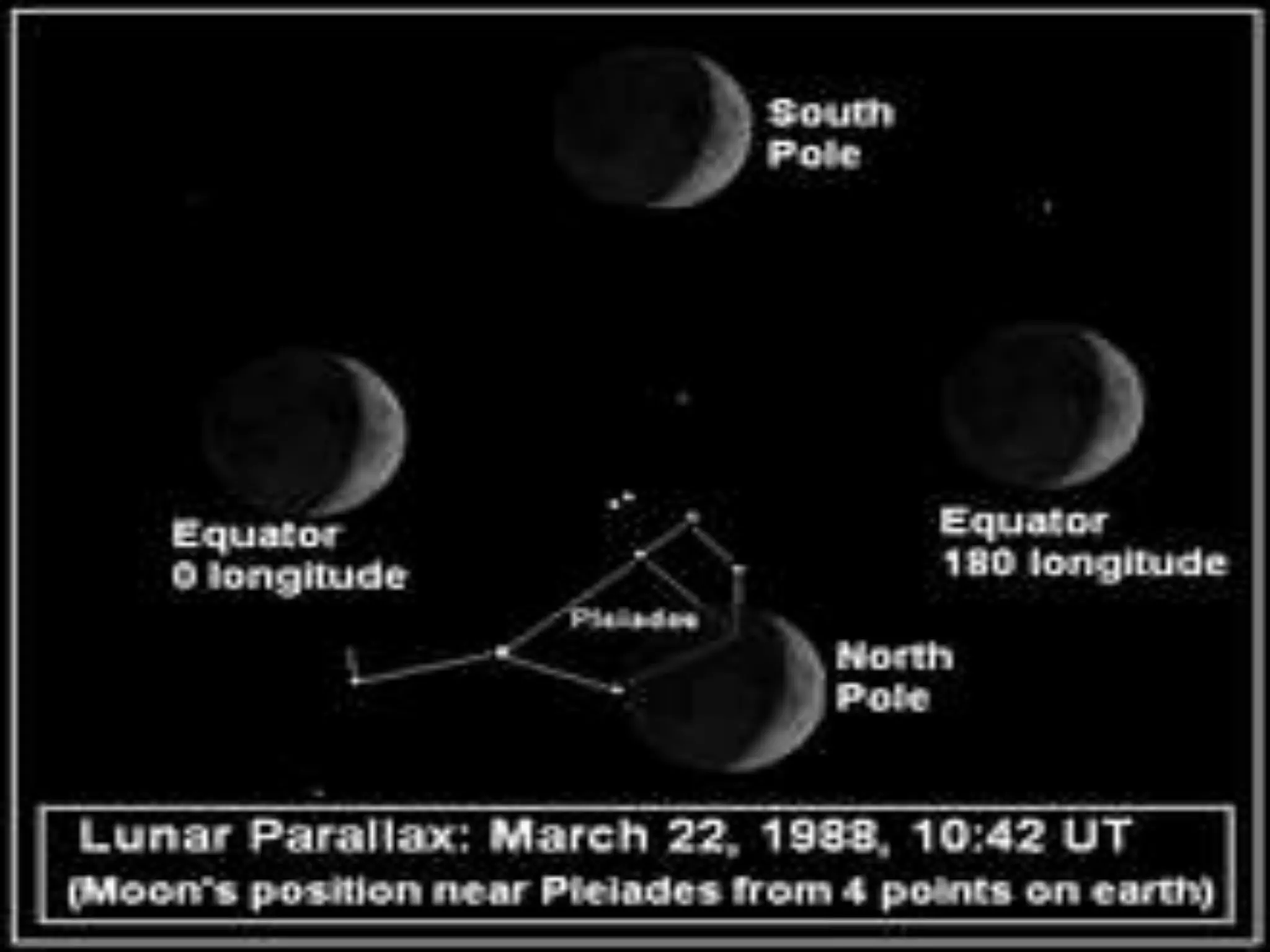
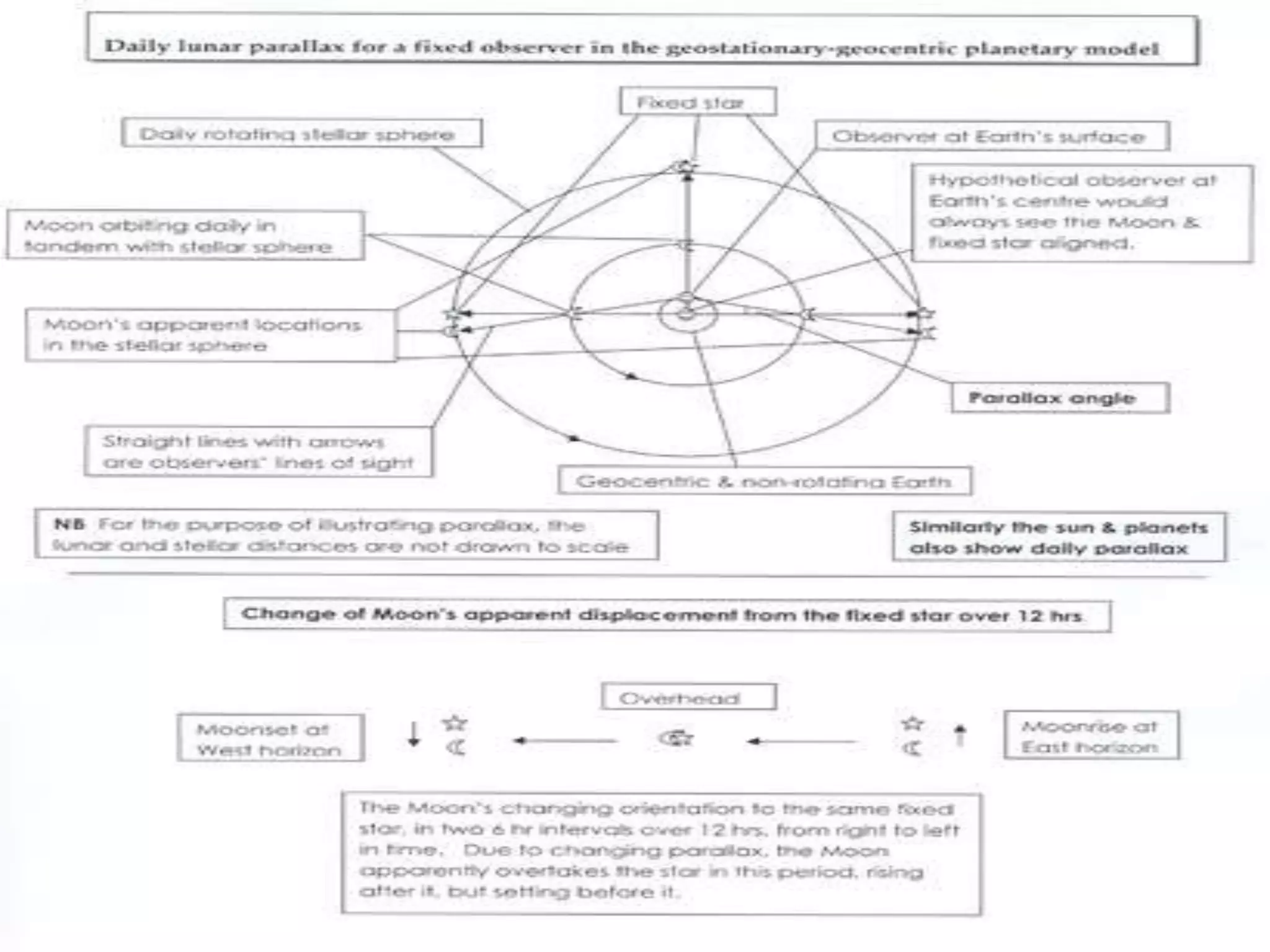
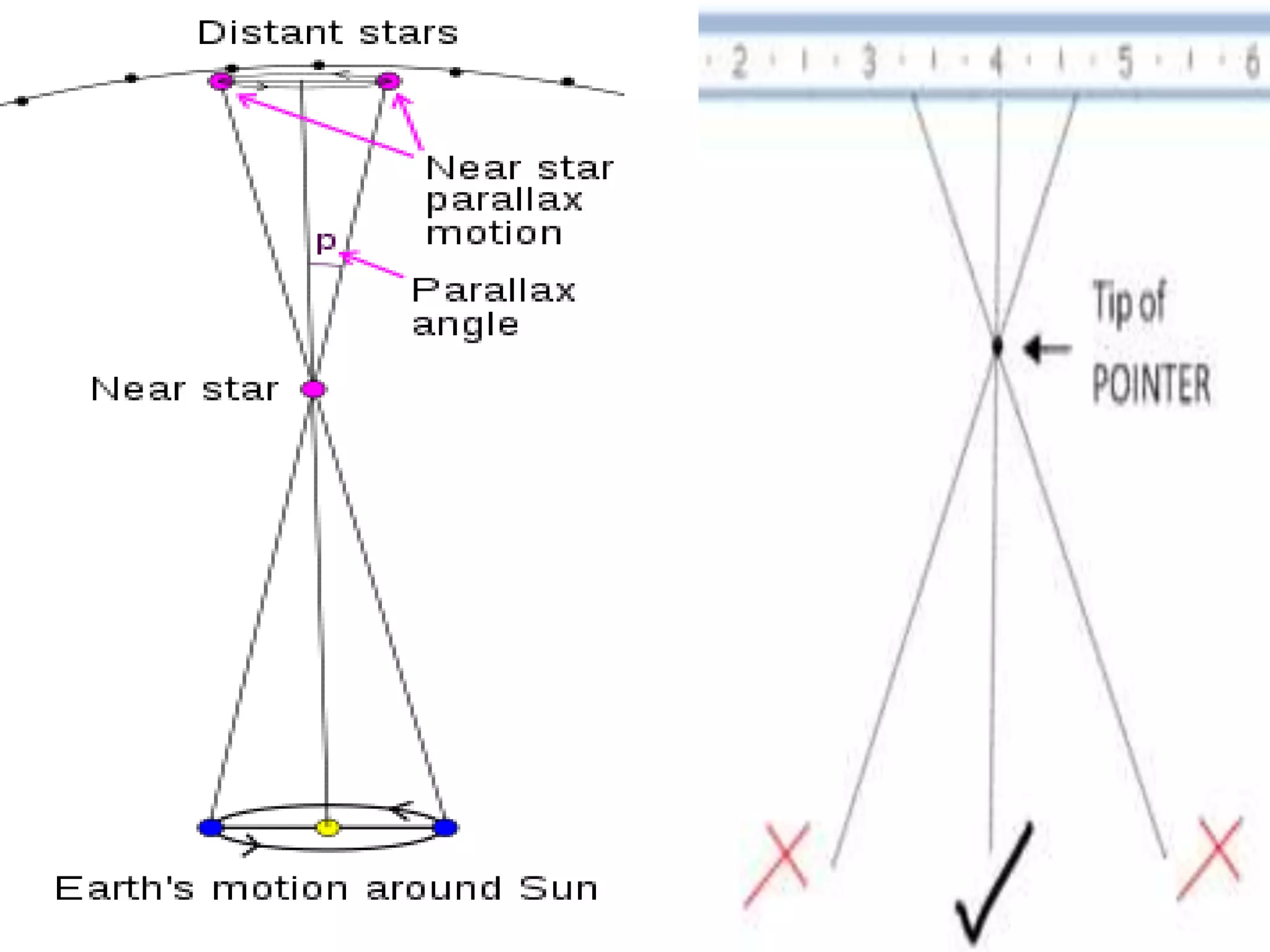
Lunar parallax
Lunarparallax (often short for lunar horizontal parallax or lunar equatorial horizontal parallax ), is a special case of (diurnal)
parallax: the Moon, being the nearest celestial body, has by far the largest maximum parallax of any celestial body, it can exceed
1 degree.[15]
The diagram (above) for stellar parallax can illustrate lunar parallax as well, if the diagram is taken to be scaled right down and
slightly modified. Instead of 'near star', read 'Moon', and instead of taking the circle at the bottom of the diagram to represent
the size of the Earth's orbit around the Sun, take it to be the size of the Earth's globe, and of a circle around the Earth's surface.
Then, the lunar (horizontal) parallax amounts to the difference in angular position, relative to the background of distant stars,
of the Moon as seen from two different viewing positions on the Earth: one of the viewing positions is the place from which the
Moon can be seen directly overhead at a given moment (that is, viewed along the vertical line in the diagram); and the other
viewing position is a place from which the Moon can be seen on the horizon at the same moment (that is, viewed along one of the
diagonal lines, from an Earth-surface position corresponding roughly to one of the blue dots on the modified diagram).


![Parallax is a displacement or difference in the apparent
position of an object viewed along two different lines of
sight, and is measured by the angle or semi-angle of
inclination between those two lines.[1][2] The term is derived
from the Greekπαράλλαξις (parallaxis), meaning "alteration".
Nearby objects have a larger parallax than more distant
objects when observed from different positions, so parallax
can be used to determine distances.
Astronomers use the principle of parallax to measure
distances to the closer stars. Here, the term "parallax" is
the semi-angle of inclination between two sight-lines to the
star, as observed when the Earth is on opposite sides of the
sun in its orbit.[3]These distances form the lowest rung of
what is called "the cosmic distance ladder", the first in a
succession of methods by which astronomers determine the
distances to celestial objects, serving as a basis for other
distance measurements in astronomy forming the higher
rungs of the ladder.](https://image.slidesharecdn.com/physics-141104095301-conversion-gate01/75/units-and-measurement-xi-physics-9-2048.jpg)
![LOGO This image demonstrates parallax. The Sun is visible above the
streetlight. The reflection in the water is a virtual image of
the Sun and the streetlight. The location of the virtual image
is below the surface of the water, offering a different
vantage point of the streetlight, which appears to be shifted
relative to the more distant Sun.
As the eyes of humans and other animals are in different
positions on the head, they present different views
simultaneously. This is the basis of stereopsis, the process by
which the brain exploits the parallax due to the different
views from the eye to gain depth perception and estimate
distances to objects.[4] Animals also use motion parallax, in
which the animals (or just the head) move to gain different
viewpoints. For example, pigeons (whose eyes do not have
overlapping fields of view and thus cannot use stereopsis) bob
their heads up and down to see depth.[5]
The motion parallax is exploited also in wiggle stereoscopy,
computer graphics which provide depth cues through
viewpoint-shifting animation rather than through binocular](https://image.slidesharecdn.com/physics-141104095301-conversion-gate01/75/units-and-measurement-xi-physics-12-2048.jpg)


![Stellar parallax
Stellar parallax created by the relative motion between the Earth and
a star can be seen, in the Copernican model, as arising from the orbit of
the Earth around the Sun: the star only appears to move relative to more
distant objects in the sky. In a geostatic model, the movement of the star
would have to be taken as real with the star oscillating across the sky with
respect to the background stars.
Stellar parallax is most often measured using annual parallax, defined as
the difference in position of a star as seen from the Earth and Sun, i. e.
the angle subtended at a star by the mean radius of the Earth's orbit
around the Sun. The parsec (3.26 light-years) is defined as the distance
for which the annual parallax is 1 arcsecond. Annual parallax is normally
measured by observing the position of a star at different times of
the year as the Earth moves through its orbit. Measurement of annual
parallax was the first reliable way to determine the distances to the
closest stars. The first successful measurements of stellar parallax were
made byFriedrich Bessel in 1838 for the star 61 Cygni using
a heliometer.[6] Stellar parallax remains the standard for calibrating other
measurement methods. Accurate calculations of distance based on stellar
parallax require a measurement of the distance from the Earth to the Sun,
now based on radar reflection off the surfaces of planets.[7]](https://image.slidesharecdn.com/physics-141104095301-conversion-gate01/75/units-and-measurement-xi-physics-16-2048.jpg)
![measure. The nearest star to the Sun (and thus the star with the largest
parallax), Proxima Centauri, has a parallax of 0.7687 ± 0.0003 arcsec.[8] This angle
is approximately that subtended by an object 2 centimeters in diameter located 5.3
kilometers away.
2014).[9]
The fact that stellar parallax was so small that it was unobservable at the time was
used as the main scientific argument against heliocentrism during the early modern
age. It is clear from Euclid's geometry that the effect would be undetectable if
the stars were far enough away, but for various reasons such gigantic distances
involved seemed entirely implausible: it was one of Tycho's principal objections
to Copernican heliocentrism that in order for it to be compatible with the lack of
observable stellar parallax, there would have to be an enormous and unlikely void
between the orbit of Saturn and the eighth sphere (the fixed stars).[10]
In 1989, the satellite Hipparcos was launched primarily for obtaining improved
parallaxes and proper motions for over 100,000 nearby stars, increasing the reach
of the method tenfold. Even so, Hipparcos is only able to measure parallax angles
for stars up to about 1,600 light-years away, a little more than one percent of the
diameter of theMilky Way Galaxy. The European Space Agency's Gaia mission,
launched in December 2013, will be able to measure parallax angles to an accuracy
of 10 microarcseconds, thus mapping nearby stars (and potentially planets) up to a
distance of tens of thousands of light-years from Earth.[11][12] In April 2014, NASA
astronomers reported that the Hubble Space Telescope, by using spatial scanning,
can now precisely measure distances up to 10,000 light-years away, a ten-fold
improvement over earlier measurements.[9] (related image)](https://image.slidesharecdn.com/physics-141104095301-conversion-gate01/75/units-and-measurement-xi-physics-18-2048.jpg)
![The angles involved in these calculations are very small and thus difficult to measure. The nearest star to
the Sun (and thus the star with the largest parallax), Proxima Centauri, has a parallax of
0.7687 ± 0.0003 arcsec.[8] This angle is approximately that subtended by an object 2 centimeters in
diameter located 5.3 kilometers away.
The fact that stellar parallax was so small that it was unobservable at the time was used as the main
scientific argument against heliocentrism during the early modern age. It is clear
from Euclid's geometry that the effect would be undetectable if the stars were far enough away, but for
various reasons such gigantic distances involved seemed entirely implausible: it was one of Tycho's
principal objections to Copernican heliocentrism that in order for it to be compatible with the lack of
observable stellar parallax, there would have to be an enormous and unlikely void between the orbit of
Saturn and the eighth sphere (the fixed stars).[10]](https://image.slidesharecdn.com/physics-141104095301-conversion-gate01/75/units-and-measurement-xi-physics-20-2048.jpg)
![In 1989, the satellite Hipparcos was launched primarily for obtaining improved parallaxes
and proper motions for over 100,000 nearby stars, increasing the reach of the method tenfold.
Even so, Hipparcos is only able to measure parallax angles for stars up to about 1,600 light-years
away, a little more than one percent of the diameter of theMilky Way Galaxy.
The European Space Agency's Gaia mission, launched in December 2013, will be able to measure
parallax angles to an accuracy of 10 microarcseconds, thus mapping nearby stars (and
potentially planets) up to a distance of tens of thousands of light-years from Earth.[11][12] In April
2014, NASA astronomers reported that the Hubble Space Telescope, by using spatial scanning,
can now precisely measure distances up to 10,000 light-years away, a ten-fold improvement over
earlier measurements.[9] (related image)](https://image.slidesharecdn.com/physics-141104095301-conversion-gate01/75/units-and-measurement-xi-physics-22-2048.jpg)
![Distance measurement
Distance measurement by parallax is a special case of the principle of triangulation, which
states that one can solve for all the sides and angles in a network of triangles if, in addition to all
the angles in the network, the length of at least one side has been measured. Thus, the careful
measurement of the length of one baseline can fix the scale of an entire triangulation network.
In parallax, the triangle is extremely long and narrow, and by measuring both its shortest side
(the motion of the observer) and the small top angle (always less than 1 arcsecond,[6] leaving the
other two close to 90 degrees), the length of the long sides (in practice considered to be equal)
can be determined.](https://image.slidesharecdn.com/physics-141104095301-conversion-gate01/75/units-and-measurement-xi-physics-24-2048.jpg)
![Lunar parallax
Lunar parallax (often short for lunar horizontal parallax or lunar equatorial horizontal parallax ), is a special case of (diurnal)
parallax: the Moon, being the nearest celestial body, has by far the largest maximum parallax of any celestial body, it can exceed
1 degree.[15]
The diagram (above) for stellar parallax can illustrate lunar parallax as well, if the diagram is taken to be scaled right down and
slightly modified. Instead of 'near star', read 'Moon', and instead of taking the circle at the bottom of the diagram to represent
the size of the Earth's orbit around the Sun, take it to be the size of the Earth's globe, and of a circle around the Earth's surface.
Then, the lunar (horizontal) parallax amounts to the difference in angular position, relative to the background of distant stars,
of the Moon as seen from two different viewing positions on the Earth: one of the viewing positions is the place from which the
Moon can be seen directly overhead at a given moment (that is, viewed along the vertical line in the diagram); and the other
viewing position is a place from which the Moon can be seen on the horizon at the same moment (that is, viewed along one of the
diagonal lines, from an Earth-surface position corresponding roughly to one of the blue dots on the modified diagram).](https://image.slidesharecdn.com/physics-141104095301-conversion-gate01/75/units-and-measurement-xi-physics-26-2048.jpg)



![1316 ditto[1]](https://cdn.slidesharecdn.com/ss_thumbnails/d1npaetpr4vbrc9ij5xw-signature-fabe374f978bfb273f92443e2c8243d3e294d623a7c677008fe136d7284f57a9-poli-140825181533-phpapp02-thumbnail.jpg?width=640&height=640&fit=bounds)


