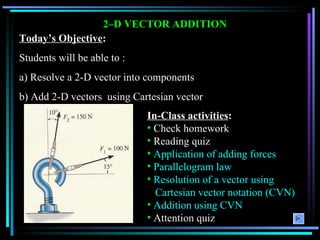
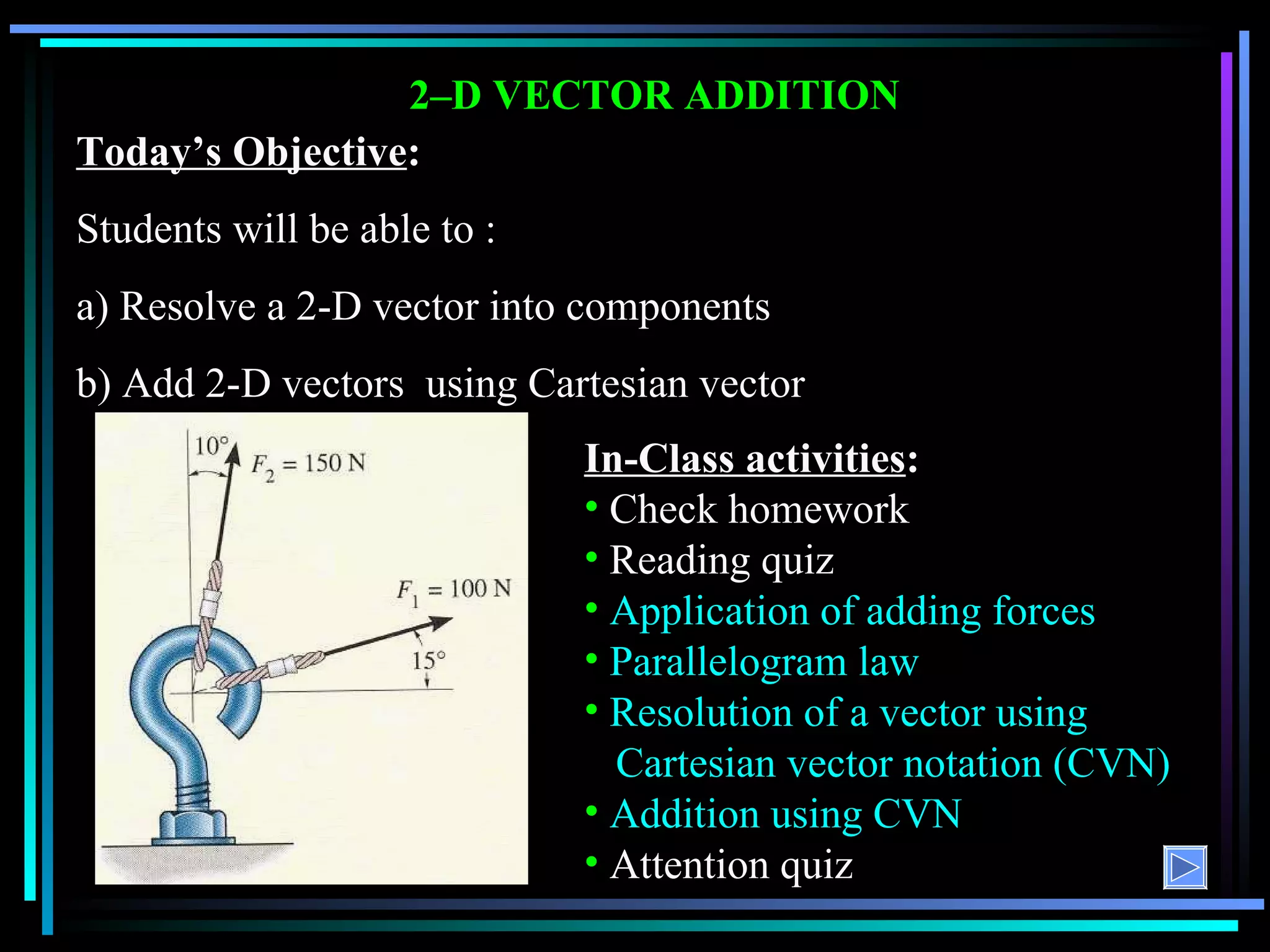

2–D VECTOR ADDITION   Today’s Objective : Students will be able to :   a) Resolve a 2-D vector into components b) Add 2-D vectors  using Cartesian vector notations. In-Class activities : Check homework Reading quiz  Application of adding forces Parallelogram law  Resolution of a vector using  Cartesian vector notation (CVN)  Addition using CVN   Attention quiz
READING  QUIZ 1. Which one of the following is a scalar quantity? A) Force  B) Position  C) Mass  D) Velocity 2. For vector addition you have to use ______ law. A) Newton’s Second B) the arithmetic C) Pascal’s  D) the parallelogram
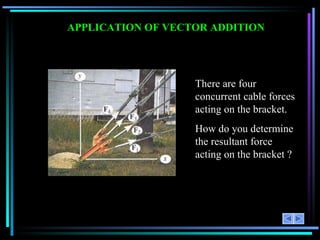
APPLICATION OF VECTOR ADDITION There are four concurrent cable forces acting on the bracket. How do you determine the resultant force acting on the bracket ?
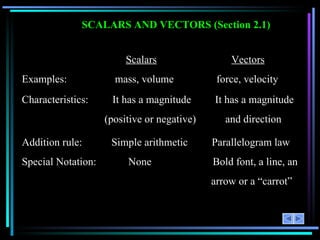
SCALARS AND VECTORS (Section 2.1)   Scalars   Vectors Examples:  mass, volume  force, velocity Characteristics:  It has a magnitude  It has a magnitude (positive or negative)  and direction Addition rule:  Simple arithmetic  Parallelogram law Special Notation:  None  Bold font, a line, an arrow or a “carrot”
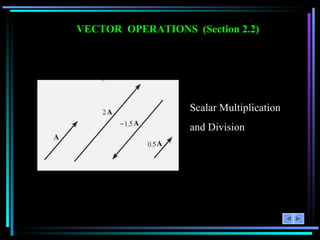
VECTOR  OPERATIONS   (Section 2.2) Scalar Multiplication  and Division
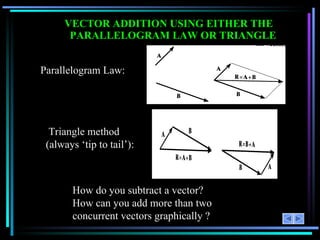
VECTOR ADDITION USING EITHER THE   PARALLELOGRAM LAW OR TRIANGLE Parallelogram Law: Triangle method (always ‘tip to tail’):  How do you subtract a vector? How can you add more than two concurrent vectors graphically ?
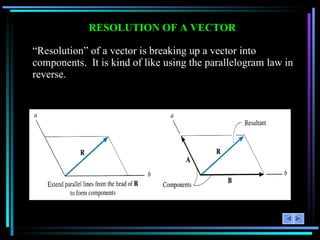
“ Resolution” of a vector is breaking up a vector into components.  It is kind of like using the parallelogram law in reverse.  RESOLUTION OF A VECTOR
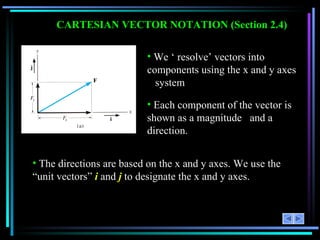
CARTESIAN VECTOR NOTATION (Section 2.4) Each component of the vector is shown as a magnitude  and a direction. We ‘ resolve’ vectors into components using the x and y axes  system  The directions are based on the x and y axes. We use the “unit vectors”  i  and  j  to designate the x and y axes.
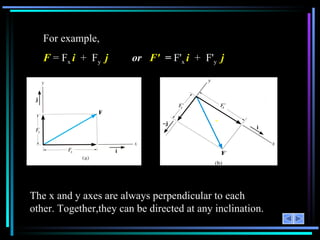
For example, F  = F x  i   +  F y  j  or  F '   =  F ' x  i   +  F ' y  j  The x and y axes are always perpendicular to each other. Together,they can be directed at any inclination.
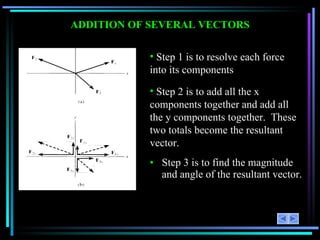
ADDITION OF SEVERAL VECTORS Step 3 is to find the magnitude and angle of the resultant vector. Step 1 is to resolve each force into its components Step 2 is to add all the x components together and add all the y components together.  These two totals become the resultant vector.
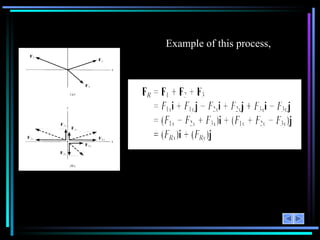
Example of this process,
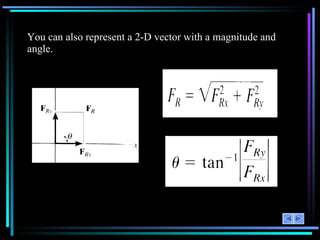
You can also represent a 2-D vector with a magnitude and angle.
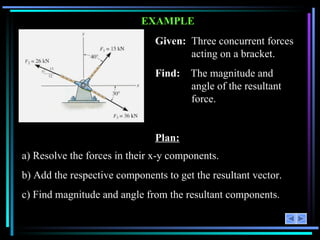
EXAMPLE Given:   Three concurrent forces acting on a bracket. Find:   The magnitude and angle of the resultant force. Plan: a) Resolve the forces in their x-y components. b) Add the respective components to get the resultant vector. c) Find magnitude and angle from the resultant components.
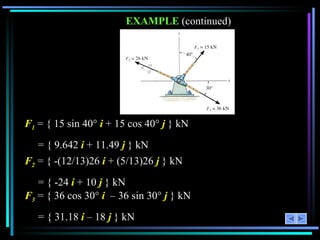
EXAMPLE  (continued) F 1  = { 15 sin 40 °  i  + 15 cos 40°  j  } kN = { 9.642  i  + 11.49  j  } kN F 2  = { -(12/13)26  i  + (5/13)26  j  } kN = { -24  i  + 10  j  } kN F 3  = { 36 cos 30°  i   –  36 sin 30°  j  } kN = { 31.18  i   –  18  j  } kN
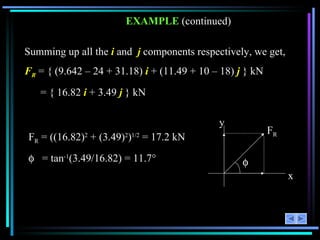
EXAMPLE  (continued) Summing up all the  i  and  j  components respectively, we get, F R  = { (9.642 – 24 + 31.18)  i  + (11.49 + 10 – 18)  j  } kN = { 16.82  i  + 3.49  j  } kN F R  = ((16.82) 2  + (3.49) 2 ) 1/2  = 17.2 kN    = tan -1 (3.49/16.82) = 11.7 ° x y  F R
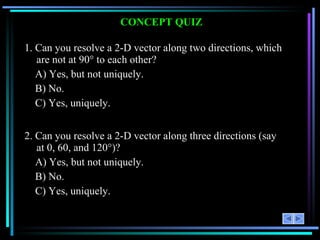
CONCEPT QUIZ 1. Can you resolve a 2-D vector along two directions, which are not at 90° to each other? A) Yes, but not uniquely. B) No. C) Yes, uniquely. 2. Can you resolve a 2-D vector along three directions (say at 0, 60, and 120°)? A) Yes, but not uniquely. B) No. C) Yes, uniquely.
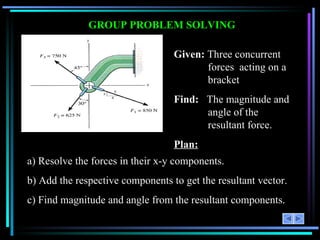
GROUP PROBLEM SOLVING Given:  Three concurrent forces  acting on a bracket Find:   The magnitude and angle of the resultant force. Plan: a) Resolve the forces in their x-y components. b) Add the respective components to get the resultant vector. c) Find magnitude and angle from the resultant components.
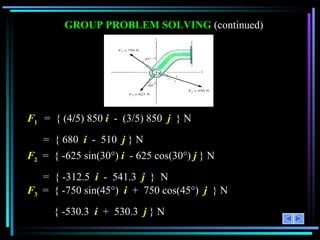
F 1   =  { (4 / 5) 850  i  -  (3/5) 850  j   } N =  { 680  i   -  510  j  } N F 2   =  { -625 sin(30 °)  i   - 625 cos(30°)  j  } N =  { -312.5  i   -  541.3  j   }  N F 3   =  { -750 sin(45 °)  i   +  750 cos(45°)  j  } N { -530.3  i   +  530.3  j  } N  GROUP PROBLEM SOLVING  (continued)
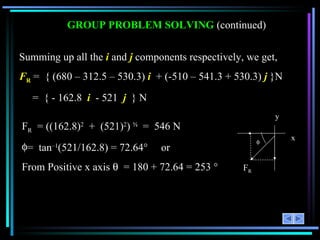
GROUP PROBLEM SOLVING  (continued) Summing up all the  i  and  j  components respectively, we get, F R  =  { (680 – 312.5 – 530.3)  i   + (-510 – 541.3 + 530.3)  j  }N  =  { - 162.8  i   - 521  j   } N F R   = ((162.8) 2   +  (521) 2 )   ½   =  546 N =  tan –1 (521/162.8) = 72.64°  or From Positive x axis     = 180 + 72.64 = 253  °  y x F R
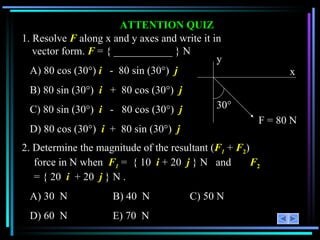
ATTENTION QUIZ 1. Resolve  F   along x and y axes and write it in vector form.  F  = { ___________ } N A) 80 cos (30 °)  i   -  80 sin (30°)  j B)  80 sin (30 °)  i   +  80 cos (30°)  j C)  80 sin (30 °)  i   -  80 cos (30°)  j   D)  80 cos (30 °)  i   +  80 sin (30°)  j 2. Determine the magnitude of the resultant ( F 1  +  F 2 ) force in N when  F 1  =  { 10  i  + 20  j  } N  and  F 2  = { 20  i   + 20  j  } N . A) 30  N  B) 40  N  C) 50 N D) 60  N  E) 70  N  30 ° x y F = 80 N
End of the Lecture Let Learning Continue

Capitulo2

  • 1.
    2–D VECTOR ADDITION Today’s Objective : Students will be able to : a) Resolve a 2-D vector into components b) Add 2-D vectors using Cartesian vector notations. In-Class activities : Check homework Reading quiz Application of adding forces Parallelogram law Resolution of a vector using Cartesian vector notation (CVN) Addition using CVN Attention quiz
  • 2.
    READING QUIZ1. Which one of the following is a scalar quantity? A) Force B) Position C) Mass D) Velocity 2. For vector addition you have to use ______ law. A) Newton’s Second B) the arithmetic C) Pascal’s D) the parallelogram
  • 3.
    APPLICATION OF VECTORADDITION There are four concurrent cable forces acting on the bracket. How do you determine the resultant force acting on the bracket ?
  • 4.
    SCALARS AND VECTORS(Section 2.1) Scalars Vectors Examples: mass, volume force, velocity Characteristics: It has a magnitude It has a magnitude (positive or negative) and direction Addition rule: Simple arithmetic Parallelogram law Special Notation: None Bold font, a line, an arrow or a “carrot”
  • 5.
    VECTOR OPERATIONS (Section 2.2) Scalar Multiplication and Division
  • 6.
    VECTOR ADDITION USINGEITHER THE PARALLELOGRAM LAW OR TRIANGLE Parallelogram Law: Triangle method (always ‘tip to tail’): How do you subtract a vector? How can you add more than two concurrent vectors graphically ?
  • 7.
    “ Resolution” ofa vector is breaking up a vector into components. It is kind of like using the parallelogram law in reverse. RESOLUTION OF A VECTOR
  • 8.
    CARTESIAN VECTOR NOTATION(Section 2.4) Each component of the vector is shown as a magnitude and a direction. We ‘ resolve’ vectors into components using the x and y axes system The directions are based on the x and y axes. We use the “unit vectors” i and j to designate the x and y axes.
  • 9.
    For example, F = F x i + F y j or F ' = F ' x i + F ' y j The x and y axes are always perpendicular to each other. Together,they can be directed at any inclination.
  • 10.
    ADDITION OF SEVERALVECTORS Step 3 is to find the magnitude and angle of the resultant vector. Step 1 is to resolve each force into its components Step 2 is to add all the x components together and add all the y components together. These two totals become the resultant vector.
  • 11.
  • 12.
    You can alsorepresent a 2-D vector with a magnitude and angle.
  • 13.
    EXAMPLE Given: Three concurrent forces acting on a bracket. Find: The magnitude and angle of the resultant force. Plan: a) Resolve the forces in their x-y components. b) Add the respective components to get the resultant vector. c) Find magnitude and angle from the resultant components.
  • 14.
    EXAMPLE (continued)F 1 = { 15 sin 40 ° i + 15 cos 40° j } kN = { 9.642 i + 11.49 j } kN F 2 = { -(12/13)26 i + (5/13)26 j } kN = { -24 i + 10 j } kN F 3 = { 36 cos 30° i – 36 sin 30° j } kN = { 31.18 i – 18 j } kN
  • 15.
    EXAMPLE (continued)Summing up all the i and j components respectively, we get, F R = { (9.642 – 24 + 31.18) i + (11.49 + 10 – 18) j } kN = { 16.82 i + 3.49 j } kN F R = ((16.82) 2 + (3.49) 2 ) 1/2 = 17.2 kN  = tan -1 (3.49/16.82) = 11.7 ° x y  F R
  • 16.
    CONCEPT QUIZ 1.Can you resolve a 2-D vector along two directions, which are not at 90° to each other? A) Yes, but not uniquely. B) No. C) Yes, uniquely. 2. Can you resolve a 2-D vector along three directions (say at 0, 60, and 120°)? A) Yes, but not uniquely. B) No. C) Yes, uniquely.
  • 17.
    GROUP PROBLEM SOLVINGGiven: Three concurrent forces acting on a bracket Find: The magnitude and angle of the resultant force. Plan: a) Resolve the forces in their x-y components. b) Add the respective components to get the resultant vector. c) Find magnitude and angle from the resultant components.
  • 18.
    F 1 = { (4 / 5) 850 i - (3/5) 850 j } N = { 680 i - 510 j } N F 2 = { -625 sin(30 °) i - 625 cos(30°) j } N = { -312.5 i - 541.3 j } N F 3 = { -750 sin(45 °) i + 750 cos(45°) j } N { -530.3 i + 530.3 j } N GROUP PROBLEM SOLVING (continued)
  • 19.
    GROUP PROBLEM SOLVING (continued) Summing up all the i and j components respectively, we get, F R = { (680 – 312.5 – 530.3) i + (-510 – 541.3 + 530.3) j }N = { - 162.8 i - 521 j } N F R = ((162.8) 2 + (521) 2 ) ½ = 546 N = tan –1 (521/162.8) = 72.64° or From Positive x axis  = 180 + 72.64 = 253 °  y x F R
  • 20.
    ATTENTION QUIZ 1.Resolve F along x and y axes and write it in vector form. F = { ___________ } N A) 80 cos (30 °) i - 80 sin (30°) j B) 80 sin (30 °) i + 80 cos (30°) j C) 80 sin (30 °) i - 80 cos (30°) j D) 80 cos (30 °) i + 80 sin (30°) j 2. Determine the magnitude of the resultant ( F 1 + F 2 ) force in N when F 1 = { 10 i + 20 j } N and F 2 = { 20 i + 20 j } N . A) 30 N B) 40 N C) 50 N D) 60 N E) 70 N 30 ° x y F = 80 N
  • 21.
    End of theLecture Let Learning Continue

Editor's Notes

  • #3 Answers: 1. C 2. D
  • #17 Answers: 1. C 2. A
  • #21 Answers: 1. C 2. C