Overview of International Livestock Research (ILRI) 
activities in Ethiopia 
Siboniso Moyo 
Strengthening CGIAR - EARS partnerships for effective agricultural transformation in Ethiopia 
Consultative Meeting, 4 – 5 December 2014
Outline 
• ILRI’s strategic objectives 
• Project highlights (a snapshot) 
• The ILRI Genebank 
• Influencing – the (Ethiopia Livestock Master 
Plan) 
• Capacity Development 
• Upcoming and recently launched initiatives 
• How to strengthen our collaboration? 
2
ILRI acts in three (mutually reinforcing) areas 
• To prove that better use of livestock can make 
a big difference in many people’s lives through 
improved practice. 
• To influence decision-makers so that they will 
increase investment in livestock systems. 
• To ensure there is sufficient capacity in 
developing countries and among investors to 
use increased investment effectively and 
efficiently.
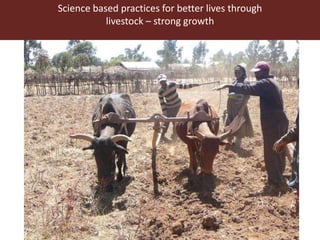
Science based practices for better lives through 
livestock – strong growth 
4
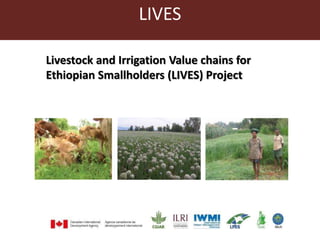
LIVES 
Livestock and Irrigation Value chains for 
Ethiopian Smallholders (LIVES) Project
LIVES Objectives 
• Introduction/adaptation of tested and new value chain interventions for 
6 
targeted value chains/areas (value chain development) 
• Capacity development of value chain actors, service providers and 
educational institutions (capacity development) 
• Introduction/adaptation of tested and new knowledge management 
interventions in support of value chain development (knowledge 
management) 
• Generation and documentation of new knowledge on value chain 
interventions through diagnosis, action and impact research studies (action 
research) 
• Promotion of knowledge generated for scaling out beyond the project areas 
(promotion for scaling out)
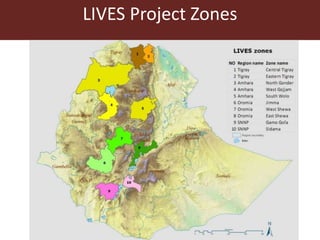
LIVES Project Zones 
7
Africa RISING - Africa Research in 
Sustainable Intensification for the Next 
Generation 
Ethiopian Highlands Project
Africa RISING 
 Project life span – 2012-2016 
 Funded by USAID’s Feed the Future (FtF) initiative 
 Principal focus – “Sustainable Intensification” of mixed farming 
systems 
 Research outputs FtF outcomes (e.g. food security, income 
diversification, nutrition, gender equity) 
 Eight research kebeles in four regions (Amhara, Oromia, SNNPR, 
S. Tigray) 
 Partners – nine CG centers, four local universities, four regional 
research institutes, four woreda agriculture offices, NGOs and 
farmers 
 Partnerships facilitated via multi-tier innovation platforms
Key Themes in the Africa RISING Work Plan 
1. Feed and forage development. 
2. Field crop varietal selection and management. 
3. Integration of high value products into mixed farming systems. 
4. Improved land and water management for sustainability. 
5. Improving the efficiency of mixed farming systems through 
more effective crop-livestock integration. 
6. Cross-cutting problems and opportunities. 
7. Knowledge management, exchange and capacity 
development.
Issues around animal-source foods in Ethiopia 
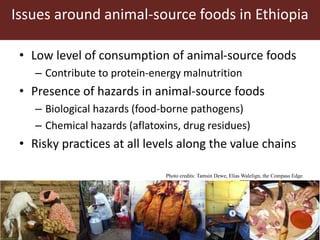
• Low level of consumption of animal-source foods 
– Contribute to protein-energy malnutrition 
• Presence of hazards in animal-source foods 
– Biological hazards (food-borne pathogens) 
– Chemical hazards (aflatoxins, drug residues) 
• Risky practices at all levels along the value chains 
Photo credits: Tamsin Dewe, Elias Walelign, the Compass Edge
ILRI food safety work in Ethiopia 
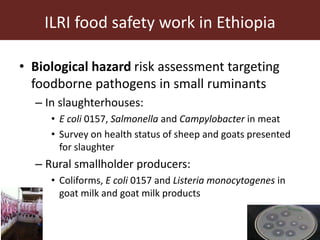
• Biological hazard risk assessment targeting 
foodborne pathogens in small ruminants 
– In slaughterhouses: 
• E coli 0157, Salmonella and Campylobacter in meat 
• Survey on health status of sheep and goats presented 
for slaughter 
– Rural smallholder producers: 
• Coliforms, E coli 0157 and Listeria monocytogenes in 
goat milk and goat milk products
ILRI food safety work in Ethiopia 
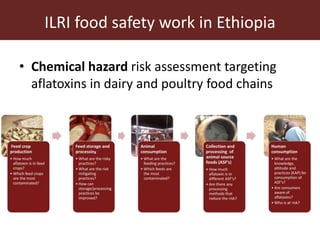
• Chemical hazard risk assessment targeting 
aflatoxins in dairy and poultry food chains
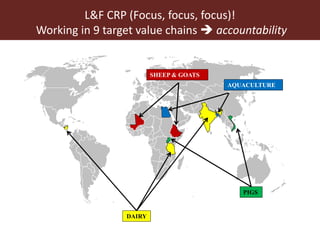
L&F CRP (Focus, focus, focus)! 
Working in 9 target value chains  accountability 
AQUACULTURE 
PIGS 
SHEEP & GOATS 
DAIRY
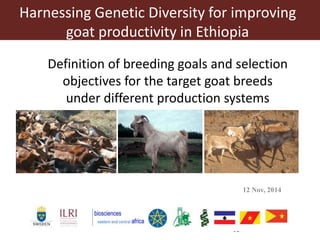
Harnessing Genetic Diversity for improving 
goat productivity in Ethiopia 
Definition of breeding goals and selection 
objectives for the target goat breeds 
under different production systems 
15 
12 Nov, 2014
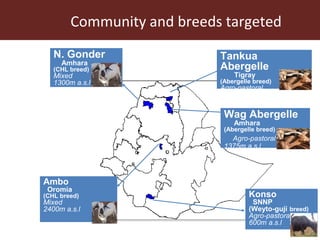
Community and breeds targeted 
Tankua 
Abergelle 
Tigray 
(Abergelle breed) 
Agro-pastoral 
1687m a.s.l 
Wag Abergelle 
Amhara 
(Abergelle breed) 
Agro-pastoral 
1375m a.s.l 
Konso 
SNNP 
(Weyto-guji breed) 
Agro-pastoral 
600m a.s.l 
N. Gonder 
Amhara 
(CHL breed) 
Mixed 
1300m a.s.l 
Ambo 
Oromia 
(CHL breed) 
Mixed 
2400m a.s.l
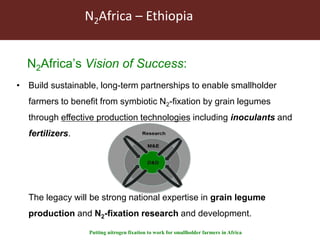
N2Africa – Ethiopia 
N2Africa’s Vision of Success: 
• Build sustainable, long-term partnerships to enable smallholder 
farmers to benefit from symbiotic N2-fixation by grain legumes 
through effective production technologies including inoculants and 
fertilizers. 
The legacy will be strong national expertise in grain legume 
production and N2-fixation research and development. 
Putting nitrogen fixation to work for smallholder farmers in Africa
MoA 
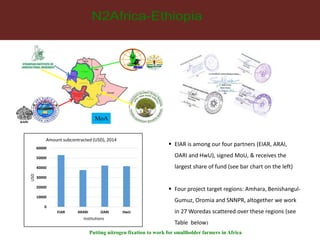
 EIAR is among our four partners (EIAR, ARAI, 
OARI and HwU), signed MoU, & receives the 
largest share of fund (see bar chart on the left) 
 Four project target regions: Amhara, Benishangul- 
Gumuz, Oromia and SNNPR, altogether we work 
in 27 Woredas scattered over these regions (see 
Table below) 
Amount subcontracted (USD), 2014 
Putting nitrogen fixation to work for smallholder farmers in Africa 
60000 
50000 
40000 
30000 
20000 
10000 
0 
EIAR ARARI OARI HwU 
USD 
Institutions
Legume CHOICE 
‘Realizing the underexploited potential of 
multi-purpose legumes towards improved 
livelihoods and a better environment in 
crop-livestock systems in East & Central 
Africa’ 
Conception of HOusehold 
Innovations for Creating 
legume Expansion 
3 years, starting 1 April 2014
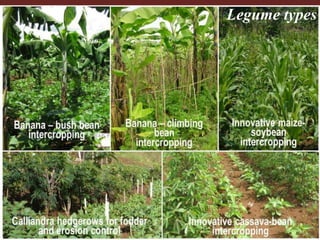
Legume types 
Putting nitrogen fixation to work for smallholder farmers in Africa
From Plan to Action 
Field Studies and Ex Ante Analysis 
Feed the 
Future 
Innovation Lab 
for Small-Scale 
Irrigation
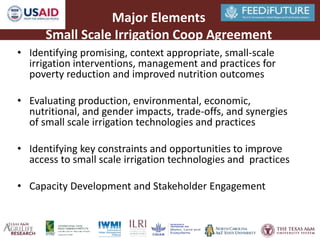
Major Elements 
Small Scale Irrigation Coop Agreement 
• Identifying promising, context appropriate, small-scale 
irrigation interventions, management and practices for 
poverty reduction and improved nutrition outcomes 
• Evaluating production, environmental, economic, 
nutritional, and gender impacts, trade-offs, and synergies 
of small scale irrigation technologies and practices 
• Identifying key constraints and opportunities to improve 
access to small scale irrigation technologies and practices 
• Capacity Development and Stakeholder Engagement
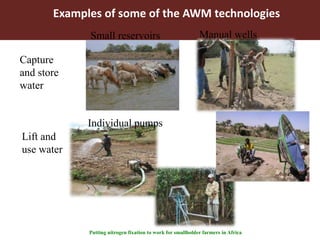
Examples of some of the AWM technologies 
Manual wells 
Small reservoirs 
Individual pumps 
Putting nitrogen fixation to work for smallholder farmers in Africa 
Capture 
and store 
water 
Lift and 
use water
ILRI/EMDIDI FeedSeed Project 
Piloting climate-adaptive forage seed 
systems in Ethiopia 
Project Status, Achievements, Challenges and Next Steps 
6 October, 2014 
Addis Ababa, Ethiopia 
EMDIDI
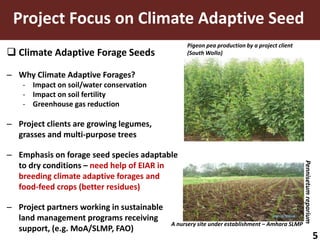
 Climate Adaptive Forage Seeds 
– Why Climate Adaptive Forages? 
- Impact on soil/water conservation 
- Impact on soil fertility 
- Greenhouse gas reduction 
– Project clients are growing legumes, 
grasses and multi-purpose trees 
– Emphasis on forage seed species adaptable 
to dry conditions – need help of EIAR in 
breeding climate adaptive forages and 
food-feed crops (better residues) 
– Project partners working in sustainable 
land management programs receiving 
support, (e.g. MoA/SLMP, FAO) 
Pigeon pea production by a project client 
(South Wollo) 
A nursery site under establishment – Amhara SLMP 
Pennisetum reparium 
5 
Project Focus on Climate Adaptive Seed
ILRI Genebank 
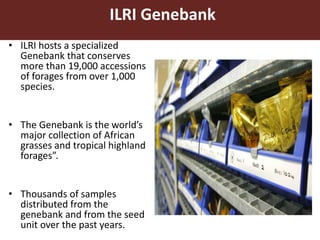
• ILRI hosts a specialized 
Genebank that conserves 
more than 19,000 accessions 
of forages from over 1,000 
species. 
• The Genebank is the world’s 
major collection of African 
grasses and tropical highland 
forages”. 
• Thousands of samples 
distributed from the 
genebank and from the seed 
unit over the past years.
Putting nitrogen fixation to work for smallholder farmers in Africa 27
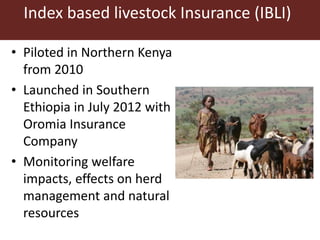
Index based livestock Insurance (IBLI) 
• Piloted in Northern Kenya 
from 2010 
• Launched in Southern 
Ethiopia in July 2012 with 
Oromia Insurance 
Company 
• Monitoring welfare 
impacts, effects on herd 
management and natural 
resources
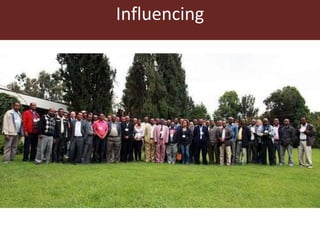
Influencing
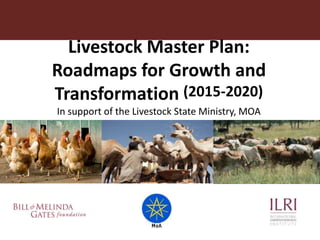
Livestock Master Plan: 
Roadmaps for Growth and 
Transformation (2015-2020) 
In support of the Livestock State Ministry, MOA
Ethiopia Livestock Master Plan (LMP): 
Origin and GoE Ownership 
• MOA State Minister for Agriculture, HE Ato Wondirad asked 
Jimmy Smith, the DG of ILRI to help create a Livestock 
Master Plan 
• HE Dr Gebregziabher Gebreyohannes became the Livestock 
State Minister for the Livestock Resources Development 
Sector, and has guided the development of the Livestock 
Master Plan 
• Livestock Master Plan (LMP) is a value chain investment plan 
or roadmap (detailed action plan) 
• Livestock State Ministry Directors have been fully engaged 
and own the document 
• The LMP team included MOA, EIAR and ILRI staff 
• LMP work overseen by Technical Advisory Committee
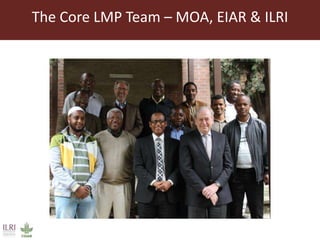
The Core LMP Team – MOA, EIAR & ILRI
Capacity Development
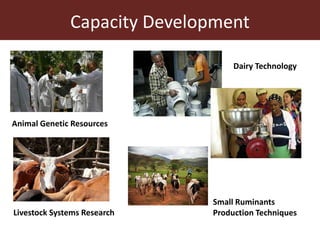
Capacity Development 
Dairy Technology 
Livestock Systems Research 
Small Ruminants 
Production Techniques 
Animal Genetic Resources
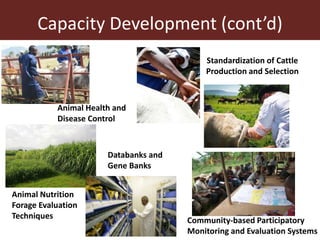
Capacity Development (cont’d) 
Animal Health and 
Disease Control 
Animal Nutrition 
Forage Evaluation 
Techniques 
Databanks and 
Gene Banks 
Standardization of Cattle 
Production and Selection 
Community-based Participatory 
Monitoring and Evaluation Systems
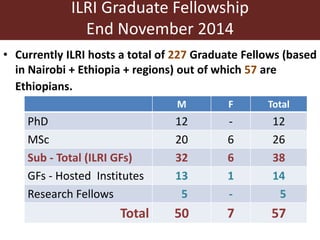
ILRI Graduate Fellowship 
End November 2014 
• Currently ILRI hosts a total of 227 Graduate Fellows (based 
in Nairobi + Ethiopia + regions) out of which 57 are 
Ethiopians. 
M F Total 
PhD 12 - 12 
MSc 20 6 26 
Sub - Total (ILRI GFs) 32 6 38 
GFs - Hosted Institutes 13 1 14 
Research Fellows 5 - 5 
Total 50 7 57
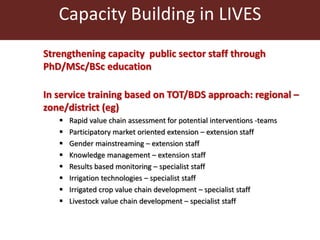
Capacity Building in LIVES 
Strengthening capacity public sector staff through 
PhD/MSc/BSc education 
In service training based on TOT/BDS approach: regional – 
zone/district (eg) 
 Rapid value chain assessment for potential interventions -teams 
 Participatory market oriented extension – extension staff 
 Gender mainstreaming – extension staff 
 Knowledge management – extension staff 
 Results based monitoring – specialist staff 
 Irrigation technologies – specialist staff 
 Irrigated crop value chain development – specialist staff 
 Livestock value chain development – specialist staff
Upcoming or recently launched projects/initiatives
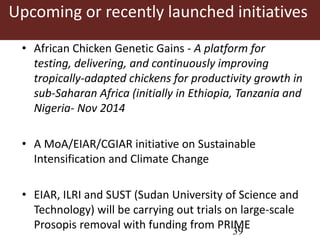
Upcoming or recently launched initiatives 
• African Chicken Genetic Gains - A platform for 
testing, delivering, and continuously improving 
tropically-adapted chickens for productivity growth in 
sub-Saharan Africa (initially in Ethiopia, Tanzania and 
Nigeria- Nov 2014 
• A MoA/EIAR/CGIAR initiative on Sustainable 
Intensification and Climate Change 
• EIAR, ILRI and SUST (Sudan University of Science and 
Technology) will be carrying out trials on large-scale 
Prosopis removal with funding from PRIME 
39
Upcoming or recently launched initiatives 
• We are discussing with the Pastoral Areas 
research office at EIAR on mapping, valuing, 
servicing and protecting livestock corridors – 
concept note sent to a potential donor. 
• ILRI staff, Fiona Flintan is in the Advisory 
Committee for writing the National Strategy 
on Prosopis Management together with staff 
from EIAR and others from the Ministry of 
Agriculture 
40
Upcoming or recently launched initiatives 
• ILRI together with partners will be conducting an 
impact study which is focusing on ILRI’s gene-bank/ 
seed unit, more specifically on the effects of 
the fodder material it has been distributing in 
Ethiopia and Kenya. – See brochure for more. 
• A conceptual framework of a National Dairy 
Genetic Gain System for selected countries in 
Eastern Africa to start next year. The initial 
meeting to define the focus in Ethiopia was held 
here at EIAR last month. 41
How to strengthen our collaboration? 
• Agree on a shared vision and re-commit to 
strengthening our partnerships. 
• Agree on priority areas that we will work on together 
including joint proposal development for fund raising 
purposes. 
• Let us commit to meet and review progress at strategic 
points 
42
How to strengthen our collaboration? 
• Minimize delays in reporting – technical as well as 
financial (as this will delay release of subsequent 
installments) 
• Let us not over commit our staff time from both sides 
to the point where we end up too stretched. 
• Let us focus on goals and how to achieve these to 
conduct good research that will result in impact. 
43
Better lives through livestock 
ilri.org 
The presentation has a Creative Commons licence. You are free to re-use or distribute this work, provided credit is given to ILRI.

Overview of International Livestock Research (ILRI) activities in Ethiopia

  • 1.
    Overview of InternationalLivestock Research (ILRI) activities in Ethiopia Siboniso Moyo Strengthening CGIAR - EARS partnerships for effective agricultural transformation in Ethiopia Consultative Meeting, 4 – 5 December 2014
  • 2.
    Outline • ILRI’sstrategic objectives • Project highlights (a snapshot) • The ILRI Genebank • Influencing – the (Ethiopia Livestock Master Plan) • Capacity Development • Upcoming and recently launched initiatives • How to strengthen our collaboration? 2
  • 3.
    ILRI acts inthree (mutually reinforcing) areas • To prove that better use of livestock can make a big difference in many people’s lives through improved practice. • To influence decision-makers so that they will increase investment in livestock systems. • To ensure there is sufficient capacity in developing countries and among investors to use increased investment effectively and efficiently.
  • 4.
    Science based practicesfor better lives through livestock – strong growth 4
  • 5.
    LIVES Livestock andIrrigation Value chains for Ethiopian Smallholders (LIVES) Project
  • 6.
    LIVES Objectives •Introduction/adaptation of tested and new value chain interventions for 6 targeted value chains/areas (value chain development) • Capacity development of value chain actors, service providers and educational institutions (capacity development) • Introduction/adaptation of tested and new knowledge management interventions in support of value chain development (knowledge management) • Generation and documentation of new knowledge on value chain interventions through diagnosis, action and impact research studies (action research) • Promotion of knowledge generated for scaling out beyond the project areas (promotion for scaling out)
  • 7.
  • 8.
    Africa RISING -Africa Research in Sustainable Intensification for the Next Generation Ethiopian Highlands Project
  • 9.
    Africa RISING Project life span – 2012-2016  Funded by USAID’s Feed the Future (FtF) initiative  Principal focus – “Sustainable Intensification” of mixed farming systems  Research outputs FtF outcomes (e.g. food security, income diversification, nutrition, gender equity)  Eight research kebeles in four regions (Amhara, Oromia, SNNPR, S. Tigray)  Partners – nine CG centers, four local universities, four regional research institutes, four woreda agriculture offices, NGOs and farmers  Partnerships facilitated via multi-tier innovation platforms
  • 10.
    Key Themes inthe Africa RISING Work Plan 1. Feed and forage development. 2. Field crop varietal selection and management. 3. Integration of high value products into mixed farming systems. 4. Improved land and water management for sustainability. 5. Improving the efficiency of mixed farming systems through more effective crop-livestock integration. 6. Cross-cutting problems and opportunities. 7. Knowledge management, exchange and capacity development.
  • 11.
    Issues around animal-sourcefoods in Ethiopia • Low level of consumption of animal-source foods – Contribute to protein-energy malnutrition • Presence of hazards in animal-source foods – Biological hazards (food-borne pathogens) – Chemical hazards (aflatoxins, drug residues) • Risky practices at all levels along the value chains Photo credits: Tamsin Dewe, Elias Walelign, the Compass Edge
  • 12.
    ILRI food safetywork in Ethiopia • Biological hazard risk assessment targeting foodborne pathogens in small ruminants – In slaughterhouses: • E coli 0157, Salmonella and Campylobacter in meat • Survey on health status of sheep and goats presented for slaughter – Rural smallholder producers: • Coliforms, E coli 0157 and Listeria monocytogenes in goat milk and goat milk products
  • 13.
    ILRI food safetywork in Ethiopia • Chemical hazard risk assessment targeting aflatoxins in dairy and poultry food chains
  • 14.
    L&F CRP (Focus,focus, focus)! Working in 9 target value chains  accountability AQUACULTURE PIGS SHEEP & GOATS DAIRY
  • 15.
    Harnessing Genetic Diversityfor improving goat productivity in Ethiopia Definition of breeding goals and selection objectives for the target goat breeds under different production systems 15 12 Nov, 2014
  • 16.
    Community and breedstargeted Tankua Abergelle Tigray (Abergelle breed) Agro-pastoral 1687m a.s.l Wag Abergelle Amhara (Abergelle breed) Agro-pastoral 1375m a.s.l Konso SNNP (Weyto-guji breed) Agro-pastoral 600m a.s.l N. Gonder Amhara (CHL breed) Mixed 1300m a.s.l Ambo Oromia (CHL breed) Mixed 2400m a.s.l
  • 17.
    N2Africa – Ethiopia N2Africa’s Vision of Success: • Build sustainable, long-term partnerships to enable smallholder farmers to benefit from symbiotic N2-fixation by grain legumes through effective production technologies including inoculants and fertilizers. The legacy will be strong national expertise in grain legume production and N2-fixation research and development. Putting nitrogen fixation to work for smallholder farmers in Africa
  • 18.
    MoA  EIARis among our four partners (EIAR, ARAI, OARI and HwU), signed MoU, & receives the largest share of fund (see bar chart on the left)  Four project target regions: Amhara, Benishangul- Gumuz, Oromia and SNNPR, altogether we work in 27 Woredas scattered over these regions (see Table below) Amount subcontracted (USD), 2014 Putting nitrogen fixation to work for smallholder farmers in Africa 60000 50000 40000 30000 20000 10000 0 EIAR ARARI OARI HwU USD Institutions
  • 19.
    Legume CHOICE ‘Realizingthe underexploited potential of multi-purpose legumes towards improved livelihoods and a better environment in crop-livestock systems in East & Central Africa’ Conception of HOusehold Innovations for Creating legume Expansion 3 years, starting 1 April 2014
  • 20.
    Legume types Puttingnitrogen fixation to work for smallholder farmers in Africa
  • 21.
    From Plan toAction Field Studies and Ex Ante Analysis Feed the Future Innovation Lab for Small-Scale Irrigation
  • 22.
    Major Elements SmallScale Irrigation Coop Agreement • Identifying promising, context appropriate, small-scale irrigation interventions, management and practices for poverty reduction and improved nutrition outcomes • Evaluating production, environmental, economic, nutritional, and gender impacts, trade-offs, and synergies of small scale irrigation technologies and practices • Identifying key constraints and opportunities to improve access to small scale irrigation technologies and practices • Capacity Development and Stakeholder Engagement
  • 23.
    Examples of someof the AWM technologies Manual wells Small reservoirs Individual pumps Putting nitrogen fixation to work for smallholder farmers in Africa Capture and store water Lift and use water
  • 24.
    ILRI/EMDIDI FeedSeed Project Piloting climate-adaptive forage seed systems in Ethiopia Project Status, Achievements, Challenges and Next Steps 6 October, 2014 Addis Ababa, Ethiopia EMDIDI
  • 25.
     Climate AdaptiveForage Seeds – Why Climate Adaptive Forages? - Impact on soil/water conservation - Impact on soil fertility - Greenhouse gas reduction – Project clients are growing legumes, grasses and multi-purpose trees – Emphasis on forage seed species adaptable to dry conditions – need help of EIAR in breeding climate adaptive forages and food-feed crops (better residues) – Project partners working in sustainable land management programs receiving support, (e.g. MoA/SLMP, FAO) Pigeon pea production by a project client (South Wollo) A nursery site under establishment – Amhara SLMP Pennisetum reparium 5 Project Focus on Climate Adaptive Seed
  • 26.
    ILRI Genebank •ILRI hosts a specialized Genebank that conserves more than 19,000 accessions of forages from over 1,000 species. • The Genebank is the world’s major collection of African grasses and tropical highland forages”. • Thousands of samples distributed from the genebank and from the seed unit over the past years.
  • 27.
    Putting nitrogen fixationto work for smallholder farmers in Africa 27
  • 28.
    Index based livestockInsurance (IBLI) • Piloted in Northern Kenya from 2010 • Launched in Southern Ethiopia in July 2012 with Oromia Insurance Company • Monitoring welfare impacts, effects on herd management and natural resources
  • 29.
  • 30.
    Livestock Master Plan: Roadmaps for Growth and Transformation (2015-2020) In support of the Livestock State Ministry, MOA
  • 31.
    Ethiopia Livestock MasterPlan (LMP): Origin and GoE Ownership • MOA State Minister for Agriculture, HE Ato Wondirad asked Jimmy Smith, the DG of ILRI to help create a Livestock Master Plan • HE Dr Gebregziabher Gebreyohannes became the Livestock State Minister for the Livestock Resources Development Sector, and has guided the development of the Livestock Master Plan • Livestock Master Plan (LMP) is a value chain investment plan or roadmap (detailed action plan) • Livestock State Ministry Directors have been fully engaged and own the document • The LMP team included MOA, EIAR and ILRI staff • LMP work overseen by Technical Advisory Committee
  • 32.
    The Core LMPTeam – MOA, EIAR & ILRI
  • 33.
  • 34.
    Capacity Development DairyTechnology Livestock Systems Research Small Ruminants Production Techniques Animal Genetic Resources
  • 35.
    Capacity Development (cont’d) Animal Health and Disease Control Animal Nutrition Forage Evaluation Techniques Databanks and Gene Banks Standardization of Cattle Production and Selection Community-based Participatory Monitoring and Evaluation Systems
  • 36.
    ILRI Graduate Fellowship End November 2014 • Currently ILRI hosts a total of 227 Graduate Fellows (based in Nairobi + Ethiopia + regions) out of which 57 are Ethiopians. M F Total PhD 12 - 12 MSc 20 6 26 Sub - Total (ILRI GFs) 32 6 38 GFs - Hosted Institutes 13 1 14 Research Fellows 5 - 5 Total 50 7 57
  • 37.
    Capacity Building inLIVES Strengthening capacity public sector staff through PhD/MSc/BSc education In service training based on TOT/BDS approach: regional – zone/district (eg)  Rapid value chain assessment for potential interventions -teams  Participatory market oriented extension – extension staff  Gender mainstreaming – extension staff  Knowledge management – extension staff  Results based monitoring – specialist staff  Irrigation technologies – specialist staff  Irrigated crop value chain development – specialist staff  Livestock value chain development – specialist staff
  • 38.
    Upcoming or recentlylaunched projects/initiatives
  • 39.
    Upcoming or recentlylaunched initiatives • African Chicken Genetic Gains - A platform for testing, delivering, and continuously improving tropically-adapted chickens for productivity growth in sub-Saharan Africa (initially in Ethiopia, Tanzania and Nigeria- Nov 2014 • A MoA/EIAR/CGIAR initiative on Sustainable Intensification and Climate Change • EIAR, ILRI and SUST (Sudan University of Science and Technology) will be carrying out trials on large-scale Prosopis removal with funding from PRIME 39
  • 40.
    Upcoming or recentlylaunched initiatives • We are discussing with the Pastoral Areas research office at EIAR on mapping, valuing, servicing and protecting livestock corridors – concept note sent to a potential donor. • ILRI staff, Fiona Flintan is in the Advisory Committee for writing the National Strategy on Prosopis Management together with staff from EIAR and others from the Ministry of Agriculture 40
  • 41.
    Upcoming or recentlylaunched initiatives • ILRI together with partners will be conducting an impact study which is focusing on ILRI’s gene-bank/ seed unit, more specifically on the effects of the fodder material it has been distributing in Ethiopia and Kenya. – See brochure for more. • A conceptual framework of a National Dairy Genetic Gain System for selected countries in Eastern Africa to start next year. The initial meeting to define the focus in Ethiopia was held here at EIAR last month. 41
  • 42.
    How to strengthenour collaboration? • Agree on a shared vision and re-commit to strengthening our partnerships. • Agree on priority areas that we will work on together including joint proposal development for fund raising purposes. • Let us commit to meet and review progress at strategic points 42
  • 43.
    How to strengthenour collaboration? • Minimize delays in reporting – technical as well as financial (as this will delay release of subsequent installments) • Let us not over commit our staff time from both sides to the point where we end up too stretched. • Let us focus on goals and how to achieve these to conduct good research that will result in impact. 43
  • 44.
    Better lives throughlivestock ilri.org The presentation has a Creative Commons licence. You are free to re-use or distribute this work, provided credit is given to ILRI.

Editor's Notes

  • #18 By Default, we share a common vision i.e. this is a common goal for both ILRI-N2Africa and EIAR/MoA. We work on four legumes (Common bean, Chickpea, Faba bean and Soybean) and also in connection on maximizing legume residues for livestock feed in the smallholder system.
  • #25 There MUST be a CGIAR logo or a CRP logo. You can copy and paste the logo you need from the final slide of this presentation. Then you can delete that final slide   To replace a photo above, copy and paste this link in your browser: http://www.flickr.com/photos/ilri/sets/72157632057087650/detail/   Find a photo you like and the right size, copy and paste it in the block above.