ILRI activities in Ethiopia
Iain Wright
Consultation on livestock research for food security and poverty
reduction: Opportunities and Challenges for Ethiopia, Addis Ababa,
Ethiopia, 25 June 2013
Strategic Objectives
• Develop, test, adapt and promote science-based practices
that—being sustainable and scalable—achieve better lives
through livestock.
• Provide compelling scientific evidence in ways that
persuade decision-makers—from farms to boardrooms
and parliaments—that smarter policies and bigger
livestock investments can deliver significant
socioeconomic, health and environmental dividends to
both poor nations and households.
• Work to increase capacity among ILRI’s key stakeholders
and the institute itself so that they can make better use of
livestock science and investments for better lives through
livestock.
2
Science based practices for better lives through
livestock – strong growth
3
LIVES
Livestock and Irrigation Value chains forLivestock and Irrigation Value chains for
Ethiopian Smallholders (LIVES) ProjectEthiopian Smallholders (LIVES) Project
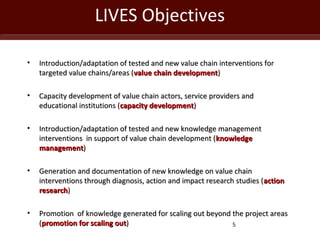
LIVES Objectives
5
• Introduction/adaptation of tested and new value chain interventions forIntroduction/adaptation of tested and new value chain interventions for
targeted value chains/areas (targeted value chains/areas (value chain developmentvalue chain development))
• Capacity development of value chain actors, service providers andCapacity development of value chain actors, service providers and
educational institutions (educational institutions (capacity developmentcapacity development))
• Introduction/adaptation of tested and new knowledge managementIntroduction/adaptation of tested and new knowledge management
interventions in support of value chain development (interventions in support of value chain development (knowledgeknowledge
managementmanagement))
• Generation and documentation of new knowledge on value chainGeneration and documentation of new knowledge on value chain
interventions through diagnosis, action and impact research studies (interventions through diagnosis, action and impact research studies (actionaction
researchresearch))
• Promotion of knowledge generated for scaling out beyond the project areasPromotion of knowledge generated for scaling out beyond the project areas
((promotion for scaling outpromotion for scaling out))
LIVES Project Zones
6
Africa RISING
7
• RISING = Research into Sustainable
Intensification for a New Generation
• USD 9m across three project (Guinea
Savannah, Ethiopian Highlands, East
and Southern Africa)
• USD 2m for Ethiopian Highlands
• R4D / farming systems approach to SI
in mixed crop-livestock systems
Siteselection
Characterisation
Typologies
Problem
ID
Options
Entry points
Research
teams
Modeling
Participatory
evaluation
Adaptation
Combination
Farm-level
impacts
Sustainability/resilience
DStools
M
etaanalysis
Forecast
replicability
Validate
replicability
Scaling approaches
Aggregated impacts
Im
plem
ntation
support
Synthesis
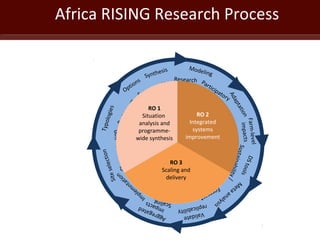
Africa RISING Research Process
RO 1
Situation
analysis and
programme-
wide synthesis
RO 2
Integrated
systems
improvement
RO 3
Scaling and
delivery
Africa RISING interventions
• Knowledge and capacity strengthening
• Social cohesion
• Technical advances
• Institutional strengthening
• Research partners: CGIAR Centres, NARS,
Universities
• Development partners: NGOs, AGP initiatives,
USAID, ATA
9
Nile Basin Development Challenge
• Good understanding on
the effectiveness of
different RWM
technologies to
sustainably intensify
production
• But difficult to translate
into success on the
ground
NBDC Innovation Platforms
NBDC
Local
Research
NGO
Private
sector
District
extension
District
water
District
admin
Lead
farmers
District offices
NBDC research
outputs
Nationalresearch
Indigenous
knowledge
Businessideas
CommComm
Comm
Action1
Action2
Action 3
Safe Food Fair Food
12
3 main components:
Multi-pathogen assessment and economic
assessment in 5 African value chains (L&F chains)
Best-bet interventions piloted in value chains
Engagement with Regional Economic
Communities (RECs) and vet schools
 Communicate evidence to policy makers
 Advocacy for informal markets
 Include participatory risk analysis to training curricula
Science based practices for better lives through
livestock – fragile growth
Index Based Livestock Insurance
• Piloted in Northern Kenya
from 2010
• Launched in Southern
Ethiopia in July 2012 with
Oromia Insurance
Company
• Monitoring welfare
impacts, effects on herd
management and natural
resources
Influencing
Ethiopia Livestock Masterplan
• Vision and Strategy Framework in Support of the
GOE/Livestock Resources State Ministry, MOA
16
Ethiopia Livestock Masterplan
17
- Ag State Minister, MOA - Ato Wondirad asked ILRI
to increase its activities and impact in Ethiopia
- Endorsed by Livestock State Minister – Dr
Gebregziabher
• Long-term vision and strategy for livestock sector
development for planning to justify GOE funding for
livestock development and support from donors and
stakeholders
• Master Plan - a road map (or detailed value chain
action or implementation plans)
• Create Livestock Policy Support Unit
Ethiopia Livestock Masterplan -
Approach
18
•Develop “road map” or value chain action plans
with Livestock Sector Investment and Policy
Toolkit (LSIPT) results as input to LMP
•Develop planning capacity of new State Ministry
with funding from the Bill & Melinda Gates
Foundation
•Hold stakeholder consultations to get buy-in and
achieve stakeholder consensus (agreement to
approach and principles)
•LMP to provide baseline, targets, and strategies
for future GOE development plan (after GTP)
Capacity Building in LIVES
Strengthening capacity public sector staff throughStrengthening capacity public sector staff through
PhD/MSc/BSc educationPhD/MSc/BSc education
In service training based on TOT/BDS approach: regional –In service training based on TOT/BDS approach: regional –
zone/district (eg)zone/district (eg)
 Rapid value chain assessment for potential interventions -teamsRapid value chain assessment for potential interventions -teams
 Participatory market oriented extension – extension staffParticipatory market oriented extension – extension staff
 Gender mainstreaming – extension staffGender mainstreaming – extension staff
 Knowledge management – extension staffKnowledge management – extension staff
 Results based monitoring – specialist staffResults based monitoring – specialist staff
 Irrigation technologies – specialist staffIrrigation technologies – specialist staff
 Irrigated crop value chain development – specialist staffIrrigated crop value chain development – specialist staff
 Livestock value chain development – specialist staffLivestock value chain development – specialist staff
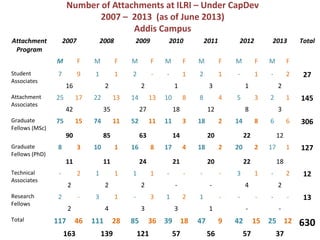
Number of Attachments at ILRI – Under CapDev
2007 – 2013 (as of June 2013)
Addis Campus
Attachment
Program
2007 2008 2009 2010 2011 2012 2013 Total
M F M F M F M F M F M F M F
Student
Associates
7 9 1 1 2 - - 1 2 1 - 1 - 2 27
16 2 2 1 3 1 2
Attachment
Associates
25 17 22 13 14 13 10 8 8 4 5 3 2 1 145
42 35 27 18 12 8 3
Graduate
Fellows (MSc)
75 15 74 11 52 11 11 3 18 2 14 8 6 6 306
90 85 63 14 20 22 12
Graduate
Fellows (PhD)
8 3 10 1 16 8 17 4 18 2 20 2 17 1 127
11 11 24 21 20 22 18
Technical
Associates
- 2 1 1 1 1 - - - - 3 1 - 2 12
2 2 2 - - 4 2
Research
Fellows
2 - 3 1 - 3 1 2 1 - - - - - 13
2 4 3 3 1 - -
Total 117 46 111 28 85 36 39 18 47 9 42 15 25 12 630
163 139 121 57 56 57 37
www.ilri.org/ethiopia
The presentation has a Creative Commons licence. You are free to re-use or distribute this work, provided credit is given to ILRI.
better lives through livestock
ilri.org

ILRI activities in Ethiopia

  • 1.
    ILRI activities inEthiopia Iain Wright Consultation on livestock research for food security and poverty reduction: Opportunities and Challenges for Ethiopia, Addis Ababa, Ethiopia, 25 June 2013
  • 2.
    Strategic Objectives • Develop,test, adapt and promote science-based practices that—being sustainable and scalable—achieve better lives through livestock. • Provide compelling scientific evidence in ways that persuade decision-makers—from farms to boardrooms and parliaments—that smarter policies and bigger livestock investments can deliver significant socioeconomic, health and environmental dividends to both poor nations and households. • Work to increase capacity among ILRI’s key stakeholders and the institute itself so that they can make better use of livestock science and investments for better lives through livestock. 2
  • 3.
    Science based practicesfor better lives through livestock – strong growth 3
  • 4.
    LIVES Livestock and IrrigationValue chains forLivestock and Irrigation Value chains for Ethiopian Smallholders (LIVES) ProjectEthiopian Smallholders (LIVES) Project
  • 5.
    LIVES Objectives 5 • Introduction/adaptationof tested and new value chain interventions forIntroduction/adaptation of tested and new value chain interventions for targeted value chains/areas (targeted value chains/areas (value chain developmentvalue chain development)) • Capacity development of value chain actors, service providers andCapacity development of value chain actors, service providers and educational institutions (educational institutions (capacity developmentcapacity development)) • Introduction/adaptation of tested and new knowledge managementIntroduction/adaptation of tested and new knowledge management interventions in support of value chain development (interventions in support of value chain development (knowledgeknowledge managementmanagement)) • Generation and documentation of new knowledge on value chainGeneration and documentation of new knowledge on value chain interventions through diagnosis, action and impact research studies (interventions through diagnosis, action and impact research studies (actionaction researchresearch)) • Promotion of knowledge generated for scaling out beyond the project areasPromotion of knowledge generated for scaling out beyond the project areas ((promotion for scaling outpromotion for scaling out))
  • 6.
  • 7.
    Africa RISING 7 • RISING= Research into Sustainable Intensification for a New Generation • USD 9m across three project (Guinea Savannah, Ethiopian Highlands, East and Southern Africa) • USD 2m for Ethiopian Highlands • R4D / farming systems approach to SI in mixed crop-livestock systems
  • 8.
  • 9.
    Africa RISING interventions •Knowledge and capacity strengthening • Social cohesion • Technical advances • Institutional strengthening • Research partners: CGIAR Centres, NARS, Universities • Development partners: NGOs, AGP initiatives, USAID, ATA 9
  • 10.
    Nile Basin DevelopmentChallenge • Good understanding on the effectiveness of different RWM technologies to sustainably intensify production • But difficult to translate into success on the ground
  • 11.
    NBDC Innovation Platforms NBDC Local Research NGO Private sector District extension District water District admin Lead farmers Districtoffices NBDC research outputs Nationalresearch Indigenous knowledge Businessideas CommComm Comm Action1 Action2 Action 3
  • 12.
    Safe Food FairFood 12 3 main components: Multi-pathogen assessment and economic assessment in 5 African value chains (L&F chains) Best-bet interventions piloted in value chains Engagement with Regional Economic Communities (RECs) and vet schools  Communicate evidence to policy makers  Advocacy for informal markets  Include participatory risk analysis to training curricula
  • 13.
    Science based practicesfor better lives through livestock – fragile growth
  • 14.
    Index Based LivestockInsurance • Piloted in Northern Kenya from 2010 • Launched in Southern Ethiopia in July 2012 with Oromia Insurance Company • Monitoring welfare impacts, effects on herd management and natural resources
  • 15.
  • 16.
    Ethiopia Livestock Masterplan •Vision and Strategy Framework in Support of the GOE/Livestock Resources State Ministry, MOA 16
  • 17.
    Ethiopia Livestock Masterplan 17 -Ag State Minister, MOA - Ato Wondirad asked ILRI to increase its activities and impact in Ethiopia - Endorsed by Livestock State Minister – Dr Gebregziabher • Long-term vision and strategy for livestock sector development for planning to justify GOE funding for livestock development and support from donors and stakeholders • Master Plan - a road map (or detailed value chain action or implementation plans) • Create Livestock Policy Support Unit
  • 18.
    Ethiopia Livestock Masterplan- Approach 18 •Develop “road map” or value chain action plans with Livestock Sector Investment and Policy Toolkit (LSIPT) results as input to LMP •Develop planning capacity of new State Ministry with funding from the Bill & Melinda Gates Foundation •Hold stakeholder consultations to get buy-in and achieve stakeholder consensus (agreement to approach and principles) •LMP to provide baseline, targets, and strategies for future GOE development plan (after GTP)
  • 19.
    Capacity Building inLIVES Strengthening capacity public sector staff throughStrengthening capacity public sector staff through PhD/MSc/BSc educationPhD/MSc/BSc education In service training based on TOT/BDS approach: regional –In service training based on TOT/BDS approach: regional – zone/district (eg)zone/district (eg)  Rapid value chain assessment for potential interventions -teamsRapid value chain assessment for potential interventions -teams  Participatory market oriented extension – extension staffParticipatory market oriented extension – extension staff  Gender mainstreaming – extension staffGender mainstreaming – extension staff  Knowledge management – extension staffKnowledge management – extension staff  Results based monitoring – specialist staffResults based monitoring – specialist staff  Irrigation technologies – specialist staffIrrigation technologies – specialist staff  Irrigated crop value chain development – specialist staffIrrigated crop value chain development – specialist staff  Livestock value chain development – specialist staffLivestock value chain development – specialist staff
  • 20.
    Number of Attachmentsat ILRI – Under CapDev 2007 – 2013 (as of June 2013) Addis Campus Attachment Program 2007 2008 2009 2010 2011 2012 2013 Total M F M F M F M F M F M F M F Student Associates 7 9 1 1 2 - - 1 2 1 - 1 - 2 27 16 2 2 1 3 1 2 Attachment Associates 25 17 22 13 14 13 10 8 8 4 5 3 2 1 145 42 35 27 18 12 8 3 Graduate Fellows (MSc) 75 15 74 11 52 11 11 3 18 2 14 8 6 6 306 90 85 63 14 20 22 12 Graduate Fellows (PhD) 8 3 10 1 16 8 17 4 18 2 20 2 17 1 127 11 11 24 21 20 22 18 Technical Associates - 2 1 1 1 1 - - - - 3 1 - 2 12 2 2 2 - - 4 2 Research Fellows 2 - 3 1 - 3 1 2 1 - - - - - 13 2 4 3 3 1 - - Total 117 46 111 28 85 36 39 18 47 9 42 15 25 12 630 163 139 121 57 56 57 37
  • 21.
  • 22.
    The presentation hasa Creative Commons licence. You are free to re-use or distribute this work, provided credit is given to ILRI. better lives through livestock ilri.org