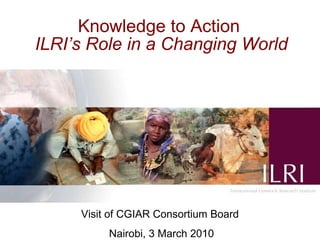
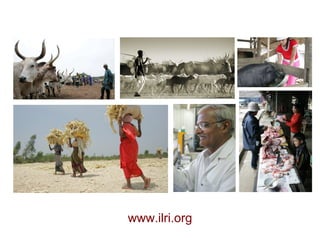
Knowledge to Action   ILRI’s Role in a Changing World     Visit of CGIAR Consortium Board Nairobi, 3 March 2010
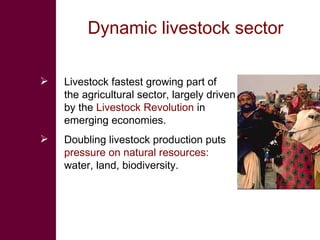
Dynamic livestock sector   Livestock fastest growing part of the agricultural sector, largely driven by the  L ivestock Revolution  in emerging economies. Doubling livestock production puts  pressure on natural resources:  water, land, biodiversity.
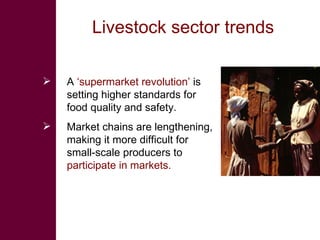
Livestock sector trends  A  ‘supermarket revolution’  is setting higher standards for food quality and safety. Market chains are lengthening, making it more difficult for small-scale producers to  participate in markets.
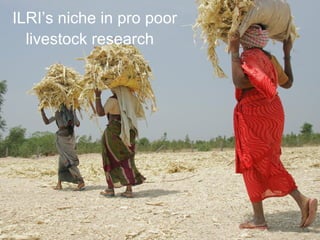
ILRI’s niche in pro poor livestock research
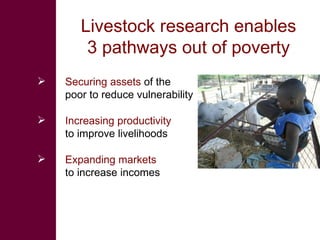
Livestock research enables 3 pathways out of poverty Securing assets  of the poor to reduce vulnerability Increasing productivity to improve livelihoods Expanding markets to increase incomes
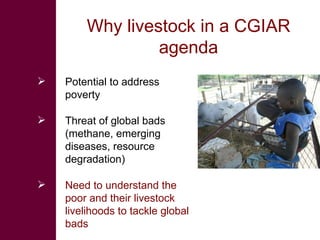
Why livestock in a CGIAR agenda Potential to address poverty Threat of global bads (methane, emerging diseases, resource degradation) Need to understand the poor and their livestock livelihoods to tackle global bads
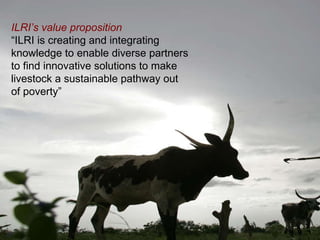
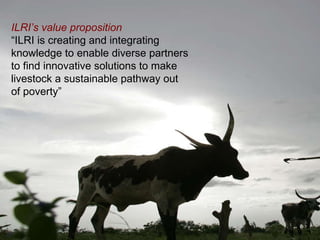
ILRI Spearheading a  New Way Forward  ILRI’s value proposition   “ ILRI is creating and integrating knowledge to enable diverse partners to find innovative solutions to make livestock a sustainable pathway out of poverty”
Science base Core competencies  Livestock genetics, health and nutrition Biosciences, molecular biology and immunology Food safety, epidemiology and systems analysis Natural resources management Livestock economics and social sciences
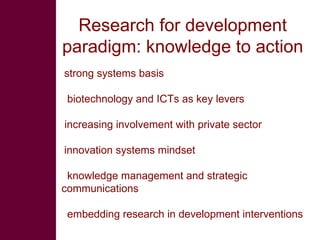
Research for development paradigm: knowledge to action strong systems basis biotechnology and ICTs as key levers   increasing involvement with private sector innovation systems mindset knowledge management and strategic  communications embedding research in development interventions
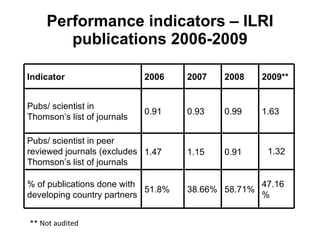
Performance indicators – ILRI publications 2006-2009 ** Not audited Indicator 2006 2007 2008 2009** Pubs/ scientist in Thomson’s list of journals 0.91 0.93 0.99 1.63 Pubs/ scientist in peer reviewed journals (excludes Thomson’s list of journals 1.47 1.15 0.91 1.32 % of publications done with developing country partners 51.8% 38.66% 58.71% 47.16%
4. Future directions and challenges
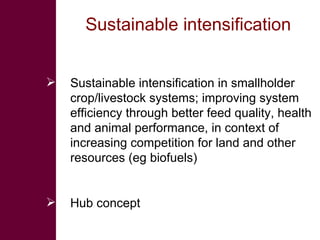
Sustainable intensification  Sustainable intensification in smallholder crop/livestock systems; improving system efficiency through better feed quality, health and animal performance, in context of increasing competition for land and other resources (eg biofuels) Hub concept
Vulnerability  Vulnerability – Identifying livestock interventions to reduce the vulnerability of livestock dependent households; understanding relations between livestock systems and other ecosystem services.  Vaccines, index based insurance, ecosystem services
Climate change  Climate change – livestock based adaptation to impacts of climate change; growing trade offs between livestock production and other ecosystem services; managing livestock negative impacts on climate change.  Targeting of interventions Intensification of ruminant systems Carbon sequestration in rangelands
Food safety  and market access   SPS and markets – Sanitary and phytosanitary (SPS) issues, growing market requirements for food safety and quality constraining market access by smallholders  Appropriate development of smallholder dairy markets
Emerging zoonotic diseases  Emerging diseases – combating bird flu and other emerging diseases in developing countries;  understanding and mapping risks AVID project
Vaccines   Vaccine development for livestock diseases; new focus on addressing common  problem of improving the immune response to protozoa parasites  Improving existing vaccines (ECF, CBPP) Developing molecular approaches approaches to problems (eg transgenic tryps resistant cow)
Conservation and Sustainable Use of Animal Genetic Resources Priority setting for conservation Appropriate methodologies of conservation Reproductive technologies for fast deployment of improved genotypes Appropriate breeding approaches for smallholder systems
Partnerships and research platforms  ILRI develops and shares knowledge and technology platforms with national and international partners.  Platform examples – Biosciences eastern and central Africa (BecA) platform; JLLRGR Joint Laboratory for Livestock and Forage Genetic Resources, CAAS, Beijing
ILRI Spearheading a  New Way Forward  ILRI’s value proposition   “ ILRI is creating and integrating knowledge to enable diverse partners to find innovative solutions to make livestock a sustainable pathway out of poverty”
www.ilri.org

Knowledge to Action: ILRI’s Role in a Changing World

  • 1.
    Knowledge to Action ILRI’s Role in a Changing World Visit of CGIAR Consortium Board Nairobi, 3 March 2010
  • 2.
    Dynamic livestock sector Livestock fastest growing part of the agricultural sector, largely driven by the L ivestock Revolution in emerging economies. Doubling livestock production puts pressure on natural resources: water, land, biodiversity.
  • 3.
    Livestock sector trends A ‘supermarket revolution’ is setting higher standards for food quality and safety. Market chains are lengthening, making it more difficult for small-scale producers to participate in markets.
  • 4.
    ILRI’s niche inpro poor livestock research
  • 5.
    Livestock research enables3 pathways out of poverty Securing assets of the poor to reduce vulnerability Increasing productivity to improve livelihoods Expanding markets to increase incomes
  • 6.
    Why livestock ina CGIAR agenda Potential to address poverty Threat of global bads (methane, emerging diseases, resource degradation) Need to understand the poor and their livestock livelihoods to tackle global bads
  • 7.
    ILRI Spearheading a New Way Forward ILRI’s value proposition “ ILRI is creating and integrating knowledge to enable diverse partners to find innovative solutions to make livestock a sustainable pathway out of poverty”
  • 8.
    Science base Corecompetencies Livestock genetics, health and nutrition Biosciences, molecular biology and immunology Food safety, epidemiology and systems analysis Natural resources management Livestock economics and social sciences
  • 9.
    Research for developmentparadigm: knowledge to action strong systems basis biotechnology and ICTs as key levers increasing involvement with private sector innovation systems mindset knowledge management and strategic communications embedding research in development interventions
  • 10.
    Performance indicators –ILRI publications 2006-2009 ** Not audited Indicator 2006 2007 2008 2009** Pubs/ scientist in Thomson’s list of journals 0.91 0.93 0.99 1.63 Pubs/ scientist in peer reviewed journals (excludes Thomson’s list of journals 1.47 1.15 0.91 1.32 % of publications done with developing country partners 51.8% 38.66% 58.71% 47.16%
  • 11.
    4. Future directionsand challenges
  • 12.
    Sustainable intensification Sustainable intensification in smallholder crop/livestock systems; improving system efficiency through better feed quality, health and animal performance, in context of increasing competition for land and other resources (eg biofuels) Hub concept
  • 13.
    Vulnerability Vulnerability– Identifying livestock interventions to reduce the vulnerability of livestock dependent households; understanding relations between livestock systems and other ecosystem services. Vaccines, index based insurance, ecosystem services
  • 14.
    Climate change Climate change – livestock based adaptation to impacts of climate change; growing trade offs between livestock production and other ecosystem services; managing livestock negative impacts on climate change. Targeting of interventions Intensification of ruminant systems Carbon sequestration in rangelands
  • 15.
    Food safety and market access SPS and markets – Sanitary and phytosanitary (SPS) issues, growing market requirements for food safety and quality constraining market access by smallholders Appropriate development of smallholder dairy markets
  • 16.
    Emerging zoonotic diseases Emerging diseases – combating bird flu and other emerging diseases in developing countries; understanding and mapping risks AVID project
  • 17.
    Vaccines Vaccine development for livestock diseases; new focus on addressing common problem of improving the immune response to protozoa parasites Improving existing vaccines (ECF, CBPP) Developing molecular approaches approaches to problems (eg transgenic tryps resistant cow)
  • 18.
    Conservation and SustainableUse of Animal Genetic Resources Priority setting for conservation Appropriate methodologies of conservation Reproductive technologies for fast deployment of improved genotypes Appropriate breeding approaches for smallholder systems
  • 19.
    Partnerships and researchplatforms ILRI develops and shares knowledge and technology platforms with national and international partners. Platform examples – Biosciences eastern and central Africa (BecA) platform; JLLRGR Joint Laboratory for Livestock and Forage Genetic Resources, CAAS, Beijing
  • 20.
    ILRI Spearheading a New Way Forward ILRI’s value proposition “ ILRI is creating and integrating knowledge to enable diverse partners to find innovative solutions to make livestock a sustainable pathway out of poverty”
  • 21.