POLY(VINYL CARBAZOLE)
Submitted By,
Vishal K P
semester 6
PS&RT
CUSAT
-SYNTHESIS, PROPERTIES & APPLICATION
INTRODUCTION
 They are known as Photoconductive materials, i.e., its
electrical conductivity increases with exposure to light.
 Polyvinyl carbazole has good resistance to heat and
chemicals.
 Softens at 150°C
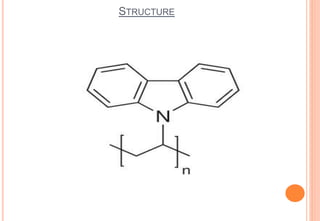
STRUCTURE
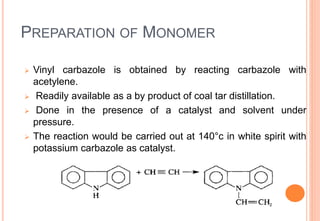
PREPARATION OF MONOMER
 Vinyl carbazole is obtained by reacting carbazole with
acetylene.
 Readily available as a by product of coal tar distillation.
 Done in the presence of a catalyst and solvent under
pressure.
 The reaction would be carried out at 140°c in white spirit with
potassium carbazole as catalyst.
POLYMERIZATION
 High M.W polymers can be prepared by bulk polymerization
using Di-tert-butyl peroxide & 2,2-azobisdi-isobutyronitrile used
as initiators pressurized with N2 .
 Heating to 80-90°C causes an onset of polymerisation and a
rapid increase in temperature.
 After the maximum temperature has been reached the mass is
allowed to cool under pressure.
PROCESSING
 The polymer is not easy to process and in injection moulding
melt temperatures of 300°C are employed.
 In order to prevent excess embrittlement by shock cooling of
the melt, mould temperatures as high as 150°C may be used.
 The polymer may also be compression moulded at
temperatures of 250-260°C.
THE MOST IMPORTANT PROPERTIES OF POLY( VINYL
CARBAZOLE) ARE:
 Good photoconductivity
 A high softening
 High refractive index
 High brittleness
 Poly vinyl carbazole is insoluble in alcohol, esters,
ethers, ketones, carbon tetra chloride & caster oil
APPLICATIONS
 Earlier applications as a capacitor dielectric and other
electrical applications such as switch parts, cable connectors
and co-axial cable spacers are now very limited.
 The main application today for poly(vinyl carbazole) arises out
of its photoconductivity and is in electrostatic dry copying
machine.
XEROGRAPHY
 The polymer is applied from solution in thin film layers onto a
conductive substrate.
 In order to obtain the desired photoconductive characteristics,
toughness and adherence to the substrate various additives
are used.
 It is usual to incorporate additives such as electron acceptors,
plasticisers and primers.
 A typical electron acceptor is 2,4,7-trinitrofluoronone.
WORKING PRINCIPLE OF XEROGRAPHY
 When an electrostatic charge is applied to a coating in the dark
it is observed to discharge to an equilibrium value.
 When the light source is switched on, the conductivity is
increased and discharging occurs, leading to a negligible
charge.
 Which is then developed by a dry method by transferring the
charge onto a powder known as the toner.
OTHER APPLICATIONS
 The polymer may be regarded in these applications as a form of
photo resistor.
 It has been used in holography and in the manufacture of
printing plates.
 However, it has also been suggested for use in solar cells and
for measuring photoelectric resistance.
REFERENCES
 Conducting polymers & plastic by J Margolis ,Chapman
& Hall London 1993
 Plastics Materials by J A Brydson
THANK YOU

Poly vinyl carbazole

  • 1.
    POLY(VINYL CARBAZOLE) Submitted By, VishalK P semester 6 PS&RT CUSAT -SYNTHESIS, PROPERTIES & APPLICATION
  • 2.
    INTRODUCTION  They areknown as Photoconductive materials, i.e., its electrical conductivity increases with exposure to light.  Polyvinyl carbazole has good resistance to heat and chemicals.  Softens at 150°C
  • 3.
  • 4.
    PREPARATION OF MONOMER Vinyl carbazole is obtained by reacting carbazole with acetylene.  Readily available as a by product of coal tar distillation.  Done in the presence of a catalyst and solvent under pressure.  The reaction would be carried out at 140°c in white spirit with potassium carbazole as catalyst.
  • 5.
    POLYMERIZATION  High M.Wpolymers can be prepared by bulk polymerization using Di-tert-butyl peroxide & 2,2-azobisdi-isobutyronitrile used as initiators pressurized with N2 .  Heating to 80-90°C causes an onset of polymerisation and a rapid increase in temperature.  After the maximum temperature has been reached the mass is allowed to cool under pressure.
  • 6.
    PROCESSING  The polymeris not easy to process and in injection moulding melt temperatures of 300°C are employed.  In order to prevent excess embrittlement by shock cooling of the melt, mould temperatures as high as 150°C may be used.  The polymer may also be compression moulded at temperatures of 250-260°C.
  • 7.
    THE MOST IMPORTANTPROPERTIES OF POLY( VINYL CARBAZOLE) ARE:  Good photoconductivity  A high softening  High refractive index  High brittleness  Poly vinyl carbazole is insoluble in alcohol, esters, ethers, ketones, carbon tetra chloride & caster oil
  • 8.
    APPLICATIONS  Earlier applicationsas a capacitor dielectric and other electrical applications such as switch parts, cable connectors and co-axial cable spacers are now very limited.  The main application today for poly(vinyl carbazole) arises out of its photoconductivity and is in electrostatic dry copying machine.
  • 9.
    XEROGRAPHY  The polymeris applied from solution in thin film layers onto a conductive substrate.  In order to obtain the desired photoconductive characteristics, toughness and adherence to the substrate various additives are used.  It is usual to incorporate additives such as electron acceptors, plasticisers and primers.  A typical electron acceptor is 2,4,7-trinitrofluoronone.
  • 10.
    WORKING PRINCIPLE OFXEROGRAPHY  When an electrostatic charge is applied to a coating in the dark it is observed to discharge to an equilibrium value.  When the light source is switched on, the conductivity is increased and discharging occurs, leading to a negligible charge.  Which is then developed by a dry method by transferring the charge onto a powder known as the toner.
  • 11.
    OTHER APPLICATIONS  Thepolymer may be regarded in these applications as a form of photo resistor.  It has been used in holography and in the manufacture of printing plates.  However, it has also been suggested for use in solar cells and for measuring photoelectric resistance.
  • 12.
    REFERENCES  Conducting polymers& plastic by J Margolis ,Chapman & Hall London 1993  Plastics Materials by J A Brydson
  • 13.