Centrifugation
Contents 1. Definition 2. Classification 3. Composition 4. Relative force & application
Centrifugation Use of the centrifugal force for the separation of mixtures More-dense components migrate away from the axis of the centrifuge  less-dense components of migrate towards the axis
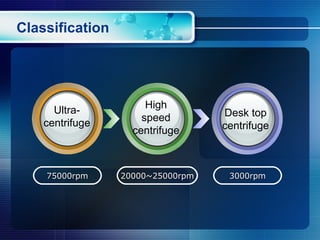
Classification  75000rpm 20000~25000rpm 3000rpm Ultra- centrifuge High speed centrifuge Desk top centrifuge
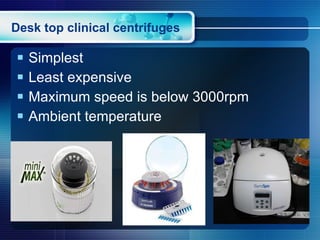
Desk top clinical centrifuges Simplest Least expensive Maximum speed is below 3000rpm Ambient temperature
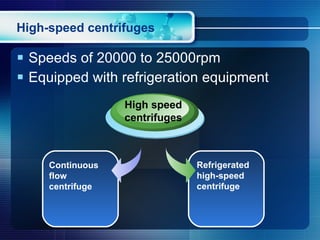
High-speed centrifuges Speeds of 20000 to 25000rpm Equipped with refrigeration equipment Refrigerated high-speed centrifuge Continuous flow centrifuge High speed centrifuges
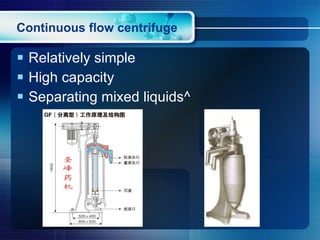
Continuous flow centrifuge Relatively simple High capacity Separating mixed liquids^
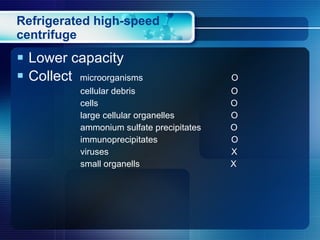
Refrigerated high-speed centrifuge Lower capacity Collect  microorganisms  O cellular debris  O cells  O large cellular organelles  O ammonium sulfate precipitates  O immunoprecipitates  O viruses  X small organells  X
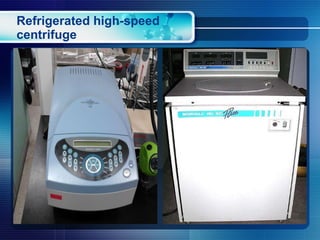
Refrigerated high-speed centrifuge
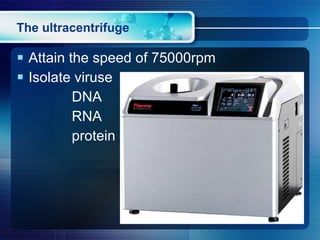
The ultracentrifuge Attain the speed of 75000rpm Isolate viruse DNA RNA protein
Composition Centrifuge consist of four parts: Drive and speed control Temperature control Vacuum system Rotors
Drive & Speed control Drive: water-cooled electric motor Speed control:  1.selected by rheostat 2.monitored with a tachometer
Overspeed system Prevent operation of a rotor above its maximum rated speed Consist of ^ 1.a ring of alternating reflecting and nonreflecting surfaces attached to the bottom of the rotor. 2.a small but intense point source of light 3.a photocell
Temperature control highspeed centrifuge: placing a thermocouple in the rotor chamber monitoring only the rotor chamber temperature Ultracentrifuge: an infrared radiometric sensor placed beneath the rotor  continuously monitors the rotor temperature
Vacuum system The speed of centrifuge < 15000 to 20000rp  Not required The  speed of centrifuge > 4000rpm Required
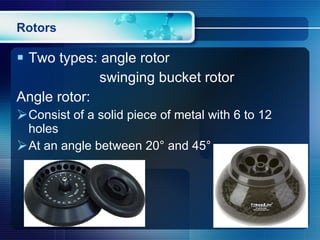
Rotors Two types: angle rotor  swinging bucket rotor Angle rotor:  Consist of a solid piece of metal with 6 to 12 holes At an angle between 20° and 45°
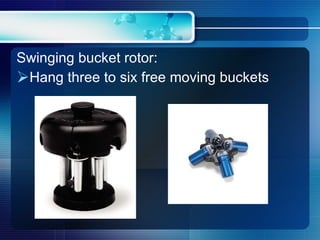
Swinging bucket rotor: Hang three to six free moving buckets
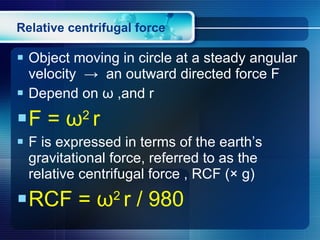
Relative centrifugal force  Object moving in circle at a steady angular velocity  ->  an outward directed force F Depend on  ω  ,and r F =  ω 2  r F is expressed in terms of the earth’s gravitational force, referred to as the relative centrifugal force , RCF (× g) RCF =  ω 2  r / 980
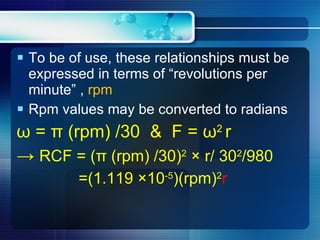
To be of use, these relationships must be expressed in terms of “revolutions per minute” ,  rpm Rpm values may be converted to radians ω  =  π  (rpm) /30  &  F =  ω 2  r ->  RCF = ( π  (rpm) /30) 2  × r/ 30 2 /980 =(1.119 ×10 -5 )(rpm) 2 r
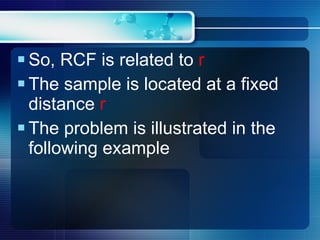
So, RCF is related to  r   The sample is located at a fixed distance  r The problem is illustrated in the following example
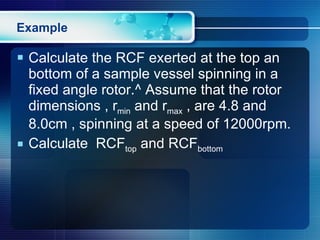
Example Calculate the RCF exerted at the top an bottom of a sample vessel spinning in a fixed angle rotor.^ Assume that the rotor dimensions , r min  and r max  , are 4.8 and 8.0cm , spinning at a speed of 12000rpm. Calculate  RCF top  and RCF bottom
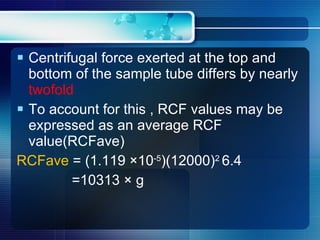
Centrifugal force exerted at the top and bottom of the sample tube differs by nearly  twofold To account for this , RCF values may be expressed as an average RCF value(RCFave) RCFave  = (1.119 ×10 -5 )(12000) 2  6.4 =10313 × g
Application Zone Centrifugation or Sedimentation velocity Isopycnic Centrifugation or Sedimentation equilibrium
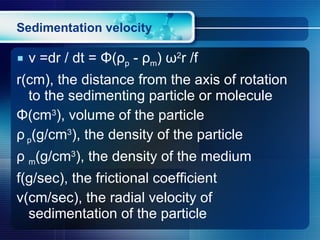
Sedimentation velocity v =dr / dt =  Φ ( ρ p  -  ρ m )  ω 2 r /f r(cm), the distance from the axis of rotation to the sedimenting particle or molecule Φ (cm 3 ), volume of the particle ρ   p (g/cm 3 ), the density of the particle ρ  m (g/cm 3 ), the density of the medium f(g/sec), the frictional coefficient v(cm/sec), the radial velocity of sedimentation of the particle
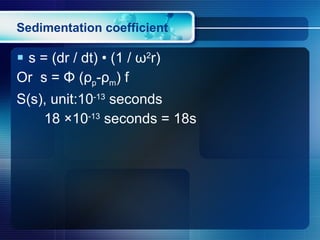
Sedimentation coefficient s = (dr / dt) • (1 /  ω 2 r) Or  s =  Φ  ( ρ p - ρ m ) f S(s), unit:10 -13  seconds 18 ×10 -13  seconds = 18s
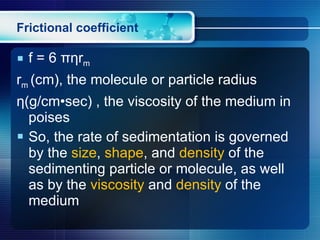
Frictional coefficient f = 6  πη r m r m  (cm), the molecule or particle radius η (g/cm•sec) , the viscosity of the medium in poises So, the rate of sedimentation is governed by the  size ,  shape , and  density  of the sedimenting particle or molecule, as well as by the  viscosity  and  density  of the medium
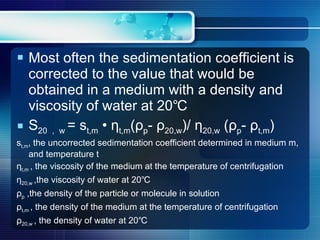
Most often the sedimentation coefficient is corrected to the value that would be obtained in a medium with a density and viscosity of water at 20℃ S 20 , w  = s t,m  •  η t,m ( ρ p -  ρ 20,w )/  η 20,w  ( ρ p -  ρ t,m ) s t,m , the uncorrected sedimentation coefficient determined in medium m, and temperature t η t,m  , the viscosity of the medium at the temperature of centrifugation η 20,w  ,the viscosity of water at 20℃ ρ p  ,the density of the particle or molecule in solution ρ t,m  , the density of the medium at the temperature of centrifugation ρ 20,w  , the density of water at 20℃
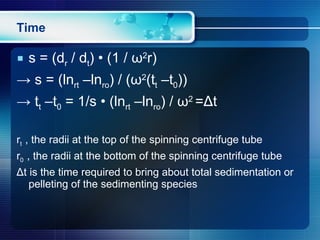
Time  s = (d r  / d t ) • (1 /  ω 2 r) ->  s = (ln rt  –ln ro ) / ( ω 2 (t t  –t 0 )) ->  t t  –t 0  = 1/s • (ln rt  –ln ro ) /  ω 2  = Δ t r t  , the radii at the top of the spinning centrifuge tube r 0  , the radii at the bottom of the spinning centrifuge tube Δ t is the time required to bring about total sedimentation or pelleting of the sedimenting species
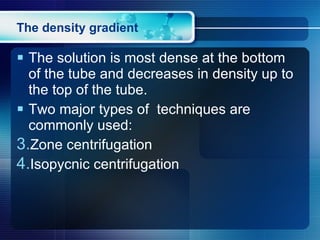
The density gradient The solution is most dense at the bottom of the tube and decreases in density up to the top of the tube. Two major types of  techniques are commonly used: Zone centrifugation Isopycnic centrifugation
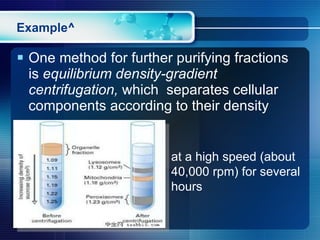
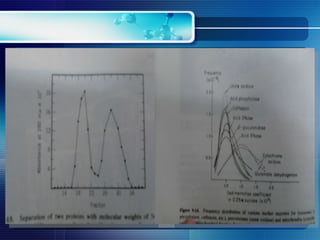
Example^ One method for further purifying fractions is  equilibrium density-gradient centrifugation,  which  separates cellular components according to their density at a high speed (about 40,000 rpm) for several hours
 
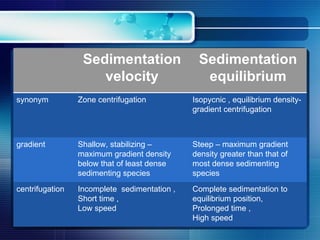
Sedimentation velocity Sedimentation equilibrium synonym Zone centrifugation Isopycnic , equilibrium density-gradient centrifugation gradient Shallow, stabilizing – maximum gradient density below that of least dense sedimenting species Steep – maximum gradient density greater than that of most dense sedimenting species centrifugation Incomplete  sedimentation , Short time , Low speed Complete sedimentation to equilibrium position, Prolonged time ,  High speed
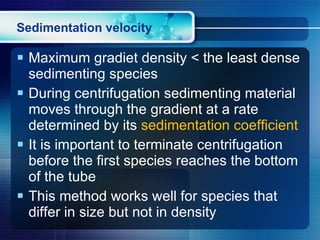
Sedimentation velocity Maximum gradiet density < the least dense sedimenting species During centrifugation sedimenting material moves through the gradient at a rate determined by its  sedimentation coefficient It is important to terminate centrifugation before the first species reaches the bottom of the tube This method works well for species that differ in size but not in density
 
Sedimentation equilibrium Allowing the sedimenting species to move through the gradient until they reach a point  no further sedimentation occurs because they are floating on a “cushion” of material that has a density greater than their own Maximum gradient density > the most dense sedimenting species prolonged periods and at relatively higher speeds This technique is used to separate particles similar in size but of differing densities
SUN WEI Pharmacy of woosuk university [email_address] Thank You !

Centrifugation sunwei 2011.3.17

  • 1.
  • 2.
    Contents 1. Definition2. Classification 3. Composition 4. Relative force & application
  • 3.
    Centrifugation Use ofthe centrifugal force for the separation of mixtures More-dense components migrate away from the axis of the centrifuge less-dense components of migrate towards the axis
  • 4.
    Classification 75000rpm20000~25000rpm 3000rpm Ultra- centrifuge High speed centrifuge Desk top centrifuge
  • 5.
    Desk top clinicalcentrifuges Simplest Least expensive Maximum speed is below 3000rpm Ambient temperature
  • 6.
    High-speed centrifuges Speedsof 20000 to 25000rpm Equipped with refrigeration equipment Refrigerated high-speed centrifuge Continuous flow centrifuge High speed centrifuges
  • 7.
    Continuous flow centrifugeRelatively simple High capacity Separating mixed liquids^
  • 8.
    Refrigerated high-speed centrifugeLower capacity Collect microorganisms O cellular debris O cells O large cellular organelles O ammonium sulfate precipitates O immunoprecipitates O viruses X small organells X
  • 9.
  • 10.
    The ultracentrifuge Attainthe speed of 75000rpm Isolate viruse DNA RNA protein
  • 11.
    Composition Centrifuge consistof four parts: Drive and speed control Temperature control Vacuum system Rotors
  • 12.
    Drive & Speedcontrol Drive: water-cooled electric motor Speed control: 1.selected by rheostat 2.monitored with a tachometer
  • 13.
    Overspeed system Preventoperation of a rotor above its maximum rated speed Consist of ^ 1.a ring of alternating reflecting and nonreflecting surfaces attached to the bottom of the rotor. 2.a small but intense point source of light 3.a photocell
  • 14.
    Temperature control highspeedcentrifuge: placing a thermocouple in the rotor chamber monitoring only the rotor chamber temperature Ultracentrifuge: an infrared radiometric sensor placed beneath the rotor continuously monitors the rotor temperature
  • 15.
    Vacuum system Thespeed of centrifuge < 15000 to 20000rp Not required The speed of centrifuge > 4000rpm Required
  • 16.
    Rotors Two types:angle rotor swinging bucket rotor Angle rotor: Consist of a solid piece of metal with 6 to 12 holes At an angle between 20° and 45°
  • 17.
    Swinging bucket rotor:Hang three to six free moving buckets
  • 18.
    Relative centrifugal force Object moving in circle at a steady angular velocity -> an outward directed force F Depend on ω ,and r F = ω 2 r F is expressed in terms of the earth’s gravitational force, referred to as the relative centrifugal force , RCF (× g) RCF = ω 2 r / 980
  • 19.
    To be ofuse, these relationships must be expressed in terms of “revolutions per minute” , rpm Rpm values may be converted to radians ω = π (rpm) /30 & F = ω 2 r -> RCF = ( π (rpm) /30) 2 × r/ 30 2 /980 =(1.119 ×10 -5 )(rpm) 2 r
  • 20.
    So, RCF isrelated to r The sample is located at a fixed distance r The problem is illustrated in the following example
  • 21.
    Example Calculate theRCF exerted at the top an bottom of a sample vessel spinning in a fixed angle rotor.^ Assume that the rotor dimensions , r min and r max , are 4.8 and 8.0cm , spinning at a speed of 12000rpm. Calculate RCF top and RCF bottom
  • 22.
    Centrifugal force exertedat the top and bottom of the sample tube differs by nearly twofold To account for this , RCF values may be expressed as an average RCF value(RCFave) RCFave = (1.119 ×10 -5 )(12000) 2 6.4 =10313 × g
  • 23.
    Application Zone Centrifugationor Sedimentation velocity Isopycnic Centrifugation or Sedimentation equilibrium
  • 24.
    Sedimentation velocity v=dr / dt = Φ ( ρ p - ρ m ) ω 2 r /f r(cm), the distance from the axis of rotation to the sedimenting particle or molecule Φ (cm 3 ), volume of the particle ρ p (g/cm 3 ), the density of the particle ρ m (g/cm 3 ), the density of the medium f(g/sec), the frictional coefficient v(cm/sec), the radial velocity of sedimentation of the particle
  • 25.
    Sedimentation coefficient s= (dr / dt) • (1 / ω 2 r) Or s = Φ ( ρ p - ρ m ) f S(s), unit:10 -13 seconds 18 ×10 -13 seconds = 18s
  • 26.
    Frictional coefficient f= 6 πη r m r m (cm), the molecule or particle radius η (g/cm•sec) , the viscosity of the medium in poises So, the rate of sedimentation is governed by the size , shape , and density of the sedimenting particle or molecule, as well as by the viscosity and density of the medium
  • 27.
    Most often thesedimentation coefficient is corrected to the value that would be obtained in a medium with a density and viscosity of water at 20℃ S 20 , w = s t,m • η t,m ( ρ p - ρ 20,w )/ η 20,w ( ρ p - ρ t,m ) s t,m , the uncorrected sedimentation coefficient determined in medium m, and temperature t η t,m , the viscosity of the medium at the temperature of centrifugation η 20,w ,the viscosity of water at 20℃ ρ p ,the density of the particle or molecule in solution ρ t,m , the density of the medium at the temperature of centrifugation ρ 20,w , the density of water at 20℃
  • 28.
    Time s= (d r / d t ) • (1 / ω 2 r) -> s = (ln rt –ln ro ) / ( ω 2 (t t –t 0 )) -> t t –t 0 = 1/s • (ln rt –ln ro ) / ω 2 = Δ t r t , the radii at the top of the spinning centrifuge tube r 0 , the radii at the bottom of the spinning centrifuge tube Δ t is the time required to bring about total sedimentation or pelleting of the sedimenting species
  • 29.
    The density gradientThe solution is most dense at the bottom of the tube and decreases in density up to the top of the tube. Two major types of techniques are commonly used: Zone centrifugation Isopycnic centrifugation
  • 30.
    Example^ One methodfor further purifying fractions is  equilibrium density-gradient centrifugation,  which  separates cellular components according to their density at a high speed (about 40,000 rpm) for several hours
  • 31.
  • 32.
    Sedimentation velocity Sedimentationequilibrium synonym Zone centrifugation Isopycnic , equilibrium density-gradient centrifugation gradient Shallow, stabilizing – maximum gradient density below that of least dense sedimenting species Steep – maximum gradient density greater than that of most dense sedimenting species centrifugation Incomplete sedimentation , Short time , Low speed Complete sedimentation to equilibrium position, Prolonged time , High speed
  • 33.
    Sedimentation velocity Maximumgradiet density < the least dense sedimenting species During centrifugation sedimenting material moves through the gradient at a rate determined by its sedimentation coefficient It is important to terminate centrifugation before the first species reaches the bottom of the tube This method works well for species that differ in size but not in density
  • 34.
  • 35.
    Sedimentation equilibrium Allowingthe sedimenting species to move through the gradient until they reach a point no further sedimentation occurs because they are floating on a “cushion” of material that has a density greater than their own Maximum gradient density > the most dense sedimenting species prolonged periods and at relatively higher speeds This technique is used to separate particles similar in size but of differing densities
  • 36.
    SUN WEI Pharmacyof woosuk university [email_address] Thank You !