Presented by :
Gurleen Kaur
Roll no. 60235
M.Sc. Biotechnology (1)
Centrifugation
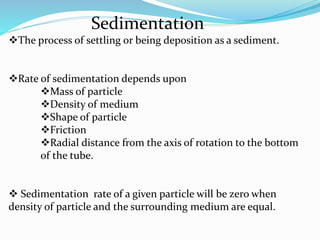
Sedimentation
The process of settling or being deposition as a sediment.
Rate of sedimentation depends upon
Mass of particle
Density of medium
Shape of particle
Friction
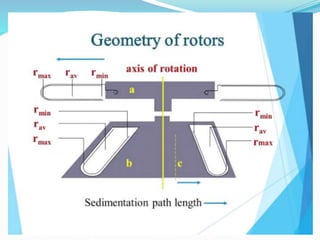
Radial distance from the axis of rotation to the bottom
of the tube.
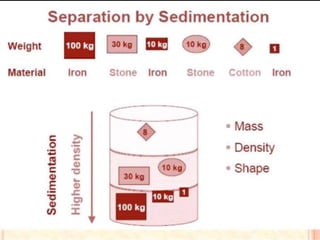
 Sedimentation rate of a given particle will be zero when
density of particle and the surrounding medium are equal.
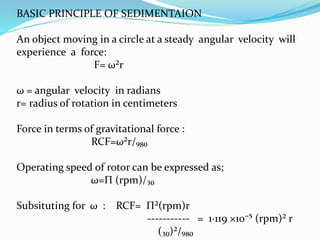
BASIC PRINCIPLE OF SEDIMENTAION
An object moving in a circle at a steady angular velocity will
experience a force:
F= ω²r
ω = angular velocity in radians
r= radius of rotation in centimeters
Force in terms of gravitational force :
RCF=ω²r/₉₈₀
Operating speed of rotor can be expressed as;
ω=Π (rpm)/₃₀
Subsituting for ω : RCF= Π²(rpm)r
----------- = 1∙119 ×10⁻⁵ (rpm)² r
(₃₀)²/₉₈₀
To avoid ambiguity in scientific work. It is better to express
the force acting upon particle in terms of RCF rather than
Rpm.
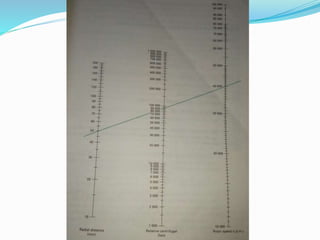
From Nomograph by aligning the values of the radius and
rotor speed, one can find the value of RCF.
NOMOGRAPH
Used for the determination of relative centrifugal field for
given rotor speed and radius.
The three columns represents the radial distance (in mm), the
relative centrifugal field and rotor speed (in rpm).
For the conversion between relative centrifugal force and
speed of centrifuge spindle in rpm at different radii, draw a
straight edge through known values in two columns. The
desired figure can be read where the straight edge intersects
the third column.
Centrifugation
Process which involves use of centrifugal force to separate or
concentrate materials suspended in a liquid medium.
Centrifuge
Consist of two components
Electric motor
Rotor
 Device for separating particles from a solution according to
their shape , size, density, viscosity of the medium and rotor
speed.
Centrifugal Force
A force arising from the body’s inertia , which appears to act
on a body moving in a circular path and is directed away from
the centre around which the body is moving.
Fc=mv²/r
Where Fc=centrifugal force,
m= mass, v= speed and r=radius .
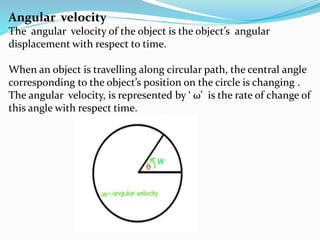
Angular velocity
The angular velocity of the object is the object’s angular
displacement with respect to time.
When an object is travelling along circular path, the central angle
corresponding to the object’s position on the circle is changing .
The angular velocity, is represented by ‘ ω’ is the rate of change of
this angle with respect time.
W=angular velocity
W
θ
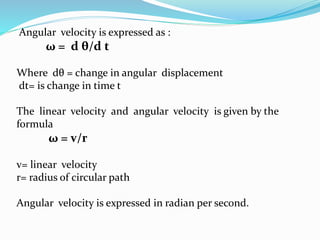
Angular velocity is expressed as :
ω = d θ/d t
Where dθ = change in angular displacement
dt= is change in time t
The linear velocity and angular velocity is given by the
formula
ω = v/r
v= linear velocity
r= radius of circular path
Angular velocity is expressed in radian per second.
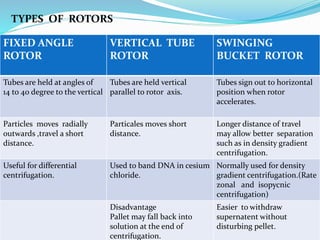
TYPES OF ROTORS
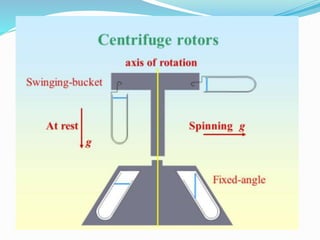
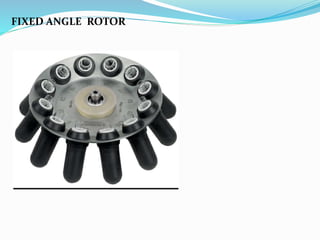
FIXED ANGLE
ROTOR
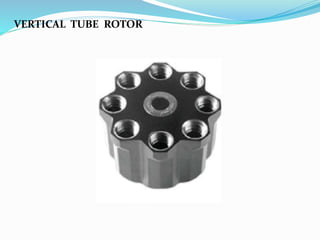
VERTICAL TUBE
ROTOR
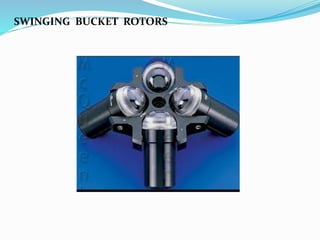
SWINGING
BUCKET ROTOR
Tubes are held at angles of
14 to 40 degree to the vertical
Tubes are held vertical
parallel to rotor axis.
Tubes sign out to horizontal
position when rotor
accelerates.
Particles moves radially
outwards ,travel a short
distance.
Particales moves short
distance.
Longer distance of travel
may allow better separation
such as in density gradient
centrifugation.
Useful for differential
centrifugation.
Used to band DNA in cesium
chloride.
Normally used for density
gradient centrifugation.(Rate
zonal and isopycnic
centrifugation)
Disadvantage
Pallet may fall back into
solution at the end of
centrifugation.
Easier to withdraw
supernatent without
disturbing pellet.
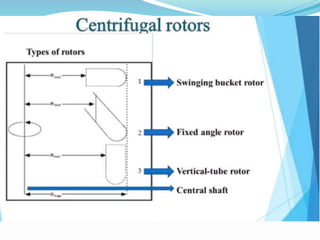
FIXED ANGLE ROTOR
VERTICAL TUBE ROTOR
SWINGING BUCKET ROTORS
TYPES OF CENTRIFUGE
 Low speed centrifuge
 High speed centrifuges
 Ultracentrifuges(Analytical, Preparative)
LOW SPEED CENTRIFUGE
Simple and small.
 Maximum speed of 4000-5000 rpm.
Do not have any temperature regulatory system.
Two types of rotor are used in it :
 Fixed angle
 Swinging bucket
Used to collect substances such as
Blood cells
 yeast cells
 Bulky ppts of chemical reactions.
HIGH SPEED CENTRIFUGE
•Maximum speed of 25000 rpm .
• Equipped with referigeration system .
• Temperature maintained at 0-4˚C.
•Three types of rotor s :
•Fixed angle , Swinging bucket, Vertical rotor
Used to collect:
 cells
cell debris
large cellular organelles
 ppts of chemical reactions
Useful in isolating the sub cellular organelles(nuclei,
mitochondria, lysosomes).
ULTRACENTRIFUGE
•Operates at speed of 75000 rpm providing the centrifugal
force of 50,000g
•Rotor chamber is sealed and evacuated by pump to attain
vaccum.
•Refrigeration system(temparature 0-4˚C ).
•Used for both preparative work and analytical work.
PREPARATIVE CENTRIFUGATION
Centrifugation for isolation and purification of components is
known as preparative centrifugation .
Divided into two main techniques depending on suspension
medium in which separation occurs:
•Homogenous medium---- Differential centrifugation
•Density gradient medium---- Density gradient centrifugation
DIFFERENTIAL CENTRIFUGATION
•Separation is achieved on the basis of the basis of the size of
the particles.
•It is commonly used for the simple pelleting and separation of
subcellular organelle, tissue and cells.
•During centrifugation, larger particles sediments faster than
the smaller ones.
•At a series of progressive higher g- force generate partially
purified organelles.
•Inspite of its reduced yield differential centrifugation remains
probably the most commonly used method for isolation of
intracellular organelle from tissue homogenates because of
its:
•Relative ease
•Convenience
•Time economy
Drawback is its poor yield and fact that preparation obtained
never pure.
DENSITY GRADIENT CENTRIFUGATION
Method to purify subcellular organelles and macromolecules.
Density gradient can be generated by placing layer of gradient
media such as sucrose in tube , with heaviest layer at the
bottom and lightest layer at the top in either.
It is mainly classified into two categories:
Rate Zonal Separation
Isopycnic Separation
Rate zonal separation
Based on density gradient.
Sample is applied in thin zone at the top of the centrifuge
tube on a density gradient.
 The particle will begin sedimenting in separate zones
according to size, shape and density.
Isopycnic separation
Particle of a particular density will sink during centrifugation
Until position is reaches where the density of the surrounding
solution is exactly the same as the density of the particle.
ANALYTICAL CENTRIFUGATION
It operates at speed of 7000o rpm.
It is equipped with refrigeration system and optical system.
Built in Optical system to analyze the progress of molecules
during centrifugation.
Used to determine sedimentation coefficient and molecular
weight of molecules.
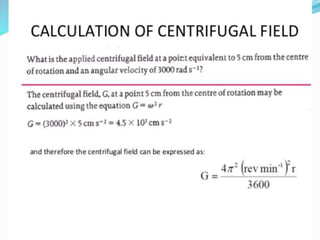
W=2Πrpm¯¹/60
G=w²r
W=4Π²rpm².r
----------
3600
Safety measures for centrifuges:
Proper cleaning
Voltage maintenance
Prevention from moisture
CENTRIFUGATION

CENTRIFUGATION

  • 1.
    Presented by : GurleenKaur Roll no. 60235 M.Sc. Biotechnology (1) Centrifugation
  • 2.
    Sedimentation The process ofsettling or being deposition as a sediment. Rate of sedimentation depends upon Mass of particle Density of medium Shape of particle Friction Radial distance from the axis of rotation to the bottom of the tube.  Sedimentation rate of a given particle will be zero when density of particle and the surrounding medium are equal.
  • 4.
    BASIC PRINCIPLE OFSEDIMENTAION An object moving in a circle at a steady angular velocity will experience a force: F= ω²r ω = angular velocity in radians r= radius of rotation in centimeters Force in terms of gravitational force : RCF=ω²r/₉₈₀ Operating speed of rotor can be expressed as; ω=Π (rpm)/₃₀ Subsituting for ω : RCF= Π²(rpm)r ----------- = 1∙119 ×10⁻⁵ (rpm)² r (₃₀)²/₉₈₀
  • 5.
    To avoid ambiguityin scientific work. It is better to express the force acting upon particle in terms of RCF rather than Rpm. From Nomograph by aligning the values of the radius and rotor speed, one can find the value of RCF.
  • 7.
    NOMOGRAPH Used for thedetermination of relative centrifugal field for given rotor speed and radius. The three columns represents the radial distance (in mm), the relative centrifugal field and rotor speed (in rpm). For the conversion between relative centrifugal force and speed of centrifuge spindle in rpm at different radii, draw a straight edge through known values in two columns. The desired figure can be read where the straight edge intersects the third column.
  • 8.
    Centrifugation Process which involvesuse of centrifugal force to separate or concentrate materials suspended in a liquid medium. Centrifuge Consist of two components Electric motor Rotor  Device for separating particles from a solution according to their shape , size, density, viscosity of the medium and rotor speed.
  • 9.
    Centrifugal Force A forcearising from the body’s inertia , which appears to act on a body moving in a circular path and is directed away from the centre around which the body is moving. Fc=mv²/r Where Fc=centrifugal force, m= mass, v= speed and r=radius .
  • 10.
    Angular velocity The angularvelocity of the object is the object’s angular displacement with respect to time. When an object is travelling along circular path, the central angle corresponding to the object’s position on the circle is changing . The angular velocity, is represented by ‘ ω’ is the rate of change of this angle with respect time. W=angular velocity W θ
  • 11.
    Angular velocity isexpressed as : ω = d θ/d t Where dθ = change in angular displacement dt= is change in time t The linear velocity and angular velocity is given by the formula ω = v/r v= linear velocity r= radius of circular path Angular velocity is expressed in radian per second.
  • 12.
    TYPES OF ROTORS FIXEDANGLE ROTOR VERTICAL TUBE ROTOR SWINGING BUCKET ROTOR Tubes are held at angles of 14 to 40 degree to the vertical Tubes are held vertical parallel to rotor axis. Tubes sign out to horizontal position when rotor accelerates. Particles moves radially outwards ,travel a short distance. Particales moves short distance. Longer distance of travel may allow better separation such as in density gradient centrifugation. Useful for differential centrifugation. Used to band DNA in cesium chloride. Normally used for density gradient centrifugation.(Rate zonal and isopycnic centrifugation) Disadvantage Pallet may fall back into solution at the end of centrifugation. Easier to withdraw supernatent without disturbing pellet.
  • 16.
  • 17.
  • 18.
  • 19.
    TYPES OF CENTRIFUGE Low speed centrifuge  High speed centrifuges  Ultracentrifuges(Analytical, Preparative)
  • 20.
    LOW SPEED CENTRIFUGE Simpleand small.  Maximum speed of 4000-5000 rpm. Do not have any temperature regulatory system. Two types of rotor are used in it :  Fixed angle  Swinging bucket Used to collect substances such as Blood cells  yeast cells  Bulky ppts of chemical reactions.
  • 21.
    HIGH SPEED CENTRIFUGE •Maximumspeed of 25000 rpm . • Equipped with referigeration system . • Temperature maintained at 0-4˚C. •Three types of rotor s : •Fixed angle , Swinging bucket, Vertical rotor Used to collect:  cells cell debris large cellular organelles  ppts of chemical reactions Useful in isolating the sub cellular organelles(nuclei, mitochondria, lysosomes).
  • 22.
    ULTRACENTRIFUGE •Operates at speedof 75000 rpm providing the centrifugal force of 50,000g •Rotor chamber is sealed and evacuated by pump to attain vaccum. •Refrigeration system(temparature 0-4˚C ). •Used for both preparative work and analytical work.
  • 23.
    PREPARATIVE CENTRIFUGATION Centrifugation forisolation and purification of components is known as preparative centrifugation . Divided into two main techniques depending on suspension medium in which separation occurs: •Homogenous medium---- Differential centrifugation •Density gradient medium---- Density gradient centrifugation
  • 24.
    DIFFERENTIAL CENTRIFUGATION •Separation isachieved on the basis of the basis of the size of the particles. •It is commonly used for the simple pelleting and separation of subcellular organelle, tissue and cells. •During centrifugation, larger particles sediments faster than the smaller ones. •At a series of progressive higher g- force generate partially purified organelles. •Inspite of its reduced yield differential centrifugation remains probably the most commonly used method for isolation of intracellular organelle from tissue homogenates because of its:
  • 25.
    •Relative ease •Convenience •Time economy Drawbackis its poor yield and fact that preparation obtained never pure.
  • 26.
    DENSITY GRADIENT CENTRIFUGATION Methodto purify subcellular organelles and macromolecules. Density gradient can be generated by placing layer of gradient media such as sucrose in tube , with heaviest layer at the bottom and lightest layer at the top in either. It is mainly classified into two categories: Rate Zonal Separation Isopycnic Separation
  • 27.
    Rate zonal separation Basedon density gradient. Sample is applied in thin zone at the top of the centrifuge tube on a density gradient.  The particle will begin sedimenting in separate zones according to size, shape and density. Isopycnic separation Particle of a particular density will sink during centrifugation Until position is reaches where the density of the surrounding solution is exactly the same as the density of the particle.
  • 28.
    ANALYTICAL CENTRIFUGATION It operatesat speed of 7000o rpm. It is equipped with refrigeration system and optical system. Built in Optical system to analyze the progress of molecules during centrifugation. Used to determine sedimentation coefficient and molecular weight of molecules.
  • 29.
  • 30.
    Safety measures forcentrifuges: Proper cleaning Voltage maintenance Prevention from moisture