CENTRIFUGAL EXTRACTOR
(LIQUID-LIQUID EXTRACTION)
Group no. 12
11BCH056-60
INTRODUCTION
A centrifugal extractor—also known as a centrifugal
contactor or annular centrifugal contactor—uses the
rotation of the rotor inside a centrifuge to mix
two immiscible liquids outside the rotor and to separate
the liquids in the field of gravity inside the rotor. This way,
a centrifugal extractor generates a
continuous extraction from one liquid phase (fermentation
broth) into another liquid phase (organic solvent).
10/24/2013 2CENTRIFUGE
WORKING OF CENTRIFUGE
Two immiscible liquids of different densities are fed to the separate
inlets and are rapidly mixed in the annular space between the
spinning rotor and stationary housing. The mixed phases are directed
toward the center of the rotor by radial vanes in the housing base. As
the liquids enter the central opening of the rotor, they are accelerated
toward the wall. The mixed phases are rapidly accelerated to rotor
speed and separation begins as the liquids are displaced upward. A
system of weirs at the top of the rotor allow each phase to exit the
rotor where it lands in a collector ring and exits the stage. Flow from
between stages is by gravity with no need for inter-stage pumps. The
centrifugal contactors thus acts as a mixer, centrifuge and pump.
10/24/2013 3CENTRIFUGE
• Mix and separation.
• Separation by direct feed.
• Multi-stage processing.
10/24/2013 4
CONFIGURATION OF
CENTRIFUGE
CENTRIFUGE
10/24/2013 5
MIX AND
SEPERATION
CENTRIFUGE
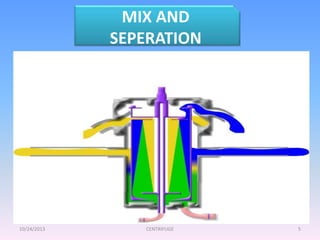
The mix & separation configuration is the standard
operation for centrifugal contactors used for liquid-
liquid extraction processes. The two liquids (typically
an aqueous phase (heavy) and an organic phase (light))
enter the annular mixing zone where a liquid-liquid
dispersion is formed and extraction occurs as solutes
(e.g. dissolved metal ions) are transferred from one
phase into the other. Inside the rotor, the liquids will be
separated into a heavy (blue) and a light (yellow) phase
by their respective densities. This proportion of each
phase (phase ratio), total flow rate, rotor speed, and
weir sizes are varied to optimize separation efficiency.
The separated liquids are discharged without pressure
and flow by gravity to exit the stage
10/24/2013 6CENTRIFUGE
10/24/2013 7
SEPERATION BY DIRECT FEED
CENTRIFUGE
10/24/2013 8
For applications requiring only separation of a
pre-mixed dispersion (e.g. oil/water
separation in environmental cleanup), the
direct feed offers the option to feed the mixed
liquid stream at a low sheer force directly into
the rotor. Inside the rotor, the liquids will be
separated into a heavy (blue) and a light
(yellow) phase. This principle is used to
optimize the separation efficiency. The
separated liquids will be discharged without
pressure.
CENTRIFUGE
10/24/2013 9
MULTISTAGE PROCESSING
CENTRIFUGE
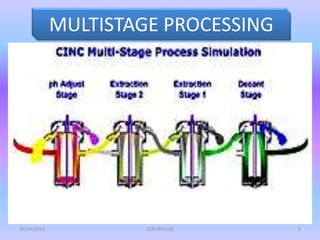
• Typically for solvent extraction processes in stage-
wise equipment such as the centrifugal contactor,
we would have multiple contactors in series for
extraction, scrubbing, and stripping (and perhaps
others). The number of stages needed in each
section of the process would depend on process
design requirements (necessary extraction
factor). In this case, four interconnected stages
provide a continuous process in which the first
stage is a decanting stage. The next two stages
show a counter current extraction. The last stage
is a neutralization as a cross stream
interconnection.
10/24/2013 10CENTRIFUGE

Centrifugal extractor(PDPU)

  • 1.
  • 2.
    INTRODUCTION A centrifugal extractor—alsoknown as a centrifugal contactor or annular centrifugal contactor—uses the rotation of the rotor inside a centrifuge to mix two immiscible liquids outside the rotor and to separate the liquids in the field of gravity inside the rotor. This way, a centrifugal extractor generates a continuous extraction from one liquid phase (fermentation broth) into another liquid phase (organic solvent). 10/24/2013 2CENTRIFUGE
  • 3.
    WORKING OF CENTRIFUGE Twoimmiscible liquids of different densities are fed to the separate inlets and are rapidly mixed in the annular space between the spinning rotor and stationary housing. The mixed phases are directed toward the center of the rotor by radial vanes in the housing base. As the liquids enter the central opening of the rotor, they are accelerated toward the wall. The mixed phases are rapidly accelerated to rotor speed and separation begins as the liquids are displaced upward. A system of weirs at the top of the rotor allow each phase to exit the rotor where it lands in a collector ring and exits the stage. Flow from between stages is by gravity with no need for inter-stage pumps. The centrifugal contactors thus acts as a mixer, centrifuge and pump. 10/24/2013 3CENTRIFUGE
  • 4.
    • Mix andseparation. • Separation by direct feed. • Multi-stage processing. 10/24/2013 4 CONFIGURATION OF CENTRIFUGE CENTRIFUGE
  • 5.
  • 6.
    The mix &separation configuration is the standard operation for centrifugal contactors used for liquid- liquid extraction processes. The two liquids (typically an aqueous phase (heavy) and an organic phase (light)) enter the annular mixing zone where a liquid-liquid dispersion is formed and extraction occurs as solutes (e.g. dissolved metal ions) are transferred from one phase into the other. Inside the rotor, the liquids will be separated into a heavy (blue) and a light (yellow) phase by their respective densities. This proportion of each phase (phase ratio), total flow rate, rotor speed, and weir sizes are varied to optimize separation efficiency. The separated liquids are discharged without pressure and flow by gravity to exit the stage 10/24/2013 6CENTRIFUGE
  • 7.
    10/24/2013 7 SEPERATION BYDIRECT FEED CENTRIFUGE
  • 8.
    10/24/2013 8 For applicationsrequiring only separation of a pre-mixed dispersion (e.g. oil/water separation in environmental cleanup), the direct feed offers the option to feed the mixed liquid stream at a low sheer force directly into the rotor. Inside the rotor, the liquids will be separated into a heavy (blue) and a light (yellow) phase. This principle is used to optimize the separation efficiency. The separated liquids will be discharged without pressure. CENTRIFUGE
  • 9.
  • 10.
    • Typically forsolvent extraction processes in stage- wise equipment such as the centrifugal contactor, we would have multiple contactors in series for extraction, scrubbing, and stripping (and perhaps others). The number of stages needed in each section of the process would depend on process design requirements (necessary extraction factor). In this case, four interconnected stages provide a continuous process in which the first stage is a decanting stage. The next two stages show a counter current extraction. The last stage is a neutralization as a cross stream interconnection. 10/24/2013 10CENTRIFUGE