Submitted To
Ms. Sonali Jat
Asst. Professor
Submitted By
Mr.Devendra kumar Pandey
B.Ph 3rd sem
A PRESENTATION ON
CENTRIFUGATION
CONTENT
• Introduction
• Defination
• Principle
• Application
• Types
• Instruments
COMMON INTRODUCTION
• Centrifugation is a technique to centrifuge the dispersion of two immiscible liquids either
S/L or L/L.
• It involves the application of centrifugal force to separate the particles.
• It only use for the particle size less then 5um ,
• Centrifugation provide a convenient method for separating either two immiscible
liquids or a solid from a liquid.
DEFINATION
• Centrifugation is a technique which involves the application of centrifugal force to
separate particles from a solution according to their size, shape, density, viscosity of the
medium and rotor speed.
• Centrifugation is the unit operation employed for seperating the constituents present in
a dispersion with the aid of centrifugal force
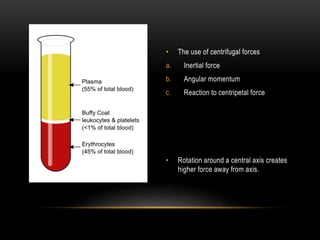
• The use of centrifugal forces
a. Inertial force
b. Angular momentum
c. Reaction to centripetal force
• Rotation around a central axis creates
higher force away from axis.
Theory & Principle
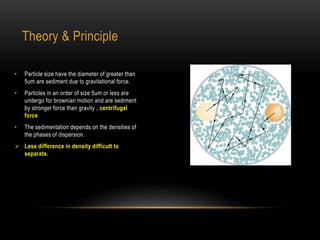
• Particle size have the diameter of greater than
5um are sediment due to gravitational force.
• Particles in an order of size 5um or less are
undergo for brownian motion and are sediment
by stronger force than gravity , centrifugal
force
• The sedimentation depends on the densities of
the phases of dispersion.
 Less difference in density difficult to
separate.
RELATIVE CENTRIFUGAL FORCE
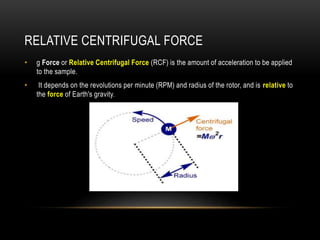
• g Force or Relative Centrifugal Force (RCF) is the amount of acceleration to be applied
to the sample.
• It depends on the revolutions per minute (RPM) and radius of the rotor, and is relative to
the force of Earth's gravity.
APPLICATIONS
• PRODUCTION OF BULK DRUGS – Centrifuge is used in the formation of many drug by
separating crystalline drug from mother liqure.
• PRODUCTION OF BIOLOGICAL PRODUCTS – Most of drug are present as colloidal dispersion
in water. Centrifugal methods are used for separation of these constituents from water. Ex.
INSULIN can separate in pure form by this.
• BIOPHARMACEUTICAL ANALYSIS OF DRUG – Drug are present in body`s liquid in form
of colloidal dispersions , these centrifugation is use to separate them. This is essential for
pharmakokinetics evaluation parameters.
• EVALUATION OF SUSPENSION & EMULSION – Centrifugation is used in the parameters
of evaluation of suspension and emulsion. In suspension its sedimentation test & in
emulsion it is creaming and stability test.
CLASSIFICATION
OF
CENTRIFUGES
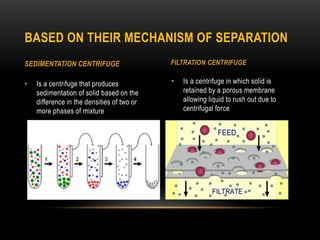
• Is a centrifuge in which solid is
retained by a porous membrane
allowing liquid to rush out due to
centrifugal force
• Is a centrifuge that produces
sedimentation of solid based on the
difference in the densities of two or
more phases of mixture
BASED ON THEIR MECHANISM OF SEPARATION
SEDIMENTATION CENTRIFUGE FILTRATION CENTRIFUGE
• Construction is complicated
• Capacity is limited
• Compact and occupy a very small
space
• Two immiscible liquids are easily
separated on a continuous process.
• Controlation is easy.
SEDIMENTATION CENTRIFUGE
ADVANTAGE DISADVANTAGE
• It is a complicated cycle resulting in
considerable labour costs.
• It is a batch process/ semi-continuous
type
• Solid is in a form of hard cake and
hard to remove
• It can handle slurries with a high no. of
solid paricles and even a paste.
• Final product have very low moisture
contain.
• The dissolved solid are separated from
the cake.
FILTRATION CENTRIFUGE
ADVANTAGE DISADVANTAGE
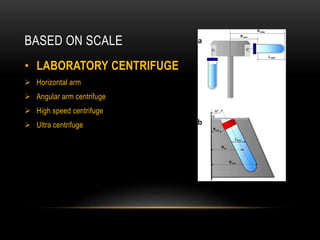
BASED ON SCALE
• LABORATORY CENTRIFUGE
 Horizontal arm
 Angular arm centrifuge
 High speed centrifuge
 Ultra centrifuge
COMMERCIAL SCALE
• BATCH TYPE – Perforated basket centrifuge
• SEMI-CONTINUOUS TYPE – Short cycle batch centrifuge
• CONTINUOUS TYPE - Supercentrifuge
INSTRUMENTS
• Perforated basket centrifuge
• Non-perforated basket centrifuge
• Semi-continuous centrifuge
• Super centrifuge
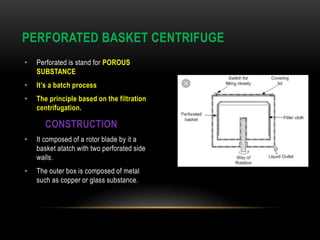
• Perforated is stand for POROUS
SUBSTANCE
• It’s a batch process
• The principle based on the filtration
centrifugation.
CONSTRUCTION
• It composed of a rotor blade by it a
basket atatch with two perforated side
walls.
• The outer box is composed of metal
such as copper or glass substance.
PERFORATED BASKET CENTRIFUGE
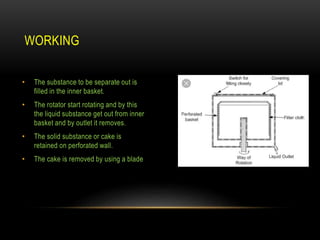
• The substance to be separate out is
filled in the inner basket.
• The rotator start rotating and by this
the liquid substance get out from inner
basket and by outlet it removes.
• The solid substance or cake is
retained on perforated wall.
• The cake is removed by using a blade
WORKING
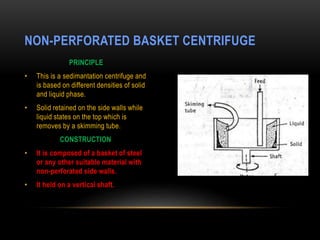
PRINCIPLE
• This is a sedimantation centrifuge and
is based on different densities of solid
and liquid phase.
• Solid retained on the side walls while
liquid states on the top which is
removes by a skimming tube.
CONSTRUCTION
• It is composed of a basket of steel
or any other suitable material with
non-perforated side walls.
• It held on a vertical shaft.
NON-PERFORATED BASKET CENTRIFUGE
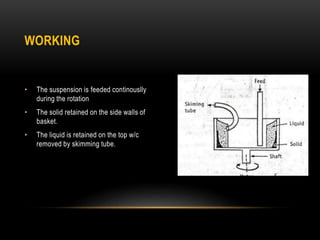
• The suspension is feeded continouslly
during the rotation
• The solid retained on the side walls of
basket.
• The liquid is retained on the top w/c
removed by skimming tube.
WORKING
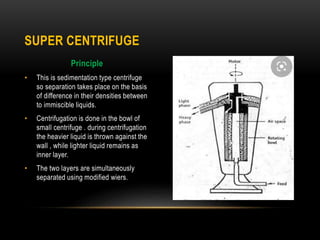
Principle
• This is sedimentation type centrifuge
so separation takes place on the basis
of difference in their densities between
to immiscible liquids.
• Centrifugation is done in the bowl of
small centrifuge . during centrifugation
the heavier liquid is thrown against the
wall , while lighter liquid remains as
inner layer.
• The two layers are simultaneously
separated using modified wiers.
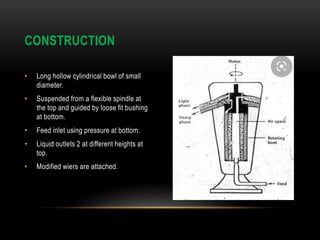
SUPER CENTRIFUGE
• Long hollow cylindrical bowl of small
diameter.
• Suspended from a flexible spindle at
the top and guided by loose fit bushing
at bottom.
• Feed inlet using pressure at bottom.
• Liquid outlets 2 at different heights at
top.
• Modified wiers are attached.
CONSTRUCTION
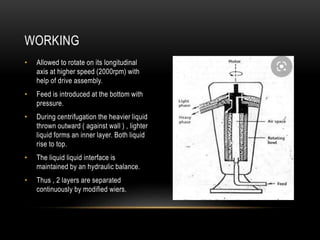
• Allowed to rotate on its longitudinal
axis at higher speed (2000rpm) with
help of drive assembly.
• Feed is introduced at the bottom with
pressure.
• During centrifugation the heavier liquid
thrown outward ( against wall ) , lighter
liquid forms an inner layer. Both liquid
rise to top.
• The liquid liquid interface is
maintained by an hydraulic balance.
• Thus , 2 layers are separated
continuously by modified wiers.
WORKING
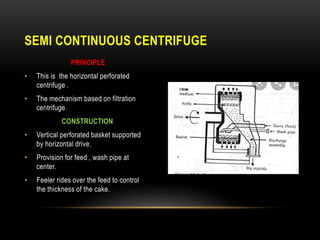
PRINCIPLE
• This is the horizontal perforated
centrifuge .
• The mechanism based on filtration
centrifuge.
CONSTRUCTION
• Vertical perforated basket supported
by horizontal drive.
• Provision for feed , wash pipe at
center.
• Feeler rides over the feed to control
the thickness of the cake.
SEMI CONTINUOUS CENTRIFUGE
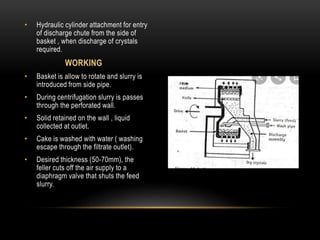
• Hydraulic cylinder attachment for entry
of discharge chute from the side of
basket , when discharge of crystals
required.
WORKING
• Basket is allow to rotate and slurry is
introduced from side pipe.
• During centrifugation slurry is passes
through the perforated wall.
• Solid retained on the wall , liquid
collected at outlet.
• Cake is washed with water ( washing
escape through the filtrate outlet).
• Desired thickness (50-70mm), the
feller cuts off the air supply to a
diaphragm valve that shuts the feed
slurry.
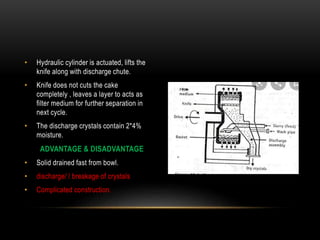
• Hydraulic cylinder is actuated, lifts the
knife along with discharge chute.
• Knife does not cuts the cake
completely , leaves a layer to acts as
filter medium for further separation in
next cycle.
• The discharge crystals contain 2*4%
moisture.
ADVANTAGE & DISADVANTAGE
• Solid drained fast from bowl.
• discharge/ / breakage of crystals
• Complicated construction.
THANK YOU

Centrifugation

  • 1.
    Submitted To Ms. SonaliJat Asst. Professor Submitted By Mr.Devendra kumar Pandey B.Ph 3rd sem A PRESENTATION ON CENTRIFUGATION
  • 2.
    CONTENT • Introduction • Defination •Principle • Application • Types • Instruments
  • 3.
    COMMON INTRODUCTION • Centrifugationis a technique to centrifuge the dispersion of two immiscible liquids either S/L or L/L. • It involves the application of centrifugal force to separate the particles. • It only use for the particle size less then 5um , • Centrifugation provide a convenient method for separating either two immiscible liquids or a solid from a liquid.
  • 4.
    DEFINATION • Centrifugation isa technique which involves the application of centrifugal force to separate particles from a solution according to their size, shape, density, viscosity of the medium and rotor speed. • Centrifugation is the unit operation employed for seperating the constituents present in a dispersion with the aid of centrifugal force
  • 5.
    • The useof centrifugal forces a. Inertial force b. Angular momentum c. Reaction to centripetal force • Rotation around a central axis creates higher force away from axis.
  • 6.
    Theory & Principle •Particle size have the diameter of greater than 5um are sediment due to gravitational force. • Particles in an order of size 5um or less are undergo for brownian motion and are sediment by stronger force than gravity , centrifugal force • The sedimentation depends on the densities of the phases of dispersion.  Less difference in density difficult to separate.
  • 7.
    RELATIVE CENTRIFUGAL FORCE •g Force or Relative Centrifugal Force (RCF) is the amount of acceleration to be applied to the sample. • It depends on the revolutions per minute (RPM) and radius of the rotor, and is relative to the force of Earth's gravity.
  • 8.
    APPLICATIONS • PRODUCTION OFBULK DRUGS – Centrifuge is used in the formation of many drug by separating crystalline drug from mother liqure. • PRODUCTION OF BIOLOGICAL PRODUCTS – Most of drug are present as colloidal dispersion in water. Centrifugal methods are used for separation of these constituents from water. Ex. INSULIN can separate in pure form by this. • BIOPHARMACEUTICAL ANALYSIS OF DRUG – Drug are present in body`s liquid in form of colloidal dispersions , these centrifugation is use to separate them. This is essential for pharmakokinetics evaluation parameters. • EVALUATION OF SUSPENSION & EMULSION – Centrifugation is used in the parameters of evaluation of suspension and emulsion. In suspension its sedimentation test & in emulsion it is creaming and stability test.
  • 9.
  • 10.
    • Is acentrifuge in which solid is retained by a porous membrane allowing liquid to rush out due to centrifugal force • Is a centrifuge that produces sedimentation of solid based on the difference in the densities of two or more phases of mixture BASED ON THEIR MECHANISM OF SEPARATION SEDIMENTATION CENTRIFUGE FILTRATION CENTRIFUGE
  • 11.
    • Construction iscomplicated • Capacity is limited • Compact and occupy a very small space • Two immiscible liquids are easily separated on a continuous process. • Controlation is easy. SEDIMENTATION CENTRIFUGE ADVANTAGE DISADVANTAGE
  • 12.
    • It isa complicated cycle resulting in considerable labour costs. • It is a batch process/ semi-continuous type • Solid is in a form of hard cake and hard to remove • It can handle slurries with a high no. of solid paricles and even a paste. • Final product have very low moisture contain. • The dissolved solid are separated from the cake. FILTRATION CENTRIFUGE ADVANTAGE DISADVANTAGE
  • 13.
    BASED ON SCALE •LABORATORY CENTRIFUGE  Horizontal arm  Angular arm centrifuge  High speed centrifuge  Ultra centrifuge
  • 14.
    COMMERCIAL SCALE • BATCHTYPE – Perforated basket centrifuge • SEMI-CONTINUOUS TYPE – Short cycle batch centrifuge • CONTINUOUS TYPE - Supercentrifuge
  • 15.
    INSTRUMENTS • Perforated basketcentrifuge • Non-perforated basket centrifuge • Semi-continuous centrifuge • Super centrifuge
  • 16.
    • Perforated isstand for POROUS SUBSTANCE • It’s a batch process • The principle based on the filtration centrifugation. CONSTRUCTION • It composed of a rotor blade by it a basket atatch with two perforated side walls. • The outer box is composed of metal such as copper or glass substance. PERFORATED BASKET CENTRIFUGE
  • 17.
    • The substanceto be separate out is filled in the inner basket. • The rotator start rotating and by this the liquid substance get out from inner basket and by outlet it removes. • The solid substance or cake is retained on perforated wall. • The cake is removed by using a blade WORKING
  • 18.
    PRINCIPLE • This isa sedimantation centrifuge and is based on different densities of solid and liquid phase. • Solid retained on the side walls while liquid states on the top which is removes by a skimming tube. CONSTRUCTION • It is composed of a basket of steel or any other suitable material with non-perforated side walls. • It held on a vertical shaft. NON-PERFORATED BASKET CENTRIFUGE
  • 19.
    • The suspensionis feeded continouslly during the rotation • The solid retained on the side walls of basket. • The liquid is retained on the top w/c removed by skimming tube. WORKING
  • 20.
    Principle • This issedimentation type centrifuge so separation takes place on the basis of difference in their densities between to immiscible liquids. • Centrifugation is done in the bowl of small centrifuge . during centrifugation the heavier liquid is thrown against the wall , while lighter liquid remains as inner layer. • The two layers are simultaneously separated using modified wiers. SUPER CENTRIFUGE
  • 21.
    • Long hollowcylindrical bowl of small diameter. • Suspended from a flexible spindle at the top and guided by loose fit bushing at bottom. • Feed inlet using pressure at bottom. • Liquid outlets 2 at different heights at top. • Modified wiers are attached. CONSTRUCTION
  • 22.
    • Allowed torotate on its longitudinal axis at higher speed (2000rpm) with help of drive assembly. • Feed is introduced at the bottom with pressure. • During centrifugation the heavier liquid thrown outward ( against wall ) , lighter liquid forms an inner layer. Both liquid rise to top. • The liquid liquid interface is maintained by an hydraulic balance. • Thus , 2 layers are separated continuously by modified wiers. WORKING
  • 23.
    PRINCIPLE • This isthe horizontal perforated centrifuge . • The mechanism based on filtration centrifuge. CONSTRUCTION • Vertical perforated basket supported by horizontal drive. • Provision for feed , wash pipe at center. • Feeler rides over the feed to control the thickness of the cake. SEMI CONTINUOUS CENTRIFUGE
  • 24.
    • Hydraulic cylinderattachment for entry of discharge chute from the side of basket , when discharge of crystals required. WORKING • Basket is allow to rotate and slurry is introduced from side pipe. • During centrifugation slurry is passes through the perforated wall. • Solid retained on the wall , liquid collected at outlet. • Cake is washed with water ( washing escape through the filtrate outlet). • Desired thickness (50-70mm), the feller cuts off the air supply to a diaphragm valve that shuts the feed slurry.
  • 25.
    • Hydraulic cylinderis actuated, lifts the knife along with discharge chute. • Knife does not cuts the cake completely , leaves a layer to acts as filter medium for further separation in next cycle. • The discharge crystals contain 2*4% moisture. ADVANTAGE & DISADVANTAGE • Solid drained fast from bowl. • discharge/ / breakage of crystals • Complicated construction.
  • 26.