SAMINAR TOPIC:- MULTI EFFECT
EVAPORATER
SEMINAR Mrs. Smita gupta
COORDINATER:- Mr. S.K. Srivastava
PRESENTED BY:-
C.Shekhar
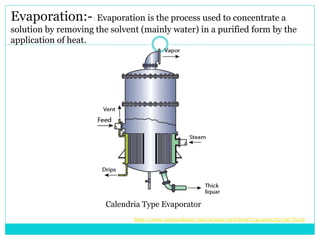
Evaporation:-: Evaporation is the process used to concentrate a
solution by removing the solvent (mainly water) in a purified form by the
application of heat.
http://www.sciencedirect.com/science/article0877404001232/pii/S026
Calendria Type Evaporator
Multi Effect Evaporation:-
Multiple Effect Evaporation remains one of the popular
methods used for the concentration of aqueous solutions.
Water is removed from a solution by boiling the liquor in
an evaporator and withdrawing the vapour.
Evaporation occur in three steps:-
1- Pre-heating of a solution prior to evaporation,
2- Removal of water (solvent) as vapour by steam heating,
3- Condensing the vapour removed.
Multi Effect Evaporator:-
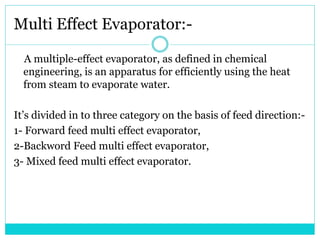
A multiple-effect evaporator, as defined in chemical
engineering, is an apparatus for efficiently using the heat
from steam to evaporate water.
It’s divided in to three category on the basis of feed direction:-
1- Forward feed multi effect evaporator,
2-Backword Feed multi effect evaporator,
3- Mixed feed multi effect evaporator.
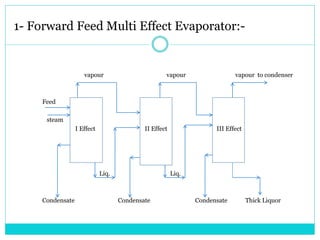
1- Forward Feed Multi Effect Evaporator:-
vapour vapour vapour to condenser
Feed
steam
I Effect II Effect III Effect
Liq. Liq.
Condensate Condensate Condensate Thick Liquor
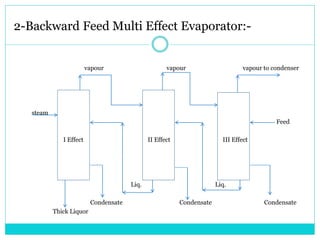
2-Backward Feed Multi Effect Evaporator:-
vapour vapour vapour to condenser
steam
Feed
I Effect II Effect III Effect
Liq. Liq.
Condensate Condensate Condensate
Thick Liquor
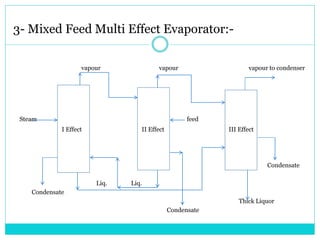
3- Mixed Feed Multi Effect Evaporator:-
vapour vapour vapour to condenser
Steam feed
I Effect II Effect III Effect
Condensate
Liq. Liq.
Condensate
Thick Liquor
Condensate
Application:-
 Product concentration,
 Solvent Volume reduction in a solution,
 Water / solvent recovery,
 Crystallization.
Advantage:-
 Advanced System,
 Easy Operation And Maintenance,
 Own Manufacturing And Quality Checked,
 Cost Effective Operations.
Reference:-
 http://www.sciencedirect.com/science/article/pii/S
0260877404001232
 http://www.lenntech.com/evaporation.htm#ixzz2cx
f14cVw
 http://www.wikipedia.com/eveporation
 “Unit Operation in Chemical Engineering”
Mc,Cabe,Smith,Harriot(7th Edition),
Multi effect evaporator

Multi effect evaporator

  • 1.
    SAMINAR TOPIC:- MULTIEFFECT EVAPORATER SEMINAR Mrs. Smita gupta COORDINATER:- Mr. S.K. Srivastava PRESENTED BY:- C.Shekhar
  • 2.
    Evaporation:-: Evaporation isthe process used to concentrate a solution by removing the solvent (mainly water) in a purified form by the application of heat. http://www.sciencedirect.com/science/article0877404001232/pii/S026 Calendria Type Evaporator
  • 3.
    Multi Effect Evaporation:- MultipleEffect Evaporation remains one of the popular methods used for the concentration of aqueous solutions. Water is removed from a solution by boiling the liquor in an evaporator and withdrawing the vapour. Evaporation occur in three steps:- 1- Pre-heating of a solution prior to evaporation, 2- Removal of water (solvent) as vapour by steam heating, 3- Condensing the vapour removed.
  • 4.
    Multi Effect Evaporator:- Amultiple-effect evaporator, as defined in chemical engineering, is an apparatus for efficiently using the heat from steam to evaporate water. It’s divided in to three category on the basis of feed direction:- 1- Forward feed multi effect evaporator, 2-Backword Feed multi effect evaporator, 3- Mixed feed multi effect evaporator.
  • 5.
    1- Forward FeedMulti Effect Evaporator:- vapour vapour vapour to condenser Feed steam I Effect II Effect III Effect Liq. Liq. Condensate Condensate Condensate Thick Liquor
  • 6.
    2-Backward Feed MultiEffect Evaporator:- vapour vapour vapour to condenser steam Feed I Effect II Effect III Effect Liq. Liq. Condensate Condensate Condensate Thick Liquor
  • 7.
    3- Mixed FeedMulti Effect Evaporator:- vapour vapour vapour to condenser Steam feed I Effect II Effect III Effect Condensate Liq. Liq. Condensate Thick Liquor Condensate
  • 8.
    Application:-  Product concentration, Solvent Volume reduction in a solution,  Water / solvent recovery,  Crystallization.
  • 9.
    Advantage:-  Advanced System, Easy Operation And Maintenance,  Own Manufacturing And Quality Checked,  Cost Effective Operations.
  • 10.
    Reference:-  http://www.sciencedirect.com/science/article/pii/S 0260877404001232  http://www.lenntech.com/evaporation.htm#ixzz2cx f14cVw http://www.wikipedia.com/eveporation  “Unit Operation in Chemical Engineering” Mc,Cabe,Smith,Harriot(7th Edition),