Domina Petric, MD
Central visual
processing
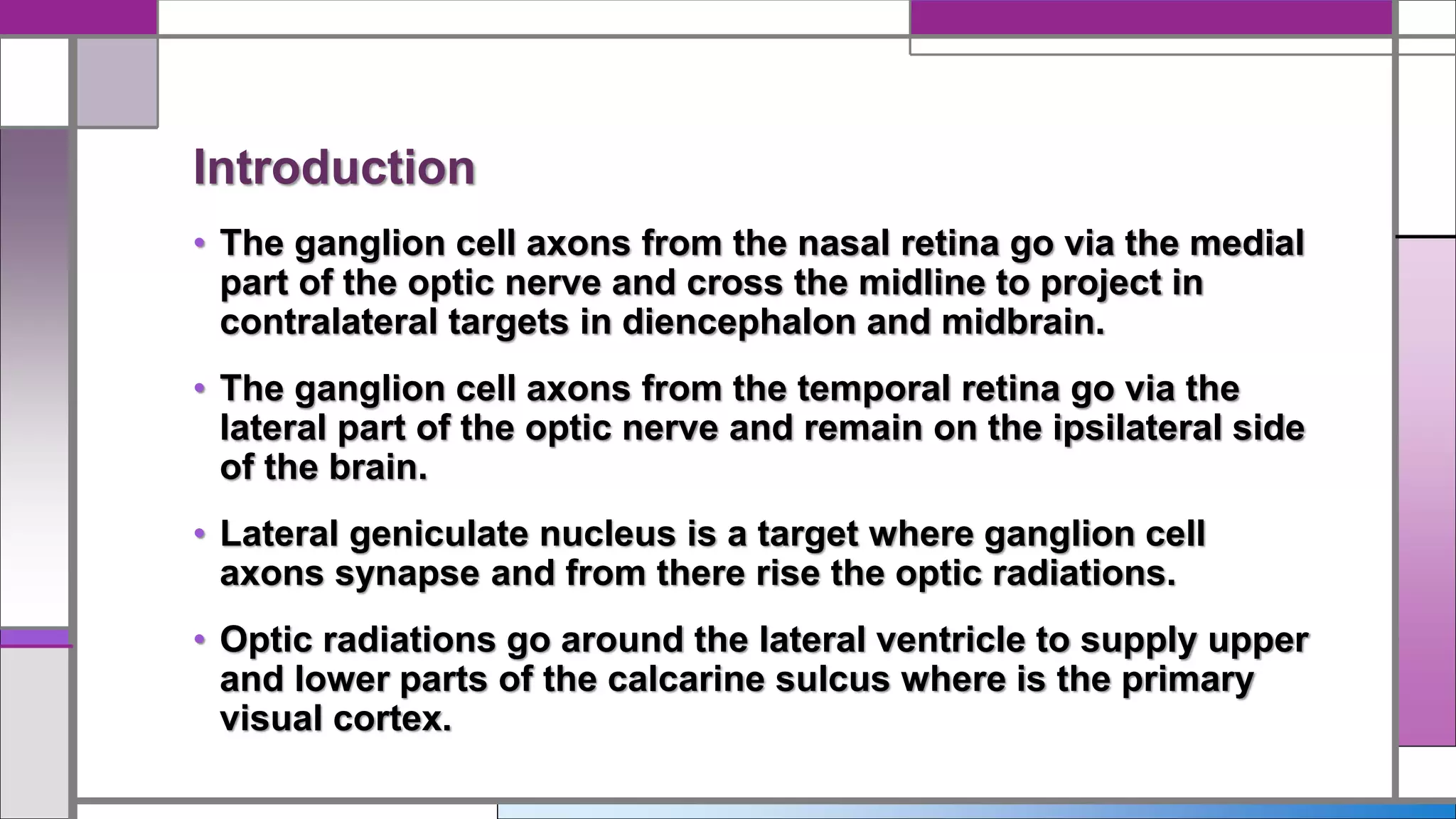
• The ganglion cell axons from the nasal retina go via the medial
part of the optic nerve and cross the midline to project in
contralateral targets in diencephalon and midbrain.
• The ganglion cell axons from the temporal retina go via the
lateral part of the optic nerve and remain on the ipsilateral side
of the brain.
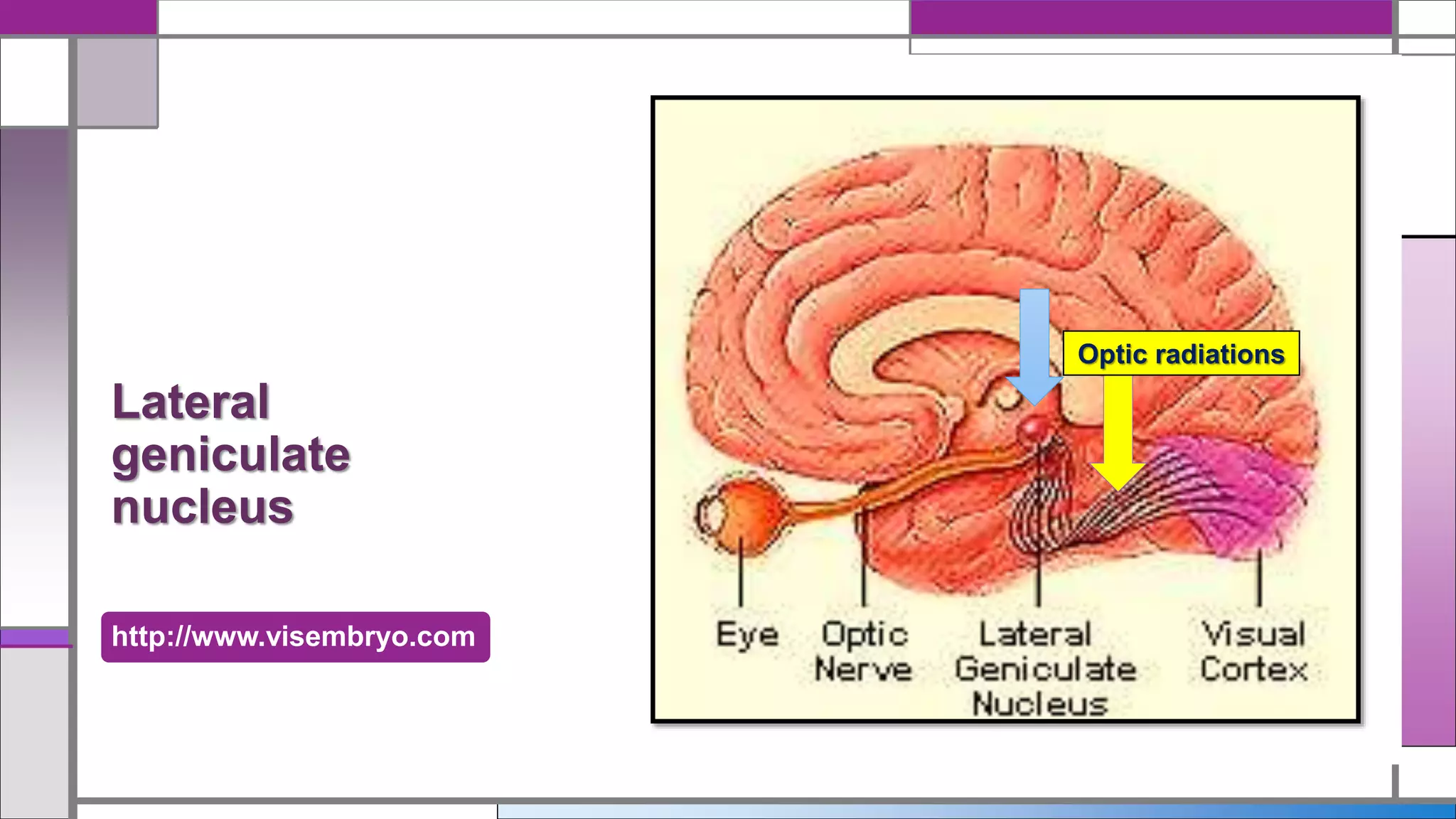
• Lateral geniculate nucleus is a target where ganglion cell
axons synapse and from there rise the optic radiations.
• Optic radiations go around the lateral ventricle to supply upper
and lower parts of the calcarine sulcus where is the primary
visual cortex.
Introduction
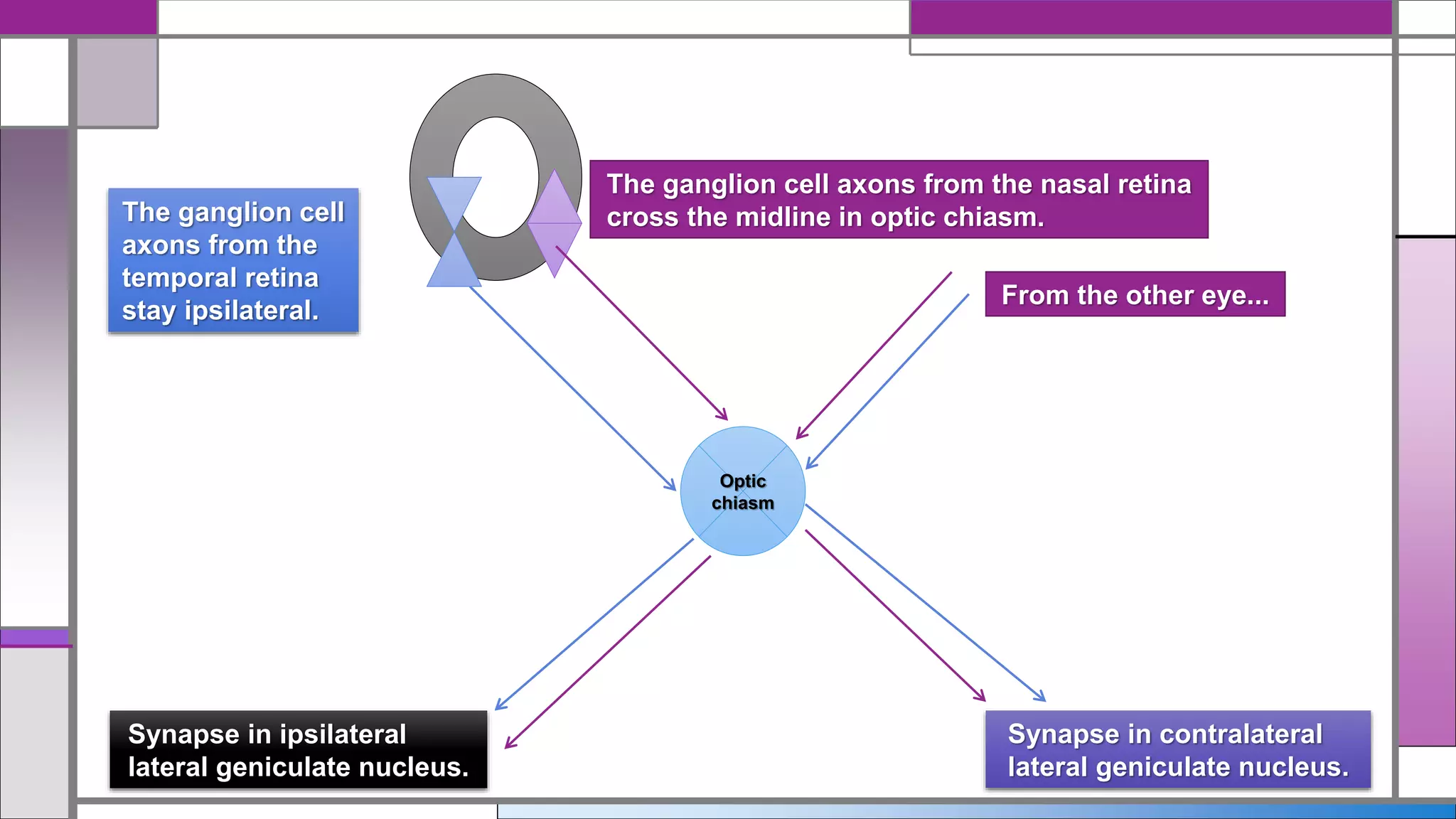
The ganglion cell axons from the nasal retina
cross the midline in optic chiasm.
Optic
chiasm
Synapse in contralateral
lateral geniculate nucleus.
The ganglion cell
axons from the
temporal retina
stay ipsilateral.
Synapse in ipsilateral
lateral geniculate nucleus.
From the other eye...
http://www.visembryo.com
Lateral
geniculate
nucleus
Optic radiations
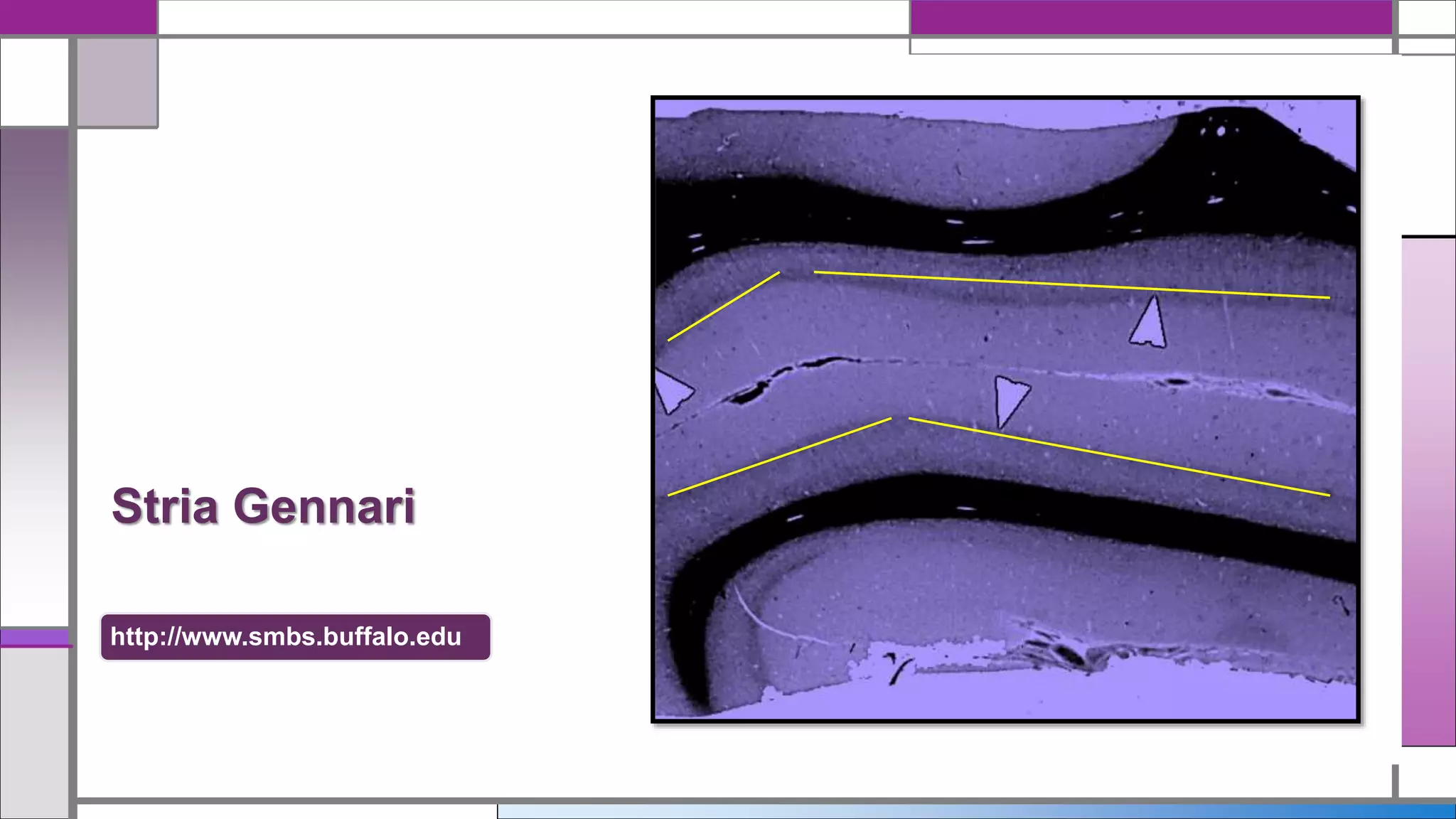
Stria of Gennari: area 17 or the striate cortex.
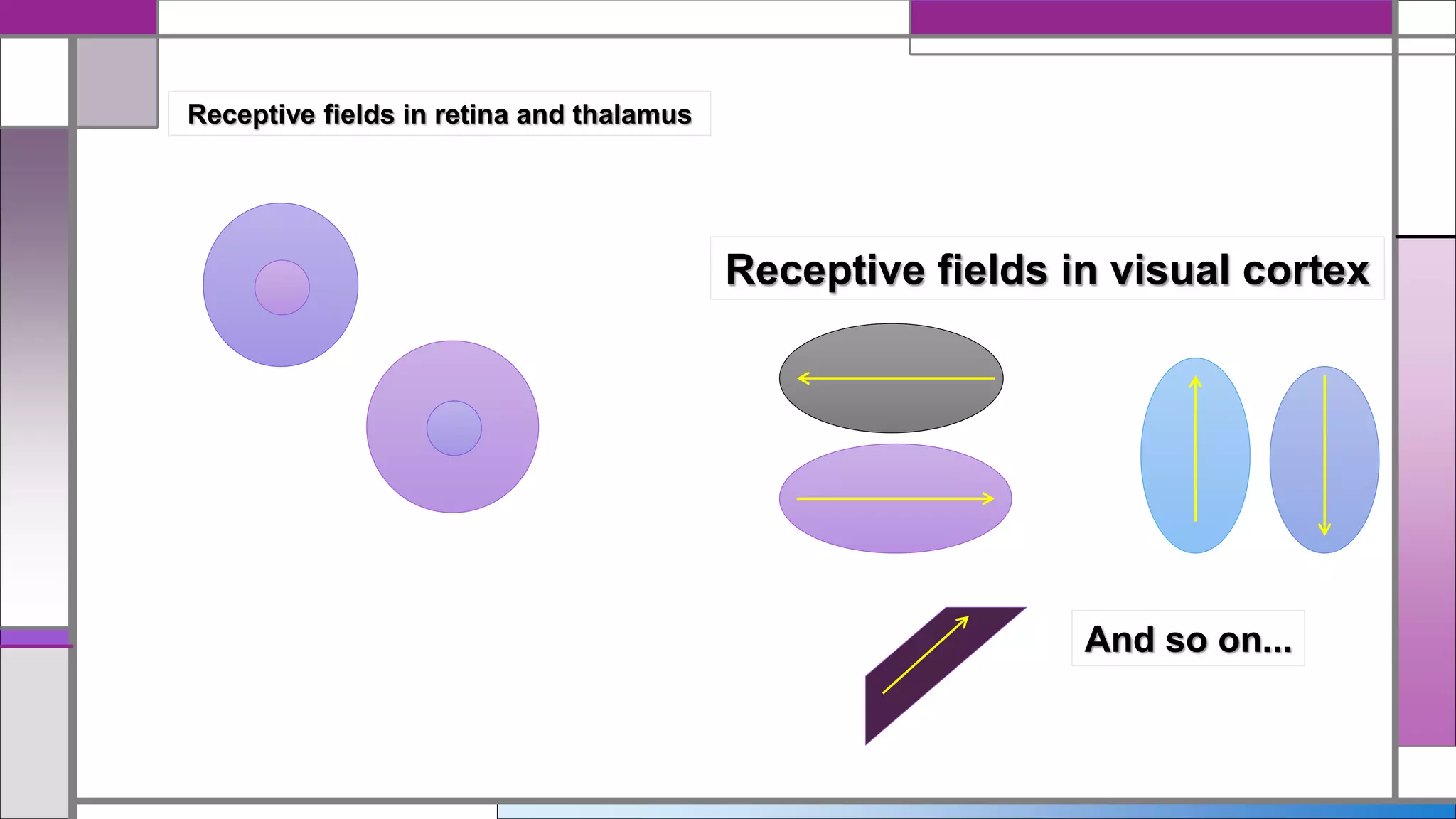
Orientation selectivity of receptive field in V1 is
preferred response to a bar of a particular orientation.
Direction selectivity of receptive field in V1 is preferred
response to a bar of a particular direction of motion.
Primary visual cortex (V1)
http://www.smbs.buffalo.edu
Stria Gennari
Receptive fields in retina and thalamus
Receptive fields in visual cortex
And so on...
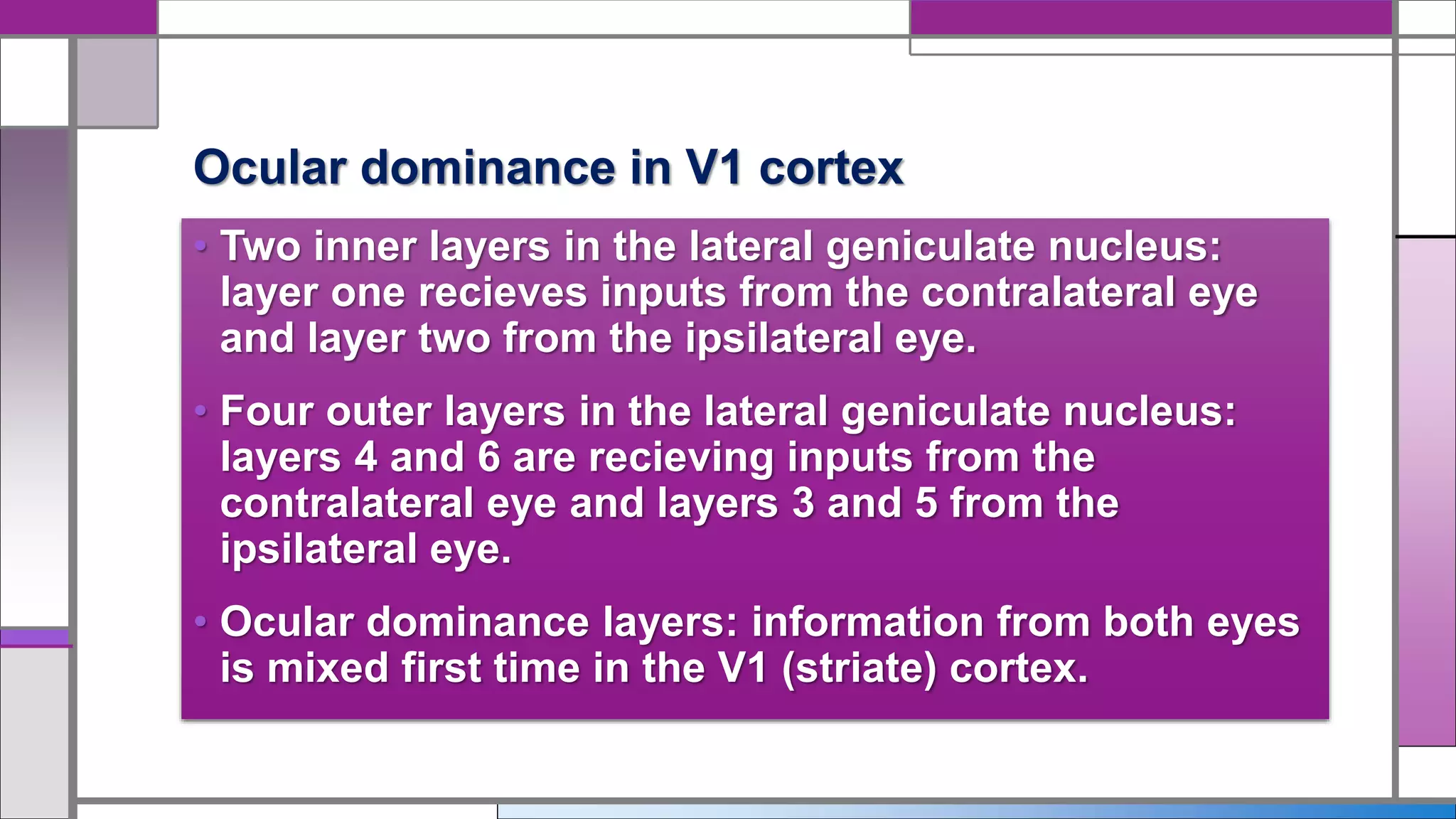
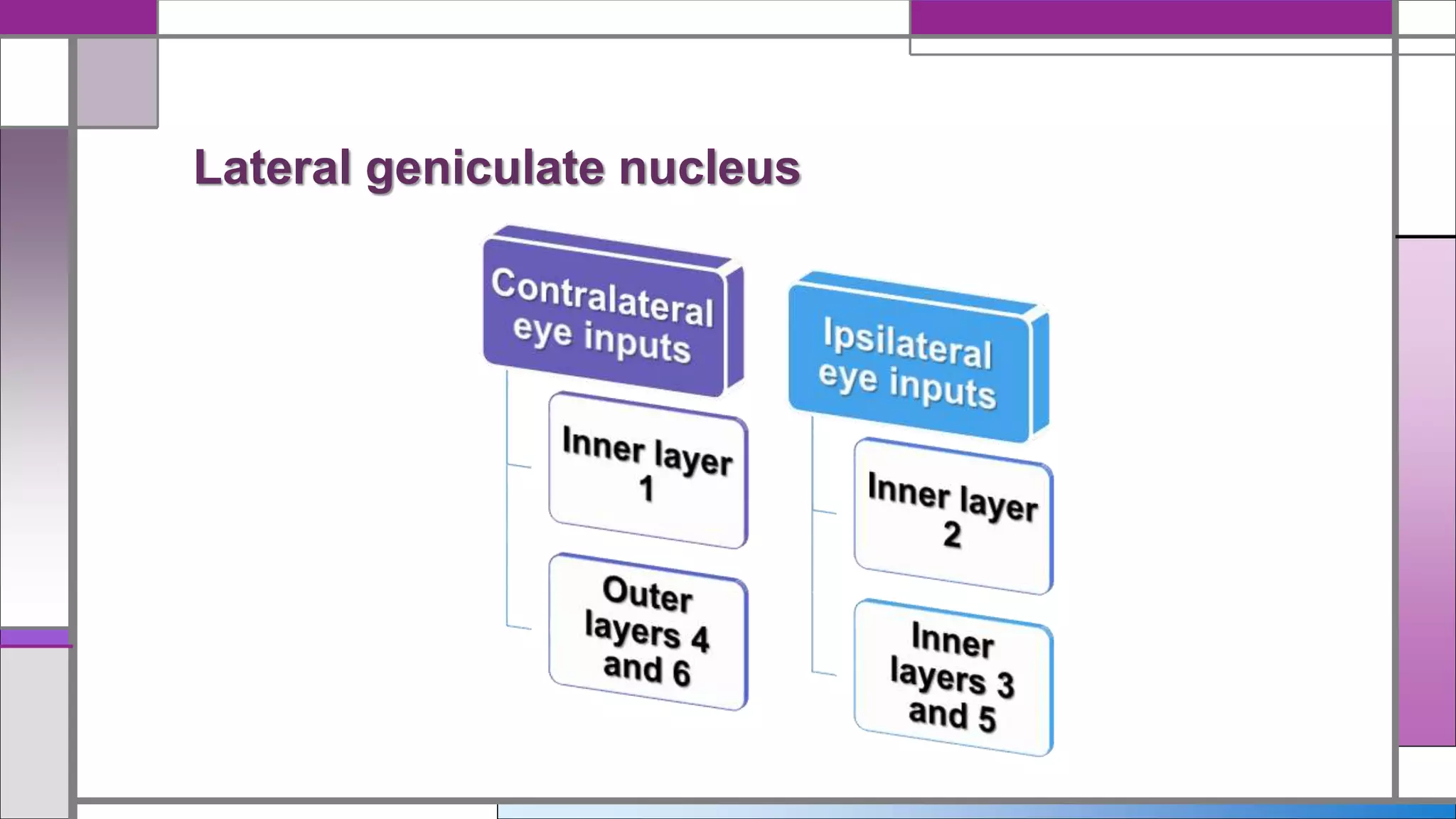
• Two inner layers in the lateral geniculate nucleus:
layer one recieves inputs from the contralateral eye
and layer two from the ipsilateral eye.
• Four outer layers in the lateral geniculate nucleus:
layers 4 and 6 are recieving inputs from the
contralateral eye and layers 3 and 5 from the
ipsilateral eye.
• Ocular dominance layers: information from both eyes
is mixed first time in the V1 (striate) cortex.
Ocular dominance in V1 cortex
Lateral geniculate nucleus
Fixation point is going to be projected
on the non corresponding areas of the
retinas.
That is the mechanism of depth
perception: near and far disparities that
project to the visual cortex.
Stereopsis
• P ganglion cell (the
smallest)
• M ganglion cell (the
largest)
• K ganglion cell (medium
size)
Types of
retinal
ganglion
cells:
Parallel pathways
Axonal projections from small P ganglion cells terminate
among small cell layers in the lateral geniculate nucleus: the
parvocellular layers (layers 3 to 6 ).
Axonal projections from large M ganglion cells terminate in
the first two layers of lateral geniculate nucleus
(magnocellular layers).
Axonal projections from K ganglion cells terminate in a zone
between the layers: koniocellular layers.
Parallel pathways
Axons from parvocellular layers synapse into the bottom part
of layer 4 in the visual cortex (4Cβ).
Axons from magnocellular layers synapse into the layer 4C .
Axons from koniocellular layers synapse into the layer 3, in
the zones rich with oxidative metabolism.
Parvocellular layers are concerned with shape and color,
magnocellular layers with broad patterns of motion.
Parallel pathways
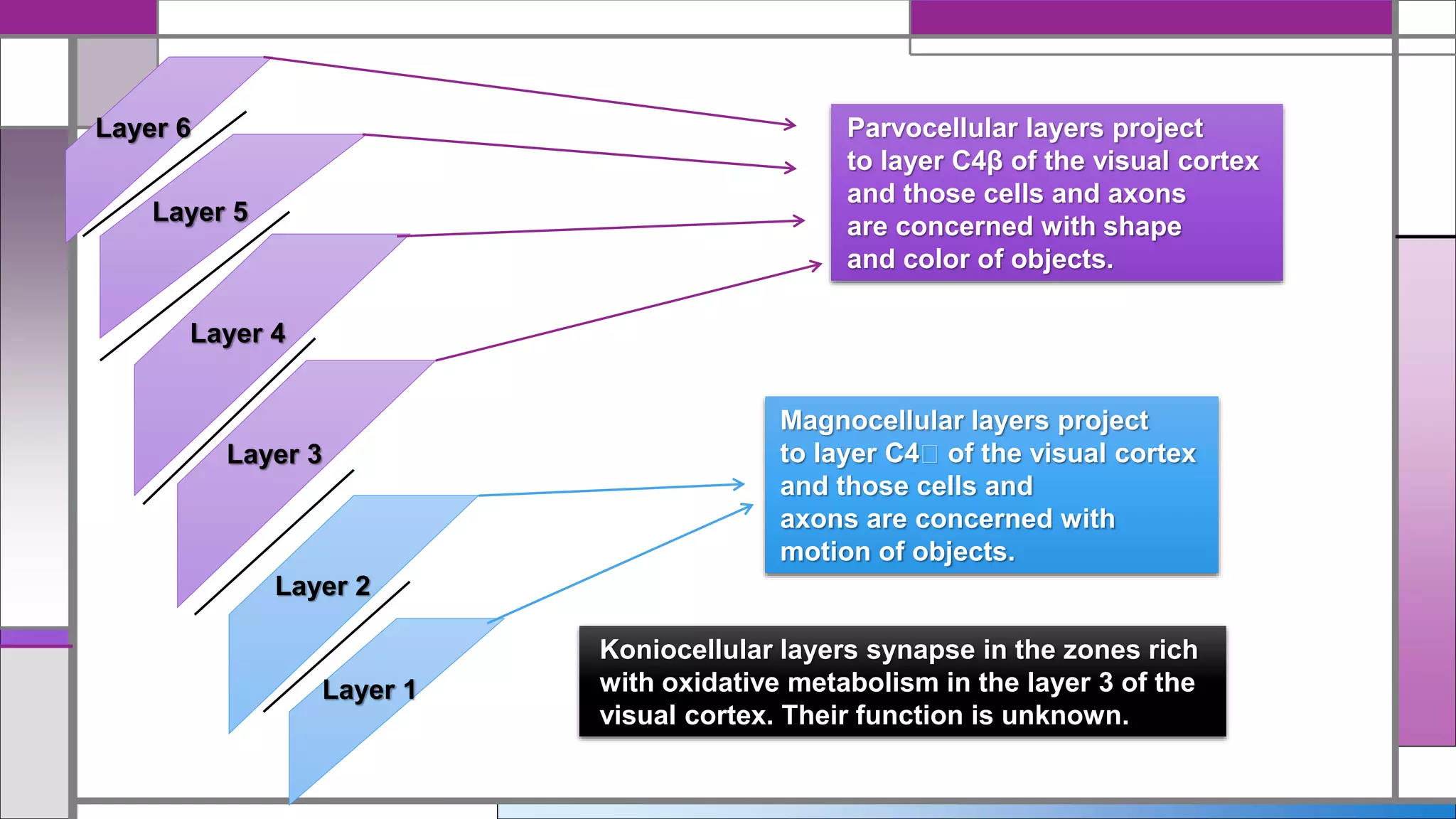
Layer 5
Layer 4
Layer 3
Layer 6
Layer 2
Layer 1
Parvocellular layers project
to layer C4β of the visual cortex
and those cells and axons
are concerned with shape
and color of objects.
Magnocellular layers project
to layer C4 of the visual cortex
and those cells and
axons are concerned with
motion of objects.
Koniocellular layers synapse in the zones rich
with oxidative metabolism in the layer 3 of the
visual cortex. Their function is unknown.
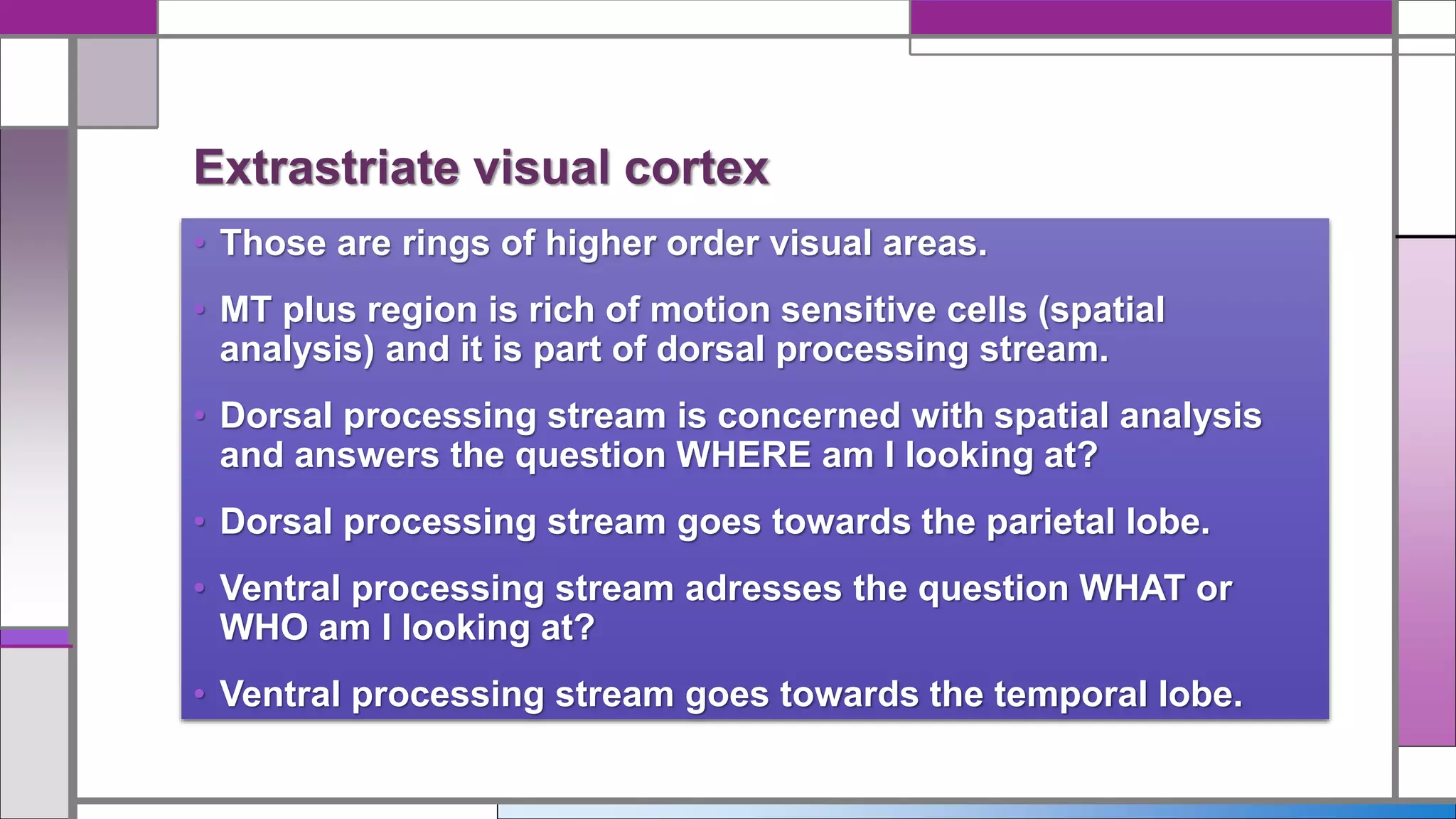
• Those are rings of higher order visual areas.
• MT plus region is rich of motion sensitive cells (spatial
analysis) and it is part of dorsal processing stream.
• Dorsal processing stream is concerned with spatial analysis
and answers the question WHERE am I looking at?
• Dorsal processing stream goes towards the parietal lobe.
• Ventral processing stream adresses the question WHAT or
WHO am I looking at?
• Ventral processing stream goes towards the temporal lobe.
Extrastriate visual cortex
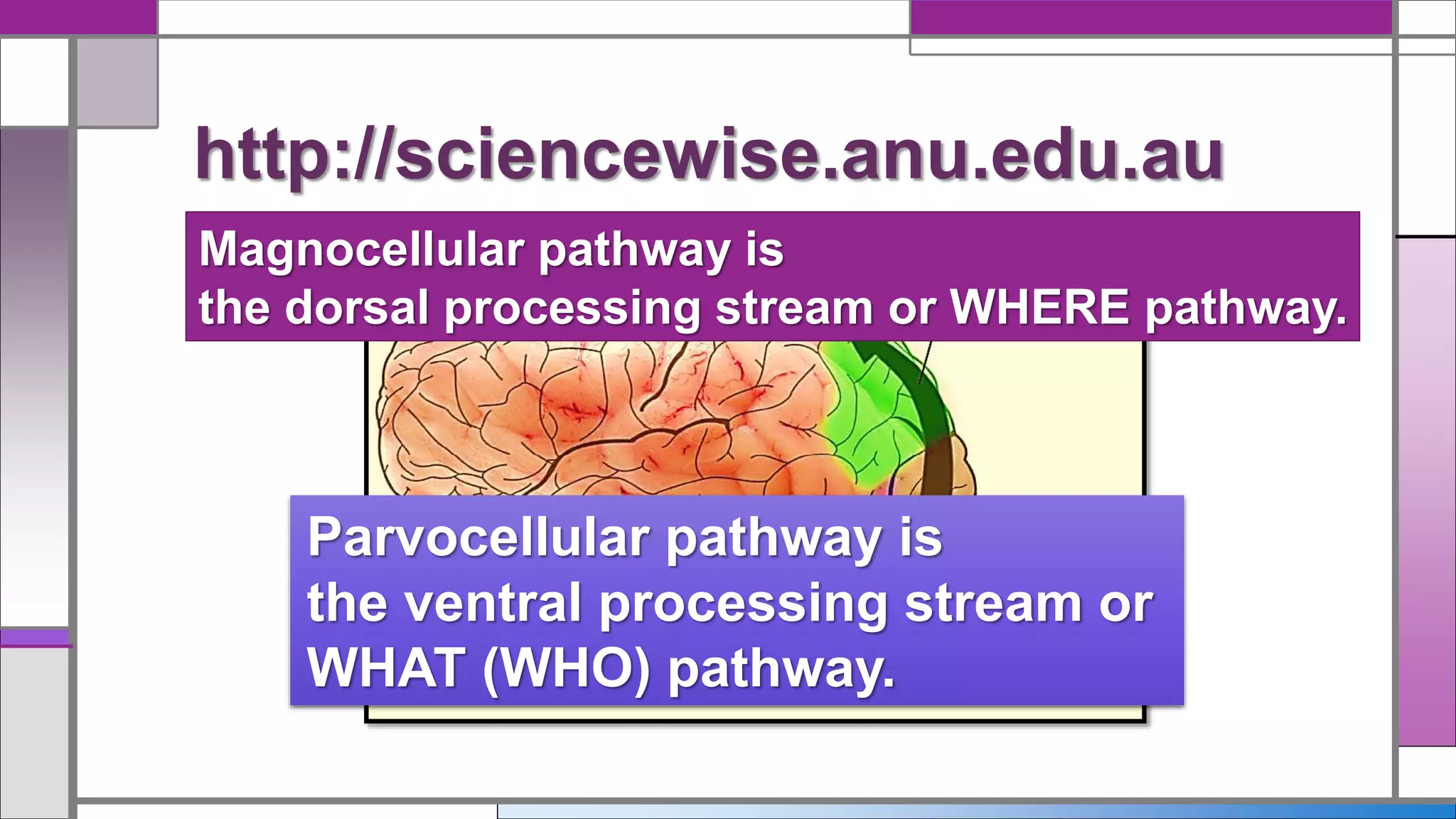
http://sciencewise.anu.edu.au
Magnocellular pathway is
the dorsal processing stream or WHERE pathway.
Parvocellular pathway is
the ventral processing stream or
WHAT (WHO) pathway.
Region of posterior occipitotemporal
gyrus is called the fusiform gyrus.
Damage of the fusiform gyrus causes
the inability to recognise faces and that
is called PROSOPAGNOSIA.
Prosopagnosia
•https://www.coursera.org/learn/medic
al-neuroscience/lecture: Leonard E.
White, PhD, Duke University
•http://www.visembryo.com
•http://www.smbs.buffalo.edu
•http://sciencewise.anu.edu.au
Literature

Central visual processing

  • 1.
    Domina Petric, MD Centralvisual processing
  • 2.
    • The ganglioncell axons from the nasal retina go via the medial part of the optic nerve and cross the midline to project in contralateral targets in diencephalon and midbrain. • The ganglion cell axons from the temporal retina go via the lateral part of the optic nerve and remain on the ipsilateral side of the brain. • Lateral geniculate nucleus is a target where ganglion cell axons synapse and from there rise the optic radiations. • Optic radiations go around the lateral ventricle to supply upper and lower parts of the calcarine sulcus where is the primary visual cortex. Introduction
  • 3.
    The ganglion cellaxons from the nasal retina cross the midline in optic chiasm. Optic chiasm Synapse in contralateral lateral geniculate nucleus. The ganglion cell axons from the temporal retina stay ipsilateral. Synapse in ipsilateral lateral geniculate nucleus. From the other eye...
  • 4.
  • 5.
    Stria of Gennari:area 17 or the striate cortex. Orientation selectivity of receptive field in V1 is preferred response to a bar of a particular orientation. Direction selectivity of receptive field in V1 is preferred response to a bar of a particular direction of motion. Primary visual cortex (V1)
  • 6.
  • 7.
    Receptive fields inretina and thalamus Receptive fields in visual cortex And so on...
  • 8.
    • Two innerlayers in the lateral geniculate nucleus: layer one recieves inputs from the contralateral eye and layer two from the ipsilateral eye. • Four outer layers in the lateral geniculate nucleus: layers 4 and 6 are recieving inputs from the contralateral eye and layers 3 and 5 from the ipsilateral eye. • Ocular dominance layers: information from both eyes is mixed first time in the V1 (striate) cortex. Ocular dominance in V1 cortex
  • 9.
  • 10.
    Fixation point isgoing to be projected on the non corresponding areas of the retinas. That is the mechanism of depth perception: near and far disparities that project to the visual cortex. Stereopsis
  • 11.
    • P ganglioncell (the smallest) • M ganglion cell (the largest) • K ganglion cell (medium size) Types of retinal ganglion cells: Parallel pathways
  • 12.
    Axonal projections fromsmall P ganglion cells terminate among small cell layers in the lateral geniculate nucleus: the parvocellular layers (layers 3 to 6 ). Axonal projections from large M ganglion cells terminate in the first two layers of lateral geniculate nucleus (magnocellular layers). Axonal projections from K ganglion cells terminate in a zone between the layers: koniocellular layers. Parallel pathways
  • 13.
    Axons from parvocellularlayers synapse into the bottom part of layer 4 in the visual cortex (4Cβ). Axons from magnocellular layers synapse into the layer 4C . Axons from koniocellular layers synapse into the layer 3, in the zones rich with oxidative metabolism. Parvocellular layers are concerned with shape and color, magnocellular layers with broad patterns of motion. Parallel pathways
  • 14.
    Layer 5 Layer 4 Layer3 Layer 6 Layer 2 Layer 1 Parvocellular layers project to layer C4β of the visual cortex and those cells and axons are concerned with shape and color of objects. Magnocellular layers project to layer C4 of the visual cortex and those cells and axons are concerned with motion of objects. Koniocellular layers synapse in the zones rich with oxidative metabolism in the layer 3 of the visual cortex. Their function is unknown.
  • 15.
    • Those arerings of higher order visual areas. • MT plus region is rich of motion sensitive cells (spatial analysis) and it is part of dorsal processing stream. • Dorsal processing stream is concerned with spatial analysis and answers the question WHERE am I looking at? • Dorsal processing stream goes towards the parietal lobe. • Ventral processing stream adresses the question WHAT or WHO am I looking at? • Ventral processing stream goes towards the temporal lobe. Extrastriate visual cortex
  • 16.
    http://sciencewise.anu.edu.au Magnocellular pathway is thedorsal processing stream or WHERE pathway. Parvocellular pathway is the ventral processing stream or WHAT (WHO) pathway.
  • 17.
    Region of posterioroccipitotemporal gyrus is called the fusiform gyrus. Damage of the fusiform gyrus causes the inability to recognise faces and that is called PROSOPAGNOSIA. Prosopagnosia
  • 18.
    •https://www.coursera.org/learn/medic al-neuroscience/lecture: Leonard E. White,PhD, Duke University •http://www.visembryo.com •http://www.smbs.buffalo.edu •http://sciencewise.anu.edu.au Literature