Dr. Maliha Nawar
Resident, Phase-A(year-1)
Community Ophthalmology
BSMMU
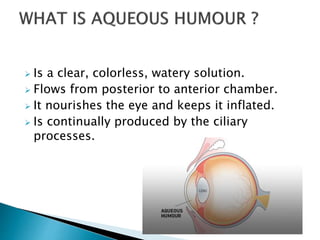
 Is a clear, colorless, watery solution.
 Flows from posterior to anterior chamber.
 It nourishes the eye and keeps it inflated.
 Is continually produced by the ciliary
processes.
•Volume of aqueous humour is about 0.31 ml
a) 0.25ml in anterior chamber
b) 0.06ml in posterior chamber
•Refractive index 1.336.
•Slightly acidic with a pH in the anterior
chamber of 7.2
•Normal production rate is 2.0-2.5µl/ min.
•Slightly Hyper osmotic to plasma by 3-5
mOsml/L.
• Water: Constitutes of about 99.9%.
• Solid: 0.1%
• ( Proteins: 5-16mg/100ml
• Amino acids: aqueous/plasma concentration varies from
0.08-3.14
• Non colloidal constituents: conc. Of ascorbate, pyruvate,
lactate in higher amount while urea and glucose are
much less.
• Inulin and steroid
• Prostaglandins
• Cyclic AMP)
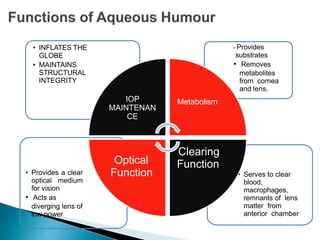
• Serves to clear
blood,
macrophages,
remnants of lens
matter from
anterior chamber
• Provides a clear
optical medium
for vision
• Acts as
diverging lens of
low power
• Provides
substrates
• Removes
metabolites
from cornea
and lens.
• INFLATES THE
GLOBE
• MAINTAINS
STRUCTURAL
INTEGRITY
IOP
MAINTENAN
CE
Metabolism
Clearing
FunctionOptical
Function
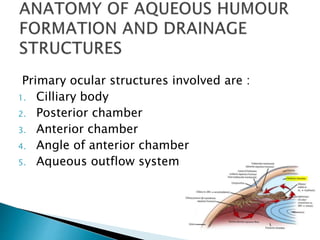
Primary ocular structures involved are :
1. Cilliary body
2. Posterior chamber
3. Anterior chamber
4. Angle of anterior chamber
5. Aqueous outflow system
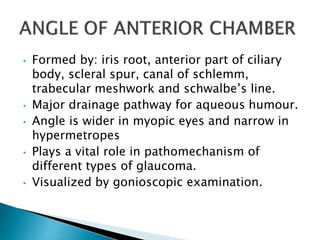
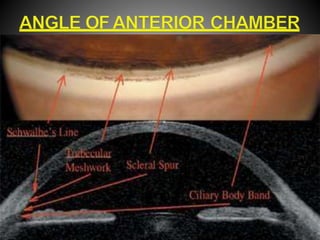
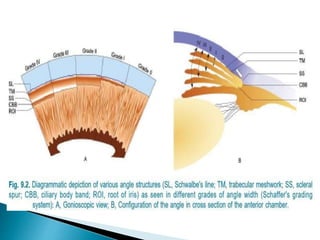
• Formed by: iris root, anterior part of ciliary
body, scleral spur, canal of schlemm,
trabecular meshwork and schwalbe’s line.
• Major drainage pathway for aqueous humour.
• Angle is wider in myopic eyes and narrow in
hypermetropes
• Plays a vital role in pathomechanism of
different types of glaucoma.
• Visualized by gonioscopic examination.
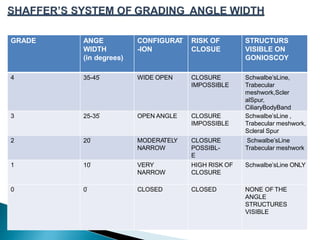
GRADE ANGE
WIDTH
(in degrees)
CONFIGURAT
-ION
RISK OF
CLOSUE
STRUCTURS
VISIBLE ON
GONIOSCOY
4 35-45֯ WIDE OPEN CLOSURE
IMPOSSIBLE
Schwalbe’sLine,
Trabecular
meshwork,Scler
alSpur,
CiliaryBodyBand
3 25-35֯ OPEN ANGLE CLOSURE
IMPOSSIBLE
Schwalbe’sLine ,
Trabecular meshwork,
Scleral Spur
2 20֯ MODERATELY
NARROW
CLOSURE
POSSIBL-
E
Schwalbe’sLine
Trabecular meshwork
1 10֯ VERY
NARROW
HIGH RISK OF
CLOSURE
Schwalbe’sLine ONLY
0 0֯ CLOSED CLOSED NONE OF THE
ANGLE
STRUCTURES
VISIBLE
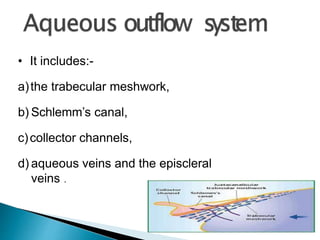
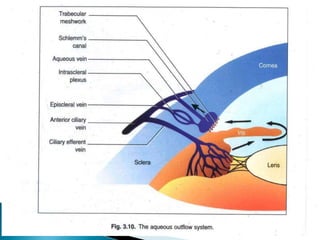
• It includes:-
a)the trabecular meshwork,
b) Schlemm’s canal,
c)collector channels,
d) aqueous veins and the episcleral
veins .
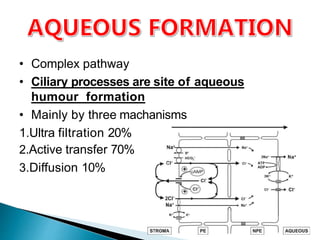
• Complex pathway
• Ciliary processes are site of aqueous
humour formation
• Mainly by three machanisms
1.Ultra filtration 20%
2.Active transfer 70%
3.Diffusion 10%
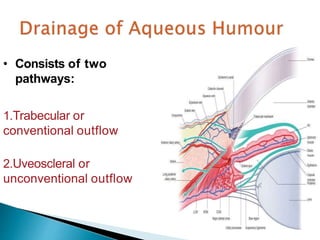
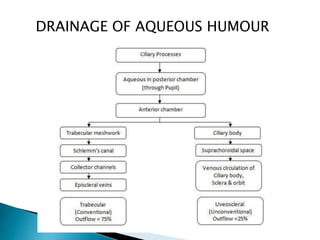
• Consists of two
pathways:
1.Trabecular or
conventional outflow
2.Uveoscleral or
unconventional outflow
DRAINAGE OF AQUEOUS HUMOUR
Aqueous humor dynamics(at a glance)

Aqueous humor dynamics(at a glance)

  • 1.
    Dr. Maliha Nawar Resident,Phase-A(year-1) Community Ophthalmology BSMMU
  • 2.
     Is aclear, colorless, watery solution.  Flows from posterior to anterior chamber.  It nourishes the eye and keeps it inflated.  Is continually produced by the ciliary processes.
  • 3.
    •Volume of aqueoushumour is about 0.31 ml a) 0.25ml in anterior chamber b) 0.06ml in posterior chamber •Refractive index 1.336. •Slightly acidic with a pH in the anterior chamber of 7.2 •Normal production rate is 2.0-2.5µl/ min. •Slightly Hyper osmotic to plasma by 3-5 mOsml/L.
  • 4.
    • Water: Constitutesof about 99.9%. • Solid: 0.1% • ( Proteins: 5-16mg/100ml • Amino acids: aqueous/plasma concentration varies from 0.08-3.14 • Non colloidal constituents: conc. Of ascorbate, pyruvate, lactate in higher amount while urea and glucose are much less. • Inulin and steroid • Prostaglandins • Cyclic AMP)
  • 5.
    • Serves toclear blood, macrophages, remnants of lens matter from anterior chamber • Provides a clear optical medium for vision • Acts as diverging lens of low power • Provides substrates • Removes metabolites from cornea and lens. • INFLATES THE GLOBE • MAINTAINS STRUCTURAL INTEGRITY IOP MAINTENAN CE Metabolism Clearing FunctionOptical Function
  • 6.
    Primary ocular structuresinvolved are : 1. Cilliary body 2. Posterior chamber 3. Anterior chamber 4. Angle of anterior chamber 5. Aqueous outflow system
  • 8.
    • Formed by:iris root, anterior part of ciliary body, scleral spur, canal of schlemm, trabecular meshwork and schwalbe’s line. • Major drainage pathway for aqueous humour. • Angle is wider in myopic eyes and narrow in hypermetropes • Plays a vital role in pathomechanism of different types of glaucoma. • Visualized by gonioscopic examination.
  • 10.
    GRADE ANGE WIDTH (in degrees) CONFIGURAT -ION RISKOF CLOSUE STRUCTURS VISIBLE ON GONIOSCOY 4 35-45֯ WIDE OPEN CLOSURE IMPOSSIBLE Schwalbe’sLine, Trabecular meshwork,Scler alSpur, CiliaryBodyBand 3 25-35֯ OPEN ANGLE CLOSURE IMPOSSIBLE Schwalbe’sLine , Trabecular meshwork, Scleral Spur 2 20֯ MODERATELY NARROW CLOSURE POSSIBL- E Schwalbe’sLine Trabecular meshwork 1 10֯ VERY NARROW HIGH RISK OF CLOSURE Schwalbe’sLine ONLY 0 0֯ CLOSED CLOSED NONE OF THE ANGLE STRUCTURES VISIBLE
  • 12.
    • It includes:- a)thetrabecular meshwork, b) Schlemm’s canal, c)collector channels, d) aqueous veins and the episcleral veins .
  • 13.
    • Complex pathway •Ciliary processes are site of aqueous humour formation • Mainly by three machanisms 1.Ultra filtration 20% 2.Active transfer 70% 3.Diffusion 10%
  • 14.
    • Consists oftwo pathways: 1.Trabecular or conventional outflow 2.Uveoscleral or unconventional outflow
  • 15.