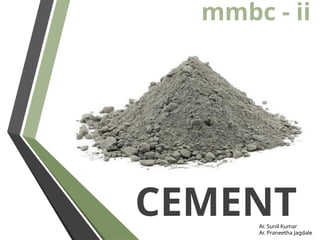
CEMENT
mmbc - ii
Ar. Sunil Kumar
Ar. Praneetha Jagdale
Table of Contents
• Introduction
• Raw materials of cement
• Manufacturing of cement
• Characteristics of cement
• Types of cement and their Properties
• Grades of cement
• Function of cement
• Setting
• Ratio of mixture
• Storage of cement
• Tests
• Uses of cement
• Conclusion
Introduction
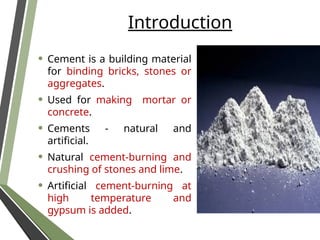
• Cement is a building material
for binding bricks, stones or
aggregates.
• Used for making mortar or
concrete.
• Cements - natural and
artificial.
• Natural cement-burning and
crushing of stones and lime.
• Artificial cement-burning at
high temperature and
gypsum is added.
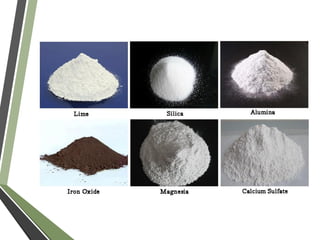
• Lime- excess will decrease the strength.
Deficiency will make it set quickly.
• Silica- higher silica increases the strength
but setting time is prolonged.
• Alumina- results in quick setting. Excess
alumina weakens cement.
• Iron oxide- for hardness and strength.
• Magnesia- hardness and colour.
• Calcium sulfate is mainly from gypsum
and has an effect of slowing down the
solidification speed.
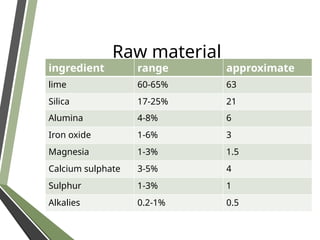
Raw material
ingredient range approximate
lime 60-65% 63
Silica 17-25% 21
Alumina 4-8% 6
Iron oxide 1-6% 3
Magnesia 1-3% 1.5
Calcium sulphate 3-5% 4
Sulphur 1-3% 1
Alkalies 0.2-1% 0.5
Manufacturing Of Cement
• Mixing of raw material(wet or dry)
• Burning
• Grinding
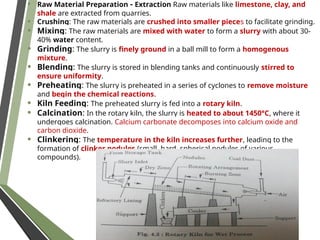
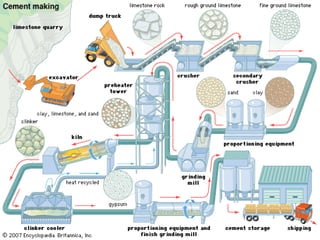
• Raw Material Preparation - Extraction Raw materials like limestone, clay, and
shale are extracted from quarries.
• Crushing: The raw materials are crushed into smaller pieces to facilitate grinding.
• Mixing: The raw materials are mixed with water to form a slurry with about 30-
40% water content.
• Grinding: The slurry is finely ground in a ball mill to form a homogenous
mixture.
• Blending: The slurry is stored in blending tanks and continuously stirred to
ensure uniformity.
• Preheating: The slurry is preheated in a series of cyclones to remove moisture
and begin the chemical reactions.
• Kiln Feeding: The preheated slurry is fed into a rotary kiln.
• Calcination: In the rotary kiln, the slurry is heated to about 1450°C, where it
undergoes calcination. Calcium carbonate decomposes into calcium oxide and
carbon dioxide.
• Clinkering: The temperature in the kiln increases further, leading to the
formation of clinker nodules (small, hard, spherical nodules of various
compounds).
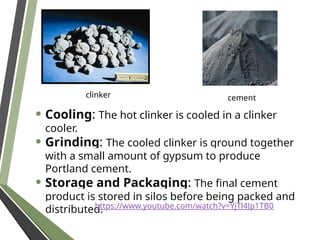
clinker
• Cooling: The hot clinker is cooled in a clinker
cooler.
• Grinding: The cooled clinker is ground together
with a small amount of gypsum to produce
Portland cement.
• Storage and Packaging: The final cement
product is stored in silos before being packed and
distributed.
cement
https://www.youtube.com/watch?v=YjTl4Jp1TB0
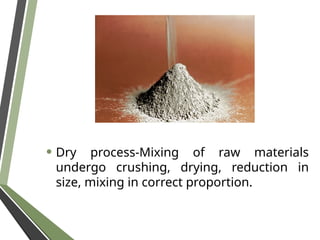
• Dry process-Mixing of raw materials
undergo crushing, drying, reduction in
size, mixing in correct proportion.
• The dry process of cement manufacturing involves the following steps:
• Raw Material Preparation: Raw materials (limestone, clay, and other
components) are mined and transported to the cement plant.
• Crushing: The raw materials are crushed into smaller sizes using crushers.
• Mixing and Pre-homogenization: The crushed materials are mixed and
stored in silos to achieve a uniform chemical composition.
• Drying and Grinding: The raw materials are dried and ground into a fine
powder in a raw mill.
• Homogenization: The powdered raw materials are homogenized in blending
silos to ensure a consistent mix.
• Preheating: The homogenized raw meal is preheated in a series of cyclones to
begin the chemical reactions and remove moisture.
• Pre-calcination: In the pre-calciner, the material is further heated, and
calcination begins, transforming calcium carbonate into calcium oxide and
releasing CO2.
• Kiln Feeding: The preheated and pre-calcined raw meal is fed into a rotary
kiln.
• Calcination and Clinkering: Inside the rotary kiln, the material is heated to
about 1450°C, where it undergoes complete calcination and forms clinker
nodules through chemical reactions.
• Cooling: The hot clinker is cooled rapidly in a clinker cooler to stabilize its
structure and make it easier to handle.
• Grinding: The cooled clinker is ground with a small amount of gypsum in a
cement mill to produce cement.
• Storage and Packaging: The finished cement is stored in silos and then
packed in bags or transported in bulk for distribution.
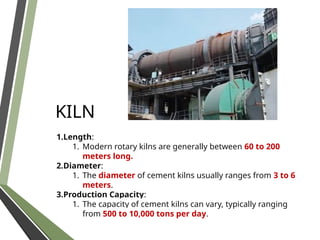
KILN
1.Length:
1. Modern rotary kilns are generally between 60 to 200
meters long.
2.Diameter:
1. The diameter of cement kilns usually ranges from 3 to 6
meters.
3.Production Capacity:
1. The capacity of cement kilns can vary, typically ranging
from 500 to 10,000 tons per day.
Characteristics
Fineness: The fineness of cement particles affects
the rate of hydration and strength development.
Finer cement reacts faster with water.
Setting Time: Cement should have a specific
initial and final setting time. Initial setting time
should be enough for mixing, transporting, and
placing. Final setting time is the time taken to
completely harden.
Soundness: Soundness ensures that the cement
does not undergo excessive expansion after
setting, which could lead to cracking.
Strength: Cement should develop sufficient
strength in compression, tension, and flexure. The
compressive strength of cement is most
commonly measured.
Characteristics
Consistency: Refers to the ability of cement paste
to flow. Standard consistency is determined using a
Vicat apparatus.
Durability: Cement should contribute to the
durability of concrete, resisting chemical attacks,
weathering, and wear over time.
Workability: Cement should impart good
workability to the concrete or mortar, making it
easy to mix, place, and finish.
Alkali Content: Lower alkali content in cement
reduces the risk of expansion and cracking.
Color: Uniformity in color is essential for aesthetic
purposes in architectural concrete.
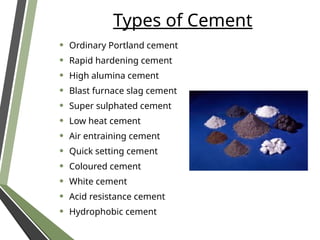
Types of Cement
• Ordinary Portland cement
• Rapid hardening cement
• High alumina cement
• Blast furnace slag cement
• Super sulphated cement
• Low heat cement
• Air entraining cement
• Quick setting cement
• Coloured cement
• White cement
• Acid resistance cement
• Hydrophobic cement
• Ordinary portland cement
• Most commonly used cement
• Moderate strength
• Mainly used in pavements and buildings.
• Normal setting time.(initial setting 30mins, final setting
8hrs, hardening in 3days)
• Rapid hardening cement
• hardens in 1 day.
• Stronger than OPC
• Light weight, extra fine
• Mainly used in highways, under water structures and in
cold weather areas.
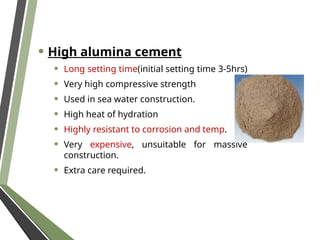
• High alumina cement
• Long setting time(initial setting time 3-5hrs)
• Very high compressive strength
• Used in sea water construction.
• High heat of hydration
• Highly resistant to corrosion and temp.
• Very expensive, unsuitable for massive
construction.
• Extra care required.
• Blast furnace slag cement
• Low heat of hydration
• Not suitable for dry acid zones
• Less strength than other cement, need longer curing
period.
• cheap
• Quick setting cement
• Higher aluminium sulphate content.
• Sets in 5mins and final setting 30mins.
• Extra care required, hardens very quickly
• Used in running water
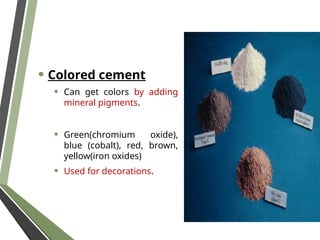
• Colored cement
• Can get colors by adding
mineral pigments.
• Green(chromium oxide),
blue (cobalt), red, brown,
yellow(iron oxides)
• Used for decorations.
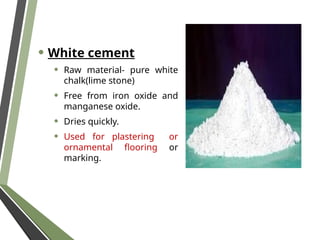
• White cement
• Raw material- pure white
chalk(lime stone)
• Free from iron oxide and
manganese oxide.
• Dries quickly.
• Used for plastering or
ornamental flooring or
marking.
Grades of Cement
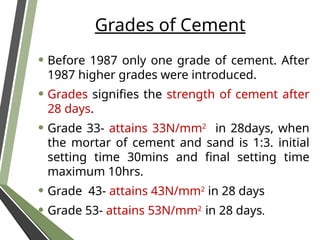
• Before 1987 only one grade of cement. After
1987 higher grades were introduced.
• Grades signifies the strength of cement after
28 days.
• Grade 33- attains 33N/mm2
in 28days, when
the mortar of cement and sand is 1:3. initial
setting time 30mins and final setting time
maximum 10hrs.
• Grade 43- attains 43N/mm2
in 28 days
• Grade 53- attains 53N/mm2
in 28 days.
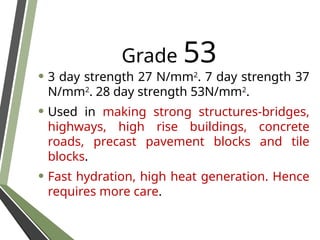
Grade 53
• 3 day strength 27 N/mm2
. 7 day strength 37
N/mm2
. 28 day strength 53N/mm2
.
• Used in making strong structures-bridges,
highways, high rise buildings, concrete
roads, precast pavement blocks and tile
blocks.
• Fast hydration, high heat generation. Hence
requires more care.
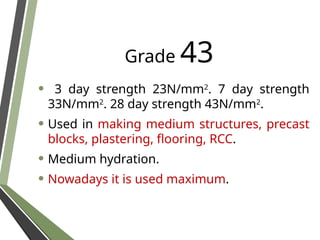
Grade 43
• 3 day strength 23N/mm2
. 7 day strength
33N/mm2
. 28 day strength 43N/mm2
.
• Used in making medium structures, precast
blocks, plastering, flooring, RCC.
• Medium hydration.
• Nowadays it is used maximum.
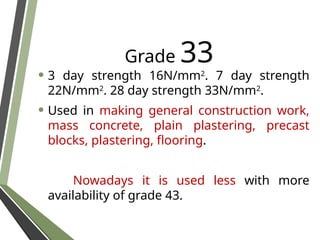
Grade 33
• 3 day strength 16N/mm2
. 7 day strength
22N/mm2
. 28 day strength 33N/mm2
.
• Used in making general construction work,
mass concrete, plain plastering, precast
blocks, plastering, flooring.
Nowadays it is used less with more
availability of grade 43.
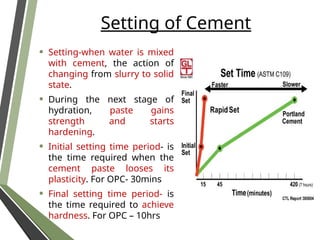
Setting of Cement
• Setting-when water is mixed
with cement, the action of
changing from slurry to solid
state.
• During the next stage of
hydration, paste gains
strength and starts
hardening.
• Initial setting time period- is
the time required when the
cement paste looses its
plasticity. For OPC- 30mins
• Final setting time period- is
the time required to achieve
hardness. For OPC – 10hrs
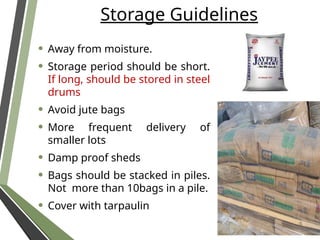
Storage Guidelines
• Away from moisture.
• Storage period should be short.
If long, should be stored in steel
drums
• Avoid jute bags
• More frequent delivery of
smaller lots
• Damp proof sheds
• Bags should be stacked in piles.
Not more than 10bags in a pile.
• Cover with tarpaulin
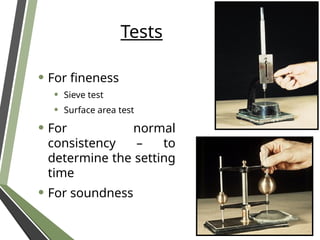
Tests
• For fineness
• Sieve test
• Surface area test
• For normal
consistency – to
determine the setting
time
• For soundness
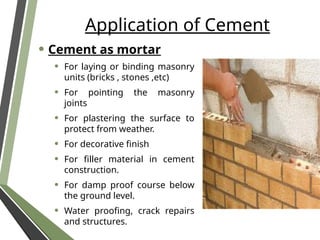
Application of Cement
• Cement as mortar
• For laying or binding masonry
units (bricks , stones ,etc)
• For pointing the masonry
joints
• For plastering the surface to
protect from weather.
• For decorative finish
• For filler material in cement
construction.
• For damp proof course below
the ground level.
• Water proofing, crack repairs
and structures.
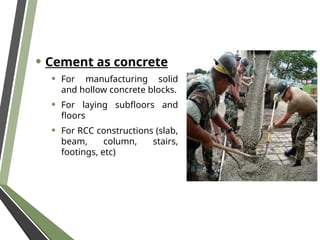
• Cement as concrete
• For manufacturing solid
and hollow concrete blocks.
• For laying subfloors and
floors
• For RCC constructions (slab,
beam, column, stairs,
footings, etc)
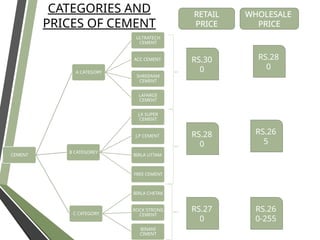
CEMENT
A CATEGORY
ULTRATECH
CEMENT
ACC CEMENT
SHREERAM
CEMENT
LAFARGE
CEMENT
B CATEGOREY
J.K SUPER
CEMENT
J.P CEMENT
BIRLA UTTAM
FREE CEMENT
C CATEGORY
BIRLA CHETAK
ROCK STRONG
CEMENT
BINANI
CIMENT
RETAIL
PRICE
WHOLESALE
PRICE
RS.28
0
RS.30
0
RS.26
5
RS.28
0
RS.26
0-255
RS.27
0
CATEGORIES AND
PRICES OF CEMENT
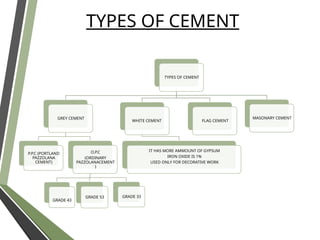
TYPES OF CEMENT
GREY CEMENT
P.P.C (PORTLAND
PAZZOLANA
CEMENT)
O.P.C
(ORDINARY
PAZZOLANACEMENT
)
GRADE 43
GRADE 53 GRADE 33
WHITE CEMENT
IT HAS MORE AMMOUNT OF GYPSUM
IRON OXIDE IS 1%
USED ONLY FOR DECORATIVE WORK
FLAG CEMENT
MASONARY CEMENT
TYPES OF CEMENT
THANK YOU

CEMENT - MMBC II.pptx, architecture, use

  • 1.
    CEMENT mmbc - ii Ar.Sunil Kumar Ar. Praneetha Jagdale
  • 2.
    Table of Contents •Introduction • Raw materials of cement • Manufacturing of cement • Characteristics of cement • Types of cement and their Properties • Grades of cement • Function of cement • Setting • Ratio of mixture • Storage of cement • Tests • Uses of cement • Conclusion
  • 3.
    Introduction • Cement isa building material for binding bricks, stones or aggregates. • Used for making mortar or concrete. • Cements - natural and artificial. • Natural cement-burning and crushing of stones and lime. • Artificial cement-burning at high temperature and gypsum is added.
  • 4.
    • Lime- excesswill decrease the strength. Deficiency will make it set quickly. • Silica- higher silica increases the strength but setting time is prolonged. • Alumina- results in quick setting. Excess alumina weakens cement. • Iron oxide- for hardness and strength. • Magnesia- hardness and colour. • Calcium sulfate is mainly from gypsum and has an effect of slowing down the solidification speed.
  • 6.
    Raw material ingredient rangeapproximate lime 60-65% 63 Silica 17-25% 21 Alumina 4-8% 6 Iron oxide 1-6% 3 Magnesia 1-3% 1.5 Calcium sulphate 3-5% 4 Sulphur 1-3% 1 Alkalies 0.2-1% 0.5
  • 7.
    Manufacturing Of Cement •Mixing of raw material(wet or dry) • Burning • Grinding
  • 8.
    • Raw MaterialPreparation - Extraction Raw materials like limestone, clay, and shale are extracted from quarries. • Crushing: The raw materials are crushed into smaller pieces to facilitate grinding. • Mixing: The raw materials are mixed with water to form a slurry with about 30- 40% water content. • Grinding: The slurry is finely ground in a ball mill to form a homogenous mixture. • Blending: The slurry is stored in blending tanks and continuously stirred to ensure uniformity. • Preheating: The slurry is preheated in a series of cyclones to remove moisture and begin the chemical reactions. • Kiln Feeding: The preheated slurry is fed into a rotary kiln. • Calcination: In the rotary kiln, the slurry is heated to about 1450°C, where it undergoes calcination. Calcium carbonate decomposes into calcium oxide and carbon dioxide. • Clinkering: The temperature in the kiln increases further, leading to the formation of clinker nodules (small, hard, spherical nodules of various compounds).
  • 9.
    clinker • Cooling: Thehot clinker is cooled in a clinker cooler. • Grinding: The cooled clinker is ground together with a small amount of gypsum to produce Portland cement. • Storage and Packaging: The final cement product is stored in silos before being packed and distributed. cement https://www.youtube.com/watch?v=YjTl4Jp1TB0
  • 10.
    • Dry process-Mixingof raw materials undergo crushing, drying, reduction in size, mixing in correct proportion.
  • 12.
    • The dryprocess of cement manufacturing involves the following steps: • Raw Material Preparation: Raw materials (limestone, clay, and other components) are mined and transported to the cement plant. • Crushing: The raw materials are crushed into smaller sizes using crushers. • Mixing and Pre-homogenization: The crushed materials are mixed and stored in silos to achieve a uniform chemical composition. • Drying and Grinding: The raw materials are dried and ground into a fine powder in a raw mill. • Homogenization: The powdered raw materials are homogenized in blending silos to ensure a consistent mix. • Preheating: The homogenized raw meal is preheated in a series of cyclones to begin the chemical reactions and remove moisture. • Pre-calcination: In the pre-calciner, the material is further heated, and calcination begins, transforming calcium carbonate into calcium oxide and releasing CO2. • Kiln Feeding: The preheated and pre-calcined raw meal is fed into a rotary kiln. • Calcination and Clinkering: Inside the rotary kiln, the material is heated to about 1450°C, where it undergoes complete calcination and forms clinker nodules through chemical reactions. • Cooling: The hot clinker is cooled rapidly in a clinker cooler to stabilize its structure and make it easier to handle. • Grinding: The cooled clinker is ground with a small amount of gypsum in a cement mill to produce cement. • Storage and Packaging: The finished cement is stored in silos and then packed in bags or transported in bulk for distribution.
  • 13.
    KILN 1.Length: 1. Modern rotarykilns are generally between 60 to 200 meters long. 2.Diameter: 1. The diameter of cement kilns usually ranges from 3 to 6 meters. 3.Production Capacity: 1. The capacity of cement kilns can vary, typically ranging from 500 to 10,000 tons per day.
  • 14.
    Characteristics Fineness: The finenessof cement particles affects the rate of hydration and strength development. Finer cement reacts faster with water. Setting Time: Cement should have a specific initial and final setting time. Initial setting time should be enough for mixing, transporting, and placing. Final setting time is the time taken to completely harden. Soundness: Soundness ensures that the cement does not undergo excessive expansion after setting, which could lead to cracking. Strength: Cement should develop sufficient strength in compression, tension, and flexure. The compressive strength of cement is most commonly measured.
  • 15.
    Characteristics Consistency: Refers tothe ability of cement paste to flow. Standard consistency is determined using a Vicat apparatus. Durability: Cement should contribute to the durability of concrete, resisting chemical attacks, weathering, and wear over time. Workability: Cement should impart good workability to the concrete or mortar, making it easy to mix, place, and finish. Alkali Content: Lower alkali content in cement reduces the risk of expansion and cracking. Color: Uniformity in color is essential for aesthetic purposes in architectural concrete.
  • 16.
    Types of Cement •Ordinary Portland cement • Rapid hardening cement • High alumina cement • Blast furnace slag cement • Super sulphated cement • Low heat cement • Air entraining cement • Quick setting cement • Coloured cement • White cement • Acid resistance cement • Hydrophobic cement
  • 17.
    • Ordinary portlandcement • Most commonly used cement • Moderate strength • Mainly used in pavements and buildings. • Normal setting time.(initial setting 30mins, final setting 8hrs, hardening in 3days) • Rapid hardening cement • hardens in 1 day. • Stronger than OPC • Light weight, extra fine • Mainly used in highways, under water structures and in cold weather areas.
  • 18.
    • High aluminacement • Long setting time(initial setting time 3-5hrs) • Very high compressive strength • Used in sea water construction. • High heat of hydration • Highly resistant to corrosion and temp. • Very expensive, unsuitable for massive construction. • Extra care required.
  • 19.
    • Blast furnaceslag cement • Low heat of hydration • Not suitable for dry acid zones • Less strength than other cement, need longer curing period. • cheap • Quick setting cement • Higher aluminium sulphate content. • Sets in 5mins and final setting 30mins. • Extra care required, hardens very quickly • Used in running water
  • 20.
    • Colored cement •Can get colors by adding mineral pigments. • Green(chromium oxide), blue (cobalt), red, brown, yellow(iron oxides) • Used for decorations.
  • 21.
    • White cement •Raw material- pure white chalk(lime stone) • Free from iron oxide and manganese oxide. • Dries quickly. • Used for plastering or ornamental flooring or marking.
  • 22.
    Grades of Cement •Before 1987 only one grade of cement. After 1987 higher grades were introduced. • Grades signifies the strength of cement after 28 days. • Grade 33- attains 33N/mm2 in 28days, when the mortar of cement and sand is 1:3. initial setting time 30mins and final setting time maximum 10hrs. • Grade 43- attains 43N/mm2 in 28 days • Grade 53- attains 53N/mm2 in 28 days.
  • 23.
    Grade 53 • 3day strength 27 N/mm2 . 7 day strength 37 N/mm2 . 28 day strength 53N/mm2 . • Used in making strong structures-bridges, highways, high rise buildings, concrete roads, precast pavement blocks and tile blocks. • Fast hydration, high heat generation. Hence requires more care.
  • 24.
    Grade 43 • 3day strength 23N/mm2 . 7 day strength 33N/mm2 . 28 day strength 43N/mm2 . • Used in making medium structures, precast blocks, plastering, flooring, RCC. • Medium hydration. • Nowadays it is used maximum.
  • 25.
    Grade 33 • 3day strength 16N/mm2 . 7 day strength 22N/mm2 . 28 day strength 33N/mm2 . • Used in making general construction work, mass concrete, plain plastering, precast blocks, plastering, flooring. Nowadays it is used less with more availability of grade 43.
  • 26.
    Setting of Cement •Setting-when water is mixed with cement, the action of changing from slurry to solid state. • During the next stage of hydration, paste gains strength and starts hardening. • Initial setting time period- is the time required when the cement paste looses its plasticity. For OPC- 30mins • Final setting time period- is the time required to achieve hardness. For OPC – 10hrs
  • 27.
    Storage Guidelines • Awayfrom moisture. • Storage period should be short. If long, should be stored in steel drums • Avoid jute bags • More frequent delivery of smaller lots • Damp proof sheds • Bags should be stacked in piles. Not more than 10bags in a pile. • Cover with tarpaulin
  • 28.
    Tests • For fineness •Sieve test • Surface area test • For normal consistency – to determine the setting time • For soundness
  • 29.
    Application of Cement •Cement as mortar • For laying or binding masonry units (bricks , stones ,etc) • For pointing the masonry joints • For plastering the surface to protect from weather. • For decorative finish • For filler material in cement construction. • For damp proof course below the ground level. • Water proofing, crack repairs and structures.
  • 30.
    • Cement asconcrete • For manufacturing solid and hollow concrete blocks. • For laying subfloors and floors • For RCC constructions (slab, beam, column, stairs, footings, etc)
  • 31.
    CEMENT A CATEGORY ULTRATECH CEMENT ACC CEMENT SHREERAM CEMENT LAFARGE CEMENT BCATEGOREY J.K SUPER CEMENT J.P CEMENT BIRLA UTTAM FREE CEMENT C CATEGORY BIRLA CHETAK ROCK STRONG CEMENT BINANI CIMENT RETAIL PRICE WHOLESALE PRICE RS.28 0 RS.30 0 RS.26 5 RS.28 0 RS.26 0-255 RS.27 0 CATEGORIES AND PRICES OF CEMENT
  • 32.
    TYPES OF CEMENT GREYCEMENT P.P.C (PORTLAND PAZZOLANA CEMENT) O.P.C (ORDINARY PAZZOLANACEMENT ) GRADE 43 GRADE 53 GRADE 33 WHITE CEMENT IT HAS MORE AMMOUNT OF GYPSUM IRON OXIDE IS 1% USED ONLY FOR DECORATIVE WORK FLAG CEMENT MASONARY CEMENT TYPES OF CEMENT
  • 33.