
Quality Of Cement
Studying of Quality of Cement requirement in Site
Index
I. Definition
II. Constituent of Portland cement
III. How to check quality of cement in field or site
IV. How to check quality of cement in Lab
Index
Cement :
•Cement is a material which has cohesive and adhesive properties in the presences of water
•Cement is a product of obtained by pulverizing clinker formed by calcinating raw-materials primarily consist
of lime, Silicate, Alumina, and Iron oxide
•Cement used in construction of industries can be classified as Hydraulic and non hydraulic
•Non hydraulic cements are derived from calcination of gypsum or limestone because their products of
hydration are not resistant to water, eg. Portland cement
•Cement can be manufactured either from natural cement stones or artificially by using calcareous and
argillaceous materials.
Constituent s of Portland Cement ( Raw Materials )
63
20
6 3 2 1 1.5
Lime,CaO Silica, Alimina Iron Oxide Magnesia Soda/Potash
oxide
Sulphulr
trioxide
Constituent s of Portland Cement ( Raw Materials )
Avg Composition
HOW TO CHECK QUALITY OF CEMENT ON SITE?
It is necessary to check the quality of cement on site at the time of preliminary inspection. It
is not possible to check all the engineering qualities of cement on site but there exist some
field test which gives us a rough idea of quality of cement. While on site we can perform
these field tests to judge the quality of cement. These field tests are as follows:
1. Date of packing
2. Colour
3. Rubbing
4. Hand Insertion
5. Float Test
6. Smell Test
7. Presence of lumps
8. Shape Test
9. Strength Test
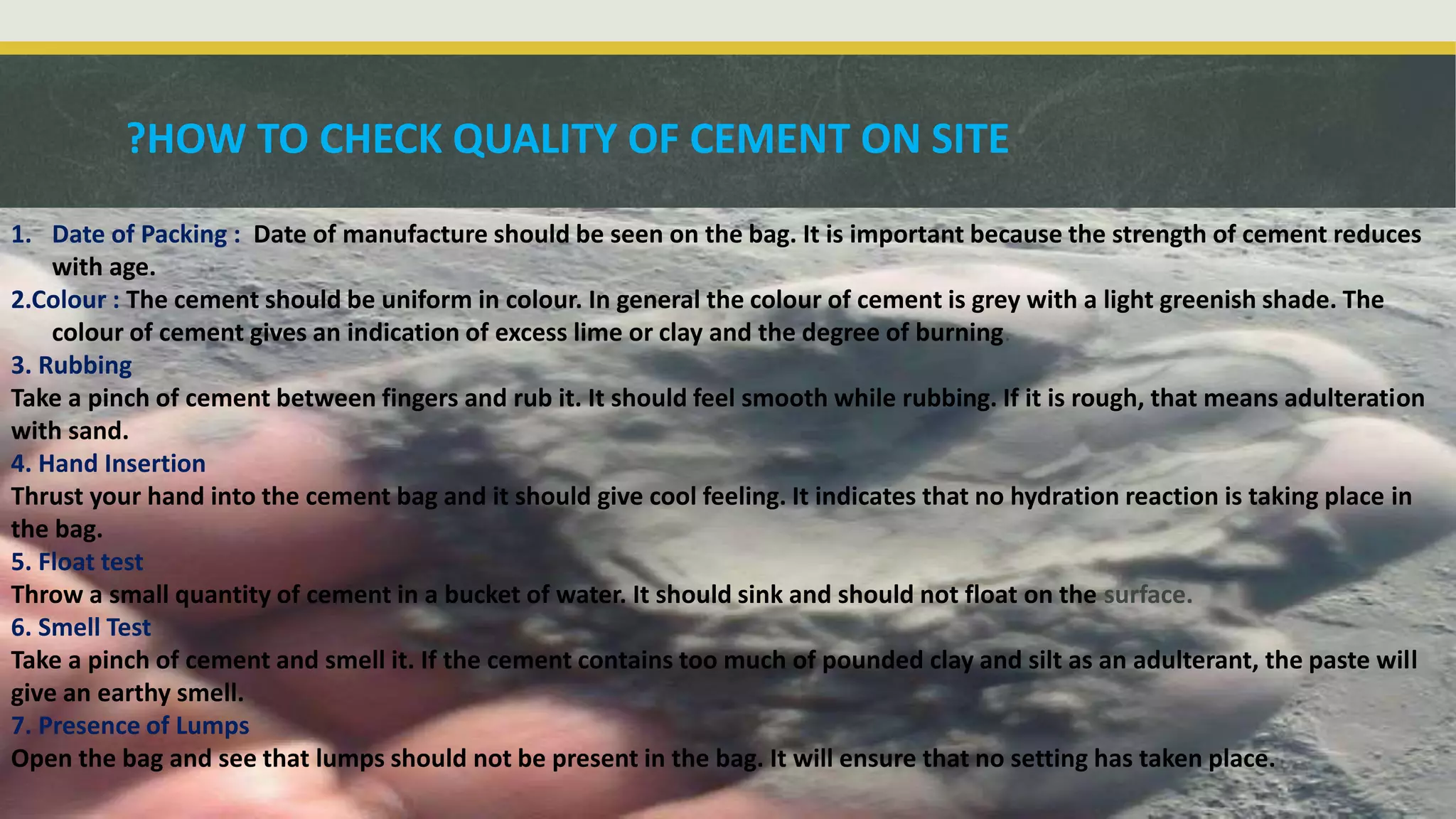
1. Date of Packing : Date of manufacture should be seen on the bag. It is important because the strength of cement reduces
with age.
2.Colour : The cement should be uniform in colour. In general the colour of cement is grey with a light greenish shade. The
colour of cement gives an indication of excess lime or clay and the degree of burning.
3. Rubbing
Take a pinch of cement between fingers and rub it. It should feel smooth while rubbing. If it is rough, that means adulteration
with sand.
4. Hand Insertion
Thrust your hand into the cement bag and it should give cool feeling. It indicates that no hydration reaction is taking place in
the bag.
5. Float test
Throw a small quantity of cement in a bucket of water. It should sink and should not float on the surface.
6. Smell Test
Take a pinch of cement and smell it. If the cement contains too much of pounded clay and silt as an adulterant, the paste will
give an earthy smell.
7. Presence of Lumps
Open the bag and see that lumps should not be present in the bag. It will ensure that no setting has taken place.
HOW TO CHECK QUALITY OF CEMENT ON SITE?
HOW TO CHECK QUALITY OF CEMENT ON LAB?
CEMENT LAB TEST
Physical Test
1.Fineness Test
2. Consistency Test
3.Initial and Final Setting Time
4.Soundness Test
5. Determination of Strength
6.Heat of hydration
6.Specific Gravity
Chemical test
1. Loss of ignition
2. Chemical Composition
Test
Regards
Timma Reddy
bmtreddy@gmail.com
+91-8123974780

Quality of cement

  • 1.
    Quality Of Cement Studyingof Quality of Cement requirement in Site
  • 2.
    Index I. Definition II. Constituentof Portland cement III. How to check quality of cement in field or site IV. How to check quality of cement in Lab
  • 3.
    Index Cement : •Cement isa material which has cohesive and adhesive properties in the presences of water •Cement is a product of obtained by pulverizing clinker formed by calcinating raw-materials primarily consist of lime, Silicate, Alumina, and Iron oxide •Cement used in construction of industries can be classified as Hydraulic and non hydraulic •Non hydraulic cements are derived from calcination of gypsum or limestone because their products of hydration are not resistant to water, eg. Portland cement •Cement can be manufactured either from natural cement stones or artificially by using calcareous and argillaceous materials.
  • 4.
    Constituent s ofPortland Cement ( Raw Materials ) 63 20 6 3 2 1 1.5 Lime,CaO Silica, Alimina Iron Oxide Magnesia Soda/Potash oxide Sulphulr trioxide Constituent s of Portland Cement ( Raw Materials ) Avg Composition
  • 5.
    HOW TO CHECKQUALITY OF CEMENT ON SITE? It is necessary to check the quality of cement on site at the time of preliminary inspection. It is not possible to check all the engineering qualities of cement on site but there exist some field test which gives us a rough idea of quality of cement. While on site we can perform these field tests to judge the quality of cement. These field tests are as follows: 1. Date of packing 2. Colour 3. Rubbing 4. Hand Insertion 5. Float Test 6. Smell Test 7. Presence of lumps 8. Shape Test 9. Strength Test
  • 6.
    1. Date ofPacking : Date of manufacture should be seen on the bag. It is important because the strength of cement reduces with age. 2.Colour : The cement should be uniform in colour. In general the colour of cement is grey with a light greenish shade. The colour of cement gives an indication of excess lime or clay and the degree of burning. 3. Rubbing Take a pinch of cement between fingers and rub it. It should feel smooth while rubbing. If it is rough, that means adulteration with sand. 4. Hand Insertion Thrust your hand into the cement bag and it should give cool feeling. It indicates that no hydration reaction is taking place in the bag. 5. Float test Throw a small quantity of cement in a bucket of water. It should sink and should not float on the surface. 6. Smell Test Take a pinch of cement and smell it. If the cement contains too much of pounded clay and silt as an adulterant, the paste will give an earthy smell. 7. Presence of Lumps Open the bag and see that lumps should not be present in the bag. It will ensure that no setting has taken place. HOW TO CHECK QUALITY OF CEMENT ON SITE?
  • 7.
    HOW TO CHECKQUALITY OF CEMENT ON LAB? CEMENT LAB TEST Physical Test 1.Fineness Test 2. Consistency Test 3.Initial and Final Setting Time 4.Soundness Test 5. Determination of Strength 6.Heat of hydration 6.Specific Gravity Chemical test 1. Loss of ignition 2. Chemical Composition Test
  • 8.