Building Materials &
Construction Presentation
SEMESTER- I
INTRODUCTIO
N
▪ Cement was first invented by Egyptians.
▪ The Greeks and the Babylonians brought about
some changes in the original cement composition.
▪ Later the Romans produced cement from
Pozzolana, an ash found in all of the volcanic areas
of Italy, by mixing the ash with lime.
▪ The manufacturing of cement was started in
England around 1825.
INDIAN CEMENT
INDUSTRY
▪ India started cement production in 1904. The first cement
factory was installed inTamil Nadu.
▪ Our country is the 2nd largest producer of cement in the
world.
▪ There are about 51 companies and 99 plants having
installed capacity of manufacturing 770 million kN of
cement. It accounts for about 4% of the world production.
DEFINITION
CEMENT :
A powdery substance made by calcining Lime and Clay, mixed
with water to form mortar or mixed with sand, gravel, and water to make
concrete. It is a binder, a substance that sets and hardens independently,
and can bind other materials together.
Lime + Clay +Water = Cement
And
Cement + Sand + Gravel = Concrete
TYPES OF CEMENT
▪ Ordinary Portland Cement (OPC):
The most commonly used type of cement, which is a basic ingredient of concrete,
mortar and most non-specialty grout.
▪ Rapid-Hardening Portland Cement (RHPC):
These cements are more finely ground than OPC and strength gain ability is relatively
faster than OPC.They also sets faster than OPC.
▪ Portland Blast-Furnace Slag Cement (PBFSC):
It is an intimate mixture of finely-ground cement clinker and blast furnace slag to which
a little gypsum is added to retard and adjust the setting time of the cement.
it provides the following advantages :
▪ Improve concrete workability ;
▪ Enhanced Finish ability ;
▪ Higher resistance to aggressive chemicals and ;
▪ Increased compressive and flexural strengths .
▪ Sulfate Resistant Cement (SRC) :
These Cements are generally used to Protect a structure from Sulfate Attack, which reacts chemically
with hydrated lime and hydrated aluminate which are composed in a cement and may cause rapid
disintegration in a concrete structure.
▪ Quick Setting Portland Cement (QSPC) :
These cements sets much Faster than OPC and RHPC because it contains a lesser
amount of gypsum (CaSO4.2H2O) .The initial setting time is 5 Mins. and final setting
time is 3o Mins.
▪ Portland Pozzolana Cement (PPC) :
It is a Low-heating cement containing a defined percentage of Natural or artificial
Pozzolana. Pozzolana is a siliceous and aluminous material which is derived from one
of the primary deposits of volcanic ash.
• White Cement
It is a form of OPC consisting of a little Pozzolana and
Gypsum, due to which it has a comparatively smaller setting
time. It is used for :
▪ Finishing purposes ,
▪ Sealing purposes,
▪ .Decoration Patterns
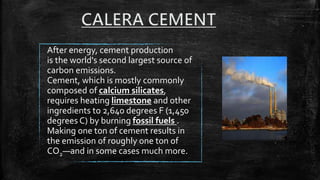
After energy, cement production
is the world's second largest source of
carbon emissions.
Cement, which is mostly commonly
composed of calcium silicates,
requires heating limestone and other
ingredients to 2,640 degrees F (1,450
degrees C) by burning fossil fuels .
Making one ton of cement results in
the emission of roughly one ton of
CO2—and in some cases much more.
The net result, said Calera was
that there was a consumption
of a half ton of carbon dioxide
per ton of cement produced,
rather than a ton emitted.
A new
California
company,
CALERA says
it can use
more than
90% of CO2
wafting up and
out of the
power plants
to make
cement.
a CO2-rich flue gas mixed with
seawater droplets is used to form
the calcium and magnesium
carbonates that would be the
component of cement.
The U.S. Green Building Council co-founder
David Gottfried said “The potential is huge: It's
like planting forests of trees through the
pouring of concrete or bricks,”
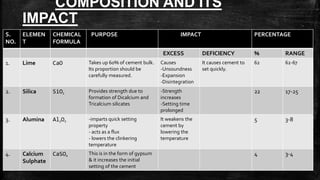
COMPOSITION AND ITS
IMPACT
S.
NO.
ELEMEN
T
CHEMICAL
FORMULA
PURPOSE IMPACT PERCENTAGE
EXCESS DEFICIENCY % RANGE
1. Lime CaO Takes up 60% of cement bulk.
Its proportion should be
carefully measured.
Causes
-Unsoundness
-Expansion
-Disintegration
It causes cement to
set quickly.
62 62-67
2. Silica SiO2
Provides strength due to
formation of Dicalcium and
Tricalcium silicates
-Strength
increases
-Setting time
prolonged
22 17-25
3. Alumina Al2O3
-imparts quick setting
property
- acts as a flux
- lowers the clinkering
temperature
It weakens the
cement by
lowering the
temperature
5 3-8
4. Calcium
Sulphate
CaSO4
This is in the form of gypsum
& it increases the initial
setting of the cement
4 3-4
S.
NO.
ELEMENT CHEMICAL
FORMULA
PURPOSE IMPACT PERCENTAGE
EXCESS DEFICIENCY % RANGE
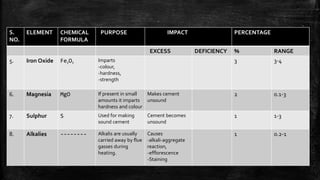
5. Iron Oxide Fe2O3
Imparts
-colour,
-hardness,
-strength
3 3-4
6. Magnesia MgO If present in small
amounts it imparts
hardness and colour
Makes cement
unsound
2 0.1-3
7. Sulphur S Used for making
sound cement
Cement becomes
unsound
1 1-3
8. Alkalies -------- Alkalis are usually
carried away by flue
gasses during
heating.
Causes
-alkali-aggregate
reaction,
-efflorescence
-Staining
1 0.2-1
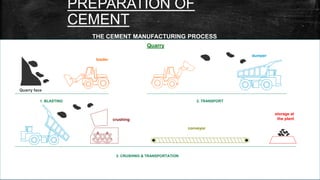
PREPARATION OF
CEMENT
THE CEMENT MANUFACTURING PROCESS
Quarry
loader
dumper
Quarry face
1. BLASTING 2. TRANSPORT
crushing
conveyor
storage at
the plant
3. CRUSHING & TRANSPORTATION
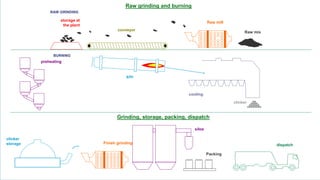
conveyor
Raw mix
storage at
the plant
Raw mill
Raw grinding and burning
preheating
cooling
clinker
RAW GRINDING
BURNING
clinker
storage
Grinding, storage, packing, dispatch
Finish grinding
silos
Packing
dispatch
STORAG
E
▪ The cement should be stored carefully. Otherwise it may absorb moisture
from the atmosphere and may become useless for the structural work.
▪ Following precautions are to be taken for the storage of cement:
1. Moisture : if moisture is kept away from cement, it is found that cement
will maintain its quality for indefinite period. Absorption of 1 or 2% of
moisture has no appreciable effect on the quality of cement , but if it
exceeds 5% the cement becomes totally useless.
2. Period of storage : the loose cement may be stored indefinitely in air
tight containers. But it is advisable to avoid storing of cement in jute bag
for a period of more than 3 months.
3. Piles: The cement bags are stacked in piles . It is
economical to form a pile 10 bags of cement . A distance
of about 300mm should be kept between the piles of
cement bags and the exterior walls of the building.
4. Storage sheds: For storing cement for sufficiently long
period , the storage sheds of special design should be
constructed.The walls , roof and floor of such sheds
should be waterproof construction. Few small windows
should be provided and they should be kept tightly shut.
FIELD TESTS FOR
CEMENT
▪ Following four field tests may be carried out to ascertain
roughly the quality of cement:
1. COLOUR:
the colour of cement should be uniform. It should be
typical cement colour i.e. grey with greenish shade.
This is not always reliable test. But it gives an
indication of excess lime and clay and the degree of
burning.
2. PHYSICAL PROPERTIES:
i.The cement should feel smooth when touched or rubbed
between the fingers. If it is felt rough it indicates the adulteration
with sand.
ii. If hand is inserted in a bag or heap of cement, it should feel
cool and not warm.
iii. If a small quantity of cement is thrown in a bucket of water, it
should not float on the surface of water.
3. PRESENCE OF LUMPS: The cement should be free
from any hard lumps. Such lumps are formed by the absorption
of moisture from the atmosphere. Any bag of cement contains
such lumps should be rejected.
4. Strength: the strength can be roughly ascertained in the
following way:
The briquette with a lean or weak mortar are made.The
size of the briquette should be about 75x 25x12 mm.
The proportion of cement and sand may be 1:6. the
briquettes are immersed in water for a period of 3 days.
If the cement is of sound quality, such briquettes will
not be broken easily and it will be difficult to turn them
into powder form.
APPLICATIONS OF
CEMENT
Cements may be used alone, but the normal use is in mortar and concrete in which
the cement is mixed with inert material known as aggregate. Concrete is a mixture
of cement, sand or other fine aggregates. Mixtures of soil and Portland cement are
used as a base for roads. Portland cement also used in the manufacture of bricks,
tiles, shingles, pipes, beams, railroad, ties and various extruded products.
Because concrete is the most widely used of all construction materials in the world
today. Each year almost one ton of concrete is poured per capita in the developed
countries.
• Some other applications for cement, however, are now growing in importance.
One of these is solidification/ stabilization(S/S)- a widely used technique for the
management and disposal of a broad range of contaminated materials and
wastes, including radioactive wastes. Cement is mixed into the contaminated
substance, immobilizing the contaminants and preventing them from
migrating to plants, animals and humans.The process is most often used to
reclaim polluted industrial sites for redevelopment or recreational use.
• Engineered soils are another important application. Cement is mixed in to stabilize
substandard soils as a base for buildings, roadways, airport runways, parking lots
and other uses.
USES OF
CEMENT
Cement is used widely for the construction of various structures. Some of them
are listed below:
(i) Cement slurry is used for filling cracks in concrete structures.
(ii) Cement mortar is used for masonry work, plastering and pointing.
(iii) Cement concrete is used for the construction of various structures like buildings,
bridges. water tanks, tunnels, docks, harbour etc.
(iv) Cement is used to manufacture lamp posts, telephone posts, railway sleepers, piles etc.
(v) For manufacturing cement pipes, garden seats, dust bins, flower pots etc. cement is
commonly used.
(vi) It is useful for the construction of roads, footpaths, courts for various sports etc.
PROPERTIES OF GOOD
CEMENT
a) It gives excellent strength to the brick masonry.
b) It is an excellent binding material.
c) It is easily workable.
d) It offers good resistance to the moisture.
e) It possesses a good plasticity.
f) It stiffens or hardens early.
DEFECTS AND
IMPURITIES
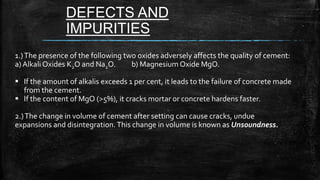
1.)The presence of the following two oxides adversely affects the quality of cement:
a) Alkali Oxides K2O and Na2O. b) Magnesium Oxide MgO.
 If the amount of alkalis exceeds 1 per cent, it leads to the failure of concrete made
from the cement.
 If the content of MgO (>5%), it cracks mortar or concrete hardens faster.
2.)The change in volume of cement after setting can cause cracks, undue
expansions and disintegration. This change in volume is known as Unsoundness.
BUREAU OF INDIAN STANDARDS
(BIS)
 What is BIS?
The Bureau of Indian Standards (BIS) is the national Standards Body of India
working under the aegis of Ministry of Consumer Affairs, Government of India.
One of the major functions of the Bureau is the formulation, recognition and
promotion of the Indian Standards. These cover important segments of
economy, which helps the industry in upgrading the quality of their products
and services.
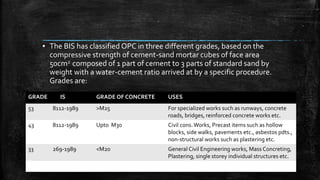
▪ The BIS has classified OPC in three different grades, based on the
compressive strength of cement-sand mortar cubes of face area
50cm2 composed of 1 part of cement to 3 parts of standard sand by
weight with a water-cement ratio arrived at by a specific procedure.
Grades are:
GRADE IS GRADE OF CONCRETE USES
53 8112-1989 >M25 For specialized works such as runways, concrete
roads, bridges, reinforced concrete works etc.
43 8112-1989 Upto M30 Civil cons.Works, Precast items such as hollow
blocks, side walks, pavements etc., asbestos pdts.,
non-structural works such as plastering etc.
33 269-1989 <M20 General Civil Engineering works, Mass Concreting,
Plastering, single storey individual structures etc.
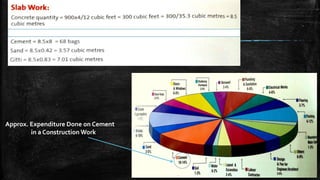
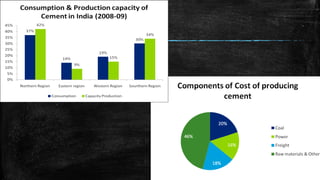
Approx. Expenditure Done on Cement
in a Construction Work
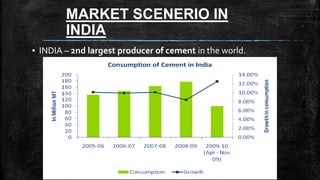
MARKET SCENERIO IN
INDIA
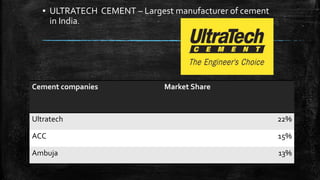
▪ INDIA – 2nd largest producer of cement in the world.
▪ ULTRATECH CEMENT – Largest manufacturer of cement
in India.
Cement companies Market Share
Ultratech 22%
ACC 15%
Ambuja 13%
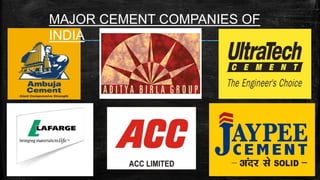
MAJOR CEMENT COMPANIES OF
INDIA
THANK YOU

Introduction to Cement

  • 1.
    Building Materials & ConstructionPresentation SEMESTER- I
  • 2.
    INTRODUCTIO N ▪ Cement wasfirst invented by Egyptians. ▪ The Greeks and the Babylonians brought about some changes in the original cement composition. ▪ Later the Romans produced cement from Pozzolana, an ash found in all of the volcanic areas of Italy, by mixing the ash with lime. ▪ The manufacturing of cement was started in England around 1825.
  • 3.
    INDIAN CEMENT INDUSTRY ▪ Indiastarted cement production in 1904. The first cement factory was installed inTamil Nadu. ▪ Our country is the 2nd largest producer of cement in the world. ▪ There are about 51 companies and 99 plants having installed capacity of manufacturing 770 million kN of cement. It accounts for about 4% of the world production.
  • 4.
    DEFINITION CEMENT : A powderysubstance made by calcining Lime and Clay, mixed with water to form mortar or mixed with sand, gravel, and water to make concrete. It is a binder, a substance that sets and hardens independently, and can bind other materials together. Lime + Clay +Water = Cement And Cement + Sand + Gravel = Concrete
  • 5.
    TYPES OF CEMENT ▪Ordinary Portland Cement (OPC): The most commonly used type of cement, which is a basic ingredient of concrete, mortar and most non-specialty grout. ▪ Rapid-Hardening Portland Cement (RHPC): These cements are more finely ground than OPC and strength gain ability is relatively faster than OPC.They also sets faster than OPC. ▪ Portland Blast-Furnace Slag Cement (PBFSC): It is an intimate mixture of finely-ground cement clinker and blast furnace slag to which a little gypsum is added to retard and adjust the setting time of the cement.
  • 6.
    it provides thefollowing advantages : ▪ Improve concrete workability ; ▪ Enhanced Finish ability ; ▪ Higher resistance to aggressive chemicals and ; ▪ Increased compressive and flexural strengths . ▪ Sulfate Resistant Cement (SRC) : These Cements are generally used to Protect a structure from Sulfate Attack, which reacts chemically with hydrated lime and hydrated aluminate which are composed in a cement and may cause rapid disintegration in a concrete structure.
  • 7.
    ▪ Quick SettingPortland Cement (QSPC) : These cements sets much Faster than OPC and RHPC because it contains a lesser amount of gypsum (CaSO4.2H2O) .The initial setting time is 5 Mins. and final setting time is 3o Mins. ▪ Portland Pozzolana Cement (PPC) : It is a Low-heating cement containing a defined percentage of Natural or artificial Pozzolana. Pozzolana is a siliceous and aluminous material which is derived from one of the primary deposits of volcanic ash.
  • 8.
    • White Cement Itis a form of OPC consisting of a little Pozzolana and Gypsum, due to which it has a comparatively smaller setting time. It is used for : ▪ Finishing purposes , ▪ Sealing purposes, ▪ .Decoration Patterns
  • 9.
    After energy, cementproduction is the world's second largest source of carbon emissions. Cement, which is mostly commonly composed of calcium silicates, requires heating limestone and other ingredients to 2,640 degrees F (1,450 degrees C) by burning fossil fuels . Making one ton of cement results in the emission of roughly one ton of CO2—and in some cases much more.
  • 10.
    The net result,said Calera was that there was a consumption of a half ton of carbon dioxide per ton of cement produced, rather than a ton emitted. A new California company, CALERA says it can use more than 90% of CO2 wafting up and out of the power plants to make cement. a CO2-rich flue gas mixed with seawater droplets is used to form the calcium and magnesium carbonates that would be the component of cement.
  • 11.
    The U.S. GreenBuilding Council co-founder David Gottfried said “The potential is huge: It's like planting forests of trees through the pouring of concrete or bricks,”
  • 12.
    COMPOSITION AND ITS IMPACT S. NO. ELEMEN T CHEMICAL FORMULA PURPOSEIMPACT PERCENTAGE EXCESS DEFICIENCY % RANGE 1. Lime CaO Takes up 60% of cement bulk. Its proportion should be carefully measured. Causes -Unsoundness -Expansion -Disintegration It causes cement to set quickly. 62 62-67 2. Silica SiO2 Provides strength due to formation of Dicalcium and Tricalcium silicates -Strength increases -Setting time prolonged 22 17-25 3. Alumina Al2O3 -imparts quick setting property - acts as a flux - lowers the clinkering temperature It weakens the cement by lowering the temperature 5 3-8 4. Calcium Sulphate CaSO4 This is in the form of gypsum & it increases the initial setting of the cement 4 3-4
  • 13.
    S. NO. ELEMENT CHEMICAL FORMULA PURPOSE IMPACTPERCENTAGE EXCESS DEFICIENCY % RANGE 5. Iron Oxide Fe2O3 Imparts -colour, -hardness, -strength 3 3-4 6. Magnesia MgO If present in small amounts it imparts hardness and colour Makes cement unsound 2 0.1-3 7. Sulphur S Used for making sound cement Cement becomes unsound 1 1-3 8. Alkalies -------- Alkalis are usually carried away by flue gasses during heating. Causes -alkali-aggregate reaction, -efflorescence -Staining 1 0.2-1
  • 14.
    PREPARATION OF CEMENT THE CEMENTMANUFACTURING PROCESS Quarry loader dumper Quarry face 1. BLASTING 2. TRANSPORT crushing conveyor storage at the plant 3. CRUSHING & TRANSPORTATION
  • 15.
    conveyor Raw mix storage at theplant Raw mill Raw grinding and burning preheating cooling clinker RAW GRINDING BURNING clinker storage Grinding, storage, packing, dispatch Finish grinding silos Packing dispatch
  • 16.
    STORAG E ▪ The cementshould be stored carefully. Otherwise it may absorb moisture from the atmosphere and may become useless for the structural work. ▪ Following precautions are to be taken for the storage of cement: 1. Moisture : if moisture is kept away from cement, it is found that cement will maintain its quality for indefinite period. Absorption of 1 or 2% of moisture has no appreciable effect on the quality of cement , but if it exceeds 5% the cement becomes totally useless. 2. Period of storage : the loose cement may be stored indefinitely in air tight containers. But it is advisable to avoid storing of cement in jute bag for a period of more than 3 months.
  • 17.
    3. Piles: Thecement bags are stacked in piles . It is economical to form a pile 10 bags of cement . A distance of about 300mm should be kept between the piles of cement bags and the exterior walls of the building. 4. Storage sheds: For storing cement for sufficiently long period , the storage sheds of special design should be constructed.The walls , roof and floor of such sheds should be waterproof construction. Few small windows should be provided and they should be kept tightly shut.
  • 18.
    FIELD TESTS FOR CEMENT ▪Following four field tests may be carried out to ascertain roughly the quality of cement: 1. COLOUR: the colour of cement should be uniform. It should be typical cement colour i.e. grey with greenish shade. This is not always reliable test. But it gives an indication of excess lime and clay and the degree of burning.
  • 19.
    2. PHYSICAL PROPERTIES: i.Thecement should feel smooth when touched or rubbed between the fingers. If it is felt rough it indicates the adulteration with sand. ii. If hand is inserted in a bag or heap of cement, it should feel cool and not warm. iii. If a small quantity of cement is thrown in a bucket of water, it should not float on the surface of water. 3. PRESENCE OF LUMPS: The cement should be free from any hard lumps. Such lumps are formed by the absorption of moisture from the atmosphere. Any bag of cement contains such lumps should be rejected.
  • 20.
    4. Strength: thestrength can be roughly ascertained in the following way: The briquette with a lean or weak mortar are made.The size of the briquette should be about 75x 25x12 mm. The proportion of cement and sand may be 1:6. the briquettes are immersed in water for a period of 3 days. If the cement is of sound quality, such briquettes will not be broken easily and it will be difficult to turn them into powder form.
  • 21.
    APPLICATIONS OF CEMENT Cements maybe used alone, but the normal use is in mortar and concrete in which the cement is mixed with inert material known as aggregate. Concrete is a mixture of cement, sand or other fine aggregates. Mixtures of soil and Portland cement are used as a base for roads. Portland cement also used in the manufacture of bricks, tiles, shingles, pipes, beams, railroad, ties and various extruded products. Because concrete is the most widely used of all construction materials in the world today. Each year almost one ton of concrete is poured per capita in the developed countries.
  • 22.
    • Some otherapplications for cement, however, are now growing in importance. One of these is solidification/ stabilization(S/S)- a widely used technique for the management and disposal of a broad range of contaminated materials and wastes, including radioactive wastes. Cement is mixed into the contaminated substance, immobilizing the contaminants and preventing them from migrating to plants, animals and humans.The process is most often used to reclaim polluted industrial sites for redevelopment or recreational use. • Engineered soils are another important application. Cement is mixed in to stabilize substandard soils as a base for buildings, roadways, airport runways, parking lots and other uses.
  • 23.
    USES OF CEMENT Cement isused widely for the construction of various structures. Some of them are listed below: (i) Cement slurry is used for filling cracks in concrete structures. (ii) Cement mortar is used for masonry work, plastering and pointing. (iii) Cement concrete is used for the construction of various structures like buildings, bridges. water tanks, tunnels, docks, harbour etc. (iv) Cement is used to manufacture lamp posts, telephone posts, railway sleepers, piles etc. (v) For manufacturing cement pipes, garden seats, dust bins, flower pots etc. cement is commonly used. (vi) It is useful for the construction of roads, footpaths, courts for various sports etc.
  • 24.
    PROPERTIES OF GOOD CEMENT a)It gives excellent strength to the brick masonry. b) It is an excellent binding material. c) It is easily workable. d) It offers good resistance to the moisture. e) It possesses a good plasticity. f) It stiffens or hardens early.
  • 25.
    DEFECTS AND IMPURITIES 1.)The presenceof the following two oxides adversely affects the quality of cement: a) Alkali Oxides K2O and Na2O. b) Magnesium Oxide MgO.  If the amount of alkalis exceeds 1 per cent, it leads to the failure of concrete made from the cement.  If the content of MgO (>5%), it cracks mortar or concrete hardens faster. 2.)The change in volume of cement after setting can cause cracks, undue expansions and disintegration. This change in volume is known as Unsoundness.
  • 26.
    BUREAU OF INDIANSTANDARDS (BIS)  What is BIS? The Bureau of Indian Standards (BIS) is the national Standards Body of India working under the aegis of Ministry of Consumer Affairs, Government of India. One of the major functions of the Bureau is the formulation, recognition and promotion of the Indian Standards. These cover important segments of economy, which helps the industry in upgrading the quality of their products and services.
  • 27.
    ▪ The BIShas classified OPC in three different grades, based on the compressive strength of cement-sand mortar cubes of face area 50cm2 composed of 1 part of cement to 3 parts of standard sand by weight with a water-cement ratio arrived at by a specific procedure. Grades are: GRADE IS GRADE OF CONCRETE USES 53 8112-1989 >M25 For specialized works such as runways, concrete roads, bridges, reinforced concrete works etc. 43 8112-1989 Upto M30 Civil cons.Works, Precast items such as hollow blocks, side walks, pavements etc., asbestos pdts., non-structural works such as plastering etc. 33 269-1989 <M20 General Civil Engineering works, Mass Concreting, Plastering, single storey individual structures etc.
  • 28.
    Approx. Expenditure Doneon Cement in a Construction Work
  • 29.
    MARKET SCENERIO IN INDIA ▪INDIA – 2nd largest producer of cement in the world.
  • 30.
    ▪ ULTRATECH CEMENT– Largest manufacturer of cement in India. Cement companies Market Share Ultratech 22% ACC 15% Ambuja 13%
  • 33.
  • 34.