Cellulose
By Audrey Zahra
Carbohydrate Chemistry
The term 'carbohydrate' (French 'hydrate de carbone') was originally applied to the large group of
biomolecules which formula can be expressed as Cn(H2O)n. Carbohydrates are polyhydroxic carbon chains
with at least one aldehyde- or keto group. It follows the definition that a simple carbohydrate (i.e., with one
single carbon chain), a monosaccharide, must have at least three carbons (n ≥ 3).
Ring Structures of
Monosaccharides
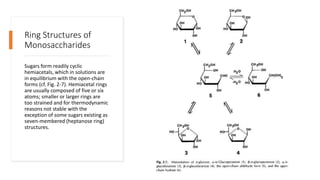
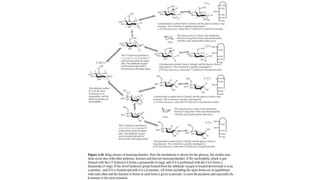
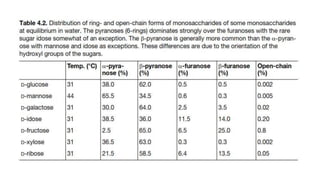
Sugars form readily cyclic
hemiacetals, which in solutions are
in equilibrium with the open-chain
forms (cf. Fig. 2-7). Hemiacetal rings
are usually composed of five or six
atoms; smaller or larger rings are
too strained and for thermodynamic
reasons not stable with the
exception of some sugars existing as
seven-membered (heptanose ring)
structures.
Di-, Oligo- and Polysaccharides
Disaccharides are divided into reducing- and non-reducing sugars, where the later lack a free anomeric carbon
of aldose type. Nonreducing sugars can undergo mutarotation in the monosaccharide residue carrying the free
anomeric carbon, similar as monosaccharides.
Oligosaccharide is a rather vague term for saccharides containing from three to approximately ten
monosaccharide residues. If the number shall be specified terms based on the Greek number is used,
trisaccharide, tetrasaccharide, pentasaccharide etc. Oligosaccharides are often chemically coupled to other
biomolecules, as membrane phospholipids, proteins and polysaccharides. Their role is sometimes in
recognition, where the rich possibility for combination is explored.
Polysaccharides are used by nature as energy storage or as construction materials. The number of
monosaccharide residues (degree of polymerization, DP) can vary from around ten (there is no sharp borderline
towards oligosaccharides) up to ten thousands. A homopolysaccharide consists exclusively of one kind of
monosaccharide residue, whereas a heteropolysaccharide consists of two or more kinds of monosaccharide
residues.
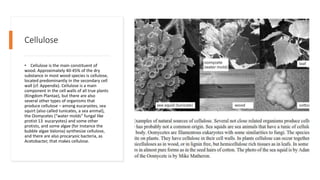
Cellulose
• Cellulose is the main constituent of
wood. Approximately 40-45% of the dry
substance in most wood species is cellulose,
located predominantly in the secondary cell
wall (cf. Appendix). Cellulose is a main
component in the cell walls of all true plants
(Kingdom Plantae), but there are also
several other types of organisms that
produce cellulose – among eucaryotes, sea
squirt (also called tunicates, a sea animal),
the Oomycetes (“water molds” fungal like
protist 13 eucaryotes) and some other
protists, and some algae (for instance the
bubble algae Valonia) synthesize cellulose,
and there are also procaryoic bacteria, as
Acetobacter, that makes cellulose.
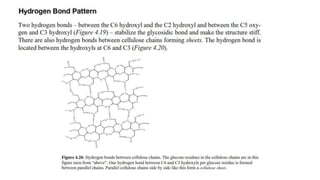
Cellulose is a homopolysaccharide composed of ß-D glucopyranose units which are linked together by (1
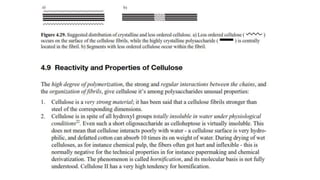
—» 4)-glycosidic bonds (Fig. 3-5). Cellulose molecules are completely linear and have a strong tendency to
form intra and Intermolecular hydrogen bonds.
 Consists of thousands of D-glucopyranosyl 1,4--glucopyranosides as in
cellobiose
 Cellulose molecules form a large aggregate structures held together by
hydrogen bonds
 Cellulose is the main component of wood and plant fiber
Cellulose
Cellulose
Cellulose
Cellulose
Cellulose
Cellulose

Cellulose

  • 1.
  • 2.
    Carbohydrate Chemistry The term'carbohydrate' (French 'hydrate de carbone') was originally applied to the large group of biomolecules which formula can be expressed as Cn(H2O)n. Carbohydrates are polyhydroxic carbon chains with at least one aldehyde- or keto group. It follows the definition that a simple carbohydrate (i.e., with one single carbon chain), a monosaccharide, must have at least three carbons (n ≥ 3).
  • 5.
    Ring Structures of Monosaccharides Sugarsform readily cyclic hemiacetals, which in solutions are in equilibrium with the open-chain forms (cf. Fig. 2-7). Hemiacetal rings are usually composed of five or six atoms; smaller or larger rings are too strained and for thermodynamic reasons not stable with the exception of some sugars existing as seven-membered (heptanose ring) structures.
  • 8.
    Di-, Oligo- andPolysaccharides Disaccharides are divided into reducing- and non-reducing sugars, where the later lack a free anomeric carbon of aldose type. Nonreducing sugars can undergo mutarotation in the monosaccharide residue carrying the free anomeric carbon, similar as monosaccharides. Oligosaccharide is a rather vague term for saccharides containing from three to approximately ten monosaccharide residues. If the number shall be specified terms based on the Greek number is used, trisaccharide, tetrasaccharide, pentasaccharide etc. Oligosaccharides are often chemically coupled to other biomolecules, as membrane phospholipids, proteins and polysaccharides. Their role is sometimes in recognition, where the rich possibility for combination is explored. Polysaccharides are used by nature as energy storage or as construction materials. The number of monosaccharide residues (degree of polymerization, DP) can vary from around ten (there is no sharp borderline towards oligosaccharides) up to ten thousands. A homopolysaccharide consists exclusively of one kind of monosaccharide residue, whereas a heteropolysaccharide consists of two or more kinds of monosaccharide residues.
  • 11.
    Cellulose • Cellulose isthe main constituent of wood. Approximately 40-45% of the dry substance in most wood species is cellulose, located predominantly in the secondary cell wall (cf. Appendix). Cellulose is a main component in the cell walls of all true plants (Kingdom Plantae), but there are also several other types of organisms that produce cellulose – among eucaryotes, sea squirt (also called tunicates, a sea animal), the Oomycetes (“water molds” fungal like protist 13 eucaryotes) and some other protists, and some algae (for instance the bubble algae Valonia) synthesize cellulose, and there are also procaryoic bacteria, as Acetobacter, that makes cellulose.
  • 12.
    Cellulose is ahomopolysaccharide composed of ß-D glucopyranose units which are linked together by (1 —» 4)-glycosidic bonds (Fig. 3-5). Cellulose molecules are completely linear and have a strong tendency to form intra and Intermolecular hydrogen bonds.
  • 13.
     Consists ofthousands of D-glucopyranosyl 1,4--glucopyranosides as in cellobiose  Cellulose molecules form a large aggregate structures held together by hydrogen bonds  Cellulose is the main component of wood and plant fiber