CARBOHYDRATES
INTRODUCTION:
 Carbohydrate are among the most widely distributed compounds in
both plant and animal kingdoms.
 Plants can build up carbohydrates from carbon dioxide by
photosynthesis.
 Many plants and animals contain large quantities of carbohydrates
as reserve food material.
 Carbohydrates are also important structural compounds.
 They are primarily composed of the elements
Carbon, Hydrogen, Oxygen
✶ Carbohydrates are broadly defined as polyhydroxy aldehydes or
ketones and their derivatives or as substances that yields one of
these compounds
✶ Composed of carbon, hydrogen, and oxygen
✶ Functional groups present include hydroxyl groups
✶ -ose indicates sugar
Function of Carbohydrates in Cells
✶ Major source of energy for the cell
✶ Major structural component of plant cell
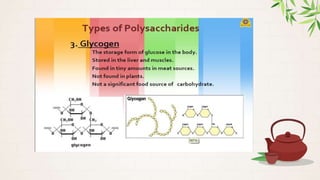
✶ Immediate energy in the form of GLUCOSE
✶ Reserve or stored energy in the form of GLYCOGEN
DEFINITION
Carbohydrates are polyhydroxy aldehydes or ketones and
their derivates or as substances that yield one of these
compounds on hydrolysis.
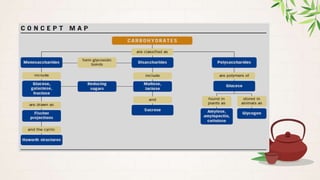
CLASSIFICATION:
Carbohydrates are classified into two blood groups
1. Sugars
2. Non- sugar
1. SUGARS
✶ Sugars are sweet, crystalline substances and soluble in water.
✶ Their molecular weights was known and and fixed for a particular
compound.
✶ They are sub divided into two groups
1. Monosaccharide
2. Oligosaccharide
✶ Classification of Carbohydrates
Carbohydrates are classified according to the number of subunits
that make them up
3 Types of Carbohydrates
✶ 1.Monosaccharides
✶ 2.Oligosaccharides
A) Disaccharides
B) Trisaccharides
C) Tetrasaccharides
✶ 3.Polysaccharides
✶ Monosaccharides are simple sugars, or the compounds which possess
a free aldehyde (CHO) or ketone (C=O) group and two or more
hydroxyl (OH) groups.
✶ They are the simplest sugars and cannot be hydrolysed further into
smaller units.
✶ Monosaccharides contain a single carbon chain and are classified on
the basis of number of carbon atoms they possess, and as aldoses or
ketoses depending upon their groups.
1. MONOSACCHARIDES:
(Greek mono- single, saccharon- sugar)
 They are the simplest group of carbohydrates and are often referred
to as simple sugars.
 They have the general formula CnH₂nOn.
 They cannot be further hydrolyzed.
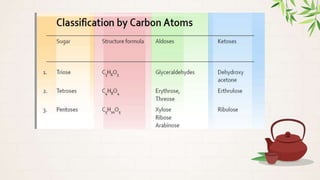
 They are further subdivided according to the type of carbonyl group
and the number of carbon atoms in the molecule.
TYPE OF CARBONYL GROUP:
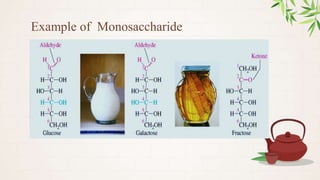
Aldoses (having aldehyde group) ketones (having ketone group)
Example of Monosaccharide
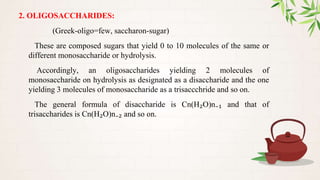
2. OLIGOSACCHARIDES:
(Greek-oligo=few, saccharon-sugar)
These are composed sugars that yield 0 to 10 molecules of the same or
different monosaccharide or hydrolysis.
Accordingly, an oligosaccharides yielding 2 molecules of
monosaccharide on hydrolysis as designated as a disaccharide and the one
yielding 3 molecules of monosaccharide as a trisaccchride and so on.
The general formula of disaccharide is Cn(H₂O)n₋₁ and that of
trisaccharides is Cn(H₂O)n₋₂ and so on.
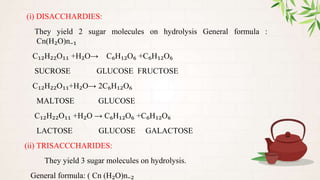
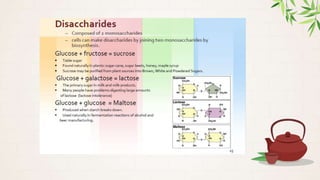
(i) DISACCHARDIES:
They yield 2 sugar molecules on hydrolysis General formula :
Cn(H₂O)n₋₁
C₁₂H₂₂O₁₁ +H₂O→ C₆H₁₂O₆ +C₆H₁₂O₆
SUCROSE GLUCOSE FRUCTOSE
C₁₂H₂₂O₁₁+H₂O→ 2C₆H₁₂O₆
MALTOSE GLUCOSE
C₁₂H₂₂O₁₁ +H₂O → C₆H₁₂O₆ +C₆H₁₂O₆
LACTOSE GLUCOSE GALACTOSE
(ii) TRISACCCHARIDES:
They yield 3 sugar molecules on hydrolysis.
General formula: ( Cn (H₂O)n₋₂
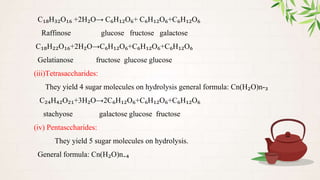
C₁₈H₃₂O₁₆ +2H₂O→ C₆H₁₂O₆+ C₆H₁₂O₆+C₆H₁₂O₆
Raffinose glucose fructose galactose
C₁₈H₂₂O₁₆+2H₂O→C₆H₁₂O₆+C₆H₁₂O₆+C₆H₁₂O₆
Gelatianose fructose glucose glucose
(iii)Tetrasaccharides:
They yield 4 sugar molecules on hydrolysis general formula: Cn(H₂O)n-₃
C₂₄H₄₂O₂₁+3H₂O→2C₆H₁₂O₆+C₆H₁₂O₆+C₆H₁₂O₆
stachyose galactose glucose fructose
(iv) Pentasccharides:
They yield 5 sugar molecules on hydrolysis.
General formula: Cn(H₂O)n₋₄
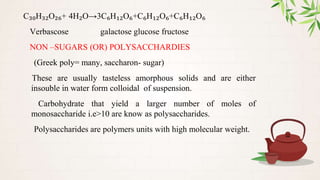
C₃₀H₃₂O₂₆+ 4H₂O→3C₆H₁₂O₆+C₆H₁₂O₆+C₆H₁₂O₆
Verbascose galactose glucose fructose
NON –SUGARS (OR) POLYSACCHARDIES
(Greek poly= many, saccharon- sugar)
These are usually tasteless amorphous solids and are either
insouble in water form colloidal of suspension.
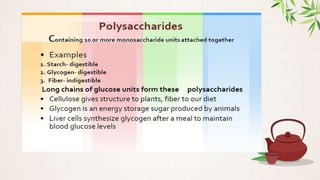
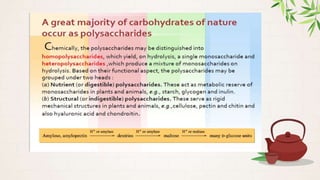
Carbohydrate that yield a larger number of moles of
monosaccharide i.e>10 are know as polysaccharides.
Polysaccharides are polymers units with high molecular weight.
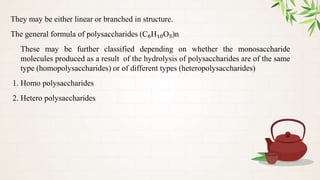
They may be either linear or branched in structure.
The general formula of polysaccharides (C₆H₁₀O₅)n
These may be further classified depending on whether the monosaccharide
molecules produced as a result of the hydrolysis of polysaccharides are of the same
type (homopolysaccharides) or of different types (heteropolysaccharides)
1. Homo polysaccharides
2. Hetero polysaccharides
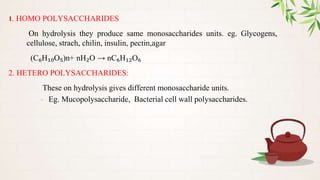
1. HOMO POLYSACCHARIDES
On hydrolysis they produce same monosaccharides units. eg. Glycogens,
cellulose, strach, chilin, insulin, pectin,agar
(C₆H₁₀O₅)n+ nH₂O → nC₆H₁₂O₆
2. HETERO POLYSACCHARIDES:
These on hydrolysis gives different monosaccharide units.
- Eg. Mucopolysaccharide, Bacterial cell wall polysaccharides.
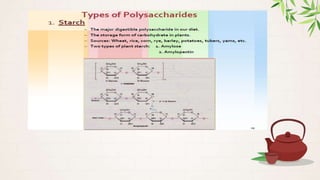
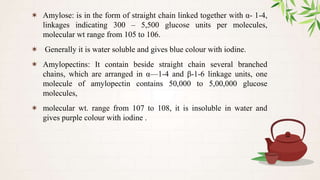
✶ Amylose: is in the form of straight chain linked together with α- 1-4,
linkages indicating 300 – 5,500 glucose units per molecules,
molecular wt range from 105 to 106.
✶ Generally it is water soluble and gives blue colour with iodine.
✶ Amylopectins: It contain beside straight chain several branched
chains, which are arranged in α—1-4 and β-1-6 linkage units, one
molecule of amylopectin contains 50,000 to 5,00,000 glucose
molecules,
✶ molecular wt. range from 107 to 108, it is insoluble in water and
gives purple colour with iodine .
HYDROLYSIS:
Starch can be hydrolyzed by both acid as well as enzymes. It is
hydrolyzed to glucose in which the intermediate product is maltose.
Starch on partial hydrolysis, dextrin is formed which is used in
infants food preparations, since it is easily digestible.
Starch →(acid hydrolysis) glucose.
Starch →(enzymatic hydrolysis /amylase) glucose.
Starch → (Incomplete hydrolysis) Dextrin.
Amylose has linear complex.
So, it occupies more area and it forms starch iodine complex.
Since it is able to accommodate more iodine molecules starch
gives blue colour with iodine.
PROPERTIES:
o It is a white soft amorphous powder and lacks sweetness.
o It is insoluble in water, alcohol and either at ordinary
temperature.
o Starch is a non- reducing sugar, it reduces Fehling's, Benedict's
reagent only after hydrolysis.
o A compound which yields only glucose molecules on hydrolysis
is called a glucosan. Hence, starch is a glucosan.
Partial hydrolysis of starch gives dextrin, it posses adhesive property and
it is used as adhesive on paper product.
BIOLOGICAL SIGNIFICANCE:
1. Starch is used as a food more than half of the carbohydrates
ingested by human is starch.
2. It is used in coating and sizing papers in order to improve the
writing qualities.
3. It is used in the manufacture of glucose. Dextrin is used for feeding
infants, since it is easily digestable.
4. It is a major storage from carbohydrate in plants, synthesis and storage
occurs in the chloroplast.
5. It is used in the manufacture of starch nitrate, which is used as an
explosive.
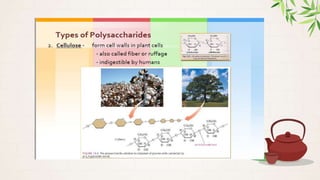
CELLULOSE
OCCURRENCE:
It is a homopolysaccharide found in the cell wall of plants.
It is also found in a few micro- organisms and lower organisms.
It is also found in cotton (90-94%), woods (45-50%) and jute (60-
65%)
It forms the major part of vegetables .
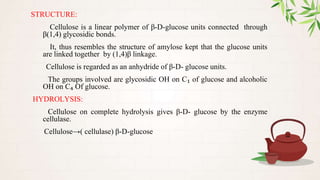
STRUCTURE:
Cellulose is a linear polymer of β-D-glucose units connected through
β(1,4) glycosidic bonds.
It, thus resembles the structure of amylose kept that the glucose units
are linked together by (1,4)β linkage.
Cellulose is regarded as an anhydride of β-D- glucose units.
The groups involved are glycosidic OH on C₁ of glucose and alcoholic
OH on C₄ Of glucose.
HYDROLYSIS:
Cellulose on complete hydrolysis gives β-D- glucose by the enzyme
cellulase.
Cellulose→( cellulase) β-D-glucose
On partial hydrolysis cellulose gives a disaccharides called cellobiose.
Cellulose →( partial hydrolysis) cellobiose.
PROPERTIES:
a) Cellulose is insoluble in water and it lacks sweetness.
b) It gives no colour with iodine.
c) It is not fermented by yeast.
d) Cellulose is a non–reducing sugar, it does not reduce Fehling's,
Benedict's solution. It does not react with phenyl hydrazine to form
osazone.
BIOLOGICAL IMPORTANCE:
1. In humans cellulose is not digested , because cellulose digesting
enzyme is absent.
2. But in ruminants (cattle, sheep, goat) cellulose digesting enzyme is
present and cellulose forms the bulk of faecal matter.
3. Cellulose reacts with acetic anhydride in the presence of acetic acid
and a small amount of concentrated sulpuric acid to give cellulose
acetate.
Cellulose→( acetic anhydride, acetic acid and H₂SO₄) Cellulose
acetate
Cellulose acetate is used in photographic film and for packing
materials.
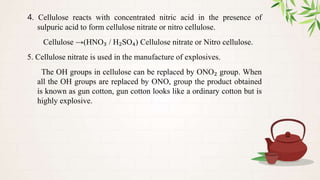
4. Cellulose reacts with concentrated nitric acid in the presence of
sulpuric acid to form cellulose nitrate or nitro cellulose.
Cellulose →(HNO₃ / H₂SO₄) Cellulose nitrate or Nitro cellulose.
5. Cellulose nitrate is used in the manufacture of explosives.
The OH groups in cellulose can be replaced by ONO₂ group. When
all the OH groups are replaced by ONO, group the product obtained
is known as gun cotton, gun cotton looks like a ordinary cotton but is
highly explosive.
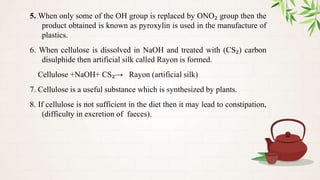
5. When only some of the OH group is replaced by ONO₂ group then the
product obtained is known as pyroxylin is used in the manufacture of
plastics.
6. When cellulose is dissolved in NaOH and treated with (CS₂) carbon
disulphide then artificial silk called Rayon is formed.
Cellulose +NaOH+ CS₂→ Rayon (artificial silk)
7. Cellulose is a useful substance which is synthesized by plants.
8. If cellulose is not sufficient in the diet then it may lead to constipation,
(difficulty in excretion of faeces).
CARBOHYDRATES.pptx
CARBOHYDRATES.pptx
CARBOHYDRATES.pptx

CARBOHYDRATES.pptx

  • 1.
  • 2.
    INTRODUCTION:  Carbohydrate areamong the most widely distributed compounds in both plant and animal kingdoms.  Plants can build up carbohydrates from carbon dioxide by photosynthesis.  Many plants and animals contain large quantities of carbohydrates as reserve food material.  Carbohydrates are also important structural compounds.  They are primarily composed of the elements Carbon, Hydrogen, Oxygen
  • 3.
    ✶ Carbohydrates arebroadly defined as polyhydroxy aldehydes or ketones and their derivatives or as substances that yields one of these compounds ✶ Composed of carbon, hydrogen, and oxygen ✶ Functional groups present include hydroxyl groups ✶ -ose indicates sugar
  • 4.
    Function of Carbohydratesin Cells ✶ Major source of energy for the cell ✶ Major structural component of plant cell ✶ Immediate energy in the form of GLUCOSE ✶ Reserve or stored energy in the form of GLYCOGEN
  • 5.
    DEFINITION Carbohydrates are polyhydroxyaldehydes or ketones and their derivates or as substances that yield one of these compounds on hydrolysis. CLASSIFICATION: Carbohydrates are classified into two blood groups 1. Sugars 2. Non- sugar
  • 6.
    1. SUGARS ✶ Sugarsare sweet, crystalline substances and soluble in water. ✶ Their molecular weights was known and and fixed for a particular compound. ✶ They are sub divided into two groups 1. Monosaccharide 2. Oligosaccharide
  • 7.
    ✶ Classification ofCarbohydrates Carbohydrates are classified according to the number of subunits that make them up 3 Types of Carbohydrates ✶ 1.Monosaccharides ✶ 2.Oligosaccharides A) Disaccharides B) Trisaccharides C) Tetrasaccharides ✶ 3.Polysaccharides
  • 8.
    ✶ Monosaccharides aresimple sugars, or the compounds which possess a free aldehyde (CHO) or ketone (C=O) group and two or more hydroxyl (OH) groups. ✶ They are the simplest sugars and cannot be hydrolysed further into smaller units. ✶ Monosaccharides contain a single carbon chain and are classified on the basis of number of carbon atoms they possess, and as aldoses or ketoses depending upon their groups.
  • 9.
    1. MONOSACCHARIDES: (Greek mono-single, saccharon- sugar)  They are the simplest group of carbohydrates and are often referred to as simple sugars.  They have the general formula CnH₂nOn.  They cannot be further hydrolyzed.  They are further subdivided according to the type of carbonyl group and the number of carbon atoms in the molecule. TYPE OF CARBONYL GROUP: Aldoses (having aldehyde group) ketones (having ketone group)
  • 10.
  • 12.
    2. OLIGOSACCHARIDES: (Greek-oligo=few, saccharon-sugar) Theseare composed sugars that yield 0 to 10 molecules of the same or different monosaccharide or hydrolysis. Accordingly, an oligosaccharides yielding 2 molecules of monosaccharide on hydrolysis as designated as a disaccharide and the one yielding 3 molecules of monosaccharide as a trisaccchride and so on. The general formula of disaccharide is Cn(H₂O)n₋₁ and that of trisaccharides is Cn(H₂O)n₋₂ and so on.
  • 13.
    (i) DISACCHARDIES: They yield2 sugar molecules on hydrolysis General formula : Cn(H₂O)n₋₁ C₁₂H₂₂O₁₁ +H₂O→ C₆H₁₂O₆ +C₆H₁₂O₆ SUCROSE GLUCOSE FRUCTOSE C₁₂H₂₂O₁₁+H₂O→ 2C₆H₁₂O₆ MALTOSE GLUCOSE C₁₂H₂₂O₁₁ +H₂O → C₆H₁₂O₆ +C₆H₁₂O₆ LACTOSE GLUCOSE GALACTOSE (ii) TRISACCCHARIDES: They yield 3 sugar molecules on hydrolysis. General formula: ( Cn (H₂O)n₋₂
  • 15.
    C₁₈H₃₂O₁₆ +2H₂O→ C₆H₁₂O₆+C₆H₁₂O₆+C₆H₁₂O₆ Raffinose glucose fructose galactose C₁₈H₂₂O₁₆+2H₂O→C₆H₁₂O₆+C₆H₁₂O₆+C₆H₁₂O₆ Gelatianose fructose glucose glucose (iii)Tetrasaccharides: They yield 4 sugar molecules on hydrolysis general formula: Cn(H₂O)n-₃ C₂₄H₄₂O₂₁+3H₂O→2C₆H₁₂O₆+C₆H₁₂O₆+C₆H₁₂O₆ stachyose galactose glucose fructose (iv) Pentasccharides: They yield 5 sugar molecules on hydrolysis. General formula: Cn(H₂O)n₋₄
  • 16.
    C₃₀H₃₂O₂₆+ 4H₂O→3C₆H₁₂O₆+C₆H₁₂O₆+C₆H₁₂O₆ Verbascose galactoseglucose fructose NON –SUGARS (OR) POLYSACCHARDIES (Greek poly= many, saccharon- sugar) These are usually tasteless amorphous solids and are either insouble in water form colloidal of suspension. Carbohydrate that yield a larger number of moles of monosaccharide i.e>10 are know as polysaccharides. Polysaccharides are polymers units with high molecular weight.
  • 18.
    They may beeither linear or branched in structure. The general formula of polysaccharides (C₆H₁₀O₅)n These may be further classified depending on whether the monosaccharide molecules produced as a result of the hydrolysis of polysaccharides are of the same type (homopolysaccharides) or of different types (heteropolysaccharides) 1. Homo polysaccharides 2. Hetero polysaccharides
  • 19.
    1. HOMO POLYSACCHARIDES Onhydrolysis they produce same monosaccharides units. eg. Glycogens, cellulose, strach, chilin, insulin, pectin,agar (C₆H₁₀O₅)n+ nH₂O → nC₆H₁₂O₆ 2. HETERO POLYSACCHARIDES: These on hydrolysis gives different monosaccharide units. - Eg. Mucopolysaccharide, Bacterial cell wall polysaccharides.
  • 22.
    ✶ Amylose: isin the form of straight chain linked together with α- 1-4, linkages indicating 300 – 5,500 glucose units per molecules, molecular wt range from 105 to 106. ✶ Generally it is water soluble and gives blue colour with iodine. ✶ Amylopectins: It contain beside straight chain several branched chains, which are arranged in α—1-4 and β-1-6 linkage units, one molecule of amylopectin contains 50,000 to 5,00,000 glucose molecules, ✶ molecular wt. range from 107 to 108, it is insoluble in water and gives purple colour with iodine .
  • 23.
    HYDROLYSIS: Starch can behydrolyzed by both acid as well as enzymes. It is hydrolyzed to glucose in which the intermediate product is maltose. Starch on partial hydrolysis, dextrin is formed which is used in infants food preparations, since it is easily digestible. Starch →(acid hydrolysis) glucose. Starch →(enzymatic hydrolysis /amylase) glucose. Starch → (Incomplete hydrolysis) Dextrin.
  • 24.
    Amylose has linearcomplex. So, it occupies more area and it forms starch iodine complex. Since it is able to accommodate more iodine molecules starch gives blue colour with iodine. PROPERTIES: o It is a white soft amorphous powder and lacks sweetness. o It is insoluble in water, alcohol and either at ordinary temperature. o Starch is a non- reducing sugar, it reduces Fehling's, Benedict's reagent only after hydrolysis. o A compound which yields only glucose molecules on hydrolysis is called a glucosan. Hence, starch is a glucosan.
  • 25.
    Partial hydrolysis ofstarch gives dextrin, it posses adhesive property and it is used as adhesive on paper product. BIOLOGICAL SIGNIFICANCE: 1. Starch is used as a food more than half of the carbohydrates ingested by human is starch. 2. It is used in coating and sizing papers in order to improve the writing qualities. 3. It is used in the manufacture of glucose. Dextrin is used for feeding infants, since it is easily digestable.
  • 26.
    4. It isa major storage from carbohydrate in plants, synthesis and storage occurs in the chloroplast. 5. It is used in the manufacture of starch nitrate, which is used as an explosive. CELLULOSE OCCURRENCE: It is a homopolysaccharide found in the cell wall of plants. It is also found in a few micro- organisms and lower organisms. It is also found in cotton (90-94%), woods (45-50%) and jute (60- 65%) It forms the major part of vegetables .
  • 28.
    STRUCTURE: Cellulose is alinear polymer of β-D-glucose units connected through β(1,4) glycosidic bonds. It, thus resembles the structure of amylose kept that the glucose units are linked together by (1,4)β linkage. Cellulose is regarded as an anhydride of β-D- glucose units. The groups involved are glycosidic OH on C₁ of glucose and alcoholic OH on C₄ Of glucose. HYDROLYSIS: Cellulose on complete hydrolysis gives β-D- glucose by the enzyme cellulase. Cellulose→( cellulase) β-D-glucose
  • 29.
    On partial hydrolysiscellulose gives a disaccharides called cellobiose. Cellulose →( partial hydrolysis) cellobiose. PROPERTIES: a) Cellulose is insoluble in water and it lacks sweetness. b) It gives no colour with iodine. c) It is not fermented by yeast. d) Cellulose is a non–reducing sugar, it does not reduce Fehling's, Benedict's solution. It does not react with phenyl hydrazine to form osazone.
  • 30.
    BIOLOGICAL IMPORTANCE: 1. Inhumans cellulose is not digested , because cellulose digesting enzyme is absent. 2. But in ruminants (cattle, sheep, goat) cellulose digesting enzyme is present and cellulose forms the bulk of faecal matter. 3. Cellulose reacts with acetic anhydride in the presence of acetic acid and a small amount of concentrated sulpuric acid to give cellulose acetate. Cellulose→( acetic anhydride, acetic acid and H₂SO₄) Cellulose acetate Cellulose acetate is used in photographic film and for packing materials.
  • 31.
    4. Cellulose reactswith concentrated nitric acid in the presence of sulpuric acid to form cellulose nitrate or nitro cellulose. Cellulose →(HNO₃ / H₂SO₄) Cellulose nitrate or Nitro cellulose. 5. Cellulose nitrate is used in the manufacture of explosives. The OH groups in cellulose can be replaced by ONO₂ group. When all the OH groups are replaced by ONO, group the product obtained is known as gun cotton, gun cotton looks like a ordinary cotton but is highly explosive.
  • 32.
    5. When onlysome of the OH group is replaced by ONO₂ group then the product obtained is known as pyroxylin is used in the manufacture of plastics. 6. When cellulose is dissolved in NaOH and treated with (CS₂) carbon disulphide then artificial silk called Rayon is formed. Cellulose +NaOH+ CS₂→ Rayon (artificial silk) 7. Cellulose is a useful substance which is synthesized by plants. 8. If cellulose is not sufficient in the diet then it may lead to constipation, (difficulty in excretion of faeces).