Derived lipids
Have a nice day to all
Believe your self
By
Dr. Santhosh Kumar.N
Associate Professor
III. Derived lipids
Lipids obtained after hydrolysis of the simple & complex
lipids, which possess characteristics of lipids.
 Fatty acids
 Steroids
Respiratory distress syndrome is caused by deficiency of
a) Cephalin, b) Cardiolipin , c) Sphingomylin, d) lecithin
Caramide is made up of
a) Sphingosine+ fatty acid, b) Sphingosine+ glycerol c) glycerol+fatty acid d) None of above
Composition of lung surfactant? - Dipalmitoyl lecithin
Constituents of lung surfactant? - Dipalmitoyl lecithin, phosphatidyl glycerol, &
surfactant proteins- A, B,& C
– Glycolipids
Which phospholipid is involved
in blood coagulation
– Phosphatidyl ethanolamine
Name the non-phosphorylated lipids
Q:Which glycolipids contains sialic acid – Ganglioside (Ceramide+ oligosaccharide+ N-
acetyl neuraminic acid)
- Unpleasant odor, taste & flavor in foods due to deterioration
of natural fats either due to hydrolysis or oxidation
Q: Why linoleic & linolenic
acid cannot be synthesized in
our body?
- Lack of enzyme to introduce double bonds at
carbon atoms beyond C 9 in the fatty acid.
Q: Define Rancidity
Q: Name the synthetic
antioxidant to prevent
rancidity
As food additives - Butylated hydroxy anisole (BHA),
Propyl gallate & Butylated hydroxy toluene
FATTY ACIDS
R COOH
Mono carboxylic acids with a long hydrocarbon side chain
(amphipathic in nature)
Hydrophilic /polar
Hydrophobic /non polar
Sources
Rich sources: Vegetable Oils
Fish
Other sources: Nuts
Seeds
Soya products
Beans and whole grains
Classification of fatty acids
Fatty acids are mainly 3 types depending on.
- Length of hydrocarbon chain.
- Representation of double bonds of FAs
- Chain nature
I. Depending on the length of hydrocarbon chain
Acetic (2) Vinegar
Butyric (4) Butter
Caproic (6) Butter
Short chain fatty acids
(2 to 6 carbon atoms)
Medium chain fatty acids
(8 to 14 carbon atoms)
Long chain fatty acids
(16 to 24 carbon atoms)
Caprylic Acid (8) Coconut oil
Capric Acid (10) Coconut oil
Lauric Acid (12) Coconut oil
Myristic Acid(14) Palm oil
Palmitoleic Acid (16) animal fats
Oleic Acid (18) olive oil
Linoleic Acid (18) sunflower oil
α-Linolenic Acid (18) linseed oil
Arachidonic Acid (20) liver fats
Behenic acid (22) rapeseed oil
2. Representation of double bonds of fatty acids
C-
system
Eg: Oleic acid – (C:18:1:∆9) / (C:18:1:ω9)
ω –
system
i.e. C1 being the carboxyl carbon
i.e. C1 being the methyl carbon (ω carbon)
3. Depending upon the nature of carbon chain
Straight chain fatty acids
Saturated fatty acid
eg: butanoic acid
Depending on the total number of carbon atoms of
Saturated fatty acid
Even chain
fatty acid
Odd chain fatty
acid
common name no of ‘C’ atoms Occurrence
Acetic acid 2 Vinegar
Butyric acid 4 Butter
Caproic acid 6 ,,,
Lauric Acid 12 Coconut oil
Linoleic acid 18 Vegetable oil
common name no of ‘C’
atoms
Occurrence
Propionic acid 3 Metabolic
intermediate
Valeric acid 5 ,,
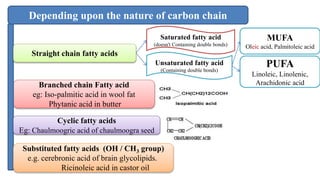
Depending upon the nature of carbon chain
Branched chain Fatty acid
eg: Iso-palmitic acid in wool fat
Phytanic acid in butter
Cyclic fatty acids
Eg: Chaulmoogric acid of chaulmoogra seed
Substituted fatty acids (OH / CH3 group)
e.g. cerebronic acid of brain glycolipids.
Ricinoleic acid in castor oil
Straight chain fatty acids
Saturated fatty acid
(doesn't Containing double bonds)
Unsaturated fatty acid
(Containing double bonds)
MUFA
Oleic acid, Palmitoleic acid
PUFA
Linoleic, Linolenic,
Arachidonic acid
ESSENTIAL FATTY ACIDS / PUFA
Which cannot be synthesized in the body & they have to be essentially
supplied in the diet and required for optimal health.
Eg: Linoleic acid, Linolenic acid & Arachidonic acid
EFAs Linoleic acids Linolenic acids Arachidonic acid
Double bonds 2 - (C18:2: ∆9,12) 3 - (C18:3: ∆9,12,15). 4 -(C20:4: ∆5, 8, 11, 14)
Formula CnH2n-3 COOH CnH2 n-5 COOH CnH2n-7 COOH
Sources Peanut, Coconut, cotton
seed, sun flower, soybean
oils & egg yolk.
Lineseed, Rapeseed,soy
bean oils, cod liver oil
Peanut oil & animal
fats
Family Omega (ω)-6 ω -3 ω -6
Clinical
significance
It attached to cerebrosides
in the skin & form acyl-
glucosylceramide
Helps to make the skin
impermeable to water
Deficiency leads to skin
lesions & Red scaly
dermatitis
Docosa hexaenoic acid
/ Cervonic acid (22C)
syn from linolenic acid
Needed for
development of the
retina & brain during
neonatal period
Linoleic acid by
addition of acetyl Co-
A
Precursor for
Eicosanoids
Required for proper development, structure &
functioning of the brain and nervous system.
Necessary for the formation of Eicosanoids
Antiatherogenic effect (reduces serum cholesterol)
Prevention of fatty liver.
Function of
EFA
It involved in the cell membrane structure
Regulating BP, blood viscosity, vasoconstriction,
& response to immune & inflammatory.
Eicosanoids
[Derived from 20C PUFA (Arachidonic acid)]
EICOSANOIDS
Lipoxygenase System
Prostacycline
(PGI)
Prostaglandins
(PGs)
•Leukotrienes (LTs)
•Lipoxins (LXs)
Cycloxygenase system
PROSTANOIDS
Thromboxanes
(Tx)
Eicosanoids Functions
Prostanoids:
20C FAs
- Cyclopentane ring
- OHgp at 15th
position
- Trans double bond
at 13th position
Prostaglandins: Most potent vasodilators, increased capillary
permeability, inhibitor of platelet aggregation
Prostacyclins: prevent thrombus formation (act as Vasodilators,
Inhibit platelet aggregation & blood clotting)
Thromboxane: favors thrombus formation (Vasoconstrictor and
enhances platelet aggregation)
Leukotrienes
leucocytes &
macrophages
- Increases vascular permeability,
- Mediators in inflammation reactions.
- Stimulate Chemotaxis & chemokinines of neutrophils & eosinophils
Lipoxins
leucocytes &
macrophages
Vasoactivator
Immuno-modulatory and anti-inflammatory actions
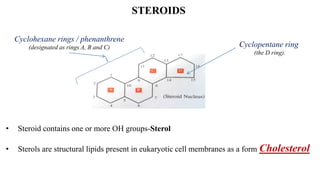
STEROIDS
• Steroid contains one or more OH groups-Sterol
• Sterols are structural lipids present in eukaryotic cell membranes as a form Cholesterol
Cyclohexane rings / phenanthrene
(designated as rings A, B and C) Cyclopentane ring
(the D ring).
It produced by the liver & we consume it from
meat and dairy products
Structure of Cholesterol
General formula: C27H46O
Cyclo pentano per hydro
phenanthrene
Aliphatic side chain
Polar head non polar
Amphipathic in nature
Cholesterol Esters
• Excess cholesterol is stored as cholesterol
esters in cytosolic lipid droplets
In total cholesterol :
• About 30% free form (un esterified)
70% - cholesteryl esters form
Functions of cholesterol:
• It is major structural components in biological membranes.
• Component of lipoproteins, it helps transport lipids and fat soluble vitamins.
• It is a poor conductor of heat &electricity
• Decrease membrane fluidity
Vit -D3 (Cholecalciferol):
– It formed from cholesterol.
– Vit-D3 enhancing intestinal absorption of Ca+ and helps in bone formation.
Synthesis of steroid hormones :
• Glucocorticoids, Mineralocorticoids & sex hormones (estrogen and
progesterone),
• Helps to control metabolisms, inflammation, immune functions, water and
electrolyte balance & development of sexual characteristics.
- It forms Bile acids & Bile salts
• Synthesized in the liver from cholesterol and Stored & concentrated in the gallbladder.
Bile acids:
Primary Bile Acids - Glyco cholic acid & Tauro cholic acid
Glyco chenodeoxycholic acid & Tauro chenodeoxycholic acid
Secondary Bile Acids- Deoxycholic Acid
Lithocholic acid
Bile salts: Na+ & K + glycocholic acid
Na + & K + Tauro chenodeoxy cholic acid
Functions of Bile acids & Bile salts:
• They make easy to the digestion of dietary TG by acting as emulsifying agents that
render fats accessible to pancreatic lipases.
• Discharged into gut and aides in absorption of intra luminal lipids, cholesterol, & fat
soluble vitamins.
• Bile acids & phospholipids solubilize cholesterol in the bile -preventing the
precipitation of cholesterol in the gallbladder.
Disorders of lipid
• Q: A 45 year old attended medical OPD complaining of pain abdomen, loss of
appetite, weight loss, weakness, fatigue, itchy skin and light yellowish color of
the skin. Patient gives H/O chronic alcoholism. O/E mild jaundice + Ve, Pallor
Present, and liver enlarged. Serum looks opalescent, turbid and lipemic.
a) What is your probable diagnosis?
b) What are the causes for your diagnosis?
c) What are the biochemical parameters measured under lipid profile and
enzymes?
d) Explain how lipotropic factors prevent above condition.
FATTY LIVER
 Fatty liver disease (steatosis) is a condition caused by having too much fat
deposited in the liver.
 Major risk factors include obesity and type 2 diabetes associated with
excessive alcohol consumption.
Symptoms occur, fatigue, weight loss and abdominal pain.
Lipotropic factor – substances that prevents fat deposition in the liver (fatty
liver ) eg: choline, betaine, essential fatty acids, Methionine, Vit-B12 & folic
acid
Q: Deficiency of lung surfactant causes respiratory distress
syndrome (1+2+1+1)
– What is the composition of lung surfactant
– Functions of lung surfactant
– What is the biochemical basis for respiratory distress syndrome
– What is the significance of L: S ratio
Gallstones
Bile acids & phospholipids solubilize cholesterol in the bile
It preventing the precipitation of cholesterol in the gallbladder to reduced
gallstone formation
Slideshare
www.slideshare.net
santhoshkumar2185

class-3 Derived lipids (steorids).pptx

  • 1.
    Derived lipids Have anice day to all Believe your self By Dr. Santhosh Kumar.N Associate Professor
  • 2.
    III. Derived lipids Lipidsobtained after hydrolysis of the simple & complex lipids, which possess characteristics of lipids.  Fatty acids  Steroids
  • 3.
    Respiratory distress syndromeis caused by deficiency of a) Cephalin, b) Cardiolipin , c) Sphingomylin, d) lecithin Caramide is made up of a) Sphingosine+ fatty acid, b) Sphingosine+ glycerol c) glycerol+fatty acid d) None of above Composition of lung surfactant? - Dipalmitoyl lecithin Constituents of lung surfactant? - Dipalmitoyl lecithin, phosphatidyl glycerol, & surfactant proteins- A, B,& C – Glycolipids Which phospholipid is involved in blood coagulation – Phosphatidyl ethanolamine Name the non-phosphorylated lipids
  • 4.
    Q:Which glycolipids containssialic acid – Ganglioside (Ceramide+ oligosaccharide+ N- acetyl neuraminic acid) - Unpleasant odor, taste & flavor in foods due to deterioration of natural fats either due to hydrolysis or oxidation Q: Why linoleic & linolenic acid cannot be synthesized in our body? - Lack of enzyme to introduce double bonds at carbon atoms beyond C 9 in the fatty acid. Q: Define Rancidity Q: Name the synthetic antioxidant to prevent rancidity As food additives - Butylated hydroxy anisole (BHA), Propyl gallate & Butylated hydroxy toluene
  • 5.
    FATTY ACIDS R COOH Monocarboxylic acids with a long hydrocarbon side chain (amphipathic in nature) Hydrophilic /polar Hydrophobic /non polar
  • 6.
    Sources Rich sources: VegetableOils Fish Other sources: Nuts Seeds Soya products Beans and whole grains
  • 7.
    Classification of fattyacids Fatty acids are mainly 3 types depending on. - Length of hydrocarbon chain. - Representation of double bonds of FAs - Chain nature
  • 8.
    I. Depending onthe length of hydrocarbon chain Acetic (2) Vinegar Butyric (4) Butter Caproic (6) Butter Short chain fatty acids (2 to 6 carbon atoms) Medium chain fatty acids (8 to 14 carbon atoms) Long chain fatty acids (16 to 24 carbon atoms) Caprylic Acid (8) Coconut oil Capric Acid (10) Coconut oil Lauric Acid (12) Coconut oil Myristic Acid(14) Palm oil Palmitoleic Acid (16) animal fats Oleic Acid (18) olive oil Linoleic Acid (18) sunflower oil α-Linolenic Acid (18) linseed oil Arachidonic Acid (20) liver fats Behenic acid (22) rapeseed oil
  • 9.
    2. Representation ofdouble bonds of fatty acids C- system Eg: Oleic acid – (C:18:1:∆9) / (C:18:1:ω9) ω – system i.e. C1 being the carboxyl carbon i.e. C1 being the methyl carbon (ω carbon)
  • 10.
    3. Depending uponthe nature of carbon chain Straight chain fatty acids Saturated fatty acid eg: butanoic acid
  • 11.
    Depending on thetotal number of carbon atoms of Saturated fatty acid Even chain fatty acid Odd chain fatty acid common name no of ‘C’ atoms Occurrence Acetic acid 2 Vinegar Butyric acid 4 Butter Caproic acid 6 ,,, Lauric Acid 12 Coconut oil Linoleic acid 18 Vegetable oil common name no of ‘C’ atoms Occurrence Propionic acid 3 Metabolic intermediate Valeric acid 5 ,,
  • 12.
    Depending upon thenature of carbon chain Branched chain Fatty acid eg: Iso-palmitic acid in wool fat Phytanic acid in butter Cyclic fatty acids Eg: Chaulmoogric acid of chaulmoogra seed Substituted fatty acids (OH / CH3 group) e.g. cerebronic acid of brain glycolipids. Ricinoleic acid in castor oil Straight chain fatty acids Saturated fatty acid (doesn't Containing double bonds) Unsaturated fatty acid (Containing double bonds) MUFA Oleic acid, Palmitoleic acid PUFA Linoleic, Linolenic, Arachidonic acid
  • 13.
    ESSENTIAL FATTY ACIDS/ PUFA Which cannot be synthesized in the body & they have to be essentially supplied in the diet and required for optimal health. Eg: Linoleic acid, Linolenic acid & Arachidonic acid
  • 14.
    EFAs Linoleic acidsLinolenic acids Arachidonic acid Double bonds 2 - (C18:2: ∆9,12) 3 - (C18:3: ∆9,12,15). 4 -(C20:4: ∆5, 8, 11, 14) Formula CnH2n-3 COOH CnH2 n-5 COOH CnH2n-7 COOH Sources Peanut, Coconut, cotton seed, sun flower, soybean oils & egg yolk. Lineseed, Rapeseed,soy bean oils, cod liver oil Peanut oil & animal fats Family Omega (ω)-6 ω -3 ω -6 Clinical significance It attached to cerebrosides in the skin & form acyl- glucosylceramide Helps to make the skin impermeable to water Deficiency leads to skin lesions & Red scaly dermatitis Docosa hexaenoic acid / Cervonic acid (22C) syn from linolenic acid Needed for development of the retina & brain during neonatal period Linoleic acid by addition of acetyl Co- A Precursor for Eicosanoids
  • 16.
    Required for properdevelopment, structure & functioning of the brain and nervous system. Necessary for the formation of Eicosanoids Antiatherogenic effect (reduces serum cholesterol) Prevention of fatty liver. Function of EFA It involved in the cell membrane structure Regulating BP, blood viscosity, vasoconstriction, & response to immune & inflammatory.
  • 17.
    Eicosanoids [Derived from 20CPUFA (Arachidonic acid)] EICOSANOIDS Lipoxygenase System Prostacycline (PGI) Prostaglandins (PGs) •Leukotrienes (LTs) •Lipoxins (LXs) Cycloxygenase system PROSTANOIDS Thromboxanes (Tx)
  • 18.
    Eicosanoids Functions Prostanoids: 20C FAs -Cyclopentane ring - OHgp at 15th position - Trans double bond at 13th position Prostaglandins: Most potent vasodilators, increased capillary permeability, inhibitor of platelet aggregation Prostacyclins: prevent thrombus formation (act as Vasodilators, Inhibit platelet aggregation & blood clotting) Thromboxane: favors thrombus formation (Vasoconstrictor and enhances platelet aggregation) Leukotrienes leucocytes & macrophages - Increases vascular permeability, - Mediators in inflammation reactions. - Stimulate Chemotaxis & chemokinines of neutrophils & eosinophils Lipoxins leucocytes & macrophages Vasoactivator Immuno-modulatory and anti-inflammatory actions
  • 19.
    STEROIDS • Steroid containsone or more OH groups-Sterol • Sterols are structural lipids present in eukaryotic cell membranes as a form Cholesterol Cyclohexane rings / phenanthrene (designated as rings A, B and C) Cyclopentane ring (the D ring).
  • 20.
    It produced bythe liver & we consume it from meat and dairy products
  • 21.
    Structure of Cholesterol Generalformula: C27H46O Cyclo pentano per hydro phenanthrene Aliphatic side chain Polar head non polar Amphipathic in nature
  • 22.
    Cholesterol Esters • Excesscholesterol is stored as cholesterol esters in cytosolic lipid droplets In total cholesterol : • About 30% free form (un esterified) 70% - cholesteryl esters form
  • 23.
    Functions of cholesterol: •It is major structural components in biological membranes. • Component of lipoproteins, it helps transport lipids and fat soluble vitamins. • It is a poor conductor of heat &electricity • Decrease membrane fluidity
  • 24.
    Vit -D3 (Cholecalciferol): –It formed from cholesterol. – Vit-D3 enhancing intestinal absorption of Ca+ and helps in bone formation. Synthesis of steroid hormones : • Glucocorticoids, Mineralocorticoids & sex hormones (estrogen and progesterone), • Helps to control metabolisms, inflammation, immune functions, water and electrolyte balance & development of sexual characteristics.
  • 25.
    - It formsBile acids & Bile salts • Synthesized in the liver from cholesterol and Stored & concentrated in the gallbladder. Bile acids: Primary Bile Acids - Glyco cholic acid & Tauro cholic acid Glyco chenodeoxycholic acid & Tauro chenodeoxycholic acid Secondary Bile Acids- Deoxycholic Acid Lithocholic acid Bile salts: Na+ & K + glycocholic acid Na + & K + Tauro chenodeoxy cholic acid
  • 26.
    Functions of Bileacids & Bile salts: • They make easy to the digestion of dietary TG by acting as emulsifying agents that render fats accessible to pancreatic lipases. • Discharged into gut and aides in absorption of intra luminal lipids, cholesterol, & fat soluble vitamins. • Bile acids & phospholipids solubilize cholesterol in the bile -preventing the precipitation of cholesterol in the gallbladder.
  • 27.
  • 28.
    • Q: A45 year old attended medical OPD complaining of pain abdomen, loss of appetite, weight loss, weakness, fatigue, itchy skin and light yellowish color of the skin. Patient gives H/O chronic alcoholism. O/E mild jaundice + Ve, Pallor Present, and liver enlarged. Serum looks opalescent, turbid and lipemic. a) What is your probable diagnosis? b) What are the causes for your diagnosis? c) What are the biochemical parameters measured under lipid profile and enzymes? d) Explain how lipotropic factors prevent above condition.
  • 29.
    FATTY LIVER  Fattyliver disease (steatosis) is a condition caused by having too much fat deposited in the liver.  Major risk factors include obesity and type 2 diabetes associated with excessive alcohol consumption. Symptoms occur, fatigue, weight loss and abdominal pain. Lipotropic factor – substances that prevents fat deposition in the liver (fatty liver ) eg: choline, betaine, essential fatty acids, Methionine, Vit-B12 & folic acid
  • 31.
    Q: Deficiency oflung surfactant causes respiratory distress syndrome (1+2+1+1) – What is the composition of lung surfactant – Functions of lung surfactant – What is the biochemical basis for respiratory distress syndrome – What is the significance of L: S ratio
  • 32.
    Gallstones Bile acids &phospholipids solubilize cholesterol in the bile It preventing the precipitation of cholesterol in the gallbladder to reduced gallstone formation
  • 33.