PLASMA MEMBRANE :
TRANSPORT SYSTEM
Presented by:
Dr. Ayesha Fatima
Assistant Professor
Transport across Cell Membrane
• Plasma membrane acts as a barrier to most, but not all molecules.
• Plasma membrane is a semi-permeable barrier separating the inner
cellular environment from the outer cellular environment.
• Since the plasma membrane is made up of a lipid bilayer with proteins
attached on the surface and also passing through the cell membrane, there
is possibility of transport across this membrane.
• All lipid soluble substances can easily and freely diffuse in and out, e.g.
O2 and CO2. Water soluble substances like ions, glucose and
macromolecules should find a special way of transport with the help of
integral and trans-membrane proteins which act as binding sites, channels
and gates to facilitate movement.
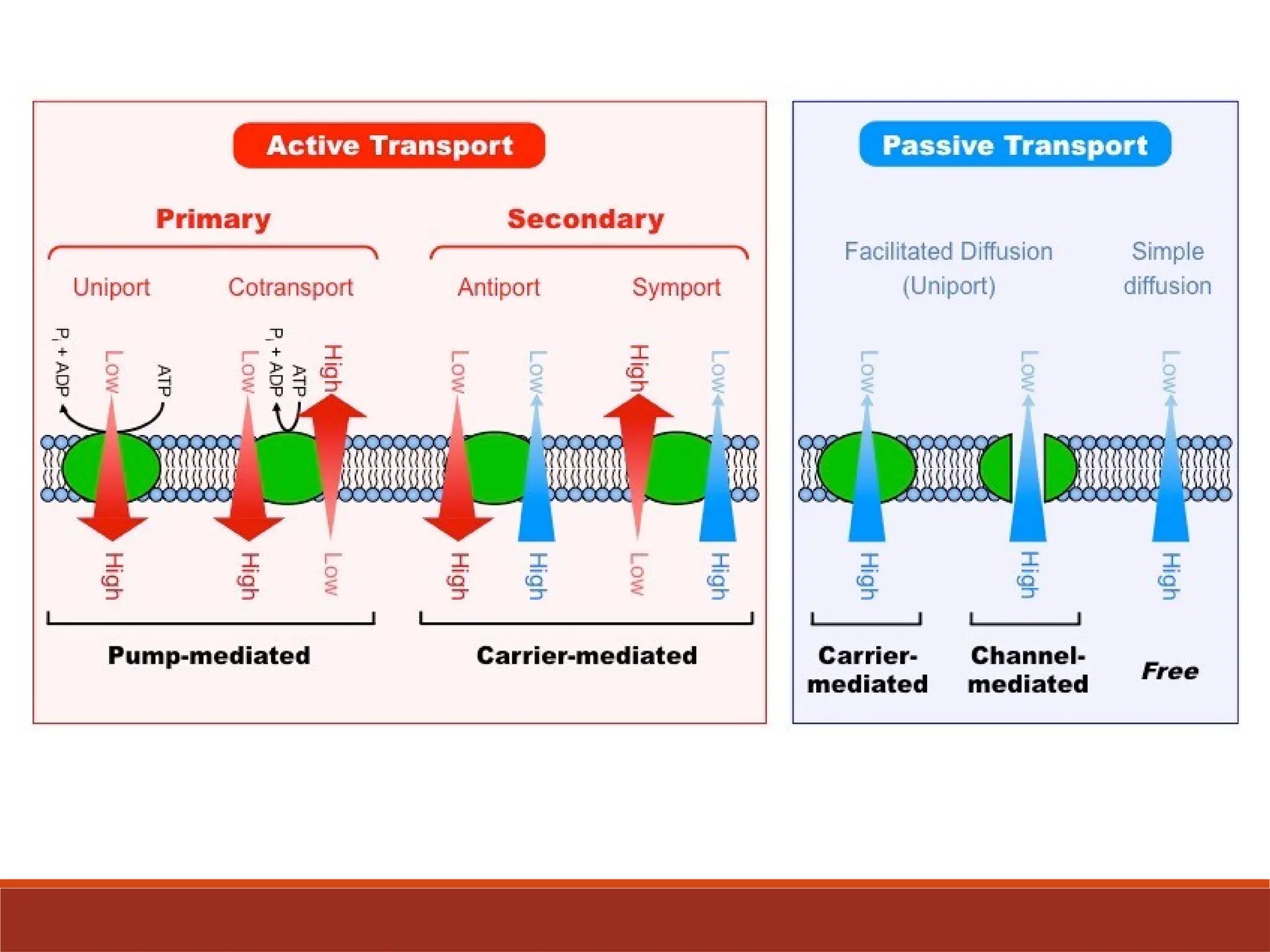
• Transport across cell membrane is classified into four ways:
1. Passive Transport
2. Osmosis
3. Active Transport
4. Vesicular Transport.
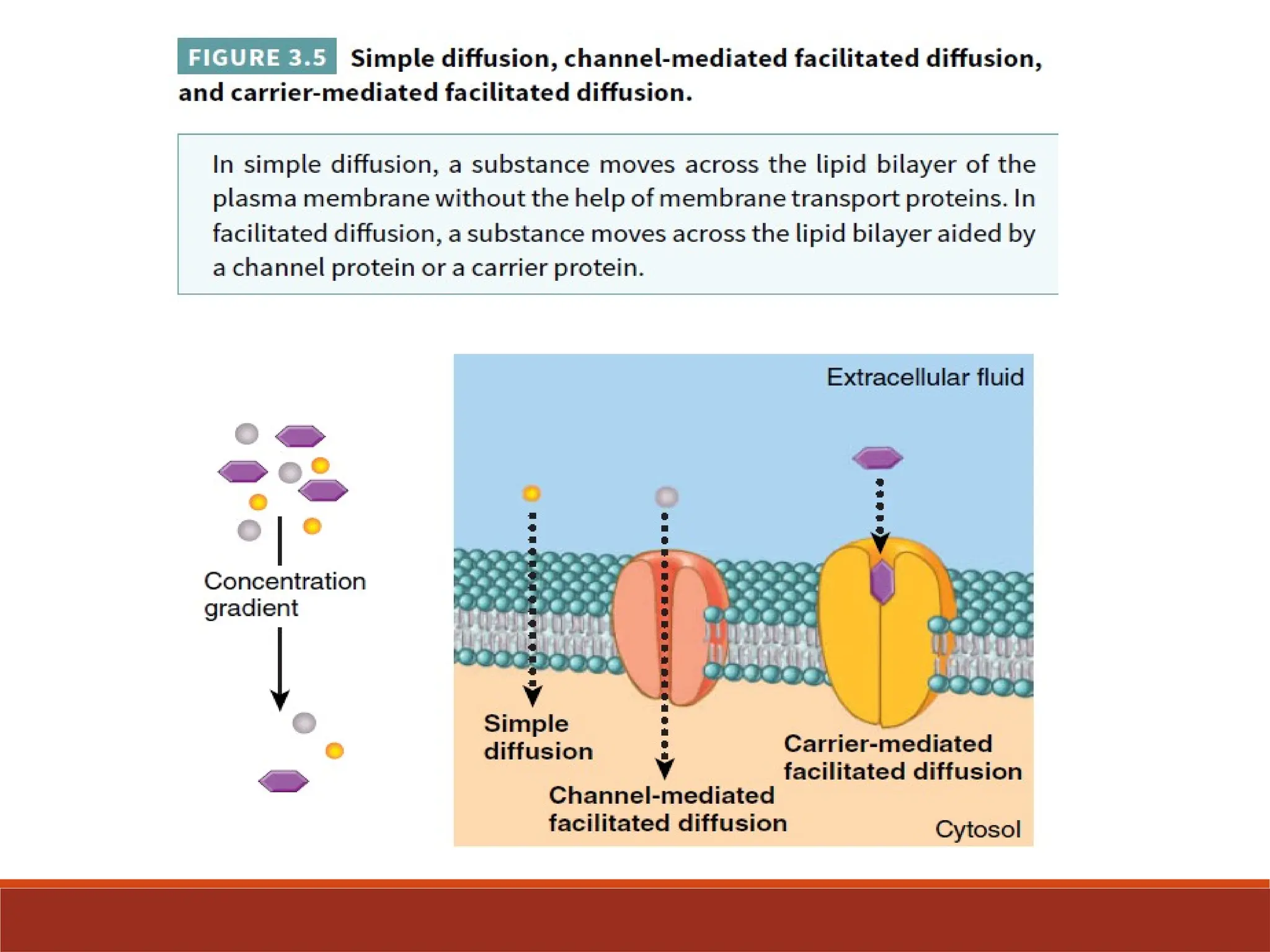
Passive Transport : Diffusion
It is the net movement of a substance (liquid or gas) from an area of higher
concentration to lower concentration without expenditure of energy is called
diffusion.
Diffusion can be further divided as follows:
A. Simple diffusion
B. Facilitated diffusion.
A. Simple Diffusion: It is further classified into two categories:
i. Diffusion of lipid soluble substance through lipid bilayer.
ii. Diffusion of lipid insoluble substance through protein channels.
i. Diffusion of Lipid Soluble Substance through the Lipid Bilayer:
Substance like oxygen and carbon dioxide and alcohols are highly lipid
soluble and dissolve in the layer easily and diffuse through the membrane. The
rate of diffusion is determined by the solubility of the substance. For example,
exchange of gases in the lungs.
ii. Diffusion of Lipid Insoluble Substance through Protein Channels:
This is possible through either selective permeability of protein channel or
through gated channels
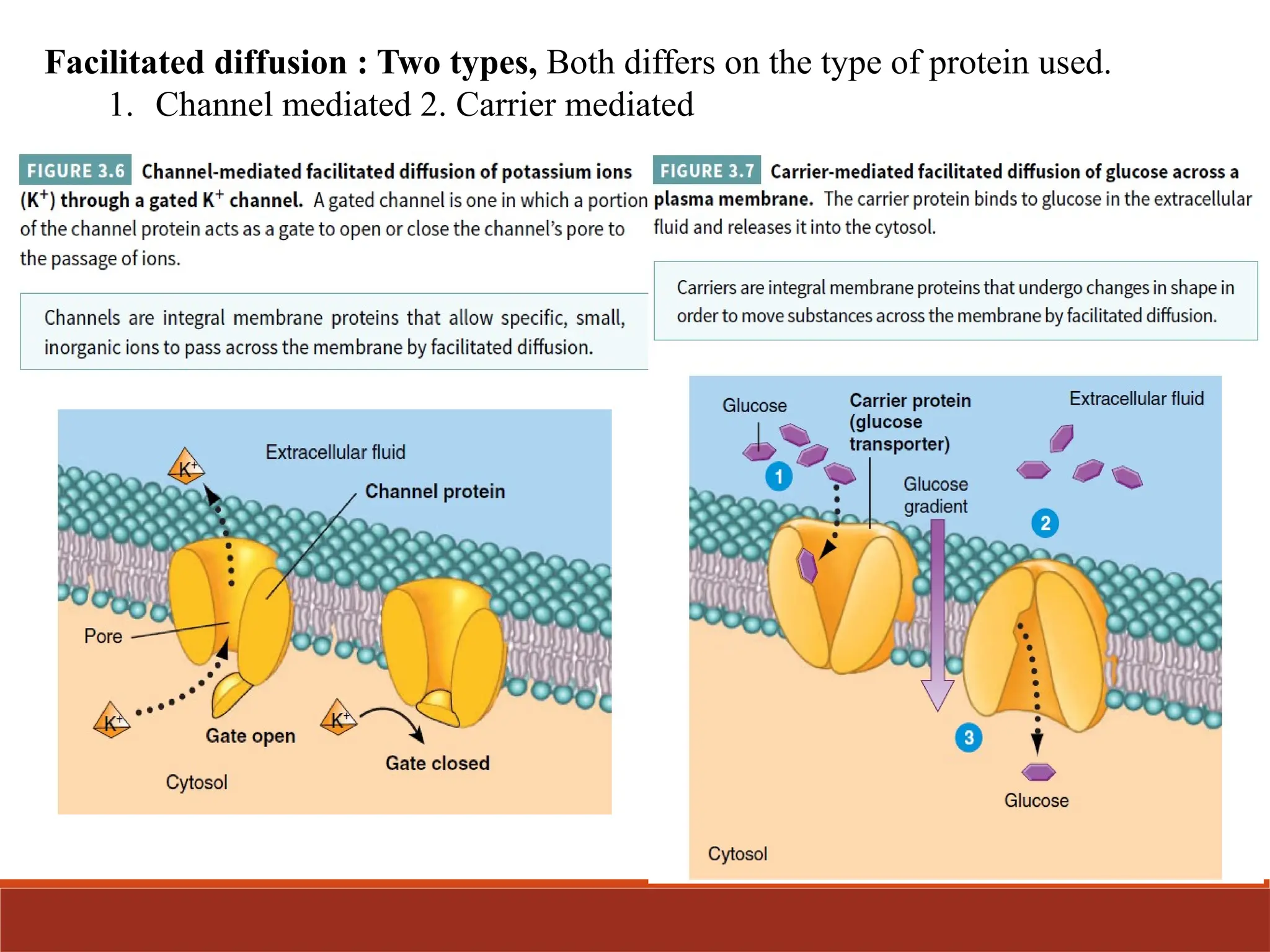
Facilitated diffusion : Two types, Both differs on the type of protein used.
1. Channel mediated 2. Carrier mediated
CHANNEL-MEDIATED FACILITATED DIFFUSION
• In channel-mediated facilitated diffusion, a solute moves down its
concentration gradient across the lipid bilayer through a membrane channel.
• Membrane channels are ion channels, integral transmembrane proteins that
allow passage of small, inorganic ions that are too hydrophilic to penetrate the
nonpolar interior of the lipid bilayer.
• Each ion can diff use across the membrane only at certain sites.
• In typical plasma membranes, the most numerous ion channels are selective
for K+ ions or Cl− ions; fewer channels are available for Na+ ions or Ca2+
ions.
• Diffusion of ions through channels is generally slower than free diffusion
through the lipid bilayer because channels occupy a smaller fraction of the
membrane’s total surface area than lipids.
• A channel is said to be gated when part of the channel protein acts as a “plug”
or “gate,” changing shape in one way to open the pore and in another way to
close it. Gated channels randomly alternate between the open and closed
positions;
• regulated by chemical or electrical changes inside and outside the cell.
• When the gates of a channel are open, ions diffuse into or out of cells, down
their electrochemical gradients.
CARRIER-MEDIATED FACILITATED DIFFUSION
• In carrier-mediated facilitated diffusion, a carrier (also called a transporter)
moves a
• solute down its concentration gradient across the plasma membrane
• The solute binds to a specific carrier on one side of the membrane and is released
on the other side aft er the carrier undergoes a change in shape.
• The solute binds more often to the carrier on the side of the membrane with a
higher concentration of solute.
• Once the concentration is the same on both sides of the membrane, solute
molecules bind to the carrier on the cytosolic side and move out to the
extracellular fluid as rapidly as they bind to the carrier on the extracellular side
and move into the cytosol.
• The number of carriers available in a plasma membrane places an upper limit,
called the transport maximum, on the rate at which facilitated diffusion can
occur.
• Once all of the carriers are occupied, the transport maximum is reached, and a
further increase in the concentration gradient does not increase the rate of
facilitated diffusion, the process of carrier-mediated facilitated diffusion exhibits
saturation.
• Substances that move across the plasma membrane by carrier mediated facilitated
diffusion include glucose, fructose, galactose, and some vitamins
OSMOSIS
• Osmosis is a type of diffusion in which there is net movement of a
solvent through a selectively permeable membrane. It is a passive
process
• In osmosis, water moves through a selectively permeable membrane
from an area of lower solute concentration to an area of higher solute
concentration.
• During osmosis, water molecules pass through a plasma membrane in
two ways:
1. by moving between neighboring phospholipid molecules in the lipid
bilayer via simple diffusion,
2. by moving through aquaporins or AQPs, integral membrane proteins
that function as water channels.
• Different types of AQPs have been found in different cells and tissues
throughout the body. AQPs are responsible for the production of
cerebrospinal fluid, aqueous humor, tears, sweat, saliva, and the
concentration of urine.
• Osmosis occurs only when a membrane is permeable to water but is not
permeable to certain solutes.
• Diffusion of water across a membrane generates a pressure called osmotic
pressure. If the pressure in the compartment into which water is flowing is
raised to the equivalent of the osmotic pressure, movement of water will stop.
This pressure is often called hydrostatic ('water-stopping') pressure
• The amount of pressure needed to restore the startingcondition equals the
osmotic pressure. Hydrostatic pressure is the pressure exerted by a fluid at rest
due to gravity
• The osmotic pressure of the cytosol is the same as the osmotic pressure of
the interstitial fluid outside cells. Because the osmotic pressure on both sides
of the plasma membrane is the same, cell volume remains relatively
• constant.
• When body cells are placed in a solution having a different osmotic pressure
than cytosol, however, the shape and volume of the cells change.
• As water moves by osmosis into or out of the cells, their volume increases or
decreases
• A solution’s tonicity is a measure of the solution’s ability to change the
volume of cells by altering their water content.
•Isotonic: The solutions being compared have equal concentration of solutes.
• When the cell is placed in isotonic solution, the water diffuses in and out of the
cell in same rate.
• Ex. RBC placed in 0.9% NaCl solution, RBC maintain its cell shape and
volume.
•Hypertonic: The solution with the higher concentration of solutes.
• When cell is placed in hypertonic solution, water diffuses out of the cell
causing the cell to shrink. Such shrinkage is called as Crenation.
• Ex. RBC placed in 2% NaCl solution, RBC Shrink
•Hypotonic: The solution with the lower concentration of solutes.
• When cell is placed in hypotonic solution, the water diffuses into the cell
causing it to swell and possible explode. Explosion/rupture by this process
called as lysis.
• Ex. RBC placed in 0.45% NaCl solution, RBC Swell and rupture called as
hemolysis.
Active Transport
• Some polar or charged solutes that must enter or leave body cells cannot cross
the plasma membrane through any form of passive transport because they
would need to move “uphill,” against their concentration gradients. Such
solutes may be able to cross the membrane by a process called active
transport.
• Active transport is an active process because energy is required for carrier
proteins to move solutes across the membrane against a concentration gradient.
• Two sources of cellular energy can be used to drive active transport:
(1) Energy obtained from hydrolysis of ATP is the source in primary active
transport;
(2) energy stored in an ionic concentration gradient is the source in secondary
active transport.
• Active transport processes transport maximum and saturation.
• Solutes actively transported across the plasma membrane include several ions,
such as Na+, K+, H+, Ca2+, I− (iodide ions), and Cl−; amino acids; and
monosaccharides
• Small substances constantly pass through plasma membranes.
• Active transport maintains concentrations of ions and other substances needed
by living cells in the face of these passive movements.
• Active transport mechanisms depend on a cell’s metabolism for energy, they are
sensitive to many metabolic poisons that interfere with the supply of ATP.
• Two mechanisms exist for the transport of small-molecular weight material and
small molecules.
• Primary active transport moves ions across a membrane and creates a
difference in charge across that membrane, which is directly dependent on ATP.
• Secondary active transport describes the movement of material that is due to
the electrochemical gradient established by primary active transport that does
not directly require ATP.
Carrier Proteins for Active Transport
• An important membrane adaption for active transport is the presence of specific
carrier proteins or pumps to facilitate movement: there are three types of these
proteins or transporters.
• A Uniporter carries one specific ion or molecule.
• A Symporter carries two different ions or molecules, both in the same
direction.
• An Antiporter also carries two different ions or molecules, but in different
directions.
• All of these transporters can also transport small, uncharged organic molecules
like glucose. These three types of carrier proteins are also found in facilitated
diffusion, but they do not require ATP to work in that process.
• Some examples of pumps for active transport are Na+
-K+
ATPase, which
carries sodium and potassium ions, and H+
-K+
ATPase, which carries hydrogen
and potassium ions.
• Both of these are antiporter carrier proteins.
• Two other carrier proteins (both are pumps) are Ca2+
ATPase and H+
ATPase,
which carry only calcium and only hydrogen ions, respectively.
A uniporter carries one molecule or ion.
A symporter carries two different molecules or ions, both in the same direction.
An antiporter also carries two different molecules or ions, but in different
directions.
PRIMARY ACTIVE TRANSPORT
• In primary active transport, the energy is derived directly from the breakdown
of ATP.
Ion-pumps may be of two types:
(i) Electro neutral pumps (ii) Electro genic pumps.
1. Electro neutral pumps are those which are associated with transport of ions
with no net move­
ment of charge across the membrane.
• For example H+
/K+
-ATPase of some animal cells, pumps out one H+
for each
K+
taken in with no net movement of charge. Therefore, it is an electro neutral
pump.
2. Electro genic pumps on the other hand, transport ions involving net
movement of charge across the membrane.
• One of the most important pumps is the sodium-potassium pump (Na+
-K+
ATPase), which maintains the electrochemical gradient in living cells.
• The sodium-potassium pump moves K+
into the cell while moving Na+
out
at the same time, at a ratio of three Na+
for every two K+
ions moved in.
• The Na+
-K+
ATPase exists in two forms, depending on its orientation to the
interior or exterior of the cell and its affinity for either sodium or potassium
ions
Electro neutral pumps : Proton-ATPase Pumps (H+
-ATPases):
• These pumps are also known as P-type ATPases and are found in plasma
membrane, and possibly other cell membranes.
• These are structurally distinct and operate in reverse of F-type ATPases i.e.,
they hydrolyse ATP instead of synthesizing it (ATPases of mitochon­
dria is
also known as F-type ATPases)
• This enzyme protein is a single chain polypeptide with 10 hydrophobic trans
membrane seg­
ments or domains .
• These segments are joined by hydrophilic loops which project in cyto­
sol and
cell wall (apoplast).
• The ATP binding site is believed to be an aspartic acid residue (D) situated on
loop connecting 4th and 5th segments towards cytosilic side.
• Hydrolysis of ATP causes conformational change in the protein and one H+
ion is transported from cytosol to outside across the plasma membrane.
Electrogenic pumps:- Na+
/K+
– ATPase
• The most prevalent primary active transport mechanism expels sodium ions (Na+)
from cells and brings potassium ions (K+) in. Because of the specific ions it
moves, this carrier is called the sodium–potassium pump. Because a part of the
sodium–potassium pump acts as an ATPase, an enzyme that hydrolyzes ATP,
another name for this pump is Na+–K+ ATPase.
• These sodium– potassium pumps maintain a low concentration of Na+ in the
cytosol, by pumping these ions into the extracellular fluid against the Na+
concentration gradient.
• At the same time, the pumps move K+ into cells against the K+ concentration
gradient. Because K+ and Na+ slowly leak back across the plasma membrane
down their electrochemical gradients—through passive transport or secondary
active transport—the sodium–potassium pumps must work nonstop to maintain a
low concentration of Na+ and a high concentration of K+ in the cytosol.
1. Three Na+ in the cytosol bind to the pump protein.
2. Binding of Na+ triggers the hydrolysis of ATP into ADP, a reaction that also attaches a
phosphate group P to the pump protein. This chemical reaction changes the shape of
the pump protein, expelling the three Na+ into the extracellular fluid. Now the shape of
the pump protein favors binding of two K+ in the extracellular fluid to the pump
protein.
3. The binding of K+ triggers release of the phosphate group from the pump protein. This
reaction again causes the shape of the pump protein to change.
4. As the pump protein reverts to its original shape, it releases K+ into the cytosol. At this
point, the pump is again ready to bind three Na+, and the cycle repeats.
Secondary active transport
• In secondary active transport, the energy stored in a Na+ or H+ concentration
gradient is used to drive other substances across the membrane against their
own concentration gradients.
• Because a Na+ or H+ gradient is established by primary active transport,
secondary active transport indirectly uses energy obtained from the hydrolysis
of ATP.
• The sodium–potassium pump maintains concentration gradient of Na+ across
the plasma membrane. As a result, the sodium ions have stored energy.
• some of the stored energy converted to kinetic energy and used to transport
other substances against their concentration gradients.
• In secondary active transport, a carrier protein simultaneously binds to Na+ and
another substance and then changes its shape so that both substances cross the
membrane at the same time.
• If these transporters move two substances in the same direction they are called
symporters; antiporters, by contrast, move two substances in opposite
directions across the membrane
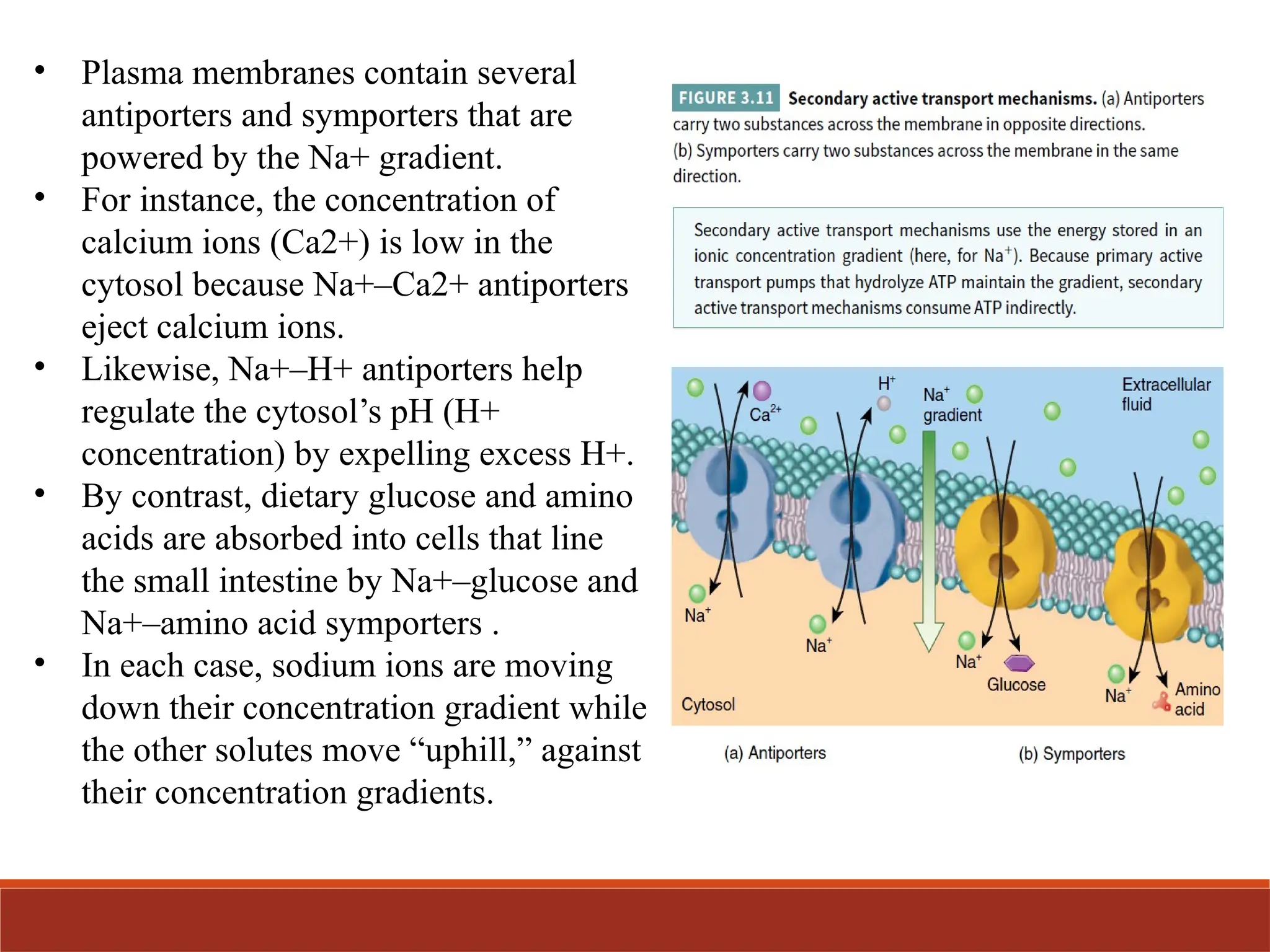
• Plasma membranes contain several
antiporters and symporters that are
powered by the Na+ gradient.
• For instance, the concentration of
calcium ions (Ca2+) is low in the
cytosol because Na+–Ca2+ antiporters
eject calcium ions.
• Likewise, Na+–H+ antiporters help
regulate the cytosol’s pH (H+
concentration) by expelling excess H+.
• By contrast, dietary glucose and amino
acids are absorbed into cells that line
the small intestine by Na+–glucose and
Na+–amino acid symporters .
• In each case, sodium ions are moving
down their concentration gradient while
the other solutes move “uphill,” against
their concentration gradients.

Transport system - Active transport, Passive transport .pptx

  • 1.
    PLASMA MEMBRANE : TRANSPORTSYSTEM Presented by: Dr. Ayesha Fatima Assistant Professor
  • 2.
    Transport across CellMembrane • Plasma membrane acts as a barrier to most, but not all molecules. • Plasma membrane is a semi-permeable barrier separating the inner cellular environment from the outer cellular environment. • Since the plasma membrane is made up of a lipid bilayer with proteins attached on the surface and also passing through the cell membrane, there is possibility of transport across this membrane. • All lipid soluble substances can easily and freely diffuse in and out, e.g. O2 and CO2. Water soluble substances like ions, glucose and macromolecules should find a special way of transport with the help of integral and trans-membrane proteins which act as binding sites, channels and gates to facilitate movement. • Transport across cell membrane is classified into four ways: 1. Passive Transport 2. Osmosis 3. Active Transport 4. Vesicular Transport.
  • 5.
    Passive Transport :Diffusion It is the net movement of a substance (liquid or gas) from an area of higher concentration to lower concentration without expenditure of energy is called diffusion. Diffusion can be further divided as follows: A. Simple diffusion B. Facilitated diffusion. A. Simple Diffusion: It is further classified into two categories: i. Diffusion of lipid soluble substance through lipid bilayer. ii. Diffusion of lipid insoluble substance through protein channels. i. Diffusion of Lipid Soluble Substance through the Lipid Bilayer: Substance like oxygen and carbon dioxide and alcohols are highly lipid soluble and dissolve in the layer easily and diffuse through the membrane. The rate of diffusion is determined by the solubility of the substance. For example, exchange of gases in the lungs. ii. Diffusion of Lipid Insoluble Substance through Protein Channels: This is possible through either selective permeability of protein channel or through gated channels
  • 6.
    Facilitated diffusion :Two types, Both differs on the type of protein used. 1. Channel mediated 2. Carrier mediated
  • 7.
    CHANNEL-MEDIATED FACILITATED DIFFUSION •In channel-mediated facilitated diffusion, a solute moves down its concentration gradient across the lipid bilayer through a membrane channel. • Membrane channels are ion channels, integral transmembrane proteins that allow passage of small, inorganic ions that are too hydrophilic to penetrate the nonpolar interior of the lipid bilayer. • Each ion can diff use across the membrane only at certain sites. • In typical plasma membranes, the most numerous ion channels are selective for K+ ions or Cl− ions; fewer channels are available for Na+ ions or Ca2+ ions. • Diffusion of ions through channels is generally slower than free diffusion through the lipid bilayer because channels occupy a smaller fraction of the membrane’s total surface area than lipids. • A channel is said to be gated when part of the channel protein acts as a “plug” or “gate,” changing shape in one way to open the pore and in another way to close it. Gated channels randomly alternate between the open and closed positions; • regulated by chemical or electrical changes inside and outside the cell. • When the gates of a channel are open, ions diffuse into or out of cells, down their electrochemical gradients.
  • 8.
    CARRIER-MEDIATED FACILITATED DIFFUSION •In carrier-mediated facilitated diffusion, a carrier (also called a transporter) moves a • solute down its concentration gradient across the plasma membrane • The solute binds to a specific carrier on one side of the membrane and is released on the other side aft er the carrier undergoes a change in shape. • The solute binds more often to the carrier on the side of the membrane with a higher concentration of solute. • Once the concentration is the same on both sides of the membrane, solute molecules bind to the carrier on the cytosolic side and move out to the extracellular fluid as rapidly as they bind to the carrier on the extracellular side and move into the cytosol. • The number of carriers available in a plasma membrane places an upper limit, called the transport maximum, on the rate at which facilitated diffusion can occur. • Once all of the carriers are occupied, the transport maximum is reached, and a further increase in the concentration gradient does not increase the rate of facilitated diffusion, the process of carrier-mediated facilitated diffusion exhibits saturation. • Substances that move across the plasma membrane by carrier mediated facilitated diffusion include glucose, fructose, galactose, and some vitamins
  • 9.
    OSMOSIS • Osmosis isa type of diffusion in which there is net movement of a solvent through a selectively permeable membrane. It is a passive process • In osmosis, water moves through a selectively permeable membrane from an area of lower solute concentration to an area of higher solute concentration. • During osmosis, water molecules pass through a plasma membrane in two ways: 1. by moving between neighboring phospholipid molecules in the lipid bilayer via simple diffusion, 2. by moving through aquaporins or AQPs, integral membrane proteins that function as water channels. • Different types of AQPs have been found in different cells and tissues throughout the body. AQPs are responsible for the production of cerebrospinal fluid, aqueous humor, tears, sweat, saliva, and the concentration of urine.
  • 10.
    • Osmosis occursonly when a membrane is permeable to water but is not permeable to certain solutes. • Diffusion of water across a membrane generates a pressure called osmotic pressure. If the pressure in the compartment into which water is flowing is raised to the equivalent of the osmotic pressure, movement of water will stop. This pressure is often called hydrostatic ('water-stopping') pressure • The amount of pressure needed to restore the startingcondition equals the osmotic pressure. Hydrostatic pressure is the pressure exerted by a fluid at rest due to gravity
  • 11.
    • The osmoticpressure of the cytosol is the same as the osmotic pressure of the interstitial fluid outside cells. Because the osmotic pressure on both sides of the plasma membrane is the same, cell volume remains relatively • constant. • When body cells are placed in a solution having a different osmotic pressure than cytosol, however, the shape and volume of the cells change. • As water moves by osmosis into or out of the cells, their volume increases or decreases • A solution’s tonicity is a measure of the solution’s ability to change the volume of cells by altering their water content.
  • 12.
    •Isotonic: The solutionsbeing compared have equal concentration of solutes. • When the cell is placed in isotonic solution, the water diffuses in and out of the cell in same rate. • Ex. RBC placed in 0.9% NaCl solution, RBC maintain its cell shape and volume. •Hypertonic: The solution with the higher concentration of solutes. • When cell is placed in hypertonic solution, water diffuses out of the cell causing the cell to shrink. Such shrinkage is called as Crenation. • Ex. RBC placed in 2% NaCl solution, RBC Shrink •Hypotonic: The solution with the lower concentration of solutes. • When cell is placed in hypotonic solution, the water diffuses into the cell causing it to swell and possible explode. Explosion/rupture by this process called as lysis. • Ex. RBC placed in 0.45% NaCl solution, RBC Swell and rupture called as hemolysis.
  • 14.
    Active Transport • Somepolar or charged solutes that must enter or leave body cells cannot cross the plasma membrane through any form of passive transport because they would need to move “uphill,” against their concentration gradients. Such solutes may be able to cross the membrane by a process called active transport. • Active transport is an active process because energy is required for carrier proteins to move solutes across the membrane against a concentration gradient. • Two sources of cellular energy can be used to drive active transport: (1) Energy obtained from hydrolysis of ATP is the source in primary active transport; (2) energy stored in an ionic concentration gradient is the source in secondary active transport. • Active transport processes transport maximum and saturation. • Solutes actively transported across the plasma membrane include several ions, such as Na+, K+, H+, Ca2+, I− (iodide ions), and Cl−; amino acids; and monosaccharides
  • 15.
    • Small substancesconstantly pass through plasma membranes. • Active transport maintains concentrations of ions and other substances needed by living cells in the face of these passive movements. • Active transport mechanisms depend on a cell’s metabolism for energy, they are sensitive to many metabolic poisons that interfere with the supply of ATP. • Two mechanisms exist for the transport of small-molecular weight material and small molecules. • Primary active transport moves ions across a membrane and creates a difference in charge across that membrane, which is directly dependent on ATP. • Secondary active transport describes the movement of material that is due to the electrochemical gradient established by primary active transport that does not directly require ATP.
  • 16.
    Carrier Proteins forActive Transport • An important membrane adaption for active transport is the presence of specific carrier proteins or pumps to facilitate movement: there are three types of these proteins or transporters. • A Uniporter carries one specific ion or molecule. • A Symporter carries two different ions or molecules, both in the same direction. • An Antiporter also carries two different ions or molecules, but in different directions. • All of these transporters can also transport small, uncharged organic molecules like glucose. These three types of carrier proteins are also found in facilitated diffusion, but they do not require ATP to work in that process. • Some examples of pumps for active transport are Na+ -K+ ATPase, which carries sodium and potassium ions, and H+ -K+ ATPase, which carries hydrogen and potassium ions. • Both of these are antiporter carrier proteins. • Two other carrier proteins (both are pumps) are Ca2+ ATPase and H+ ATPase, which carry only calcium and only hydrogen ions, respectively.
  • 17.
    A uniporter carriesone molecule or ion. A symporter carries two different molecules or ions, both in the same direction. An antiporter also carries two different molecules or ions, but in different directions.
  • 18.
    PRIMARY ACTIVE TRANSPORT •In primary active transport, the energy is derived directly from the breakdown of ATP. Ion-pumps may be of two types: (i) Electro neutral pumps (ii) Electro genic pumps. 1. Electro neutral pumps are those which are associated with transport of ions with no net move­ ment of charge across the membrane. • For example H+ /K+ -ATPase of some animal cells, pumps out one H+ for each K+ taken in with no net movement of charge. Therefore, it is an electro neutral pump. 2. Electro genic pumps on the other hand, transport ions involving net movement of charge across the membrane. • One of the most important pumps is the sodium-potassium pump (Na+ -K+ ATPase), which maintains the electrochemical gradient in living cells. • The sodium-potassium pump moves K+ into the cell while moving Na+ out at the same time, at a ratio of three Na+ for every two K+ ions moved in. • The Na+ -K+ ATPase exists in two forms, depending on its orientation to the interior or exterior of the cell and its affinity for either sodium or potassium ions
  • 19.
    Electro neutral pumps: Proton-ATPase Pumps (H+ -ATPases): • These pumps are also known as P-type ATPases and are found in plasma membrane, and possibly other cell membranes. • These are structurally distinct and operate in reverse of F-type ATPases i.e., they hydrolyse ATP instead of synthesizing it (ATPases of mitochon­ dria is also known as F-type ATPases) • This enzyme protein is a single chain polypeptide with 10 hydrophobic trans membrane seg­ ments or domains . • These segments are joined by hydrophilic loops which project in cyto­ sol and cell wall (apoplast). • The ATP binding site is believed to be an aspartic acid residue (D) situated on loop connecting 4th and 5th segments towards cytosilic side. • Hydrolysis of ATP causes conformational change in the protein and one H+ ion is transported from cytosol to outside across the plasma membrane.
  • 20.
    Electrogenic pumps:- Na+ /K+ –ATPase • The most prevalent primary active transport mechanism expels sodium ions (Na+) from cells and brings potassium ions (K+) in. Because of the specific ions it moves, this carrier is called the sodium–potassium pump. Because a part of the sodium–potassium pump acts as an ATPase, an enzyme that hydrolyzes ATP, another name for this pump is Na+–K+ ATPase. • These sodium– potassium pumps maintain a low concentration of Na+ in the cytosol, by pumping these ions into the extracellular fluid against the Na+ concentration gradient. • At the same time, the pumps move K+ into cells against the K+ concentration gradient. Because K+ and Na+ slowly leak back across the plasma membrane down their electrochemical gradients—through passive transport or secondary active transport—the sodium–potassium pumps must work nonstop to maintain a low concentration of Na+ and a high concentration of K+ in the cytosol.
  • 21.
    1. Three Na+in the cytosol bind to the pump protein. 2. Binding of Na+ triggers the hydrolysis of ATP into ADP, a reaction that also attaches a phosphate group P to the pump protein. This chemical reaction changes the shape of the pump protein, expelling the three Na+ into the extracellular fluid. Now the shape of the pump protein favors binding of two K+ in the extracellular fluid to the pump protein. 3. The binding of K+ triggers release of the phosphate group from the pump protein. This reaction again causes the shape of the pump protein to change. 4. As the pump protein reverts to its original shape, it releases K+ into the cytosol. At this point, the pump is again ready to bind three Na+, and the cycle repeats.
  • 22.
    Secondary active transport •In secondary active transport, the energy stored in a Na+ or H+ concentration gradient is used to drive other substances across the membrane against their own concentration gradients. • Because a Na+ or H+ gradient is established by primary active transport, secondary active transport indirectly uses energy obtained from the hydrolysis of ATP. • The sodium–potassium pump maintains concentration gradient of Na+ across the plasma membrane. As a result, the sodium ions have stored energy. • some of the stored energy converted to kinetic energy and used to transport other substances against their concentration gradients. • In secondary active transport, a carrier protein simultaneously binds to Na+ and another substance and then changes its shape so that both substances cross the membrane at the same time. • If these transporters move two substances in the same direction they are called symporters; antiporters, by contrast, move two substances in opposite directions across the membrane
  • 23.
    • Plasma membranescontain several antiporters and symporters that are powered by the Na+ gradient. • For instance, the concentration of calcium ions (Ca2+) is low in the cytosol because Na+–Ca2+ antiporters eject calcium ions. • Likewise, Na+–H+ antiporters help regulate the cytosol’s pH (H+ concentration) by expelling excess H+. • By contrast, dietary glucose and amino acids are absorbed into cells that line the small intestine by Na+–glucose and Na+–amino acid symporters . • In each case, sodium ions are moving down their concentration gradient while the other solutes move “uphill,” against their concentration gradients.