Physiology of the cell
by
H. Khorrami Ph.D.
http://khorrami1962.spaces.live.com
http://www.scribd.com/khorrami4
khorrami4@yahoo.com
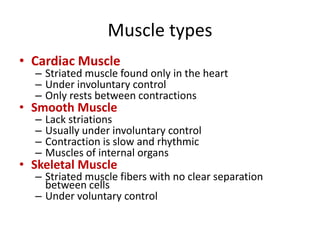
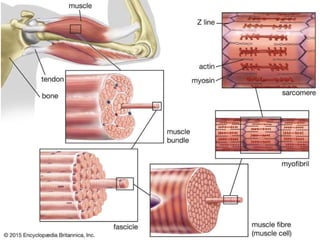
Muscle types
• Cardiac Muscle
– Striated muscle found only in the heart
– Under involuntary control
– Only rests between contractions
• Smooth Muscle
– Lack striations
– Usually under involuntary control
– Contraction is slow and rhythmic
– Muscles of internal organs
• Skeletal Muscle
– Striated muscle fibers with no clear separation
between cells
– Under voluntary control
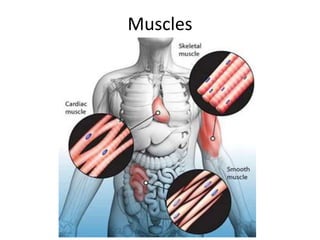
Muscles
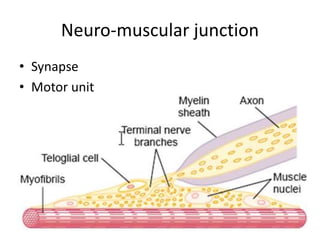
• Synapse
• Motor unit
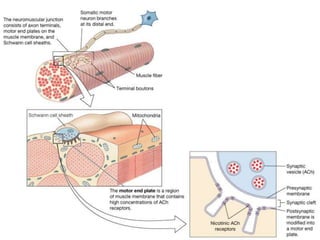
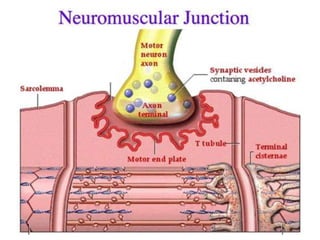
Neuro-muscular junction
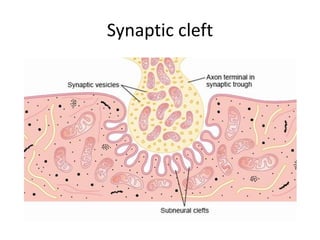
Synaptic cleft
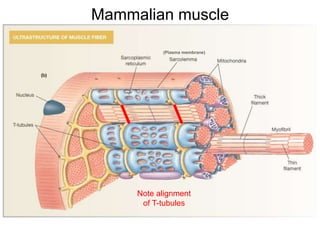
(Plasma membrane)
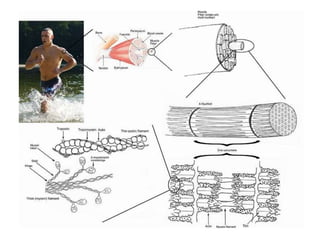
Mammalian muscle
Note alignment
of T-tubules
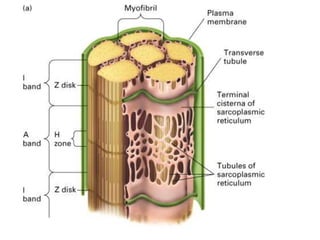
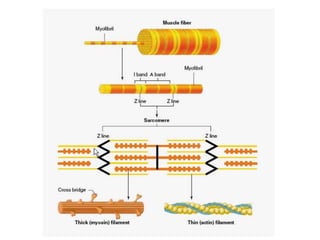
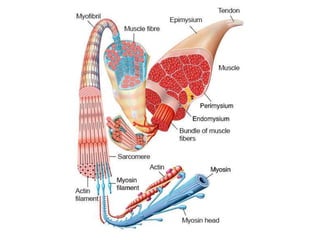
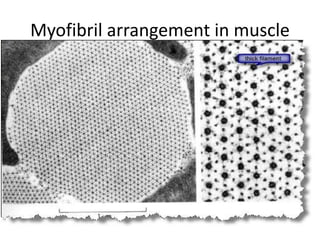
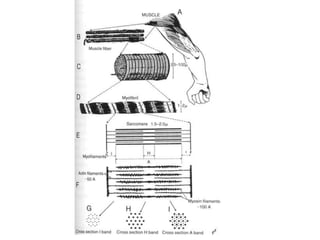
Myofibril arrangement in muscle
• http://www.youtube.com/watch?v=CepeYFvq
mk4
• https://www.youtube.com/watch?v=hr1M4Sa
F1D4
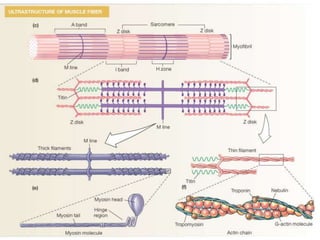
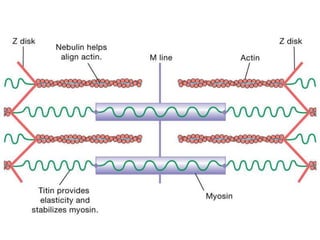
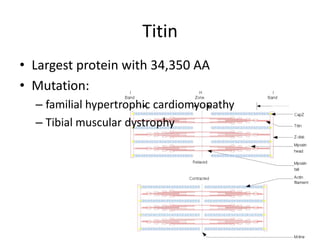
Titin
• Largest protein with 34,350 AA
• Mutation:
– familial hypertrophic cardiomyopathy
– Tibial muscular dystrophy
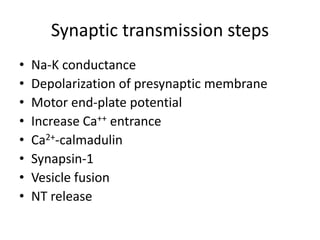
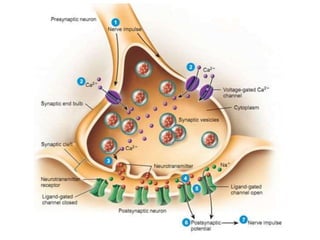
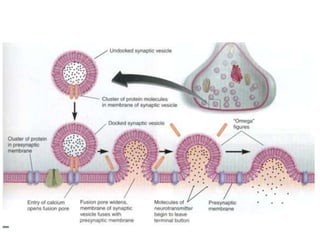
Synaptic transmission steps
• Na-K conductance
• Depolarization of presynaptic membrane
• Motor end-plate potential
• Increase Ca++ entrance
• Ca2+-calmadulin
• Synapsin-1
• Vesicle fusion
• NT release
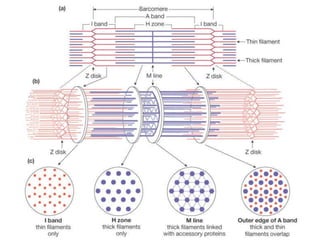
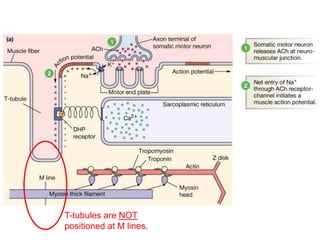
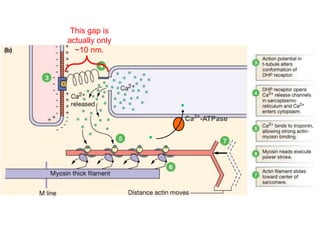
T-tubules are NOT
positioned at M lines.
This gap is
actually only
~10 nm.
Ca2+
-ATPase
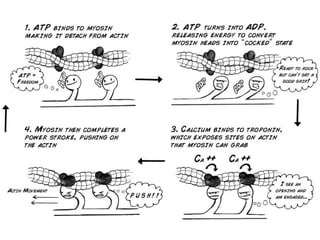
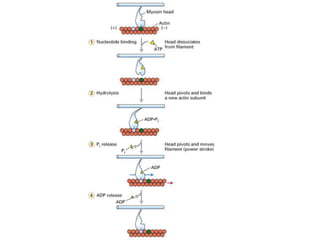
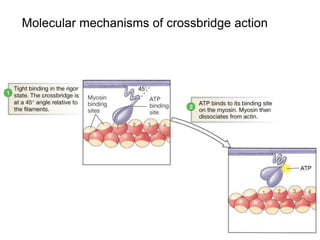
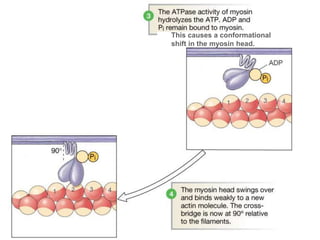
Molecular mechanisms of crossbridge action
This causes a conformational
shift in the myosin head.
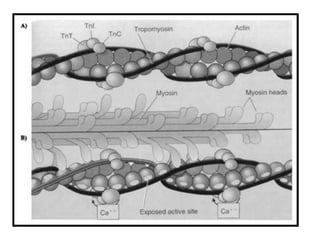
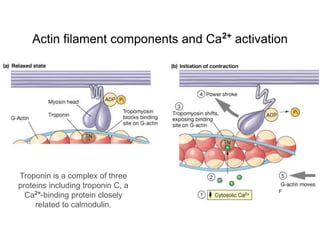
Actin filament components and Ca2+
activation
F
Troponin is a complex of three
proteins including troponin C, a
Ca2+
-binding protein closely
related to calmodulin.
Binding of myosin to actin
leads to release of Pi.
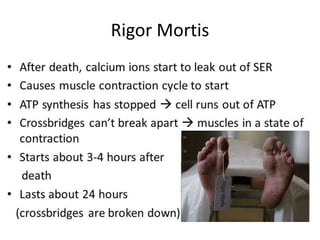
After death, as ATP runs out,
cytosolic [Ca2+
] slowly rises,
actin binding sites are opened,
crossbridges are formed and
become locked in the "rigor"
position without ATP to bind.
Rigor Mortis
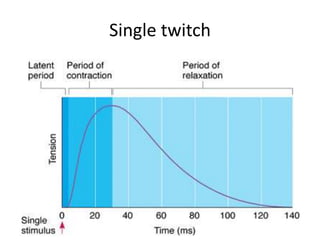
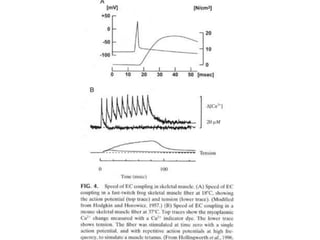
Single twitch
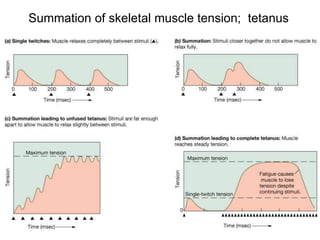
Summation of skeletal muscle tension; tetanus
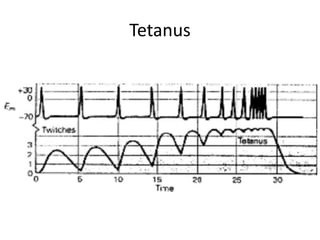
Tetanus
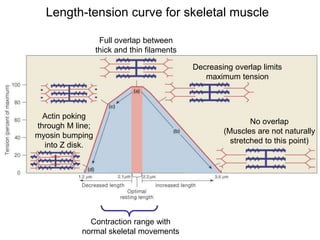
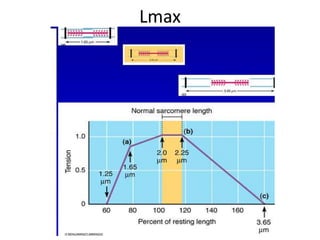
Length-tension curve for skeletal muscle
Full overlap between
thick and thin filaments
Decreasing overlap limits
maximum tension
No overlap
(Muscles are not naturally
stretched to this point)
Actin poking
through M line;
myosin bumping
into Z disk.
Contraction range with
normal skeletal movements
Lmax
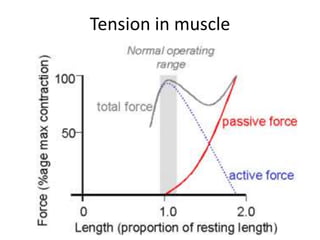
Tension in muscle
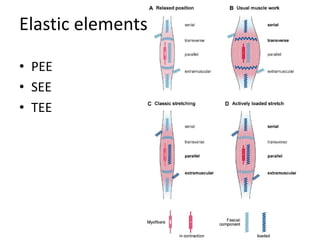
Elastic elements
• PEE
• SEE
• TEE
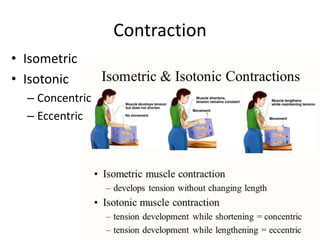
Contraction
• Isometric
• Isotonic
– Concentric
– Eccentric
Time is required for maximal twitch force to develop, because some
shortening of sarcomeres must occur to stretch elastic elements of
muscle before force can be transmitted through tendons
By the time this maximal force is developed, [Ca2+
] and number of
active crossbridges have greatly decreased, so an individual twitch
reaches much less than the maximum force the muscle can develop
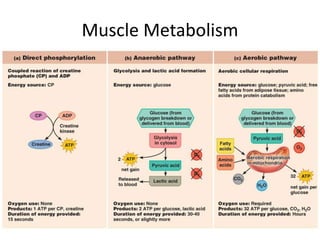
Muscle Metabolism
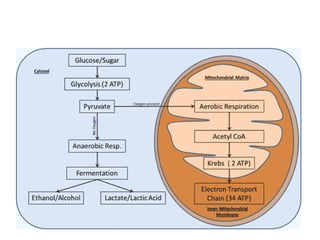
Mitochondria generate ~32 ATP from one glucose
(slow, but efficient).
Glycolysis generates 2 ATP from one glucose
(fast, but inefficient; lactate accumulates).
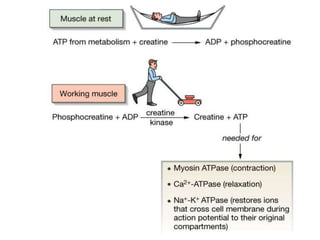
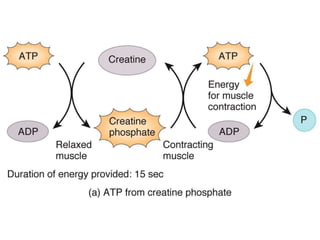
Creatine kinase reaction: (fastest)
ADP + creatine-P  ATP + creatine
Adenylate kinase reaction (fast; used when ATP
levels are very low):
ADP + MgADP  AMP + MgATP
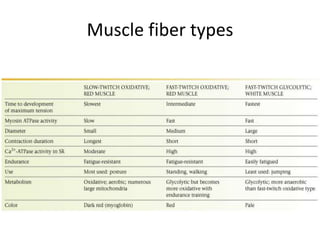
Muscle fiber types
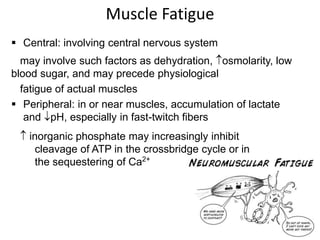
 Central: involving central nervous system
may involve such factors as dehydration, osmolarity, low
blood sugar, and may precede physiological
fatigue of actual muscles
 Peripheral: in or near muscles, accumulation of lactate
and pH, especially in fast-twitch fibers
 inorganic phosphate may increasingly inhibit
cleavage of ATP in the crossbridge cycle or in
the sequestering of Ca2+
Muscle Fatigue
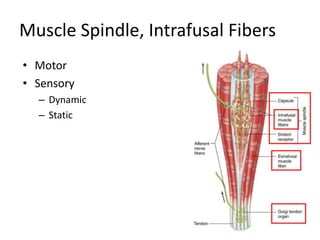
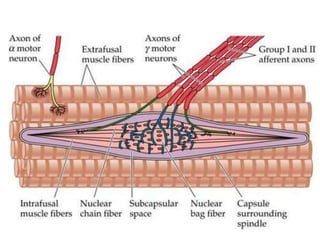
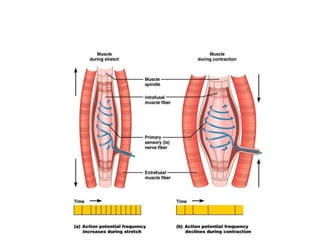
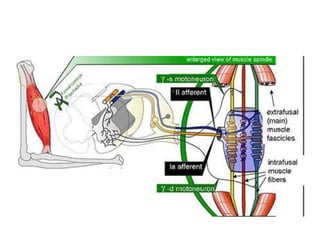
Muscle Spindle, Intrafusal Fibers
• Motor
• Sensory
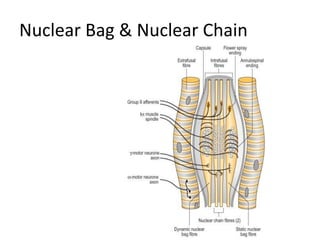
– Dynamic
– Static
Nuclear Bag & Nuclear Chain
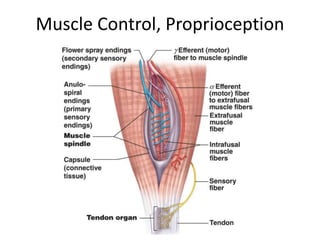
Muscle Control, Proprioception
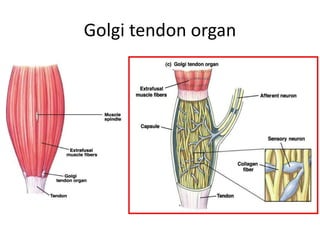
Golgi tendon organ
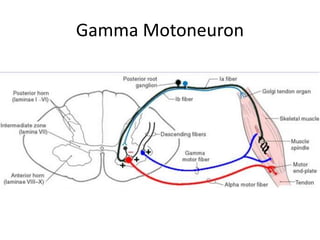
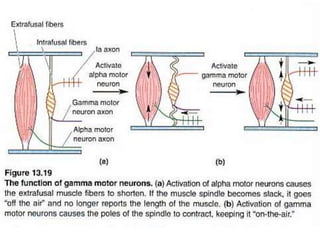
Gamma Motoneuron
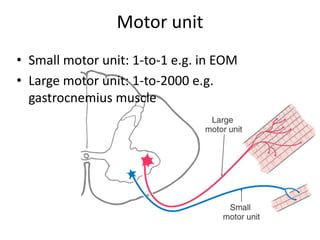
Motor unit
• Small motor unit: 1-to-1 e.g. in EOM
• Large motor unit: 1-to-2000 e.g.
gastrocnemius muscle
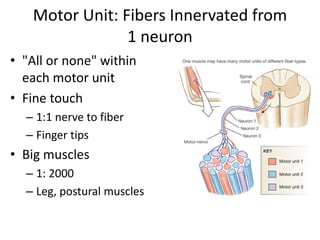
Motor Unit: Fibers Innervated from
1 neuron
• "All or none" within
each motor unit
• Fine touch
– 1:1 nerve to fiber
– Finger tips
• Big muscles
– 1: 2000
– Leg, postural muscles
PLAY
Animation: Muscular System:
Contraction of Motor Units
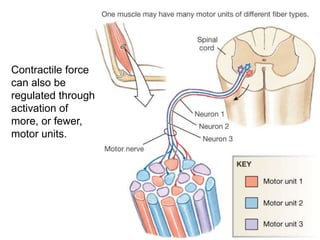
Contractile force
can also be
regulated through
activation of
more, or fewer,
motor units.
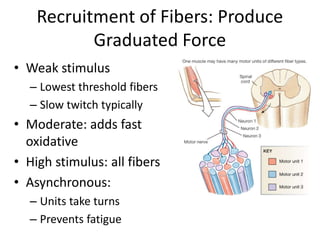
• Weak stimulus
– Lowest threshold fibers
– Slow twitch typically
• Moderate: adds fast
oxidative
• High stimulus: all fibers
• Asynchronous:
– Units take turns
– Prevents fatigue
Recruitment of Fibers: Produce
Graduated Force
Hypokalemia, Causes
• Kidney disease
• Diabetes
• Cirrhosis(chronic alcoholism)
• Laxative abuse(loose weight)
• Diuretics
• Steroids,…
– steroid psychosis, mood changes, agitation, and
irrational behavior
• Corticosteroids( organ transplant, Cushing
disease,…)
• Hypervitaminosis B12
Hypokalemia,
• Proximal muscle weakness
• Myopathies
• Cardiac arrhythmia
• Hypokalemic periodic quadriparesis
– Autosomal dominant disorder
– Areflexic paresis
– Irregular attacks
– Large carbohydrate meals often precipitate attacks
Hyponatremia
• Compulsive water intake
• Adrenal insufficiency
• Kidney disease
• Hi ADH
• Medications
Hyponatremia
• Osmosis, cell swelling, cerebral edema,..
• Confusion, agitation, stupor
• Nausea and vomiting
• Headache, confusion
• Loss of energy, drowsiness and fatigue
• Restlessness and irritability
• Muscle weakness, spasms or cramps
• Seizures
• Coma
Proprioceptors
• Specialised sensory receptors within joints, muscles,
and tendons
• Sensitive to both tension and pressure
• Play a role in relaying information concerning muscle
dynamics to the conscious and subconscious parts of
the CNS
• They provide the brain with information concerning
kinesthetic sense, or conscious appreciation of the
position of body parts with respect to gravity
• Mostly at subconscious level,
• GTO located in tendons near the myotendinous
junction and are in series
Techniques to Increase ROM
• MET
• PNF( Proprioceptive Neuromuscular
Facilitation)
PNF Theories
• Autogenic inhibition
• Reciprocal inhibition
• Stress relaxation
• Gate control theory
PNF Techniques
• Contract-Relax (CR) method
• Contract-Relax-Antagonist-Contract (CRAC)
Method
• **PNF before exercise decrease the muscle
performance
• ** PNF after exercise increase the muscle
performance
Ach Agonist
• Stimulate Ach receptor but not destroyed by
AchE:
– Nicotine, carbacol & methacoline
– Produce spasm
Skeletal Muscle Attachment
• Tendon Attachments
– Origin
• Attachment to the bone that doesn’t move
– Insertion
• Attachment to the bone that does move
• Antagonistic Pairs
– Flexor
• Flexes the joint (moves toward the body)
– Extensor
• Extends the joint (away from the body)
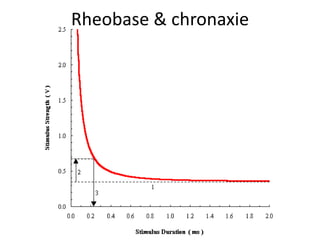
Rheobase & chronaxie
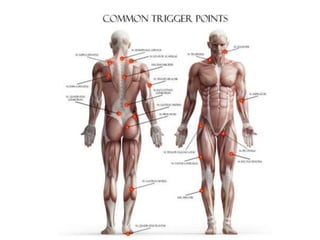
Trigger points
• Is a hyperirritable spot, a palpable nodule
in the taut bands of the skeletal muscles'
fascia
• Direct compression or muscle contraction
can elicit jump sign, local tenderness, local
twitch response and referred pain which
usually responds with a pain pattern
distant from the spot
Classification of Triger Point
• Primary
– Muscle belly, severe pain(jump sign) with pressure
and radiate according to referred pain map
• Secondary(satellite) or as cluster
– Usually disappear when central trigger point heal
• Active/Inactive(can increase stiffness)
• Tendon, can develop degenerative process of
the joint if not treated
• Ligamentous, i.g. ant longitudinal,
Ligamentum patellae, fibular collateral
Causes of Trigger Point
• Injury sustained by a fall, by stress or birth trauma
• Lack of exercise, commonly in sedentary persons, 45% are
men
• Aging
• Bad posture, upper and lower crossed pattern, swayback
posture, telephone posture, cross-legged sitting,
• Muscle overuse and respective micro trauma,
weightlifting, ..
• Chronic stress condition, anxiety, depression,
psychological stress trauma,
• Vitamin deficiencies, vitamin C, D, B; folic acid; iron;
• Sleep disturbance,
• Joint problems and hypermobility
Pathophysiology
• Overactive
• Local inflammation
• Loss of oxygen & nutrients
• Involuntary muscle contraction
• Higher demand to oxygen
• Higher concentration of Ach, NAd, 5HT
• Low PH
Muscle Cramp
• If you’ve ever had a “charley horse” that odd
pain in your calf, you’ve had a cramp
• But they can happen anywhere in your body
at any time, even when you’re asleep
• No matter where you get them, what’s going
on inside is the same: Your muscles suddenly
tighten up when you don’t want them to
• Several things can bring on cramps, but you
can do some things to keep them from
happening
Possible Cause: Not Enough Water
• Cramps may be your body’s way of telling you
that you need some, you’re dehydrated
• Other signs include dizziness, headache, and
constipation. So keep water with you and sip it
throughout the day, especially if you’re
outside in hot weather
High Temperatures
• Your body loses fluids when you work or
exercise in the heat, and that can make you
more likely to cramp. This may be partly
because your muscles need water, but it’s also
because you sweat out important minerals
called electrolytes, sodium, potassium, and
calcium
Medications
• Statins, which are used to control cholesterol,
and diuretics, which help your body get rid of
fluid, are just two of the drugs that can bring
on cramping as a side effect
Poor Circulation
• If your cramps get worse when you walk, your
muscles may not be getting enough blood.
That can happen as you get older or if you’re
not very active. It also can be caused by a
condition called claudication, when arteries
are narrower than they should be and blood
can’t get through easily
Monthly Cycle
• Some women get cramps during their periods.
That happens because a woman’s body makes
certain hormones that make the muscles in
her uterus tighten up. This helps push out
blood and tissue, but it can also cause
cramping
Growth
• Kids often get cramps when they go through a
growth spurt. These are sometimes called
“growing pains,” but they may actually be
caused by too much activity, or kids may just
be more sensitive to pain. The cramps happen
most often in the legs and can wake a child
out of a sound sleep. It may help to stretch
the muscle or put a heating pad on the area
for a short time
Exercise
• It’s important to stay active, but if you do too
much all at once or your body’s not used to it,
your muscles can cramp. Instead, pace
yourself: Regular exercise can make your
muscles stronger and harder to tire out, so
they won’t cramp as easily. Be sure to warm
up first, and do plenty of stretching before and
after
How to Feel Better
• Cramps usually go away on their own fairly
quickly, but you can do some things to help
them along. If an activity like running
triggered one, stop right away. Then gently
stretch or massage the muscle or use a
heating pad or hot bath to bring blood to the
area and relax it. Ice and over-the-counter
anti-inflammatories, like ibuprofen, can help if
you have pain and swelling, too
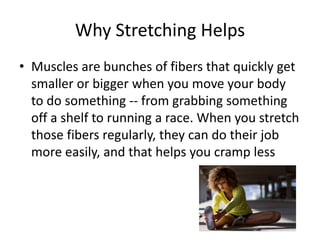
Why Stretching Helps
• Muscles are bunches of fibers that quickly get
smaller or bigger when you move your body
to do something -- from grabbing something
off a shelf to running a race. When you stretch
those fibers regularly, they can do their job
more easily, and that helps you cramp less
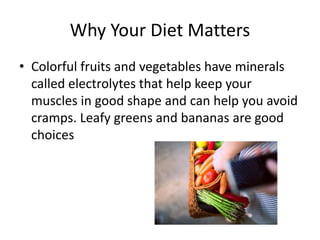
Why Your Diet Matters
• Colorful fruits and vegetables have minerals
called electrolytes that help keep your
muscles in good shape and can help you avoid
cramps. Leafy greens and bananas are good
choices
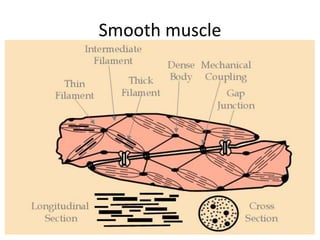
Smooth muscle

Cell physiology2

  • 1.
    Physiology of thecell by H. Khorrami Ph.D. http://khorrami1962.spaces.live.com http://www.scribd.com/khorrami4 khorrami4@yahoo.com
  • 2.
    Muscle types • CardiacMuscle – Striated muscle found only in the heart – Under involuntary control – Only rests between contractions • Smooth Muscle – Lack striations – Usually under involuntary control – Contraction is slow and rhythmic – Muscles of internal organs • Skeletal Muscle – Striated muscle fibers with no clear separation between cells – Under voluntary control
  • 3.
  • 4.
    • Synapse • Motorunit Neuro-muscular junction
  • 5.
  • 7.
  • 12.
  • 18.
  • 19.
    Titin • Largest proteinwith 34,350 AA • Mutation: – familial hypertrophic cardiomyopathy – Tibial muscular dystrophy
  • 20.
    Synaptic transmission steps •Na-K conductance • Depolarization of presynaptic membrane • Motor end-plate potential • Increase Ca++ entrance • Ca2+-calmadulin • Synapsin-1 • Vesicle fusion • NT release
  • 25.
  • 27.
    This gap is actuallyonly ~10 nm. Ca2+ -ATPase
  • 29.
    Molecular mechanisms ofcrossbridge action
  • 30.
    This causes aconformational shift in the myosin head.
  • 31.
    Actin filament componentsand Ca2+ activation F Troponin is a complex of three proteins including troponin C, a Ca2+ -binding protein closely related to calmodulin.
  • 32.
    Binding of myosinto actin leads to release of Pi. After death, as ATP runs out, cytosolic [Ca2+ ] slowly rises, actin binding sites are opened, crossbridges are formed and become locked in the "rigor" position without ATP to bind.
  • 34.
  • 36.
  • 38.
    Summation of skeletalmuscle tension; tetanus
  • 39.
  • 40.
    Length-tension curve forskeletal muscle Full overlap between thick and thin filaments Decreasing overlap limits maximum tension No overlap (Muscles are not naturally stretched to this point) Actin poking through M line; myosin bumping into Z disk. Contraction range with normal skeletal movements
  • 41.
  • 42.
  • 43.
  • 44.
  • 45.
    Time is requiredfor maximal twitch force to develop, because some shortening of sarcomeres must occur to stretch elastic elements of muscle before force can be transmitted through tendons By the time this maximal force is developed, [Ca2+ ] and number of active crossbridges have greatly decreased, so an individual twitch reaches much less than the maximum force the muscle can develop
  • 48.
  • 50.
    Mitochondria generate ~32ATP from one glucose (slow, but efficient). Glycolysis generates 2 ATP from one glucose (fast, but inefficient; lactate accumulates). Creatine kinase reaction: (fastest) ADP + creatine-P  ATP + creatine Adenylate kinase reaction (fast; used when ATP levels are very low): ADP + MgADP  AMP + MgATP
  • 51.
  • 52.
     Central: involvingcentral nervous system may involve such factors as dehydration, osmolarity, low blood sugar, and may precede physiological fatigue of actual muscles  Peripheral: in or near muscles, accumulation of lactate and pH, especially in fast-twitch fibers  inorganic phosphate may increasingly inhibit cleavage of ATP in the crossbridge cycle or in the sequestering of Ca2+ Muscle Fatigue
  • 53.
    Muscle Spindle, IntrafusalFibers • Motor • Sensory – Dynamic – Static
  • 56.
    Nuclear Bag &Nuclear Chain
  • 57.
  • 58.
  • 59.
  • 61.
    Motor unit • Smallmotor unit: 1-to-1 e.g. in EOM • Large motor unit: 1-to-2000 e.g. gastrocnemius muscle
  • 64.
    Motor Unit: FibersInnervated from 1 neuron • "All or none" within each motor unit • Fine touch – 1:1 nerve to fiber – Finger tips • Big muscles – 1: 2000 – Leg, postural muscles PLAY Animation: Muscular System: Contraction of Motor Units
  • 65.
    Contractile force can alsobe regulated through activation of more, or fewer, motor units.
  • 66.
    • Weak stimulus –Lowest threshold fibers – Slow twitch typically • Moderate: adds fast oxidative • High stimulus: all fibers • Asynchronous: – Units take turns – Prevents fatigue Recruitment of Fibers: Produce Graduated Force
  • 67.
    Hypokalemia, Causes • Kidneydisease • Diabetes • Cirrhosis(chronic alcoholism) • Laxative abuse(loose weight) • Diuretics • Steroids,… – steroid psychosis, mood changes, agitation, and irrational behavior • Corticosteroids( organ transplant, Cushing disease,…) • Hypervitaminosis B12
  • 68.
    Hypokalemia, • Proximal muscleweakness • Myopathies • Cardiac arrhythmia • Hypokalemic periodic quadriparesis – Autosomal dominant disorder – Areflexic paresis – Irregular attacks – Large carbohydrate meals often precipitate attacks
  • 69.
    Hyponatremia • Compulsive waterintake • Adrenal insufficiency • Kidney disease • Hi ADH • Medications
  • 70.
    Hyponatremia • Osmosis, cellswelling, cerebral edema,.. • Confusion, agitation, stupor • Nausea and vomiting • Headache, confusion • Loss of energy, drowsiness and fatigue • Restlessness and irritability • Muscle weakness, spasms or cramps • Seizures • Coma
  • 71.
    Proprioceptors • Specialised sensoryreceptors within joints, muscles, and tendons • Sensitive to both tension and pressure • Play a role in relaying information concerning muscle dynamics to the conscious and subconscious parts of the CNS • They provide the brain with information concerning kinesthetic sense, or conscious appreciation of the position of body parts with respect to gravity • Mostly at subconscious level, • GTO located in tendons near the myotendinous junction and are in series
  • 72.
    Techniques to IncreaseROM • MET • PNF( Proprioceptive Neuromuscular Facilitation)
  • 73.
    PNF Theories • Autogenicinhibition • Reciprocal inhibition • Stress relaxation • Gate control theory
  • 74.
    PNF Techniques • Contract-Relax(CR) method • Contract-Relax-Antagonist-Contract (CRAC) Method • **PNF before exercise decrease the muscle performance • ** PNF after exercise increase the muscle performance
  • 76.
    Ach Agonist • StimulateAch receptor but not destroyed by AchE: – Nicotine, carbacol & methacoline – Produce spasm
  • 77.
    Skeletal Muscle Attachment •Tendon Attachments – Origin • Attachment to the bone that doesn’t move – Insertion • Attachment to the bone that does move • Antagonistic Pairs – Flexor • Flexes the joint (moves toward the body) – Extensor • Extends the joint (away from the body)
  • 78.
  • 80.
    Trigger points • Isa hyperirritable spot, a palpable nodule in the taut bands of the skeletal muscles' fascia • Direct compression or muscle contraction can elicit jump sign, local tenderness, local twitch response and referred pain which usually responds with a pain pattern distant from the spot
  • 81.
    Classification of TrigerPoint • Primary – Muscle belly, severe pain(jump sign) with pressure and radiate according to referred pain map • Secondary(satellite) or as cluster – Usually disappear when central trigger point heal • Active/Inactive(can increase stiffness) • Tendon, can develop degenerative process of the joint if not treated • Ligamentous, i.g. ant longitudinal, Ligamentum patellae, fibular collateral
  • 82.
    Causes of TriggerPoint • Injury sustained by a fall, by stress or birth trauma • Lack of exercise, commonly in sedentary persons, 45% are men • Aging • Bad posture, upper and lower crossed pattern, swayback posture, telephone posture, cross-legged sitting, • Muscle overuse and respective micro trauma, weightlifting, .. • Chronic stress condition, anxiety, depression, psychological stress trauma, • Vitamin deficiencies, vitamin C, D, B; folic acid; iron; • Sleep disturbance, • Joint problems and hypermobility
  • 84.
    Pathophysiology • Overactive • Localinflammation • Loss of oxygen & nutrients • Involuntary muscle contraction • Higher demand to oxygen • Higher concentration of Ach, NAd, 5HT • Low PH
  • 85.
    Muscle Cramp • Ifyou’ve ever had a “charley horse” that odd pain in your calf, you’ve had a cramp • But they can happen anywhere in your body at any time, even when you’re asleep • No matter where you get them, what’s going on inside is the same: Your muscles suddenly tighten up when you don’t want them to • Several things can bring on cramps, but you can do some things to keep them from happening
  • 86.
    Possible Cause: NotEnough Water • Cramps may be your body’s way of telling you that you need some, you’re dehydrated • Other signs include dizziness, headache, and constipation. So keep water with you and sip it throughout the day, especially if you’re outside in hot weather
  • 87.
    High Temperatures • Yourbody loses fluids when you work or exercise in the heat, and that can make you more likely to cramp. This may be partly because your muscles need water, but it’s also because you sweat out important minerals called electrolytes, sodium, potassium, and calcium
  • 88.
    Medications • Statins, whichare used to control cholesterol, and diuretics, which help your body get rid of fluid, are just two of the drugs that can bring on cramping as a side effect
  • 89.
    Poor Circulation • Ifyour cramps get worse when you walk, your muscles may not be getting enough blood. That can happen as you get older or if you’re not very active. It also can be caused by a condition called claudication, when arteries are narrower than they should be and blood can’t get through easily
  • 90.
    Monthly Cycle • Somewomen get cramps during their periods. That happens because a woman’s body makes certain hormones that make the muscles in her uterus tighten up. This helps push out blood and tissue, but it can also cause cramping
  • 91.
    Growth • Kids oftenget cramps when they go through a growth spurt. These are sometimes called “growing pains,” but they may actually be caused by too much activity, or kids may just be more sensitive to pain. The cramps happen most often in the legs and can wake a child out of a sound sleep. It may help to stretch the muscle or put a heating pad on the area for a short time
  • 92.
    Exercise • It’s importantto stay active, but if you do too much all at once or your body’s not used to it, your muscles can cramp. Instead, pace yourself: Regular exercise can make your muscles stronger and harder to tire out, so they won’t cramp as easily. Be sure to warm up first, and do plenty of stretching before and after
  • 93.
    How to FeelBetter • Cramps usually go away on their own fairly quickly, but you can do some things to help them along. If an activity like running triggered one, stop right away. Then gently stretch or massage the muscle or use a heating pad or hot bath to bring blood to the area and relax it. Ice and over-the-counter anti-inflammatories, like ibuprofen, can help if you have pain and swelling, too
  • 94.
    Why Stretching Helps •Muscles are bunches of fibers that quickly get smaller or bigger when you move your body to do something -- from grabbing something off a shelf to running a race. When you stretch those fibers regularly, they can do their job more easily, and that helps you cramp less
  • 95.
    Why Your DietMatters • Colorful fruits and vegetables have minerals called electrolytes that help keep your muscles in good shape and can help you avoid cramps. Leafy greens and bananas are good choices
  • 96.