Muscle Physiology:
Muscular System Functions
 Body movement
 Maintenance of posture
 Respiration
 Production of body heat
 Communication
 Constriction of organs and vessels
 Heart beat
Properties of Muscle
 Contractility
 Ability of a muscle to shorten with force
 Excitability
 Capacity of muscle to respond to a stimulus
 Extensibility
 Muscle can be stretched to its normal resting length and
beyond to a limited degree
 Elasticity
 Ability of muscle to recoil to original resting length after
stretched
Muscle Tissue Types
 Skeletal
 Attached to bones
 Nuclei multiple and peripherally located
 Striated, Voluntary and involuntary (reflexes)
 Smooth
 Walls of hollow organs, blood vessels, eye, glands, skin
 Single nucleus centrally located
 Not striated, involuntary, gap junctions in visceral smooth
 Cardiac
 Heart
 Single nucleus centrally located
 Striations, involuntary, intercalated disks
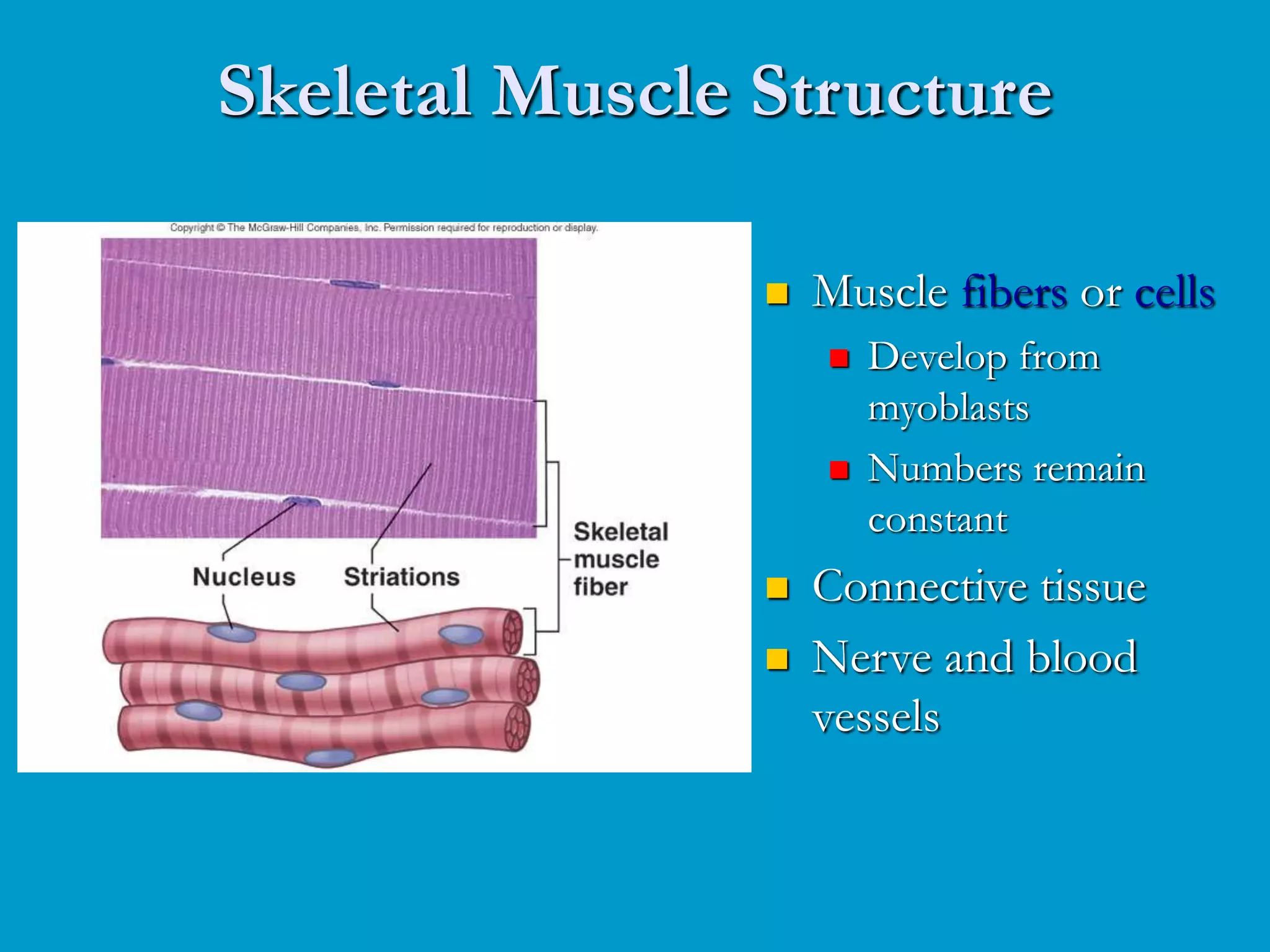
Skeletal Muscle Structure
 Muscle fibers or cells
 Develop from
myoblasts
 Numbers remain
constant
 Connective tissue
 Nerve and blood
vessels
Organization I:
Organization II:
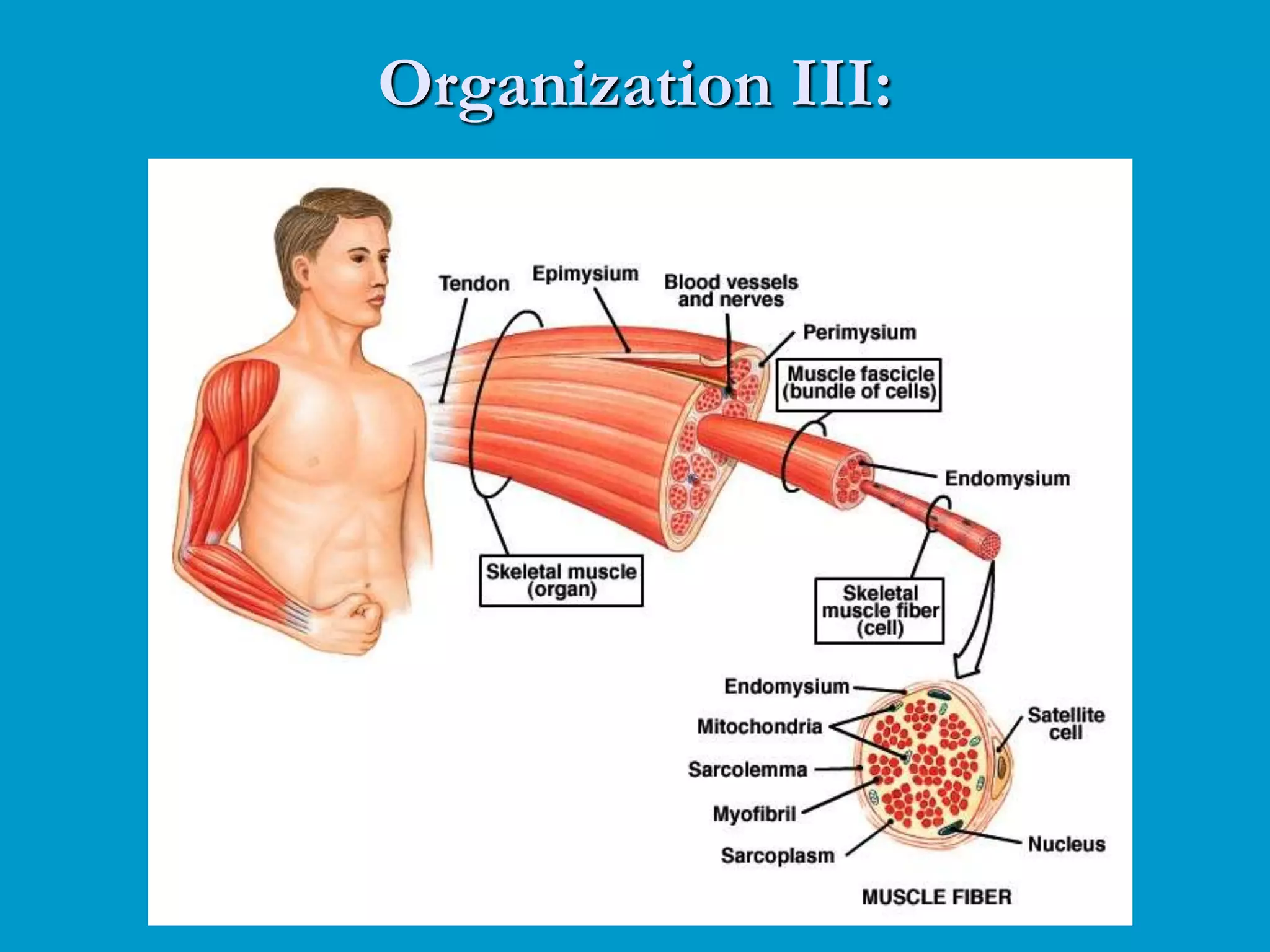
Organization III:
Connective Tissue, Nerve,
Blood Vessels
 Connective tissue
 External lamina
 Endomysium
 Perimysium
 Fasciculus
 Epimysium
 Fascia
 Nerve and blood vessels
 Abundant
Embryologic origin:
Muscle fibre:
Internal organization:
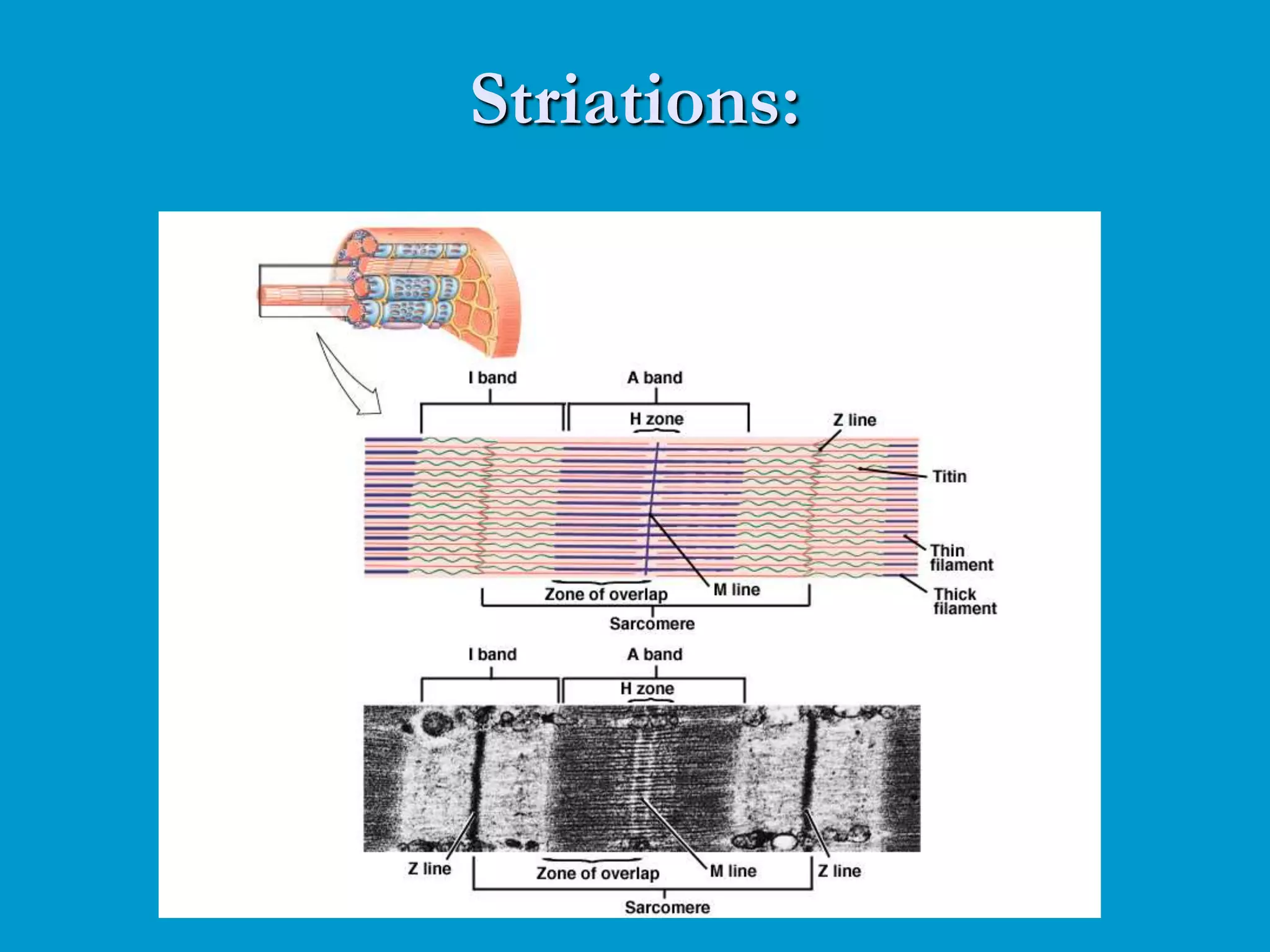
Striations:
Organization of myofilaments I:
Organization of myofilaments II:
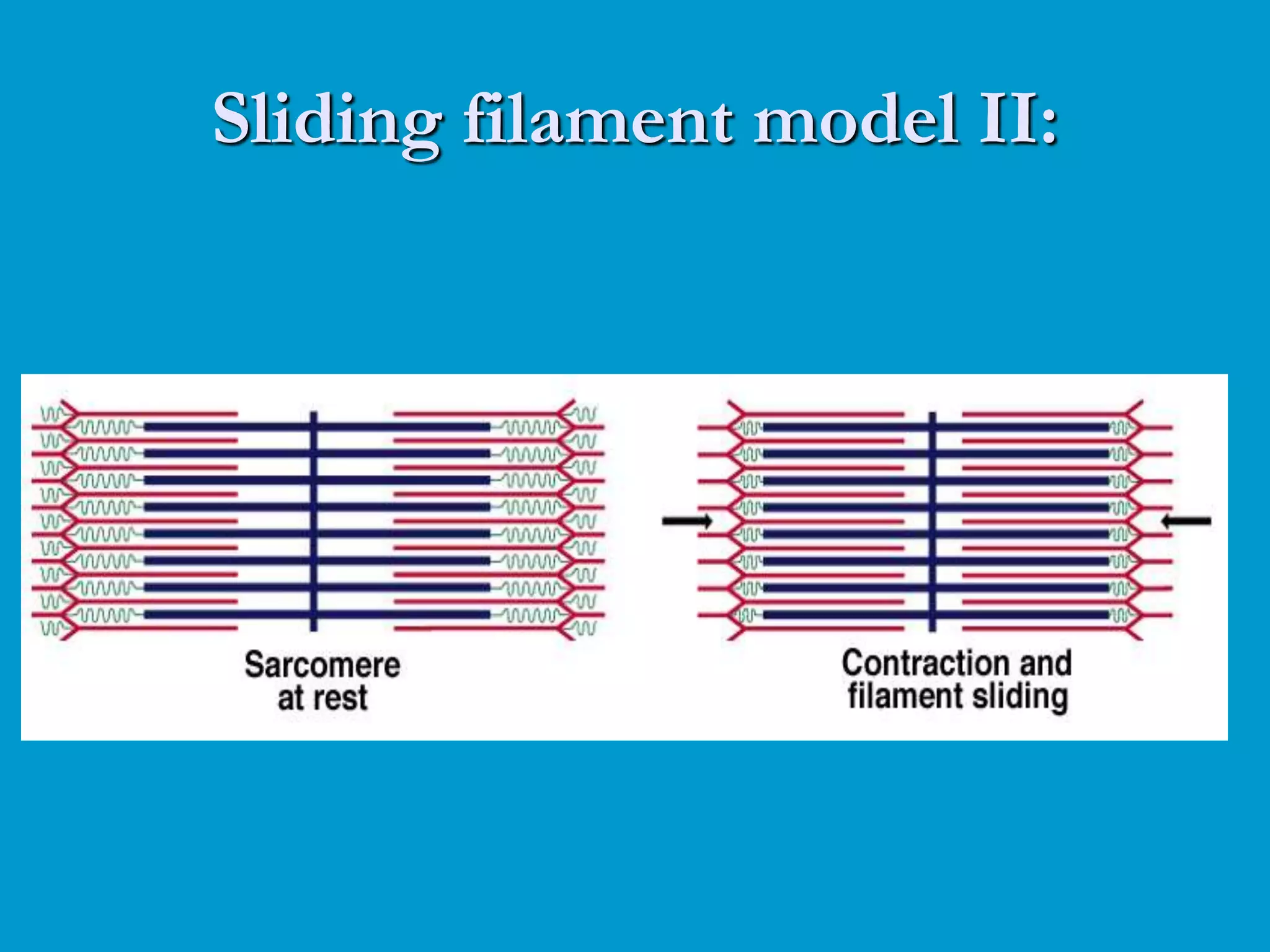
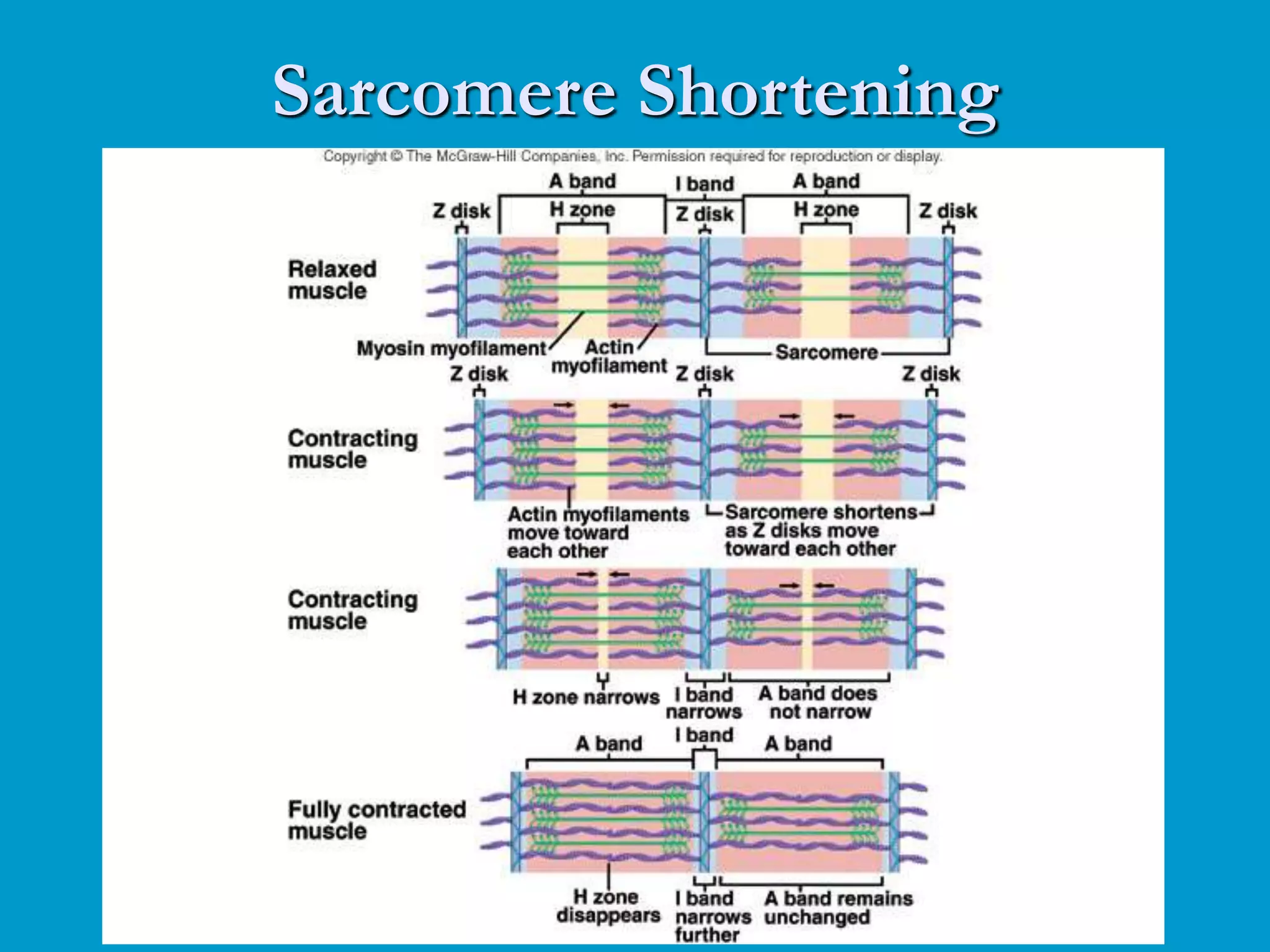
Sliding Filament Model I:
 Actin myofilaments sliding over myosin to
shorten sarcomeres
 Actin and myosin do not change length
 Shortening sarcomeres responsible for skeletal
muscle contraction
 During relaxation, sarcomeres lengthen
Sliding filament model II:
Sarcomere Shortening
Structure of Actin and Myosin
Myosin structure:
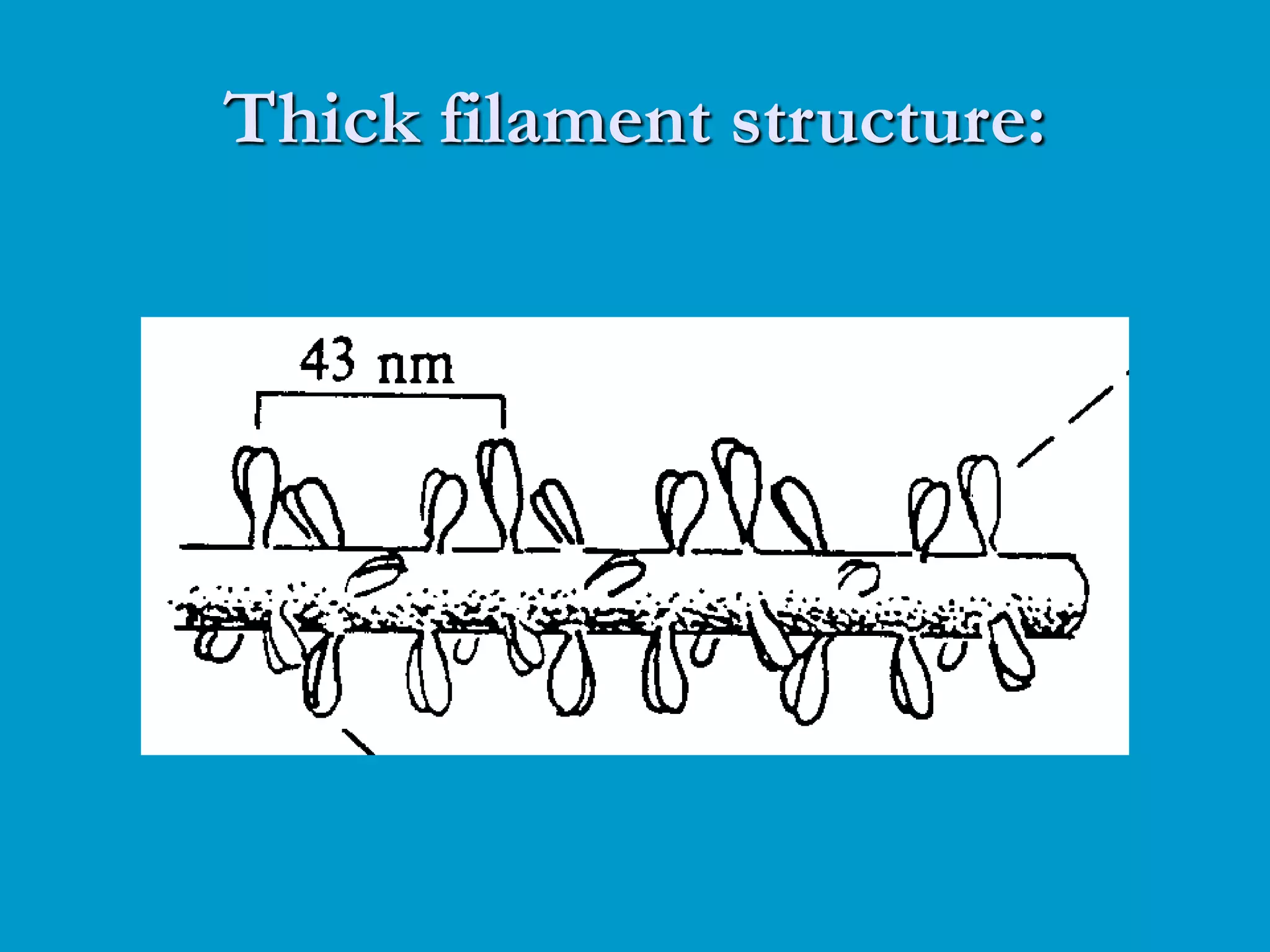
Thick filament structure:
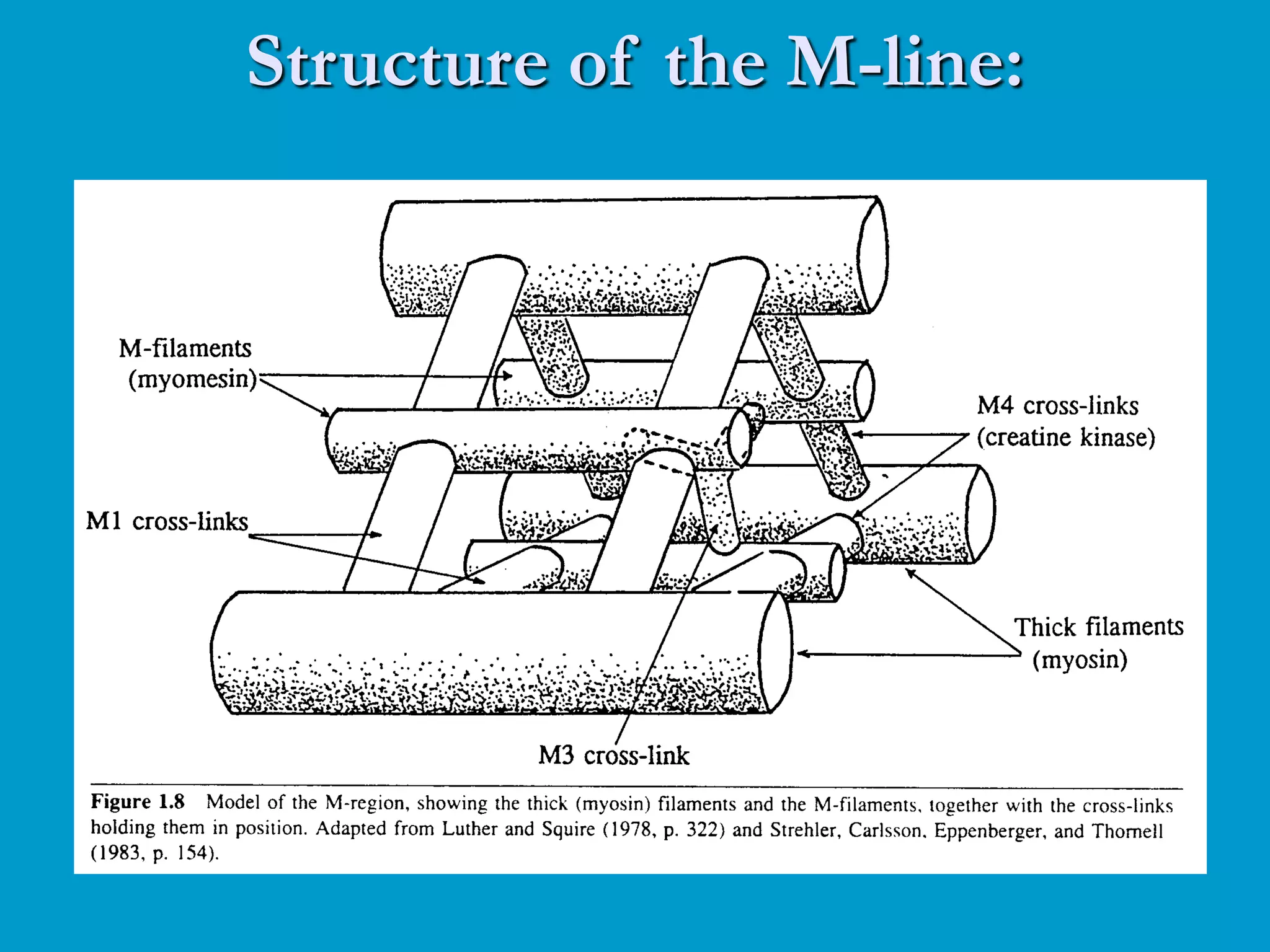
Structure of the M-line:
Structure of thin filament:
Cross-bridge formation:
Mechanism of muscle
contraction
Physiology of Skeletal Muscle
 Nervous system
 Controls muscle
contractions through action
potentials
 Resting membrane
potentials
 Membrane voltage
difference across membranes
(polarized)
• Inside cell more negative
and more K+
 Outside cell more positive
and more Na+
 Must exist for action
potential to occur
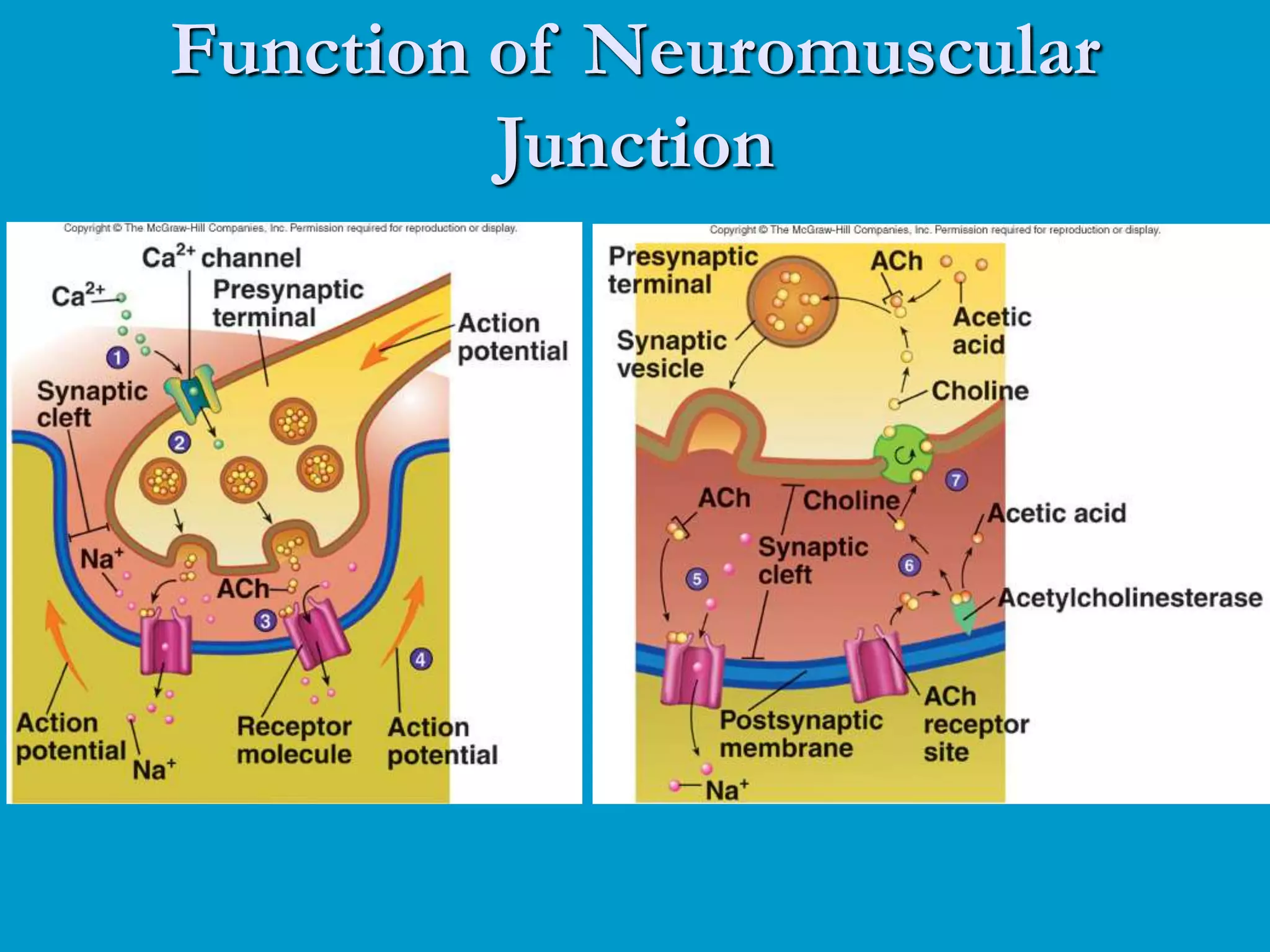
Function of Neuromuscular
Junction
Action Potentials
 Phases
 Depolarization
 Inside plasma membrane
becomes less negative
 Repolarization
 Return of resting
membrane potential
 All-or-none principle
 Like camera flash system
 Propagate
 Spread from one location to
another
 Frequency
 Number of action potential
produced per unit of time
Excitation-Contraction
Coupling
 Mechanism where an
action potential causes
muscle fiber contraction
 Involves
 Sarcolemma
 Transverse or T tubules
 Terminal cisternae
 Sarcoplasmic reticulum
 Ca2+
 Troponin
Action Potentials and Muscle
Contraction
Muscle Twitch
 Muscle contraction in
response to a stimulus
that causes action
potential in one or
more muscle fibers
 Phases
 Lag or latent
 Contraction
 Relaxation
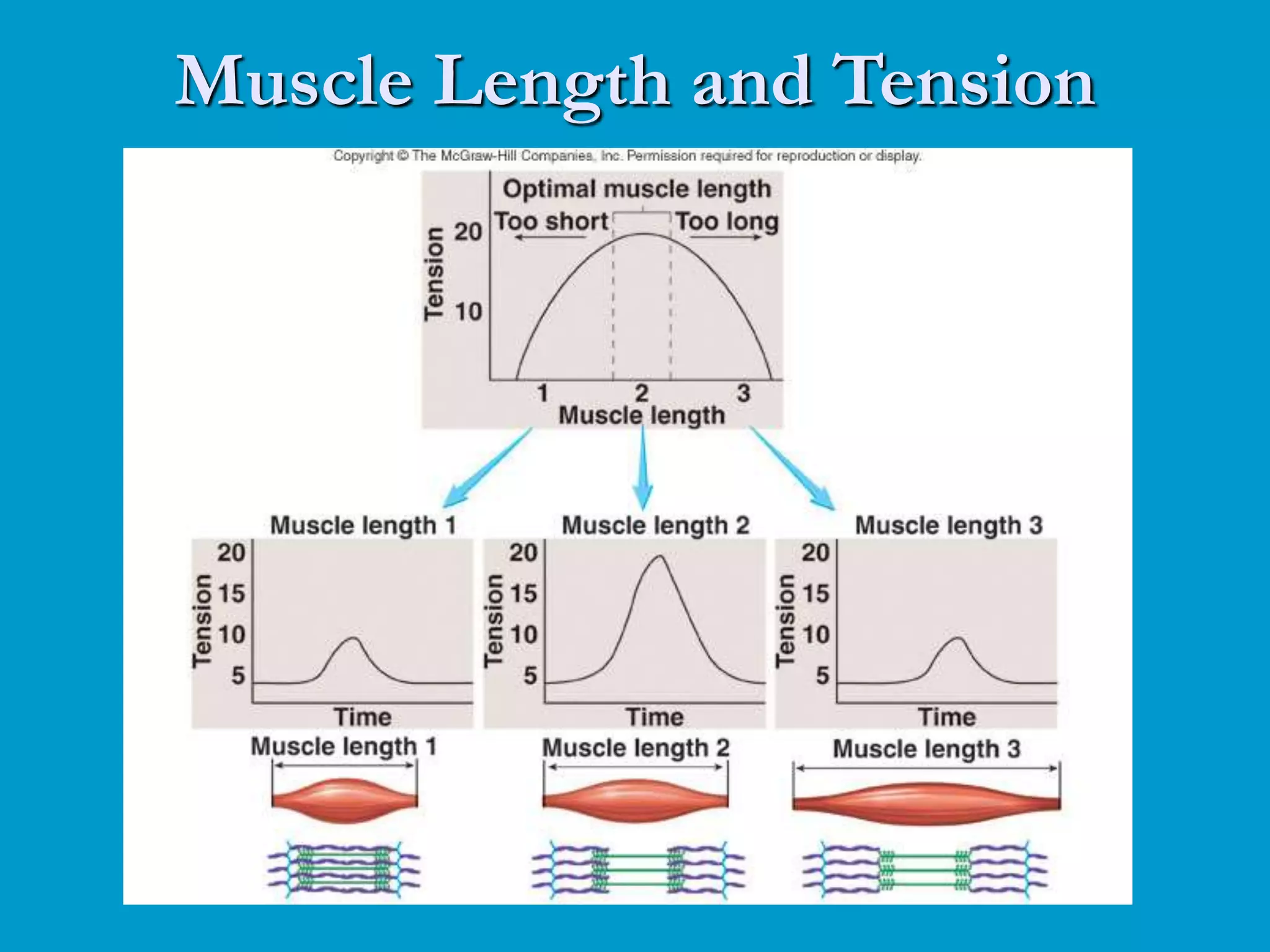
Muscle Length and Tension
Stimulus Strength and Muscle
Contraction
 All-or-none law for muscle
fibers
 Contraction of equal force in
response to each action potential
 Sub-threshold stimulus
 Threshold stimulus
 Stronger than threshold
 Motor units
 Single motor neuron and all
muscle fibers innervated
 Graded for whole muscles
 Strength of contractions range
from weak to strong depending
on stimulus strength
Types of Muscle Contractions
 Isometric: No change in length but tension increases
 Postural muscles of body
 Isotonic: Change in length but tension constant
 Concentric: Overcomes opposing resistance and muscle
shortens
 Eccentric: Tension maintained but muscle lengthens
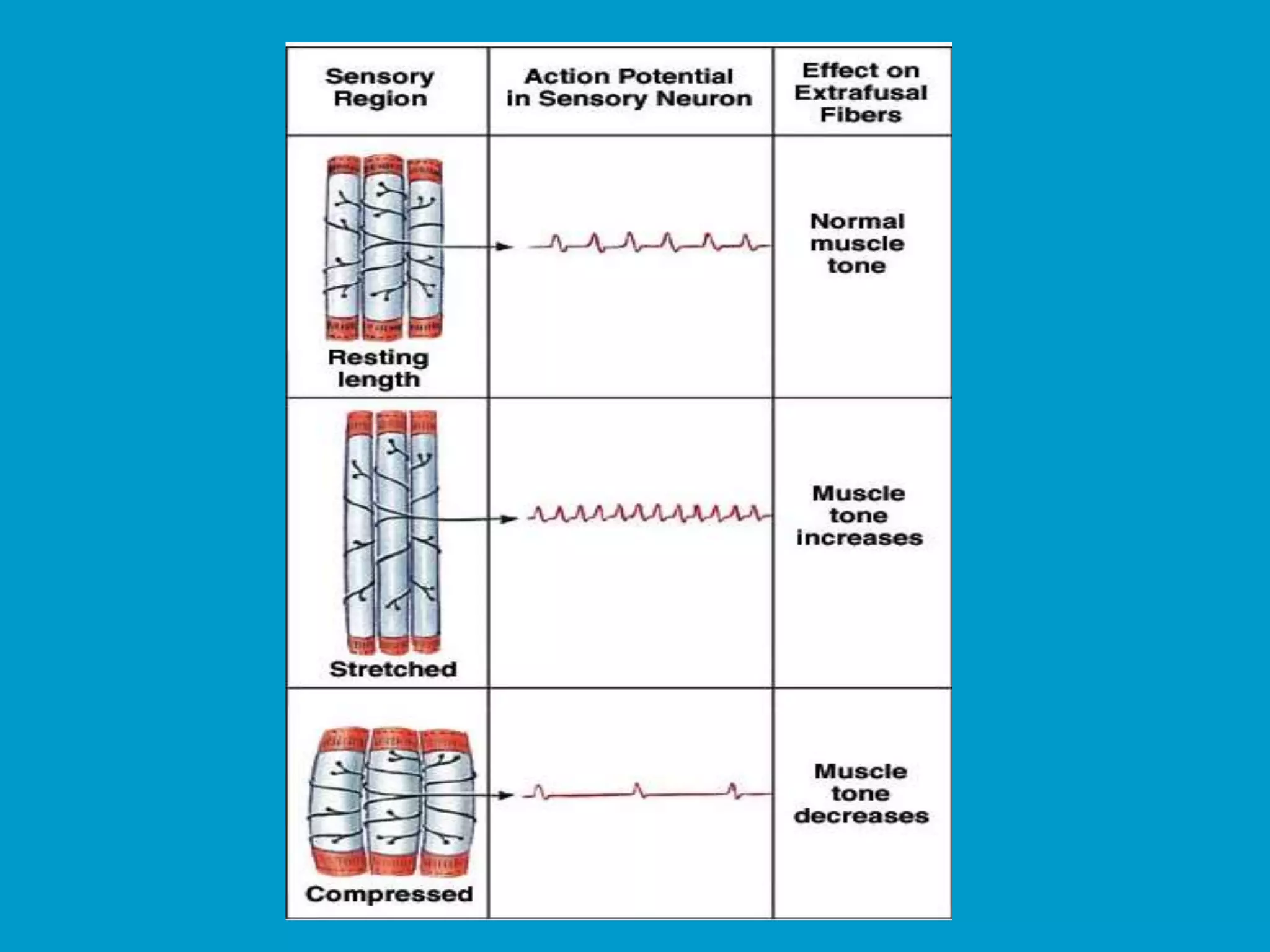
 Muscle tone: Constant tension by muscles for long
periods of time
Multiple Motor Unit
Summation
 A whole muscle contracts with a small or large force
depending on number of motor units stimulated to
contract
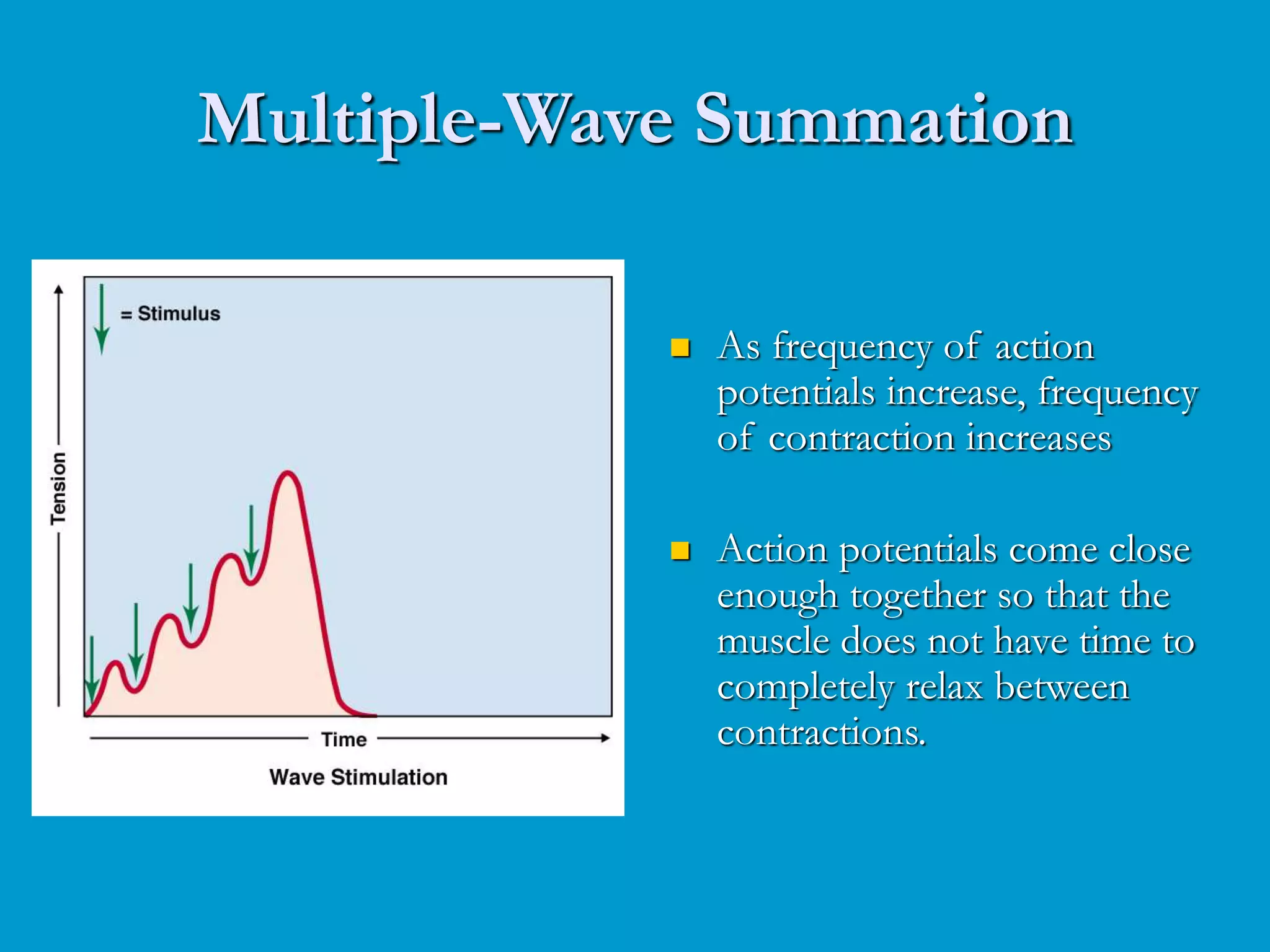
Multiple-Wave Summation
 As frequency of action
potentials increase, frequency
of contraction increases
 Action potentials come close
enough together so that the
muscle does not have time to
completely relax between
contractions.
 Incomplete tetanus
 Muscle fibers partially relax
between contraction
 There is time for Ca 2+ to
be recycled through the SR
between action potentials
 Complete tetanus
 No relaxation between
contractions
 Action potentials come sp
close together that Ca 2+
does not get re-sequestered
in the SR
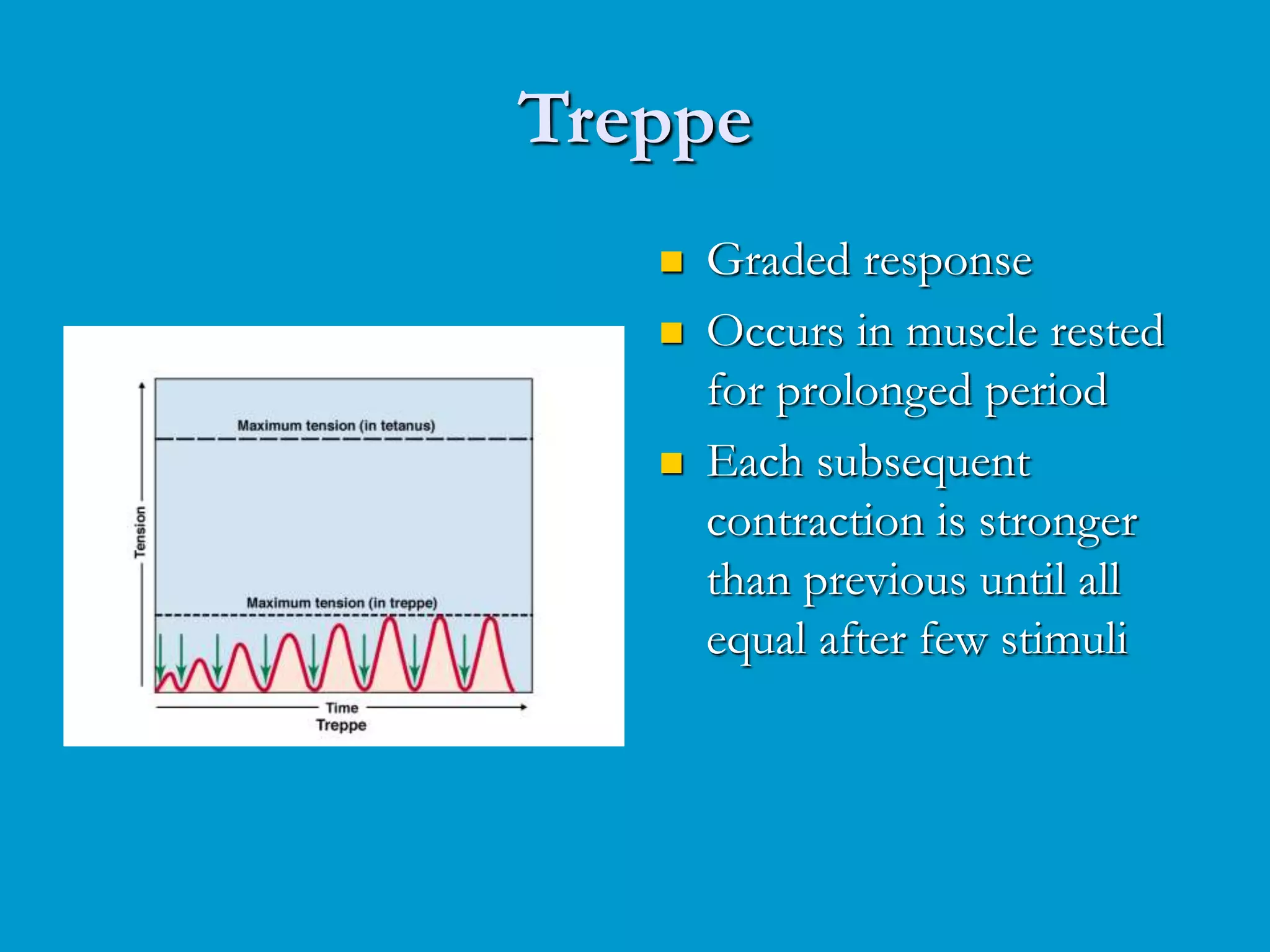
Treppe
 Graded response
 Occurs in muscle rested
for prolonged period
 Each subsequent
contraction is stronger
than previous until all
equal after few stimuli
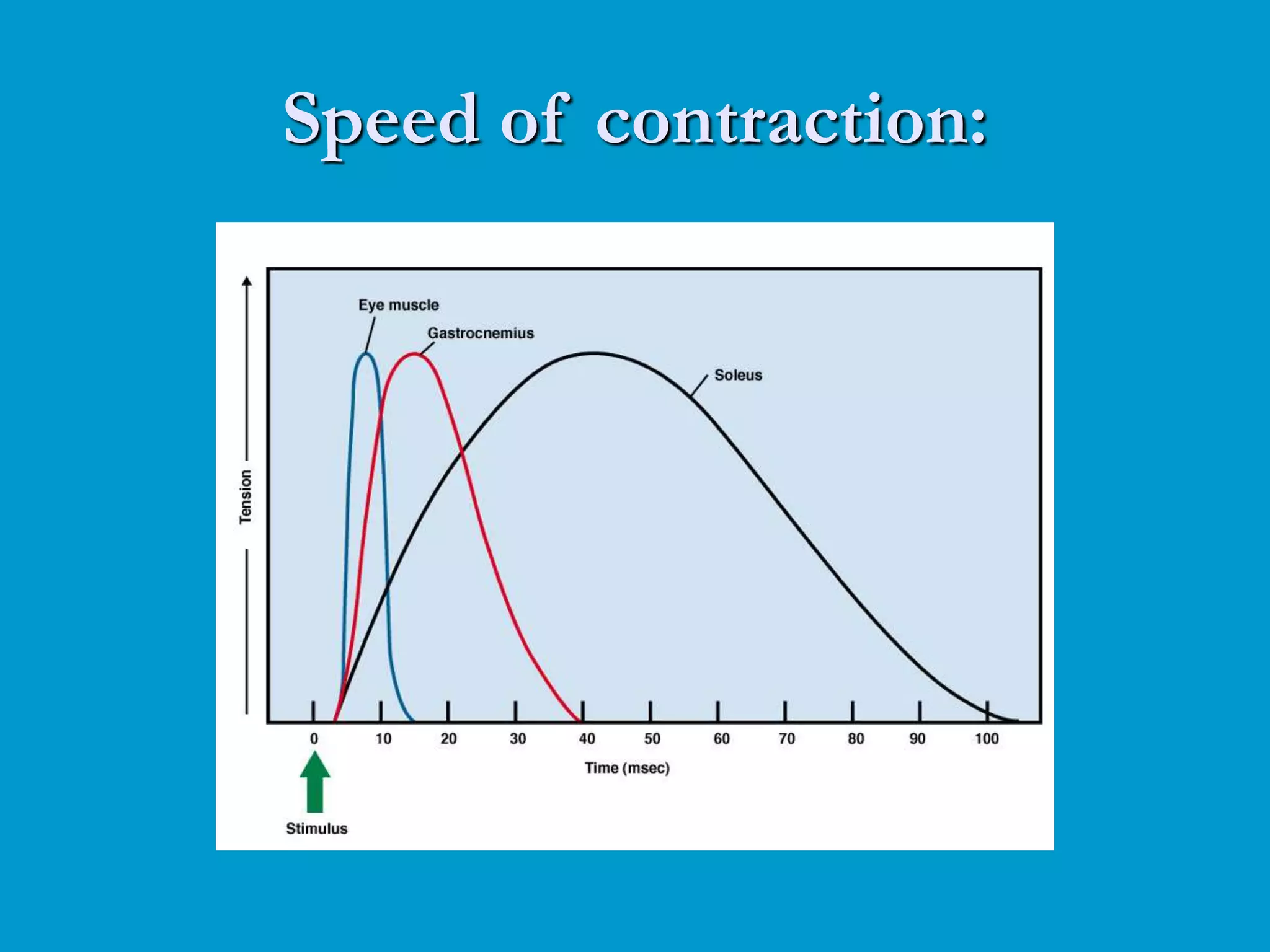
Speed of contraction:
Sustained sub-maximal tension:
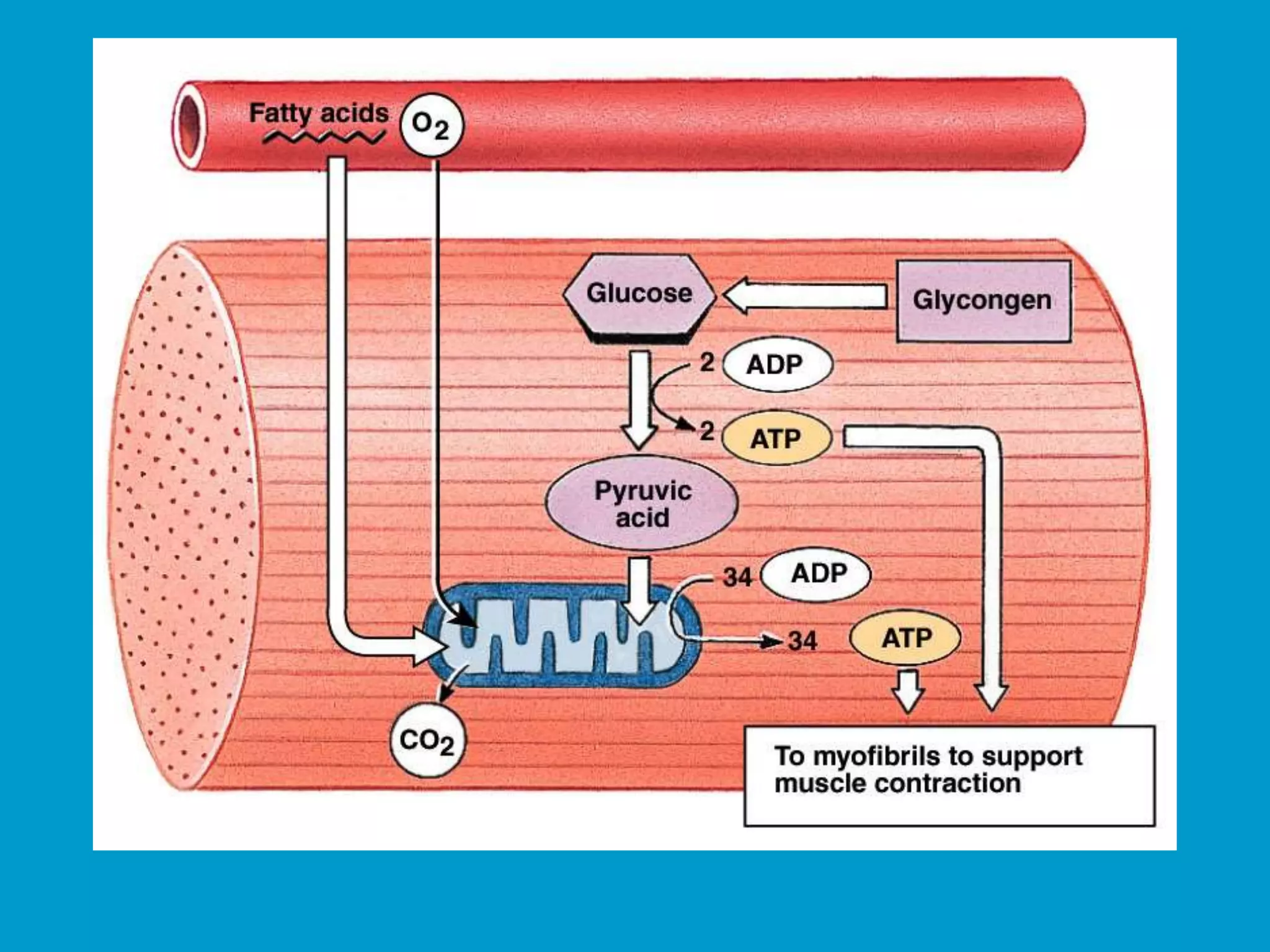
Energy Sources
 ATP provides immediate energy for muscle
contractions from 3 sources
 Creatine phosphate
 During resting conditions stores energy to synthesize ATP
 Anaerobic respiration
 Occurs in absence of oxygen and results in breakdown of
glucose to yield ATP and lactic acid
 Aerobic respiration
 Requires oxygen and breaks down glucose to produce ATP,
carbon dioxide and water
 More efficient than anaerobic
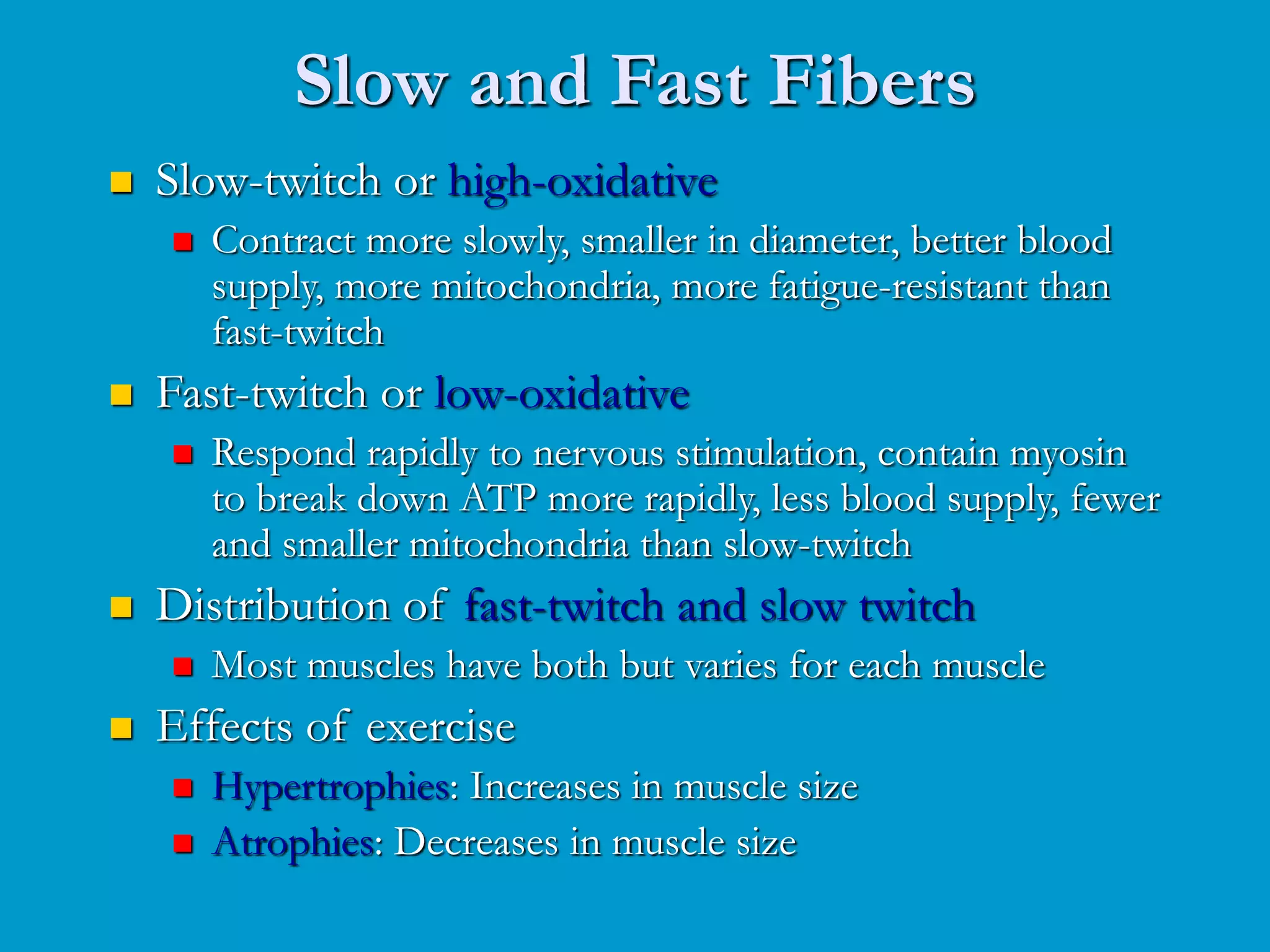
Slow and Fast Fibers
 Slow-twitch or high-oxidative
 Contract more slowly, smaller in diameter, better blood
supply, more mitochondria, more fatigue-resistant than
fast-twitch
 Fast-twitch or low-oxidative
 Respond rapidly to nervous stimulation, contain myosin
to break down ATP more rapidly, less blood supply, fewer
and smaller mitochondria than slow-twitch
 Distribution of fast-twitch and slow twitch
 Most muscles have both but varies for each muscle
 Effects of exercise
 Hypertrophies: Increases in muscle size
 Atrophies: Decreases in muscle size
Fatigue
 Decreased capacity to work and reduced
efficiency of performance
 Types:
 Psychological
 Depends on emotional state of individual
 Muscular
 Results from ATP depletion
 Synaptic
 Occurs in neuromuscular junction due to lack of
acetylcholine
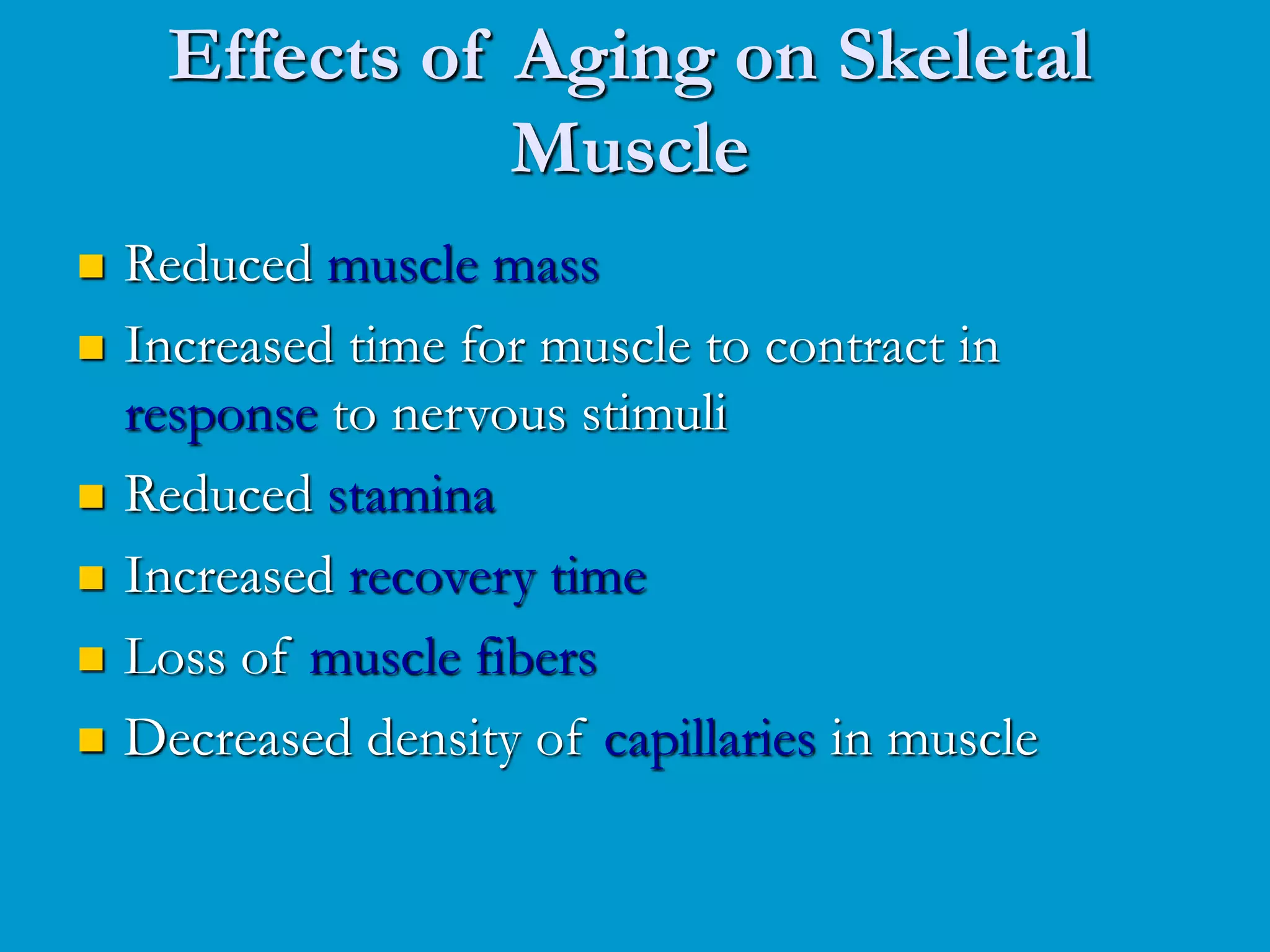
Effects of Aging on Skeletal
Muscle
 Reduced muscle mass
 Increased time for muscle to contract in
response to nervous stimuli
 Reduced stamina
 Increased recovery time
 Loss of muscle fibers
 Decreased density of capillaries in muscle
Parts of a Muscle
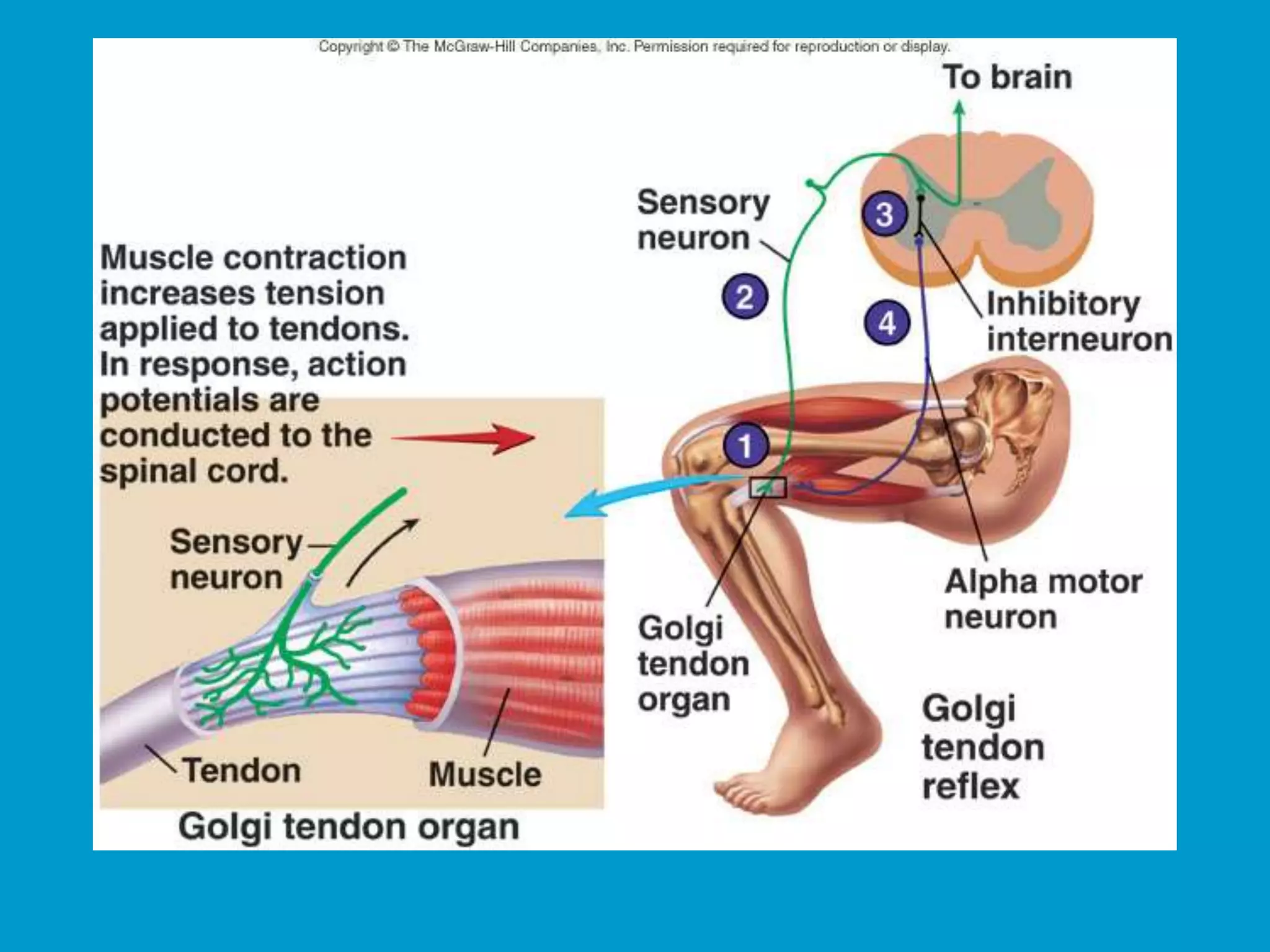
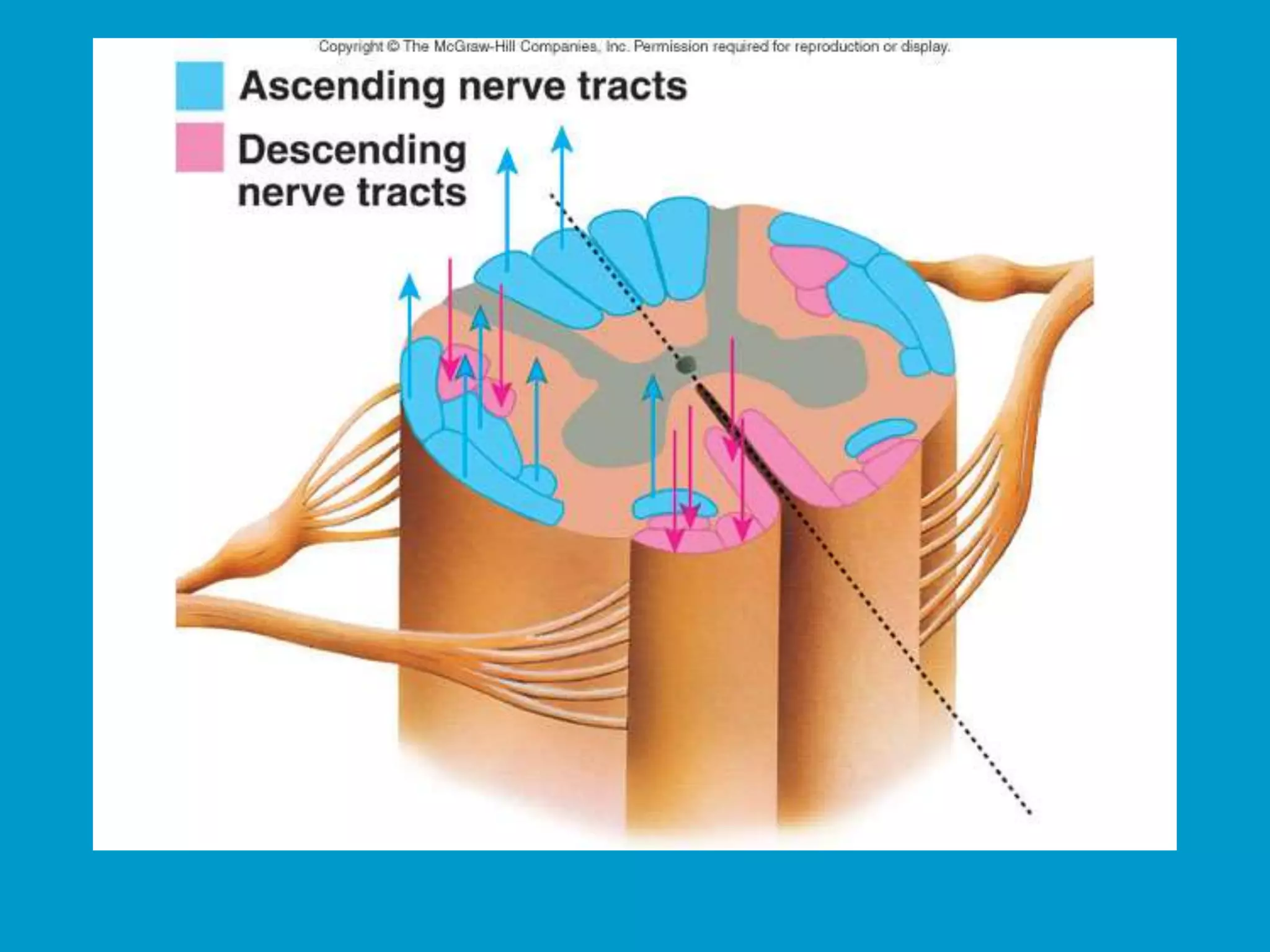
Reflexes:
Muscle reflexes:
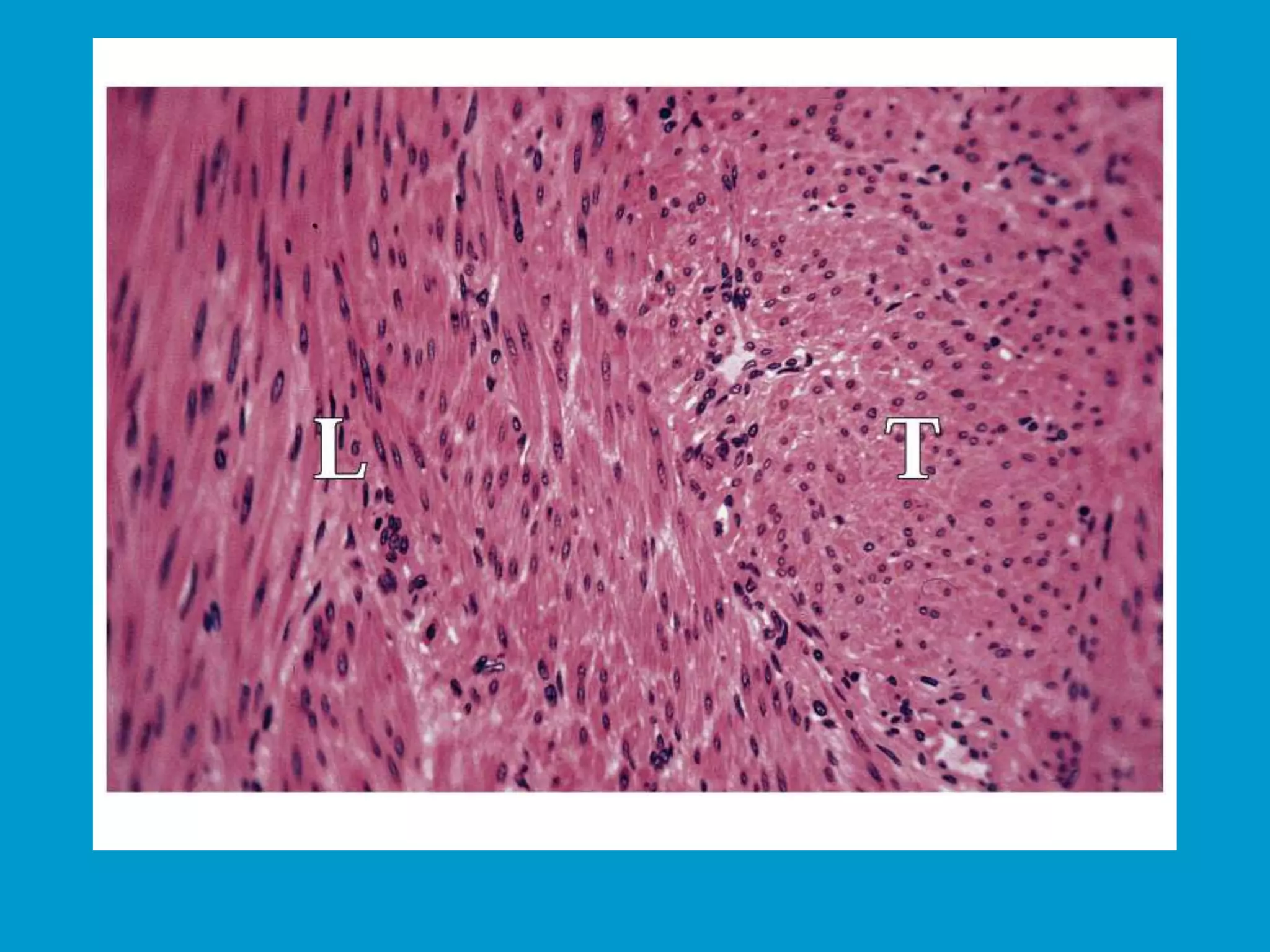
Smooth Muscle
 Characteristics
 Not striated
 Dense bodies instead of Z
disks as in skeletal muscle
 Have noncontractile
intermediate filaments
 Ca2+ required to initiate
contractions
 Types
 Visceral or unitary
 Function as a unit
 Multiunit
 Cells or groups of cells act
as independent units
Smooth Muscle Contraction
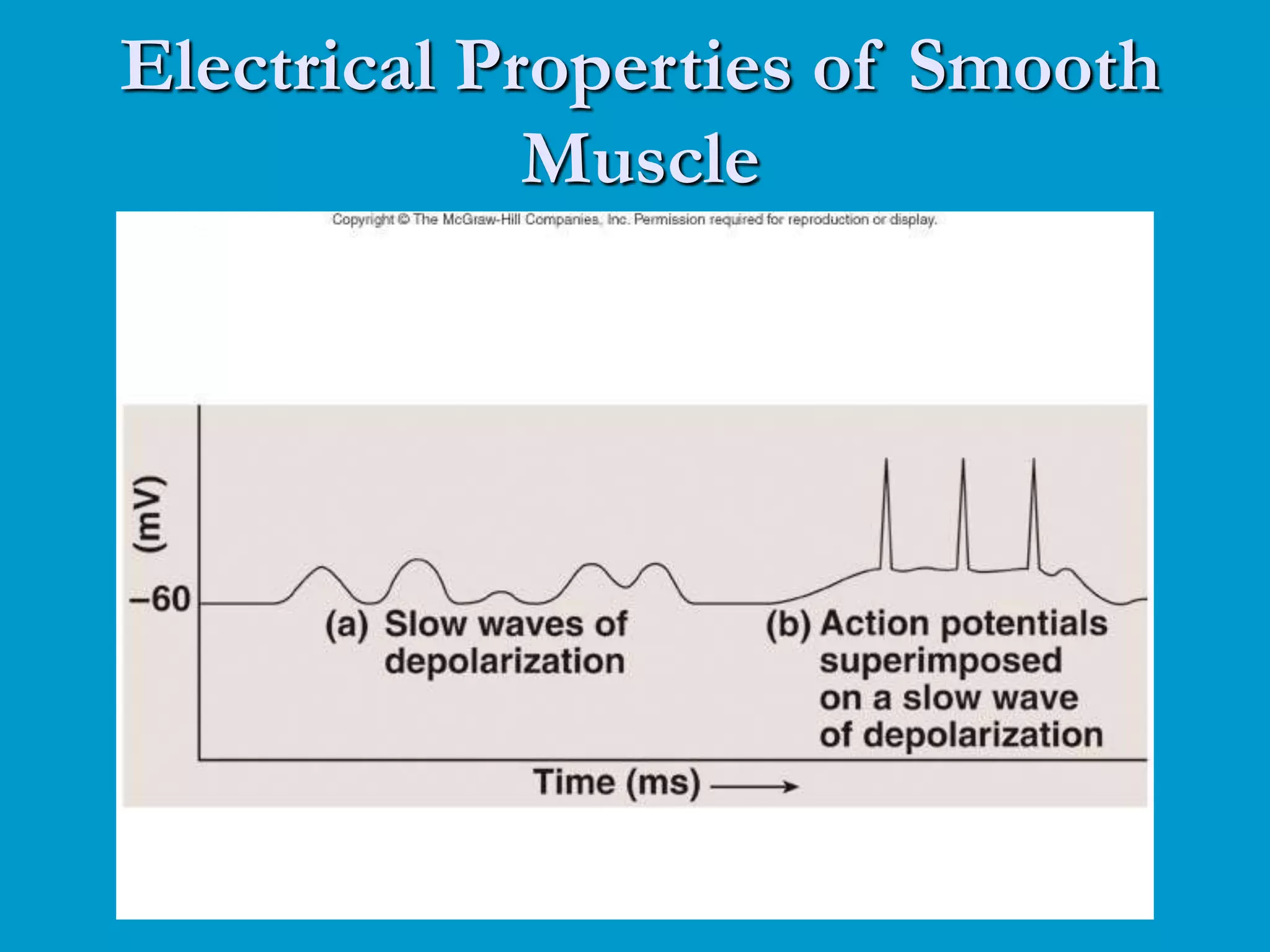
Electrical Properties of Smooth
Muscle
Functional Properties of
Smooth Muscle
 Some visceral muscle exhibits autorhythmic
contractions
 Tends to contract in response to sudden stretch
but no to slow increase in length
 Exhibits relatively constant tension: Smooth
muscle tone
 Amplitude of contraction remains constant
although muscle length varies
Smooth Muscle Regulation
 Innervated by autonomic nervous system
 Neurotransmitter are acetylcholine and
norepinephrine
 Hormones important as epinephrine and
oxytocin
 Receptors present on plasma membrane
which neurotransmitters or hormones bind
determines response
physiology.ppt
physiology.ppt

physiology.ppt

  • 1.
  • 2.
    Muscular System Functions Body movement  Maintenance of posture  Respiration  Production of body heat  Communication  Constriction of organs and vessels  Heart beat
  • 3.
    Properties of Muscle Contractility  Ability of a muscle to shorten with force  Excitability  Capacity of muscle to respond to a stimulus  Extensibility  Muscle can be stretched to its normal resting length and beyond to a limited degree  Elasticity  Ability of muscle to recoil to original resting length after stretched
  • 4.
    Muscle Tissue Types Skeletal  Attached to bones  Nuclei multiple and peripherally located  Striated, Voluntary and involuntary (reflexes)  Smooth  Walls of hollow organs, blood vessels, eye, glands, skin  Single nucleus centrally located  Not striated, involuntary, gap junctions in visceral smooth  Cardiac  Heart  Single nucleus centrally located  Striations, involuntary, intercalated disks
  • 5.
    Skeletal Muscle Structure Muscle fibers or cells  Develop from myoblasts  Numbers remain constant  Connective tissue  Nerve and blood vessels
  • 6.
  • 7.
  • 8.
  • 9.
    Connective Tissue, Nerve, BloodVessels  Connective tissue  External lamina  Endomysium  Perimysium  Fasciculus  Epimysium  Fascia  Nerve and blood vessels  Abundant
  • 10.
  • 11.
  • 12.
  • 13.
  • 14.
  • 15.
  • 17.
    Sliding Filament ModelI:  Actin myofilaments sliding over myosin to shorten sarcomeres  Actin and myosin do not change length  Shortening sarcomeres responsible for skeletal muscle contraction  During relaxation, sarcomeres lengthen
  • 18.
  • 19.
  • 22.
  • 23.
  • 24.
  • 25.
  • 26.
  • 27.
  • 28.
  • 29.
    Physiology of SkeletalMuscle  Nervous system  Controls muscle contractions through action potentials  Resting membrane potentials  Membrane voltage difference across membranes (polarized) • Inside cell more negative and more K+  Outside cell more positive and more Na+  Must exist for action potential to occur
  • 30.
  • 31.
    Action Potentials  Phases Depolarization  Inside plasma membrane becomes less negative  Repolarization  Return of resting membrane potential  All-or-none principle  Like camera flash system  Propagate  Spread from one location to another  Frequency  Number of action potential produced per unit of time
  • 32.
    Excitation-Contraction Coupling  Mechanism wherean action potential causes muscle fiber contraction  Involves  Sarcolemma  Transverse or T tubules  Terminal cisternae  Sarcoplasmic reticulum  Ca2+  Troponin
  • 34.
    Action Potentials andMuscle Contraction
  • 35.
    Muscle Twitch  Musclecontraction in response to a stimulus that causes action potential in one or more muscle fibers  Phases  Lag or latent  Contraction  Relaxation
  • 36.
  • 37.
    Stimulus Strength andMuscle Contraction  All-or-none law for muscle fibers  Contraction of equal force in response to each action potential  Sub-threshold stimulus  Threshold stimulus  Stronger than threshold  Motor units  Single motor neuron and all muscle fibers innervated  Graded for whole muscles  Strength of contractions range from weak to strong depending on stimulus strength
  • 38.
    Types of MuscleContractions  Isometric: No change in length but tension increases  Postural muscles of body  Isotonic: Change in length but tension constant  Concentric: Overcomes opposing resistance and muscle shortens  Eccentric: Tension maintained but muscle lengthens  Muscle tone: Constant tension by muscles for long periods of time
  • 39.
    Multiple Motor Unit Summation A whole muscle contracts with a small or large force depending on number of motor units stimulated to contract
  • 40.
    Multiple-Wave Summation  Asfrequency of action potentials increase, frequency of contraction increases  Action potentials come close enough together so that the muscle does not have time to completely relax between contractions.
  • 41.
     Incomplete tetanus Muscle fibers partially relax between contraction  There is time for Ca 2+ to be recycled through the SR between action potentials
  • 43.
     Complete tetanus No relaxation between contractions  Action potentials come sp close together that Ca 2+ does not get re-sequestered in the SR
  • 44.
    Treppe  Graded response Occurs in muscle rested for prolonged period  Each subsequent contraction is stronger than previous until all equal after few stimuli
  • 46.
  • 50.
  • 54.
    Energy Sources  ATPprovides immediate energy for muscle contractions from 3 sources  Creatine phosphate  During resting conditions stores energy to synthesize ATP  Anaerobic respiration  Occurs in absence of oxygen and results in breakdown of glucose to yield ATP and lactic acid  Aerobic respiration  Requires oxygen and breaks down glucose to produce ATP, carbon dioxide and water  More efficient than anaerobic
  • 58.
    Slow and FastFibers  Slow-twitch or high-oxidative  Contract more slowly, smaller in diameter, better blood supply, more mitochondria, more fatigue-resistant than fast-twitch  Fast-twitch or low-oxidative  Respond rapidly to nervous stimulation, contain myosin to break down ATP more rapidly, less blood supply, fewer and smaller mitochondria than slow-twitch  Distribution of fast-twitch and slow twitch  Most muscles have both but varies for each muscle  Effects of exercise  Hypertrophies: Increases in muscle size  Atrophies: Decreases in muscle size
  • 61.
    Fatigue  Decreased capacityto work and reduced efficiency of performance  Types:  Psychological  Depends on emotional state of individual  Muscular  Results from ATP depletion  Synaptic  Occurs in neuromuscular junction due to lack of acetylcholine
  • 62.
    Effects of Agingon Skeletal Muscle  Reduced muscle mass  Increased time for muscle to contract in response to nervous stimuli  Reduced stamina  Increased recovery time  Loss of muscle fibers  Decreased density of capillaries in muscle
  • 63.
    Parts of aMuscle
  • 64.
  • 65.
  • 79.
    Smooth Muscle  Characteristics Not striated  Dense bodies instead of Z disks as in skeletal muscle  Have noncontractile intermediate filaments  Ca2+ required to initiate contractions  Types  Visceral or unitary  Function as a unit  Multiunit  Cells or groups of cells act as independent units
  • 82.
  • 83.
  • 84.
    Functional Properties of SmoothMuscle  Some visceral muscle exhibits autorhythmic contractions  Tends to contract in response to sudden stretch but no to slow increase in length  Exhibits relatively constant tension: Smooth muscle tone  Amplitude of contraction remains constant although muscle length varies
  • 85.
    Smooth Muscle Regulation Innervated by autonomic nervous system  Neurotransmitter are acetylcholine and norepinephrine  Hormones important as epinephrine and oxytocin  Receptors present on plasma membrane which neurotransmitters or hormones bind determines response