The Nervous System/Part II
Dr. Fawaz A. Mustafa
PhD in Medical Physiology and Pharmacology
Unlimited permission is granted free of charge to print or photocopy all pages of this
work for educational, not for profit use by university staff or students
Sensory system
• Sensory system: it is the system to detect the
information or messages.
• The information come in form of energy. Human
beings have the ability to detect some of these
information, others lie beyond that ability for
detection.
• No information goes towards the body without
the interaction between the information and
receptors.
Sensory system
• After interaction, this information goes through the
nerve fibre. Each receptor is connected to a nerve
fibre
• All sensory information that need to be analysed
has to go to the cerebral cortex in postcentral
gyrus.
• If the information comes through the spinal cord, it
has to go, upwards, to pons, medulla oblongata
and mid brain to be transported to the cerebral
cortex.
Sensory system
• This sensory information will be either:
1. Light (photon energy)
2. Sound or electromagnetic wave energy.
3. Touch or pressure (mechanical energy).
4. Something hot or cold (thermal energy)
Sensory system
• How can the body tell that this information is
for light, and this is for sound or pain? In
other words, how can that there is no mixing
between the action potential of all these
energies?
• The interaction between the information (or
energy) and the receptor will produce an
action potential, but how?
Sensory system
• The interaction (information + receptor) leads to
opening Na+ and/or Ca2+ channels. Large
amounts of Na+ and Ca2+ enter the cell resulting
in depolarisation.
• Once, the membrane potential reaches the
threshold level, overshooting occurs.
• This depolarisation is known as “receptor
potential” which is much less than action
potential in the nerve fibre.
Sensory system
• If the information is so urgent, it is connected
through a myelinated and large diameter nerve
fibre. Usually, nerve fibre type Aa, Ab, Ag is fast-
conducting fibre
• The receptive field and receptors number are
not uniformly distributed throughout the body
• The more condensed receptors number, the
better the ability to feel stimuli and differentiate
between them.
Sensory system
• If there are two stimuli, and applied them to
a. Surface area of the skin where there are huge
numbers of receptor, there is a feeling of two
stimuli
b. Surface area of the skin where there are few
numbers of receptor. There can either feel the
two stimuli in case of that each one falls on a
separate receptive field or cannot feel the two
stimuli, instead feel them as being one stimulus
Sensory system
• When a stimulus is applied to a receptor, action
potential is produced and then travels through
the adjacent nerve fibre.
• In some receptors, if we keep on applying
stimulus, and there will always be an action
potential, this kind of receptors is the “tonic or
non-adapting receptors”. e.g. the receptors for
pain sensation
Sensory system
• The other type of receptors is that producing an
action potential just when first apply a stimulus,
but if keeping on applying a stimulus, there will
be no action potential, or it will decrease. These
are called “phasic or adapting receptors”
• Another example is the mechanical receptors
in and around the joints (especially in the lower
limb), they are very important because when we
are walking they will tell us about our walking
rate and when we walk faster or when we try to
stop
Sensory system
• Now, the question is “do the internal
organs inside the body have
receptors?”
Sensory pathway and projection
• The sensory pathway includes: the stimulus to a
receptor which is connected with nerve fibre,
that comes from a nerve cell body (soma), this is
called the “the first order neuron”. This neuron
synapses with another neuron “second order
neuron” which synapses with another neuron
“third order neuron” till reach the final centre
for analysis. If painful stimuli are applied to the
receptor, the feeling is pain. If we put a piece of
cotton on the skin, the feeling is touch sensation.
Sensory pathway and projection
• Sometimes, the stimulus is applied to second or
third order neuron instead of applying it to the
receptor. The result is the same as applying it to
the receptor. The kind of sensation (touch, pain,
temperature) depends on whether the pathway is
for pain or touch… etc.
• In subjects with amputated limbs, sometimes they
feel as there is something touching their toes
despite the fact that they have no toes. This is
because something stimulates somewhere in the
pathway that comes to the toe
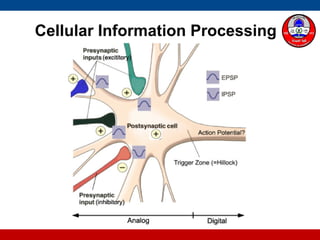
Cellular Information Processing
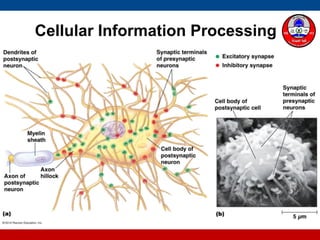
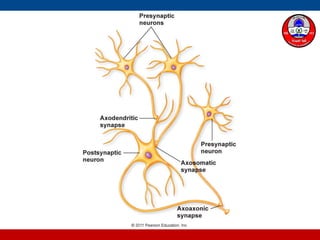
• At each synapse, an action potential arriving at a
synaptic knob triggers a chemical or electrical
event that affect another cell.
• Some of the neurotransmitters arriving at the
postsynaptic cell may be Excitatory, while
others from different presynaptic neuron may be
Inhibitory.
• Postsynaptic Potential: is a graded potential
that develops in the postsynaptic membrane in
response to a neurotransmitter.
Cellular Information Processing
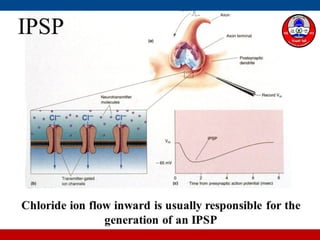
• Postsynaptic potentials fall into two categories:
– Excitatory postsynaptic potentials (EPSPs)
are depolarizations that bring the membrane
potential toward threshold
– Inhibitory postsynaptic potentials (IPSPs)
are hyperpolarizations that move the membrane
potential farther from threshold
Cellular Information Processing
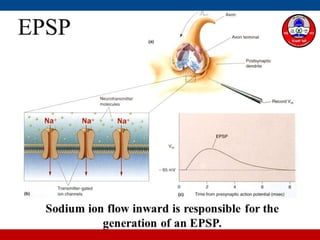
• EPSP is caused by opening of chemically
regulated Na+ (ion) channels, EPSP affects the
area immediately surrounding the synapse. e.g.:
ACh
Cellular Information Processing
• IPSP may result from the opening chemically
regulated K+ ion channels (while the
hyperpolarization continue the neuron is
inhibited).
• In transmembrane potential where resting at -
85mV because of an IPSP the stimulus will
depolarize it only to -75mV which is still below
threshold
Cellular Information Processing
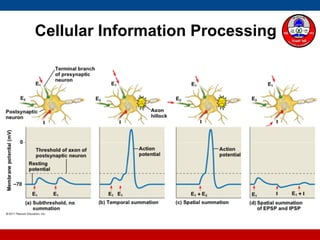
Summation
• Is the mechanism responsible for the integration
of EPSP, IPSP or some combination of the two
in the postsynaptic neuron.
• There are two forms of summation
a. Temporal summation
b. Spatial summation
Cellular Information Processing
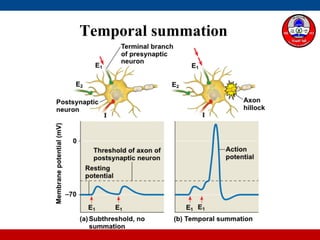
• Temporal summation: is addition of stimuli
occurring rapidly at a single synapse. Every
time an action potential arrives at the synapse
another group of vesicles discharges ACh into
the cleft.
• Every time more ACh arrives at the postsynaptic
membrane → more chemically regulated
channels open → degree of depolarization ↑es
→ so series of small steps can bring the initial
segment to threshold → AP.
Temporal summation
Cellular Information Processing
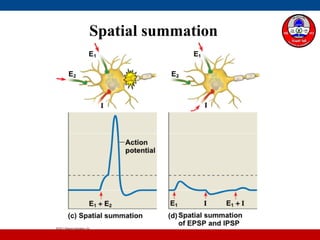
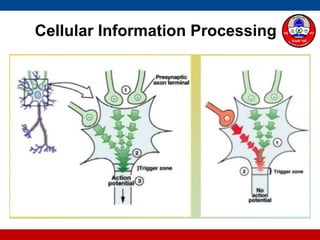
• Spatial summation: occur when EPSPs
produced nearly simultaneously by different
synapses on the same postsynaptic neuron add
together
• More than one synapse is active at the same
time → all will "pour" Na+ ions across
postsynaptic membrane → as an effect on the
initial segment is accumulative → degree of
depolarization depend on number of synapses
active → threshold → AP.
Spatial summation
Cellular Information Processing
Summation of EPSP & IPSP
• IPSP is like EPSP stimulate spatially &
temporally (but IPSP is activation of deferent
type of ion channels) so the antagonism of IPSP
& EPSP is important for cellular information
processing
Cellular Information Processing
Facilitation
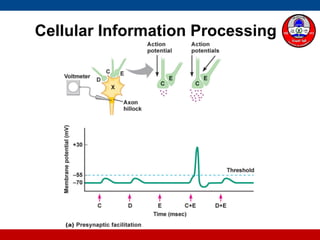
• Spatial or temporal summation of EPSPs will not
necessary depolarize the initial segment to
threshold. But every step closer to threshold
makes it easier for the next stimulus to trigger an
AP. So a neuron that has been brought closer
to threshold is facilitated.
Cellular Information Processing
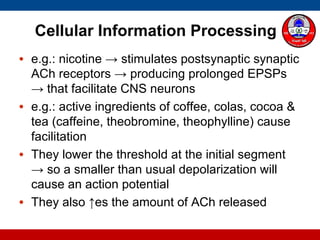
• e.g.: nicotine → stimulates postsynaptic synaptic
ACh receptors → producing prolonged EPSPs
→ that facilitate CNS neurons
• e.g.: active ingredients of coffee, colas, cocoa &
tea (caffeine, theobromine, theophylline) cause
facilitation
• They lower the threshold at the initial segment
→ so a smaller than usual depolarization will
cause an action potential
• They also ↑es the amount of ACh released
Chloride (Cl-) channels & EPSP &
IPSP summation
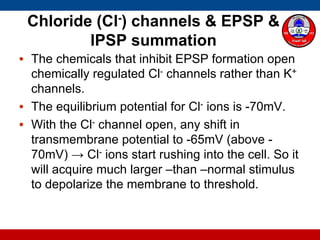
• The chemicals that inhibit EPSP formation open
chemically regulated Cl- channels rather than K+
channels.
• The equilibrium potential for Cl- ions is -70mV.
• With the Cl- channel open, any shift in
transmembrane potential to -65mV (above -
70mV) → Cl- ions start rushing into the cell. So it
will acquire much larger –than –normal stimulus
to depolarize the membrane to threshold.
Cellular Information Processing
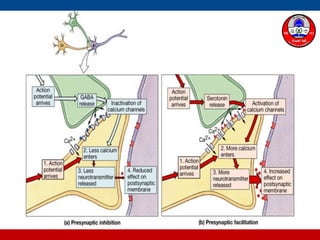
• Presynaptic Facilitation → activity at
axoaxonal synapse ↑es amount of
neurotransmitter release when AP arrives at the
synaptic knob, e.g. Serotonin → voltage
regulated Ca+ channel remain open.
- AP arrives.
- prolong opening of Ca+ channels.
- more Ca+ enters.
- more neurotransmitter released.
- ↑es effect on post synaptic membrane
Cellular Information Processing
• Presynaptic Inhibition → GABA inhibits the
opening of voltage regulated Ca+ channels in the
synaptic knob → ↓es amount of neurotransmitter
release when AP arrives at the synaptic knob.
– AP arrive.
– fewer Ca+ channels open.
– less Ca+ enters.
– less neurotransmitter release.
– ↓es effect on postsynaptic membrane.
Sensory pathway and projection
Strong and weak stimuli
• How can we discriminate between strong
painful or weak painful stimulus, since the
language of the nervous system is
uniformed?
Sensory unit, lateral inhibition and
acuity of sensation
• In the sensory system, there is a term called
“sensory unit” which consists of the receptor, its
receptive field and the nerve fibre which comes
from a neuron soma.
• In the transmission of sensation from the
receptor through a nerve fibre, there is a
phenomenon called “lateral inhibition”
• If we force a pen’s tip on one of our fingers, the
sensation will be transmitted from the receptors
through the median nerve (which supplies the
lateral 3 and half fingers cutaneously) to the
cervical segments of the spinal cord
• At the same time, the axon in the central area of
the skin (where the pen’s tip is applied) sends
collaterals to the axons in the area adjacent to
the central area (the peripheral area)
Sensory unit, lateral inhibition and
acuity of sensation
• These collaterals are inhibitory to the peripheral
axons preventing the transmission of sensation
through them. Thus, there is a better
transmission and sensation in the central part,
and a small sensation in the periphery. i.e.
acuity of sensation in the centre area is greater.
This provides a “contrast”
• Collateral inhibition enables us to increase the
acuity of sensation in the central area
Sensory unit, lateral inhibition and
acuity of sensation
Sensory system
Synaptic fatigue
• The transmission of an impulse between two
neurons is by the release of neurotransmitter
which is stored in vesicles to be released in the
space between the two neurons during action
potential, then it combines with receptor on the
second neuron cell membrane. But,
neurotransmitter releases will not be forever,
because nerve endings have a limited amount of
it
Sensory system
Sensation and perception
• Sensation starts when a stimulus is applied to a
receptor, and ends when reaching the final centre,
and there is awareness of it.
• Perception is when we know the meaning of the
sensation (its kind, location, intensity…. etc.), but
the final centre is not enough for this job. So many
areas (such as memory area, emotion area) will
contribute to give the sensation its meaning.

The Nervous system: Part II

  • 1.
    The Nervous System/PartII Dr. Fawaz A. Mustafa PhD in Medical Physiology and Pharmacology Unlimited permission is granted free of charge to print or photocopy all pages of this work for educational, not for profit use by university staff or students
  • 2.
    Sensory system • Sensorysystem: it is the system to detect the information or messages. • The information come in form of energy. Human beings have the ability to detect some of these information, others lie beyond that ability for detection. • No information goes towards the body without the interaction between the information and receptors.
  • 3.
    Sensory system • Afterinteraction, this information goes through the nerve fibre. Each receptor is connected to a nerve fibre • All sensory information that need to be analysed has to go to the cerebral cortex in postcentral gyrus. • If the information comes through the spinal cord, it has to go, upwards, to pons, medulla oblongata and mid brain to be transported to the cerebral cortex.
  • 4.
    Sensory system • Thissensory information will be either: 1. Light (photon energy) 2. Sound or electromagnetic wave energy. 3. Touch or pressure (mechanical energy). 4. Something hot or cold (thermal energy)
  • 5.
    Sensory system • Howcan the body tell that this information is for light, and this is for sound or pain? In other words, how can that there is no mixing between the action potential of all these energies? • The interaction between the information (or energy) and the receptor will produce an action potential, but how?
  • 6.
    Sensory system • Theinteraction (information + receptor) leads to opening Na+ and/or Ca2+ channels. Large amounts of Na+ and Ca2+ enter the cell resulting in depolarisation. • Once, the membrane potential reaches the threshold level, overshooting occurs. • This depolarisation is known as “receptor potential” which is much less than action potential in the nerve fibre.
  • 7.
    Sensory system • Ifthe information is so urgent, it is connected through a myelinated and large diameter nerve fibre. Usually, nerve fibre type Aa, Ab, Ag is fast- conducting fibre • The receptive field and receptors number are not uniformly distributed throughout the body • The more condensed receptors number, the better the ability to feel stimuli and differentiate between them.
  • 8.
    Sensory system • Ifthere are two stimuli, and applied them to a. Surface area of the skin where there are huge numbers of receptor, there is a feeling of two stimuli b. Surface area of the skin where there are few numbers of receptor. There can either feel the two stimuli in case of that each one falls on a separate receptive field or cannot feel the two stimuli, instead feel them as being one stimulus
  • 9.
    Sensory system • Whena stimulus is applied to a receptor, action potential is produced and then travels through the adjacent nerve fibre. • In some receptors, if we keep on applying stimulus, and there will always be an action potential, this kind of receptors is the “tonic or non-adapting receptors”. e.g. the receptors for pain sensation
  • 10.
    Sensory system • Theother type of receptors is that producing an action potential just when first apply a stimulus, but if keeping on applying a stimulus, there will be no action potential, or it will decrease. These are called “phasic or adapting receptors” • Another example is the mechanical receptors in and around the joints (especially in the lower limb), they are very important because when we are walking they will tell us about our walking rate and when we walk faster or when we try to stop
  • 11.
    Sensory system • Now,the question is “do the internal organs inside the body have receptors?”
  • 12.
    Sensory pathway andprojection • The sensory pathway includes: the stimulus to a receptor which is connected with nerve fibre, that comes from a nerve cell body (soma), this is called the “the first order neuron”. This neuron synapses with another neuron “second order neuron” which synapses with another neuron “third order neuron” till reach the final centre for analysis. If painful stimuli are applied to the receptor, the feeling is pain. If we put a piece of cotton on the skin, the feeling is touch sensation.
  • 13.
    Sensory pathway andprojection • Sometimes, the stimulus is applied to second or third order neuron instead of applying it to the receptor. The result is the same as applying it to the receptor. The kind of sensation (touch, pain, temperature) depends on whether the pathway is for pain or touch… etc. • In subjects with amputated limbs, sometimes they feel as there is something touching their toes despite the fact that they have no toes. This is because something stimulates somewhere in the pathway that comes to the toe
  • 14.
    Cellular Information Processing •At each synapse, an action potential arriving at a synaptic knob triggers a chemical or electrical event that affect another cell. • Some of the neurotransmitters arriving at the postsynaptic cell may be Excitatory, while others from different presynaptic neuron may be Inhibitory. • Postsynaptic Potential: is a graded potential that develops in the postsynaptic membrane in response to a neurotransmitter.
  • 15.
  • 16.
    Cellular Information Processing •Postsynaptic potentials fall into two categories: – Excitatory postsynaptic potentials (EPSPs) are depolarizations that bring the membrane potential toward threshold – Inhibitory postsynaptic potentials (IPSPs) are hyperpolarizations that move the membrane potential farther from threshold
  • 17.
    Cellular Information Processing •EPSP is caused by opening of chemically regulated Na+ (ion) channels, EPSP affects the area immediately surrounding the synapse. e.g.: ACh
  • 18.
    Cellular Information Processing •IPSP may result from the opening chemically regulated K+ ion channels (while the hyperpolarization continue the neuron is inhibited). • In transmembrane potential where resting at - 85mV because of an IPSP the stimulus will depolarize it only to -75mV which is still below threshold
  • 19.
  • 20.
    Cellular Information Processing Summation •Is the mechanism responsible for the integration of EPSP, IPSP or some combination of the two in the postsynaptic neuron. • There are two forms of summation a. Temporal summation b. Spatial summation
  • 21.
    Cellular Information Processing •Temporal summation: is addition of stimuli occurring rapidly at a single synapse. Every time an action potential arrives at the synapse another group of vesicles discharges ACh into the cleft. • Every time more ACh arrives at the postsynaptic membrane → more chemically regulated channels open → degree of depolarization ↑es → so series of small steps can bring the initial segment to threshold → AP.
  • 22.
  • 23.
    Cellular Information Processing •Spatial summation: occur when EPSPs produced nearly simultaneously by different synapses on the same postsynaptic neuron add together • More than one synapse is active at the same time → all will "pour" Na+ ions across postsynaptic membrane → as an effect on the initial segment is accumulative → degree of depolarization depend on number of synapses active → threshold → AP.
  • 24.
  • 25.
    Cellular Information Processing Summationof EPSP & IPSP • IPSP is like EPSP stimulate spatially & temporally (but IPSP is activation of deferent type of ion channels) so the antagonism of IPSP & EPSP is important for cellular information processing
  • 26.
  • 27.
  • 28.
    Cellular Information Processing Facilitation •Spatial or temporal summation of EPSPs will not necessary depolarize the initial segment to threshold. But every step closer to threshold makes it easier for the next stimulus to trigger an AP. So a neuron that has been brought closer to threshold is facilitated.
  • 29.
  • 30.
    Cellular Information Processing •e.g.: nicotine → stimulates postsynaptic synaptic ACh receptors → producing prolonged EPSPs → that facilitate CNS neurons • e.g.: active ingredients of coffee, colas, cocoa & tea (caffeine, theobromine, theophylline) cause facilitation • They lower the threshold at the initial segment → so a smaller than usual depolarization will cause an action potential • They also ↑es the amount of ACh released
  • 31.
    Chloride (Cl-) channels& EPSP & IPSP summation • The chemicals that inhibit EPSP formation open chemically regulated Cl- channels rather than K+ channels. • The equilibrium potential for Cl- ions is -70mV. • With the Cl- channel open, any shift in transmembrane potential to -65mV (above - 70mV) → Cl- ions start rushing into the cell. So it will acquire much larger –than –normal stimulus to depolarize the membrane to threshold.
  • 34.
    Cellular Information Processing •Presynaptic Facilitation → activity at axoaxonal synapse ↑es amount of neurotransmitter release when AP arrives at the synaptic knob, e.g. Serotonin → voltage regulated Ca+ channel remain open. - AP arrives. - prolong opening of Ca+ channels. - more Ca+ enters. - more neurotransmitter released. - ↑es effect on post synaptic membrane
  • 37.
    Cellular Information Processing •Presynaptic Inhibition → GABA inhibits the opening of voltage regulated Ca+ channels in the synaptic knob → ↓es amount of neurotransmitter release when AP arrives at the synaptic knob. – AP arrive. – fewer Ca+ channels open. – less Ca+ enters. – less neurotransmitter release. – ↓es effect on postsynaptic membrane.
  • 38.
    Sensory pathway andprojection Strong and weak stimuli • How can we discriminate between strong painful or weak painful stimulus, since the language of the nervous system is uniformed?
  • 39.
    Sensory unit, lateralinhibition and acuity of sensation • In the sensory system, there is a term called “sensory unit” which consists of the receptor, its receptive field and the nerve fibre which comes from a neuron soma. • In the transmission of sensation from the receptor through a nerve fibre, there is a phenomenon called “lateral inhibition”
  • 40.
    • If weforce a pen’s tip on one of our fingers, the sensation will be transmitted from the receptors through the median nerve (which supplies the lateral 3 and half fingers cutaneously) to the cervical segments of the spinal cord • At the same time, the axon in the central area of the skin (where the pen’s tip is applied) sends collaterals to the axons in the area adjacent to the central area (the peripheral area) Sensory unit, lateral inhibition and acuity of sensation
  • 41.
    • These collateralsare inhibitory to the peripheral axons preventing the transmission of sensation through them. Thus, there is a better transmission and sensation in the central part, and a small sensation in the periphery. i.e. acuity of sensation in the centre area is greater. This provides a “contrast” • Collateral inhibition enables us to increase the acuity of sensation in the central area Sensory unit, lateral inhibition and acuity of sensation
  • 42.
    Sensory system Synaptic fatigue •The transmission of an impulse between two neurons is by the release of neurotransmitter which is stored in vesicles to be released in the space between the two neurons during action potential, then it combines with receptor on the second neuron cell membrane. But, neurotransmitter releases will not be forever, because nerve endings have a limited amount of it
  • 43.
    Sensory system Sensation andperception • Sensation starts when a stimulus is applied to a receptor, and ends when reaching the final centre, and there is awareness of it. • Perception is when we know the meaning of the sensation (its kind, location, intensity…. etc.), but the final centre is not enough for this job. So many areas (such as memory area, emotion area) will contribute to give the sensation its meaning.