B Y
H O S S E I N K H O R R A M I P h D . D O M P,
SHOULDER
khorrami4@yahoo.com
http://www.scribd.com/khorrami4
Shoulder bones
• Humerus
• Scapula
• Clavicle
• Ribs
• Vertebrae
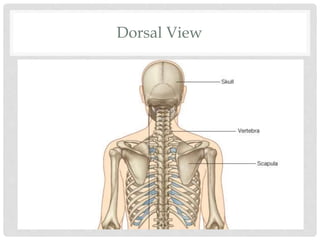
Dorsal View
Shoulder
• Joints
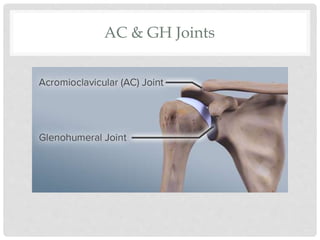
• Acromioclavicular(AC) joint
• Glenohumeral (GH) joint, ball & socket joint
• Sternoclavicular(SC) joint
• Scapulothoracic joints
• Ligaments
• Tendons
• Capsules
• Bursa
• Vessels
• Brachial plexus
• muscles
• https://www.youtube.com/watch?v=D3GVKjeY1FM
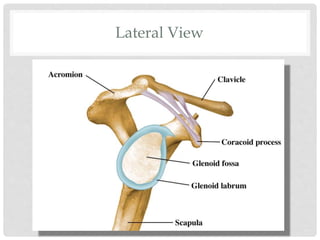
Lateral View
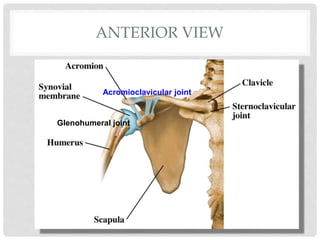
ANTERIOR VIEW
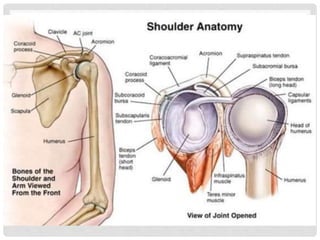
Glenohumeral joint
Acromioclavicular joint
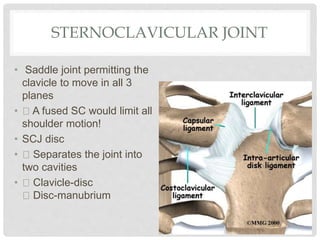
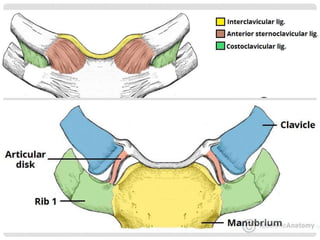
STERNOCLAVICULAR JOINT
• Saddle joint permitting the
clavicle to move in all 3
planes
• A fused SC would limit all
shoulder motion!
• SCJ disc
• Separates the joint into
two cavities
• Clavicle-disc
Disc-manubrium
SCJ, MOVEMENTS
• Functions of the SCJ
• Provide movement of the scapula (along with the
• ACJ)
• Absorb forces from the upper extremity
• Elevatoin
• Depression
• Protraction
• Retraction
• Rotation
SCJ MVMT
• Motions allowed at the SCJ
• • Elevation-Depression of the clavicle
• Elevation occurs with shoulder flexion and abduction
• Depression with shoulder extension and adduction
SCAPULOTHORACIC JOINT
• Elevation
• Depression
• Protraction
• Retraction
• Upward
• Downward
• Internal rotation( Tipping)
• External rotation
• Winging
• Protraction-Retraction of the clavicle
• Occurs mostly between the disc and the manubrium
• Protraction occurs with shoulder horiz adduction
• Retraction with horiz abduction, shoulder extension
• Rotation
• Occurs due to tightening of the coraco- clavicular
ligament during humeral elevation (after 90)
• If no posterior rotation available, can only get 120 of
humeral elevation
AC & GH Joints
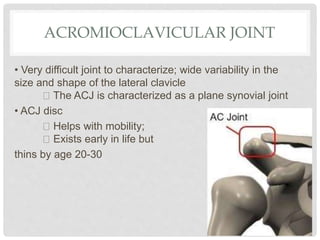
ACROMIOCLAVICULAR JOINT
• Very difficult joint to characterize; wide variability in the
size and shape of the lateral clavicle
The ACJ is characterized as a plane synovial joint
• ACJ disc
Helps with mobility;
Exists early in life but
thins by age 20-30
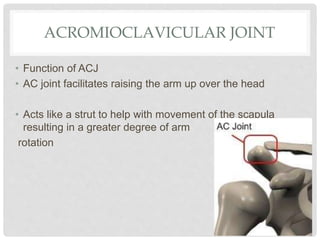
ACROMIOCLAVICULAR JOINT
• Function of ACJ
• AC joint facilitates raising the arm up over the head
• Acts like a strut to help with movement of the scapula
resulting in a greater degree of arm
rotation
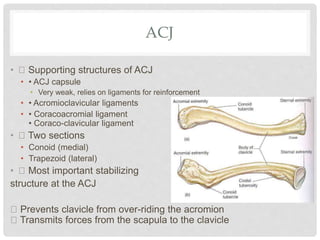
ACJ
• Supporting structures of ACJ
• • ACJ capsule
• Very weak, relies on ligaments for reinforcement
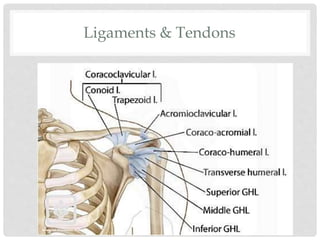
• • Acromioclavicular ligaments
• • Coracoacromial ligament
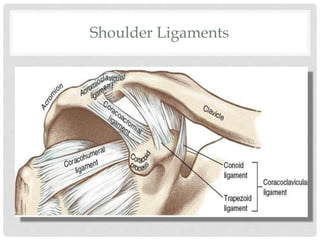
• Coraco-clavicular ligament
• Two sections
• Conoid (medial)
• Trapezoid (lateral)
• Most important stabilizing
structure at the ACJ
Prevents clavicle from over-riding the acromion
Transmits forces from the scapula to the clavicle
Ligaments & Tendons
Shoulder Ligaments
GLENOHUMERAL JOINT
• Classic ball and socket
• joint
• • Composed of glenoid
• fossa and humeral head
• Fossa only articulates with 25% of the humeral head
• • Sacrifices stability for mobility
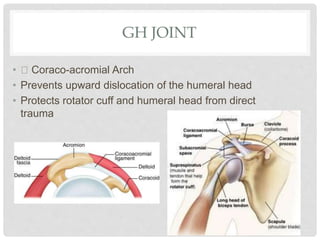
GH JOINT
• Coraco-acromial Arch
• Prevents upward dislocation of the humeral head
• Protects rotator cuff and humeral head from direct
trauma
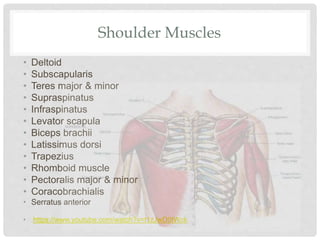
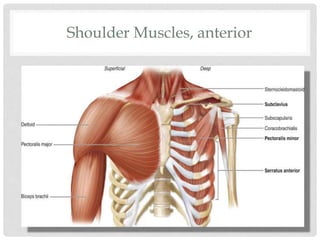
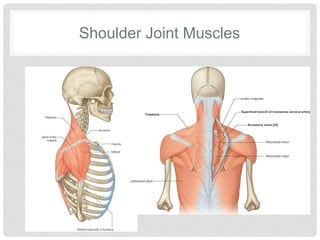
Shoulder Muscles
• Deltoid
• Subscapularis
• Teres major & minor
• Supraspinatus
• Infraspinatus
• Levator scapula
• Biceps brachii
• Latissimus dorsi
• Trapezius
• Rhomboid muscle
• Pectoralis major & minor
• Coracobrachialis
• Serratus anterior
• https://www.youtube.com/watch?v=t1zJwD0tWck
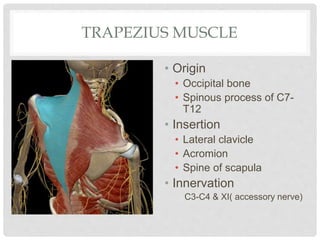
TRAPEZIUS MUSCLE
• Origin
• Occipital bone
• Spinous process of C7-
T12
• Insertion
• Lateral clavicle
• Acromion
• Spine of scapula
• Innervation
C3-C4 & XI( accessory nerve)
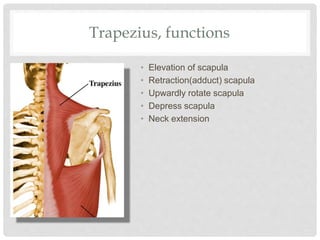
Trapezius, functions
• Elevation of scapula
• Retraction(adduct) scapula
• Upwardly rotate scapula
• Depress scapula
• Neck extension
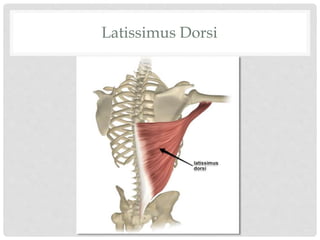
Latissimus Dorsi
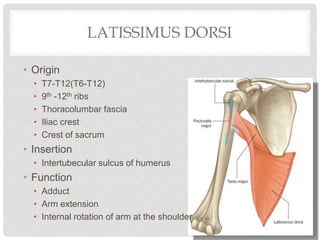
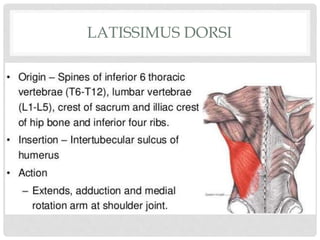
LATISSIMUS DORSI
• Origin
• T7-T12(T6-T12)
• 9th -12th ribs
• Thoracolumbar fascia
• Iliac crest
• Crest of sacrum
• Insertion
• Intertubecular sulcus of humerus
• Function
• Adduct
• Arm extension
• Internal rotation of arm at the shoulder
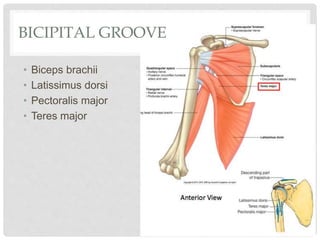
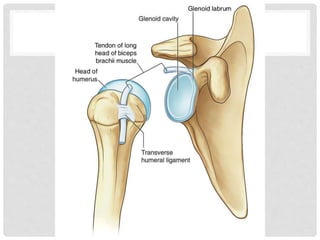
BICIPITAL GROOVE
• Biceps brachii
• Latissimus dorsi
• Pectoralis major
• Teres major
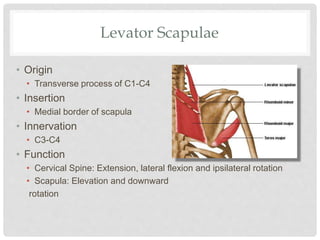
LATISSIMUS DORSI
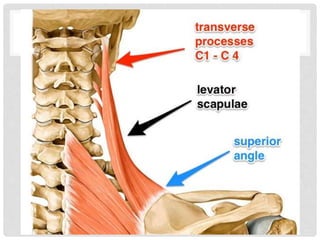
• Origin
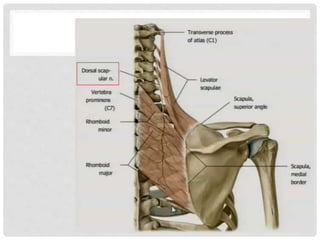
• Transverse process of C1-C4
• Insertion
• Medial border of scapula
• Innervation
• C3-C4
• Function
• Cervical Spine: Extension, lateral flexion and ipsilateral rotation
• Scapula: Elevation and downward
rotation
Levator Scapulae
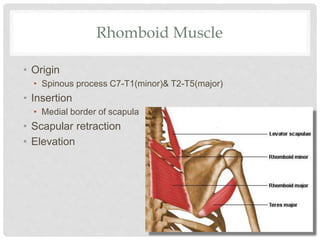
Rhomboid Muscle
• Origin
• Spinous process C7-T1(minor)& T2-T5(major)
• Insertion
• Medial border of scapula
• Scapular retraction
• Elevation
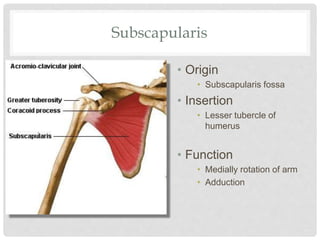
Subscapularis
• Origin
• Subscapularis fossa
• Insertion
• Lesser tubercle of
humerus
• Function
• Medially rotation of arm
• Adduction
Shoulder Muscles, anterior
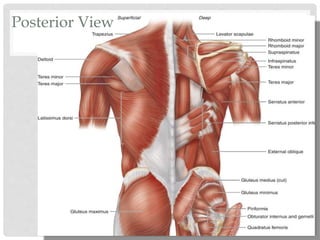
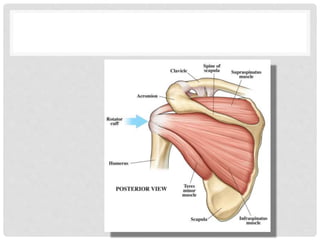
Posterior View
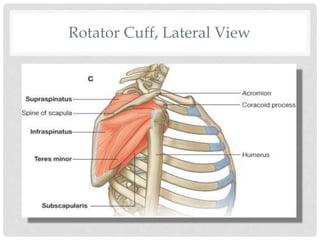
Rotator Cuff Muscles
• Teres minor
• Supraspinatus
• Infraspinatus
• Subscapularis
Rotator Cuff, Lateral View
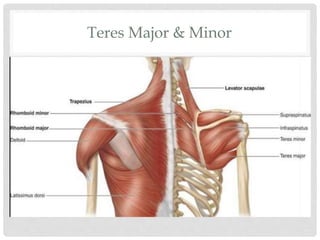
Teres Major & Minor
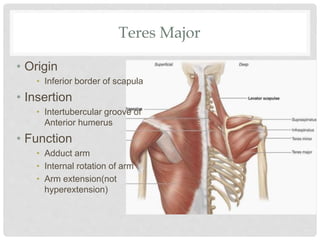
Teres Major
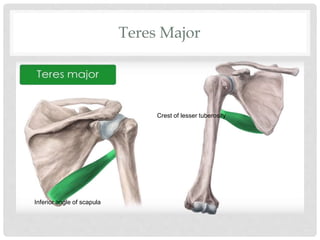
• Origin
• Inferior border of scapula
• Insertion
• Intertubercular groove of
Anterior humerus
• Function
• Adduct arm
• Internal rotation of arm
• Arm extension(not
hyperextension)
Teres Major
Crest of lesser tuberosity
Inferior angle of scapula
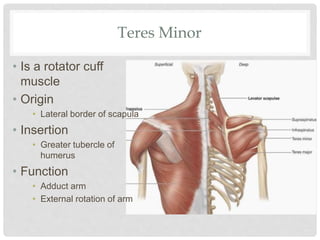
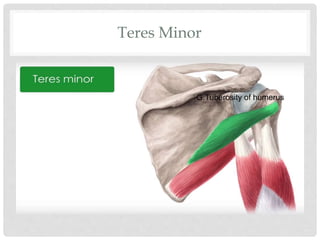
Teres Minor
• Is a rotator cuff
muscle
• Origin
• Lateral border of scapula
• Insertion
• Greater tubercle of
humerus
• Function
• Adduct arm
• External rotation of arm
Teres Minor
G.Tuberosity of humerus
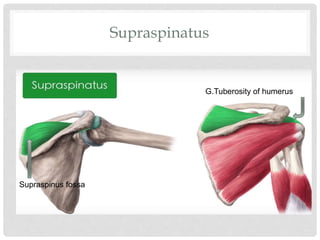
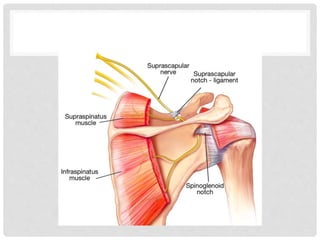
Supraspinatus
Supraspinus fossa
G.Tuberosity of humerus
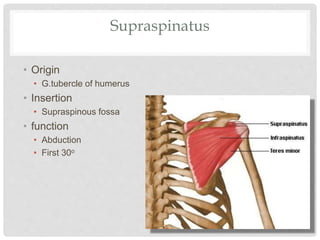
Supraspinatus
• Origin
• G.tubercle of humerus
• Insertion
• Supraspinous fossa
• function
• Abduction
• First 30o
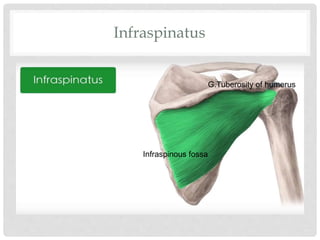
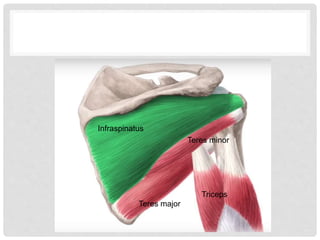
Infraspinatus
Infraspinous fossa
G.Tuberosity of humerus
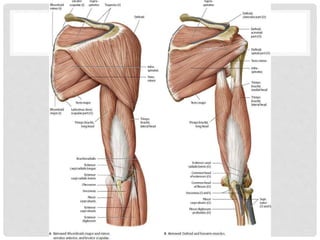
Triceps
Teres major
Teres minor
Infraspinatus
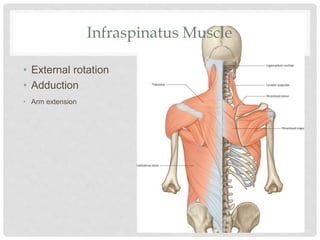
Infraspinatus Muscle
• External rotation
• Adduction
• Arm extension
• https://www.facebook.com/Fisioterapia.hospitalar1/video
s/1127055657486653/
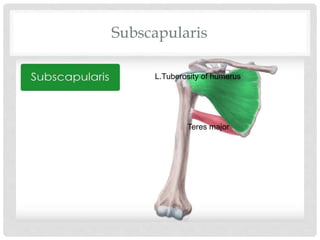
Subscapularis
L.Tuberosity of humerus
Teres major
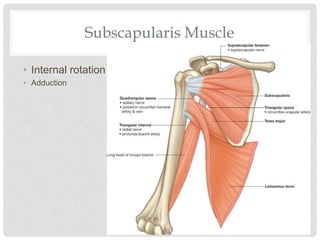
Subscapularis Muscle
• Internal rotation
• Adduction
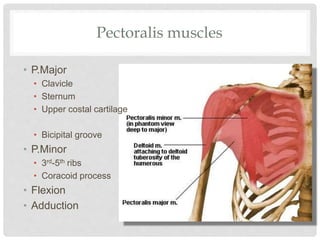
Pectoralis muscles
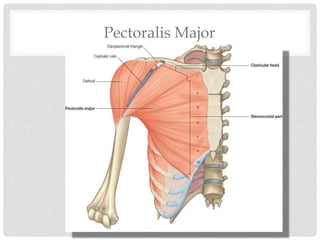
• P.Major
• Clavicle
• Sternum
• Upper costal cartilage
• Bicipital groove
• P.Minor
• 3rd-5th ribs
• Coracoid process
• Flexion
• Adduction
Pectoralis Major
Shoulder Joint Muscles
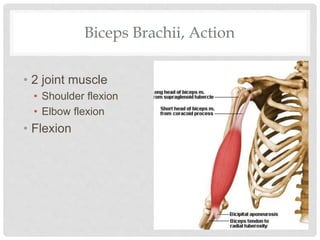
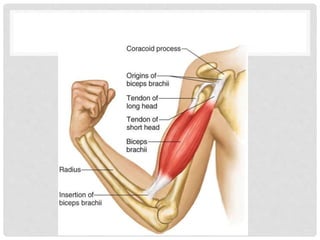
Biceps Brachii, Action
• 2 joint muscle
• Shoulder flexion
• Elbow flexion
• Flexion
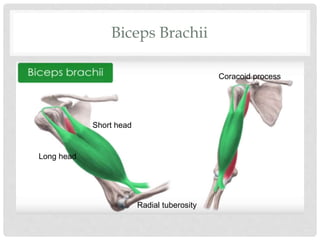
Biceps Brachii
Short head
Long head
Radial tuberosity
Coracoid process
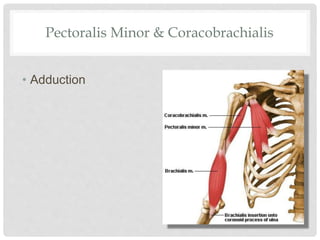
Pectoralis Minor & Coracobrachialis
• Adduction
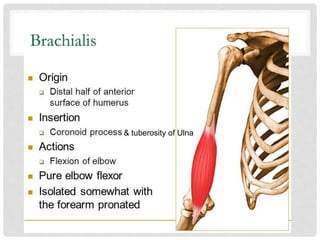
& tuberosity of Ulna
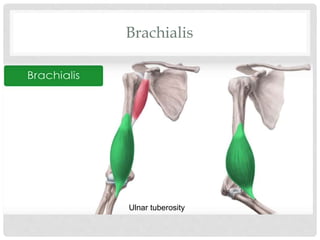
Brachialis
Ulnar tuberosity
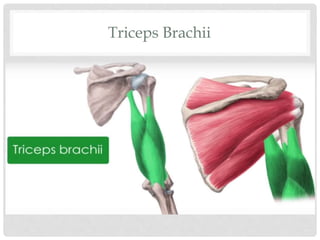
Triceps Brachii
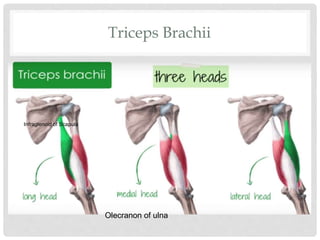
Triceps Brachii
Infraglenoid of Scapula
Olecranon of ulna
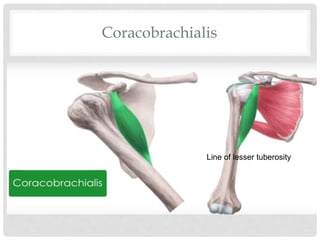
Coracobrachialis
Line of lesser tuberosity
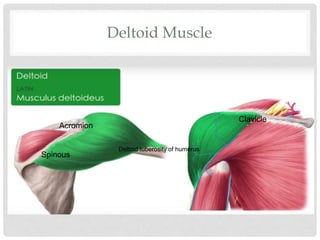
Deltoid Muscle
Acromion
Spinous
Clavicle
Deltoid tuberosity of humerus
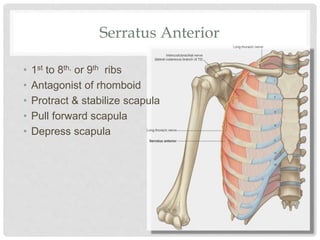
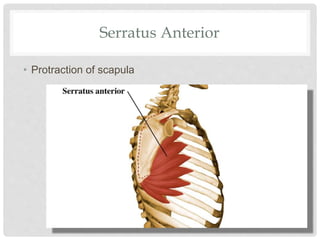
Serratus Anterior
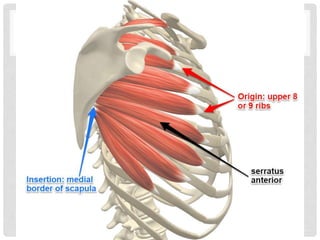
• 1st to 8th, or 9th ribs
• Antagonist of rhomboid
• Protract & stabilize scapula
• Pull forward scapula
• Depress scapula
Serratus Anterior
• Protraction of scapula
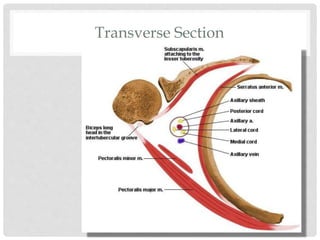
Transverse Section
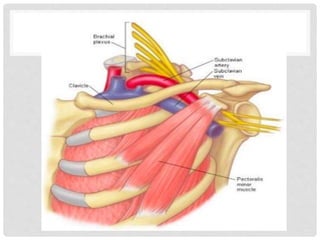
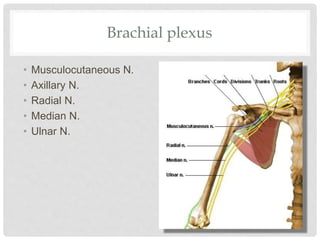
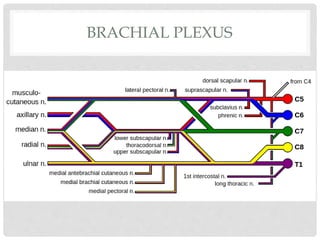
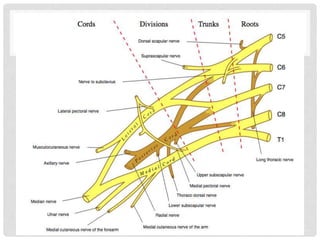
Brachial plexus
• Musculocutaneous N.
• Axillary N.
• Radial N.
• Median N.
• Ulnar N.
BRACHIAL PLEXUS
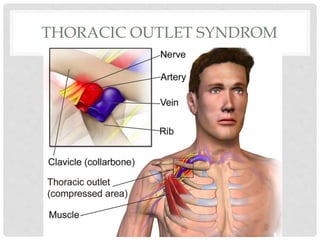
THORACIC OUTLET SYNDROM
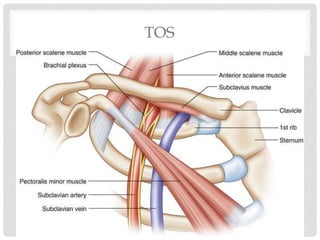
TOS
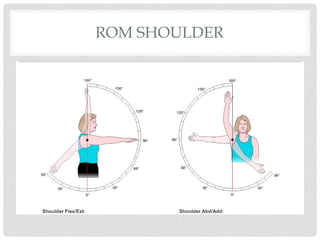
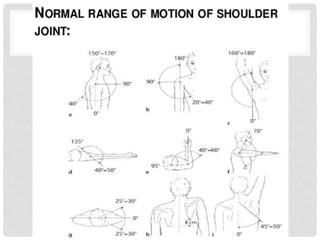
ROM SHOULDER
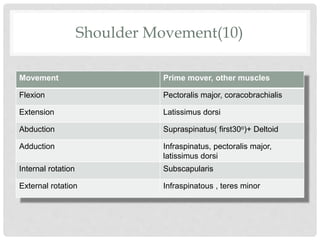
Shoulder Movement(10)
Movement Prime mover, other muscles
Flexion Pectoralis major, coracobrachialis
Extension Latissimus dorsi
Abduction Supraspinatus( first30o)+ Deltoid
Adduction Infraspinatus, pectoralis major,
latissimus dorsi
Internal rotation Subscapularis
External rotation Infraspinatous , teres minor
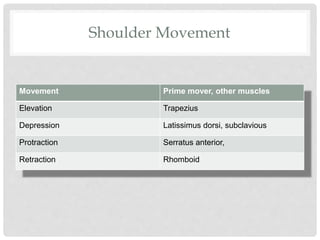
Shoulder Movement
Movement Prime mover, other muscles
Elevation Trapezius
Depression Latissimus dorsi, subclavious
Protraction Serratus anterior,
Retraction Rhomboid
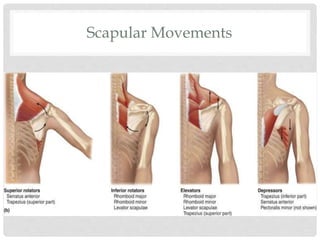
Scapular Movements
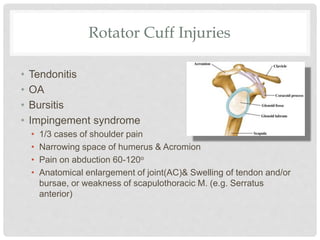
Rotator Cuff Injuries
• Tendonitis
• OA
• Bursitis
• Impingement syndrome
• 1/3 cases of shoulder pain
• Narrowing space of humerus & Acromion
• Pain on abduction 60-120o
• Anatomical enlargement of joint(AC)& Swelling of tendon and/or
bursae, or weakness of scapulothoracic M. (e.g. Serratus
anterior)
Rotator Cuff Injuries
• Rotator cuff tear( tennis shoulder)
• Most common cause of shoulder pain
• Pain during motion & night
• Muscular atrophy & weakness
• Labral tears
• Rim of soft tissue in glenoid
• Connect with biceps tendon
• Injury, age
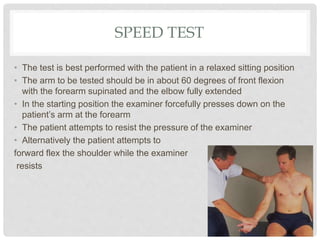
SPEED TEST
• The test is best performed with the patient in a relaxed sitting position
• The arm to be tested should be in about 60 degrees of front flexion
with the forearm supinated and the elbow fully extended
• In the starting position the examiner forcefully presses down on the
patient’s arm at the forearm
• The patient attempts to resist the pressure of the examiner
• Alternatively the patient attempts to
forward flex the shoulder while the examiner
resists
Positive Speed Test
• If pain is reported in the bicipital groove
• Weakness in maintaining the forward flexion position will also
likely be noted
• A positive test is indicative of long head of biceps tendon
instability or tendonitis
• Tenderness on palpation of the bicipital groove also indicates
bicipital tendinitis
• When the therapist stops pushing down on the arm a sudden
jerking motion may result
• Pain at this point may indicate a positive test for sub-acromial
bursitis
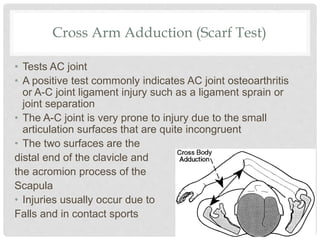
Cross Arm Adduction (Scarf Test)
• Tests AC joint
• A positive test commonly indicates AC joint osteoarthritis
or A-C joint ligament injury such as a ligament sprain or
joint separation
• The A-C joint is very prone to injury due to the small
articulation surfaces that are quite incongruent
• The two surfaces are the
distal end of the clavicle and
the acromion process of the
Scapula
• Injuries usually occur due to
Falls and in contact sports
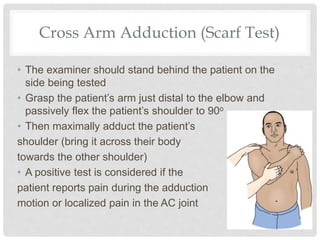
Cross Arm Adduction (Scarf Test)
• The examiner should stand behind the patient on the
side being tested
• Grasp the patient’s arm just distal to the elbow and
passively flex the patient’s shoulder to 90o
• Then maximally adduct the patient’s
shoulder (bring it across their body
towards the other shoulder)
• A positive test is considered if the
patient reports pain during the adduction
motion or localized pain in the AC joint
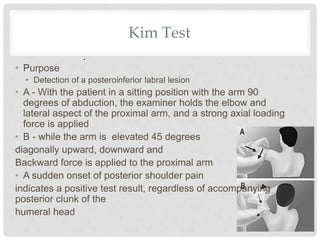
Kim Test
• Purpose
• Detection of a posteroinferior labral lesion
• A - With the patient in a sitting position with the arm 90
degrees of abduction, the examiner holds the elbow and
lateral aspect of the proximal arm, and a strong axial loading
force is applied
• B - while the arm is elevated 45 degrees
diagonally upward, downward and
Backward force is applied to the proximal arm
• A sudden onset of posterior shoulder pain
indicates a positive test result, regardless of accompanying
posterior clunk of the
humeral head
.
LAG Test
• Purpose
• To test for rotator cuff tears of the Subscapularis tendon
• Technique
• Patient is seated with examiner behind patient
• The affected arm is brought into maximal internal rotation behind the
back
• Examiner controls patient's arm at the elbow and wrist/hand which is
passively brought into 20 degrees of extension taking the forearm
and hand away from the back
• Instruct patient to actively maintain this position as examiner
releases the wrist but maintains support at the elbow
• A LAG is indicative of a subscapularis tendon tear describe the
magnitude of the LAG in 5 degree intervals with an obvious drop
indicating large or massive tear and a smaller lag revealing a partial
tear
• https://www.youtube.com/watch?v=qi3KK_-R7ZY
Tendonitis
• Develop with repetitive overhead activities
• Playing tennis
• Pitching (baseball and golf)
• Painting
• Shoveling
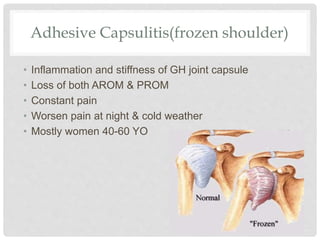
Adhesive Capsulitis(frozen shoulder)
• Inflammation and stiffness of GH joint capsule
• Loss of both AROM & PROM
• Constant pain
• Worsen pain at night & cold weather
• Mostly women 40-60 YO
Risk Factors Of Frozen Shoulder
• DM
• Stroke
• Lung disease
• RA
• Heart disease
• Immobilization
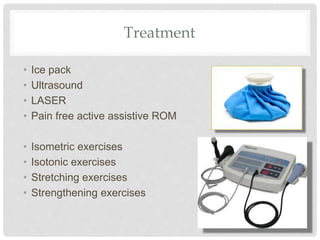
Treatment
• Ice pack
• Ultrasound
• LASER
• Pain free active assistive ROM
• Isometric exercises
• Isotonic exercises
• Stretching exercises
• Strengthening exercises
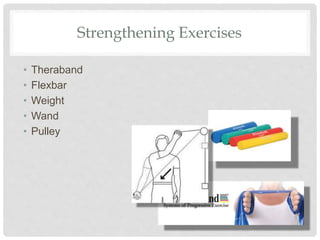
Strengthening Exercises
• Theraband
• Flexbar
• Weight
• Wand
• Pulley
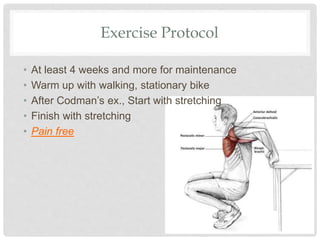
Exercise Protocol
• At least 4 weeks and more for maintenance
• Warm up with walking, stationary bike
• After Codman’s ex., Start with stretching
• Finish with stretching
• Pain free
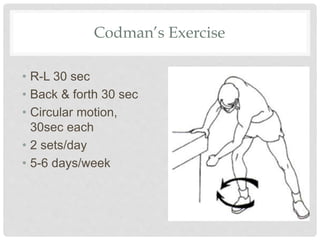
Codman’s Exercise
• R-L 30 sec
• Back & forth 30 sec
• Circular motion,
30sec each
• 2 sets/day
• 5-6 days/week
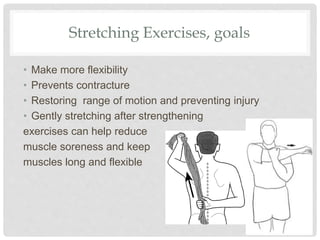
Stretching Exercises, goals
• Make more flexibility
• Prevents contracture
• Restoring range of motion and preventing injury
• Gently stretching after strengthening
exercises can help reduce
muscle soreness and keep
muscles long and flexible
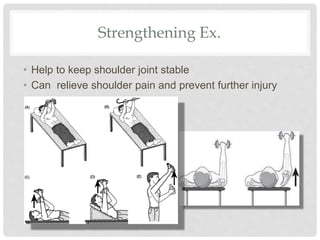
Strengthening Ex.
• Help to keep shoulder joint stable
• Can relieve shoulder pain and prevent further injury
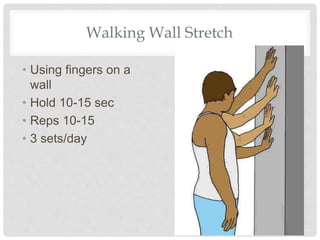
Walking Wall Stretch
• Using fingers on a
wall
• Hold 10-15 sec
• Reps 10-15
• 3 sets/day
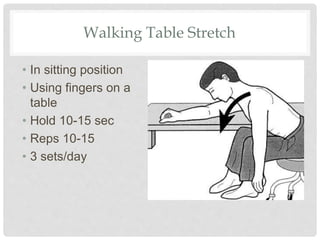
Walking Table Stretch
• In sitting position
• Using fingers on a
table
• Hold 10-15 sec
• Reps 10-15
• 3 sets/day
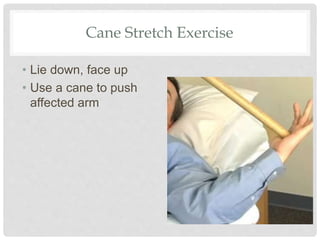
Cane Stretch Exercise
• Lie down, face up
• Use a cane to push
affected arm
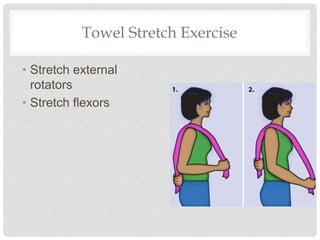
Towel Stretch Exercise
• Stretch external
rotators
• Stretch flexors
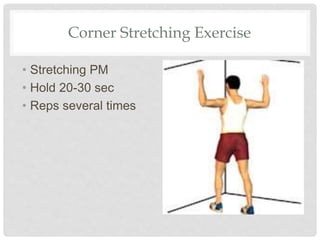
Corner Stretching Exercise
• Stretching PM
• Hold 20-30 sec
• Reps several times
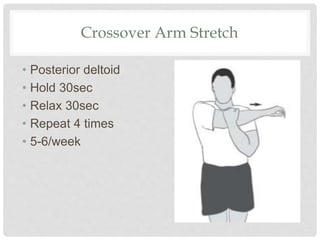
Crossover Arm Stretch
• Posterior deltoid
• Hold 30sec
• Relax 30sec
• Repeat 4 times
• 5-6/week
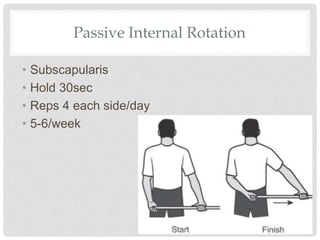
Passive Internal Rotation
• Subscapularis
• Hold 30sec
• Reps 4 each side/day
• 5-6/week
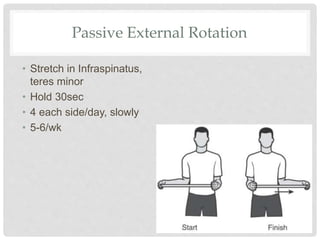
Passive External Rotation
• Stretch in Infraspinatus,
teres minor
• Hold 30sec
• 4 each side/day, slowly
• 5-6/wk
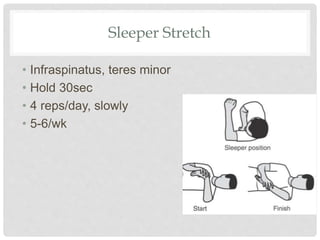
Sleeper Stretch
• Infraspinatus, teres minor
• Hold 30sec
• 4 reps/day, slowly
• 5-6/wk
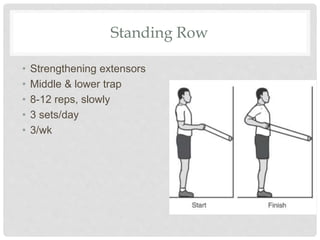
Standing Row
• Strengthening extensors
• Middle & lower trap
• 8-12 reps, slowly
• 3 sets/day
• 3/wk
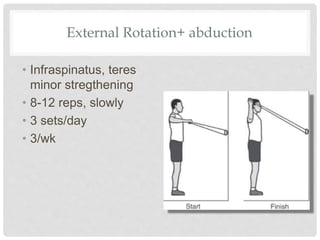
External Rotation+ abduction
• Infraspinatus, teres
minor stregthening
• 8-12 reps, slowly
• 3 sets/day
• 3/wk
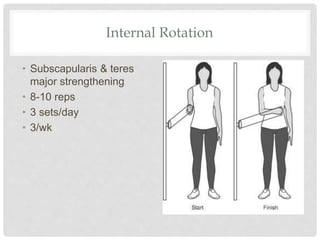
Internal Rotation
• Subscapularis & teres
major strengthening
• 8-10 reps
• 3 sets/day
• 3/wk
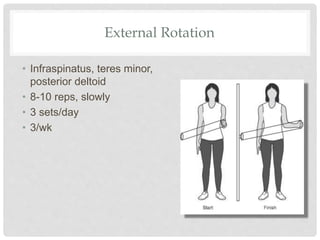
External Rotation
• Infraspinatus, teres minor,
posterior deltoid
• 8-10 reps, slowly
• 3 sets/day
• 3/wk
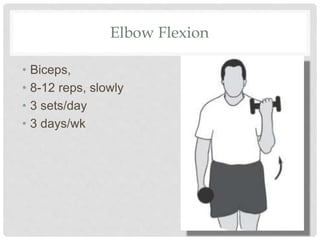
Elbow Flexion
• Biceps,
• 8-12 reps, slowly
• 3 sets/day
• 3 days/wk
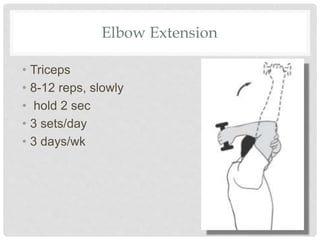
Elbow Extension
• Triceps
• 8-12 reps, slowly
• hold 2 sec
• 3 sets/day
• 3 days/wk
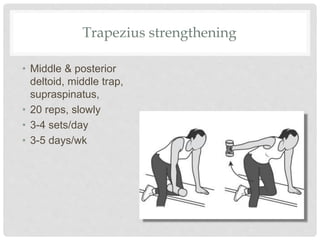
Trapezius strengthening
• Middle & posterior
deltoid, middle trap,
supraspinatus,
• 20 reps, slowly
• 3-4 sets/day
• 3-5 days/wk
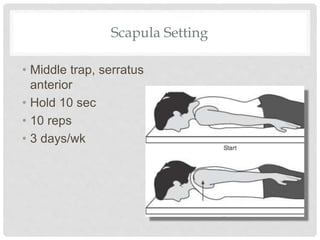
Scapula Setting
• Middle trap, serratus
anterior
• Hold 10 sec
• 10 reps
• 3 days/wk
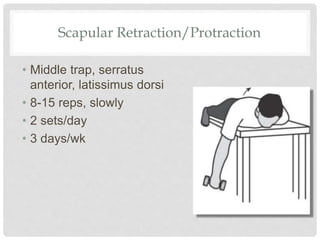
Scapular Retraction/Protraction
• Middle trap, serratus
anterior, latissimus dorsi
• 8-15 reps, slowly
• 2 sets/day
• 3 days/wk
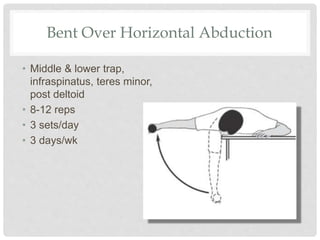
Bent Over Horizontal Abduction
• Middle & lower trap,
infraspinatus, teres minor,
post deltoid
• 8-12 reps
• 3 sets/day
• 3 days/wk
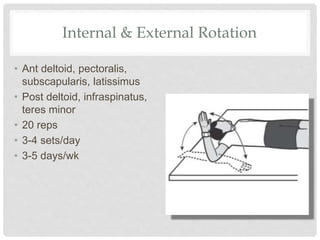
Internal & External Rotation
• Ant deltoid, pectoralis,
subscapularis, latissimus
• Post deltoid, infraspinatus,
teres minor
• 20 reps
• 3-4 sets/day
• 3-5 days/wk
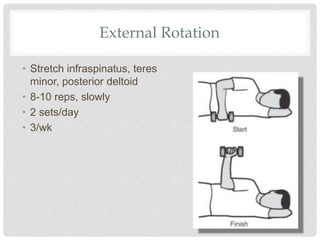
External Rotation
• Stretch infraspinatus, teres
minor, posterior deltoid
• 8-10 reps, slowly
• 2 sets/day
• 3/wk
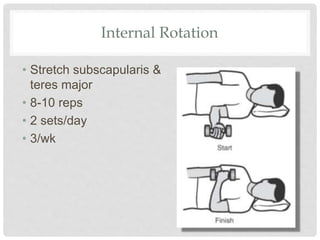
Internal Rotation
• Stretch subscapularis &
teres major
• 8-10 reps
• 2 sets/day
• 3/wk
Shoulder anatomy

Shoulder anatomy

  • 1.
    B Y H OS S E I N K H O R R A M I P h D . D O M P, SHOULDER khorrami4@yahoo.com http://www.scribd.com/khorrami4
  • 2.
    Shoulder bones • Humerus •Scapula • Clavicle • Ribs • Vertebrae
  • 3.
  • 4.
    Shoulder • Joints • Acromioclavicular(AC)joint • Glenohumeral (GH) joint, ball & socket joint • Sternoclavicular(SC) joint • Scapulothoracic joints • Ligaments • Tendons • Capsules • Bursa • Vessels • Brachial plexus • muscles • https://www.youtube.com/watch?v=D3GVKjeY1FM
  • 5.
  • 6.
  • 7.
    STERNOCLAVICULAR JOINT • Saddlejoint permitting the clavicle to move in all 3 planes • A fused SC would limit all shoulder motion! • SCJ disc • Separates the joint into two cavities • Clavicle-disc Disc-manubrium
  • 9.
    SCJ, MOVEMENTS • Functionsof the SCJ • Provide movement of the scapula (along with the • ACJ) • Absorb forces from the upper extremity • Elevatoin • Depression • Protraction • Retraction • Rotation
  • 10.
    SCJ MVMT • Motionsallowed at the SCJ • • Elevation-Depression of the clavicle • Elevation occurs with shoulder flexion and abduction • Depression with shoulder extension and adduction
  • 11.
    SCAPULOTHORACIC JOINT • Elevation •Depression • Protraction • Retraction • Upward • Downward • Internal rotation( Tipping) • External rotation • Winging
  • 12.
    • Protraction-Retraction ofthe clavicle • Occurs mostly between the disc and the manubrium • Protraction occurs with shoulder horiz adduction • Retraction with horiz abduction, shoulder extension
  • 13.
    • Rotation • Occursdue to tightening of the coraco- clavicular ligament during humeral elevation (after 90) • If no posterior rotation available, can only get 120 of humeral elevation
  • 14.
    AC & GHJoints
  • 15.
    ACROMIOCLAVICULAR JOINT • Verydifficult joint to characterize; wide variability in the size and shape of the lateral clavicle The ACJ is characterized as a plane synovial joint • ACJ disc Helps with mobility; Exists early in life but thins by age 20-30
  • 16.
    ACROMIOCLAVICULAR JOINT • Functionof ACJ • AC joint facilitates raising the arm up over the head • Acts like a strut to help with movement of the scapula resulting in a greater degree of arm rotation
  • 17.
    ACJ • Supporting structuresof ACJ • • ACJ capsule • Very weak, relies on ligaments for reinforcement • • Acromioclavicular ligaments • • Coracoacromial ligament • Coraco-clavicular ligament • Two sections • Conoid (medial) • Trapezoid (lateral) • Most important stabilizing structure at the ACJ Prevents clavicle from over-riding the acromion Transmits forces from the scapula to the clavicle
  • 18.
  • 20.
  • 21.
    GLENOHUMERAL JOINT • Classicball and socket • joint • • Composed of glenoid • fossa and humeral head • Fossa only articulates with 25% of the humeral head • • Sacrifices stability for mobility
  • 23.
    GH JOINT • Coraco-acromialArch • Prevents upward dislocation of the humeral head • Protects rotator cuff and humeral head from direct trauma
  • 24.
    Shoulder Muscles • Deltoid •Subscapularis • Teres major & minor • Supraspinatus • Infraspinatus • Levator scapula • Biceps brachii • Latissimus dorsi • Trapezius • Rhomboid muscle • Pectoralis major & minor • Coracobrachialis • Serratus anterior • https://www.youtube.com/watch?v=t1zJwD0tWck
  • 25.
    TRAPEZIUS MUSCLE • Origin •Occipital bone • Spinous process of C7- T12 • Insertion • Lateral clavicle • Acromion • Spine of scapula • Innervation C3-C4 & XI( accessory nerve)
  • 26.
    Trapezius, functions • Elevationof scapula • Retraction(adduct) scapula • Upwardly rotate scapula • Depress scapula • Neck extension
  • 27.
  • 28.
    LATISSIMUS DORSI • Origin •T7-T12(T6-T12) • 9th -12th ribs • Thoracolumbar fascia • Iliac crest • Crest of sacrum • Insertion • Intertubecular sulcus of humerus • Function • Adduct • Arm extension • Internal rotation of arm at the shoulder
  • 29.
    BICIPITAL GROOVE • Bicepsbrachii • Latissimus dorsi • Pectoralis major • Teres major
  • 30.
  • 31.
    • Origin • Transverseprocess of C1-C4 • Insertion • Medial border of scapula • Innervation • C3-C4 • Function • Cervical Spine: Extension, lateral flexion and ipsilateral rotation • Scapula: Elevation and downward rotation Levator Scapulae
  • 34.
    Rhomboid Muscle • Origin •Spinous process C7-T1(minor)& T2-T5(major) • Insertion • Medial border of scapula • Scapular retraction • Elevation
  • 35.
    Subscapularis • Origin • Subscapularisfossa • Insertion • Lesser tubercle of humerus • Function • Medially rotation of arm • Adduction
  • 36.
  • 37.
  • 38.
    Rotator Cuff Muscles •Teres minor • Supraspinatus • Infraspinatus • Subscapularis
  • 39.
  • 40.
  • 42.
    Teres Major • Origin •Inferior border of scapula • Insertion • Intertubercular groove of Anterior humerus • Function • Adduct arm • Internal rotation of arm • Arm extension(not hyperextension)
  • 43.
    Teres Major Crest oflesser tuberosity Inferior angle of scapula
  • 44.
    Teres Minor • Isa rotator cuff muscle • Origin • Lateral border of scapula • Insertion • Greater tubercle of humerus • Function • Adduct arm • External rotation of arm
  • 45.
  • 46.
  • 47.
    Supraspinatus • Origin • G.tubercleof humerus • Insertion • Supraspinous fossa • function • Abduction • First 30o
  • 48.
  • 49.
  • 50.
    Infraspinatus Muscle • Externalrotation • Adduction • Arm extension
  • 51.
  • 52.
  • 53.
    Subscapularis Muscle • Internalrotation • Adduction
  • 57.
    Pectoralis muscles • P.Major •Clavicle • Sternum • Upper costal cartilage • Bicipital groove • P.Minor • 3rd-5th ribs • Coracoid process • Flexion • Adduction
  • 58.
  • 59.
  • 60.
    Biceps Brachii, Action •2 joint muscle • Shoulder flexion • Elbow flexion • Flexion
  • 61.
    Biceps Brachii Short head Longhead Radial tuberosity Coracoid process
  • 64.
    Pectoralis Minor &Coracobrachialis • Adduction
  • 65.
  • 66.
  • 67.
  • 68.
    Triceps Brachii Infraglenoid ofScapula Olecranon of ulna
  • 69.
  • 70.
  • 71.
    Serratus Anterior • 1stto 8th, or 9th ribs • Antagonist of rhomboid • Protract & stabilize scapula • Pull forward scapula • Depress scapula
  • 73.
  • 74.
  • 75.
    Brachial plexus • MusculocutaneousN. • Axillary N. • Radial N. • Median N. • Ulnar N.
  • 76.
  • 78.
  • 79.
  • 80.
  • 82.
    Shoulder Movement(10) Movement Primemover, other muscles Flexion Pectoralis major, coracobrachialis Extension Latissimus dorsi Abduction Supraspinatus( first30o)+ Deltoid Adduction Infraspinatus, pectoralis major, latissimus dorsi Internal rotation Subscapularis External rotation Infraspinatous , teres minor
  • 83.
    Shoulder Movement Movement Primemover, other muscles Elevation Trapezius Depression Latissimus dorsi, subclavious Protraction Serratus anterior, Retraction Rhomboid
  • 84.
  • 85.
    Rotator Cuff Injuries •Tendonitis • OA • Bursitis • Impingement syndrome • 1/3 cases of shoulder pain • Narrowing space of humerus & Acromion • Pain on abduction 60-120o • Anatomical enlargement of joint(AC)& Swelling of tendon and/or bursae, or weakness of scapulothoracic M. (e.g. Serratus anterior)
  • 86.
    Rotator Cuff Injuries •Rotator cuff tear( tennis shoulder) • Most common cause of shoulder pain • Pain during motion & night • Muscular atrophy & weakness • Labral tears • Rim of soft tissue in glenoid • Connect with biceps tendon • Injury, age
  • 87.
    SPEED TEST • Thetest is best performed with the patient in a relaxed sitting position • The arm to be tested should be in about 60 degrees of front flexion with the forearm supinated and the elbow fully extended • In the starting position the examiner forcefully presses down on the patient’s arm at the forearm • The patient attempts to resist the pressure of the examiner • Alternatively the patient attempts to forward flex the shoulder while the examiner resists
  • 88.
    Positive Speed Test •If pain is reported in the bicipital groove • Weakness in maintaining the forward flexion position will also likely be noted • A positive test is indicative of long head of biceps tendon instability or tendonitis • Tenderness on palpation of the bicipital groove also indicates bicipital tendinitis • When the therapist stops pushing down on the arm a sudden jerking motion may result • Pain at this point may indicate a positive test for sub-acromial bursitis
  • 89.
    Cross Arm Adduction(Scarf Test) • Tests AC joint • A positive test commonly indicates AC joint osteoarthritis or A-C joint ligament injury such as a ligament sprain or joint separation • The A-C joint is very prone to injury due to the small articulation surfaces that are quite incongruent • The two surfaces are the distal end of the clavicle and the acromion process of the Scapula • Injuries usually occur due to Falls and in contact sports
  • 90.
    Cross Arm Adduction(Scarf Test) • The examiner should stand behind the patient on the side being tested • Grasp the patient’s arm just distal to the elbow and passively flex the patient’s shoulder to 90o • Then maximally adduct the patient’s shoulder (bring it across their body towards the other shoulder) • A positive test is considered if the patient reports pain during the adduction motion or localized pain in the AC joint
  • 91.
    Kim Test • Purpose •Detection of a posteroinferior labral lesion • A - With the patient in a sitting position with the arm 90 degrees of abduction, the examiner holds the elbow and lateral aspect of the proximal arm, and a strong axial loading force is applied • B - while the arm is elevated 45 degrees diagonally upward, downward and Backward force is applied to the proximal arm • A sudden onset of posterior shoulder pain indicates a positive test result, regardless of accompanying posterior clunk of the humeral head .
  • 92.
    LAG Test • Purpose •To test for rotator cuff tears of the Subscapularis tendon • Technique • Patient is seated with examiner behind patient • The affected arm is brought into maximal internal rotation behind the back • Examiner controls patient's arm at the elbow and wrist/hand which is passively brought into 20 degrees of extension taking the forearm and hand away from the back • Instruct patient to actively maintain this position as examiner releases the wrist but maintains support at the elbow • A LAG is indicative of a subscapularis tendon tear describe the magnitude of the LAG in 5 degree intervals with an obvious drop indicating large or massive tear and a smaller lag revealing a partial tear • https://www.youtube.com/watch?v=qi3KK_-R7ZY
  • 93.
    Tendonitis • Develop withrepetitive overhead activities • Playing tennis • Pitching (baseball and golf) • Painting • Shoveling
  • 94.
    Adhesive Capsulitis(frozen shoulder) •Inflammation and stiffness of GH joint capsule • Loss of both AROM & PROM • Constant pain • Worsen pain at night & cold weather • Mostly women 40-60 YO
  • 95.
    Risk Factors OfFrozen Shoulder • DM • Stroke • Lung disease • RA • Heart disease • Immobilization
  • 96.
    Treatment • Ice pack •Ultrasound • LASER • Pain free active assistive ROM • Isometric exercises • Isotonic exercises • Stretching exercises • Strengthening exercises
  • 97.
    Strengthening Exercises • Theraband •Flexbar • Weight • Wand • Pulley
  • 98.
    Exercise Protocol • Atleast 4 weeks and more for maintenance • Warm up with walking, stationary bike • After Codman’s ex., Start with stretching • Finish with stretching • Pain free
  • 99.
    Codman’s Exercise • R-L30 sec • Back & forth 30 sec • Circular motion, 30sec each • 2 sets/day • 5-6 days/week
  • 100.
    Stretching Exercises, goals •Make more flexibility • Prevents contracture • Restoring range of motion and preventing injury • Gently stretching after strengthening exercises can help reduce muscle soreness and keep muscles long and flexible
  • 101.
    Strengthening Ex. • Helpto keep shoulder joint stable • Can relieve shoulder pain and prevent further injury
  • 102.
    Walking Wall Stretch •Using fingers on a wall • Hold 10-15 sec • Reps 10-15 • 3 sets/day
  • 103.
    Walking Table Stretch •In sitting position • Using fingers on a table • Hold 10-15 sec • Reps 10-15 • 3 sets/day
  • 104.
    Cane Stretch Exercise •Lie down, face up • Use a cane to push affected arm
  • 105.
    Towel Stretch Exercise •Stretch external rotators • Stretch flexors
  • 106.
    Corner Stretching Exercise •Stretching PM • Hold 20-30 sec • Reps several times
  • 107.
    Crossover Arm Stretch •Posterior deltoid • Hold 30sec • Relax 30sec • Repeat 4 times • 5-6/week
  • 108.
    Passive Internal Rotation •Subscapularis • Hold 30sec • Reps 4 each side/day • 5-6/week
  • 109.
    Passive External Rotation •Stretch in Infraspinatus, teres minor • Hold 30sec • 4 each side/day, slowly • 5-6/wk
  • 110.
    Sleeper Stretch • Infraspinatus,teres minor • Hold 30sec • 4 reps/day, slowly • 5-6/wk
  • 111.
    Standing Row • Strengtheningextensors • Middle & lower trap • 8-12 reps, slowly • 3 sets/day • 3/wk
  • 112.
    External Rotation+ abduction •Infraspinatus, teres minor stregthening • 8-12 reps, slowly • 3 sets/day • 3/wk
  • 113.
    Internal Rotation • Subscapularis& teres major strengthening • 8-10 reps • 3 sets/day • 3/wk
  • 114.
    External Rotation • Infraspinatus,teres minor, posterior deltoid • 8-10 reps, slowly • 3 sets/day • 3/wk
  • 115.
    Elbow Flexion • Biceps, •8-12 reps, slowly • 3 sets/day • 3 days/wk
  • 116.
    Elbow Extension • Triceps •8-12 reps, slowly • hold 2 sec • 3 sets/day • 3 days/wk
  • 117.
    Trapezius strengthening • Middle& posterior deltoid, middle trap, supraspinatus, • 20 reps, slowly • 3-4 sets/day • 3-5 days/wk
  • 118.
    Scapula Setting • Middletrap, serratus anterior • Hold 10 sec • 10 reps • 3 days/wk
  • 119.
    Scapular Retraction/Protraction • Middletrap, serratus anterior, latissimus dorsi • 8-15 reps, slowly • 2 sets/day • 3 days/wk
  • 120.
    Bent Over HorizontalAbduction • Middle & lower trap, infraspinatus, teres minor, post deltoid • 8-12 reps • 3 sets/day • 3 days/wk
  • 121.
    Internal & ExternalRotation • Ant deltoid, pectoralis, subscapularis, latissimus • Post deltoid, infraspinatus, teres minor • 20 reps • 3-4 sets/day • 3-5 days/wk
  • 122.
    External Rotation • Stretchinfraspinatus, teres minor, posterior deltoid • 8-10 reps, slowly • 2 sets/day • 3/wk
  • 123.
    Internal Rotation • Stretchsubscapularis & teres major • 8-10 reps • 2 sets/day • 3/wk