Mr. S. P. Shinde
Assistant Professor
Pune- Maharashtra
The chemical processes in plants or animals that change food into energy and
help them grow.
The chemical (metabolic) processes that take place as your body converts
foods and drinks into energy.
Catabolism: The degradative processes concerned with the breakdown of
complex molecules to simpler ones, with a concomitant release of energy.
Anabolism: The biosynthesis reactions involving the formation of complex
molecules from simple precursors.
Mr. S. P. Shinde
Metabolism
Glycolysis
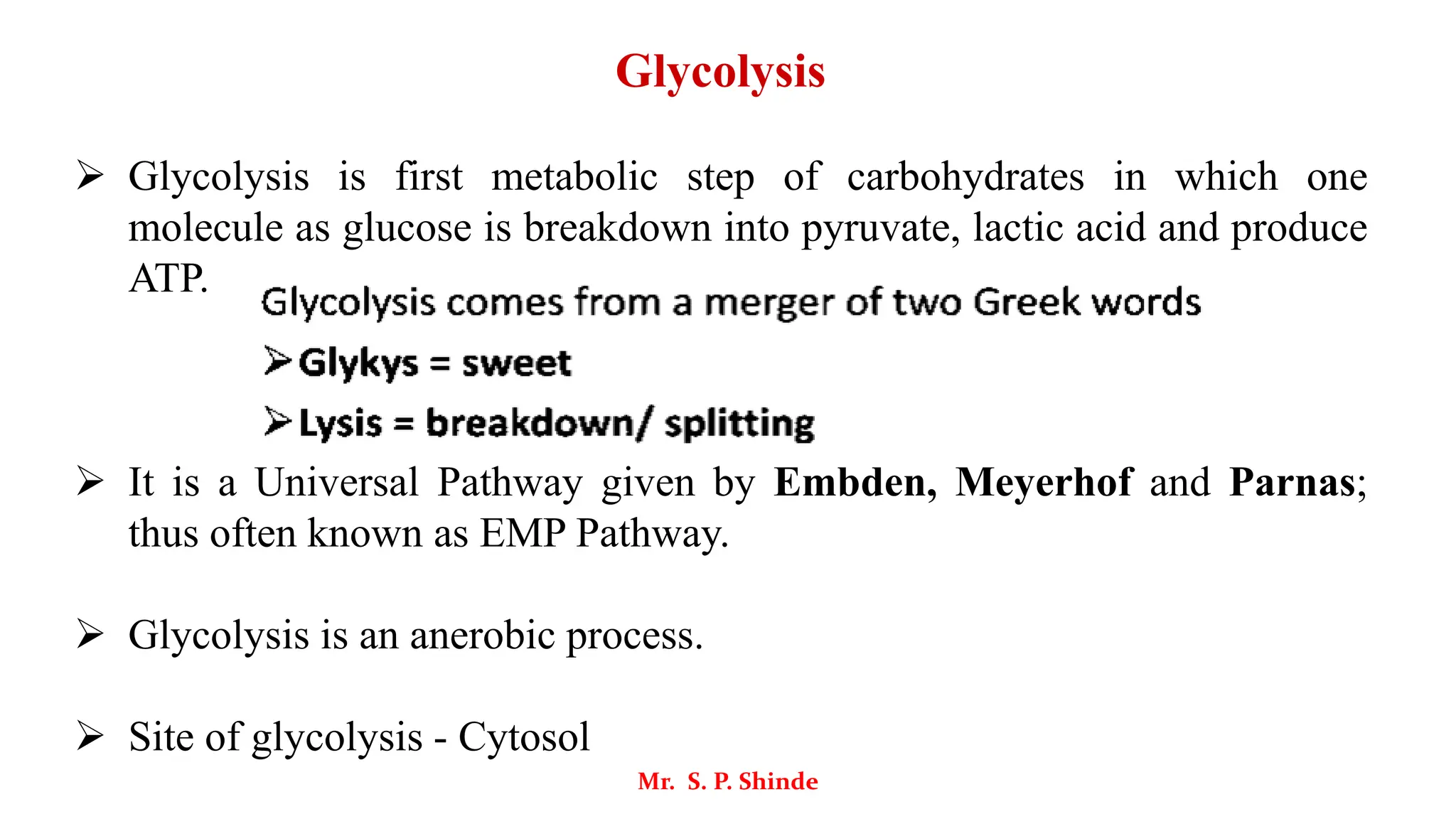
➢ Glycolysis is first metabolic step of carbohydrates in which one
molecule as glucose is breakdown into pyruvate, lactic acid and produce
ATP.
➢ It is a Universal Pathway given by Embden, Meyerhof and Parnas;
thus often known as EMP Pathway.
➢ Glycolysis is an anerobic process.
➢ Site of glycolysis - Cytosol
Mr. S. P. Shinde
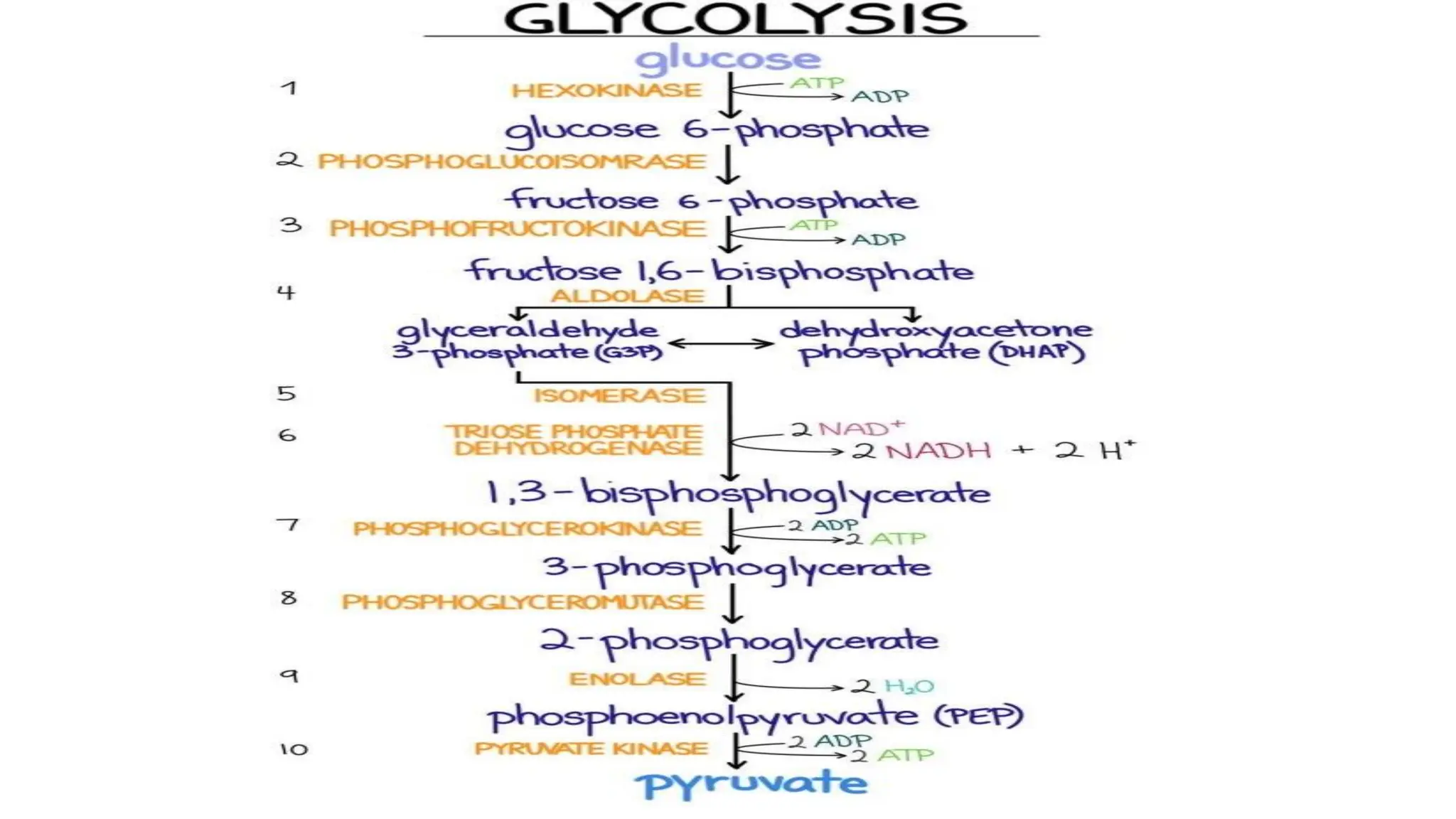
Glucose reacts with hexokinase by using ATP and convert into Glucose 6-
Phosphate
Kinase: It is an enzymes which act phosphorylation.
Mr. S. P. Shinde
Step 1 Phosphorylation
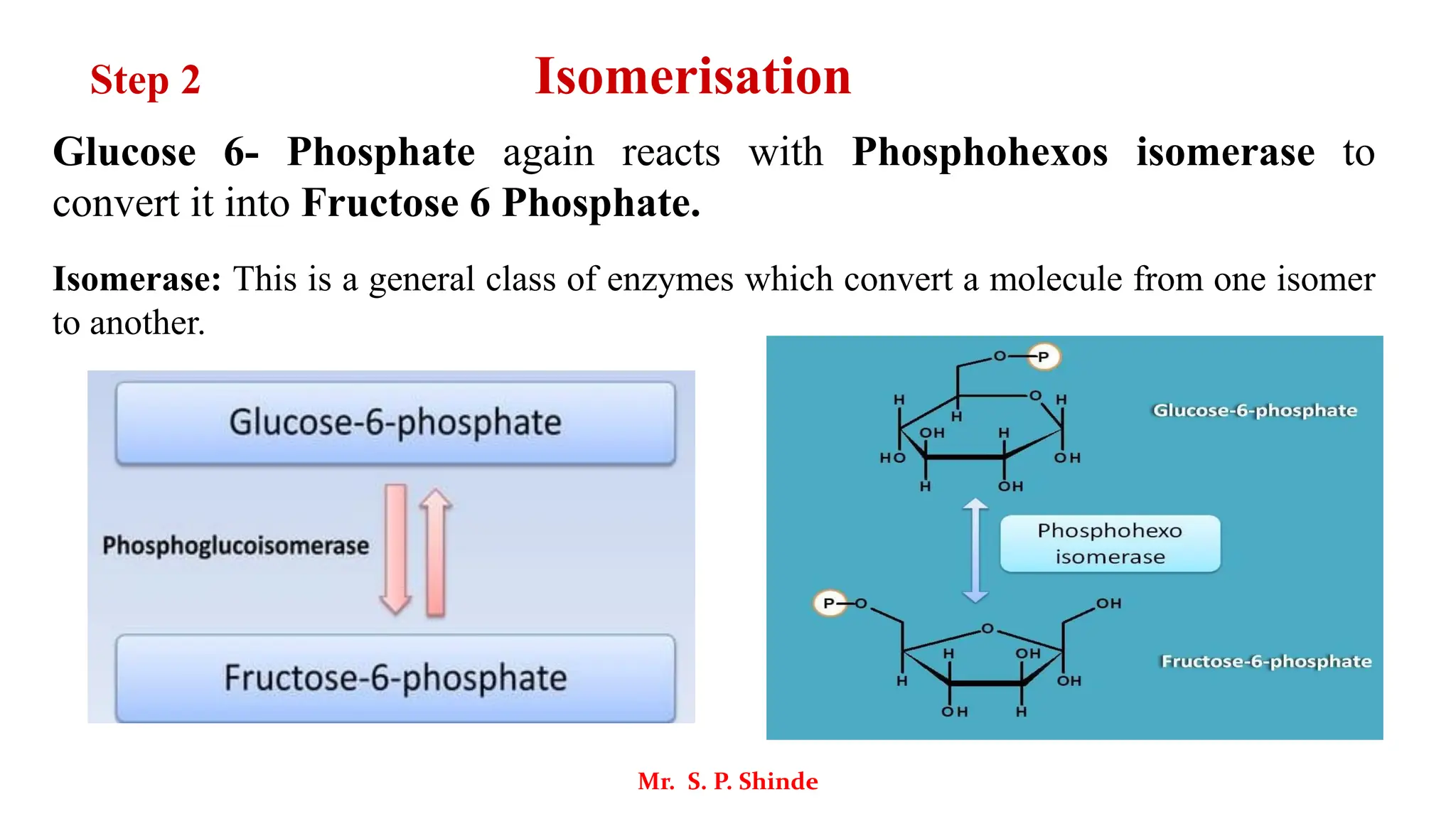
Glucose 6- Phosphate again reacts with Phosphohexos isomerase to
convert it into Fructose 6 Phosphate.
Isomerase: This is a general class of enzymes which convert a molecule from one isomer
to another.
Mr. S. P. Shinde
Step 2 Isomerisation
Fructose 6 Phosphate react with Phosphofructokinase and convert it into
Fructose-1, 6-bisphosphate.
Mr. S. P. Shinde
Step 3 Phosphorylation
Fructose-1, 6-bisphosphate reacts with aldolase and breaks down into two
parts Glyceraldehyde-3-phosphate (G3P) and Dihydroxy acetone
phosphate (DHAP).
Aldolase: is an enzyme that helps to
break down to sugar to produce energy.
Mr. S. P. Shinde
Step 4 Breakdown
Isomerisation of dihydroxyacetone phosphate (DHAP) into glyceraldehyde
3 phosphate (G3P).
Because only G3P can be used further in glycolysis.
Mr. S. P. Shinde
Step 5 Isomerisation
Glyceraldehyde 3 phosphate converts into 1, 3-bisphosphoglycerate by the
help of Glyceraldehyde 3-phosphate dehydrogenase.
Mr. S. P. Shinde
Step 6 Phosphorylation
The enzyme phosphoglycerate kinase acts on 1, 3-bisphosphogycerate
coverts into 3-phosphoglycerate.
Mr. S. P. Shinde
Step 7 Substrate Level
3-Phosphoglycerate is converted into 2-phosphoglycerate by
phosphoglycerate mutase.
Mr. S. P. Shinde
Step 8 Mutation/ Isomerisation
2-Phosphoglycerate reacts with Enolase and it converts into Phosphoenol
pyruvate.
Mr. S. P. Shinde
Step 9 Dehydration
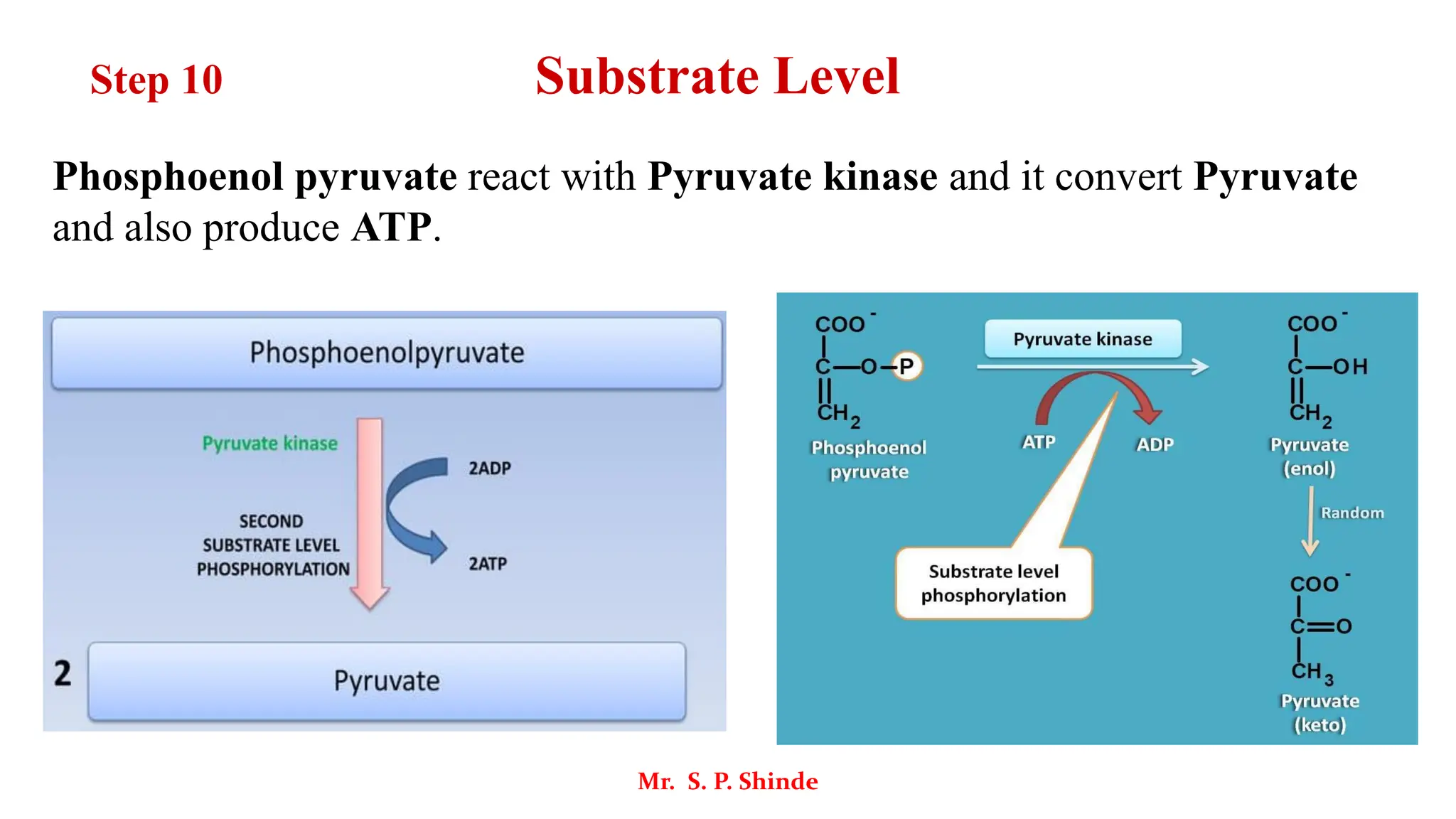
Phosphoenol pyruvate react with Pyruvate kinase and it convert Pyruvate
and also produce ATP.
Mr. S. P. Shinde
Step 10 Substrate Level
Mr. S. P. Shinde
Mr. S. P. Shinde
Glycolysis Pathway

Glycolysis Pathway

  • 1.
    Mr. S. P.Shinde Assistant Professor Pune- Maharashtra
  • 2.
    The chemical processesin plants or animals that change food into energy and help them grow. The chemical (metabolic) processes that take place as your body converts foods and drinks into energy. Catabolism: The degradative processes concerned with the breakdown of complex molecules to simpler ones, with a concomitant release of energy. Anabolism: The biosynthesis reactions involving the formation of complex molecules from simple precursors. Mr. S. P. Shinde Metabolism
  • 3.
    Glycolysis ➢ Glycolysis isfirst metabolic step of carbohydrates in which one molecule as glucose is breakdown into pyruvate, lactic acid and produce ATP. ➢ It is a Universal Pathway given by Embden, Meyerhof and Parnas; thus often known as EMP Pathway. ➢ Glycolysis is an anerobic process. ➢ Site of glycolysis - Cytosol Mr. S. P. Shinde
  • 5.
    Glucose reacts withhexokinase by using ATP and convert into Glucose 6- Phosphate Kinase: It is an enzymes which act phosphorylation. Mr. S. P. Shinde Step 1 Phosphorylation
  • 6.
    Glucose 6- Phosphateagain reacts with Phosphohexos isomerase to convert it into Fructose 6 Phosphate. Isomerase: This is a general class of enzymes which convert a molecule from one isomer to another. Mr. S. P. Shinde Step 2 Isomerisation
  • 7.
    Fructose 6 Phosphatereact with Phosphofructokinase and convert it into Fructose-1, 6-bisphosphate. Mr. S. P. Shinde Step 3 Phosphorylation
  • 8.
    Fructose-1, 6-bisphosphate reactswith aldolase and breaks down into two parts Glyceraldehyde-3-phosphate (G3P) and Dihydroxy acetone phosphate (DHAP). Aldolase: is an enzyme that helps to break down to sugar to produce energy. Mr. S. P. Shinde Step 4 Breakdown
  • 9.
    Isomerisation of dihydroxyacetonephosphate (DHAP) into glyceraldehyde 3 phosphate (G3P). Because only G3P can be used further in glycolysis. Mr. S. P. Shinde Step 5 Isomerisation
  • 10.
    Glyceraldehyde 3 phosphateconverts into 1, 3-bisphosphoglycerate by the help of Glyceraldehyde 3-phosphate dehydrogenase. Mr. S. P. Shinde Step 6 Phosphorylation
  • 11.
    The enzyme phosphoglyceratekinase acts on 1, 3-bisphosphogycerate coverts into 3-phosphoglycerate. Mr. S. P. Shinde Step 7 Substrate Level
  • 12.
    3-Phosphoglycerate is convertedinto 2-phosphoglycerate by phosphoglycerate mutase. Mr. S. P. Shinde Step 8 Mutation/ Isomerisation
  • 13.
    2-Phosphoglycerate reacts withEnolase and it converts into Phosphoenol pyruvate. Mr. S. P. Shinde Step 9 Dehydration
  • 14.
    Phosphoenol pyruvate reactwith Pyruvate kinase and it convert Pyruvate and also produce ATP. Mr. S. P. Shinde Step 10 Substrate Level
  • 15.
    Mr. S. P.Shinde
  • 16.
    Mr. S. P.Shinde