POLYUNSATURATED FATTY ACIDS:
CHEMISTRY, METABOLISM AND
CLINICAL SIGNIFICANCE
Presenter: Dr DNYANESH AMLE
Moderator: Dr T. K. MISHRA
OVERVIEW
 Lipids
 Fatty acids
 Fatty acid synthesis(in brief)
 Unsaturated fatty acid sysnthesis
 Fatty acid catabolism(in brief)
 Unsaturated fatty acid catabolism
 Essential fatty acids
 Eicosanoids
 Trans fatty acids
THE LIPIDS
Heterogeneous group of compounds
• Insoluble in water
• Soluble in nonpolar solvennt
• Eg: fats, oils, steroids, waxes & related
compounds
• Related more by their physical than by chemical
properties
THE LIPIDS
• Important dietary constituents:
- Energy provision
- Fat soluble vitamins
- The essential fatty acids
• storage form of energy (high energy value)
• Thermal insulator
• Non-polar lipids –
- electrical insulators in myelinated nerves
- rapid propagation of depolarization waves
• Lipoproteins(lipid + protein):
- Imp. cellular constituents :cell membrane, mitochondria
- Transporting lipids in the blood
CLASSIFICATION
1. Simple lipids: Esters of fatty acids with various alcohols.
a. Fats: fatty acids + glycerol.
b. Waxes: fatty acids + higher mol wt monohydric alcohols
2. Complex lipids: fatty acid + alcohol + other groups
a. Phospholipids: fatty acid + alcohol + phosphoric acid + N
bases etc.
- Glycerophospholipids: F A + glycerol+ phosphoric acid
- Sphingophospholipids: F A+ sphingosine + phosphoric
acid
b. Glycolipids(glycosphingolipids):F A+ sphingosine +
carbohydrate
3. Precursor and derived lipids:
 fatty acids
 Glycerol
 Steroids
 other alcohols
 fatty aldehydes and ketone bodies
 hydrocarbons
 lipid-soluble vitamins
 hormones
FATTY ACIDS
• Fatty Acids:
Long hydrocarbon chains
- varying lengths
- varying degrees of unsaturation
- terminated with carboxylic acid groups
• Occurrence:
- Mainly as esters : Fats & Oils
- Unesterified : free fatty acids
• Higher plants & animals  predominant C16 and C18 species
(palmitic, oleic, linoleic, and stearic acids)
• Fatty acids with <14 or >20 carbon : Uncommon
• Mostly even no.: biosynthesized by the concatenation of C2
units
NOMENCLATURE
 The systematic name :
 Parent hydrocarbon  Alkane :Octadecane (18 c)
 No double bonds: e  oic
 18:0, Stearic acid , Octadecanoic acid , CH3(CH2)16COOH
 1 double bonds : e  enoic
 18:1 , n–9 Oleic acid, 9-Octadecenoic acid
 CH3(CH2)7CH=CH(CH2)7COOH
 2 double bonds: e  dienoic
 18:2 , n–6 Linoleic acid , 9,12-Octadecadienoic acid
 CH3(CH2)4(CH=CHCH2)2(CH2)6COOH
 3 double bonds : e trienoic
 18:3 , n–3 -Linolenic acid , 9,12,15-Octadecatrienoic acid
 CH3CH2(CH=CHCH2)3(CH2)6COOH
Saturated Fatty Acid Structure
omega end alpha end
degree of saturation: single carbon bond
H H H H H H H H H H H H H H H H H O
H-C--C--C--C--C--C--C--C--C--C--C--C--C--C--C--C--C-C-OH
H H H H H H H H H H H H H H H H H
SATURATED FATTY ACIDS
 No Double Bonds
 Acetic acid (CH3-COOH) : first member , -CH2- is
progressively added
 saturated fatty acids  zigzag pattern when extended (↓
temp.)
 highly flexible molecules
 free rotation about each of their C-C bonds
 assume a wide range of conformations
 fully extended conformation steric interference↓ 
ENEGRY↓
 higher temperatures some bonds rotate  chain
Shortening
 So bio-membranes become thinner with temperature
↓↑
computing
Presentation copyright © 2002 David A Bender and some images copyright © 2002 Taylor & Francis Ltd 
Saturated fatty acids
no of Cno of C double bondsdouble bonds first C=Cfirst C=C shorthandshorthand
butyricbutyric 44 00 -- C4:0C4:0
caproiccaproic 66 00 -- C6:0C6:0
capryliccaprylic 88 00 -- C8:0C8:0
capriccapric 1010 00 -- C10:0C10:0
lauriclauric 1212 00 -- C12:0C12:0
myristicmyristic 1414 00 -- C14:0C14:0
palmiticpalmitic 1616 00 -- C16:0C16:0
stearicstearic 1818 00 -- C18:0C18:0
arachidicarachidic 2020 00 -- C20:0C20:0
behenicbehenic 2222 00 -- C22:0C22:0
lignocericlignoceric 2424 00 -- C24:0C24:0
Unsaturated Fatty Acids :≥ 1 Double Bonds
(1) Monounsaturated(monoethenoid, monoenoic) : one
double bond
(2) Polyunsaturated(polyethenoid, polyenoic) : two or more
double bonds.
(3) Eicosanoids:
-derived from eicosa- (20-carbon) polyenoic fatty acids,
- prostanoids (prostaglandins,
prostacyclins & thromboxanes)
- leukotrienes (LTs),
- lipoxins (LXs)
UNSATURATED FATTY ACID
- first double bond: between its C9 and C10 (Δ9
-or 9-double bond)
omega end alpha end
One double bond
H H H H H H H H H H H H H H H O
H-C--C--C--C--C--C--C--C--C=C--C--C--C--C--C--C--C--C-OH
H H H H H H H H H H H H H H H H H
Monounsaturated Fatty Acid Structure
computing
Presentation copyright © 2002 David A Bender and some images copyright © 2002 Taylor & Francis Ltd 
no of Cno of C double bondsdouble bonds first C=Cfirst C=C shorthandshorthand
palmitoleicpalmitoleic 1616 11 66 C16:1C16:1 ωω66
oleicoleic 1818 11 99 C18:1C18:1 ωω99
cetoliccetolic 2222 11 1111 C22:1C22:1 ωω1111
nervonicnervonic 2424 11 99 C24:1C24:1 ωω99
Monounsaturated fatty acids
POLYUNSATURATED FATTY ACIDS (PUFA) :
 double bonds at every third C toward the methyl
terminus (-CH=CH-CH2-CH=CH-)
 almost never conjugated :Always a –CH2- between
two double bonds
 Triple bonds rarely occur
 Important classes : n – 3 (or ω– 3) & n – 6 (or ω–6)
fatty acids.
Polyunsaturated Fatty Acid Structure
omega end alpha end
> 2 double bonds
H H H H H H H H H H H H H O
H-C--C--C--C--C--C=C--C--C=C--C--C--C--C--C--C--C--C-OH
H H H H H H H H H H H H H H H H H
Polyunsaturated fatty acids computing
Presentation copyright © 2002 David A Bender and some images copyright © 2002 Taylor & Francis Ltd 
no of Cno of C double bondsdouble bonds first C=Cfirst C=C shorthandshorthand
linoleiclinoleic 1818 22 66 C18:2C18:2 ωω66
αα-linolenic-linolenic 1818 33 33 C18:3C18:3 ωω33
γγ-linolenic-linolenic 1818 33 66 C18:3C18:3 ωω66
arachidonicarachidonic 2020 44 66 C20:4C20:4 ωω66
eicosapentaenoiceicosapentaenoic 2020 55 33 C20:5C20:5 ωω33
docosatetraenoicdocosatetraenoic 2222 44 66 C22:4C22:4 ωω66
docosapentaenoicdocosapentaenoic 2222 55 33 C22:5C22:5 ωω33
docosapentaenoicdocosapentaenoic 2222 55 66 C22:5C22:5 ωω66
docosahexaenoicdocosahexaenoic 2222 66 33 C22:6C22:6 ωω33
Polyunsaturated fatty acids
Unsaturated FA
 Unsaturated FA : geometric isomerism around the
axes of double bondsdo not allow rotation
 FA double bonds : almost always cis configuration
 Rigid 30° bend in the hydrocarbon
 Interferes with their efficient packing
 Reduced van der Waals interaction
 fatty acid melting points with their degree of↑
UNSATURATION
 Lipid fluidity with the degree of unsaturation of↑
their component fatty acid residues.
Dietary Effects Of Fatty Acids
 Dietary fatty acids regulate plasma LDL-C levels
by affecting LDL receptor activity; protein, and
mRNA abundance
 Cholesterol-raising SFAs (12:0, 14:0, 16:0):
decrease LDL receptor activity, protein, and
mRNA abundance
 Unsaturated fatty acids: increase these variables
 Mechanism: Dietary modification hepatocyte
membrane fluidity
PUFAs and their various metabolites
 can act at the level of the nucleus, in conjunction with
nuclear receptors and transcription factors
 affect the transcription of a variety of genes
 peroxisome proliferator-activated receptor (PPAR)
 hepatocyte nuclear factor (HNF)-4alpha
 liver X receptor (LXR)
 sterol-regulatory element binding protein (SREBP)
 nuclear factor-kappaB (NFkappaB).
 critical to the regulation of several key genes of lipid
metabolism
 PPARα
 :important role in the regulation of cellular uptake,
activation and β-oxidation of FA
 natural, preferentially-binding ligands : long chain
unsaturated fatty acids arachidonic acid, linoleic acid, and
oleic acid
 ligand-activated PPARα binds to PPR Element of DNA &
up-regulates transcription of genes involved in lipid
catabolism and lipoprotein metabolism
 long chain FA sensor : autoregulation of long chain fatty
acid metabolism
 decreasing tissue content of lipids and minimizing
lipotoxicity
 may affect body weight improve insulin sensitivity
PPARγ :
 natural ligands : unsaturated FA (oleate, linoleate,
eicosapentaenoic and arachidonic acids)
 Adipocytes: PPARγ increases the expression of numerous
genes involved in lipid metabolism and uptake
 induces adipocyte apoptosis
 negatively regulates transcription of several genes that
impair insulin action eg. TNFα and leptin
 ↓proinflammatory cytokines produced by adipocytes and
associated with insulin resistance
 induce differentiation and apoptosis in various cancer cells
 American Heart Association recommends:
 Total Fat intake < 25-35% of total calories
 Saturated FA intake not > 10% of total calories
 MUFA intake – 10-15% of total calories
 PUFA intake upto 10% of total calories
Ditary reccomendations
Fatty Acids in Common Food Fats
SAFFLOWER OIL
Olive OIL
DE NOVO SYNTHESIS OF FATTY ACIDS
(LIPOGENESIS)
 Occurs in cytosol
 liver,kidney, brain, lung, mammary gland,
adipose tissue etc.
 cofactor : NADPH, ATP, Mn2+
,biotin, and HCO3
(as a source of CO2).
Acetyl-CoA PalmitateSYNTHESIS OF FATTY ACIDS
Acetyl CoA is transferred from mitochondria to the cytoplasm, and the
reducing potential of NADH is concomitantly converted into that of NADPH
by this series of reactions.
Citrate+ 1ATP+1CoA+1H2O → acetyl CoA+1ADP+ Pi+1 oxaloacetate
HOW TO TRNSFER ACETY COA TO CYTOSOL?
Biosynthesis of Fatty Acids
Biosynthesis of malonyl-CoA. (Enz, acetyl-CoA carboxylase.)
Production of Malonyl-CoA : Initial & Controlling Step in
Fatty Acid Synthesis
Two steps:
(1)carboxylation of biotin involving ATP
(2)transfer of the carboxyl to acetyl-CoA to form
malonyl-CoA.
 1
Biosynthesis of long-
chain FA.
Details of how
addition of a malonyl
residue causes the
acyl chain to grow by
2 c atoms.
(Cys, cysteine
residue; Pan, 4′-
phosphopantetheine.)
The blocks shown in
dark blue:
Initially : C2 unit
derived from acetyl-
CoA
Subsequently: Cn
unit formed in
reaction 5.
Microsomal
elongase system
for fatty
acid chain
elongation
Monounsaturated FA: Synthesized By Δ9
Desaturase System
 Several tissues responsible
 1 st
double bond introduced:nearly always Δ9
 Unsaturated FA in mammals: derived from
either palmitoleate (16:1), oleate (18:1),
linoleate (18:2), or linolenate (18:3).
 No. of C atoms from ω end of a derived
unsaturated fatty acid to the nearest double
bond identifies its precursor
Stearoyl CoA+ NADH+H+
+ O2 oleoyl CoA +NAD+2 H2O→
SYNTHESIS OF POLYUNSATURATED
FATTY ACIDS
 Higher Animals:
 Double bonds can be intro-duced at ∆4, ∆5,
∆6, and ∆9 positions
 additional double bonds are introduced
between the existing double bond and the
carboxyl group
 linoleic (ω6) or α-linolenic (ω3) acids required for
the synthesis of the other members of the ω6 or
ω3 families
 Must be supplied in the diet
SYNTHESIS OF PUFA :INVOLVES DESATURASE
& ELONGASE ENZYME SYSTEMS
Biosynthesis of the ω9, ω6, and ω3 families of polyunsaturated
fatty acids. Each step is catalyzed by the microsomal chain
elongation or desaturase sys-tem: 1, elongase;
2, ∆6 desaturase;
3, ∆5 desaturase;
4, ∆4 desaturase.
FATTY ACID OXIDATION
 FATTY ACIDS BETA OXIDATION
ACETYL CoA
FATTY ACID SYNTHESIS
 not the simple reverse
 entirely different process
 taking place in a separate compartment
 FA oxidation: mitochondria
 allows each process to be individually controlled
& integrated as per requirements
ACTIVATION OF FATTY ACIDS : 1ST
STEP
 Fatty acids have to be converted to an active
intermediate
 Only step requiring energy from ATP
 Acyl-CoA synthetases : found in the ER,
peroxisomes, & inside and on the outer
membrane of mitochondria
HOW TO INTRODUSE ACYL-CoA IN MITOCHONDRIA?
Carnitine (β-hydroxy-γ-trimethylammonium
butyrate)
CAT
Intermembrane
Space
OUTER
MITOCHONDRIAL
MEMBRANE
Cytoplasm
palmitoyl-CoA
AMP + PPi
ATP + CoA
palmitate
palmitoyl-CoA
Matrix
INNER
MITOCHONDRIAL
MEMBRANE
CPT-I
[2]
ACS
[1]
CPT-II
Figure 3 (bottom). Mitochondrial uptake via of palmitoyl-carnitine via
the carnitine-acylcarnitine translocase (CAT) (step 5 in Fig. 2).
Matrix
INNER
MITOCHONDRIAL
MEMBRANE
Intermembrane Space palmitoyl-carnitinecarnitine
CoApalmitoyl-CoA
CAT [3]
palmitoyl-carnitine
CPT-II
carnitine
CoApalmitoyl-CoA
[4]
CPT-I
CAT
Intermembrane
Space
OUTER
MITOCHONDRIAL
MEMBRANE
palmitoyl-carnitine
CoA
carnitine
Cytoplasm
palmitoyl-CoA
AMP + PPi
ATP + CoA
palmitate
palmitoyl-CoA
Matrix
INNER
MITOCHONDRIAL
MEMBRANE
[3]
palmitoyl-carnitinecarnitine
CoApalmitoyl-CoA
[4]
CPT-I
[2]
ACS
[1]
CPT-II
OXIDATION OF UNSATURATED FA:
MODIFIED ß-OXIDATION PATHWAY
 degraded by the enzymes normally responsible for β-
oxidation until either a ∆ 3 -cis -acyl-CoA compound
or a ∆ 4 -cis -acyl-CoA com-pound is formed
depending upon the position of the double bonds
 isomerized (Δ3 cis → Δ 2 -trans-enoyl-CoA
isomerase) to the corresponding ∆ 2 -trans –CoA
 subsequent hydration and oxidation
 Any ∆ 4 -cis -acyl-CoA is then metabolized
Essential fatty acids
 Mammals lack the enzymes to introduce double bonds
beyond C-9 in the fatty acid chain
 Hence cannot synthesize linoleate (18:2 cis-∆9,12
) and
linolenate (18:3 cis- ∆ 9,12,15
)
 Essential: must be supplied in the diet because
 they are required
 can’t be synthesized by organism itself
 starting points for the synthesis of a variety of other
unsaturated fatty acids
FUNCTION OF EFAS
 Formation of healthy cell membranes
 Proper development and functioning of the brain
and nervous system
 Production of hormone-like substances called
Eicosanoids
 Thromboxanes
 Leukotrienes
 Prostaglandins
 Responsible for regulating blood pressure,
 blood viscosity, vasoconstriction, immune and
 inflammatory responses.
Omega-3
Omega-6
Linoleic Acid (LA): C18:2, n-6 or ω-6. Essential
Fatty Acid
Alpha Linolenic Acid (ALA): C18-3, n-3 or ω-3.
Essential Fatty Acid
Good source: Flaxseed
Arachidonic Acid (AA): C20:4, n-6 or ω-6.
Good source: Liver, Beef.
Eicosapentaenoic Acid (EPA): C20:5, n-3 or ω-3. Essential Fatty Acid. Good source:
Fish oil
Docosahexaenoic Acid (DHA): C22:6, n-3 or ω-3. Essential Fatty Acid.
Good Source: Fish oil
ω -3 FATTY ACID
 Primarily from fish oil
 Also found in canola or soybean oil
 Eicosapentaenoic acid (EPA) and
docosahexaenoic acid (DHA) are related
 Metabolized to form eicosanoids
ESSENTIAL FATTY ACID- ω -3
(Α -LINOLENIC ACID)
omega end alpha end
1st double bond is located on the 3rd carbon
from the omega end
H H H H H H H H H H H H H H H H H O
H-C--C--C=C--C--C =C--C--C=C--C--C--C--C--C--C--C--C-OH
H H H H H H H H H H H
Α-LINOLENIC ACID (ALA)
 ∆9,12,15
-octadecatrienoicacid (18:3n–3, an –3 fatty
acid)
 Precursor to
 EPA(∆ 5,8,11,14,17
-eicosapentaenoic acid; 20:5n–3)
 DHA(∆ 4,7,10,13,16,19
-docosahexaenoic acid; 22:6n–3)
 polyunsaturated –ῳ3 fatty acids
 Important dietary constituents
 present in fish oils
 Improve cognitive function and vision
 protection against inflammation and
cardiovascular disease
DOCASAHEXANOIC ACID
 DHA; ῳ3, 22:6
 Source:
 Synthesized from α-linolenic acid
 Fatty Fish oil (albacore, tuna, mackerel,
salmon, sardines)
 High conc. In cerebral cortex retinal rod outer
segments,testies,sperm
 Needed for devlopment of brain and retina
 Deficiency of these ῳ –3 PUFA in brain:
associated with memory loss and diminished
cognitive function,retinitis pigmentosa
ω -6 Fatty Acid
 Found in vegetable oils
 Only need ~ 1 tablespoon a day
 Arachidonic acid can be made from omega-6
 Metabolized to form eicosanoids
Essential Fatty Acid- Omega-6
(linoleic acid)
omega end alpha end
1st double bond is located on the 6th carbon from
the omega end
H H H H H H H H H H H H H O
H-C--C--C--C-- C--C =C--C--C=C--C--C--C--C--C--C--C--C-OH
H H H H H H H H H H H H H H H H H
Linoleic acid
 Abundant in most vegetable oils
 animals on a fat-free diet : ultimately fatal
condition characterized by
 poor growth
 poor wound healing
 dermatitis
 important constituent of sphingolipids functioning
as the skin’s water permeability barrier
Omega-6 Vs Omega-3
LINOLEIC 18:2 α-LINOLENIC 18:3
∆ 6-desaturase
γ-Linolenic 18:3 Octadecatetraenoic 18:4
elongase
Dihomo-γ-linolenic 20:3 Eicosatetraenoic 20:4
∆ 5-desaturase
ARACHIDONIC 20:4 EICOSAPENTAENOIC 20:5
elongase
Adrenic 22:4 Docosapentaenoic 22:5
elongase
Tetracosatetraenoic 24:4 Tetracosapentaenoic 24:5
∆ 6-desaturase
Tetracosapentaenoic 24:5 Tetracosahexaenoic 24:6
β-oxidation
Docosapentaenoic 22:5 DOCOSAHEXAENOIC 22:6
n-3 fatty acids
Synthesis Of Essential Fatty Acids
n-6 fatty acids Enzymes
Benefits Of Omega-3s
 Anti-inflammatory
 Lower triglyceride and cholesterol levels
 Cancer prevention
 Renal maintenance
 Increase insulin sensitivity
 Enhance thermogenesis and lipid metabolism
 Benefits vision and brain function
 Decrease Skin inflammation
 Inhibit platelet adhesion
 Lower PG2s
Benefits of ω -6 Fatty Acids
ω-6 fatty acids with ↑ GLA content may help to
 Relieve the discomforts of PMS, endometriosis,
and fibrocystic breasts.
 Reduce the symptoms of eczema and psoriasis.
 Clear up acne and rosacea.
 Prevent and improve diabetic neuropathy.
Dietary EPA (ω3) Dietary linoleic acid (ω6)
(essential)
After Babcock et al. Nutrition 16:1116-1118, 2000
Arachidonic acid
(+)(-)
Prostaglandins / Eicosanoids
Proinflammatory
Cytokines (IL-1,
TNF)
AA
Omega-6 Vs Omega-3
 Relative excess omega-6 (PUFA) and a very high
omega-6/omega-3 ratio has been shown to
promote the pathogenesis of many diseases:
-cardiovascular disease
-cancer
-Inflammatory and autoimmune diseases
Table - Three 20-carbon FAs and the eicosanoid series derived from them
Dietary
Fatty Acid
Abbr
Formula
ω carbons
:double bonds
Eicosanoid product series
TX
PG
PGI
LK Effects
Gamma linolenic
acid via Dihomo
gamma linolenic
acid
GLA
DGLA
ω-6 18:3
ω-6 20:3
series-1 series-3
Anti -
inflammatory
Arachidonic acid AA ω-6 20:4 series-2 series-4
Pro -
inflammatory
Eicosapentaenoic
acid
EPA ω-3 20:5 series-3 series-5
Anti -
inflammatory
Omega-6 Vs Omega-3
Differing characteristics ω-3 and ω-6
Essential Fatty Acid Deficiencies
Omega-3 (α-Linolenic Acid) Omega-6 (Linoleic Acid)
Clinical
Features
Normal skin, growth, reproduction
Reduced learning
Abnormal electroretinogram
Impaired vision
Growth retardation
Skin lesions
Reproductive failure
Fatty liver
Biochemical
markers
Decreased 18:3 ω-3 and 22:6 ω -3
Increased 22:4 ω-6 and 22:5 ω 7
Increased 20:3 ω-9(only if ω -6 also
low)
Decreased 18:2 ω-6 and 20:4 ω-6
Increased 20:3 ω-9 (only if ω -3
also low)
Guthrie H, Picciano, Mary. Human Nutrition. Lipids p128 1995
RECOMMENDATIONS
WHO recommends:
PUFA/ Saturated FA ratio – 0.8 to 1.0
Linoleic acid (ω6)/ Linolenic acid (ω3) ratio
- 5 to 10
EFA Deficiency Sign-Symptoms
 hemorrhagic dermatitis
 skin atrophy
 scaly dermatitis
 dry skin
 weakness
 impaired vision
 tingling sensations
 mood swings
 edema
 high blood pressure
 high triglycerides
 hemorrhagic folliculitis
 hemotologic disturbances (ex: sticky platelets)
 immune and mental deficiencies
 impaired growth
EFA Deficiency Sign-Symptoms
Who Are At Risk For Deficiency?
 Long-term TPN patients without adequate lipid
 Cystic Fibrosis
 Low Birth Weight / Premature infants
 Severely malnourished patients
 Patients on Long-term MCT as fat source
 Patients with fat malabsorption
 Crohn’s disease
 Cirrhosis and alcoholism
At RISK:
 Acrodermatitis Enteropathica
 Hepatorenal Syndrome
 Sjogren-Larsson Syndrome
 Multisystem neuronal degradation
 Reye’s Syndrome
18:2 linoleic
18:3
20:3
20:4
oleic 18:1
18:2
20:2
20:3
Increased triene/tetraene plasma ratio
indicates essential fatty acid deficiency
∆ 9
delta 6 desaturase
Eicosanoids
 Arachidonate :major precursor of several classes
of signal molecules Eicosanoids
 prostaglandins, prostacyclins, thromboxanes, and
leukotrienes
 A prostaglandin is a 20-carbon fatty acid
containing a 5-carbon ring
 modified by reductases and isomerases to yield
nine major classes of prostaglandins, designated
PGA – PGI
 called eicosanoids because they contain 20
carbon atoms
Arachidonic Acid (ω6)
cyclooxygenase (COX) lipoxygenase
Prostaglandins
Thromboxanes
HPETE
HETE
Leukotrienes
Lipoxins
 Prostacyclin and throm-boxanes : generated by
prostacyclin synthase and thromboxane
synthase, respectively from nascent
prostaglandins
 Arachidonate can be converted into leukotrienes
by the action of lipoxygenase
 local hormones: short-lived
 alter the activities both of syn-thesizing and of
adjoining cells by binding to 7TM receptors
COX 1 and COX 2
Vane (2002) Science 296:474-475
The major side effect of HYDROGENATION –
Production of TRANS FATTY ACIDS
Cow. Milk and meat from cows
and other ruminants contains
naturally occurring trans fats in
small quantities
TRANS-UNSATURATED FATTY ACIDS
0% Trans Fat is a myth ?
Trans fatty acids
Trans fatty acids are structurally similar to
saturated fatty acids
Influences physical properties of cellular
membranes
 ↑ presence of cis = more fluid membrane(B).
 ↑ presence of trans = less fluid membrane(A).
 Cis is the most prevalent arrangement in fatty
acids in foods & human body.
Trans Fatty Acid Influence on
Metabolic Operations
Influence:
 Operation of several lipid enzymes
 Trans isomers that decrease PG synthesis :
↑linoleic requirement for PG synthesis
 Trans isomers devoid of EFA
 ↓ activity of ∆6
and ∆9
 Impair microsomal desaturation and chain
elongation of both linoleic acid and linolenic acid.
 Gestational development: trans fatty acids cross
the placental barrier AND are also secreted into
breast milk.
Trans Fatty Acids:
 emerged as the most detrimental type of fat
 relative to increased risk for CHD increasing
plasma LDL-C, TFAs
 decrease plasma HDL cholesterol (HDL-C)
 may increase lipoprotein (a)
HEALTH RISK ASSOCIATED WITH TRANS FATTY A
TRANS FATTY
ACID
CORONARY
HEART DISEASE
COLON &
BREAST CANCER
INCREASE INSULIN
RESISTANCE- TYPE
2 DM
ALLERGY
ALZIEMER’S
DISEASE
OBESITY
Recommendations
 Governments around the world to phase out partially
hydrogenated oil if trans fat labeling alone doesn't spur
significance reduction in their intake
 Trans fatty acids consumption < 1% of total daily energy
intake.
 DENMARK became the first country to introduce laws
strictly regulating the sale of many foods containing trans
fat - a move which effectively bans partially hydrogenated
oil
How Detrimental They Are!
 Priming reactions
(1) condensation
(2) reduction
(3) dehydration
(4) reduction
 2 enzymes involved
1. acetyl-CoA carboxylase
2. Fatty Acid Synthase Complex
1. acetyl-CoA carboxylase
 multienzyme protein
 variable number of identical subunits,
each containing
 biotin
 biotin carboxylase
 biotin carboxyl carrier protein
 transcarboxylase
 regulatory allosteric site.
2. Fatty Acid Synthase Complex
 Multi enzyme functional unit
 dimer
 comprising two identical monomers
 each containing all seven enzyme activities of
fatty acid synthase on one polypeptide chain
 ACP contains the vitamin pantothenic acid of
(4′-phosphopantetheine)
Advantages
 compartmentalization without permeability
barriers
- encoded by a single gene : synthesis of all
enzymes in the complex is coordinated
 Fatty acids : synthesized in the cytoplasm
 acetyl CoA : mitochondria
 Mitochondria : not readily permeable
acetyl CoA.
HOW TO TRNSFER ACETY COA TO
CYTOSOL?
 The barrier bypassed by citrate: carries
acetyl groups across the inner
mitochondrial membrane.
Elongation of FA : Mainly in
Endoplasmic Reticulum
 Microsomal System
 elongates saturated and unsaturated fatty acyl-
CoAs (from C10 upward)
 elongation by two C
 malonyl-CoA as acetyl donor
 NADPH as reductant
 catalyzed by microsomal fatty acid elongase
system of enzymes
 Mitochondrial elongation
 less active
 acetyl CoA as source of two C units
Main Source of NADPH:PPP
 NADPH :donor of reducing equivalents
 reduction of the 3-ketoacyl & 2,3-unsaturated acyl
derivatives
 oxidative reactions of PPP: chief source (6)
 tissues specializing lipogenesis : active PPP
 both metabolic pathways in cytosol : no barriers
against the transfer of NADPH
 Other sources :
 Malate malic enzyme (NADP malate dehydrogenase)
Pyruvate(8)
 extramitochondrial isocitrate dehydrogenase reaction
• Long-chain acyl-CoA (or FFA) will not penetrate
the inner membrane of mitochondria
• Carnitine (β-hydroxy-γ-trimethylammonium
butyrate)
• widely distributed
• particularly abundant in muscle.
ß-OXIDATION OF FATTY ACIDS
 two carbons at a time are cleaved from acyl-CoA
molecules
 starting at the carboxyl end
 chain is broken between the α(2)- and β(3)-
carbon atoms—hence the name β-oxidation
 two-carbon units formed are acetyl-CoA
 thus, palmitoyl- CoA forms eight acetyl-CoA
molecules.
 cyclic reaction sequence generates FADH2 &
NADH
 “fatty acid oxidase” found in the
mitochondrial matrix or inner membrane
catalyze
 the oxidation is coupled with the
phosphorylation of ADP TO ATP
Numbering :
 Carboxyl carbon  C1
 C adjacent to carboxyl C no.2,3 & 4 α, β & γ C respectively
 Terminal methyl carbon ω or n C
 Δ9
double bond between C 9 and 10
 ω9
 double bond on the 9th
carbon counting from the ω-
carbon
Oleic acid. n − 9 (n minus 9) is equivalent to ω9.
Δ9
ω9
Pufa 2 ppt2 (6)

Pufa 2 ppt2 (6)

  • 1.
    POLYUNSATURATED FATTY ACIDS: CHEMISTRY,METABOLISM AND CLINICAL SIGNIFICANCE Presenter: Dr DNYANESH AMLE Moderator: Dr T. K. MISHRA
  • 2.
    OVERVIEW  Lipids  Fattyacids  Fatty acid synthesis(in brief)  Unsaturated fatty acid sysnthesis  Fatty acid catabolism(in brief)  Unsaturated fatty acid catabolism  Essential fatty acids  Eicosanoids  Trans fatty acids
  • 4.
    THE LIPIDS Heterogeneous groupof compounds • Insoluble in water • Soluble in nonpolar solvennt • Eg: fats, oils, steroids, waxes & related compounds • Related more by their physical than by chemical properties
  • 5.
    THE LIPIDS • Importantdietary constituents: - Energy provision - Fat soluble vitamins - The essential fatty acids • storage form of energy (high energy value) • Thermal insulator • Non-polar lipids – - electrical insulators in myelinated nerves - rapid propagation of depolarization waves • Lipoproteins(lipid + protein): - Imp. cellular constituents :cell membrane, mitochondria - Transporting lipids in the blood
  • 6.
    CLASSIFICATION 1. Simple lipids:Esters of fatty acids with various alcohols. a. Fats: fatty acids + glycerol. b. Waxes: fatty acids + higher mol wt monohydric alcohols 2. Complex lipids: fatty acid + alcohol + other groups a. Phospholipids: fatty acid + alcohol + phosphoric acid + N bases etc. - Glycerophospholipids: F A + glycerol+ phosphoric acid - Sphingophospholipids: F A+ sphingosine + phosphoric acid b. Glycolipids(glycosphingolipids):F A+ sphingosine + carbohydrate
  • 7.
    3. Precursor andderived lipids:  fatty acids  Glycerol  Steroids  other alcohols  fatty aldehydes and ketone bodies  hydrocarbons  lipid-soluble vitamins  hormones
  • 8.
    FATTY ACIDS • FattyAcids: Long hydrocarbon chains - varying lengths - varying degrees of unsaturation - terminated with carboxylic acid groups • Occurrence: - Mainly as esters : Fats & Oils - Unesterified : free fatty acids • Higher plants & animals  predominant C16 and C18 species (palmitic, oleic, linoleic, and stearic acids) • Fatty acids with <14 or >20 carbon : Uncommon • Mostly even no.: biosynthesized by the concatenation of C2 units
  • 9.
    NOMENCLATURE  The systematicname :  Parent hydrocarbon  Alkane :Octadecane (18 c)  No double bonds: e  oic  18:0, Stearic acid , Octadecanoic acid , CH3(CH2)16COOH  1 double bonds : e  enoic  18:1 , n–9 Oleic acid, 9-Octadecenoic acid  CH3(CH2)7CH=CH(CH2)7COOH  2 double bonds: e  dienoic  18:2 , n–6 Linoleic acid , 9,12-Octadecadienoic acid  CH3(CH2)4(CH=CHCH2)2(CH2)6COOH  3 double bonds : e trienoic  18:3 , n–3 -Linolenic acid , 9,12,15-Octadecatrienoic acid  CH3CH2(CH=CHCH2)3(CH2)6COOH
  • 10.
    Saturated Fatty AcidStructure omega end alpha end degree of saturation: single carbon bond H H H H H H H H H H H H H H H H H O H-C--C--C--C--C--C--C--C--C--C--C--C--C--C--C--C--C-C-OH H H H H H H H H H H H H H H H H H
  • 11.
    SATURATED FATTY ACIDS No Double Bonds  Acetic acid (CH3-COOH) : first member , -CH2- is progressively added  saturated fatty acids  zigzag pattern when extended (↓ temp.)  highly flexible molecules  free rotation about each of their C-C bonds  assume a wide range of conformations  fully extended conformation steric interference↓  ENEGRY↓  higher temperatures some bonds rotate  chain Shortening  So bio-membranes become thinner with temperature ↓↑
  • 12.
    computing Presentation copyright ©2002 David A Bender and some images copyright © 2002 Taylor & Francis Ltd  Saturated fatty acids no of Cno of C double bondsdouble bonds first C=Cfirst C=C shorthandshorthand butyricbutyric 44 00 -- C4:0C4:0 caproiccaproic 66 00 -- C6:0C6:0 capryliccaprylic 88 00 -- C8:0C8:0 capriccapric 1010 00 -- C10:0C10:0 lauriclauric 1212 00 -- C12:0C12:0 myristicmyristic 1414 00 -- C14:0C14:0 palmiticpalmitic 1616 00 -- C16:0C16:0 stearicstearic 1818 00 -- C18:0C18:0 arachidicarachidic 2020 00 -- C20:0C20:0 behenicbehenic 2222 00 -- C22:0C22:0 lignocericlignoceric 2424 00 -- C24:0C24:0
  • 13.
    Unsaturated Fatty Acids:≥ 1 Double Bonds (1) Monounsaturated(monoethenoid, monoenoic) : one double bond (2) Polyunsaturated(polyethenoid, polyenoic) : two or more double bonds. (3) Eicosanoids: -derived from eicosa- (20-carbon) polyenoic fatty acids, - prostanoids (prostaglandins, prostacyclins & thromboxanes) - leukotrienes (LTs), - lipoxins (LXs)
  • 14.
    UNSATURATED FATTY ACID -first double bond: between its C9 and C10 (Δ9 -or 9-double bond) omega end alpha end One double bond H H H H H H H H H H H H H H H O H-C--C--C--C--C--C--C--C--C=C--C--C--C--C--C--C--C--C-OH H H H H H H H H H H H H H H H H H Monounsaturated Fatty Acid Structure
  • 15.
    computing Presentation copyright ©2002 David A Bender and some images copyright © 2002 Taylor & Francis Ltd  no of Cno of C double bondsdouble bonds first C=Cfirst C=C shorthandshorthand palmitoleicpalmitoleic 1616 11 66 C16:1C16:1 ωω66 oleicoleic 1818 11 99 C18:1C18:1 ωω99 cetoliccetolic 2222 11 1111 C22:1C22:1 ωω1111 nervonicnervonic 2424 11 99 C24:1C24:1 ωω99 Monounsaturated fatty acids
  • 16.
    POLYUNSATURATED FATTY ACIDS(PUFA) :  double bonds at every third C toward the methyl terminus (-CH=CH-CH2-CH=CH-)  almost never conjugated :Always a –CH2- between two double bonds  Triple bonds rarely occur  Important classes : n – 3 (or ω– 3) & n – 6 (or ω–6) fatty acids.
  • 17.
    Polyunsaturated Fatty AcidStructure omega end alpha end > 2 double bonds H H H H H H H H H H H H H O H-C--C--C--C--C--C=C--C--C=C--C--C--C--C--C--C--C--C-OH H H H H H H H H H H H H H H H H H
  • 18.
    Polyunsaturated fatty acidscomputing Presentation copyright © 2002 David A Bender and some images copyright © 2002 Taylor & Francis Ltd  no of Cno of C double bondsdouble bonds first C=Cfirst C=C shorthandshorthand linoleiclinoleic 1818 22 66 C18:2C18:2 ωω66 αα-linolenic-linolenic 1818 33 33 C18:3C18:3 ωω33 γγ-linolenic-linolenic 1818 33 66 C18:3C18:3 ωω66 arachidonicarachidonic 2020 44 66 C20:4C20:4 ωω66 eicosapentaenoiceicosapentaenoic 2020 55 33 C20:5C20:5 ωω33 docosatetraenoicdocosatetraenoic 2222 44 66 C22:4C22:4 ωω66 docosapentaenoicdocosapentaenoic 2222 55 33 C22:5C22:5 ωω33 docosapentaenoicdocosapentaenoic 2222 55 66 C22:5C22:5 ωω66 docosahexaenoicdocosahexaenoic 2222 66 33 C22:6C22:6 ωω33 Polyunsaturated fatty acids
  • 19.
    Unsaturated FA  UnsaturatedFA : geometric isomerism around the axes of double bondsdo not allow rotation  FA double bonds : almost always cis configuration  Rigid 30° bend in the hydrocarbon  Interferes with their efficient packing  Reduced van der Waals interaction  fatty acid melting points with their degree of↑ UNSATURATION  Lipid fluidity with the degree of unsaturation of↑ their component fatty acid residues.
  • 20.
    Dietary Effects OfFatty Acids  Dietary fatty acids regulate plasma LDL-C levels by affecting LDL receptor activity; protein, and mRNA abundance  Cholesterol-raising SFAs (12:0, 14:0, 16:0): decrease LDL receptor activity, protein, and mRNA abundance  Unsaturated fatty acids: increase these variables  Mechanism: Dietary modification hepatocyte membrane fluidity
  • 21.
    PUFAs and theirvarious metabolites  can act at the level of the nucleus, in conjunction with nuclear receptors and transcription factors  affect the transcription of a variety of genes  peroxisome proliferator-activated receptor (PPAR)  hepatocyte nuclear factor (HNF)-4alpha  liver X receptor (LXR)  sterol-regulatory element binding protein (SREBP)  nuclear factor-kappaB (NFkappaB).  critical to the regulation of several key genes of lipid metabolism
  • 22.
     PPARα  :importantrole in the regulation of cellular uptake, activation and β-oxidation of FA  natural, preferentially-binding ligands : long chain unsaturated fatty acids arachidonic acid, linoleic acid, and oleic acid  ligand-activated PPARα binds to PPR Element of DNA & up-regulates transcription of genes involved in lipid catabolism and lipoprotein metabolism  long chain FA sensor : autoregulation of long chain fatty acid metabolism  decreasing tissue content of lipids and minimizing lipotoxicity  may affect body weight improve insulin sensitivity
  • 23.
    PPARγ :  naturalligands : unsaturated FA (oleate, linoleate, eicosapentaenoic and arachidonic acids)  Adipocytes: PPARγ increases the expression of numerous genes involved in lipid metabolism and uptake  induces adipocyte apoptosis  negatively regulates transcription of several genes that impair insulin action eg. TNFα and leptin  ↓proinflammatory cytokines produced by adipocytes and associated with insulin resistance  induce differentiation and apoptosis in various cancer cells
  • 24.
     American HeartAssociation recommends:  Total Fat intake < 25-35% of total calories  Saturated FA intake not > 10% of total calories  MUFA intake – 10-15% of total calories  PUFA intake upto 10% of total calories Ditary reccomendations
  • 25.
    Fatty Acids inCommon Food Fats
  • 26.
  • 27.
    DE NOVO SYNTHESISOF FATTY ACIDS (LIPOGENESIS)  Occurs in cytosol  liver,kidney, brain, lung, mammary gland, adipose tissue etc.  cofactor : NADPH, ATP, Mn2+ ,biotin, and HCO3 (as a source of CO2). Acetyl-CoA PalmitateSYNTHESIS OF FATTY ACIDS
  • 28.
    Acetyl CoA istransferred from mitochondria to the cytoplasm, and the reducing potential of NADH is concomitantly converted into that of NADPH by this series of reactions. Citrate+ 1ATP+1CoA+1H2O → acetyl CoA+1ADP+ Pi+1 oxaloacetate HOW TO TRNSFER ACETY COA TO CYTOSOL?
  • 29.
    Biosynthesis of FattyAcids Biosynthesis of malonyl-CoA. (Enz, acetyl-CoA carboxylase.) Production of Malonyl-CoA : Initial & Controlling Step in Fatty Acid Synthesis Two steps: (1)carboxylation of biotin involving ATP (2)transfer of the carboxyl to acetyl-CoA to form malonyl-CoA.
  • 30.
  • 31.
    Biosynthesis of long- chainFA. Details of how addition of a malonyl residue causes the acyl chain to grow by 2 c atoms. (Cys, cysteine residue; Pan, 4′- phosphopantetheine.) The blocks shown in dark blue: Initially : C2 unit derived from acetyl- CoA Subsequently: Cn unit formed in reaction 5.
  • 32.
  • 33.
    Monounsaturated FA: SynthesizedBy Δ9 Desaturase System  Several tissues responsible  1 st double bond introduced:nearly always Δ9  Unsaturated FA in mammals: derived from either palmitoleate (16:1), oleate (18:1), linoleate (18:2), or linolenate (18:3).  No. of C atoms from ω end of a derived unsaturated fatty acid to the nearest double bond identifies its precursor
  • 34.
    Stearoyl CoA+ NADH+H+ +O2 oleoyl CoA +NAD+2 H2O→
  • 35.
    SYNTHESIS OF POLYUNSATURATED FATTYACIDS  Higher Animals:  Double bonds can be intro-duced at ∆4, ∆5, ∆6, and ∆9 positions  additional double bonds are introduced between the existing double bond and the carboxyl group  linoleic (ω6) or α-linolenic (ω3) acids required for the synthesis of the other members of the ω6 or ω3 families  Must be supplied in the diet
  • 36.
    SYNTHESIS OF PUFA:INVOLVES DESATURASE & ELONGASE ENZYME SYSTEMS Biosynthesis of the ω9, ω6, and ω3 families of polyunsaturated fatty acids. Each step is catalyzed by the microsomal chain elongation or desaturase sys-tem: 1, elongase; 2, ∆6 desaturase; 3, ∆5 desaturase; 4, ∆4 desaturase.
  • 37.
    FATTY ACID OXIDATION FATTY ACIDS BETA OXIDATION ACETYL CoA FATTY ACID SYNTHESIS  not the simple reverse  entirely different process  taking place in a separate compartment  FA oxidation: mitochondria  allows each process to be individually controlled & integrated as per requirements
  • 38.
    ACTIVATION OF FATTYACIDS : 1ST STEP  Fatty acids have to be converted to an active intermediate  Only step requiring energy from ATP  Acyl-CoA synthetases : found in the ER, peroxisomes, & inside and on the outer membrane of mitochondria
  • 39.
    HOW TO INTRODUSEACYL-CoA IN MITOCHONDRIA? Carnitine (β-hydroxy-γ-trimethylammonium butyrate)
  • 40.
    CAT Intermembrane Space OUTER MITOCHONDRIAL MEMBRANE Cytoplasm palmitoyl-CoA AMP + PPi ATP+ CoA palmitate palmitoyl-CoA Matrix INNER MITOCHONDRIAL MEMBRANE CPT-I [2] ACS [1] CPT-II
  • 41.
    Figure 3 (bottom).Mitochondrial uptake via of palmitoyl-carnitine via the carnitine-acylcarnitine translocase (CAT) (step 5 in Fig. 2). Matrix INNER MITOCHONDRIAL MEMBRANE Intermembrane Space palmitoyl-carnitinecarnitine CoApalmitoyl-CoA CAT [3] palmitoyl-carnitine CPT-II carnitine CoApalmitoyl-CoA [4] CPT-I
  • 42.
    CAT Intermembrane Space OUTER MITOCHONDRIAL MEMBRANE palmitoyl-carnitine CoA carnitine Cytoplasm palmitoyl-CoA AMP + PPi ATP+ CoA palmitate palmitoyl-CoA Matrix INNER MITOCHONDRIAL MEMBRANE [3] palmitoyl-carnitinecarnitine CoApalmitoyl-CoA [4] CPT-I [2] ACS [1] CPT-II
  • 44.
    OXIDATION OF UNSATURATEDFA: MODIFIED ß-OXIDATION PATHWAY  degraded by the enzymes normally responsible for β- oxidation until either a ∆ 3 -cis -acyl-CoA compound or a ∆ 4 -cis -acyl-CoA com-pound is formed depending upon the position of the double bonds  isomerized (Δ3 cis → Δ 2 -trans-enoyl-CoA isomerase) to the corresponding ∆ 2 -trans –CoA  subsequent hydration and oxidation  Any ∆ 4 -cis -acyl-CoA is then metabolized
  • 47.
    Essential fatty acids Mammals lack the enzymes to introduce double bonds beyond C-9 in the fatty acid chain  Hence cannot synthesize linoleate (18:2 cis-∆9,12 ) and linolenate (18:3 cis- ∆ 9,12,15 )  Essential: must be supplied in the diet because  they are required  can’t be synthesized by organism itself  starting points for the synthesis of a variety of other unsaturated fatty acids
  • 48.
    FUNCTION OF EFAS Formation of healthy cell membranes  Proper development and functioning of the brain and nervous system  Production of hormone-like substances called Eicosanoids  Thromboxanes  Leukotrienes  Prostaglandins  Responsible for regulating blood pressure,  blood viscosity, vasoconstriction, immune and  inflammatory responses.
  • 49.
  • 50.
    Linoleic Acid (LA):C18:2, n-6 or ω-6. Essential Fatty Acid Alpha Linolenic Acid (ALA): C18-3, n-3 or ω-3. Essential Fatty Acid Good source: Flaxseed Arachidonic Acid (AA): C20:4, n-6 or ω-6. Good source: Liver, Beef.
  • 51.
    Eicosapentaenoic Acid (EPA):C20:5, n-3 or ω-3. Essential Fatty Acid. Good source: Fish oil Docosahexaenoic Acid (DHA): C22:6, n-3 or ω-3. Essential Fatty Acid. Good Source: Fish oil
  • 52.
    ω -3 FATTYACID  Primarily from fish oil  Also found in canola or soybean oil  Eicosapentaenoic acid (EPA) and docosahexaenoic acid (DHA) are related  Metabolized to form eicosanoids
  • 53.
    ESSENTIAL FATTY ACID-ω -3 (Α -LINOLENIC ACID) omega end alpha end 1st double bond is located on the 3rd carbon from the omega end H H H H H H H H H H H H H H H H H O H-C--C--C=C--C--C =C--C--C=C--C--C--C--C--C--C--C--C-OH H H H H H H H H H H H
  • 54.
    Α-LINOLENIC ACID (ALA) ∆9,12,15 -octadecatrienoicacid (18:3n–3, an –3 fatty acid)  Precursor to  EPA(∆ 5,8,11,14,17 -eicosapentaenoic acid; 20:5n–3)  DHA(∆ 4,7,10,13,16,19 -docosahexaenoic acid; 22:6n–3)  polyunsaturated –ῳ3 fatty acids  Important dietary constituents  present in fish oils  Improve cognitive function and vision  protection against inflammation and cardiovascular disease
  • 55.
    DOCASAHEXANOIC ACID  DHA;ῳ3, 22:6  Source:  Synthesized from α-linolenic acid  Fatty Fish oil (albacore, tuna, mackerel, salmon, sardines)  High conc. In cerebral cortex retinal rod outer segments,testies,sperm  Needed for devlopment of brain and retina  Deficiency of these ῳ –3 PUFA in brain: associated with memory loss and diminished cognitive function,retinitis pigmentosa
  • 57.
    ω -6 FattyAcid  Found in vegetable oils  Only need ~ 1 tablespoon a day  Arachidonic acid can be made from omega-6  Metabolized to form eicosanoids
  • 58.
    Essential Fatty Acid-Omega-6 (linoleic acid) omega end alpha end 1st double bond is located on the 6th carbon from the omega end H H H H H H H H H H H H H O H-C--C--C--C-- C--C =C--C--C=C--C--C--C--C--C--C--C--C-OH H H H H H H H H H H H H H H H H H
  • 59.
    Linoleic acid  Abundantin most vegetable oils  animals on a fat-free diet : ultimately fatal condition characterized by  poor growth  poor wound healing  dermatitis  important constituent of sphingolipids functioning as the skin’s water permeability barrier
  • 60.
  • 61.
    LINOLEIC 18:2 α-LINOLENIC18:3 ∆ 6-desaturase γ-Linolenic 18:3 Octadecatetraenoic 18:4 elongase Dihomo-γ-linolenic 20:3 Eicosatetraenoic 20:4 ∆ 5-desaturase ARACHIDONIC 20:4 EICOSAPENTAENOIC 20:5 elongase Adrenic 22:4 Docosapentaenoic 22:5 elongase Tetracosatetraenoic 24:4 Tetracosapentaenoic 24:5 ∆ 6-desaturase Tetracosapentaenoic 24:5 Tetracosahexaenoic 24:6 β-oxidation Docosapentaenoic 22:5 DOCOSAHEXAENOIC 22:6 n-3 fatty acids Synthesis Of Essential Fatty Acids n-6 fatty acids Enzymes
  • 62.
    Benefits Of Omega-3s Anti-inflammatory  Lower triglyceride and cholesterol levels  Cancer prevention  Renal maintenance  Increase insulin sensitivity  Enhance thermogenesis and lipid metabolism  Benefits vision and brain function  Decrease Skin inflammation  Inhibit platelet adhesion  Lower PG2s
  • 63.
    Benefits of ω-6 Fatty Acids ω-6 fatty acids with ↑ GLA content may help to  Relieve the discomforts of PMS, endometriosis, and fibrocystic breasts.  Reduce the symptoms of eczema and psoriasis.  Clear up acne and rosacea.  Prevent and improve diabetic neuropathy.
  • 64.
    Dietary EPA (ω3)Dietary linoleic acid (ω6) (essential) After Babcock et al. Nutrition 16:1116-1118, 2000 Arachidonic acid (+)(-) Prostaglandins / Eicosanoids Proinflammatory Cytokines (IL-1, TNF) AA
  • 65.
    Omega-6 Vs Omega-3 Relative excess omega-6 (PUFA) and a very high omega-6/omega-3 ratio has been shown to promote the pathogenesis of many diseases: -cardiovascular disease -cancer -Inflammatory and autoimmune diseases
  • 66.
    Table - Three20-carbon FAs and the eicosanoid series derived from them Dietary Fatty Acid Abbr Formula ω carbons :double bonds Eicosanoid product series TX PG PGI LK Effects Gamma linolenic acid via Dihomo gamma linolenic acid GLA DGLA ω-6 18:3 ω-6 20:3 series-1 series-3 Anti - inflammatory Arachidonic acid AA ω-6 20:4 series-2 series-4 Pro - inflammatory Eicosapentaenoic acid EPA ω-3 20:5 series-3 series-5 Anti - inflammatory Omega-6 Vs Omega-3
  • 68.
    Differing characteristics ω-3and ω-6 Essential Fatty Acid Deficiencies Omega-3 (α-Linolenic Acid) Omega-6 (Linoleic Acid) Clinical Features Normal skin, growth, reproduction Reduced learning Abnormal electroretinogram Impaired vision Growth retardation Skin lesions Reproductive failure Fatty liver Biochemical markers Decreased 18:3 ω-3 and 22:6 ω -3 Increased 22:4 ω-6 and 22:5 ω 7 Increased 20:3 ω-9(only if ω -6 also low) Decreased 18:2 ω-6 and 20:4 ω-6 Increased 20:3 ω-9 (only if ω -3 also low) Guthrie H, Picciano, Mary. Human Nutrition. Lipids p128 1995
  • 69.
    RECOMMENDATIONS WHO recommends: PUFA/ SaturatedFA ratio – 0.8 to 1.0 Linoleic acid (ω6)/ Linolenic acid (ω3) ratio - 5 to 10
  • 70.
    EFA Deficiency Sign-Symptoms hemorrhagic dermatitis  skin atrophy  scaly dermatitis  dry skin  weakness  impaired vision  tingling sensations  mood swings  edema
  • 71.
     high bloodpressure  high triglycerides  hemorrhagic folliculitis  hemotologic disturbances (ex: sticky platelets)  immune and mental deficiencies  impaired growth EFA Deficiency Sign-Symptoms
  • 72.
    Who Are AtRisk For Deficiency?  Long-term TPN patients without adequate lipid  Cystic Fibrosis  Low Birth Weight / Premature infants  Severely malnourished patients  Patients on Long-term MCT as fat source  Patients with fat malabsorption  Crohn’s disease  Cirrhosis and alcoholism
  • 73.
    At RISK:  AcrodermatitisEnteropathica  Hepatorenal Syndrome  Sjogren-Larsson Syndrome  Multisystem neuronal degradation  Reye’s Syndrome
  • 74.
    18:2 linoleic 18:3 20:3 20:4 oleic 18:1 18:2 20:2 20:3 Increasedtriene/tetraene plasma ratio indicates essential fatty acid deficiency ∆ 9 delta 6 desaturase
  • 75.
    Eicosanoids  Arachidonate :majorprecursor of several classes of signal molecules Eicosanoids  prostaglandins, prostacyclins, thromboxanes, and leukotrienes  A prostaglandin is a 20-carbon fatty acid containing a 5-carbon ring  modified by reductases and isomerases to yield nine major classes of prostaglandins, designated PGA – PGI  called eicosanoids because they contain 20 carbon atoms
  • 76.
    Arachidonic Acid (ω6) cyclooxygenase(COX) lipoxygenase Prostaglandins Thromboxanes HPETE HETE Leukotrienes Lipoxins
  • 77.
     Prostacyclin andthrom-boxanes : generated by prostacyclin synthase and thromboxane synthase, respectively from nascent prostaglandins  Arachidonate can be converted into leukotrienes by the action of lipoxygenase  local hormones: short-lived  alter the activities both of syn-thesizing and of adjoining cells by binding to 7TM receptors
  • 81.
    COX 1 andCOX 2 Vane (2002) Science 296:474-475
  • 83.
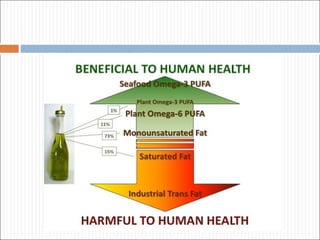
    The major sideeffect of HYDROGENATION – Production of TRANS FATTY ACIDS Cow. Milk and meat from cows and other ruminants contains naturally occurring trans fats in small quantities TRANS-UNSATURATED FATTY ACIDS
  • 85.
    0% Trans Fatis a myth ?
  • 86.
    Trans fatty acids Transfatty acids are structurally similar to saturated fatty acids
  • 88.
    Influences physical propertiesof cellular membranes  ↑ presence of cis = more fluid membrane(B).  ↑ presence of trans = less fluid membrane(A).  Cis is the most prevalent arrangement in fatty acids in foods & human body.
  • 89.
    Trans Fatty AcidInfluence on Metabolic Operations Influence:  Operation of several lipid enzymes  Trans isomers that decrease PG synthesis : ↑linoleic requirement for PG synthesis  Trans isomers devoid of EFA  ↓ activity of ∆6 and ∆9  Impair microsomal desaturation and chain elongation of both linoleic acid and linolenic acid.  Gestational development: trans fatty acids cross the placental barrier AND are also secreted into breast milk.
  • 90.
    Trans Fatty Acids: emerged as the most detrimental type of fat  relative to increased risk for CHD increasing plasma LDL-C, TFAs  decrease plasma HDL cholesterol (HDL-C)  may increase lipoprotein (a)
  • 91.
    HEALTH RISK ASSOCIATEDWITH TRANS FATTY A TRANS FATTY ACID CORONARY HEART DISEASE COLON & BREAST CANCER INCREASE INSULIN RESISTANCE- TYPE 2 DM ALLERGY ALZIEMER’S DISEASE OBESITY
  • 92.
    Recommendations  Governments aroundthe world to phase out partially hydrogenated oil if trans fat labeling alone doesn't spur significance reduction in their intake  Trans fatty acids consumption < 1% of total daily energy intake.  DENMARK became the first country to introduce laws strictly regulating the sale of many foods containing trans fat - a move which effectively bans partially hydrogenated oil
  • 93.
  • 96.
     Priming reactions (1)condensation (2) reduction (3) dehydration (4) reduction  2 enzymes involved 1. acetyl-CoA carboxylase 2. Fatty Acid Synthase Complex
  • 97.
    1. acetyl-CoA carboxylase multienzyme protein  variable number of identical subunits, each containing  biotin  biotin carboxylase  biotin carboxyl carrier protein  transcarboxylase  regulatory allosteric site.
  • 98.
    2. Fatty AcidSynthase Complex  Multi enzyme functional unit  dimer  comprising two identical monomers  each containing all seven enzyme activities of fatty acid synthase on one polypeptide chain  ACP contains the vitamin pantothenic acid of (4′-phosphopantetheine) Advantages  compartmentalization without permeability barriers - encoded by a single gene : synthesis of all enzymes in the complex is coordinated
  • 100.
     Fatty acids: synthesized in the cytoplasm  acetyl CoA : mitochondria  Mitochondria : not readily permeable acetyl CoA. HOW TO TRNSFER ACETY COA TO CYTOSOL?  The barrier bypassed by citrate: carries acetyl groups across the inner mitochondrial membrane.
  • 101.
    Elongation of FA: Mainly in Endoplasmic Reticulum  Microsomal System  elongates saturated and unsaturated fatty acyl- CoAs (from C10 upward)  elongation by two C  malonyl-CoA as acetyl donor  NADPH as reductant  catalyzed by microsomal fatty acid elongase system of enzymes  Mitochondrial elongation  less active  acetyl CoA as source of two C units
  • 102.
    Main Source ofNADPH:PPP  NADPH :donor of reducing equivalents  reduction of the 3-ketoacyl & 2,3-unsaturated acyl derivatives  oxidative reactions of PPP: chief source (6)  tissues specializing lipogenesis : active PPP  both metabolic pathways in cytosol : no barriers against the transfer of NADPH  Other sources :  Malate malic enzyme (NADP malate dehydrogenase) Pyruvate(8)  extramitochondrial isocitrate dehydrogenase reaction
  • 103.
    • Long-chain acyl-CoA(or FFA) will not penetrate the inner membrane of mitochondria • Carnitine (β-hydroxy-γ-trimethylammonium butyrate) • widely distributed • particularly abundant in muscle.
  • 104.
    ß-OXIDATION OF FATTYACIDS  two carbons at a time are cleaved from acyl-CoA molecules  starting at the carboxyl end  chain is broken between the α(2)- and β(3)- carbon atoms—hence the name β-oxidation  two-carbon units formed are acetyl-CoA  thus, palmitoyl- CoA forms eight acetyl-CoA molecules.  cyclic reaction sequence generates FADH2 & NADH
  • 105.
     “fatty acidoxidase” found in the mitochondrial matrix or inner membrane catalyze  the oxidation is coupled with the phosphorylation of ADP TO ATP
  • 106.
    Numbering :  Carboxylcarbon  C1  C adjacent to carboxyl C no.2,3 & 4 α, β & γ C respectively  Terminal methyl carbon ω or n C  Δ9 double bond between C 9 and 10  ω9  double bond on the 9th carbon counting from the ω- carbon Oleic acid. n − 9 (n minus 9) is equivalent to ω9. Δ9 ω9

Editor's Notes

  • #33 Microsomal System elongates saturated and unsaturated fatty acyl-CoAs (from C10 upward) elongation by two C malonyl-CoA as acetyl donor NADPH as reductant catalyzed by microsomal fatty acid elongase system of enzymes Mitochondrial elongation less active acetyl CoA as source of two C units
  • #39 In the presence of ATP and coenzyme A, the enzyme acyl-CoA synthetase (thiokinase) catalyzes the conversion of a fatty acid (or free fatty acid) to an “active fatty acid” or acyl-CoA, which uses one high-energy phosphate with the formation of AMP and PPi (Figure 22–1). The PPi is hydrolyzed by inorganic pyrophosphatase with the loss of a further high-energy phosphate, ensuring that the overall reaction goes to completion. Acyl-CoA synthetases are found in the endoplasmic reticulum, peroxisomes, and inside and on the outer membrane of mitochondria
  • #44 two carbons at a time are cleaved from acyl-CoA molecules starting at the carboxyl end chain is broken between the α(2)- and β(3)-carbon atoms—hence the name β-oxidation two-carbon units formed are acetyl-CoA thus, palmitoyl- CoA forms eight acetyl-CoA molecules. cyclic reaction sequence generates FADH2 &amp; NADH “fatty acid oxidase” found in the mitochondrial matrix or inner membrane catalyze the oxidation is coupled with the phosphorylation of ADP TO ATP
  • #45 ∆ 4 -cis -acyl-CoA either remaining, as in the case of linoleic acid, or entering the pathway at this point after conversion by acyl-CoA dehydrogenase to ∆2 -trans -∆ 4 -cis -dienoyl-CoA, is then metabolized
  • #76 Arachidonate 20 c fatty acid 20:4 derived from linoleate
  • #88 Figure 6.1 Structures of selected fatty acids.
  • #101 Acetyl coA is formed in mitochondria from pyruvate
  • #103 Brriers such as membrane and permiability issues
  • #105 Enzyme system fatty acid oxidase” found in the mitochondrial matrix or inner membrane