MEMBRANE STRUCTUREMEMBRANE STRUCTURE
AND FUNCTIONAND FUNCTION
ByBy
Allan P AbrahamAllan P Abraham
17BCB004117BCB0041 1
OVERVIEW: LIFE AT THE EDGEOVERVIEW: LIFE AT THE EDGE
• The plasma membrane is the boundary that separates the livingThe plasma membrane is the boundary that separates the living
cell from its surroundingscell from its surroundings
• The plasma membrane exhibitsThe plasma membrane exhibits selective permeabilityselective permeability, allowing, allowing
some substances to cross it more easily than otherssome substances to cross it more easily than others
2
CELLULAR MEMBRANES ARE FLUID MOSAICS OF LIPIDS ANDCELLULAR MEMBRANES ARE FLUID MOSAICS OF LIPIDS AND
PROTEINSPROTEINS
• Phospholipids are the most abundant lipid in the plasmaPhospholipids are the most abundant lipid in the plasma
membranemembrane
• Phospholipids arePhospholipids are amphipathicamphipathic moleculesmolecules, containing, containing
hydrophobic and hydrophilic regionshydrophobic and hydrophilic regions
• TheThe fluid mosaic modelfluid mosaic model states that a membrane is a fluidstates that a membrane is a fluid
structure with astructure with a “mosaic” of various proteins embedded in it“mosaic” of various proteins embedded in it
3
THE FLUIDITY OF MEMBRANESTHE FLUIDITY OF MEMBRANES
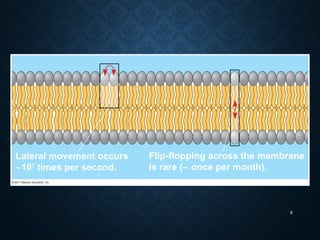
• Phospholipids in the plasma membrane can move within thePhospholipids in the plasma membrane can move within the
bilayerbilayer
• Most of the lipids, and some proteins, drift laterallyMost of the lipids, and some proteins, drift laterally
• Rarely does a molecule flip-flop transversely across theRarely does a molecule flip-flop transversely across the
membranemembrane
4
• As temperatures cool, membranes switch from a fluid state to aAs temperatures cool, membranes switch from a fluid state to a
solid statesolid state
• The temperature at which a membrane solidifies depends on theThe temperature at which a membrane solidifies depends on the
types of lipidstypes of lipids
• Membranes rich in unsaturated fatty acids are more fluid thanMembranes rich in unsaturated fatty acids are more fluid than
those rich in saturated fatty acidsthose rich in saturated fatty acids
• Membranes must be fluid to work properly; they are usuallyMembranes must be fluid to work properly; they are usually
about as fluid as salad oilabout as fluid as salad oil
• The steroid cholesterol has different effects on membraneThe steroid cholesterol has different effects on membrane
fluidity at different temperaturesfluidity at different temperatures
• At warm temperatures (such as 37°C), cholesterol restrainsAt warm temperatures (such as 37°C), cholesterol restrains
movement of phospholipidsmovement of phospholipids
• At cool temperatures, it maintains fluidity by preventing tightAt cool temperatures, it maintains fluidity by preventing tight
packingpacking
5
Lateral movement occurs
∼107
times per second.
Flip-flopping across the membrane
is rare (∼ once per month).
6
FIGURE 7.8FIGURE 7.8
Fluid
Unsaturated hydrocarbon
tails
Viscous
Saturated hydrocarbon tails
(a) Unsaturated versus saturated hydrocarbon tails
(b) Cholesterol within the animal
cell membrane
Cholesterol
7
MEMBRANE PROTEINS AND THEIR FUNCTIONSMEMBRANE PROTEINS AND THEIR FUNCTIONS
• A membrane is a collage of different proteins, often groupedA membrane is a collage of different proteins, often grouped
together, embedded in the fluid matrix of the lipid bilayertogether, embedded in the fluid matrix of the lipid bilayer
• Proteins determine most of the membraneProteins determine most of the membrane’s specific functions’s specific functions
• Peripheral proteinsPeripheral proteins are bound to the surface of theare bound to the surface of the
membranemembrane
• Integral proteinsIntegral proteins penetrate the hydrophobic corepenetrate the hydrophobic core
• Integral proteins that span the membrane are calledIntegral proteins that span the membrane are called
transmembrane proteinstransmembrane proteins
• The hydrophobic regions of an integral protein consist of oneThe hydrophobic regions of an integral protein consist of one
or more stretches of nonpolar amino acids, often coiled intoor more stretches of nonpolar amino acids, often coiled into
alpha helicesalpha helices
8
• Six major functions of membrane proteinsSix major functions of membrane proteins
• TransportTransport
• Enzymatic activityEnzymatic activity
• Signal transductionSignal transduction
• Cell-cell recognitionCell-cell recognition
• Intercellular joiningIntercellular joining
• Attachment to the cytoskeleton and extracellular matrixAttachment to the cytoskeleton and extracellular matrix
(ECM)(ECM)
9
Enzymes
Signaling molecule
Receptor
Signal transduction
ATP
(a) Transport (b) Enzymatic activity (c) Signal transduction
10
SYNTHESIS AND SIDEDNESS OF MEMBRANESSYNTHESIS AND SIDEDNESS OF MEMBRANES
• Membranes have distinct inside and outside facesMembranes have distinct inside and outside faces
• The asymmetrical distribution of proteins, lipids, andThe asymmetrical distribution of proteins, lipids, and
associated carbohydrates in the plasma membrane isassociated carbohydrates in the plasma membrane is
determined when the membrane is built by the ER and Golgidetermined when the membrane is built by the ER and Golgi
apparatusapparatus
11
FIGURE 7.12FIGURE 7.12
Transmembrane
glycoproteins
ER
ER lumen
Glycolipid
Plasma membrane:
Cytoplasmic face
Extracellular face
Secretory
protein
Golgi
apparatus
Vesicle
Transmembrane
glycoprotein Secreted
protein
Membrane
glycolipid
12
MEMBRANE STRUCTURE RESULTS IN SELECTIVE PERMEABILITYMEMBRANE STRUCTURE RESULTS IN SELECTIVE PERMEABILITY
• A cell must exchange materials with its surroundings, a processA cell must exchange materials with its surroundings, a process
controlled by the plasma membranecontrolled by the plasma membrane
• Plasma membranes are selectively permeable, regulating thePlasma membranes are selectively permeable, regulating the
cellcell’s molecular traffic’s molecular traffic
13
THE PERMEABILITY OF THE LIPID BILAYERTHE PERMEABILITY OF THE LIPID BILAYER
• Hydrophobic (nonpolar) molecules, such as hydrocarbons, canHydrophobic (nonpolar) molecules, such as hydrocarbons, can
dissolve in the lipid bilayer and pass through the membranedissolve in the lipid bilayer and pass through the membrane
rapidlyrapidly
• Polar molecules, such as sugars, do not cross the membrane easilyPolar molecules, such as sugars, do not cross the membrane easily
14
TRANSPORT PROTEINSTRANSPORT PROTEINS
• Transport proteinsTransport proteins allow passage of hydrophilic substancesallow passage of hydrophilic substances
across the membraneacross the membrane
• Some transport proteins, calledSome transport proteins, called channel proteins, have achannel proteins, have a
hydrophilic channel that certain molecules or ions can use as ahydrophilic channel that certain molecules or ions can use as a
tunneltunnel
• Channel proteins calledChannel proteins called aquaporinsaquaporins facilitate the passage offacilitate the passage of
waterwater
• Other transport proteins, called carrier proteins, bind toOther transport proteins, called carrier proteins, bind to
molecules and change shape to shuttle them across themolecules and change shape to shuttle them across the
membranemembrane
• A transport protein is specific for the substance it movesA transport protein is specific for the substance it moves
15
16
Thank YouThank You

Membrane Structure and Functions

  • 1.
    MEMBRANE STRUCTUREMEMBRANE STRUCTURE ANDFUNCTIONAND FUNCTION ByBy Allan P AbrahamAllan P Abraham 17BCB004117BCB0041 1
  • 2.
    OVERVIEW: LIFE ATTHE EDGEOVERVIEW: LIFE AT THE EDGE • The plasma membrane is the boundary that separates the livingThe plasma membrane is the boundary that separates the living cell from its surroundingscell from its surroundings • The plasma membrane exhibitsThe plasma membrane exhibits selective permeabilityselective permeability, allowing, allowing some substances to cross it more easily than otherssome substances to cross it more easily than others 2
  • 3.
    CELLULAR MEMBRANES AREFLUID MOSAICS OF LIPIDS ANDCELLULAR MEMBRANES ARE FLUID MOSAICS OF LIPIDS AND PROTEINSPROTEINS • Phospholipids are the most abundant lipid in the plasmaPhospholipids are the most abundant lipid in the plasma membranemembrane • Phospholipids arePhospholipids are amphipathicamphipathic moleculesmolecules, containing, containing hydrophobic and hydrophilic regionshydrophobic and hydrophilic regions • TheThe fluid mosaic modelfluid mosaic model states that a membrane is a fluidstates that a membrane is a fluid structure with astructure with a “mosaic” of various proteins embedded in it“mosaic” of various proteins embedded in it 3
  • 4.
    THE FLUIDITY OFMEMBRANESTHE FLUIDITY OF MEMBRANES • Phospholipids in the plasma membrane can move within thePhospholipids in the plasma membrane can move within the bilayerbilayer • Most of the lipids, and some proteins, drift laterallyMost of the lipids, and some proteins, drift laterally • Rarely does a molecule flip-flop transversely across theRarely does a molecule flip-flop transversely across the membranemembrane 4
  • 5.
    • As temperaturescool, membranes switch from a fluid state to aAs temperatures cool, membranes switch from a fluid state to a solid statesolid state • The temperature at which a membrane solidifies depends on theThe temperature at which a membrane solidifies depends on the types of lipidstypes of lipids • Membranes rich in unsaturated fatty acids are more fluid thanMembranes rich in unsaturated fatty acids are more fluid than those rich in saturated fatty acidsthose rich in saturated fatty acids • Membranes must be fluid to work properly; they are usuallyMembranes must be fluid to work properly; they are usually about as fluid as salad oilabout as fluid as salad oil • The steroid cholesterol has different effects on membraneThe steroid cholesterol has different effects on membrane fluidity at different temperaturesfluidity at different temperatures • At warm temperatures (such as 37°C), cholesterol restrainsAt warm temperatures (such as 37°C), cholesterol restrains movement of phospholipidsmovement of phospholipids • At cool temperatures, it maintains fluidity by preventing tightAt cool temperatures, it maintains fluidity by preventing tight packingpacking 5
  • 6.
    Lateral movement occurs ∼107 timesper second. Flip-flopping across the membrane is rare (∼ once per month). 6
  • 7.
    FIGURE 7.8FIGURE 7.8 Fluid Unsaturatedhydrocarbon tails Viscous Saturated hydrocarbon tails (a) Unsaturated versus saturated hydrocarbon tails (b) Cholesterol within the animal cell membrane Cholesterol 7
  • 8.
    MEMBRANE PROTEINS ANDTHEIR FUNCTIONSMEMBRANE PROTEINS AND THEIR FUNCTIONS • A membrane is a collage of different proteins, often groupedA membrane is a collage of different proteins, often grouped together, embedded in the fluid matrix of the lipid bilayertogether, embedded in the fluid matrix of the lipid bilayer • Proteins determine most of the membraneProteins determine most of the membrane’s specific functions’s specific functions • Peripheral proteinsPeripheral proteins are bound to the surface of theare bound to the surface of the membranemembrane • Integral proteinsIntegral proteins penetrate the hydrophobic corepenetrate the hydrophobic core • Integral proteins that span the membrane are calledIntegral proteins that span the membrane are called transmembrane proteinstransmembrane proteins • The hydrophobic regions of an integral protein consist of oneThe hydrophobic regions of an integral protein consist of one or more stretches of nonpolar amino acids, often coiled intoor more stretches of nonpolar amino acids, often coiled into alpha helicesalpha helices 8
  • 9.
    • Six majorfunctions of membrane proteinsSix major functions of membrane proteins • TransportTransport • Enzymatic activityEnzymatic activity • Signal transductionSignal transduction • Cell-cell recognitionCell-cell recognition • Intercellular joiningIntercellular joining • Attachment to the cytoskeleton and extracellular matrixAttachment to the cytoskeleton and extracellular matrix (ECM)(ECM) 9
  • 10.
    Enzymes Signaling molecule Receptor Signal transduction ATP (a)Transport (b) Enzymatic activity (c) Signal transduction 10
  • 11.
    SYNTHESIS AND SIDEDNESSOF MEMBRANESSYNTHESIS AND SIDEDNESS OF MEMBRANES • Membranes have distinct inside and outside facesMembranes have distinct inside and outside faces • The asymmetrical distribution of proteins, lipids, andThe asymmetrical distribution of proteins, lipids, and associated carbohydrates in the plasma membrane isassociated carbohydrates in the plasma membrane is determined when the membrane is built by the ER and Golgidetermined when the membrane is built by the ER and Golgi apparatusapparatus 11
  • 12.
    FIGURE 7.12FIGURE 7.12 Transmembrane glycoproteins ER ERlumen Glycolipid Plasma membrane: Cytoplasmic face Extracellular face Secretory protein Golgi apparatus Vesicle Transmembrane glycoprotein Secreted protein Membrane glycolipid 12
  • 13.
    MEMBRANE STRUCTURE RESULTSIN SELECTIVE PERMEABILITYMEMBRANE STRUCTURE RESULTS IN SELECTIVE PERMEABILITY • A cell must exchange materials with its surroundings, a processA cell must exchange materials with its surroundings, a process controlled by the plasma membranecontrolled by the plasma membrane • Plasma membranes are selectively permeable, regulating thePlasma membranes are selectively permeable, regulating the cellcell’s molecular traffic’s molecular traffic 13
  • 14.
    THE PERMEABILITY OFTHE LIPID BILAYERTHE PERMEABILITY OF THE LIPID BILAYER • Hydrophobic (nonpolar) molecules, such as hydrocarbons, canHydrophobic (nonpolar) molecules, such as hydrocarbons, can dissolve in the lipid bilayer and pass through the membranedissolve in the lipid bilayer and pass through the membrane rapidlyrapidly • Polar molecules, such as sugars, do not cross the membrane easilyPolar molecules, such as sugars, do not cross the membrane easily 14
  • 15.
    TRANSPORT PROTEINSTRANSPORT PROTEINS •Transport proteinsTransport proteins allow passage of hydrophilic substancesallow passage of hydrophilic substances across the membraneacross the membrane • Some transport proteins, calledSome transport proteins, called channel proteins, have achannel proteins, have a hydrophilic channel that certain molecules or ions can use as ahydrophilic channel that certain molecules or ions can use as a tunneltunnel • Channel proteins calledChannel proteins called aquaporinsaquaporins facilitate the passage offacilitate the passage of waterwater • Other transport proteins, called carrier proteins, bind toOther transport proteins, called carrier proteins, bind to molecules and change shape to shuttle them across themolecules and change shape to shuttle them across the membranemembrane • A transport protein is specific for the substance it movesA transport protein is specific for the substance it moves 15
  • 16.

Editor's Notes

  • #4 For the Cell Biology Video Structure of the Cell Membrane, go to Animation and Video Files.
  • #7 Figure 7.6 The movement of phospholipids.
  • #8 Figure 7.8 Factors that affect membrane fluidity.
  • #11 Figure 7.10 Some functions of membrane proteins.
  • #13 Figure 7.12 Synthesis of membrane components and their orientation in the membrane.